
PODCAST · education
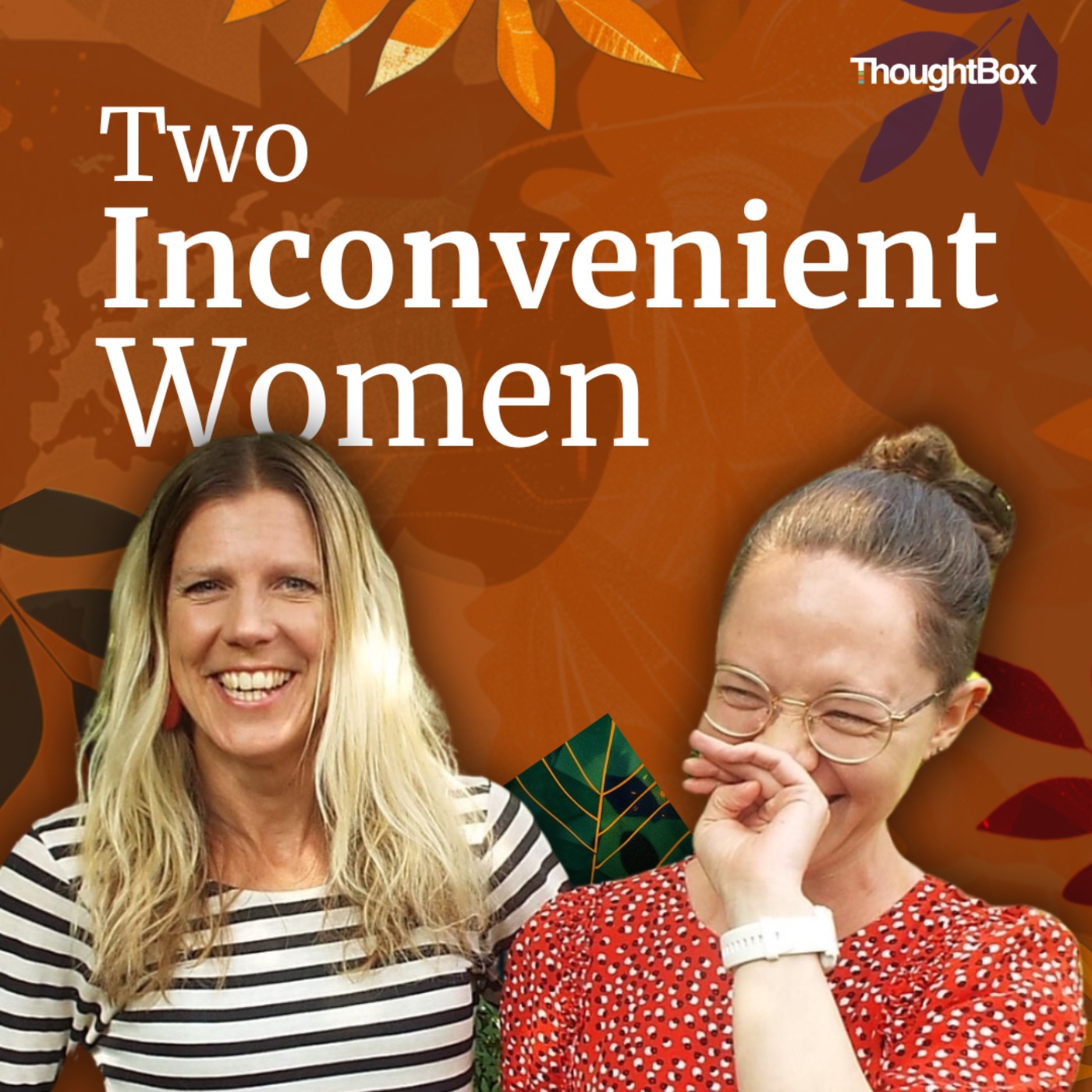
Two Inconvenient Women
by ThoughtBox Education
In a world which can feel increasingly volatile and uncertain, join Holly and Rachel from ThoughtBox as we explore some of the inconvenient truths, possibilities and opportunities of our rapidly changing world.Each episode we’ll be diving deep into the big, tricky issues of our time, exploring what it means to be ‘inconvenient’ in our work to transform lives, communities and mindsets towards a healthier future for people and planet.To find out more about the work we do at ThoughtBox Education, visit www.thoughtboxeducation.com. Hosted on Acast. See acast.com/privacy for more information.
-
99
What's live with Rachel and Holly as we start the new season?
Hosted on Acast. See acast.com/privacy for more information.
-
98
Summer Break: Rachel shares a short poem by Wendell Berry
In our last week of the summer break, Rachel finishes the summer season with a poem - sharing some of the beautiful sentiments of the late poet Wendell Berry, who passed away just a few days ago aged 92. The Peace of Wild Things - Wendell Berry-When despair for the world grows in meand I wake in the night at the least soundin fear of what my life and my children’s lives may be,I go and lie down where the wood drakerests in his beauty on the water, and the great heron feeds.I come into the peace of wild thingswho do not tax their lives with forethoughtof grief. I come into the presence of still water.And I feel above me the day-blind starswaiting with their light. For a timeI rest in the grace of the world, and am free. Hosted on Acast. See acast.com/privacy for more information.
-
97
What were your top 3 episodes of the year so far?
As the Two Inconvenient Women are on our summer break over August, we're doing a round-up of some of our favourite episodes from the last couple of seasons.This week, we share your top 3 episodes of the year so far. Here are our most downloaded episodes of Season 6:Why is play so important (and not just for children)?What's the point of hope?Red Alert: can we talk about the climate emergency now?There's an inconvenient movement growing...It's not rebellion, exactly. More of a quiet refusal to look away. We're inconvenient. And if you feel it, then maybe you are too. Join us.Join The Inconvenient Club from £5 a month. Find out more at www.thoughtboxeducation.com/the-inconvenient-club Hosted on Acast. See acast.com/privacy for more information.
-
96
What were Rachel's top 3 episodes of the year so far?
As the Two Inconvenient Women are on our summer break over August, we're doing a round-up of some of our favourite episodes from the last couple of seasons.This week, Rachel shares her top 3 episodes:E87 - Does childhood need reclaiming?E69 - Why is singing so good for us?E66 - What does it mean to winter?There's an inconvenient movement growing...It's not rebellion, exactly. More of a quiet refusal to look away. We're inconvenient. And if you feel it, then maybe you are too. Join us.Join The Inconvenient Club from £5 a month. Find out more at www.thoughtboxeducation.com/the-inconvenient-club Hosted on Acast. See acast.com/privacy for more information.
-
95
What were Holly's top 3 episodes of the year so far?
As the Two Inconvenient Women are on our summer break over August, we're doing a round-up of some of our favourite episodes from the last couple of seasons.This week, Holly shares her top 3 episodes:E85 - What's the problem with tolerating diversity? E76 - Why is the wisdom of children's books so relevant right now?E74 - Do we need to know what the future looks like?There's an inconvenient movement growing...It's not rebellion, exactly. More of a quiet refusal to look away. We're inconvenient. And if you feel it, then maybe you are too. Join us.Join The Inconvenient Club from £5 a month. Find out more at www.thoughtboxeducation.com/the-inconvenient-club Hosted on Acast. See acast.com/privacy for more information.
-
94
Summer Break: Holly shares a short poem by Mary Oliver
As we head into our summer break here at ThoughtBox, Holly shares a short poem by Mary Oliver. Hosted on Acast. See acast.com/privacy for more information.
-
93
What if we see growth as spiral rather than linear?
How can there be infinite growth on a finite planet? This question sits at the heart of many conversations about growth - especially those centred around economics, which also directly influences the cultural stories that shape the way we think, feel and act in the world. Within our educational landscapes, we're often taught to see growth as a trajectory and place to reach, and many of our cultural stories, frames and influences also encourage this sort of linearity. But what if growth wasn't linear but spiral?One of the practices that helps to see growth is returning to a familiar place or event each year (or month or however long) to see how you might see things in a similar and different way; from a wider or deeper perspective, or be feeling different in yourself about things. Helping appreciate that growth is expansion is a useful tool to appreciate growth not being linear, as it allows for spaciousness and appreciates that shedding or letting go / unlearning is as growth-ful as accumulation. So what are some of the ways that we can tap into this more spiral dynamic of growth in our personal, social and collective spheres?This week we referenced the following:Wilding (film) and the Knepp Estate (location) (website)Accidental Gods interview - Remzi Bairami (podcast)An introduction to Spiral Dynamics - Cris Reider (article)Donut Economics - Kate Raworth (website / movement)Gross National Happiness Index (website / metrics, frame & model)Spiritual Friendships - Plum Village Podcast (podcast interview)The Dunning-Kruger effect chart (graphic)✨ Today's magic moment was about our new one-to-on Coaching offer, and our upcoming Leadership short-course✨There's an inconvenient movement growing...It's not rebellion, exactly. More of a quiet refusal to look away. We're inconvenient. And if you feel it, then maybe you are too. Join us.Join The Inconvenient Club from £5 a month. Find out more at www.thoughtboxeducation.com/the-inconvenient-club Hosted on Acast. See acast.com/privacy for more information.
-
92
What happens when we pay attention?
"Attention is the rarest and purest form of generosity"(Simone Weil) and holds the power to radically and deeply shift how we think, feel and act in the world. Many people are now pointing to a shift of attention as key to unlocking humans from being stuck within so many negative behavioural patterns; inviting us to pay closer attention to what we are actually doing, why that might be and whether our thoughts, feelings and actions are serving us or future generations of life on this planet.But what does it mean to pay attention? And why is this so hard these days?In this week's podcast we dive into the complexities of staying present and alert in a culture dominated by fractured attention; reflecting on how hard it feels to be consciously alert when our attention is being grabbed and actively manipulated by social media algorithms and quick dopamine hits. We explore the pressures of staying present in an overwhelmingly complex culture, and talk about some of the practices for coming back into the 'now'; thinking about the different ways of paying closer attention to ourselves, to each other and to the wider world we are part of.In this conversation, we reference the following:The Power of Now - Eckhart Tolle (Book)Cosmic Eye (short video)Flow - Mihaly Csikszentmihalyi (book)The Master and his Emissary - Iain McGilchrist (book)Why our attention spans are shrinking - Gloria Mark (PDF) Hosted on Acast. See acast.com/privacy for more information.
-
91
Are we losing our humanity?
What does it mean to be humane? And, conversely, what might it mean to be inhumane? Whilst there is no one way to be human, there are many shared qualities that encompass the human experience and that sit as the essence of what it is to be human; qualities that set us aside from other species. We are relational beings by nature, and have within us a quality drawn to connection. Yet there is a conflict within many areas of modernity which challenges this natural essence and fuels feelings of fear, disconnection whilst actively encouraging a sense of dehumanising - both of others and of ourselves. Driven by divisive political systems, media outlets and technological advancements, many areas of culture are actively encouraging a feeling of othering, with rigid control in areas such as education, healthcare, industry driven by fear conflicting with a sense of trust, dignity and wellbeing. So what does it mean to reclaim our humanity and how can we pay attention to what it is within us that makes us human and humane?In this episode we reference the following:All that we share (TV 2 advert) - VideoImagined otherness - why we dehumanise our political opponents - Dylan Walsh / Sameer Srivastava (article)Groups & Gangs resources - ThoughtBox (PowerPoint lesson resources *Found in the PEOPLE CARE section)Fox's Dancing Journey - A story about refugees - ThoughtBox (PDF)✨ Today's magic moment was an invitation to join us next week for a free Introduction to Triple WellBeing workshop✨There's an inconvenient movement growing...It's not rebellion, exactly. More of a quiet refusal to look away. We're inconvenient. And if you feel it, then maybe you are too. Join us.Join The Inconvenient Club from £5 a month. Find out more at www.thoughtboxeducation.com/the-inconvenient-club Hosted on Acast. See acast.com/privacy for more information.
-
90
What's the point of hope?
What is the point of hope? This question is so perfectly poised between nihilism and optimism, and the conversation explores the territory in between. When hope can so often feel like an avoidance of the present moment, or a vacuous space of impossibility, what does it have to offer us in such complex times? Conversely, hope is an act of faith in something far bigger than the human experience, and stands as a foundation of so many people across the world, whether through religion, spiritual practice or an inherent trust in the bigger story. Wherever we are landing with the quality of hope, it is a universal human encounter and something that may perhaps offer us a doorway into a lighter, deeper, more resilient and conscious way of living.In this episode we reference the following:Active Hope - Joanna Macy (website)The opposite of grimdark is hopepunk (website)Anti-racist pedagogy in art - Kathy Wise (article)Imagination Taking Power - Rob Hopkins (website)Interview with Elin Kelsey - Episode 1: Hopepunk - The Second Transition Podcast (podcast episode)✨ Today's magic moment was a shout out to the fabulous ThoughtBox Team✨There's an inconvenient movement growing...It's not rebellion, exactly. More of a quiet refusal to look away. We're inconvenient. And if you feel it, then maybe you are too. Join us.Join The Inconvenient Club from £5 a month. Find out more at www.thoughtboxeducation.com/the-inconvenient-club Hosted on Acast. See acast.com/privacy for more information.
-
89
Why is play so important (and not just for children)?
✨ Today's magic moment features our new ThoughtBox website ✨Play is not just for children; it is an essential adult survival tool. And yet we find ourselves living in so many cultures where play is being eroded from childhood and is virtually non-existent amongst adults. Beyond the core developmental qualities that play enables in children, engaging in recreational activities that bring joy lowers stress, triggers mood-boosting endorphins, fuels creativity, and strengthens relationships by building trust and empathy. Play also reminds us of the vitality of life and offers a more generative way of living. So why is it that play has disappeared and how can we welcome it back into our lives and communities?In this episode we reference the following:Dirt is Good campaign (website)How play made us and keeps us human -Maria Popov (article)OPAL- Outdoor Play and Learning - organisation (website)Play based learning at St Ebbe's Primary, Oxford (website page)How play boosts creativity and resilience - Katina Bajaj (TedTalk Podcast)Rediscovering Play - Mindful Spark (blogpost)Play Based Learning with Dr Peter Gray (video)There's an inconvenient movement growing...It's not rebellion, exactly. More of a quiet refusal to look away. We're inconvenient. And if you feel it, then maybe you are too. Join us.Join The Inconvenient Club from £5 a month. Find out more at www.thoughtboxeducation.com/the-inconvenient-club Hosted on Acast. See acast.com/privacy for more information.
-
88
Red Alert: can we talk about the climate emergency now?
This week in the UK, we're in the middle of a heatwave. Record-breaking temperatures, flash floods, thunderstorms and lightning fires are all bringing the climate emergency into an immediacy of awareness for many people who previously may not have wanted or been able to look at it. But in the face of this emergency, how do we talk about what's happening without instilling more fear? And how do we find the courage to actually step into action?✨ Today's magic moment features our Triple WellBeing Storybooks ✨In this episode we reference:Should we be trying to save the world? with Anthea Lawson - The Examined Life (podcast episode)'I am helping - oh no' - Webcomicname by Alex Norris (comic strip)When The Baddie Plans To Destroy The World! from Mitchell And Webb Are Not Helping (short video)Don't put economy at mercy of 'Red Ed' - Daily Mail (online article)Learning for Life - ThoughtBox Education (teaching resources)National Emergency Briefing - NEB (film and local screenings)There's an inconvenient movement growing...It's not rebellion, exactly. More of a quiet refusal to look away. We're inconvenient. And if you feel it, then maybe you are too. Join us.Join The Inconvenient Club from £5 a month. Find out more at www.thoughtboxeducation.com/the-inconvenient-club Hosted on Acast. See acast.com/privacy for more information.
-
87
Does childhood need reclaiming?
All of us are former children: a fact so often forgotten and yet so powerful when we remember just what is waiting inside all of us to be re-ignited. Within the wide threads of a conversation on childhood is the desire to tap beneath the cultural stories of modern childhood to re-ignite the essence of wonder that sits within us all and that is being threatened by so many of our modern problems.Growing up in our modern world is so frequently encased with pressure. Beyond the increasing pressures from school, family and the modern world, young people are navigating the hugely fracturing world of social media and - ever increasingly - feeling the weight and burden of the climate and nature crisis. All too often, children are being asked - sometimes tasked - to take on mental responsibilities and concerns well beyond their emotional capacities to hold; and the symptoms of burnout, anxiety, overwhelm and depression are skyrocketing.Knowing that the cultures we're living in shape the way we think, feel and act in the world helps to see and explore why so many different cultural experiences of childhood exist - and by digging beneath the cultural stories, we can start to tap into the essence in all of us that is filled with wonder waiting to re-emerge.So how might shifting the cultures we're living in help keep childhood alive and re-awaken the inner child in us all?In this week's conversation we reference the following:Innocent Child Well-Being Index - UNICEF (PDF)Dutch kids declared the world’s happiest (again) - Positive News (Article)Seven-year cycles of growth: Rudolf Steiner (website)The Anxious Generation - Jonathan Haidt (book/website)There's an inconvenient movement growing...It's not rebellion, exactly. More of a quiet refusal to look away. We're inconvenient. And if you feel it, then maybe you are too. Join us.Join The Inconvenient Club from £5 a month. Find out more at www.thoughtboxeducation.com/the-inconvenient-club Hosted on Acast. See acast.com/privacy for more information.
-
86
How might criticism be enabling rather than shaming?
Why is criticism often so hard to take? What is it inside us that shrinks when someone points out something we've missed, we lack or we've done 'wrong'? Who sets the parameters for 'right and wrong' and what does it actually mean to 'critique' someone?In this week's episode we explore the qualities of criticism and why - all too often - it can elicit feelings of shame and worthlessness in the recipient. We explore some of the nuances of shame; explore the different qualities of 'lack' that are sometimes apparent in the giver and receiver of criticism and discuss at length the value and strength of criticism that allows both parties to grow together - something that is perhaps hard to do but so generative when it happens.In the conversation we reference the following:Listening to Shame - Brené Brown (TED talk video)'How Not to Be Defensive in Relationships' - The School of Life (video)The support/challenge matrix (PDF)Peonies opening (video)Being Nice vs Being Kind - Trevor Noah (video)There's an inconvenient movement growing...It's not rebellion, exactly. More of a quiet refusal to look away. We're inconvenient. And if you feel it, then maybe you are too. Join us.Join The Inconvenient Club from £5 a month. Find out more at www.thoughtboxeducation.com/the-inconvenient-club Hosted on Acast. See acast.com/privacy for more information.
-
85
What's the problem with tolerating diversity?
“It is not our differences that divide us. It is our inability to recognise, accept, and celebrate those differences.” – Audre Lorde Across the world we're seeing polarisation, division and othering increase - exacerbated by political decisions which fuel division and a dismissal of difference. And at the same time, we're seeing a rise in diversity in communities, in the workplace, in communities, in mindsets, and a growing appreciation that the health and resilience of any community lies in its diversity.In this week's podcast, we celebrate the wonder of diversity and difference, from cultural to psychological to ecological and everything in between. We discuss the issues surrounding the word 'tolerance' and the hierarchical othering that it connotates; explore some of the qualities of fear that keep us divided and reflect on the power, resourcing and resilient qualities that any system which is diverse brings.In the conversation we reference the following:The Danger of a single story - Chimamanda Adiche (TED Talk video)The Tyranny of the should - Karen Horny (article)Betwixt The Sheets - A History of Homophobia - Kate Lister with guest Dr Harry Tanner (podcast)The Science and value of diversity - Talia H. Swartz, Ann-Gel S. Palermo, Sandra K. Masur and Judith A. Aberg (article)The Wheel of power & privilege (PDF / website)The Story of Triple WellBeing - Rachel Musson (PDF ebook)Transforming Leadership Course - online workshop (website page)There's an inconvenient movement growing...It's not rebellion, exactly. More of a quiet refusal to look away. We're inconvenient. And if you feel it, then maybe you are too. Join us.Join The Inconvenient Club from £5 a month. Find out more at www.thoughtboxeducation.com/the-inconvenient-club Hosted on Acast. See acast.com/privacy for more information.
-
84
What's Holly reading this week?
Rachel and Holly are having a reading week, so in this special short episode Holly shares about the books she's currently reading, including:Great Circle by Maggie ShipsteadThe Fellowship of the Ring by JRR TolkienThe Power of Now by Eckhart TolleGeneration Hope by Arunjay KatakamThere's an inconvenient movement growing...It's not rebellion, exactly. More of a quiet refusal to look away. We're inconvenient. And if you feel it, then maybe you are too. Join us.Join The Inconvenient Club from £5 a month and support us to keep making Two Inconvenient Women and the rest of our work at ThoughtBox. Find out more at www.thoughtboxeducation.com/the-inconvenient-club Hosted on Acast. See acast.com/privacy for more information.
-
83
What's Rachel reading this week?
Rachel and Holly are getting ready for some time off next week, so in this special short episode Rachel shares about the book she's currently reading, 'The Listening Book' by W.A Matheieu.There's an inconvenient movement growing...It's not rebellion, exactly. More of a quiet refusal to look away. We're inconvenient. And if you feel it, then maybe you are too. Join us.Join The Inconvenient Club from £5 a month and support us to keep making Two Inconvenient Women and the rest of our work at ThoughtBox. Find out more at www.thoughtboxeducation.com/the-inconvenient-club Hosted on Acast. See acast.com/privacy for more information.
-
82
What does systems change look like from the inside out?
Whilst systems-change, systems-thinking and systems-transformation are becoming much more common terms used in conversations these days, discussions around 'inner systems change' are only just beginning to emerge in more public discourse. When we start to focus on systems change from the inside out, it is an invitation into introspection and exploring some of the habits, mindsets, behaviours and thought patterns that may be keeping us stuck in external behaviours contributing to many of the crises we face.This sort of 'inner work' - as it is often coined - can feel overwhelming, yet offers a doorway into profound change in the wider world as well as within ourselves, and begins by simply paying attention.In this week's episode we dive into the connections between inner and outer systems transformation, with the appreciation that how we think, feel and connect with the world shapes our outward actions. We talk about our own personal journeys, struggles and growth points in the journey of systems change, and how the Triple WellBeing approach that sits at the heart of ThoughtBox is an invitation to be working from the inside out and outside in at the same time.In this episode we reference the following:Theory U - The Presencing Institute / Otto Scharmer (book & website)Thinking in Systems - Donella Meadows (book)The work of Joanna Macy (website / books)Zen and the Art of Saving the Planet - Thich Nhat Hanh (book)Impossible Choices - Gregory Bateson (article)Warm Data - Nora Bateson (website)The Triple WellBeing Framework (PDF / website)______________There's an inconvenient movement growing...It's not rebellion, exactly. More of a quiet refusal to look away. We're inconvenient. And if you feel it, then maybe you are too. Join us.Join The Inconvenient Club from £5 a month. Find out more at www.thoughtboxeducation.com/the-inconvenient-club Hosted on Acast. See acast.com/privacy for more information.
-
81
Is self-awareness a skill we all need more of?
"Know thyself" is often cited as the foundation of philosophy and self-awareness. Yet what does this mean? How can we 'know ourselves' and where might this journey of exploration begin and end?In this week's episode, we explore the quality of self-awareness, thinking about why this level of conscious awareness is more needed than ever in our world. From exploring the qualities that make up the 'self' (e.g. mind, body, heart, soul) to the journey to find our core essence, this conversation meanders to the depths and back of the human experience, touching upon some of the key practices, tools, approaches and inquiries we can take to become more self-aware and, as a result, more consciously connected to the world around us.In this episode we reference the following:Atlas of the Heart - Brene Brown (book)Triple WellBeing practice cards - ThoughtBox (card deck)The Medicine Wheel - ancient indigenous map (website)Watching the English - Kate Fox (book)The Power of Now - Eckhart Tolle (book)Neuroplasticity in action - Sentis (video)There's an inconvenient movement growing...It's not rebellion, exactly. More of a quiet refusal to look away. We're inconvenient. And if you feel it, then maybe you are too. Join us.Join The Inconvenient Club from £5 a month. Find out more at www.thoughtboxeducation.com/the-inconvenient-clubNVC - The Centre for Non-Violent Communication (website)The Guesthouse - Jalāl al-Dīn Muḥammad Rūmī (poem) Hosted on Acast. See acast.com/privacy for more information.
-
80
What's the point of school?
Whilst many different models of schooling have evolved across recent history, the predominant mainstream model of school which has prevalence in countries and cultures across the world (spread through colonial history, missionaries and the rapid onset of a globalised world) remains deeply problematic. As the world rapidly changes around us, this structure remains designed around an archaic framing in a world far different from the one we're now living in. So what is the point of school?In this conversation we ask this question from several vantage points: What was the point of school when it was first designed? What is the point of school in our current context? What might the point of school be for the world we're moving into? By diving into each of these questions, we take time to better understand some of the constraints and limitations within the contexts of school which continue to shape the challenges being faced in our current contexts.This week's conversation dives into some of the deep complexities being faced in our current schooling system; zooming out to understand the parameters of limitation and opportunities for evolution and engages with many of the alternative pathways for an education transformation happening across the world.In this episode we reference the following:Changing Education Paradigms - Ken Robinson (RSA Animation)The Factory of Memory - Richard Hames / The Hames Report (substack)Person School Report 2026 (PDF)The Story of Triple WellBeing - Rachel Musson (Ebook)There's an inconvenient movement growing...It's not rebellion, exactly. More of a quiet refusal to look away. We're inconvenient. And if you feel it, then maybe you are too. Join us.Join The Inconvenient Club from £5 a month. Find out more at www.thoughtboxeducation.com/the-inconvenient-club Hosted on Acast. See acast.com/privacy for more information.
-
79
Why is being inconvenient becoming increasingly important?
One of the foundational premises that underpins the work of ThoughtBox is our inconvenience. We're an organisation that questions the status quo; that raises a hand in conversations to ask the vital question: "Why?"; the folks who appreciate that there are always other stories to be heard, to listen to and to perhaps follow instead. It's not easy being inconvenient - it's often quite a lonely place, but it is a place that allows us to do what is right, not what is easy. It takes courage, conviction and a lot of energy - and the recognition that the more of us there are being inconvenient, the more likely we are to turn the tide towards a more health-ful way of living together.In this episode we shine a light on some of the reasons for standing up for the moral injury of these times and how becoming inconvenient can be both liberating and energising in the work ahead. We are (excitedly!) launching in this episode The Inconvenient Club: a place for all of you out there who also question the status-quo to come join us and be part of a movement of inconvenience.In this episode we reference the following:The Inconvenient Club - membership club (website)Moral injury (website definition)A profession built on hope, strained by loss - Rhett Ayers Butler (article)There's an inconvenient movement growing...It's not rebellion, exactly. More of a quiet refusal to look away. We're inconvenient. And if you feel it, then maybe you are too. Join us.Join The Inconvenient Club from £5 a month. Find out more at www.thoughtboxeducation.com/the-inconvenient-club Hosted on Acast. See acast.com/privacy for more information.
-
78
THROWBACK EPISODE: How do we heal our broken world?
RE-LISTEN: This episode was recorded in October 2025.A painful truth in our current cultures is how much we are all struggling with our mental and emotional wellbeing. This is especially true in young people who are facing an increasing amount of overwhelm in their lives in this VUCA* world (*volatile, uncertain, complex and ambiguous). And yet the ways of suffering and the ways of wellbeing are actually two sides of the same coin...Holly and Rachel are just back from Europe's largest trauma, mental health and wellbeing conference hosted at Oxford University, under the title 'Healing our relational world'. Bringing together over 3000 educators, therapists, mental health practitioners and healers with world-renowned trauma and emotional health experts, the conference was an extraordinarily rich and deep insight and exploration of how to heal our connection with ourselves, each other and the wider world.In this episode we dive deeply into some of the 'brokenness' of our world (our inner and outer worlds) bringing in our own decade of research along with learnings from the conference. We look at some of the patterns in human behaviours that connect all of these elements of brokenness to better understand how to notice them and how to heal. We explore the impact of early attachment on shaping our relationships and the profound ways of healing in ourselves, our communities and with the planet. We touch on how the ways to respond to the symptoms and root causes of disconnection are the same and explore the foundational routes to healing.In this episode we reference the following:Dr Dan Siegel - professor (website)Dr Bessel van der Kolk - psychiatrist (website)Dr Richard Shwartz - therapist, author (website)Linda Thai - trauma therapist (website)Interpersonal Neurobiology - Dan Siegel (video)The Body Keeps The Score - Bessel van der Kolk (book / website)Internal Family Systems - Dr Richard Shwartz (website) Hosted on Acast. See acast.com/privacy for more information.
-
77
THROWBACK EPISODE: The inconvenience of joy
THROWBACK EPISODE: This podcast was first recorded in July 2025“I will never apologise for embracing joy and beauty - even when the world is falling apart – for joy and beauty are the fuel for my activism”. These words by Karen Walrond are one of the inspirations for this week’s conversation on 'Joy', exploring how cultivating joy is both a way to resource ourselves and build the resilience needed to meet the challenges of our world. Joy is often seen as being the same thing as happiness, and yet these two emotions are profoundly different; one coming from external sources, one being cultivated from within. It is not a surprise that the practice of joy is embedded into all world religions as it can become a deeply spiritual practice – as well as a beautifully infectious state to find ourselves in.In this week's conversation we dive into the meaning of joy, how it shows up in our lives; how activists across history have cultivated joy in their lives and work and what happens when we learn to practice joy as part of our daily rhythms.In this episode we reference the following:Mission: Joy – Dalai Lama & Desmond Tutu (video)Habits for practising joy - ThoughtBox (PDF)Seeking Language Large Enough – David Whyte / On Being (podcast)Climate Courage Campaign – Climate Majority Project (website)Joy Over Fear – St Ebbe’s School (website)Schools of Dreams - Kimberley Oliff Cooper TEDx Talk (video)The Fun Habit - Mike Rucker (book)Glorious – MaMuse (Rachel’s current favourite joyful song) Hosted on Acast. See acast.com/privacy for more information.
-
76
Why is the wisdom of children's books so relevant right now?
All of us are former children and for most have memories of some of the stories we read or were told when we were children. As adults, many of us still encounter these stories - whether from reading to young ones or for our own enjoyment. As a medium, children's stories are doing more than just keeping young people entertained - they are pathways for growth; helping to navigate some of the challenges, hurdles and opportunities of life in a safe and supported way. When starting to explore why storytelling is a foundation stone for human evolution, our entire understanding of children's stories can begin to expand. As former English teachers, Holly and Rachel have read and taught a lot of fiction to younger readers and we both are avid readers of children's stories, advocating the deep wisdom to be found in many classic texts, no matter our age. In this conversation we explore the why, what and how of the values and constructs of children's fiction; explore how myth and storytelling has passed down through human history; think about the impact of films on story learning and reflect on some of the wisdom of key classic texts across the world. In this episode, we mention:Why You Should Read Children's Books, Even Though You Are So Old and Wise - Katherine Rundell (article)C. S. Lewis on Writing For Children - CS Lewis (article)Meister Eckhart's Book of Darkness & Light: Meditations on the Path of the Wayless Way - Jon M. Sweeney, Mark S. Burrows and Meister Eckhart (book)The Death of the Author - Roland Barthes (book)Triple WellBeing Storybooks - Rachel Musson & Alex Brenan (storybooks) Hosted on Acast. See acast.com/privacy for more information.
-
75
Are our 'social contracts' falling apart and what does that mean for society?
The concept of social contracts in modern culture came through the work and philosophies of folks such as Thomas Hobbes, John Locke and Jean-Jacques Rousseau as a way of communities agreeing to behave and trust in collective ideals. Whilst intentions may be valid, the structures of this imposed model of organising communities falls down when trust is broken - and we're finding ourselves in that state of collapse in many countries and societies around the world. Which has the potential to open up different ways of belonging and living alongside one another - ways that come not from an imposed and centralised narrative, but that actually work within the contexts and communities we live in.In this week's episode we talk about the impact of the social contract falling away, and the reneging of social promise in many parts of our societies. We discuss where trust comes into the equation and explore models across our human story that shine a light on more robust and localised ways of building resilient and healthy communities.During the conversation we reference the following:The Social Contract - Jean-Jacques Rousseau (PDF)Local Futures (website and movement)The real Lord of the Flies - Rutger Bregman (article)Beyond Civilisation - Daniel Quinn (PDF)Transforming Leadership - online short course (website) Hosted on Acast. See acast.com/privacy for more information.
-
74
Do we need to know what the future looks like?
Many organisations and governments work within a strategy of Futures Thinking - a strategic concept to make predictions and pathways for probable and plausible futures. Yet how useful is this when the variables around us are changing so rapidly? And how plausible can any strategic planning be within structures only designed with short-term foundations? In this week's episode we explore the future (sort of) and whether we have any capacity to predict anything. We talk about the role of presence in enabling us to be rooted in the here and now, rather than living in the past or future; explore the concept of seven-generational thinking; think about the limits our future is being given as we flounder with some of the systemic challenges on a national and global scale and reflect on why it can feel both terrifying and liberating to 'let go' of knowing and start to sense our way forward instead. In this week's episode we reference the following:Berkana Two Loops model of systems change (framework & website)Berkana Institute (Website)Meg Wheatley (website)Imagination Activism - Phoebe Tickell (Website)Futures Thinking - UK Government (Website)Imagination Taking Power - Rob Hopkins (website) Hosted on Acast. See acast.com/privacy for more information.
-
73
How do we find strength in these turbulent times?
We are living in increasingly turbulent times and the shockwaves as old systems fall apart are starting to impact ever more people. Whilst we talk a lot in this podcast about why systems are changing and about the healthier systems waiting to emerge, it feels important to keep talking about the pain and discomfort of this 'in between part' as things fall away and new things arrive. Pressures of daily life mixed with increasing levels of geo-political unrest and extreme weather events is beginning to take its toll - on the nervous systems in particular. Being brave and resilient - and optimistic - whilst navigating turbulence can feel a real struggle. And yet the capacity of human resilience and strength to weather storms is humbling.In this podcast we explore the tension between discomfort and creativity; between growth and fear; light and dark and how turbulence can be a crucible for maturity. As well as sharing our own experiences of navigating complex times, we talk about the nervous system regulation and structures to support individual and collective resilience to allow us to be strong and weather storms as they come, growing in strength together.In this episode we reference the following:Everything we teach should be different from machines - Jack Ma, World Economic Forum (short video)Think like a tree - Wired Media (short video)Attached - Amir Levine, Rachel S. F. Heller (book)Learning for Life - ThoughtBox (Free learning resources) Hosted on Acast. See acast.com/privacy for more information.
-
72
Throwback episode: the inconvenience of nature connection
In many modern cultures, we find ourselves spending ever more time indoors, sitting down and separated from nature - both the nature within us and the nature all around us. At the same time, we're drawn to want to spend time outdoors and in natural environments, and we have a deep sense of ease when connected to nature. So why is it so hard?In this week's thow-back episode, we explore the inconvenience of nature connection in a modern world and the many ways that our ways of living keep us in separation - sometimes isolation - from the natural world. We explore the impact of a sedentary, indoor lifestyle on our physical, emotional and spiritual health; explore how connecting to nature is infinitely good for our holistic wellbeing - as well as supporting the health of the natural world in return - and reflect on the many different ways to welcome more nature connection into our lives and learning spaces.In this episode we reference the following:Time in Nature report - Eden Project (website)National Trust nature connection report (website)Green Social Prescribing - NHS (website)Harmony - HRH Prince of Wales (Book)The Harmony Project (website & learning resources)Soil & Public Health - Soils Association (website)Guide to forest bathing - Forestry England (website) Hosted on Acast. See acast.com/privacy for more information.
-
71
How can we be learning for life?
What sort of learning do we need to support young people with in a rapidly changing world? What does it mean to be a life-long-learner? What qualities of learning do we all possess? What is 'unlearning' and how might it be a vital form of our own growth? What is spiral-learning and how does this shape the way we grow in the world? What if learning was as much about the why and the how as it is about the what?In this week's episode we dive into the qualities of learning; from pedagogy to process and practice. In particular we talk about the newly launched 'Learning for Life' programme for educators which helps young people make sense of the world they’re growing up in by seeing how it all fits together. Developed over the past decade, these learning resources are built around a simple idea: instead of leading with content, what if we allow learning to be shaped by a pedagogy which inspires critical, curious and compassionate learners. We are gifting all of these materials, shared freely under a Creative Commons Licence and intended for use and adaptation across a range of educational settings for all ages - children and young adults alike. In this week's episode we reference the following:Learning for Life - ThoughtBox (website & resources)Futures of Education - UNESCO (website & report)Times Education Commission - The Times (PDF report)Human Flourishing Report - PISA (PDF report)Rebooting Education Report 2023 - Reboot the Future (PDF report)The Future of Education & Skills 2030/2040 - OEDC (website & report)School Report – Pearson - Pearson Education (PDF report) Hosted on Acast. See acast.com/privacy for more information.
-
70
Throwback episode: the inconvenience of systems thinking
Holly and Rachel are away this week, so we're re-sharing an episode from this time last year on the inconvenience of systems change.Systems thinking isn’t just a concept—it’s how life works. Every action, choice and relationship is part of something bigger. So why do we resist seeing the connections? In this episode, we explore what it really means to understand the world as an interconnected whole. It’s not about learning a framework, it’s about shifting how we see, think and act. This conversation explores what happens when we start noticing the patterns we’re part of—and begin to change them. Hosted on Acast. See acast.com/privacy for more information.
-
69
Why is singing so good for us?
Singing is a deeply healing and cathartic experience for humans - mentally, emotionally, neurologically and spiritually. It is a primal quality we all possess, and something that has formed an innate and constant part of human culture since the dawn of our species. Singing is a birthright, yet many of us have been told that 'we can't sing'. We often mention singing on this podcast as both Holly and myself (Rachel) are members of our local choirs. Both of us have had very different routes into singing - and perhaps represent some of the different ways that singing has shaped - or absented itself - from our lives.In this week's episode we dive deeply into the many different ways that singing is good for us - from the way it makes us feel, to how it helps soothe our nervous systems, to how it helps forge our connection to others and the wider world. We explore some of the science of singing, the qualities of song in different cultures; the resonance of singing in harmony with others and dabble a little in the profound and extraordinary mystery and magic of where and how music shapes the entire universe.In this episode we reference the following:Wednesday Lunchtime Fun Choir (event / website)The Universal Frequency (website)How flowers talk to bees - David Attenborough (video)Harriet - biopic of Harriet Tubman (film trailer)Spirituals - protest, sacredness and song (website) Hosted on Acast. See acast.com/privacy for more information.
-
68
What does it mean to belong?
Belonging is the innate human desire to be part of something larger than us. It is primal - something that we all yearn for constantly and can find in different places and spaces across our lives. So were are the places that we can find and really feel a sense of belonging? And what happens when belonging means a sacrifice of our authenticity? In this week's episode of Two Inconvenient Women, we explore what it means to belong, some of the places that we all can - and often do - find a sense of belonging; what it means to belong to ourselves and how this sense of inner belonging helps shape our authenticity in the world, allowing us to feel even more of a sense of connection.In this conversation we reference the following:Dr Dan Siegel - Interpersonal Neurobiology (website)Brene Browne - Atlas of the Heart (Book)Martin Shaw - The Woman who became a Fox (video)Dr Stephen Porges - Polyvagal Theory (website)Groups & Gangs - ThoughtBox Curriculum (website page) Hosted on Acast. See acast.com/privacy for more information.
-
67
Why are countries banning social media?
There has been a lot emerging in the media recently about countries making decisions to ban social media for under 16s. Australia has been leading the way in this movement, with many other countries now passing legislation through government and widening the public discourse. So why social media? Why 16? Why now?In this week's podcast we begin to untangle many of the complexities that living in an online world is having on our mental, physical, emotional spiritual and social health, in particular how it is influencing the development of children and young people. Drawing wisdom from the depth research of social psychologists such as Jonathan Haidt (whose infamous book The Anxious Generation is waking up millions to the 'disconnection epidemic') we wrangle with some of the questions, complexities, possibilities and opportunities of shifting ourselves away from the trappings of an online world and 'rewiring ourselves' back into healthier connections.In this episode we reference the following:The Anxious Generation - Jonathan Haidt (book)The Social Dilemma - Exposure Labs (Film / documentary)No rush to ban social media - Sonia Livingstone (LSE article)How a handful of technology companies control billions of minds - Tristan Harris (TED talk)Is Social Media making us less social? ThoughtBox (inquiries for 5-18 year olds) **COMING SOONDigital Literacy - Ditch The Label (Lesson resources 13-16 years)**We will be releasing our full Learning for Life resources for free in mid-February- keep an eye on the ThoughtBox website for more details: www.thoughtboxeducation.com Hosted on Acast. See acast.com/privacy for more information.
-
66
What does it mean to 'winter'?
Whilst many parts of the world experience a climate of winter, how many of us allow ourselves to 'winter' during this season? Or anytime? What does it mean to 'winter' - to follow nature's rhythms and allow things to slow down, to fall away, to be still, quiet. What does it mean to sit in the dark (literally and metaphorically) - how might this be allowing us to grow on a much deeper level? And what is happening in our cultures that prevents this? What does it mean to be living in a culture of 'perpetual summer' where slowness and quiet are not part of the status-quo?In this episode, we dive into the literal and metaphorical resonance of wintering; thinking about how the feeling in the atmosphere can give us clues for how to behave, discussing what some of the inner emotions around 'wintering' may bring up and exploring some of the different ways to tether more of our lives to living in balance with the rest of nature - from how we eat, sleep and act to simply being more in tune with our own needs and rhythms.We reference the following:Wintering - Katharine May (book)How Wintering Replenishes - On Being podcast with Katherine May (podcast)Reconnection Retreat - ThoughtBox (event) Hosted on Acast. See acast.com/privacy for more information.
-
65
Are we in a polycrisis and what can we do about it?
When the world feels overwhelmingly complex, it is often hard to know where to put our energy; which 'crisis' to give our attention to as it were. You may have come across the term 'polycrisis' as it's fast becoming part of the public lexicon. It's not a particularly cheery term, but it is helpful in making sense of the many interconnected and overwhelming crises that we are facing in our lives. The polycrisis is characterised by feedback loops where one crisis exacerbates another, making simple, isolated solutions ineffective. Which is the greatest inconvenience we face when trying to address them. And yet diagnosing the crisis is the first step to addressing it - and this term is useful in doing just that. In this episode, we wrangle with the complexity of the times we're living in through the frame of the polycrisis; tapping into what we can appreciate from the framing of a 'metacrisis' at the same time, and how looking at changing our perspective on the world is a powerful way to focus on meeting the symptoms and addressing the root cause of a world in crisis. We reference the following during the conversation:Reconnection Retreat - ThoughtBox & Hawkwood College (in-person gathering)The Story of Triple WellBeing - Rachel Musson (free PDF)The Metacrisis is a crisis of meaning - Ernesto van Peborgh (article)Triple WellBeing Practitioner Course (online training course)Tasting the Pickle: Ten Flavours of Metacrisis and the Appetite for a New Civilisation - Jonathan Rowson (essay) Hosted on Acast. See acast.com/privacy for more information.
-
64
Is it really a new year? Is it really a new me?!
For many in the world - those following the Gregorian calendar - January 1st marks the beginning of a new year. Midst the celebrations, revelry and resolutions is often an unspoken expectation of 'newness'. Pressures exist to have "resolutions" that make us somehow a better, fitter, happier, healthier version of ourself. But to what extent do we need this? To what extent do we want this? And to what extent is now the time for 'a fresh new world' anyway?In this week's episode of Two Inconvenient Women, we explore some of the different cultural celebrations for new year, thinking about how they map to the seasons, nature's rhythms or stories that other influences. We discuss the difference between having resolutions and intentions and how one can be a real support and guide, whilst the other can often feel like a burden or self-inflicted prison. We unpack some of the ways that new year has been coopted by a consumer culture fixated on 'bigger, better, shinier' and what this may be doing to our sense of ease. We think about what it means to be a 'new you' and whether a process of growth and becoming is a wiser step into a new year, rather than setting ourselves a goal to arrive at which has ever-moving goalposts. Hosted on Acast. See acast.com/privacy for more information.
-
63
A New Year's Gift: Poem for a New Year By Matt Goodfellow
Poem for a New YearBy Matt GoodfellowSomething’s moving in,I hear the weather in the wind,sense the tension of a sheep-fieldand the pilgrimage of fins. Something’s not the same,I taste the sap and feel the grain,hear the rolling of the rowanringing, singing in a change.Something’s set to start,there’s meadow-music in the darkand the clouds that shroud the mountainslowly, softly start to part. Hosted on Acast. See acast.com/privacy for more information.
-
62
A Christmas Gift: Stories of Triple WellBeing
We're taking a break over the holidays and are not recording a new episode of Two Inconvenient Women today. Instead, we're sharing a gift - a whole range of stories of inspiring people from across the world working to create a healthier future for people and planet. From educators in Uganda focused on self-care in leadership to teachers challenging the mainstream to communities focused on nature connection at the heart of learning, our Triple WellBeing Fellows are ordinary people with extraordinary stories.Dive into the whole community and begin your listening journey: https://thoughtboxeducation.com/stories Hosted on Acast. See acast.com/privacy for more information.
-
61
Why is gratitude so powerful?
We begin each podcast episode with a moment of gratitude. But why so? Much more than a 'nice thing to do', the practice of gratitude is ancient - part of wisdom traditions across the world and deeply embedded into spiritual and religious practice. It is a way of strengthening our own sense of resilience and presence, finding meaning in the world and feeling more grounded, connected and present in the world. But what does it actually mean to be grateful and how can this practice shape the very structure of our brains?In this week's episode we explore the topic of gratitude, asking the question: Why is gratitude so powerful? In this episode we reference the following:Healing begins with gratitude - Joanna Macy (Article)Grateful Living (website) Hosted on Acast. See acast.com/privacy for more information.
-
60
Why don't we talk to our neighbours?
Why don't we talk to our neighbours? This question is asked not to be provocative but more to reflect on what has shifted in our cultures to mean that we can inhabit the same space as people we don't quite know. For some cultures around the world, community and neighbourhoods remain a vital - and vitalising part of daily life, yet for many living in the culture of modernity, our move into hyper-individualism has been at the detriment of our community. We may not have ever met the person or people who live above, below or beside us - and we may not know anything about them - not even their name. In this week's episode we explore some of the changes across time that have led to the erosion of gathering spaces; the impact of a culture of fear and distrust on how we respond to strangers and some of the blocks, challenges and opportunities that surround us when it comes to finding connection with those in our neighbourhood.In this conversation we reference the following:Love Thy Neighbour - World Values Survey (PDF)Everyone wants a village but no-one wants to be a villager - Cassie McCure (article)36 questions - how to fall in love - New York Times (website) Hosted on Acast. See acast.com/privacy for more information.
-
59
Do we really want to be successful?
Are you successful yet? When do you know you've "made it"? And - more importantly - is it a place that we actually want to be 'arriving'? Many of us are living in cultures that have a dominant story of success - often associated with wealth, prosperity, career-ladders and progress. Our mainstream education systems teach us how to jump through the hoops on the journey towards success, and our media is filled with advertising and stories of what success looks like (normally glossy, shiny and always slightly out of reach). But who gets to decide when we've become successful, and is it worth it?In this week's episode we explore the notion of success, thinking about what it means, who grants us the title and what the possibilities are to look beyond the mainstream story and carve out a different approach to life. We explore questions such as: What happens when we don't fit the story or mould of what success looks like? What might it mean to carve out our own version of 'success'? What can we learn from failure? And what if, rather than a destination we arrive at, success is simply a way of living well?In this episode we reference the following:Steve Cutts - illustrator, satirist (website) Life & Music - Alan Watts (cartoon) Hosted on Acast. See acast.com/privacy for more information.
-
58
Are your values lived or laminated?
Many people find themselves working within organisations or structures that don't necessarily practice the values that are being preached (or laminated, advertised or promoted). It can feel deeply uncomfortable when our actions are out of line with the values we hold within us, and yet it is often not our choice to have to at in ways that contradict our values. Bit what are values? Where do they come from, and how do we connect with the values that shape our lives so that we can align actions and intentions with integrity and authenticity.In this week's episode we explore the values that shape our lives, our cultural stories and the world we're living in; thinking about how to align with our own authentic self and some of the tools and practices we can tap into in order to help shape our lives through the direction of our inner 'north star'.In this episode we reference the following:Common Cause Foundation (website / organisation)Schwartz Values Map - Shalmon Shwartz (article)Rebecca Solnit - writer & activist (website)SMSC & British Values - Department for Education (website)Rutger Bregman on Veneer Theory - Big Think (video)Why you are not as selfish as you think - BBC Future (website) Hosted on Acast. See acast.com/privacy for more information.
-
57
Why doesn't sustainability seem to be working?
The sustainability movement has been going since the 1950s, and ‘sustainability’ is now part of mainstream narrative, awareness and growing action. Yet when sustainability continues to be seen and introduced into organisations as an add-on rather than a process or foundation, how much change is it actually supporting? In this week’s episode we explore the inconvenience of sustainability, thinking about where positive change has been enabled, the impact of greenwashing; what some of the limitations may be and what opportunities are emerging for wider-level transformation when sustainable is understood as a ‘verb rather than a product. In this episode we reference the following:There You Go - Survival International (short cartoon)Earth In Mind - David Orr (book)Schumacher College - Education College & movement (website)Inside COP: Is The US Still In? - Outrage & Optimism (podcast)Indigenous protestors demand to be heard - Washington Post (news video)Earthshot Prize - Global mission & award (website) Hosted on Acast. See acast.com/privacy for more information.
-
56
What does 'home' mean to you?
What do you think of when you think of home? For some it's a building, for some it's a country, culture or identity. For many it's a feeling. Whilst there can be no universal agreement on what home means to us, there is interesting resonance between home and feelings of safety, belonging and sanctuary. Understanding that feeling safe sits as one of our most basic needs as humans helps to elevate deep compassion and empathy for any experiencing homelessness or seeking refuge and asylum; a growing pattern right across our world as ever-more people are forced to leave their 'homes' in search of safety.In this week's episode of Two Inconvenient Women, we explore the meaning of home in many different guises, exploring some of the commonalities and biases that exist within us and reflecting on how and where we can satisfy the feeling of home in our daily lives.In this episode we reference the following:Home - Warsan Shire (poem)Where Children Sleep - James Mollison (video)What does Home mean to you? - Soul Pancake (video)Second a day video - Save the Children (video)"From the Shark's Mouth to the Deep, Dark Jungle" - Holly Everett (blog)Calais Jungle Ethiopian and Eritraean Church (photo)The Hope Trust - Community Non-Profit (website)"A charity is giving people money to stop homelessness - and it says it's working" - BBC News (article) Hosted on Acast. See acast.com/privacy for more information.
-
55
Should we be scared of AI?
AI technologies are becoming increasingly intertwined with our everyday lives. From healthcare, transportation and manufacturing to education, we are already in an entangled web of connection with AI being increasingly used by individuals and organisations, often without conscious awareness. Whilst we can see AI as being a really supportive tool to address so many of the challenges of modernity, to what extent is it actually robbing us of our humanity?This conversation is tricky, emotive and deeply complex. Whilst there are so many positive shifts and evolutions that AI can support us with and lots to appreciate, many of the downsides and dangers are only just being realised with the potential threats of generative AI and a super-intelligence beginning to come to life. We are choosing to open a very complex can of worms in this conversation and begin to dance through some of the conflicting feelings, possibilities and questions that arise when thinking about the past, present and future of AI.In this episode we reference the following:AI: What could go wrong? The Weekly Show - Jon Stewart, Geoffry Hinton (podcast video)AI 2027 - D Kokotajlo, S Alexander, T Larsen, E Lifland, R Dean (Website)Teenagers and AI relationships - Guardian Newspaper (article)Burnout from Humans - Aiden Cinnamon Tea & Dorothy Ladybugboss (ebook)Wayfarers and Monk & Robot - Becky Chambers (novel series)AI & Happiness - Mo Gowdat (website)Healing through ChatGPT? Insights from Research into Real-Life Experiences of AI Therapy - Steve Siddals (research)We Could Win the Climate Fight…Thanks to AI | Life With Machines (ep.12) - Gavin McCormick and Baratunde Thurston (podcast video)AI: how can we control an alien intelligence? - Yuval Noah Harari and Stephen Fry (interview)AI, Machine Learning, Deep Learning and Generative AI Explained - IBM (video) Hosted on Acast. See acast.com/privacy for more information.
-
54
What are you learning?
This week is half term for UK schools and we've taken time away from the 'day to day' work at ThoughtBox for a reading week - a week to really dive deep into some of the ideas that we're both currently exploring. In this episode we share some of the insights, explorations, wonderings and reflections from what we're currently learning about.In this episode we reference a large number of texts and ideas we've been exploring over the past months:His Dark Materials & The Book of Dust, Philip Pulman (novel trilogies)The Master’s Tools Will Never Dismantle the Master’s House - Audre Lorde (essays)Personality, Wholeness and Connection - Dan Siegel (lecture and book)The Story of Triple WellBeing - Rachel Musson (e-book)Rumsfield Matrix (website)Keys to the Enneagram - A H Almaas (book)Wuthering Heights - Emily Brontë (novel) Never Split the Difference - Chris Voss (book)The Life Impossible - Matt Haig (novel)The Listening Book - R Ticic, E Kuschner, B Ecker (book)Tao Te Ching, Lao Tzu, trans.Ursula K. Le Guin (spiritual text)How to do Nothing: Resisting the Attention Economy - Jenny Odell (book and talk)Earth in Mind - David Orr (book)Homegoing - Yaa Gyasi (novel) Hosted on Acast. See acast.com/privacy for more information.
-
53
Is it so bad to be naïve?
This week on the podcast Rachel is off with the flu and so Holly is joined by guest inconvenient woman Sandy Glanfield, Immersive Experience Curator at Reboot the Future, to discuss the theme of naïvety.In this episode we explore questions around metrics of success, and how naivety plays an important role in bringing creativity, openness, relationship and curiosity to challenges we face. From its etymological roots of belonging to nature and innateness, to its modern association with foolishness - join us as we weave through questions around fear of failure, elderhood, reframing biases and celebrating our own unique ‘genius’. During this episode, we mention:Let’s Reboot the Future (podcast series)Assembly by Peter Burke (Sculpture Installation)We Could Win the Climate Fight…Thanks to AI | Gavin McCormick (Life with Machines, ep.12) (podcast episode)The Dunning Kruger Effect (graph)The Joy of Being Naïve | Chris Jones | TEDxPCL (TEDx Talk) Empathy Action Immersive Experiences (workshop)Sam Crosby (speaker and facilitator)Sending lots of love and a big hug to Rachel who is currently off with the flu - hopefully she'll be back with us next week! Hosted on Acast. See acast.com/privacy for more information.
-
52
What does it mean to 'trust our gut'?
Having a 'gut feeling' about something is perhaps a familiar sensation to many, but what does this actually mean? When we 'trust our gut' what is it that we're listening to? And how are intuition and gut feeling connected?In this episode we dive deep into the 'wider senses' of the human body and think about what sort of additional intelligence we can be drawing on in our daily lives. Gut instinct is a primal element in all of us, but can become quite 'rusty' or dormant when not used - just like any other sense. What is energising is how there are many things we can do to re-awaken our sense of being intuitive and start to welcome in a wider form of intelligence. We look at many elements of both why it might be dormant in many of us, what we can do to re-liven our senses and what exactly might be happening when we tap into a deeper form of consciousness.In this episode we reference the following:The Neuroscience of trusting your gut - Dr Tara Swart (website / podcast) Talking about anxiety - Martha Beck & Sarah Wilson (podcast)Whole Intelligence - Malcolm Parlett (book)The brain-gut connection - John Hopkins Medicine (website)The Nettle Dress (film)Intuition and spirituality (article)Go with the gut - Joel Pearson (article)The Blind Men and the Elephant - fable (cartoon) Hosted on Acast. See acast.com/privacy for more information.
-
51
How do we heal our broken world?
A painful truth in our current cultures is how much we are all struggling with our mental and emotional wellbeing. This is especially true in young people who are facing an increasing amount of overwhelm in their lives in this VUCA* world (*volatile, uncertain, complex and ambiguous). And yet the ways of suffering and the ways of wellbeing are actually two sides of the same coin...Holly and Rachel are just back from Europe's largest trauma, mental health and wellbeing conference hosted at Oxford University, under the title 'Healing our relational world'. Bringing together over 3000 educators, therapists, mental health practitioners and healers with world-renowned trauma and emotional health experts, the conference was an extraordinarily rich and deep insight and exploration of how to heal our connection with ourselves, each other and the wider world.In this episode we dive deeply into some of the 'brokenness' of our world (our inner and outer worlds) bringing in our own decade of research along with learnings from the conference. We look at some of the patterns in human behaviours that connect all of these elements of brokenness to better understand how to notice them and how to heal. We explore the impact of early attachment on shaping our relationships and the profound ways of healing in ourselves, our communities and with the planet. We touch on how the ways to respond to the symptoms and root causes of disconnection are the same and explore the foundational routes to healing.In this episode we reference the following:Dr Dan Siegel - professor (website)Dr Bessel van der Kolk - psychiatrist (website)Dr Richard Shwartz - therapist, author (website)Linda Thai - trauma therapist (website)Interpersonal Neurobiology - Dan Siegel (video)The Body Keeps The Score - Bessel van der Kolk (book / website)Internal Family Systems - Dr Richard Shwartz (website) Hosted on Acast. See acast.com/privacy for more information.
-
50
How do we heal our broken world? (introduction)
This week, Holly and Rachel are 'on-tour' for the podcast, which was recorded live from underneath a fig tree in a beautiful quad at Exeter College in Oxford. The (slightly shorter this week) recording took place one lunchtime mid-way through Europe's largest trauma, mental health and wellbeing conference hosted at Oxford University, under the title 'Healing our relational world'. Bringing together over 3000 educators, therapists, mental health practitioners and healers with world-renowned trauma and emotional health experts, the conference was an extraordinarily rich and deep insight and exploration of how to heal our connection with ourselves, each other and the wider world.In this short episode we touch on some of the live inquiries that we're both engaged with, think about some of the provocations and illuminations that are being shared about emotional health and wellbeing and dig into some of the tricky issues we're grappling with. This podcast serves as an introduction to some of the bigger inquiries we'll be diving into next week when back home. Hosted on Acast. See acast.com/privacy for more information.
We're indexing this podcast's transcripts for the first time — this can take a minute or two. We'll show results as soon as they're ready.
No matches for "" in this podcast's transcripts.
No topics indexed yet for this podcast.
Loading reviews...
ABOUT THIS SHOW
In a world which can feel increasingly volatile and uncertain, join Holly and Rachel from ThoughtBox as we explore some of the inconvenient truths, possibilities and opportunities of our rapidly changing world.Each episode we’ll be diving deep into the big, tricky issues of our time, exploring what it means to be ‘inconvenient’ in our work to transform lives, communities and mindsets towards a healthier future for people and planet.To find out more about the work we do at ThoughtBox Education, visit www.thoughtboxeducation.com. Hosted on Acast. See acast.com/privacy for more information.
HOSTED BY
ThoughtBox Education
Loading similar podcasts...
Frequently Asked Questions
How many episodes does Two Inconvenient Women have?
Two Inconvenient Women currently has 50 episodes available on PodParley. New episodes are automatically indexed when they're published to the podcast feed.
What is Two Inconvenient Women about?
In a world which can feel increasingly volatile and uncertain, join Holly and Rachel from ThoughtBox as we explore some of the inconvenient truths, possibilities and opportunities of our rapidly changing world.Each episode we’ll be diving deep into the big, tricky issues of our time, exploring what...
How often does Two Inconvenient Women release new episodes?
Two Inconvenient Women has 50 episodes. Check the episode list to see recent publication dates and frequency.
Where can I listen to Two Inconvenient Women?
You can listen to Two Inconvenient Women on PodParley by clicking any episode. We provide an embedded audio player for direct listening, and you can also subscribe via your preferred podcast app using the RSS feed.
Who hosts Two Inconvenient Women?
Two Inconvenient Women is created and hosted by ThoughtBox Education.
URL copied to clipboard!