
PODCAST · history
Visions of Democracy Podcast
by Kimba Stahler
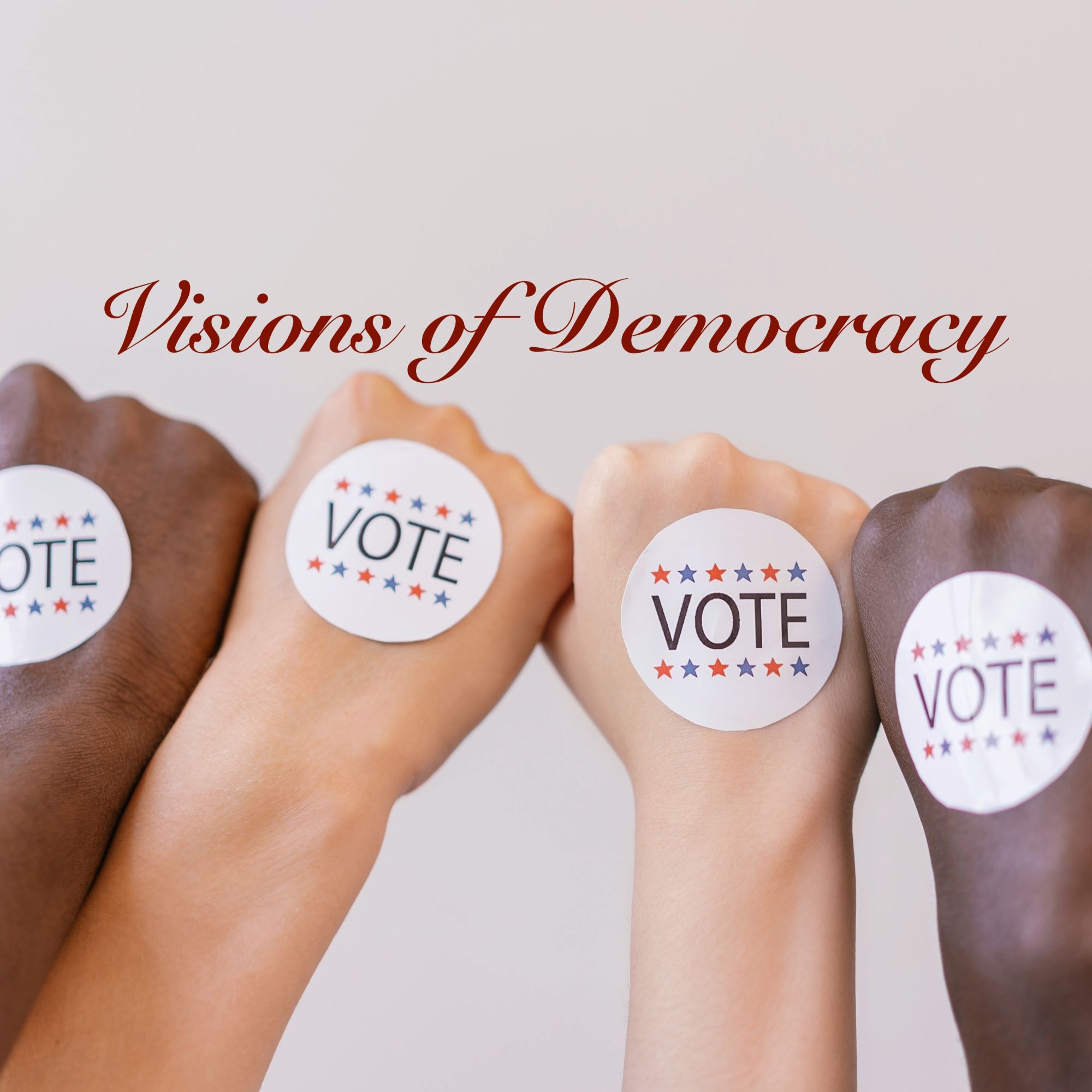
What is democracy? How does democracy function? What forms does it take? How do people enact democracy? “Visions of Democracy,” is a story-based, American history podcast that explores grassroots activism and participatory democracy. Each episode tells a story when activists worked together towards a specific goal and encourages listeners to think critically about tools for building people-power and ways to participate in democracy.
-
10
Episode 10: Earth Day Special--The Battle to Save Cape May Harbor
On this Earth Day special episode, we learn about the battle to save Cape May Harbor. The Cape May Harbor was slated for development in 1988. Residents of the island city banded together to stop the construction of a resort alongside this man-made waterway. Members of the Committee to Save Cape May Harbor waged a grassroots battle against developers and won. Thanks to their five-year effort, the harbor is protected. The Green Acres Program in New Jersey protects this waterway and other open spaces for passive recreation and environmental education. Each year, over 26,000 people enjoy the harbor and visit the Nature Center of Cape May thanks to a group of citizens who used the democratic process to prevent the area's development and degradation. Transcript available at: drive.google.com/drive/folders/19…lsSc?usp=sharing Credits: Music- Technology And Startup Ambient by KLAmedia Adobe Stock Asset ID: #1966088722 Available at: https://stock.adobe.com/search/audio?k=1966088722 Photo-From Private Collection held at the Nature Center of Cape May
-
9
Episode 09: The Child Development Group of Mississippi and the Radical Potential of Head Start
On this episode of Visions of Democracy, we explore the peculiar histories of American welfare through the radical potential of Head Start. The Child Development Group of Mississippi was one of the first Head Start programs. As Dr. Crystal Sanders shares, CDGM offered a radical curriculum of empowerment to working-class Black students and well-paying jobs to many of their mothers. Transcript available at: https://drive.google.com/drive/folders/19SMuOfQhsmvsVGYhXOsIIWn4TsWslsSc?usp=sharing Credits: Music- Wanna Go by INOSSI | @inossi Music promoted by www.free-stock-music.com Creative Commons Attribution 3.0 Unported License creativecommons.org/licenses/by/3.0/deed.en_US Photo: (picture of Operation Head Start at Webb School on July 4, 1965) Photographer Thomas J. O'Halloran. From Library of Congress: https://lccn.loc.gov/2016647284
-
8
Visions of Democracy Season Two The Peculiar Histories of American Welfare
In season two of Visions of Democracy, we will explore the economic aspects of democracy. As we all know, in democracies, citizens vote for their leaders. Elected officials represent their constituents’ interests in the policy-making process. As representatives make laws, they distribute public resources. Through the funding of public schools and libraries, the construction and maintenance of infrastructure such as roads and bridges, and much more, officials allocate our tax dollars. In the process, they make decisions about who gets to benefit from public money. They decide who deserves public resources and who does not. These are the economic aspects of democracy that we will consider this season as we examine the peculiar histories of American welfare.
-
7
Eposide 08: The Commons With Al Haber and Dr. Davis Allen
In this episode of Visions of Democracy, we hear from Al Haber and Dr. Davis Allen and we explore the commons. After the 1960s, many of the activists continued to organize in their local communities. Al Haber fought to establish a commons in Ann Arbor. His campaign succeeded. But what is a commons? How do people conceptualize common ownership of land? Dr. Davis Allen, an expert on the history of capitalism and the commons, tells us about the different ways that common ownership and use of land functioned historically. Transcript available at: https://drive.google.com/drive/folders/19SMuOfQhsmvsVGYhXOsIIWn4TsWslsSc Credits: Music- Wanna Go by INOSSI | @inossi Music promoted by www.free-stock-music.com Creative Commons Attribution 3.0 Unported License creativecommons.org/licenses/by/3.0/deed.en_US Image- Photo by Kellyson Silvaon on Unsplash
-
6
07 Political Realignment: Racial Politics in the Democratic Party during the 1960s
In this episode of Visions of Democracy, we explore efforts to realign the Democratic Party. In the early 1960s, members of the Students for a Democratic Society and the Student Nonviolent Coordinating Committee wanted to build a new alliance under the Democratic Party. Their goal was to expel Southern Democrats, economically-liberal politicians who supported Jim Crow, and bring in Progressive Republicans. Transcript available at: https://drive.google.com/drive/folders/19SMuOfQhsmvsVGYhXOsIIWn4TsWslsSc?usp=sharing Credits: Music- Wanna Go by INOSSI | @inossi Music promoted by www.free-stock-music.com Creative Commons Attribution 3.0 Unported License creativecommons.org/licenses/by/3.0/deed.en_US Image- Photo by Joakim Honkasalo on Unsplash Interested in learning more? Check out these resources: https://snccdigital.org/events/mfdp-challenge-at-democratic-national-convention/ https://thetreeofprotest.com/ https://www.zinnedproject.org/news/tdih/mfdp-convention/ Or read these books: Lisa Anderson Todd, For a Voice and the Vote: My Journey with the Mississippi Freedom Democratic Party (Lexington: University of Kentucky Press, 2015). Earnest N. Bracey, Fannie Lou Hamer: The Life of a Civil Rights Icon (Jefferson, NC: McFarland & Company, 2011).
-
5
06: Poor Single Mothers, Rats, And Poverty: Who Should Write Antipoverty Policy?
In this women's history month special episode, we explore how women on welfare demanded representation in their local government. Transcript and sources available at: https://drive.google.com/drive/folders/19SMuOfQhsmvsVGYhXOsIIWn4TsWslsSc?usp=sharing Music- Wanna Go by INOSSI | @inossi Music promoted by www.free-stock-music.com Creative Commons Attribution 3.0 Unported License creativecommons.org/licenses/by/3.0/deed.en_US
-
4
05: Teaching Democracy In The Classroom
In this episode, we hear from Carole Close and explore how student activists stayed involved after graduation. Close tells us how she used used "democratic classroom management" and promoted engaged citizenship in her classroom. Transcript available at: https://drive.google.com/drive/folders/19SMuOfQhsmvsVGYhXOsIIWn4TsWslsSc?usp=sharing Music- Wanna Go by INOSSI | @inossi Music promoted by www.free-stock-music.com Creative Commons Attribution 3.0 Unported License creativecommons.org/licenses/by/3.0/deed.en_US
-
3
04: Choosing Prison Over The Draft
In this episode, we hear from Daniel Brustein, who refused to register for the draft, a crime punishable by three years in prison. Brustein tells us what draft resisters hoped to achieve by choosing prison over the draft. Sources: "Daniel Brustein interview, 29 July 2016" (2016). Cleveland Regional Oral History Collection. Interview 750008. https://engagedscholarship.csuohio.edu/crohc000/770 Transcript available at: https://drive.google.com/drive/folders/19SMuOfQhsmvsVGYhXOsIIWn4TsWslsSc?usp=sharing Music- Wanna Go by INOSSI | @inossi Music promoted by www.free-stock-music.com Creative Commons Attribution 3.0 Unported License creativecommons.org/licenses/by/3.0/deed.en_US
-
2
03: Medical Students Objecting to the Doctor Draft
In this episode, we hear from Oliver Fein and Charlotte Phillips, who organized medical students to oppose the Doctors Draft and the Vietnam War. Additionally, we explore changes to conscientious objector status which occurred during the 1960s. Transcript available at: https://drive.google.com/drive/u/1/folders/19SMuOfQhsmvsVGYhXOsIIWn4TsWslsSc Music- Wanna Go by INOSSI | @inossi Music promoted by www.free-stock-music.com Creative Commons Attribution 3.0 Unported License creativecommons.org/licenses/by/3.0/deed.en_US
-
1
02: Opposition To The Vietnam War
In this episode, we hear from antiwar and anti-draft activists who opposed the Vietnam War. Additionally, we explore the racist and classist effect of the draft. Transcript available at: https://drive.google.com/drive/folders/19SMuOfQhsmvsVGYhXOsIIWn4TsWslsSc?usp=sharing. Sources: "Carole Close Interview, 18 June 2011" (2011). Cleveland Regional Oral History Collection. Interview 911056. https://engagedscholarship.csuohio.edu/crohc000/673. Paul T. Murray. “Blacks and the Draft: A History of Institutional Racism.” Journal of Black Studies, September, 1971. https://journals.sagepub.com/doi/abs/10.1177/002193477100200104. Music- Wanna Go by INOSSI | @inossi Music promoted by www.free-stock-music.com Creative Commons Attribution 3.0 Unported License creativecommons.org/licenses/by/3.0/deed.en_US
-
0
01: The Cleveland Community Theater
In this episode of Visions of Democracy, we explore the Cleveland Community Theater. Members of the Students for a Democratic Society organized a theater project in 1965. Their goal was to create community bonds and to politically organize impoverished Clevelanders. Transcript available at: https://drive.google.com/drive/folders/19SMuOfQhsmvsVGYhXOsIIWn4TsWslsSc?usp=sharing Sources: Music- Wanna Go by INOSSI | https://soundcloud.com/inossi Music promoted by https://www.free-stock-music.com Creative Commons Attribution 3.0 Unported License https://creativecommons.org/licenses/by/3.0/deed.en_US
We're indexing this podcast's transcripts for the first time — this can take a minute or two. We'll show results as soon as they're ready.
No matches for "" in this podcast's transcripts.
No topics indexed yet for this podcast.
Loading reviews...
ABOUT THIS SHOW
What is democracy? How does democracy function? What forms does it take? How do people enact democracy? “Visions of Democracy,” is a story-based, American history podcast that explores grassroots activism and participatory democracy. Each episode tells a story when activists worked together towards a specific goal and encourages listeners to think critically about tools for building people-power and ways to participate in democracy.
HOSTED BY
Kimba Stahler
CATEGORIES
Loading similar podcasts...
Frequently Asked Questions
How many episodes does Visions of Democracy Podcast have?
Visions of Democracy Podcast currently has 11 episodes available on PodParley. New episodes are automatically indexed when they're published to the podcast feed.
What is Visions of Democracy Podcast about?
What is democracy? How does democracy function? What forms does it take? How do people enact democracy? “Visions of Democracy,” is a story-based, American history podcast that explores grassroots activism and participatory democracy. Each episode tells a story when activists worked together towards...
How often does Visions of Democracy Podcast release new episodes?
Visions of Democracy Podcast has 11 episodes. Check the episode list to see recent publication dates and frequency.
Where can I listen to Visions of Democracy Podcast?
You can listen to Visions of Democracy Podcast on PodParley by clicking any episode. We provide an embedded audio player for direct listening, and you can also subscribe via your preferred podcast app using the RSS feed.
Who hosts Visions of Democracy Podcast?
Visions of Democracy Podcast is created and hosted by Kimba Stahler.
URL copied to clipboard!