
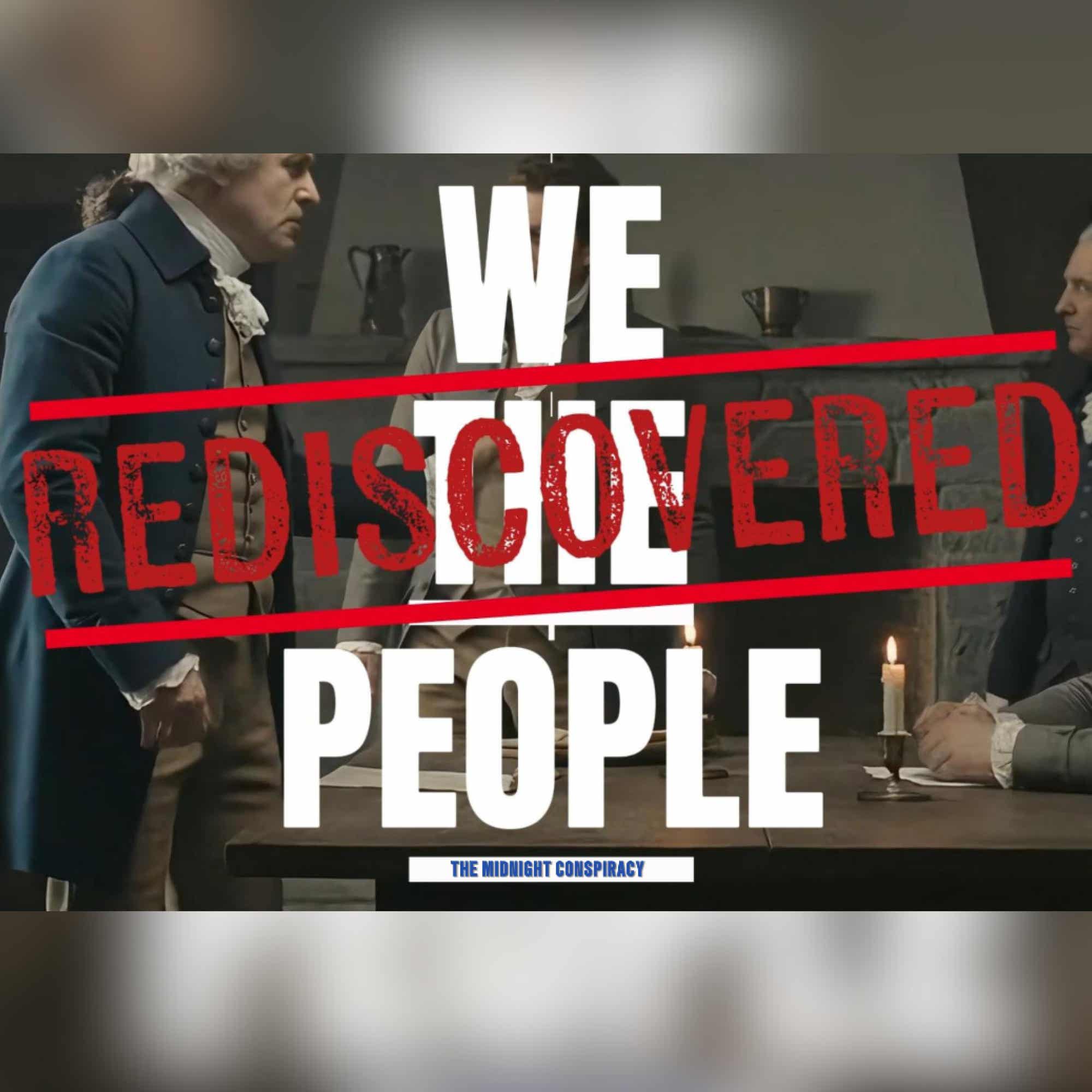
PODCAST · history
We The People: Rediscovered
by Created by Jarrad Clark
Constitutional archaeology for a generation that thought civics was dead, and in some cases buried away never to be questioned again. However we had a different idea - Welcome to America's most urgent dig site. We're not just telling history—we're investigating it like a crime scene, uncovering the buried secrets, forgotten scandals, and human drama behind the Constitution that still shapes your life today.In a nation where only 23% of students are proficient in civics and 80% feel deeply divided, we're excavating the real stories the textbooks missed. Each episode treats a constitutional amendment like an unsolved case, revealing how 200-year-old fears became your modern rights—and why democracy isn't ancient history, but breaking news and should be discussed now rigiourisly. If not at the dinner table any longer then discuss it online via your preferred platform and if you like an episode please share it and tag us #wethepeoplerediscovered Think Serial meets the Founding Fathers
-
5
SPECIAL EDITION: The Galliano Effect
ZARA x GALLIANOEXECUTIVE SUMMARYJohn Galliano has entered a two-year creative partnership with Zara, tasked with reworking the brand’s archives into new seasonal collections beginning September 2026.This is not a capsule collaboration. It is a structural test of the modern fashion system—creative currency, consumer mindset, and the shifting value of authorship.By introducing couture-level authorship into a high-street model, Inditex is testing whether creativity—not brand hierarchy—can become the primary driver of value.WHAT’S HAPPENINGThe Partnership- Two-year collaboration with seasonal drops (launch: September 2026)- Archive-led design: past Zara collections reworked into new pieces- Couture methodology applied at scale- Ongoing creative authorship—not a one-off capsuleThe Context- Galliano exited Maison Margiela in 2024 after a 5× revenue increase (~$500M)- Resale appetite for his work continues to rise- Zara growth slowed (+1% in 2025), under pressure from ultra-fast competitors- Marta Ortega Pérez is repositioning Zara toward cultural and creative credibilityWHY THIS IS DIFFERENTDesigner collaborations are not new. Since Karl Lagerfeld’s H&M partnership in 2004, high-low has been a proven model.This is something else entirely:- Duration: Multi-year vs one-off- Process: Archive deconstruction vs new product creation- Authority: A designer of narrative and technical depth- Timing: Post-luxury fatigue, digitally fluent consumersThis is not about access to luxury.It is about redefining where creative value is produced.THE MARTA ORTEGA STRATEGYUnder Marta Ortega Pérez, Zara is executing a deliberate elevation strategy:- Cultural capital via MOP Foundation exhibitions- Premium collaborations across interiors, fragrance, and hospitality- Flagship positioning in luxury retail districtsGalliano is the most significant move yet.He provides something Zara has historically lacked: authentic authorship.THE ARCHIVE AS CREATIVE CATALYSTGalliano’s genius lies in his ability to excavate the original inspiration behind a piece—to reveal the creative DNA others overlook.Where most see a jacket, he sees:- historical reference- construction logic- emotional intentionHis ability to transform these into covetable, collectible pieces is unmatched.The Zara archive—however shallow it may appear—is not a limitation.It is raw material.And constraint is where Galliano does his best work. THE INSTAGRAM GENERATIONWhat many commentators miss is the new generation of Galliano followers shaped during his Maison Margiela tenure.Through digital storytelling, he made the theatrical, conceptual, and artisanal feel accessible and contemporary.They’ve been watching—but not buying.Until now.This collaboration creates an entry point.And unlike 2004, today’s consumer is fluent in high-low dressing—making the cultural timing far more receptive.THE SUSTAINABILITY QUESTIONThe archive-led narrative aligns with circularity—but also invites scrutiny.Is this:- genuine circular design?- or strategic storytelling aligned with regulation?The answer will be measurable:- % of reused materials- production transparency- waste reductionThis is where the partnership is tested.PERSONAL INSIGHT: WORKING WITH GALLIANOHaving worked directly with John Galliano across 20+ shows and global launches, I’ve witnessed something difficult to articulate unless you’ve been inside it.He doesn’t just design—he pulls people into a world.He communicates vision in a way that transforms teams from executors into believers.From the outside, his process is described as immersive.From the inside, it is demanding.Because once you understand the vision, you’re accountable to it.And that’s where the standard changes.People go further.They care more.They push beyond what is “good enough.”THE DISCIPLINE BEHIND THE MAGICBehind the creativity is rigor.An obsession with:- drape- cut- proportion- how fabric moves and fitsHours—sometimes days—spent refining what most will never consciously notice, but will instinctively feel.That level of development is not decorative.It is foundational.WHY THIS IS DIFFERENT FOR ZARAThis is where the partnership is tested.Zara operates on speed, efficiency, and replication.Galliano operates on immersion, precision, and emotional intent.These systems do not naturally align.That tension will define the outcome.WILL IT BREAK OR TRANSFORM?If Zara embraces this process, it could unlock a level of creative credibility it has never reached.If it resists—or compresses it—the work will not translate.Because Galliano’s work cannot be reduced to surface.It must be understood from within.WHAT I KNOW FROM EXPERIENCEWhen teams meet him at that level, they don’t just improve the work.They improve themselves.And the result carries something you cannot manufacture:conviction.This collaboration will not be decided by aesthetics—or even sales.It will be decided by whether Zara can operate at that level.As Joan Burstein—who discovered Galliano in 1984—said: “While times and tastes may have changed, Galliano still has it.”If that belief still holds after a century in fashion, the industry may need to spend less time questioning this collaboration—and more time preparing for what it might become.The verdict awaits September 2026. Get full access to Jarrad Clark at jarradclark.substack.com/subscribe
-
4
We The People: Rediscovered - Episode 4
Constitutional archaeology for a generation that thought civics was dead, and in some cases buried away never to be questioned again.Welcome to America’s most urgent dig site. We’re not just telling history—we’re investigating it like a crime scene, uncovering the buried secrets, forgotten scandals, and human drama behind the Constitution that still shapes your life today.🎧 Episode 4: “The Paper Trail”The Investigation: How the amendment that was supposed to protect you from unreasonable searches somehow gave police the power to search almost anything, anytime.The Crime Scene: Boston, 1761. British customs officers with “writs of assistance”—blank search warrants that let them search anyone, anywhere, anytime. Young lawyer James Otis challenges these writs and loses the case but wins history. John Adams later says, “Then and there, the child Independence was born.”Key Revelations:* 🔍 The Fourth Amendment promised you’d never be searched without cause—but courts created more exceptions than protections* 📱 Your smartphone contains more personal information than every piece of paper the Founders ever owned combined* ⚖️ In 1967, police needed a warrant to wiretap your phone. In 2013, NSA mass surveillance was ruled constitutional* 🚔 When federal troops and civilian police merge in American cities, who needs the warrant—and who enforces the Fourth Amendment?The Constitutional Paradox: The amendment that was supposed to require specific warrants now allows general surveillance of everyone, all the time. Your “papers and effects” are digital—but the protections are still analog.The Timeline That Should Terrify You:* 1791: Fourth Amendment ratified—you have the right to be secure in your “persons, houses, papers, and effects”* 1967: Supreme Court rules police need warrants for wiretaps* 2008: iPhone is released* 2013: NSA mass surveillance ruled constitutional* 2018: Landmark Case Changed Everything* 2025: Your phone tracks everywhere you go, everyone you call, everything you search—without a warrantToday’s Question: The Founders protected “papers and effects” from unreasonable search. Your smartphone is your digital papers, diary, photo album, and filing cabinet combined. So why can the government access it without the same protections they’d need to search your house?🔥 EPISODE HIGHLIGHTS“The right to be left alone”: The Fourth Amendment was America’s promise that government agents would never again have unlimited power to invade private life. But that promise has been systematically dismantled, one court case at a time.The Exception Factory: Courts have created exceptions to the Fourth Amendment that have swallowed the rule—automobile exception, plain view exception, exigent circumstances, hot pursuit, stop and frisk, border searches, school searches, workplace searches. The list goes on.The Modern Crime Scene: With federal troops in American cities and the line between military and civilian authority blurred, Fourth Amendment protections are being tested in real time. When National Guard troops support ICE raids, who needs the warrant?The Digital Paradox: The Fourth Amendment was written for a world of physical papers in physical houses. We live in a world of digital papers in cloud servers owned by corporations in countries the Founders never imagined.💡 WHY THIS MATTERS NOWIn 2025, with federal forces deployed in American cities, the Fourth Amendment isn’t just history—it’s the live constitutional battle happening on your streets. When government blends military intelligence with civilian law enforcement, when your phone knows more about you than your closest friend, when surveillance is constant and invisible—the Fourth Amendment is either your last defense or a broken promise.Next Episode: We investigate the amendment that guarantees you’ll never be forced to confess—except when you are. The Fifth Amendment: where the right to remain silent meets the obligation to speak up.📱 SHARE YOUR THOUGHTSThe Founders couldn’t have imagined smartphones, GPS tracking, facial recognition, or cloud storage. Does the Fourth Amendment still work in the digital age—or do we need a new constitutional amendment for the 21st century?Like this episode? Share it with someone who thinks constitutional law is boring. Tag us #wethepeoplerediscovered and let’s dig deeper together.Subscribe for 20+ episodes excavating the buried truths of American democracy.We The People: Rediscovered - Where 250-year-old warnings become today’s headlines.Think Serial meets the Founding Fathers. Think National Geographic exploration with true crime investigation techniques. This isn’t your high school civics class. This is constitutional archaeology—and the artifacts we’re digging up will change how you see America forever.🎙️ Available on YouTube, Apple Podcasts 🔗 [Perfect for: History buffs who love Hardcore History, True Crime fans of Serial, anyone who wants to understand why your digital privacy is disappearing, anyone who’s proud to have an American life. Get full access to Jarrad Clark at jarradclark.substack.com/subscribe
-
3
We The People : Rediscovered
🎧 Episode 2: “The Smoking Gun”The Investigation: The Second Amendment’s most explosive secret - the modern gun rights debate is based on a legal interpretation newer than the iPhone. Both sides are arguing about something the Founders never intended.Key Revelations:- Individual gun rights interpretation only became law in 2008- Original debate was about federal armies vs. state militias, not personal protection- Supreme Court avoided ruling on gun rights for 200+ years because the amendment was so confusing“The Second Amendment was born from a deep distrust of a powerful, centralized military. Knowing that, how do you think the Founders would view our modern world, where we have the most powerful standing army in global history, alongside a heavily armed populace?”#wethepeoplerediscovered Get full access to Jarrad Clark at jarradclark.substack.com/subscribe
-
2
We The People Rediscovered
🎧 Episode 3: “The Soldier at Your Door”The Investigation: Why the “forgotten” Third Amendment is actually the secret foundation of every digital privacy right you have. From British soldiers forcing their way into colonial homes to smart devices in modern bedrooms.Key Revelations:- British Quartering Acts legalized home invasion by armed government agents- The Third Amendment built the philosophical wall that the Fourth Amendment reinforces- Your Ring doorbell debate has 250-year-old constitutional roots“The Founders believed that having a physical soldier in the home was a violation so profound it required a constitutional amendment. If they were here today, how do you think they would view a digital ‘soldier’—a government-accessible device or algorithm—that is always on, and always listening, inside the walls of our homes?” Get full access to Jarrad Clark at jarradclark.substack.com/subscribe
-
1
We The People: Rediscovered
Constitutional archaeology for a generation that thought civics was dead, and in some cases buried away never to be questioned again. However we had a different idea - Welcome to America’s most urgent dig site. We’re not just telling history—we’re investigating it like a crime scene, uncovering the buried secrets, forgotten scandals, and human drama behind the Constitution that still shapes your life today.In a nation where only 23% of students are proficient in civics and 80% feel deeply divided, we’re excavating the real stories the textbooks missed. Each episode treats a constitutional amendment like an unsolved case, revealing how 200-year-old fears became your modern rights—and why democracy isn’t ancient history, but breaking news and should be discussed now rigiourisly. If not at the dinner table any longer then discuss it online via your preferred platform and if you like an episode please share it and tag us #wethepeoplerediscoveredThink Serial meets the Founding Fathers. Think National Geographic exploration with true crime investigation techniques. Think constitutional law that feels as urgent as your next notification.This isn’t your high school civics class. This is constitutional archaeology—and the artifacts we’re digging up will change how you see America forever.Think ‘Radio Serial’ meets the ‘Founding Fathers’. Think ‘National Geographic’ exploration with ‘True Crime Investigation’ techniques.📱 WHAT LISTENERS CAN EXPECT🔥 Constitutional mysteries solved with archaeological precision🎭 Real human drama behind America’s founding principles📱 Ancient rights meet modern technology in shocking ways🕵️ True crime investigation techniques applied to historical evidence💡 Why 18th-century debates still determine 21st-century freedoms⚡ Constitutional law that feels as urgent as breaking newsPerfect for: History buffs who love Hardcore History, True Crime fans of Serial, anyone who wants to understand why American democracy feels so fragile—and so powerful, anyone who is proud to have an American life.We The People Rediscovered is not your typical civics podcast. This is constitutional archaeology for the digital age.Available on YouTube, Substack, Apple Podcasts, Spotify, and wherever you investigate the truth.Now, let’s get to the Episode 1:🎧 “The Midnight Conspiracy”The Investigation: How free speech almost didn’t exist in America. Discover the secret political deal that saved the First Amendment from the very men who initially opposed it - including James Madison’s shocking flip from opponent to champion.Key Revelations:- Madison was originally AGAINST a Bill of Rights- The First Amendment was born from desperate political horse-trading- Five separate rights packed into 45 carefully negotiated wordsDiscussion Question for Social Media:“The Founders who were against a Bill of Rights worried that any right NOT written down might someday be considered a right we don’t have. Looking at our world today and debates over things like privacy... do you think they were right to be concerned?”studiojc is a reader-supported publication. To receive new posts and support my work, consider becoming a free or paid subscriber.Subscribe to find out when the next Episode is released, you will not want to miss it, and join the conversation. #wethepeoplerediscovered Get full access to Jarrad Clark at jarradclark.substack.com/subscribe
No matches for "" in this podcast's transcripts.
No topics indexed yet for this podcast.
Loading reviews...
ABOUT THIS SHOW
Constitutional archaeology for a generation that thought civics was dead, and in some cases buried away never to be questioned again. However we had a different idea - Welcome to America's most urgent dig site. We're not just telling history—we're investigating it like a crime scene, uncovering the buried secrets, forgotten scandals, and human drama behind the Constitution that still shapes your life today.In a nation where only 23% of students are proficient in civics and 80% feel deeply divided, we're excavating the real stories the textbooks missed. Each episode treats a constitutional amendment like an unsolved case, revealing how 200-year-old fears became your modern rights—and why democracy isn't ancient history, but breaking news and should be discussed now rigiourisly. If not at the dinner table any longer then discuss it online via your preferred platform and if you like an episode please share it and tag us #wethepeoplerediscovered Think Serial meets the Founding Fathers
HOSTED BY
Created by Jarrad Clark
Loading similar podcasts...
URL copied to clipboard!