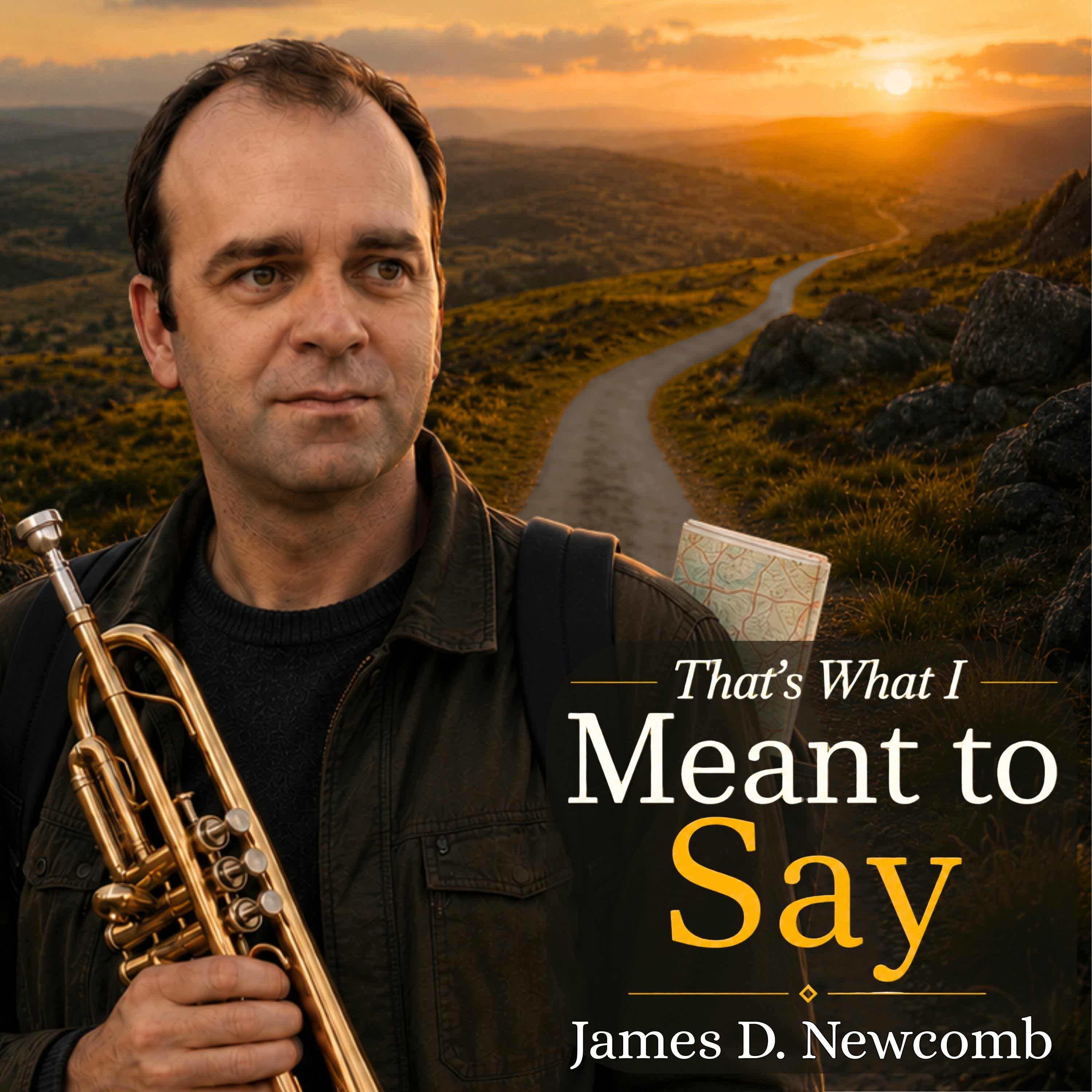
Well, That's a Deep Subject. podcast artwork

PODCAST · society

Well, That's a Deep Subject.

It all starts with something simple—an everyday object, a common phrase, a passing thought. But give it a second look, and suddenly, you're falling into the deep end.Hosted by James D. Newcomb, Well, That’s a Deep Subject is a slow-sipping conversation series where surface-level questions reveal unexpected depths. Whether it's a handshake, a coffee mug, or the word "fine," each episode begins with something familiar—and follows it down the rabbit hole of meaning, memory, and mystery.Sometimes it's philosophical. Sometimes personal. Sometimes playful. Always thoughtful.So pull up a chair. Pour yourself something warm. And get ready to find out just how deep a subject can go. www.jamesdnewcomb.com

  1. 0

    Remembering the World That Was, and Still Is, with Dr. Zachary Porcu

    What if Christianity is not primarily a moral code, a private belief system, or a set of religious customs, but a way of seeing reality?In this episode, Dr. Zachary Porcu joins the podcast to discuss his book Journey to Reality: Sacramental Life in a Secular Age. The conversation begins with the origin of the book, which grew out of Zac’s work teaching theology to students who often knew the basic claims of Christianity but lacked the worldview that made those claims intelligible.From there, we move into the deeper question: what is Christianity? Zac argues that “religion” may not be the most useful starting point. Christianity is better understood as a worldview, a way of answering the question, “What is the nature of reality?”That question leads into one of the central concepts of the conversation: the arche. Zac uses the term to move beyond the flattened modern image of God as a distant old man in the sky. Instead, he describes God as the source of being itself, the one in whom all things live, move, and have their being.The conversation then turns to the Incarnation, the claim that the source of being, life, and truth became man in Jesus Christ. Zac explains why that claim was shocking both to Jews and Greeks, and why it remains revolutionary today.We also discuss the difference between modern Christianity as intellectual assent and ancient Christianity as sacramental participation. To become Christian is not merely to agree with Christian propositions. It is to be grafted into Christ through baptism, Eucharist, and the mysteries of the Church.Later in the episode, we discuss the Reformation, the rise of the secular nation-state, the older idea of symphonia between church and empire, and the myth that public life can ever be religiously or metaphysically neutral.This conversation was recorded near the beginning of my Orthodox life. In that sense, it captures not a finished statement, but a beginning: the attempt to understand a world that once was, and still is, even if many of us have forgotten how to see it.Episode highlights:00:28 — Knowing the “what” of Christianity without knowing the “why”11:00 — Moving beyond the modern cartoon image of God15:30 — The Arche, life, and the reality behind living things24:00 — Why modern Christianity is different from Paul’s context31:00 — The Reformation and the rise of modernity35:45 — Symphonia and the Byzantine vision of church and empire37:30 — The secular nation-state and the myth of neutrality43:45 — Sacraments as mysteries entered, not merely explainedResources mentioned:Dr. Zachary Porcu’s Website zacharyporcu.comJourney to Reality Substack zacharyporcu.substack.comThe Roots of Everything Hosted by Dr. Zac PorcuJourney to Reality: Sacramental Life in a Secular Age by Dr. Zachary Porcu https://amzn.to/43FBWJ1About the guest:Dr. Zachary Porcu is an Orthodox Christian scholar, author, catechist, and host of The Roots of Everything. He is the author of Journey to Reality: Sacramental Life in a Secular Age, a book written to help modern readers understand Orthodox Christianity not merely as a set of doctrines or practices, but as a sacramental worldview. His work explores theology, history, philosophy, the Church Fathers, and the deep roots of the ideas that shape the modern world.Quotable quotes:“Christianity is not merely a set of rules. It is a way of answering the question: what is the nature of reality?”“To become Christian is not merely to agree with Christian ideas. It is to be grafted into Christ.”“The sacraments are not religious illustrations. They are mysteries we enter.”“There is no neutral worldview. Every society answers the question of reality, whether it admits it or not.”

  2. -1

    Singers in the Hands of an Angry Mob

    Composer Daniel Elder found himself at the center of intense public backlash after an Instagram post made during the unrest following George Floyd’s death. In this written interview, presented with AI-synthesized voices, Daniel gives his account of what happened, why he chose not to apologize, how institutions responded under pressure, and what the experience revealed about mob mentality, artistic conscience, and public fear.This episode is produced from a written interview with composer Daniel Elder. Daniel agreed to answer questions in writing because he did not want an off-the-cuff remark in a live conversation to create further controversy. His responses are presented using an AI-synthesized voice, and the host questions are also produced with an AI-synthesized version of my own voice.The conversation centers on Daniel’s account of the backlash that followed an Instagram post he made during the unrest after George Floyd’s death. Daniel describes his growing concern with social-media groupthink, the speed with which public discourse became accusatory, and his belief that the reaction to his post was shaped by a larger atmosphere of panic, moral certainty, and institutional fear. He also explains why he chose not to issue a public apology, arguing that doing so would have validated accusations he did not believe were true.The interview also addresses the reaction of GIA Publications, the dynamics of online activism, and Daniel’s advice for people who feel compelled to speak in moments of public pressure. His counsel is simple: remain respectful, stay calm, be patient, and do not compromise foundational convictions merely to satisfy an angry crowd.Find Daniel Elder on the web at danieleldermusic.com Follow James Newcomb on the web at jamesdnewcomb.com

  3. -2

    The Role of History

    What does it mean to ask about “the role of history”? Is history its own entity with agency of its own, or is there more to the story?In this episode, we reflect on how the past shapes the present through context, inheritance, memory, precedent, and constraint.

  4. -3

    Thinking Orthodox & A Primer on that “Other” Way of Christian Discipleship with Dr. Jeannie Constantinou

    https://jamesdnewcomb.com/jeannie“The Orthodox mind, the mind of the Church, is the mind of Christ.” We welcome biblical scholar and author Dr. Jeannie Constantinou for a sweeping, heartfelt, and clarifying conversation on phronema—the ancient Christian mindset preserved in the Orthodox Church.I open the conversation by sharing my own journey of transitioning into Orthodoxy, reflecting on how Western Christianity shaped my early worldview and how the discovery of the Orthodox Church revealed an entirely different way of understanding faith, thought, and spiritual life. As you'll hear, reframing an entire worldview and mindset does not happen overnight!In this episode, you'll hear why Orthodoxy speaks so deeply to those seeking “something more” i.e. a fuller experience of Christ rather than a purely symbolic one. The discussion highlights the West’s long-standing reliance on human reason, logic, and systematic explanations, contrasted with the Orthodox emphasis on mystery, experience, sacrament, community, and the healing of the heart.To put it another way: We can't possibly understand God in all His fullness, and we're perfectly okay with that!Dr. Jeannie explains the ancient Greek concept of phronema. This goes beyond a mere “worldview.,” It is a mindset, disposition, and lived mentality that flows from the apostles and the early Church, unchanged for two millennia.She also explains in detail how the Orthodox Church has maintained continuity with Christ’s original intent, what early Christian worship actually looked like, why tradition (and the dreaded ritual) matters, and how one begins to cultivate the mind of Christ through prayer, humility, sacramental life, and participation in the community.Whether you’re new to Orthodoxy, curious about early Christianity, or simply wrestling with the limits of Western religious paradigms, this episode offers clarity, depth, and a pastoral invitation to encounter the reality of Christ via the fullness of His Church.Episode highlights:01:10 – James’s transition (not conversion) from Protestant/Western Christianity into Orthodoxy07:10 – The unfulfilled Protestant mindset: salvation as a “destination” vs. lifelong journey10:10 – Western fixation on explanation vs. Orthodox acceptance of mystery13:10 – What phronema is—and isn’t14:10 – How Christ Himself taught “the mind of God” through His deeds and teachings17:10 – The West’s attempt to reconstruct early Christianity through reason21:10 – The problem of individualism and denominational fragmentation24:10 – The Church is the physical body of Christ, not some invisible abstraction28:10 – The Eastern Church didn’t “break off” from Rome30:10 – Bishops, councils, and why the early Church rejected papal monarchy34:10 – The sincere desire to rediscover early Christianity37:10 – How the apostles taught—and preserved—Christ’s actual teachings41:10 – Early Christian worship: sacred, communal, experiential46:10 – Oral tradition and why Scripture was never meant to stand alon49:10 – Understanding the much-maligned Constantine’s role in Church history51:10 – Why ritual is natural, ancient, and thoroughly Christian53:10 – How to acquire phronema through lived participation within community01:03:10 – How to connect with Dr. Jeannie and closing remarksAbout the guest:Dr. Jeannie Constantinou is a biblical scholar, author, speaker, and longtime teacher of the New Testament and early Church. With academic training in Orthodox theology, patristics, biblical interpretation, and law, she brings both scholarly rigor and pastoral clarity to questions of Scripture, tradition, and the Orthodox Christian mind. Her books include Thinking Orthodox: Understanding and Acquiring the Orthodox Christian Mind, The Crucifixion of the King of Glory, and Guiding to a Blessed End. Through her writing, teaching, and podcast work, Dr. Constantinou helps Christians encounter the Bible not merely as a text to be analyzed, but as the living witness of the Church.Resources mentioned:Thinking Orthodox: Understanding and Acquiring the Orthodox Christian Mind by Jeannie Constantinou

  5. -4

    I Reserve the Right to be Wrong

    Honest speech requires the freedom to be wrong. In this episode, I reflect on students afraid to speak, a mob moment from my trumpet podcast days, and the difference between correction and public shaming. When decent people are afraid to speak, fools fill the silence. I’m James Newcomb, and that’s what I meant to say. Get full access to James D. Newcomb at jamesdnewcomb.substack.com/subscribe

  6. -5

    This Guy Knows What He Wants

    I was recently asked by Deacon Stephen Wehr at my home parish (St. Mary’s Greek Orthodox Church in Minneapolis) for a personal conversation about, well, me.Steve asked me about my upbringing, my military service, my musical endeavors, marriage, faith, and how I discovered and was drawn to Orthodox Christianity.This is not some tidy conversion story, but a life shaped by vocation, risk, patience, and the slow recognition of home. Get full access to James D. Newcomb at jamesdnewcomb.substack.com/subscribe

  7. -6

    Freedom Within Constraint

    Igor Stravinsky once remarked, “The more constraints one imposes, the more one frees one’s self. And the arbitrariness of the constraint serves only to obtain precision of execution.” Stravinsky was known as one who would “push the boundaries of tolerance” for the listener of music in his time, so it is somewhat surprising to hear him say something like that. But when you think about it, it makes sense. But only if freedom is understood as the absence of limits. For Stravinsky, freedom did not mean having endless options at his disposal. Quite the contrary. Freedom was the capacity to act meaningfully within a defined field. Stravinsky was not merely offering a clever aphorism about creativity. He was describing a practical discipline of artistic work. The composer does not become more creative by standing before infinite possibility. He becomes more creative when he establishes — and sticks to — boundaries. Form, instrumentation, rhythmic structure, a tonal language. And then discovers what can be made within it. The constraint sharpens the act of creation. It removes ambiguity, and forces decision. This runs contrary to one of the modern fantasy about creativity, namely, that the creative person is most alive when he is most unrestricted. This idea is not without its romantic appeal. We imagine the writer, composer, entrepreneur, or performer as someone who breaks free from all forms and simply produces out of pure inward force. But alas, that’s a mere fantasy; it is not aligned with reality. Creativity does require a certain independence of mind, perhaps even a bit of rebellion against what is popular. But independence of mind is not the same thing as formlessness. An unlimited field produces not freedom, but paralysis. When everything is possible, nothing has priority. The blank page does not necessarily liberate the writer. More often, it exposes him to the burden of infinite choice.This is why serious creative work nearly always begins with some kind of narrowing. A writer chooses a subject. A composer chooses an ensemble. A researcher chooses a question. A business chooses a niche market. These initial decisions may feel restrictive, but they are actually essential to their success. Until the field is narrowed, the imagination has no object to engage. It can hover indefinitely in the realm of possibility, mistaking potential for progress.The point is not that every limitation is good. Some constraints are suffocating. Others are imposed by cowardice, bureaucracy, financial necessity, fear of risk (or success), or pure laziness. There are limits that diminish the work because they arise from a refusal to confront the real demand of the task. But here we’re speaking of a different kind of constraint. This constraint is not a cage. It is an instrument. The mind can stop wandering through abstractions and begin the real work with real potential.Music makes this especially clear. A composer who chooses to write for solo trumpet is immediately confronted with limits: range, tone, dynamics, and the physical realities of the instrument. And as an active trumpeter myself, I will tell you there are plenty of composers who are not the least bit familiar with those limitations, often with hilarious results.The same principle applies outside the arts. Academic writing, for example, depends heavily on constraint. The word-count maximum is more difficult to achieve than any minimum the professor may expect. The dissertation is not improved by being “about” everything. Its strength lies in narrowing its object of inquiry. A useful research question does not ask the writer to say something vaguely important about a large topic. It requires the writer to identify a specific problem, define terms, establish scope, choose a method, and submit the argument to evidence. In that sense, scholarly work is disciplined creativity. The form does not weaken the thought. The form tests the thought.This may explain why the most frustrating stage of any project is often not the work itself, but the period before the boundaries are clear. A vague project is exhausting because it requires constant renegotiation. What is this supposed to be? Who is it for? What belongs in it? What does not? What standard governs it? Without answers to those questions, even the most talented artists, academics, musicians, etc. waste enormous energy circling the work rather than engaging with it. Once the boundaries are set, however, a different kind of energy becomes available. The task is still difficult to be sure, but it is no longer ambiguous. It has real boundaries within which to work.There is also a moral dimension to this. A life without boundaries is not necessarily a free life. It may simply be an undisciplined one. To commit to a vocation, a marriage, a tradition, a craft, a faith, or a serious body of work is to accept limits. One cannot become excellent at everything. One cannot honor every possibility equally. One cannot build a coherent life while remaining indefinitely available to every competing impulse. Choice always involves renunciation. To choose one path is to leave others untraveled. That loss is real, but it is also the condition of depth.Modern culture often resists this because it tends to confuse openness with vitality. We are encouraged to keep options open, remain flexible, avoid labels, resist definition, and preserve the right to reinvent ourselves at any moment. There is a place for flexibility, but endless openness can become a subtle form of evasion. If nothing is defined, nothing can be judged. If nothing is committed to, nothing can fail. If nothing is finished, nothing has to bear the weight of public form. The refusal of constraint protects the ego from criticism, but it also prevents the work from becoming real.The boundary, then, should not be understood merely as a restriction. It is a site of incarnation. It is where the abstract becomes concrete. Before the boundary, there is only intention. After the boundary, there is material to work with. The composer has notes. The writer has sentences. The scholar has evidence. The musician has breath, time, and sound. The craftsman has the dimensions of the object. The entrepreneur has a real audience rather than an imagined public. In each case, the constraint gives the work a body.This is the deeper wisdom in Stravinsky’s claim. Freedom is not found in the absence of form, but in mastery within form.

  8. -7

    In the Middle of Somewhere and Nowhere

    An innocent word between a driver and passenger leads to a reflection on the nebulous "middle" in which so much of our lives is formed.

  9. -8

    When the Truth Feels Like an Attack

    Why do people cling to beliefs even after they’ve been proven wrong? In this episode, we explore what happens in the mind when deeply held beliefs are challenged, why facts alone often fail to persuade, and how emotional investment shapes what we accept as true. Drawing on decades of psychological research, this conversation unpacks why corrections sometimes backfire, why empathy matters more than argument, and how curiosity can open doors that confrontation slams shut. If you’ve ever wondered why misinformation spreads so easily, or why difficult conversations go nowhere, this episode offers clarity—and a more hopeful way forward.Key Themes* Why the brain treats belief challenges like physical threats* How emotional reactions precede logical reasoning* Why more evidence can sometimes make beliefs stronger* The difference between explaining a belief and defending it* Why timing matters when correcting misinformation* How and why detailed corrections can unintentionally backfire* The “truth sandwich” method and why it works* Age, emotion, and susceptibility to misinformation* Motivational interviewing as an alternative to confrontation* Why empathy changes minds more effectively than argument* Winning relationships versus winning debates#BeliefChange#Misinformation#CriticalThinking#Psychology#TruthAndMeaning#CognitiveBias#EmpathyMatters#That’sWhatIMeantToSay#fakenews Get full access to James D. Newcomb at jamesdnewcomb.substack.com/subscribe

  10. -9

    Why Being Right Feels So Good (And Costs Us So Much)

    Why do intelligent, well-informed people so often talk past one another? Why do we cling to our beliefs, even when presented with overwhelming evidence that on the surface disproves them?In this episode, we explore a phenomenon known as “Confirmation Bias.” This is the tendency to favor information, even blatantly false, that supports what we already believe to be true. Drawing on research from Harvard University, MIT, and Stanford University, the conversation examines why false information spreads faster than truth, why being proven wrong can literally feel painful, and why facts alone rarely change minds. Rather than focusing on a single event, although it would be easy to do so, this episode looks at how we receive information itself, and why we might do well to question our own certainty in an increasingly polarized world. Get full access to James D. Newcomb at jamesdnewcomb.substack.com/subscribe

  11. -10

    Protestants v. Catholics in America's Founding Era: When Certainty Becomes the Threat

    The American Founders are often remembered as champions of reason, restraint, and religious liberty. But beneath that story lies a less examined assumption: a deep certainty about which forms of belief were acceptable—and which were dangerous. In this episode, we revisit some of the important documents of that era, namely Federalist Nos. 10 and 51 and explore how fear of factions, combined with cultural and religious certainty, may have planted seeds of the very instability the Founders hoped to prevent. Rather than treating certainty as a virtue, this conversation asks whether it can quietly become a liability, not just politically, but spiritually and culturally as well.Resources & References* The Federalist Papers– Federalist No. 10 (James Madison on factions)– Federalist No. 51 (Checks, balances, and human nature)* Gordon S. Wood, The Creation of the American Republic* Philip Hamburger, Separation of Church and State* John Courtney Murray, We Hold These Truths#FederalistPapers #AmericanFounding #ReligiousLiberty #PoliticalPhilosophy #ChurchAndState #Certainty #JamesMadison #ThatsWhatIMeantToSay Get full access to James D. Newcomb at jamesdnewcomb.substack.com/subscribe

  12. -11

    The Non-Wall That Has Marginalized Christianity from the American Public Consciousness

    Most Americans assume the founders intended a rigid wall between church and state. In fact, many Christians even consider it a great blessing.Yet the historical record tells a more complicated and far more interesting story. In this episode, we examine how the Establishment Clause was originally understood, why the founders opposed state churches while wholesale embracing religion in public life, and how modern interpretations, notably from 20th Century Supreme Court decisions, diverged sharply from those assumptions. #ChurchAndState#FirstAmendment#EstablishmentClause#AmericanFounding#ReligiousFreedom#SupremeCourt#Constitution#PoliticalHistory#CivicVirtue#ThatsWhatIMeantToSay Get full access to James D. Newcomb at jamesdnewcomb.substack.com/subscribe

  13. -12

    Errand Into the Wilderness: Puritans, Power, and the Roots of American Exceptionalism

    In this episode, we explore how the theology of the New England Puritans shaped a distinctive political imagination—one that continues to echo through American culture, governance, and foreign policy. Drawing on historian Perry Miller’s concept of an “errand into the wilderness,” the conversation reframes the Puritans not as caricatured zealots, but as idealists who believed they were participating in a divine experiment with world-historical consequences. We examine how covenant theology produced a system of collective responsibility, why dissent was treated as an existential threat, and how the Puritan mission failed in practice but survived in secularized form as American exceptionalism.In This Episode* Why the Puritans saw themselves as more than religious refugees* What Perry Miller meant by an “errand into the wilderness”* The idea of America as a “city upon a hill” and the burden of being watched* Covenant theology and the logic of collective moral responsibility* How providence shaped Puritan interpretations of success, failure, and disaster* Why dissent was viewed as dangerous rather than merely disagreeable* The banishment of Roger Williams and the limits of Puritan governance* How the Puritan project failed—and how its moral logic endured* The transformation of religious mission into secular American exceptionalism* Echoes of Puritan moral certainty in modern politics, foreign policy, and corporate culture* The enduring tension between individual freedom and collective responsibilityQuotable Moments* “They weren’t just fleeing persecution. They believed they were on a cosmic assignment.”* “Dissent wasn’t disagreement—it was endangering the entire community.”* “The Puritan errand failed as a system, but not as an idea.”* “When political identity fuses with absolute moral certainty, the results are rarely sustainable.”Why This MattersUnderstanding the Puritans helps explain why Americans so often frame political conflict in moral terms, why national failure feels existential, and why appeals to destiny and responsibility recur across centuries. This episode suggests that the unresolved tensions of the Puritan experiment—between freedom and order, humility and certainty—are still very much with us.Suggested Reading* Perry Miller, Errand into the Wilderness* Mark David Hall, Proclaim Liberty Throughout All the Land* Daniel Dreisbach and Mark David Hall, The Sacred Rights of Conscience* Francis Jennings, “Puritan Expansion and Indian Resistance”Closing ReflectionIf the Puritans were idealists whose convictions ultimately made their system unsustainable, what does that suggest about our own confidence in moral clarity today?Well… that’s what I meant to say. Get full access to James D. Newcomb at jamesdnewcomb.substack.com/subscribe

  14. -13

    The Scroll Precedes the Sword

    This episode presents a dialogue exploring how religious rhetoric functioned as a form of political power in colonial New England. The conversation examines how Puritan clergy used biblical typology to justify political authority, shape collective identity, and frame historical events as divine confirmation. It also highlights dissenting voices such as Robert Cushman and Roger Williams, whose challenges to this system laid early foundations for religious liberty and the separation of church and state. The discussion traces how these colonial debates continue to echo in modern American political rhetoric.Topics Covered* Biblical typology and Puritan political authority* Religion as a legitimizing force in colonial governance* Robert Cushman’s critique of prophetic nationalism* Roger Williams and the origins of church–state separation* John Cotton and clerical authority* The persistence of “chosen nation” rhetoric in modern America* The enduring power of language to define collective identityResourcesMadsen, D. L. (1992). The sword or the scroll: The power of rhetoric in colonial New England. American Studies, 33(1), 45–61.Referenced Figures* John Winthrop* Roger Williams* Robert Cushman* John Cotton* Ronald ReaganRhetoric, Puritanism, Colonial New England, Roger Williams, Church and State, American Exceptionalism, Political Language, Power and Identity#RhetoricAndPower#ColonialAmerica#ChurchAndState#PoliticalLanguage#AmericanOrigins Get full access to James D. Newcomb at jamesdnewcomb.substack.com/subscribe

  15. -14

    It's Not What It Was

    I had a conversation with the founder of a pretty well-known American brass group yesterday. We were talking about a possible collaboration for an event here in Minnesota later this year. If anything comes of it, I’ll be sure to let you know as soon as there’s anything to report.But something this gentleman said to me stuck out from everything else we discussed. When he began his group in the 1980’s, things were very different from what they are today. For one thing, the attention span of audiences was considerably longer than they are today. I’m guilty as charged when it comes to that. It’s a struggle to not glance at that iPhone every 22.4 seconds to see if any new messages or “notifications” have come in. Of course, nothing ever does, but that doesn’t stop me from checking anyway.Another thing is the level of competition. Back in the 80’s there were a few brass groups that had sort of cornered the market when it came to that type of thing. By “that type of thing” I mean a particular style of music, i.e. classical with a touch of jazz. There’s actually a name for this weird combination.Jazzical. To true jazz musicians, “jazzical” is basically what Americans have done with Chinese food, what with General Tso’s chicken and the like.But I digress.The real competition was among these various brass groups within the American market of young musicians in school band programs.Today the competition is the couch.Why spend an evening to go to a concert, and deal with traffic and parking, when you can sit at home and watch a movie on Netflix?Nowadays, the few live groups that are still around are kind of in the same boat, facing the same realities that modern-day technologies and conveniences have brought. It’s not like rivalries don’t exist. It’s just that they’ve taken a back seat to the need to simply survive. So in some ways, this has encouraged a bit more collaboration and camaraderie between rivals. Which is a good thing if you ask me.But the one thing that has never changed with all this new technology and convenience is the basic human need for community. If anything, all this new tech has only magnified this need.What did the Covid era teach us? For one, never ever again take the word of a public health “expert” at face value.But more to my point, we crave connection with other people. Video calls are good, and they have their place. But there’s no real replacement for in-person connection, sharing pheromones and “vibes” with each other.That is what we musicians ought to aspire to. Not to wow anyone with technical precision, but to bring people together and appreciate this life we’ve been given together. So things aren’t the way they were “in the old days”.The days of sitting on stage behind music stands, playing a set list and calling it a day are over.People expect more than that.From the “professionals” anyway. Those with a bit of creativity and vision can see the opportunity and the goldmine in front of them. Get full access to James D. Newcomb at jamesdnewcomb.substack.com/subscribe

  16. -15

    Differing Views on Venezuela

    We all know what has happened in Venezuela in the last 48 hours.What we’re not so sure about is what to make of it.There’s been no shortage of opinions from all corners of the globe re: the actions of the U.S. intervening in Venezuela. I will share my own in due time. But I want to share with you today two vastly different opinions on this matter. One is from an academic, the other from a true blood Venezuelan.Both are valid in their own right, yet both are highly polemical, meaning intended to provoke an emotional reaction from whomever is consuming it.I’ve borrowed these from social media posts, and added AI voices for purposes of making the podcast. Both commentaries are below in full.The important takeaway is that these sorts of issues are incredibly emotionally charged, and it is important to take the time to listen to as many viewpoints as possible when forming you own opinion on any subject.As I say at the very end of the podcast: You only get one opinion. Use it wisely!JNThe first commentary is from blogger and academic Anoop Verma anoopverma.com.History has a habit of repeating itself, first as justification and later as regret. Venezuela today stands where many resource-rich nations have stood before—accused, isolated, and finally struck, not because it is uniquely evil, but because it is inconveniently endowed.Oil, in the modern world, is not merely a commodity. It is power in liquid form. And power, when held outside the preferred architecture of empire, becomes suspect by definition. The language changes with time—communism, terrorism, narcotics, migration threats—but the destination remains the same: regime collapse followed by resource realignment.The latest allegations levelled by Donald Trump against Caracas arrive wrapped in familiar moral packaging. Criminal networks. Security threats. Hemispheric instability. These are serious words, meant to close debate before it begins. Yet history urges caution. It reminds us that certainty in geopolitics is often manufactured, not discovered.Two decades ago, the world was told—repeatedly and confidently—that Saddam Hussein possessed weapons of mass destruction. The claim was treated not as a hypothesis, but as a verdict. Iraq was invaded. Its state dismantled. Its oil sector opened. The weapons, famously, were never found.That absence did not reverse the war. It merely arrived too late to matter.Venezuela’s story now carries an unsettling resemblance. The charges are different, but the structure is identical: demonize the regime, compress complexity into slogans, and present military action as a reluctant necessity. Propaganda succeeds not by lying outright, but by speaking with absolute confidence before facts have time to breathe.If, years from now, investigations reveal that today’s accusations were exaggerated, selectively constructed, or strategically misleading, the damage will already have been done. Governments can be toppled in weeks; truth takes decades to recover its dignity.The deeper reality is this: control over petroleum remains central to the maintenance of the American global order. This is not conspiracy; it is doctrine, openly articulated across decades of strategic literature. Energy flows shape alliances. Energy chokepoints define red lines. Energy independence for others is quietly viewed as strategic disobedience.Oil-rich states that lack institutional resilience are not seen as partners. They are seen as opportunities.The Venezuelan crisis is therefore not an aberration but a pattern—one that has touched Iran, Libya, Iraq, and others in different forms. The moral language shifts, but the economic geometry remains constant. Empire rarely announces itself as empire; it arrives disguised as concern.For countries watching from afar, the lesson is sobering. Resource wealth does not guarantee sovereignty. It tests it. Weak institutions invite intervention; strong ones complicate it. The danger is not having oil. The danger is having oil without the capacity to defend political autonomy, economic competence, and narrative control.Venezuela may yet be remembered not for what it did wrong, but for what it possessed. And history may again ask an uncomfortable question: was the real crime a security threat—or was it oil?The second commentary is from a contact of mine on Facebook named Juan Pablo Sans. Juan is an online entrepreneur, and does not claim to be any sort of political pundit or expert in any way. Yet, having experienced what all Venezuelan’s have experienced, I think his views are worth hearing as well.If you are American and you’re curious about why Trump forced Maduro out, you should read this first...(An analysis by a Venezuelan who left Venezuela)Because unless you are Venezuelan, you are missing almost everything that matters.I am Venezuelan.I left my country in 2013, when Hugo Chávez died and Nicolás Maduro took power.I didn’t leave because I wanted to “try life abroad.”I left because I could see what was coming, and staying meant watching my future shrink year after year.So when Americans ask, “What do Venezuelans think about Trump forcing Maduro out of the presidency?”Let me answer that question honestly, without slogans, without moral theater, and without pretending this is simple.Most Venezuelans feel relief.Not because we love Trump or because we believe the U.S. does things out of pure love for freedom.And not because we are naïve about geopolitics, oil, or power.We feel relief because we have lived through something Americans have never experienced: a country where nothing works, where elections don’t matter, where money stops being money, and where time itself feels broken.Now, before someone jumps in to say “but not all Venezuelans agree,” let’s be precise.Yes, there is a minority that doesn’t agree.And that minority usually falls into one of three groups.- Some were doing business with the regime.- Some were personally comfortable inside the system and insulated from its worst consequences.- And some were pushed into such extreme poverty that survival depended on obedience.This last group matters, so let me explain it clearly.Millions of Venezuelans were reduced to depending on a government-issued food box.A box with rice, pasta, oil, sometimes expired food.A box that arrived irregularly. A box that was used as leverage.People were told, explicitly or implicitly: “If the government falls, this goes away.”That is hostage psychology!When misery reaches that level, people don’t defend the system because they believe in it.They defend it because they are afraid of losing the only thing standing between them and hunger.So yes, some people opposed change.But that opposition was not free, informed, or dignified.It was coerced by collapse.The rest of us lived something else entirely.Since Maduro took power back in 2013, Venezuela lost roughly 80% of its economy.We lived through years of hyperinflation where prices didn’t rise monthly or yearly. They rose daily.Sometimes hourly.Salaries became meaningless. Pensions became symbolic.Entire professions disappeared.We protested. We marched. Thousands of people got k* and tens of thousands more were illegally incarcerated as political prisoner.Just because they didn’t like Chavez or Maduro.We also voted because we believe in democracy.In 2015, the regime lost parliament by a massive margin. The result was ignored.We voted again. In 2024, the opposition won overwhelmingly, roughly 70–30. The result was ignored.Imagine winning every swing state in the U.S. and then being told, “No.”That is not politics.And still, we didn’t rise in arms.We tried to stay constitutional. Peaceful. Legal.During all this time, around a third of the country left.Families were torn apart.My own father died in exile.Children grew up without grandparents.Entire cities aged overnight.So when Americans say, “But foreign intervention is wrong,” understand this:From the inside, Venezuela are already occupied by Iran, China, Cuba, Russia, who are using our beloved country as shelter for terrorism, d* trafficking, and as a foothold in American continent.No Venezuelan I know is celebrating bombs, humiliation, or chaos.What we are reacting to is the possibility that the lock might finally open.We know the U.S. has interests. Oil. Minerals. Strategy. Power.We are not children.But we also remember a time when Venezuela was functional, prosperous, and connected to the world.When people came to our country instead of fleeing it.When a future didn’t feel irresponsible to imagine.So if you are American and confused by Venezuelans celebrating, don’t ask whether they “support intervention.”Ask what kind of suffering makes people accept risk in...

  17. -16

    The Wise Old Owl

    Happy New Year! This is a time of reflection, and even a bit of optimism as we think about what has transpired the last year, and how we hope it can change for the better in the upcoming year. Follow my work at jamesdnewcomb.com. Get full access to James D. Newcomb at jamesdnewcomb.substack.com/subscribe

  18. -17

    The Destination Is Resonance

    What makes music feel alive? Technical precision and flawless execution are essential, but they do not explain why certain performances linger long after the final note fades. In this solo episode, James Newcomb reflects on the difference between playing notes and creating meaning, exploring how lived experience, embodiment, discipline, and humility shape real musical expression. Drawing on decades as a performer and teacher, this episode reframes music not as performance or self-expression, but as alignment—an encounter that draws both musician and listener into something deeper, larger, and true.Episode Highlights:Why technical perfection alone often fails to move the listenerThe difference between playing notes and creating meaningHow hardship and lived experience deepen musical expressionWhy music cannot live in the intellect aloneEmbodiment, presence, and the intelligence of the bodyDiscipline as the path to freedom, not limitationMusic as alignment rather than self-expressionResonance as the true destination of musical practiceFollow James Newcomb on the web at jamesdnewcomb.com. Get full access to James D. Newcomb at jamesdnewcomb.substack.com/subscribe

  19. -18

    Resilience, Adaptation, and the Invisible Battle With Mind and Body feat. Juan Berrios.

    Watch on YouTubeIn this episode, host James Newcomb welcomes French hornist and educator Juan Berrios, a longtime member of the acclaimed Dallas Brass and professor at Virginia Tech. Juan’s story is not simply about craft—it’s about resilience, self-reinvention, and learning to navigate a challenge that touches the smallest, most ordinary motions of his work.What begins as a mysterious struggle with tasks others find effortless becomes a decade-long journey of self-diagnosis, trial-and-error, and deep introspection. Juan’s candor offers a rare look into how invisible adversity shapes a performer’s inner world—how imposter syndrome forms, how expectations distort identity, and how persistence can become a quiet form of wisdom.While his experience isn’t presented as medical advice, Juan’s reflections illuminate universal themes: the danger of perfectionism, the burden of “natural talent,” and the unexpected strength that emerges when we learn to work with—rather than against—our limitations.This conversation is honest, vulnerable, and ultimately hopeful. It reveals not only a craftsman rebuilding himself, but a teacher learning to guide others through struggles he once faced alone.Episode highlights:01:10 – James shares how he met Juan at the Bud Herseth celebration concert.04:10 – Juan’s background and 15-year journey with the Dallas Brass.06:10 – Early curiosity across instruments and how he chose his craft.11:10 – The balance between performing and teaching—and where they overlap.19:10 – Why the adrenaline of performing fades and what remains after.24:10 – The early signs that something inside Juan’s technique wasn’t working.28:10 – Misdiagnoses, endurance issues, and the challenge of one-size-fits-all coaching.37:10 – The physical and neurological dimensions of his mysterious malady.44:10 – The breaking point: when familiar motions suddenly failed.49:10 – Turning imposter syndrome into power and embracing vulnerability.51:10 – Neuroplasticity, relearning the basics, and building new pathways.56:10 – Advice for students: mindset, stress, and wellness come first.59:10 – Reprioritizing well-being and reshaping identity.Sites mentioned:Dallas Brass – https://dallasbrass.comThe Embouchure Project – https://www.theembouchureproject.org/ Instagram – @jberrios05#JuanBerrios #DallasBrass #FrenchHorn #MusicEducation #FocalDystonia #MusicianWellness #Resilience #Neuroplasticity #BrassCommunity #jamesdnewcomb #trumpetpodcast #trumpet Get full access to James D. Newcomb at www.jamesdnewcomb.com/subscribe

Type above to search every episode's transcript for a word or phrase. Matches are scoped to this podcast.

Searching…

We're indexing this podcast's transcripts for the first time — this can take a minute or two. We'll show results as soon as they're ready.

No matches for "" in this podcast's transcripts.

Showing of matches

No topics indexed yet for this podcast.

Loading reviews...

ABOUT THIS SHOW

It all starts with something simple—an everyday object, a common phrase, a passing thought. But give it a second look, and suddenly, you're falling into the deep end.Hosted by James D. Newcomb, Well, That’s a Deep Subject is a slow-sipping conversation series where surface-level questions reveal unexpected depths. Whether it's a handshake, a coffee mug, or the word "fine," each episode begins with something familiar—and follows it down the rabbit hole of meaning, memory, and mystery.Sometimes it's philosophical. Sometimes personal. Sometimes playful. Always thoughtful.So pull up a chair. Pour yourself something warm. And get ready to find out just how deep a subject can go. www.jamesdnewcomb.com

HOSTED BY

It's really as deep as you want it to be...

Frequently Asked Questions

How many episodes does Well, That's a Deep Subject. have?

Well, That's a Deep Subject. currently has 19 episodes available on PodParley. New episodes are automatically indexed when they're published to the podcast feed.

What is Well, That's a Deep Subject. about?

It all starts with something simple—an everyday object, a common phrase, a passing thought. But give it a second look, and suddenly, you're falling into the deep end.Hosted by James D. Newcomb, Well, That’s a Deep Subject is a slow-sipping conversation series where surface-level questions reveal...

How often does Well, That's a Deep Subject. release new episodes?

Well, That's a Deep Subject. has 19 episodes. Check the episode list to see recent publication dates and frequency.

Where can I listen to Well, That's a Deep Subject.?

You can listen to Well, That's a Deep Subject. on PodParley by clicking any episode. We provide an embedded audio player for direct listening, and you can also subscribe via your preferred podcast app using the RSS feed.

Who hosts Well, That's a Deep Subject.?

Well, That's a Deep Subject. is created and hosted by It's really as deep as you want it to be....
URL copied to clipboard!