
PODCAST · education
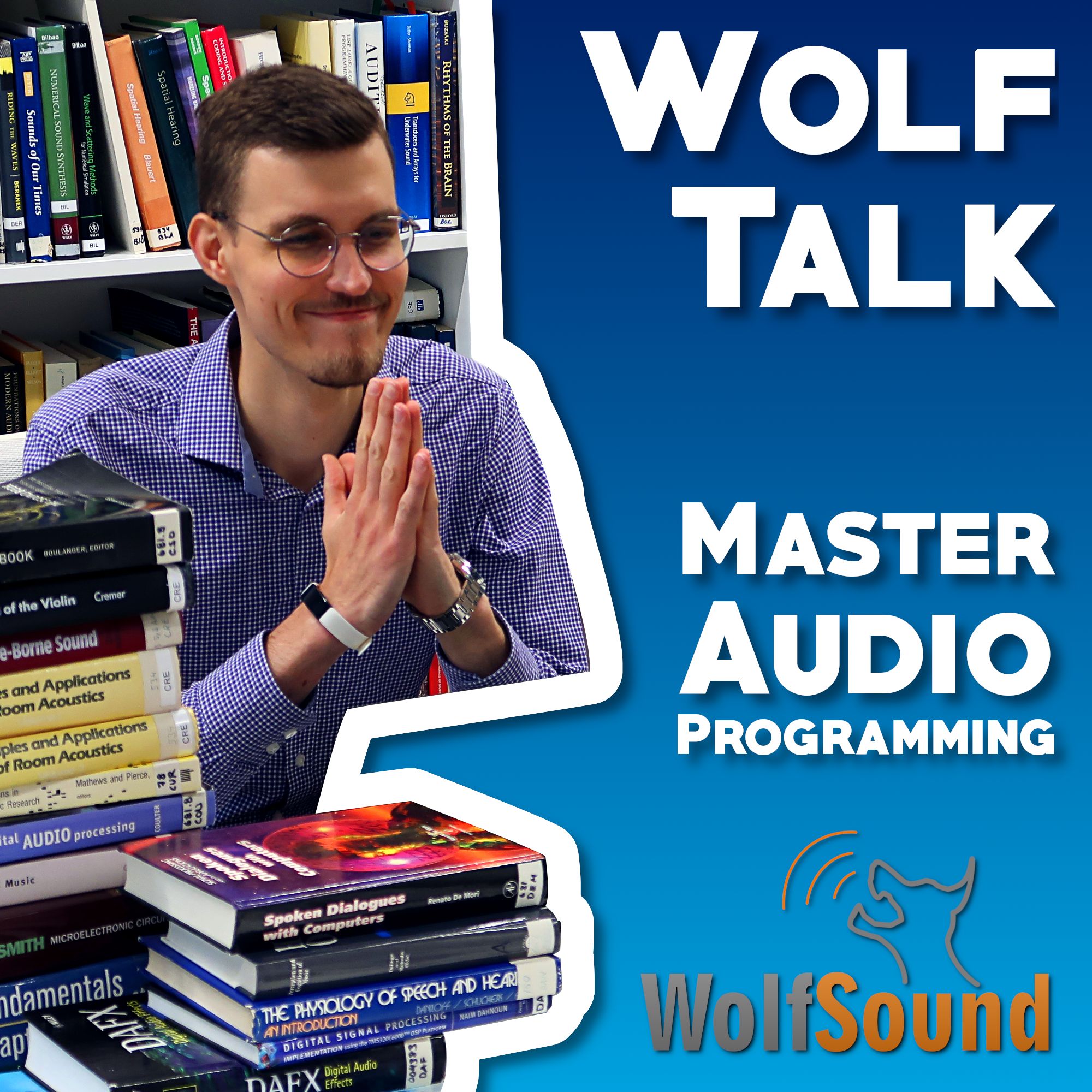
WolfTalk: Podcast About Audio Programming (People, Careers, Learning)
by Jan Wilczek
Welcome to WolfTalk, a podcast ever about audio programming. My name is Jan Wilczek. I am an audio programmer and a researcher. In this podcast you will learn how to build your career in programming or research related to audio, meet programmers and researchers from all around the world, and learn about the intricacies of sound. All resources referenced in the podcast are at www.thewolfsound.com/talkXXX, where XXX is the episode number. Don't forget to subscribe to my newsletter: https://www.thewolfsound.com/newsletter/ I sincerely hope you'll find the information here useful for your own development!
-
32
Julian Storer: Creator of JUCE C++ Framework | WolfTalk #032
Julian “Jules” Storer is the creator of the JUCE C++ framework and the Cmajor programming language dedicated to audio.He created JUCE in the late 90s, and it grew to become the most popular audio plugin development framework in the world. Apart from audio capabilities, it is a general-purpose cross-platform application development framework (Windows, macOS, Linux, Android, iOS, and embedded platforms). Most plugin companies use JUCE; whether you like it or not, it has become a de facto industry standard.You know that I love JUCE; I created the official JUCE audio plugin development course with them, and they are the sponsor of the podcast. So naturally, I was super excited to be able to interview Jules!His next big thing is the Cmajor programming language. It is a C-like, LLVM-backed programming language dedicated solely to audio.He has also given many talks at the Audio Developer Conference, so I encourage you to check them out as a way to relax and get inspired.Jules is known for his strong opinions and dry humor, so I guarantee you’ll find yourself chuckling every few minutes 😉Note: If you like the podcast so far, please go to Apple Podcasts and leave me a review there. You can do so on Spotify as well. It will benefit both sides: more reviews mean a broader reach on Apple Podcasts, and feedback can help me improve the show and deliver better-quality content to you. You can also subscribe and give a like on YouTube. Thank you for doing this 🙏Episode contents From this episode, you will learn:How Jules created the JUCE framework and distributed it initiallyHow to maintain such huge codebases as JUCEJulian’s coding principles that will make you (and me) a better devWhat problem does CMajor solve, and howWhich tools is Jules using when coding, especially when it comes to AIHis exact everyday work routines and relaxation strategies, andDoes Jules really hate CMake?This episode was recorded on January 30, 2026.00:00:00 Intro00:00:33 Introducing Jules Storer, Creator of JUCE00:02:37 Meet Jules00:03:11 How Jules Got Into Audio Programming00:04:41 University: Computing & Psychology00:05:28 Early Career00:07:46 Why Jules Built the Tracktion DAW00:11:04 Sponsor: JUCE Audio Plugin Course00:12:52 The Mackie Deal & the Birth of JUCE00:16:35 10 Years Solo: Bootstrapping JUCE00:18:59 ROLI Acquires JUCE00:20:56 How the Audio Developer Conference Began00:21:38 From ROLI to C-Major00:23:33 Cmajor: DSP Language for Any Hardware00:28:58 Cmajor Licensing & Commercial Plugins00:32:57 Cmajor Stability & AI-Written Code00:36:04 What Building a Compiler Taught Jules00:39:31 Jules' Dev Setup00:41:59 Jules' AI Coding Workflow with Claude00:47:23 Reviewing AI-Generated Code00:50:18 AI Coding: Where Jules Draws the Line00:52:22 Cmajor's Language Choice: C++, Go, and Rust00:54:36 Why Jules Hates CMake00:59:01 Clean Code: Structure, Files & Naming01:04:25 API Design Other Developers Won't Hate01:07:11 Code Review: Excess State & Verbosity01:11:35 JUCE's Inspiration from Java's JDK01:14:24 Why JUCE Dominated the Market01:15:48 Challenges with JUCE, Waveform & C-Major01:19:56 TDD and the Pain of UI Testing01:23:06 How to Start Learning Audio Programming01:26:42 Jules' Daily Routine01:31:52 How to Contact Jules01:32:42 Outro
-
31
Audio and the C++ Standard with Timur Doumler | WolfTalk #031
How do you become a C++ Standards Committee member?Why is C++ prevalent in audio?Should you still use it for audio software?Honestly, Timur Doumler is someone I have looked up to ever since I saw his “C++ in the audio industry” talk at CppCon 2015.He has a rich development history with C++ and/or audio:developer at Native Instrumentsdeveloper of the JUCE C++ framework (podcast sponsor ❤️)C++ linter developer and developer advocate at JetBrains (who make the CLion IDE)founder of Cradle, an audio plugin startupC++ Standards Committee memberCppCast podcast hostnotorious Audio Developer Conference and CppCon speakerI have probably missed a ton of stuff here, but that should already give you a flavor of what Timur is up to 😉I especially enjoy his technical talks on synchronization with the (real-time) audio thread; For example, at the Audio Developer Conference 2025, he made me finally understand memory ordering in C++ (or so I believe 😅)In the podcast interview, we discuss his story, tactics, and tips, which I hope will inspire you to follow his footsteps (as they sure did me).It also turns out we are both fond of the same music band… Listen to the interview to find out which one 😁All in all, this one of my favorite podcast episodes (audio & C++, what more do you need?), so don’t miss it!Note: If you like the podcast so far, please, go to Apple Podcasts and leave me a review there. You can do so on Spotify as well. It will benefit both sides: more reviews mean a broader reach on Apple Podcasts and feedback can help me to improve the show and provide better quality content to you. You can also subscribe and give a like on YouTube. Thank you for doing this 🙏Episode ContentsFrom this episode, you will learn:How Timur’s early interests and experiences led him toward audio programmingHis early engineering work at Native Instruments, including contributions to Kontakt and NI’s internal C++ librariesHow he joined ROLI and worked on the development of JUCEThe story behind founding CradleHow he became involved in the ISO C++ Standards Committee including his audio-related contributionsWhat he’s most excited for in the upcoming C++26 standardHow he approaches software development and maintaining a healthy work-life balance (that was a great one to learn for me personally, too)This episode was recorded on September 26, 2025.TIMESTAMPS00:00:00 Podcast Intro00:00:37 Timur Doumler00:01:55 Timur's Introduction and Background00:02:46 Early Interest in Music00:03:35 Linking Music to Software Development00:04:42 Studying Physics & Astrophysics (Berlin, Lyon, Potsdam)00:06:08 Learning C & Fortran through Cosmology Simulations00:07:46 Deciding to Become a Developer00:10:48 Getting Hired at Native Instruments00:12:16 Working on NI’s Internal C++ Libraries & Kontakt00:18:05 Sponsor: JUCE00:19:37 Moving to ROLI and Working on JUCE00:22:08 Lessons Learned from Jules & Fabian00:24:27 Joining JetBrains00:30:13 Becoming a Developer Advocate00:34:40 Founding Cradle & Building the First Products00:37:17 Life as CTO & Startup Reflections00:39:09 Bloomberg & C++ Contracts00:41:29 The 2015 Talk: C++ in the Audio Industry00:46:58 Representing the Audio Industry00:48:18 Joining the ISO C++ Committee00:50:19 Timur's Work in the C++ Committee00:55:24 How the C++ Committee Works01:02:20 How to Learn C++ Today01:06:48 Real-Time Audio Programming & Tools01:08:02 Personal Productivity: Meditation, Exercise, Time Management01:13:46 Tech Stack and Developer Tools01:14:13 Music Timur Codes To (Meshuggah, Animals as Leaders)01:17:15 How to Contact Timur01:18:59 Outro
-
30
Wave Digital Filters with Kurt Werner (Soundtoys, ex-Native Instruments, ex-iZotope) | WolfTalk #030
Kurt James Werner, PhD, is a senior research scientist at Soundtoys and one of my favorite researchers in audio DSP (virtual analog modeling in particular).While you may not have read his papers, it’s very likely that you used one of the plugins he worked on:NeoverbVinylRXGuitar Rig (Hammond vibrato/chorus)OzoneNeutronTrashIf you start peeking into the research of modeling analog audio effects in plugins, you stumble across his name right away.I consider him not only brilliant, but also insanely productive. Definitely a role model for me!In the research world, he’s mostly known for his work on Wave Digital Filters (WDFs). It’s a technique for creating a mathematical model of an analog circuit that once done is easy to implement (provided you use a WDF library).WDFs are great for modeling analog audio effects to put them inside plugins.But as a true researcher, Kurt is involved many other audio subfields that we discuss in the podcast!Did I mention that he’s a graduate from Stanford’s CCRMA?In this episode, you’ll learn about Kurt’s transition from academia to industry, his work on products at iZotope, Native Instruments, and Soundtoys, and the realities of being a research scientist in an audio plugin company.You’ll also learn all about WDFs, which is a powerful tool to master.Trust me, you don’t want to miss this one 😉Note: If you like the podcast so far, please, go to Apple Podcasts and leave me a review there. You can do so on Spotify as well. It will benefit both sides: more reviews mean a broader reach on Apple Podcasts and feedback can help me to improve the show and provide better quality content to you. You can also subscribe and give a like on YouTube. Thank you for doing this 🙏Episode Contents From this episode, you will learn:How Kurt’s early musical and DIY electronics experiments led him toward audio DSPHow was it like to study at CCRMA under Julius Smith, Jonathan Abel, and Ge WangA clear, high-level explanation of Wave Digital Filters, their origins, and why they matter in virtual analog modelingInsights from his work at iZotopeHis current work at SoundtoysCreative music practices like circuit bending and 1-bit musicWhether you need a PhD to work at an audio plugin companyHow audio research translates into pluginsTIMESTAMPS00:00:00 Podcast Intro00:00:37 Introducing Kurt Werner00:04:11 Kurt's Intro and Background00:07:20 Studying Engineering & Music at UIUC00:10:06 PhD Studies at CCRMA (Stanford)00:13:57 Structure of the PhD Program00:18:23 Sponsor: JUCE00:20:09 PhD Thesis: Wave Digital Filters00:21:26 The Culture at CCRMA00:31:44 Assistant Professor at SARC (Queen's University Belfast)00:35:59 How Teaching Influences Research00:44:19 Transition to Industry: iZotope00:49:54 The Research Team at iZotope00:52:54 Work on Neoverb, Vinyl, and Trash00:58:43 Publishing Reserach Papers01:01:35 Moving to Soundtoys01:05:12 Role and Soundtoys01:09:17 Soundtoys SuperPlate01:11:04 What are Wave Digital Filters (WDFs)?01:19:28 WDFs Before Kurt's Research01:20:54 Handling Complex Topologies01:26:56 Can Circuit Modeling be Automated?01:33:37 Importance of "Warming Up" the Simulation01:35:16 Strengths of Wave Digital Filters01:41:52 Best & Worst Circuits for WDF Modeling01:44:47 How to Approach Modeling a New Circuit01:46:47 Modeling the Motown EQ (Altec 9062A)01:52:28 Circuit Bending & Hardware Hacking01:56:58 1-Bit Music & Velvet Noise02:05:35 Deep Learning in Virtual Analog02:07:29 Do You Need a PhD for Audio Research?02:10:46 PhD for Software Engineering Roles?02:12:12 How to Learn Virtual Analog Modeling02:16:04 Productivity & Writing Research Papers02:20:04 Tools & Tech Stack02:21:29 Listening to Music While Working02:23:16 Outro
-
29
Designing Digital Musical Instruments with Victor Zappi | WolfTalk #029
Victor Zappi is a creator, researcher, and educator at the intersection of music, technology, and interaction design. He is currently an Assistant Professor of Music Technology at Northeastern University. In his career, among others, he worked on the Bela hardware platform during his time at Queen Mary University of London’s prestigious Centre for Digital Music (C4DM).In this episode, apart from Victor’s inspiring career, we focus on digital musical instruments:What is a “good” digital musical instrument like?Is it a fixed “box” that you should learn how to play?Or should it be “abused” by opening “the box,” and messing with its internals?Can an artist change the digital instrument to make it their own?We conclude with a discussion of Victor’s LDSP C++ framework, which enables low-level audio device control on Android devices.This episode is a must-listen for anyone interested in the future of musical interfaces, hackable hardware, and the technology that drives them!
-
28
Designing Music Software Architecture with Ilias Bergström
Ilias Bergström is a software engineer, researcher, and musician from Sweden. For most of his professional career, spanning over 20 years, he has been working on, as he describes it, “time-based media software.”In the audio programming world, this means digital audio workstations, video editors, and live audio-visual performance software.He generously shared his experience in Audio Developer Conference talks, two of which discuss the much underrepresented topic of the software architecture of digital audio workstations.Software architecture and software design are fascinating topics to me, so I naturally devoured both of these talks 😉In this interview, we explore not only Ilias’s journey but also go into the details of what makes audio software design hard. He discusses how he connects the dots between different types of media software through his long-running personal project, TWO, which is best described as a Media Control Workstation. It enables the simultaneous interactive combination of digital media control signals (such as OSC and MIDI) from multiple sources.Finally, we don’t shy away from discussing our favorite books on audio software development! Given that Ilias shares a ton of valuable tips and resources, you don’t want to miss this one!Note: If you like the podcast so far, please, go to Apple Podcasts and leave me a review there. You can do so on Spotify as well. It will benefit both sides: more reviews mean a broader reach on Apple Podcasts and feedback can help me to improve the show and provide better quality content to you. You can also subscribe and give a like on YouTube. Thank you for doing this 🙏Episode Contents From this episode, you will learn:How Ilias’s interest in media creation software led to a career in audio, across both research and industry.How he combines music and audio with interaction design, Human Computer Interaction, and even topics such as neuroscience and psychology, and how audio development can be seen as a form of creative coding.How different media creation software tools (like DAWs) share the same core characteristics and core architecture.Insights into his personal software project, TWO.What does a PhD give you? What can a university education offer?The importance of software architecture, testing, and documentation.A lot of audio development book recommendations.Practical advice on how to get started with audio development and audio software architecture.This episode was recorded on January 15, 2025.00:00:00 Podcast Intro00:00:34 Introducing Ilias Bergstrom00:02:15 Ilias' Background00:02:50 Getting into Music00:03:21 Developing Interest in Audio00:05:03 Masters at UCL00:07:32 Wolfsound: Learning DSP00:08:46 Starting Industry Career00:12:58 PhD at UCL00:14:24 PhD Research00:16:25 What does a PhD give you?00:18:58 Post-doc at Event Lab00:22:28 Post-doc at KTH00:24:23 Teaching Career00:25:15 What is Creative Coding?00:26:58 Back to the Industry - SCISS00:28:06 Work at SCISS on Uniview00:31:24 Elk Audio00:34:10 Sponsor: JUCE00:35:41 Future Career Plans00:36:31 TWO: Media Control Workstation00:41:08 The Development of TWO00:46:46 Opinions on Audio-Visual Performance00:48:45 Writing Large-Scale Software00:51:08 Software Design in Freelance Projects00:53:40 Software Architecture00:58:53 Architecture of Time-Based Media Software01:01:24 Architecture of Digital Audio Workstations01:03:00 Documenting Software Architecture01:07:53 Book Recommendations01:16:41 Learning Suggestions01:19:24 Final Quick-Fire Questions01:24:42 Connecting With Ilias01:27:00 Outro
-
27
Reverbs, Pitch Shifters & Freelancing with Geraint Luff | WolfTalk #027
Geraint Luff is a seasoned audio DSP developer and the founder of Signalsmith Audio. Geraint’s presentations, such as “Let’s Write a Reverb” and “Four Ways to Write a Pitch Shifter,” are among the most popular talks at the Audio Developer Conference (ADC) thanks to Geraint’s clarity of explanation and easy-to-understand visuals (not to mention the accompanying open-source repos).In the interview, Geraint shares his insights on his career path, freelancing in the audio industry, and digital signal processing (DSP). He discusses how he gained traction as a freelancer by joining a community, delivering audio-focused technical talks, and sharing open-source repos. We can also learn his approach to learning DSP, problem-solving, and the significance of visualization in explanations.Theory first of practice first? Listen to the podcast episode to find out! 😉Note: If you like the podcast so far, please, go to Apple Podcasts and leave me a review there. You can do so on Spotify as well. It will benefit both sides: more reviews mean a broader reach on Apple Podcasts and feedback can help me to improve the show and provide better quality content to you. You can also subscribe and give a like on YouTube. Thank you for doing this 🙏00:00:00 Podcast Intro00:00:38 Introducing Geraint Luff00:03:30 Geraint's Introduction00:04:14 Early Interest in Music & Programming00:05:53 Learning DSP: Asking Dad About MP3s00:06:50 University Studies: Maths at Cambridge00:08:25 First Job (Meridian Audio) & 2009 Crash00:10:36 Experience at Amazon00:12:26 Hobby Audio Effects Projects00:13:15 Transferable Skills from Non-Audio Roles00:15:49 Transitioning to Audio DSP Freelancing00:19:17 The Importance of Community00:21:01 Landing the First Freelance Gig00:21:28 Geraint's Learning Approach00:22:21 DSP Design Philosophy00:23:18 Creating the "Let's Write a Reverb" ADC Talk00:24:30 Sponsor Break: JUCE00:26:09 Geraint's Path as a Recipe for Others00:28:20 Approach to Talks & Teaching00:34:38 Story Behind "Four Ways to Write a Pitch Shifter"00:39:59 The Open Source signal_smith::stretch Library00:41:51 Creating Visuals for Talks00:44:46 Overview of Freelance Projects00:48:26 Freelancing Challenges & Realities00:49:45 Experience with KVR Developer Challenge00:50:19 Value of Specialization in Freelancing00:56:25 Using WebAssembly for DSP Demos01:01:05 Approach to Reading Academic Papers01:04:32 Learning Style: Creating from Scratch01:05:38 Thoughts on Deep Learning01:06:43 Testing and Verifying DSP Code01:10:06 Current Tech Stack01:16:52 Getting Started in Audio Programming01:19:00 Advice for Starting Freelancing01:20:22 Quick Fire Questions01:24:45 Final Thoughts & How to Connect01:26:03 Pocast Outro
-
26
Reverb, Spatial & Immersive Audio with Orchisama Das | WolfTalk #026
Orchisama Das is an outstanding audio researcher known for her work in virtual acoustics, artificial reverberation, and immersive audio. She holds a PhD from Stanford University’s prestigious CCRMA and has contributed to groundbreaking research at leading universities and major tech companies.During this interview, we talk about her path in academia and industry. Orchisama shares her thoughts about the realities of audio research, offering great insights and a very frank and honest perspective on her journey.We dive into technical topics such as artificial reverberation, virtual acoustics, immersive audio, and open problems in DSP, as well as topics like the gender imbalance in the audio research industry and how to stay productive and motivated during research.The episode is scattered with many resources and tips for anyone interested in learning the mentioned topics. It is a very inspiring and informative talk for people who are doing audio research, or curious about getting started.Note: If you like the podcast so far, please, go to Apple Podcasts and leave me a review there. You can do so on Spotify as well. It will benefit both sides: more reviews mean a broader reach on Apple Podcasts and feedback can help me to improve the show and provide better quality content to you. You can also subscribe and give a like on YouTube. Thank you for doing this 🙏Episode contentsFrom this podcast, you will learn:How Orchisama Das started her journey in audio research and her path to earning a PhD at Stanford University’s CCRMA.About her internships at Tesla and Meta Reality Labs, as well as tips and advice on how to get internships as a researcher.A big picture technical overview of artificial reverberation, virtual room acoustics, and immersive audio.Resources for learning about these topics, including books, papers, and tools.Tips and advice for a good research carrer.Her thoughts on the gender imbalance in audio research and ways to address it.This episode was recorded on November 21, 2024.00:00:00 Podast Intro00:00:38 Orchisama Das00:02:34 Wolfsound: DSP Pro00:04:33 Orchisama's Background and Introduction00:05:17 Early Interest in Music00:06:25 From Electronics to Music Technology00:10:45 Applying to PhD Programs00:12:01 PhD Research at CCRMA00:20:45 Sponsor: JUCE00:22:26 Internships at Tesla and Meta00:27:10 Postdoc at the University of Surrey00:31:27 Moving to Industry: Sonos00:36:34 Back to Academia: King's College00:40:44 Artificial Reveberation00:56:49 Spatial Audio01:01:29 Machine Learning for Audio DSP01:04:43 Tools and Technology Stack01:07:29 Personal Audio Plugin Projects01:09:08 Productivity Habits for Researchers01:11:24 Book Recommendations01:13:10 Focus Music01:14:04 Do You Need a PhD for Industry Research?01:15:25 'Women at Sonos' Resource Group01:17:01 Gender Diversity in the Audio Industry01:18:36 Comparing Research Institutes01:20:41 Composing and Performing Music01:23:23 Connecting with Orchisama01:25:06 Outro
-
25
Generating AI Music with Julian Parker (Stability AI, ex-TikTok, ex-Native Instruments) | WolfTalk #025
Julian’s career is incredible: from natural sciences through a master’s in physical modeling, a PhD in virtual analog modeling, an almost decade-long position at Native Instruments, all the way to TikTok and Stability AI, where he’s working now on generative music algorithms.There are few people who have such a rich background in audio research and industry and even fewer who are willing to share the details of it publicly. That makes this episode all the more exciting!Note: If you like the podcast so far, please, go to Apple Podcasts and leave me a review there. You can do so on Spotify as well. It will benefit both sides: more reviews mean a broader reach on Apple Podcasts and feedback can help me to improve the show and provide better quality content to you. You can also subscribe and give a like on YouTube. Thank you for doing this 🙏Episode contents From this podcast, you will learn:how machine learning forever changed audio plugin design and developmenthow big audio plugin companies operate internallyhow to learn C++ for audio programmingwhether you need to have a PhD to work in an R&D department of an audio companywhat is the state of the art in generative musichow to learn generating music with AIhow to be able to focus on research papers even if you read them after hourshow to produce quality researchhow to rest & recharge after intense and focused work
-
24
Successful Audio Plugin Freelancing with Jatin Chowdhury (ChowDSP) | WolfTalk #024
Jatin Chowdhury is quite well known in the audio programming community for his numerous contributions:various open- and closed-source audio plugins,a few published research papers on Virtual Analog modeling,a few audio-related talks, especially at the Audio Developer Conference,insightful Medium articles on creating audio software in general,significant open-source contributions including the CLAP plugin standard and Surge Synthesizer.The list could go on on and on but you get the point: he’s both incredibly productive and highly successful while being very generous to the community with his knowledge.That’s why it was amazing to have him on the podcast!Jatin currently leads his own audio plugin company ChowDSP which provides consulting and contracting as well.During the podcast we discuss his story (which is a kind of “from hero to superhero” tale, if you ask me…), what he learnt along the way, all his current strategies, and most importantly: how you can become someone like a Jatin, a successful audio plugin developer and freelancer.I was incredibly inspired during the recording of this episode and revisiting it brought up those feelings again.⚠️ WARNING ⚠️ Listening to this podcast episode will leave you highly motivated to do more audio programming. Listen at your own risk.Note: If you like the podcast so far, please, go to Apple Podcasts and leave me a review there. You can do so on Spotify as well. It will benefit both sides: more reviews mean a broader reach on Apple Podcasts and feedback can help me to improve the show and provide better quality content to you. You can also subscribe and give a like on YouTube. Thank you for doing this 🙏Episode contents From this podcast episode, you will learn:how Jatin developed his interest in all things music,how he got accepted to CCRMA at Stanford and then to Tesla,how he started freelancing as an audio programmer,how he finds clients,what’s his developer setup,which tools he’s using,resources he recommends for learning audio programming and DSP,personal daily routine for optimal productivity.This episode was recorded on June 14, 2024.
-
23
Building DAW Software with Dave Rowland (Tracktion, Prism Sound) | WolfTalk #023
Dave Rowland is the CTO of Audio Squadron: a group of audio-related companies. More specifically, he’s the architect and the lead developer of the Waveform digital audio workstation (DAW) and an Audio Manager of Prism Sound (which focuses on audio hardware manufacturing). He’s also a very successful speaker, having given talks at conferences like Audio Developer Conference or C++ on Sea.Given the popularity of Dave’s talks and his 11-year long (as of 2024) experience in developing the Waveform DAW and its open source engine, I am incredibly excited to have him on the WolfTalk podcast.During the interview, we learn not only Dave’s story but we also discuss the challenges of building real-time audio software including DAWs and learning C++, software architecture, and high-performance real-time programming concerning audio. Dave shares a ton of highly useful tips and resources so you don’t want to miss out on this one!Note: If you like the podcast so far, please, go to Apple Podcasts and leave me a review there. You can do so on Spotify as well. It will benefit both sides: more reviews mean a broader reach on Apple Podcasts and feedback can help me to improve the show and provide better quality content to you. You can also subscribe and give a like on YouTube. Thank you for doing this 🙏Episode contents From this podcast episode, you will learn:how Dave organizes his day for maximum productivity,which tools he’s leveraging on the day-to-day basis,how he went from being a music technology student to a freelance audio developer to the lead developer on the Tracktion DAW (now Waveform),how he approaches creating his widely acclaimed conference talks,which resources to use to learn high-performance real-time programming.This podcast was recorded on March 25, 2024.
-
22
Audio C++ Architecture, Optimization & Best Practices With Gustav Andersson | WolfTalk #022
Gustav Andersson is a Swedish senior C++ audio developer at Elk Audio. He has worked on their Sensus guitar featuring a rich set of controls, Elk Audio OS for embedded platforms, Sushi digital audio workstation, and Elk Live software for live music collaboration over the internet.Having studied Electrical Engineering and Digital Signal Processing, Gustav had been looking for a very long time to get into the audio industry. As for many developers, getting his first audio-related job was like a dream come true.In his free time, Gustav plays and composes his own music.In the interview, we discuss Gustav’s story, his journey to learn audio programming in C++, and his software projects, including his own plugin. We don’t shy away from software engineering details and architectural challenges of complex software like DAWs.We mention a ton of resources and tips for learning real-time & scalable audio C++, so stay tuned for these!Note: If you like the podcast so far, please, go to Apple Podcasts and leave me a review there. You can do so on Spotify as well. It will benefit both sides: more reviews mean a broader reach on Apple Podcasts and feedback can help me to improve the show and provide better quality content to you. You can also subscribe and give a like on YouTube. Thank you for doing this 🙏Episode contents From this podcast episode, you will learn:How Gustav’s interest in music and electronics led him to study digital signal processing,How he landed his first (and last) job in the audio industry,What he needed to learn from C++ for audio programming and which resources he used,What are the challenges of building digital audio workstations,How to approach building audio software in general,How to learn C++ optimization (fast!),How to relax and disengage from focused work 😎This podcast was recorded on January 30, 2024.
-
21
How To Master Real-Time Audio C++ With Fabian Renn-Giles | WolfTalk #021
In this podcast episode, I was delighted to be able one of the most prominent people of the audio developer landscape: Fabian Renn-Giles.Fabian is a former lead developer of JUCE, currently working as an independent contractor. He has worked with many great companies (e.g., iZotope, Behringer) and has an incredible portfolio. He is regarded as an expert of real-time, low-latency C++ audio programming.You may know him from his talks at the Audio Developer Conference or at CppCon.He’s also an incredibly kind and modest person; anyone that I’ve talked to about Fabian only had praise for his skills and his very down-to-earth attitude.In the light of all the above, this interview is a real treat for everyone who’d like to become a real-time audio C++ expert!Note: If you like the podcast so far, please, go to Apple Podcasts and leave me a review there. You can do so on Spotify as well. It will benefit both sides: more reviews mean a broader reach on Apple Podcasts and feedback can help me to improve the show and provide better quality content to you. You can also subscribe and give a like on YouTube. Thank you for doing this 🙏Episode contents In this podcast episode, you will learn:how Fabian self-taught himself programming at the age of 6 (sic!),how he co-founded Fielding DSP, which serves as his professional outlet for programming services,how he became the lead developer of the JUCE C++ framework and what he learned from it,how to learn real-time audio C++ programming even if you are just starting out,how to become a freelance audio developer like Fabian (what you won’t learn at a university),how to optimize your audio code for maximum performance,the secret story of the “Real-Time 101” talk that Fabian did together with Dave Rowland and which is one of the most widely cited talks in the audio programming space,what are the issues in audio software architecture and how to conceptualize them,what are Fabian’s day-to-day programming tools for optimal productivity.This episode was recorded on January 26, 2024.
-
20
How To Learn Audio Signal Processing And Audio Circuit Modeling With Eric Tarr | WolfTalk #020
Eric Tarr is a professor at the Belmont University where he teaches Audio Signal Processing. In the audio programming community, he’s most famous for his book “Hack Audio” on the basics of digital signal processing using Matlab and his point-to-point modeling library for analog audio circuit emulation.Eric’s work has definitely been an inspiration for starting the WolfSound blog and the YouTube channel so it’s really exciting to have him on the show!In the podcast, we’ll delve into his story, how he learned audio signal processing, how he managed to work with some amazing audio companies (Sennheiser, Epic Games, Skywalker Sounds), and top tips on how to learn DSP coming from Eric’s teaching experience. We also discuss in detail how to model analog audio circuits for audio plugins (so called virtual analog modeling). Here, Eric describes which state-of-the-art methods are available and how you can learn them. He also shares the details of this point-to-point modeling library which allows you to easily emulate analog audio circuits.As a special feat, I’d asked my coachees who follow Eric’s work to provide questions to him concerning a variety of different topics, including the impact of AI on the virtual analog modeling space.All in all, it’s an episode that you don’t want to miss!Note: If you like the podcast so far, please, go to Apple Podcasts and leave me a review there. You can do so on Spotify as well. It will benefit both sides: more reviews mean a broader reach on Apple Podcasts and feedback can help me to improve the show and provide better quality content to you. You can also subscribe and give a like on YouTube. Thank you for doing this 🙏Episode contents In this podcast episode, you will learn:how Eric learned digital audio signal processing based on his passion for music and electronics,how he became a professor for Audio Engineering Technology at the Belmont University,how he wrote the famous “Hack Audio” book,why he uses Matlab instead of Python in his teaching,how he was able to deliver numerous audio-related projects to various companies worldwide,how he developed his point-to-point audio circuit modeling library,how you can learn digital signal processing (even if you’re just starting out),what is the go-to language and technology stack for creating commercial audio products,what are the state-of-the-art methods to model analog audio circuits,is it worth going to the Audio Developer Conference?This episode was recorded on January 19, 2024.
-
19
How To Secure Your Audio Code Using Rust With Chase Kanipe | WolfTalk #019
In this podcast episode, I was lucky to interview Chase Kanipe: a cybersecurity professional, a musician, and an audio programmer (formerly C++ with JUCE, currently Rust). Chase is most widely known through his incredible Audio Developer Conference talks:Tips From a Hacker on License Checking at ADC22Writing Elegant DSP Code with Rust at ADC23 (to be released soon)Both were really insightful and of incredibly high quality. One could not overlook Chase’s personal culture and the depth with which he explained the concepts. Not to mention that both of his talks made it into my “Top 10 ADC Talks” videos for both ADC22 and ADC23!Chase is currently pursuing a master’s degree in Machine Learning at the University of Maryland. At the same time, he’s working on his breakthrough audio project in a self-grounded company Procedural Audio.In the podcast, we discuss his path of being a classically trained musician, a passionate cybersecurity specialist, and then transitioning into audio programming with Rust and into AI. He’s an incredibly inspiring individual and I have learned a lot from interviewing him!Note: If you like the podcast so far, please, go to Apple Podcasts and leave me a review there. You can do so on Spotify as well. It will benefit both sides: more reviews mean a broader reach on Apple Podcasts and feedback can help me to improve the show and provide better quality content to you. You can also subscribe and give a like on YouTube. Thank you for doing this 🙏Episode contents In this podcast episode, you will learn:Should an audio programmer learn assembly?What every audio programmer should know about cybersecurityMost common types of vulnerabilities in audio pluginsShould you use Rust instead of C++ for audio projects?How to optimize your audio code?Best resources on learning: cybersecurity, digital audio signal processing, Rust, and assembly.Music for optimal programming productivity 💪This episode was recorded on January 3, 2024.
-
18
How To Transition From Live Sound To Freelance Audio Programming With Ruurd Adema | WolfTalk #018
In this podcast episode, I was lucky to interview Ruurd Adema: a freelance audio developer from the Netherlands working primarily in JUCE and C++ (but not only).I met Ruurd at the Audio Developer Conference 2023 and I believe his story is incredibly inspiring; he went from being a live sound engineer doing front-of-house (FOH) mixing at the biggest events in the Netherlands to contracting as a freelance audio developer.In the interview, he shares his story and a ton of useful resources and tips to help others follow his footsteps.If you’re looking for inspiration and a clear learning path to become an audio developer this is an episode for you!Note: If you like the podcast so far, please, go to Apple Podcasts and leave me a review there. You can do so on Spotify as well. It will benefit both sides: more reviews mean a broader reach on Apple Podcasts and feedback can help me to improve the show and provide better quality content to you. You can also subscribe and give a like on YouTube. Thank you for doing this 🙏Episode contents In this podcast episode, you will learn:how Ruurd become a mixing engineer of one of the largest live shows in the world,the secret to mixing it right 😉how he started learning audio programming on the side (and how you can too),how he successfully launched his freelance audio dev career by taking 5 (sic!) projects at once,top resources to learn audio programming on your own,top tools to use in audio software development,how to find new clients in freelance audio programming, andhow to structure your workday for maximum programming productivity. 🚀This episode was recorded on December 13, 2023.
-
17
How Can a Mixing Engineer Become an Audio Programmer with Linus Corneliusson | WolfTalk #017
In this podcast episode, I was very pleased to guest Linus Corneliusson: a mixing engineer and editing assistant at Fascination Street Studios who has shifted towards audio plugin development.I met Linus (and his colleague Jacek) at the Audio Developer Conference 2022 and he’s definitely one of the most friendly and funny people in the community. What is even more amazing, he’s worked in the studio with top-notch heavy metal bands, like James LaBrie, Soilwork, DragonForce, Haken, Leprous, Dark Tranquility, Between the Buried and Me, and Fates Warning (basically most of the major names in the progressive metal genre).In the podcast, we discus how Linus started creating simple audio plugins on the side which led him to pursuing a full-blown career as an audio programmer for Bogren Digital. We also discuss tools, tips, and resources he used and recommends for starting in audio programming.Are you a mixing engineer looking for a way to transition into audio development? Are you seeking advice on which path to take and which resources are the best to reach out for? Do you need inspiration and motivation? Then this episode is for you!Note: If you like the podcast so far, please, go to Apple Podcasts and leave me a review there. You can do so on Spotify as well. It will benefit both sides: more reviews mean a broader reach on Apple Podcasts and feedback can help me to improve the show and provide better quality content to you. You can also subscribe and give a like on YouTube. Thank you for doing this 🙏Episode Contents In this podcast episode, you will learn:how Linus started his studio career and ended up working with the top metal bands 🤟 in the industryhow a mixing engineer can start writing their own plugins 🎚️how Linus decided to pursue the audio programming path and which resources he usedwhat are the tools he’s using day-to-dayis the Audio Developer Conference worth going to (spoiler: it is but find out why 😉)This episode was recorded on November 29, 2023.
-
16
Rust Audio Programming with Ian Hobson | WolfTalk #016
For this podcast episode, I was lucky to interview Ian Hobson: a former DJ who transitioned to audio programming, worked at Ableton, and then launched a successful freelancing career.Ian is well-known in the community for his talks on Rust at the Audio Developer Conferences and on YouTube. He’s also created his own programming language: Koto.We met at the Audio Developer Conference 2022 and he was kind enough to agree on recording an interview with him. I must say that after recording the podcast, I respect his drive to continuously learn and improve even more!Ian shares a ton of useful knowledge onfreelancing,Rust for audio programming,learning Rust,self-organization,learning DSP,maintaining the internal drive in the professional career,and more!I highly encourage you to listen to the podcast in full!Note: If you like the podcast so far, please, go to Apple Podcasts and leave me a review there. It will benefit both sides: more reviews mean a broader reach on Apple Podcasts and feedback can help me to improve the show and provide better quality content to you. Thank you for doing this 🙏Episode Contents In this podcast episode, you will learn:how Ian got into DJ-ing and how he then went back to the univerisity to become an audio programmerhow he landed his job at Abletonwhy he started exploring Rust for audiowhy is Rust more programmer-friendly than C++how to become a freelancer in the audio programming spacehow to stay organized as a freelancerwhat is Ian’s go-to tech stack at the moment.The episode was recorded on November 3, 2023.
-
15
Oli Larkin: Creator of iPlug2 and Web Audio Modules | WolfTalk #015
In this podcast episode, I was lucky to interview Oliver Larkin: an audio programming legend from the UK.Starting with a passion for music, going through Max, SynthEdit, PureData, then C++ to JavaScript and others, there is no audio technology that's not known to him. He has worked on projects with Arturia and Focusrite (among many more) and nowadays works for Ableton. He has conducted research in spatial audio, and has created successful plugins, like the Casio CZ-101 synthesizer emulation.He is most widely known as the co-author of Web Audio Modules and iPlug2: an C++ framework for creating audio plugins and web-hosted audio apps. It allows you to have a single codebase that builds various plugin formats out of the box, e.g., VST, AAX, and AU. Sounds familiar? That's because it is an alternative to the JUCE framework.With 20 years of experience in audio programming, he can be a role model for aspiring audio programmers.All this and more, including Oli’s learning path is discussed in this podcast episode!Note: If you like the podcast so far, please, go to Apple Podcasts and leave me a review there. It will benefit both sides: more reviews mean a broader reach on Apple Podcasts and feedback can help me to improve the show and provide better quality content to you. Thank you for doing this 🙏Episode Contents In this podcast episode, you will learn:how Oli has learned audio programming thanks to his passion for musichow his carreer path unfolded from the university up until today when he’s working full-time for Ableton in Berlinhow he collaborated with Plugin Boutique at its very starthow he came up with the idea of iPlug2 and what are the challenges involvedhow he came across the idea of Web Audio Modules and helped develop them furtherhow to be a successful freelancer in the field of audio programminghow indie developers can make their audio plugins successfulwhat’s his tech stackbest resources on learning music DSP
-
14
Web Audio Programming Basics With Christoph Guttandin | WolfTalk #014
In this podcast episode, I was lucky to interview Christoph Guttandin: a web audio developer from Berlin, Germany.Chris is a self-taught programmer with a formal training as an audio-visual technician. He’s a freelancer who deals with playing back sound in the browser, sometimes on multiple computers simultaneously. He’s a member of the W3C Audio Community Group where he gives feedback regarding the new standards. He’s especially careful about the compliance of browsers to standard updates. He regularly answers questions regarding web audio on StackOverflow. He was a speaker at the Audio Developer Conference 2022.In the podcast, we not only discuss his background and his story of how he became a web audio developer but we also uncover how you can become one. I specifically ask him about the best resources on web audio programming and which languages, tools & frameworks to use.Note: If you like the podcast so far, please, go to Apple Podcasts and leave me a review there. It will benefit both sides: more reviews mean a broader reach on Apple Podcasts and feedback can help me to improve the show and provide better quality content to you. Thank you for doing this 🙏Episode ContentsIn this podcast episode, you will learn:how Christoph learn web audio programming and how he started his freelancing careerwhich resources he recommends for learning web audio programmingwhich languages, libraries & frameworks to use best, if you want to start coding audio in the browser (it’s not JavaScript!)what are the challenges of audio synchronization on the webhow to ensure that your audio code behaves the same across all browsershow web audio standards are developed and implemented
-
13
How To Create Accessible Audio Software With Jay Pocknell | WolfTalk #013
In this podcast episode, I was lucky to interview Jay Pocknell; a production and mixing engineer from the UK.Not only is he a skilled sound engineer and a lovely person to talk to but also a proactive member of the audio community. He founded the Sound Without Sight organization and currently works at the Royal National Institute of Blind People (RNIB) advocating for music software, music hardware, and music instruments accessible to everyone: including musicians and sound engineers with disabilities.Basing on his lived experience with sight loss, he gives invaluable advice on how any audio programmer can make their software accessible. This is a gold mine of first-hand information!In the podcast episode, we discuss his path to becoming a sound engineer, which obstacles he needed to overcome, and how we as the audio community can remove some of these obstacles permanently.Note: If you like the podcast so far, please, go to Apple Podcasts and leave me a review there. It will benefit both sides: more reviews mean a broader reach on Apple Podcasts and feedback can help me to improve the show and provide better quality content to you. Thank you for doing this 🙏Episode ContentsIn this podcast episode, you will learn:how Jay became a sound engineer,how he came up with the idea to start the Sound Without Sight organization,what is the Royal National Institute of Blind People (RNIB) and how they invite industry collaborations for an accessible music experience for everyone,why you should even consider making your software accessible (hint: 💵),how audio developers can make their software accessible,how to test the accessibility of your software,what are typical difficulties of musicians and sound engineers with blindness or partial blindness,how Audio Developers Conference 2022 tackled the issue of accessibility and how ADC23 can improve upon it.This podcast was recorded on April 5, 2023.
-
12
Meinard Müller: Professor in Music Information Retrieval | WolfTalk #012
In this podcast episode, you will learn:how Meinard Müller became a professor for Music Information Retrieval at AudioLabs in Erlangen,what are AudioLabs and how they relate to Fraunhofer IIS and the University of Erlangen-Nürnberg,how professor Müller approaches doing teaching and research in his research group,how to learn doing research and how to collaborate with your supervisor (for master thesis, PhD thesis, or other research work),how to mentor your students,what is the book “Fundamentals of Music Processing” about and how did the process of writing it look,how to tackle huge projects,what is a professor’s day-to-day life like,what is music information retrieval and how did the AI/deep learning revolution influence it.
-
11
How To Run Your Neural Networks in an Audio Plugin with Andrew Fyfe | WolfTalk #011
In this episode, I was honored to interview Andrew Fyfe; a musician, a software engineer, and a researcher in the field of deep learning applied to audio.In particular, Andrew is working on an exciting new technology, Neutone. Neutone allows quick deployment of trained neural networks to audio plugins and running them in the digital audio workstation for verification, testing, up to full-blown product releases for users.At the same time, Andrew is wrapping up his PhD while working full time from Japan. He was kind enough to share his story and his journey to becoming an audio researcher.Don’t forget to submit your plugins for the Neural Audio Plugin Competition until March the 17th of 2023!Note: If you like the podcast so far, please, go to Apple Podcasts and leave me a review there. It will benefit both sides: more reviews mean a broader reach on Apple Podcasts and feedback can help me to improve the show and provide better quality content to you. Thank you for doing this 🙏Episode ContentsIn this podcast episode, you will learn:how Andrew learned audio processing and became an audio researcher after a successful rock band musician career,how he explored AI for music creation in his PhD,what is Neutone about and how to use it to deploy trained neural networks from PyTorch to audio plugins,what is Neural Audio Plugin competition,how is living and working in Japan for a person from the UK.Episode notes: https://thewolfsound.com/talk011/
-
10
How To Process Sound On The GPU With Sasha Talashov And Jonathan Rowden From GPU Audio | WolfTalk #010
In this episode, I was lucky to interview two members of GPU Audio: Jonathan Rowden and Alexander “Sasha” Talashov.GPU Audio is a software company that promises to deliver real-time audio processing capabilities to GPUs in the form of an easily usable Software Development Kit (SDK). It’s their goal to allow audio programmers to utilize the power of all GPU cores for faster and more performant audio processing.If you are interested in why it is not easy to process audio on the GPU and how it can be done, then this episode is for you!Don’t forget to submit your impulse response for their IR Competition until February 23, 2023!Note: If you like the podcast so far, please, go to Apple Podcasts and leave me a review there. It will benefit both sides: more reviews mean a broader reach on Apple Podcasts and feedback can help me to improve the show and provide better quality content to you. Thank you for doing this 🙏Episode ContentsIn this podcast episode, you will learn:how was GPU Audio conceived,why typically GPUs are not used in audio plugins,why previous approaches to GPU audio processing haven’t been widely successful,how GPU Audio’s solution handles the main problems of GPU processing,how one can learn about GPU processing in general,how you can help test their software and possibly win cool prizes in their IR competition.
-
9
From Audio Research To Own Audio Software Company With Stefano D’Angelo (Orastron, Ex-Arturia) | WolfTalk #009
In this episode, I was incredibly excited to interview Stefano D’Angelo: a freelancer in the field of audio programming.Episode notes: https://thewolfsound.com/talk009Stefano comes from Italy and is well known in the field. He’s completed his PhD thesis at the Acoustics Lab of the Aalto University, then worked for Arturia for some time, and then decided to start his own freelance gig, which eventually led to him grounding the Orastron company. During this time, he’s been incredibly active in the programming field as well as in the research field.Many WolfTalk listeners ask “how to become an audio programming freelancer?”Well, in this podcast episode, you will learn a way of how this could be done 😉Episode ContentsIn this podcast episode, you will learn:how Stefano pursued his interest in music to eventually become an audio programmer and a researcher,how developing audio software at Arturia looks like,what challenges must audio programming freelancers overcome,how to “productify” your audio programming expertise,what is the Brickworks library about,how to approach the development of novel audio products,how does work in an R&D department at a company differs from research work at the university,what are the challenges when it comes to creating virtual analog plugins,useful tools for audio research and programming,how do the Digital Audio FX conference and the Audio Developers Conference compare.
-
8
Building Audio Teams and Audio Products with Prashant Mishra | WolfTalk #008
In this episode, I was fortunate to interview Prashant Mishra, an Audio Director who is now building audio products and creating awareness about audio tech and game audio.Prashant is an audiophile who has worked as an Audio Director for educational games and videos in collaboration with Disney to create IP-specific sonic experiences, during which he created voice based apps. He helped in setting up and scaling the sound department at an India-based ed-tech since 2015 for their entire catalogue of projects.He is now building audio products with companies such as Soundly, and hosts games, spatial & interactive audio training sessions.Episode ContentsIn this podcast episode, you will learn:how Prashant went from Mechanical Engineering to audio production, to managing audio teams, and to building audio products and educating others,how Prashant cooperated with various brands, for example, Disney, with regard to sound,what is sound design and how it differs from technical sound design,what is important in managing audio-related teams of musicians, developers, and related,what tools you can use to speed up your audio workflow (as a solo producer or in the team),how you can become a technical sound designer,how Audio Developers Conference 2022 in London turned out 😄
-
7
Spatial Audio Basics with Dr Tom McKenzie | WolfTalk #007
In this episode, I was fortunate to interview Dr Tom McKenzie, a researcher in the field of spatial audio and acoustics and a musician, who is currently working at the University of Edinburgh as a lecturer in Acoustics and Architectural Acoustics.At the time of the interview (November 2021), Tom was a postdoctoral researcher at the Aalto Acoustics Lab at the Aalto University in Finland.He was the last member of the lab interviewed by me. Previous interviews included:Leonardo Fierro,Jon Fagerström, andAlec Wright.Please, if you are enjoying the podcast, leave it a review on Apple Podcasts.And if you’re looking for a simple checklist on what is needed to start writing code to process sound, download my free audio plugin developer checklist!Many thanks to Aalto Acoustics Lab for letting us record this interview in their office.Episode ContentsIn this podcast episode, you will learn:What are ambisonics?What is spatial audio?What are 6 degrees of freedom (6DoF)?What is important in spatial audio for a realistic impression?What is cross-talk cancellation?How does individualization look in virtual reality?
-
6
How Can a Musician Become an Audio Programmer with Moritz Schaller | WolfTalk #006
In this podcast episode, I had the privilege to interview Moritz Schaller: a professional musician who turned programmer and successfully transitioned into a software engineering position. Moritz is a colleague of mine from Loudly GmbH. Not only is he a skilled and smart programmer but also a great person who is extremely likeable. I am sure that if you are considering a change in your career paths, Moritz’s story and tips will provide you with inspiration and guidance on how to do this.
-
5
How to Build Your Own Audio Hardware Company with Steve Barile | WolfTalk #005
In this podcast episode, I was happy to interview Steve Barile from Conductive Labs. Steve was a 9-5 employee of Intel, until he and his best friend Darryl, started experimenting with building their own audio hardware. First prototypes led to concrete product ideas, which led to a crowdfunding campaign, which led to founding a successful business... but let's listen to him tell the story!In this podcast episode, you will learn:✅ how to start making your own music hardware, for example, hardware synthesizers,✅ where to get product ideas from,✅ how to go about validating your product in the market,✅ where to look for manufacturers,✅ recommended resources for building audio hardware.Special thanks from Steve to the Conductive Labs crew:Jesse, Cantrell, Paul, Nick, Ben, Chuck, Blake, Shashi, Kelly & SOs: Joyce and LisaEpisode notes: https://thewolfsound.com/talk005
-
4
Deep Learning for Virtual Analog Modeling with Alec Wright | WolfTalk #004
In this podcast episode, I was lucky to interview another member of the Aalto Acoustics Lab of the Aalto University in Espoo, Finland. He is involved in research applying deep learning to audio, for example, in the context of Virtual Analog modeling of guitar amplifiers. He was also the advisor of my Master Thesis. In this podcast episode, you will learn ✅ how to transition from mechanical engineering to audio processing, ✅ how to apply deep learning to music processing, for example, virtual analog modeling, ✅ challenges of deep learning in audio, ✅ how to use neural networks in real-time audio, ✅ what makes a good audio dataset, ✅ how to fuse traditional DSP and deep learning, ✅ typical neural network architectures in audio, ✅ generative models in audio, ✅ how transition from the Master's to the PhD mindset, ✅ challenges of remote research collaboration during pandemic, ✅ transition from Scotland to Finland. You can find all referenced resources at https://www.thewolfsound.com/talk004/ 📝 Note: if you like the podcast so far, please, go to iTunes and leave me a review there. It will benefit both sides: more reviews means more outreach on iTunes and feedback can help me to improve the show and provide better quality content to you. Thank you for doing this 🙏 All podcast episodes: https://www.thewolfsound.com/podcast/ Buy a coffee if you want to support this podcast: https://www.buymeacoffee.com/janwilczek Sign up for the WolfSound newsletter to master audio programming: https://thewolfsound.com/newsletter/
-
3
Challenges Of Beginner Audio Researchers & How To Overcome Them With Jon Fagerström | WolfTalk #003
In this podcast episode, I was lucky to interview another member of the Aalto Acoustics Lab of the Aalto University in Espoo, Finland. Jon Fagerström is conducting his PhD research in the domain of audio signal processing, specifically, sampling synthesis and artificial reverberation. We are discussing what challenges beginning researchers face, how to find your niche in audio research, and what interesting ways there are to end up as an audio researcher. Episode notes: thewolfsound.com/talk003.
-
2
How To Start a Career In Audio Research With Leonardo Fierro | WolfTalk #002
In this episode, I had the privilege to interview Leonard Fierro, a PhD student at the Aalto Acoustics Lab of the Aalto University in Espoo, Finland. Leonardo comes from Italy and transitioned from Communications to Audio Signal Processing. He's currently (as of 2021) in his third year of the doctoral studies. His focus is on time-scale modification (as in YouTube's 1.5x or 2x speed buttons) and transients. In this episode, we are discussing his background and also what is needed to carry out research in the domain of sound processing. Want to learn more about audio? Sign up for WolfSound's newsletter: https://www.thewolfsound.com/newsletter/
-
1
How I Got Started With Audio Programming (And How You Can Too!) | WolfTalk #001
WolfSound is all about making it easy for you to learn audio programming. We remove the requirements to read thick books, pay for expensive courses, and attend universities for years. This podcast episode is meant to give you an example way to learn audio programming: my way. I want to share my story with you so that you can relate and believe that you can do it too! In this podcast episode, you will learn > how mathematics and music led me to study the field of acoustics, > how I learned programming from scratch, > how I handled two study programmes and a part-time software engineering job, > how I learned audio programming basics within and outside of the university, > which books I read to learn programming and sound synthesis, > why I decided to pursue a research-focused master's degree in signal processing, > why I created WolfSound, > where I am going next 🧐.
We're indexing this podcast's transcripts for the first time — this can take a minute or two. We'll show results as soon as they're ready.
No matches for "" in this podcast's transcripts.
No topics indexed yet for this podcast.
Loading reviews...
ABOUT THIS SHOW
Welcome to WolfTalk, a podcast ever about audio programming. My name is Jan Wilczek. I am an audio programmer and a researcher. In this podcast you will learn how to build your career in programming or research related to audio, meet programmers and researchers from all around the world, and learn about the intricacies of sound. All resources referenced in the podcast are at www.thewolfsound.com/talkXXX, where XXX is the episode number. Don't forget to subscribe to my newsletter: https://www.thewolfsound.com/newsletter/ I sincerely hope you'll find the information here useful for your own development!
HOSTED BY
Jan Wilczek
CATEGORIES
Loading similar podcasts...
URL copied to clipboard!