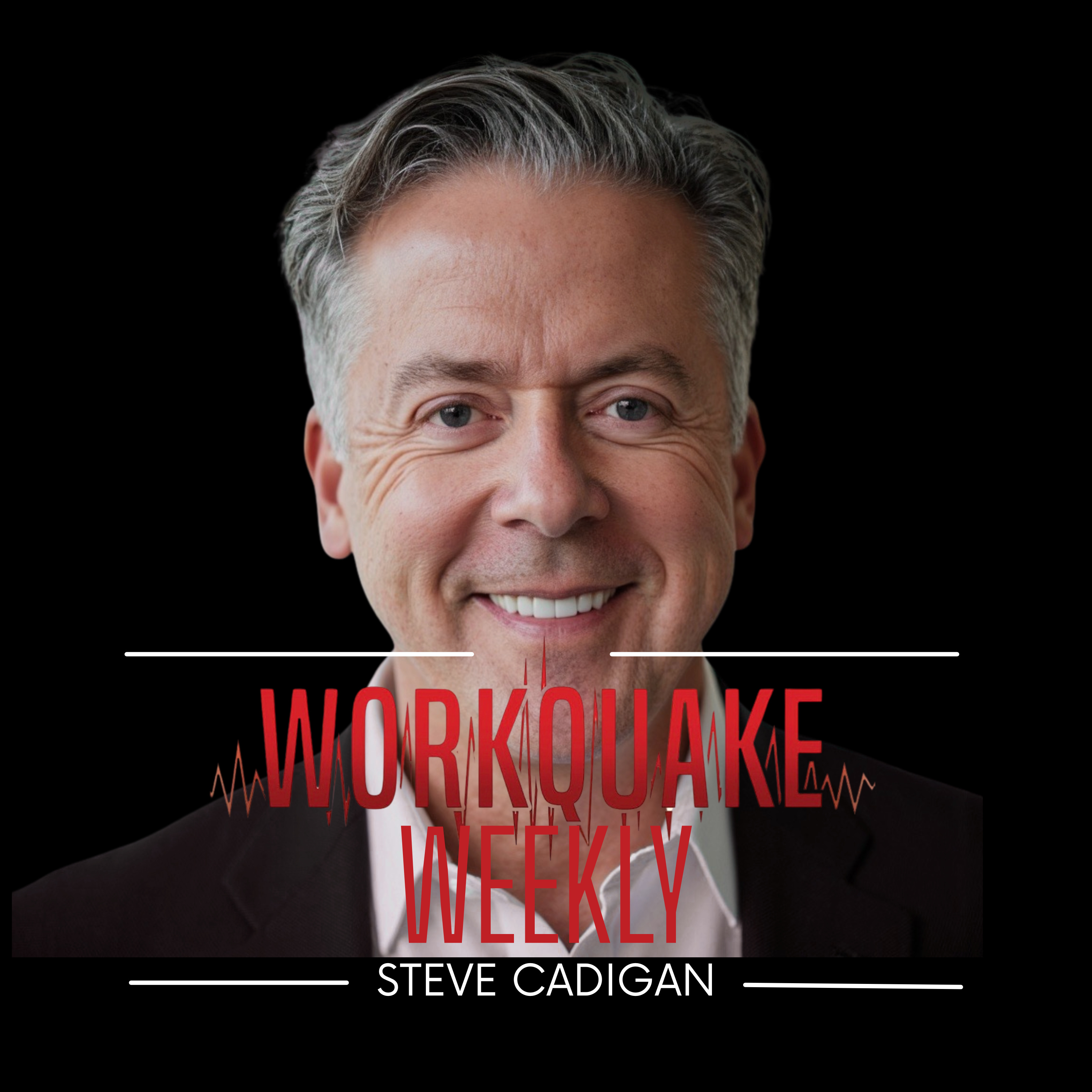
Workquake Weekly

PODCAST · business

Workquake Weekly

Most leaders are asking the wrong question about AI. Workquake Weekly is where we find the right one. Each week, Steve Cadigan, LinkedIn's founding CHRO and author of Workquake, breaks down what's actually happening at the intersection of AI, talent, and organizational transformation. Not hype. Not fear. The patterns that separate companies building lasting competitive advantage from those chasing a mirage. Ten minutes. One insight. Every week.For more on Steve visit stevecadigan.com

  1. 39

    Who's running your company in 2035?

    Three headlines from this week in work, and the pattern connecting them.Steve breaks down: why dropping degree requirements barely moved the needle on who actually gets hired (fewer than 1 in 700 hires affected), why 55% of HR leaders regret their AI-driven layoffs and one in three companies are now spending more on rehiring than they ever saved, and why a 40% collapse in entry-level tech hiring is quietly mortgaging the leadership pipeline of 2035.The thread tying it together: companies are making decisions that look smart this quarter but will look like obvious mistakes a decade from now.10 minutes. No fluff. Find Steve on LinkedIn to keep the conversation going.

  2. 38

    Loyalty Is a Broken Contract And it's time to stop pretending otherwise

    Loyalty Is a Broken Contract… And It’s Time to Stop Pretending OtherwiseWhat if the biggest misunderstanding in the workplace today isn’t about AI, remote work, or even talent shortages… but about loyalty?In this episode of Workquake Weekly, Steve Cadigan challenges one of the most deeply held assumptions in leadership: that employees should be loyal to organizations, even as the terms of employment have fundamentally changed.From companies reducing entry-level roles in anticipation of AI, to return-to-office mandates pushing top performers out the door, the signals are everywhere. The traditional “loyalty in exchange for security” contract no longer reflects reality. And yet, many organizations are still operating as if it does.Steve unpacks what he calls the “Employer Loyalty Paradox” and explores why this disconnect continues to persist… even when both employers and employees know the old model is broken.Drawing on his experience as LinkedIn’s first Chief HR Officer, Steve shares the story behind the “Tour of Duty” approach… a more transparent, growth-focused model that reframes the employer-employee relationship around mutual value, not false promises.You’ll hear why:Retention may no longer be the best measure of successGrowth and employability are becoming the real currency of workOrganizations that embrace shorter tenures can actually create more valueThe future of work depends on honesty, not nostalgiaThis episode is a call for leaders to rethink what they’re really offering… and what employees are actually agreeing to.Because the problem isn’t that loyalty is gone.It’s that the contract behind it hasn’t caught up.And the organizations willing to rewrite that contract… are the ones that will win.Tune in for a candid, practical, and optimistic take on what comes next.

  3. 37

    AI Didn't Fire You. Your Leaders Did

    Oracle cut 30,000 people last week. At 6 AM. Via email.No manager conversation. No handoff. Just: you're done, your access is revoked.Steve has been through dozens of staff reductions in his career — and this one hit differently. Not because of the number, but because of what the process communicated. In this episode, he breaks down why the Oracle move is a leadership failure dressed up as a technology decision, what every major tech shift has taught us about the human cost of "deploy first, figure people out later" — and why the organizations that will win with AI are asking a completely different question than everyone else.The research is clear. The logic is there. So why aren't more executive teams listening?

  4. 36

    Augmentation Made the Jobs Better. So Why Are We Hiring Less?

    This week on Workquake Weekly, Steve unpacks new research from Harvard Business Review that brings real data to one of the biggest debates in the future of work… are jobs being replaced by AI, or reshaped by it?The answer is becoming clearer.Roles built around human and AI collaboration are growing fast, while purely automated roles are shrinking. But the real story isn’t job loss or job growth. It’s how the work itself is changing.Steve walks through what this shift looks like in practice, from financial analysts spending less time gathering data and more time making decisions, to organizations redefining what productivity and value actually mean.But there’s a tension emerging.As companies lean into augmentation, entry-level opportunities are quietly declining, especially in AI-exposed fields. Steve challenges this instinct and asks a bigger question. If AI is unlocking capacity across organizations, why are we using it to do less instead of more?This episode explores:Why augmentation is winning over automation, and what that really means for leadersHow AI is reshaping the day-to-day reality of knowledge workThe unintended consequences for early-career talentWhy shrinking roles may be the wrong response to increased capacityA powerful example of how one company bridged the gap between experienced and junior workersSteve offers a grounded but optimistic perspective on what leaders can do next, and why this moment is less about efficiency and more about imagination.Because the real opportunity isn’t just improving what already exists. It’s building what comes next.Harvard Business School — "Displacement or Complementarity? The Labor Market Impact of Generative AI" — Suraj Srinivasan, Wilbur Xinyuan Chen, Saleh Zakerinia. Covered in Harvard Business Review, March 2026. https://hbr.org/2026/03/research-how-ai-is-changing-the-labor-marketFederal Reserve Bank of Dallas — "AI is simultaneously aiding and replacing workers, wage data suggest" — J. Scott Davis, February 2026. https://www.dallasfed.org/research/economics/2026/0224McKinsey & Company — "The State of AI in 2025: How Organizations Are Rewiring to Capture Value" — Alex Singla, Alexander Sukharevsky, Bryce Hall, Lareina Yee, Michael Chui, November 2025. https://www.mckinsey.com/capabilities/quantumblack/our-insights/the-state-of-ai

  5. 35

    Anthropic Knows AI Enriches Work — So Why Are They Only Measuring What It Destroys?

    Is AI destroying jobs, enriching them, or doing a bit of both?In this episode of Workquake Weekly, Steve Cadigan explores a new research tool released by AI company Anthropic designed to detect when AI is displacing workers across occupations. On the surface, it sounds like responsible foresight. But Steve asks a deeper question: if we’re building sophisticated systems to track job loss, why aren’t we building equally powerful tools to track job enrichment?Drawing on new surveys from Deloitte, Deutsche Bank, and others, Steve looks at the growing anxiety among Gen Z and Millennial workers who are trying to adapt quickly to AI while hearing mixed signals from the companies building it. At the same time, he highlights the massive investments companies like IBM, Microsoft, and Google are making in reskilling millions of workers around the world.This episode explores the real challenge leaders face today: not just managing disruption, but shaping a more balanced and hopeful narrative about how AI can expand human potential at work.Because the future of work isn’t something that just happens to us. It’s something we shape.

  6. 34

    Talent Velocity — Staying Calm in the AI Moment

    This week, Steve Cadigan tackles the emotional rollercoaster around AI, flipping the script from fear and FOMO to understanding and real confidence. You’ll learn:Why panic isn’t the answer—and what questions leaders should be asking insteadHow “talent velocity” (a concept highlighted in a recent LinkedIn report) puts learning security ahead of job securityWhy AI adoption isn’t a sprint but a human-centered learning cyclePractical examples from AT&T, Unilever, and Guild on building internal learning pathways and talent marketplacesFour focus areas for leaders: speeding up learning, safe experimentation, rewarding curiosity, and redesigning roles for ongoing developmentTune in to replace anxiety with real confidence, and discover how to build organizations that move at the pace of human capability—not just the technology curve.https://learning.linkedin.com/resources/talent-velocity-report

  7. 33

    When Healthcare Costs More Than Your House

    This week, Steve digs into a startling The Wall Street Journal report revealing that, for many Americans, healthcare expenses are now outpacing mortgage payments. Drawing on his own experience as an independent business owner, he explores how soaring premiums and shrinking coverage have turned “healthcare plans” into little more than catastrophic safety nets, and what that means for families and employers alike.Steve breaks down why today’s healthcare system has become so entrenched—and so maddeningly hard to fix—touching on politics, economics, insurance, technology, and fear. He then connects the dots to the workplace, showing how healthcare costs distort career mobility, fuel job-lock, and even clash with the adaptability we tout in the age of AI.Tune in for practical steps leaders can take right now to acknowledge this pressure, rethink benefits conversations, and share risk more thoughtfully within their organizations.Key Takeaway:It’s time to stop treating healthcare as an afterthought. By facing these costs head-on, leaders can help unleash the very innovation and agility they expect from their teams.If you enjoyed this episode, make sure to follow the podcast, and leave a review so you don’t miss future insights. And if you’ve read my book Workquake, I’d really appreciate you taking a minute to leave a review on Amazon—your support helps keep the conversation going. See you next Friday.https://www.wsj.com/health/healthcare/aca-health-insurance-cost-subsidies-expire-37a595a9?gaa_at=eafs&gaa_n=AWEtsqcQ7hAaSlDjbCAqfsAQMOwm1hC6_7vzfnGefpGP4BIzLzcna72YedGU9kXGyCw%3D&gaa_ts=697a76f5&gaa_sig=wcby4hKof7dCDgOEZnZEaEP0NX8WO6sJ_c0ALGjs9IBt4--ExX_qSz1hGW4jjzh-AjFGTxjcNNA8GAjfDLTNOA%3D%3D

  8. 32

    The Seatbelt Moment: Social Media on Trial — and What AI Should Learn Now

    A landmark trial in Los Angeles is testing a hard question: did social media product design cause real harm, especially for younger users? This isn’t a hearing. It’s a courtroom, with jurors and evidence, focused less on content moderation and more on product architecture… infinite scroll, autoplay, notification loops, and the incentives behind them. Steve connects this “tobacco trial moment” to the future of work and AI, arguing that design choices are never neutral and that leadership, not just technology, must carry responsibility. If social media is our seatbelt moment, AI might be the self-driving car. What guardrails will we choose, and how fast will we put them in place?What You Will LearnWhy this case centers on design decisions, not just user behaviorHow business models shape engagement and riskThe seatbelt analogy and what it teaches about cultural changePractical questions leaders should ask before shipping new techWhy thoughtful beats fastest in the long run

  9. 31

    The 2026 Prediction Trap (And What to Do Instead)

    Feeling 2026 fatigue? You are not alone. In this episode, Steve digs into the prediction trap so many leaders are stuck in right now, chasing benchmarks and waiting for a safe best practice to appear. In a supersonic world, there are no benchmarks. The only real advantage is your ability to take your best shot, learn fast, and move.Steve reframes the AI conversation as a cultural challenge, not a technical one. If AI is only a cost play, your team will feel it. If AI is an enabler of more meaningful work, they will feel that too. You will hear how to set a clear belief about AI, how to fuel your pioneers rather than convince your skeptics, and how to stop outsourcing strategy to headlines.You will learn:Why waiting for best practices keeps you behind.How to state your personal belief about AI and lead from it.How to use AI to elevate people, not squeeze them.How to anchor decisions in what is truest for your team, not what is newest in the newsfeed.Try this week:The Meaning Audit: does your AI plan create more time for meaningful work, or just more work?Map Your Pioneers: find three early adopters using AI already, interview them, and channel their energy into your broader culture.If this episode helps clear the fog, follow, share, and leave a review. And if you want to compare notes or talk about your own AI beliefs, connect with Steve on LinkedIn.

  10. 30

    Why Google’s New AI is the Irony We Need Right Now

    Email promised speed and delivered FOMO. In this episode, Steve reacts to Google’s deeper AI features in Gmail, calls out the irony of tech solving a problem it helped create, and reframes the real win of AI: buying back quiet time. We dig into how summaries, prioritization, and automated triage can free up hours, why creativity lives in the margins, and how leaders can shift from frantic processing to thoughtful insight. Inspired by reporting from The Verge on Gmail’s new AI.

  11. 29

    Rethinking New Year’s Resolutions

    Rethinking New Year’s ResolutionsNew Year’s resolutions rarely stick because they start with wishes, not reality. In this episode, Steve Cadigan shares a simple, honest alternative he learned from Tim Ferriss, the Past Year Review. Instead of guessing what to change, you look back at what actually happened, who and what gave you energy, and what quietly drained you. From there, you make small, meaningful adjustments that fit real life, at work and at home.In this episodeA 4 step Past Year Review you can do in under an hourWhy energy, not time, is the real constraintHow to spot patterns in your calendar and protect what mattersPractical ways to set boundaries, say yes with intention, and build in joy on purposePerfect for leaders, parents, and anyone ready to design a year that feels aligned, not performative.If you enjoy the show, follow Workquake Weekly and leave a quick review. It helps more people find these conversations.

  12. 28

    What Chris Paul’s Retirement Teaches Us About Work

    What can the NBA teach us about modern leadership? In this fast, practical episode, Steve riffs on a Wall Street Journal piece about Chris Paul’s retirement and the fading era of the classic “floor general.” On the court and at work, running everything through one person no longer fits the speed and complexity of today. Steve breaks down how the Warriors reinvented offense with shared playmaking, then connects it to how teams can share decision making, move faster, and become more resilient.You’ll hear why centralized control collapses under modern complexity, how leadership can be a behavior instead of a title, and exactly where to start if you’ve built your career on being the hub for every decision. Expect concrete moves you can try this week, like rotating who leads meetings, pushing decisions to the edges, removing one bottleneck, and running short retros to learn quickly.If the NBA can evolve, so can your team. This is the Workquake in action, and the future belongs to leaders who design for speed, autonomy, and trust.

  13. 27

    The Real AI Advantage Isn’t Cost Cutting — It’s Rethinking Work.

    Most AI headlines still shout about job loss. This week, I unpack McKinsey’s new State of AI report and the story is very different. Yes, many companies are experimenting, piloting, and playing. Only a small fraction are seeing real profit lift today. The ones that are winning share a pattern: they redesign how work gets done, they pursue growth and innovation, and they keep people at the center. We dig into what high performers do differently across manufacturing, consumer, finance, and life sciences, why workflow redesign beats tool buying, and how intent and trust shape adoption. If you lead people, this episode gives you a simple, practical lens to spot value, reduce fear, and build skills that elevate your teams.You’ll learn:Why growth goals outperform cost cutting in AI initiativesHow workflow redesign becomes the strongest predictor of impactWhat high performers prioritize across industries, from personalization to agentic systemsThe people moves that matter most, including reskilling and leader literacyHow to shift the narrative so employees feel enhanced, not reducedTakeaway:The best AI strategies are talent strategies. Start with value creation, redesign the work, invest in hybrid human–AI skills, and measure outcomes, not pilot activity.McKinsey AI Report 2025 : https://www.mckinsey.com/capabilities/quantumblack/our-insights/the-state-of-ai

  14. 26

    The Old Career Ladder Is Crumbling. The Class of 2026 Knows It.

    In this special, more personal episode, Steve looks past the headlines and into his own home to explore why early career paths feel so discouraging for today’s students. Using Lindsay Ellis’s Wall Street Journal article, “Companies Predict 2026 Will Be the Worst College Grad Job Market in Five Years,” as a springboard, Steve shares the real conversations he’s hearing from his college-senior son and from campuses around the country: ghosting, silence, fewer internships, and shrinking campus recruiting. Yet there’s real hope. This cohort was forged in Covid, and many aren’t waiting for permission. They’re building side hustles, micro-startups, creator businesses, and portfolios that prove capability. Steve challenges leaders to fix the early experience and invites families to support zigzags over straight lines. It’s a clear, human reset for anyone navigating or hiring into the messy first step of work.The early-career “handshake deal” is dissolving: students do the work, the system returns silence.Push factors (ghosting, black-hole processes) are beating corporate pull factors.Covid-shaped grads are unusually adaptive and entrepreneurial.Leaders must redesign the first mile of work: responsive communication, real projects, faster feedback.Families can champion experimentation, portfolios, and non-linear paths.Wall Street Journal article by Lindsay Ellis, “Companies Predict 2026 Will Be the Worst College Grad Job Market in Five Years.”https://www.wsj.com/lifestyle/careers/2026-graduates-job-market-7928bcd7?st=Lbd1QE&reflink=article_copyURL_share

  15. 25

    Our AI Shields Are Dropping

    Are our AI shields down? In this short, reflective episode, Steve explores how quickly skepticism around AI has faded and why that matters for leaders, teams, and culture. He unpacks the subtle forces behind the rush to adopt, from fear of being left behind to groupthink inside organizations, and offers a simple mindset: trust, but verify. Expect practical questions you can use with your team this week, plus a nudge to teach people how to think with AI, not for it.You’ll hear about:Why growing confidence in AI can mask complacency and confusionHow leadership pressure for speed can crowd out reflectionSimple prompts to bring curiosity, context, and healthy skepticism back into your workflowMentioned:The New Yorker, “The Case That A.I. Is Thinking,” by James Somers.

  16. 24

    AI Isn’t Killing Entry-Level Jobs — Short-Sighted Leadership Is

    This week on Workquake Weekly, Steve Cadigan dives into one of the biggest myths in today’s workplace — that AI is killing entry-level jobs.Spoiler alert: it’s not.Drawing on Airbnb CEO Brian Chesky’s recent comments that “AI can do the interns’ work, but leaders should still hire Gen Z,” Steve explores why cutting early-career roles is one of the most dangerous mistakes companies can make — and how it’s quietly dismantling the leadership ladder from the bottom up.He shares lessons from his time building LinkedIn’s early-career hiring programs, explains the real culture cost of removing young talent, and makes the case for why Gen Z might be the generation best equipped to help organizations use AI more intelligently.You’ll learn:Why the “AI took my job” narrative misses the real issue.How skipping entry-level hiring sabotages your future leadership pipeline.How to redesign early-career roles so humans and AI actually work better together.Why Gen Z could be your company’s best AI accelerators.And as always, Steve leaves you with a Workquake Challenge to turn insight into action — by reimagining one role on your team for the age of AI.Tone: Conversational, optimistic, and deeply human — this episode is a wake-up call for leaders who want to future-proof their culture and their talent.🎙️ Workquake Weekly — helping you make sense of the chaos we call modern work… one short episode at a time.https://fortune.com/2025/10/30/airbnb-ceo-brian-chesky-ai-can-do-intern-work-bosses-should-hire-gen-z-lose-management-automation-employment-hiring-advice/

  17. 23

    People Are Not OK

    This week on Workquake Weekly, Steve Cadigan unpacks a powerful truth Brené Brown shared at the Fortune Most Powerful Women Summit: “If you’re leading people, you probably know people are not okay.”In an age of nonstop change, AI disruption, and emotional overload, leaders aren’t just managing projects — they’re managing nervous systems. Steve explores why burnout today is less about weakness and more about biology, how disconnection shows up before disengagement, and what great leaders are doing differently to restore trust, calm, and meaning at work.If you’re leading anyone — or just trying to stay grounded yourself — this episode is your reminder that being human isn’t a liability. It’s the advantage.🎧 Listen in under 10 minutes — and start leading like it’s 2025, not 1999.

  18. 22

    Beyond Productivity: Using AI to Bring People Back to Life at Work

    AI has officially moved from curiosity to urgency. But before we race ahead, Steve Cadigan asks a better question: Fast enough… toward what?In this episode of Workquake Weekly, Steve explores how AI could finally repair our broken relationship with technology — if we let it. From burnout to trust, from productivity to potential, this is a call to leaders everywhere to rethink what “progress” really means.Because the defining question of this era isn’t “How fast can we deploy AI?”It’s “Will we use AI to bring people back — to creativity, curiosity, and possibility?”Listen for practical hope and grounded wisdom on how leaders can make AI a force for human good.

  19. 21

    From Stay Bonus to Perform Bonus: Rethinking Equity in the Workplace

    This week on Workquake Weekly, Steve Cadigan unpacks a quiet shift in tech compensation: companies are moving from the classic four-year, even vesting schedule to front-loaded equity. Think 40/30/20/10 or even three-year designs. Why the change, what it signals, and how it might reshape trust, loyalty, and performance at work. Steve explores potential drivers like offer competitiveness, accounting optics, and the rise of refresher grants tied to impact, along with the tradeoffs that could speed up churn or strengthen engagement. If you lead people, negotiate offers, or design rewards, this short episode will help you rethink equity as more than retention math, and more like a performance promise.What you’ll learn:• Why many firms are moving away from 25/25/25/25• How front-loaded equity changes behavior and incentives• The role of refresher grants in rewarding real impact• Risks to watch, from shorter cycles to signaling effects• Practical questions to ask when evaluating an offer

  20. 20

    The Great Reveal: CEOs Finally Show Their People Strategy on AI

    This week on Workquake Weekly, we’re peeling back the curtain on something rare: CEOs getting real about AI and talent.Accenture’s Julie Sweet admits reskilling isn’t moving fast enough. Walmart’s Doug McMillon promises to guide employees “to the other side.” Both perspectives reveal a deeper tension: leaders are trying to look in control while racing to figure it out themselves.Are companies really ready to upskill at scale? Or are they just cramming for the AI exam and hoping to pass?In under 10 minutes, Steve unpacks what these CEO confessions mean for you, why fear-driven upskilling may backfire, and what to watch for in the next wave of earnings calls.If your CEO sounds like they’re cramming… they are. And so are we.

  21. 19

    Coffee, Customers, and Connection: Starbucks’ Playbook for Work’s Future

    This week on Workquake Weekly, we’re stirring things up with a story that hits close to home — especially if you’re a coffee lover. Inspired by Heather Haddon’s recent piece in The Wall Street Journal, “Inside the Starbucks Plan to Get 200,000 Baristas on the Same Script,” we dive into one of the most pressing questions in today’s workplace:Can you engineer human connection… with a script?Steve unpacks Starbucks’ surprising move to give baristas more time to connect with customers — while also standardizing exactly how those connections should happen. It’s a fascinating case study in the delicate balancing act every leader is facing:Speed vs. Humanity. Efficiency vs. Experience. Cost vs. Culture.We explore:Why burnout is bad business — for employees and customersHow scripting authenticity might backfireWhat Starbucks’ decision says about the broader evolution of workAnd how you can rethink what you’re optimizing for in your own organizationWhether you’re leading a team, designing employee experience, or just ordering your next oat milk latte… this episode will get you thinking about what really drives connection — and why that matters more than ever.Tune in, reflect, and maybe look a little closer at your barista next time.☕If you enjoy the show, be sure to follow, rate, and leave a review. And if you’ve read Workquake, a review on Amazon goes a long way in helping others join the conversation. See you next Friday! https://www.wsj.com/business/hospitality/starbucks-barista-training-sales-b1f11395?st=unzGPP&reflink=article_copyURL_share

  22. 18

    Boredom: The Hidden Superpower We’ve Been Dodging

    In this episode of Workquake Weekly, Steve Cadigan dives into something that feels almost rebellious in today’s always-on world: boredom.Inspired by Arthur Brooks’ recent article in Harvard Business Review, “You Need to Be Bored. Here’s Why,” Steve explores how boredom isn’t wasted time—it’s fertile ground for creativity, reflection, and even breakthrough ideas. From brain science to leadership strategy, Steve makes the case that embracing stillness might be the smartest move for anyone trying to innovate, lead, or simply think more clearly.He also shares a personal story, practical tips, and one simple challenge to help you tap into your creative default mode.If you’ve been feeling stuck, overstimulated, or just too busy to think—this episode might be the nudge you didn’t know you needed.https://hbr.org/2025/08/you-need-to-be-bored-heres-why by Arthur C. Brooks

  23. 17

    The Truth Bomb About AI We Don’t Want to Hear

    AI feels brand new, but the pattern we’re living through is not. In this week’s episode, Steve Cadigan explores why most AI investments are failing to deliver value — and what history can teach us about breaking that cycle. Inspired by Ibanga Umanah’s article “From Email to AI: The Hidden Pattern Behind Tech Adoption Failure,” Steve examines why it’s so hard to let go of old processes, why unlearning may be the hardest skill of all, and how leaders can shift the question from “How do I do what I already do better with AI?” to “How can AI help me solve problems differently?”If you’ve ever felt overwhelmed by AI hype or unsure where to start, this episode offers clarity, encouragement, and a powerful mindset shift for navigating what’s next in work.https://www.linkedin.com/pulse/from-email-ai-hidden-pattern-behind-tech-adoption-failure-umanah-gfmec

  24. 16

    AI and the New Workplace Taboo

    AI is supposed to be our shiny new superpower, yet many people feel embarrassed using it. In this episode, Steve digs into the rise of “AI shame” at work, unpacking a Times of India report, “AI Shame Is a Real Phenomenon in the Workplace, Claims Report: What Is Scaring Top Execs in America.” The surprising part, executives and Gen Z appear to be hiding it most. According to the survey Steve cites, 53% of executives conceal their AI use, and 62% of Gen Z pass off AI-generated work as their own. Formal training is scarce too, roughly 6–7% for Gen Z and 17% for executives, which means most people are winging it. No wonder 65% of Gen Z say AI slows them down, and 68% feel pressure to overperform.Steve connects this to earlier stigmas like online dating, then shifts the conversation to culture, identity, and how we define value when AI is always in the room. You’ll hear practical steps for leaders and teams, from setting norms on when and how AI can be used, to creating safe forums, to running low-stakes experiments that build confidence and transparency.What you’ll take away:• Why secrecy emerges when there is no playbook.• How to talk about contribution and originality in an AI-assisted world.• A simple starter plan for leaders and teams to make AI use normal, not taboo.If you find this helpful, follow the show and leave a quick review to support the conversation.

  25. 15

    Leading 'All Too Well' — The Taylor Swift Edition

    In this episode of Workquake Weekly, Steve Cadigan explores why Taylor Swift isn’t just a global pop icon — she’s also a masterclass in leadership. From constant reinvention to building genuine community, from generosity that strengthens her team to humanity that inspires an entire industry, Taylor shows us what modern leadership looks like. Steve unpacks four big lessons we can borrow from her playbook and challenges listeners to apply at least one in their own “era” of work this week. Because sometimes the most powerful leadership examples don’t come from the boardroom… they come from the stage.

  26. 14

    From Dashboards to Depth — Rethinking Leadership Today

    Manager engagement just dipped to 27% in Gallup’s latest survey, and Steve asks a sharper question: is this a manager problem, or a system that keeps overloading and undertraining leaders? In this episode, Steve pairs the Gallup data with Jonathan J. Hsu’s Rolling Stone argument for slowing down, going deeper, and leading more humanly. The result is a candid look at why speed and dashboards won’t fix disengagement, and what will.You’ll hear:• Why 27% isn’t the real headline• How slowing down builds trust and better decisions• Why human, not heroic, leadership wins• Simple ways to create space, support, and clarity for managersTakeaway: less noise, more depth. Create one meaningful pause this week, ask a better question, and give your team room to be heard.If you enjoyed this episode, follow and leave a review. And if you’ve read Workquake, a quick Amazon review helps keep the conversation going. See you next Friday.

  27. 13

    AI, Coaching, and the Surprising Human Upside

    Welcome to Workquake Weekly. Each week we take a short pause to make sense of the wild, ever-changing world of work, without the doom and gloom. Think of this as your weekly coffee break for fresh ideas, practical experiments, and maybe a laugh when work feels like it is spinning out of control.In this episode, Steve Cadigan digs into a surprising insight from recent research covered in Fast Company. Many people are opening up more to an AI coach than to a human one. Why would that be, and what does it mean for real coaches, leaders, and teams? Steve unpacks the idea of psychological safety wrapped in code, shares what he is seeing through Slate Advisers and their AI coach, Kai, and lays out where AI can help and where humans still shine. We also talk about the big caveat, privacy, and how to blend AI for breadth with humans for depth so coaching becomes more accessible and more effective.Highlights: why people feel safer with a bot, what stays uniquely human, experiments you can try this week, and the privacy must-haves to earn trust.Questions or want to learn more about Kai, email [email protected] you enjoyed this episode, follow the podcast, share it with a friend, and leave a quick review. Your support helps grow this conversation.

  28. 12

    The Talent You Need Might Not Look the Part (Yet)

    This week on Workquake Weekly, we’re heading to the gridiron—not for football tips, but for leadership gold.Steve Cadigan takes inspiration from Bill Belichick’s new book The Art of Winning—specifically Chapter 5, a masterclass in talent evaluation—and breaks down how the Patriots’ legendary coach built a dynasty by spotting potential others overlooked.Forget résumés and star power. Belichick built his teams around grit, adaptability, and fit. And as Steve argues, it’s exactly the mindset modern leaders need now more than ever.Tune in to learn:Why hiring for potential beats hiring for pedigreeHow to build roles around people—not the other way aroundThe overlooked power of development-first culturesWhat NFL stars like Brady, Edelman, and Vrabel can teach us about seeing talent differentlyWhether you’re building a team, leading a company, or just trying to unlock more from your people—this one’s for you.And hey… if you’ve ever passed on someone who “wasn’t quite ready,” this episode might make you think twice.

  29. 11

    The Real AI Gap? We Don’t Know What We’ve Got.

    Most companies aren’t falling behind in AI because they lack the tools… they’re falling behind because they don’t know what they’ve already got.In this week’s episode of Workquake Weekly, Steve unpacks two powerful articles—one from Sally Thornton at Forshay, and another by David Michels in Forbes—that both spotlight a surprising but critical truth: the real AI opportunity isn’t just about upskilling. It’s about skill visibility.Steve explores why organizations are freezing instead of evolving, how outdated talent systems are holding us back, and what leaders at every level can do to move forward—one smart question at a time.If you’re leading people, growing your own career, or just trying to make sense of the future of work, this one’s for you.

  30. 10

    Does working from home really kill company culture?

    In this week’s episode, Steve tackles a question that just won’t go away: Does working from home damage company culture?Inspired by a recent article in The Economist — “Does working from home kill company culture?” — Steve unpacks why this debate is still alive years after the pandemic “officially” ended, and why the return-to-office narrative isn’t as clear-cut as some leaders might think.Key takeaways from the episode:Culture is complicated. Everyone agrees it’s important… but no one fully agrees on what it is. Is it energy? Values? Trust? Decision speed? That ambiguity makes it a tough scapegoat for in-office mandates.The data tells a different story. Research from the University of Pittsburgh shows that forcing employees back into the office led to lower engagement and higher turnover — not the cultural boost leaders hoped for.Maybe it’s not culture that’s the issue… it’s leadership. Remote and hybrid environments don’t kill culture, but they do expose weak leadership. If your direction is vague, your communication is inconsistent, or your team doesn’t feel seen — it shows up fast in a remote setup.Most companies are already hybrid. Whether leaders realize it or not, if you have teams across time zones or offices in different cities, you’re already managing remotely. So why treat working from home like a radical shift?It’s time for better questions. Instead of asking “Where should people work?” Steve suggests asking things like:“What kind of experience are we trying to create?”“What do our people need to do their best work?”“Is it really the culture that’s struggling… or our ability to lead in new ways?”Ultimately, Steve challenges us to stop seeing proximity as a proxy for culture — and to start seeing trust, clarity, and intentional leadership as the real drivers.🎧 Final thought:The future of work isn’t about one-size-fits-all answers. It’s about choice, context, and the courage to keep evolving.

  31. 9

    Is It Time to Rethink the College-to-Career Playbook?

    In this episode, we’re diving into a question that touches just about everyone—students, parents, leaders, and anyone thinking about the future of work: Is the traditional college-to-career pipeline still working?Steve breaks down two recent articles from The Atlantic by Rose Horowitch that reveal a surprising shift in education trends:✅ Humanities majors are making a comeback❌ Computer science degrees are cooling offWhat’s going on here? And what does it say about how we prepare people for a future that’s moving way too fast for old playbooks?Tune in as Steve explores:Why the “major = career” formula is crackingWhat future-fluency means in a world of AI and ambiguityHow parents, educators, and leaders can shift the conversation around career readinessPlus, he shares a mindset challenge to help you rethink how we learn, lead, and grow—no matter where you are in your career journey.

  32. 8

    AI Is Making Great Leaders More Human — Here’s the Proof

    AI isn’t the end of leadership. It might just be the beginning of better leadership.In this episode, I dig into two recent Fortune articles that finally move the AI-leadership conversation from theory to reality. We explore how Chris O’Neill, CEO of GrowthLoop, is using AI to become more present, not less. And we zoom out with Fortune’s bold insight: “AI doesn’t make you less of a leader. It forces you to become more of one.”This is a turning point. We’re seeing leaders use AI not to escape their responsibilities, but to elevate them.If you’re wondering how to lead when machines can do almost everything (except be human), this one’s for you.Let’s talk about what makes leadership truly human—and how to use AI to double down on exactly that.––Follow Workquake Weekly for practical insight on the future of work, every Friday.

  33. 7

    A Inspiring New Benchmark for the Future of Work

    This week on Workquake Weekly, Steve Cadigan takes you inside a recent trip that left him more hopeful than ever about the future of work. Invited to speak at Technological University Dublin (TU Dublin), Steve didn’t just deliver a talk—he discovered a living, breathing ecosystem that’s actively reshaping how learning and careers intersect.From students solving real-world problems to industry partners co-designing curriculum, TU Dublin isn’t just innovating—they’re implementing. In this episode, Steve shares what he saw, what surprised him, and why he walked away more energized than ever.If you’ve ever wondered what the future of education and work could look like… this is it.

  34. 6

    The Entry-Level Crisis Isn’t About Jobs, It’s About Fit

    🎓 This week on Workquake Weekly, we’re diving into the crisis that’s quietly reshaping the early career landscape: the disappearance of entry-level work.With headlines flooding in from The Wall Street Journal, The Economist, The Financial Times, and more, it’s clear—this isn’t just a bad year for new grads. It’s a global shift. And it’s time we stop pretending otherwise.In this episode, Steve Cadigan unpacks why the entry-level job market is drying up… and what we can do about it. From rethinking internships and onboarding strategies, to building better bridges between education and employment, this conversation is a wake-up call for leaders, educators, parents—and anyone trying to launch a career in 2025.🔥 Plus: practical takeaways, a dose of optimism, and a big call to action for companies that want to stay competitive in the age of AI.If you’re a grad, a parent, or someone who hires early talent—you don’t want to miss this one.

  35. 5

    Forecast: Foggy. What Ford’s Pause Means for Every Leader

    This week on Workquake Weekly, Steve unpacks a jarring headline: Ford just pulled its financial forecast for the year. With profits plunging and EV policy swinging wildly, one of America’s most iconic companies hit pause on long-term planning. But this isn’t just Ford’s problem. It’s a signal flare for every employer navigating the intersection of business, politics, and people.In this episode, Steve explores how political volatility—not just AI or tech disruption—is reshaping workforce strategy in 2025. He reflects on the emotional toll of uncertainty for workers, the rising strategic burden on HR, and why today’s leaders need more than operational plans… they need civic agility.Whether you’re running a factory or managing a team, this one’s for you.Tune in for fresh insights, a challenge to spark honest conversations about volatility, and a call to lead with trust—even when the rules keep changing.

  36. 4

    AI and YOU — What Makes Us Valuable Now

    Hello everyone — welcome back to Workquake Weekly! I’m Steve Cadigan, and in this episode we’re getting personal… with AI.That’s right. We’re not talking about AI in the abstract. We’re talking about AI and YOU. And me. And how it’s reshaping not just our workflows, but how we think about value, identity, and growth.Here’s what we’ll dig into:Why graduation season isn’t just for students anymoreHow AI is shifting the question from “What do you do?” to “What do you uniquely bring?”Why soft skills are now power skills — and how to flex themWhat it means to build a mindset for reinventionAnd the one question I think everyone should sit with this weekSpoiler alert: this isn’t about competing with machines. It’s about becoming more human than ever before.Ready to rethink your edge in the age of AI?Let’s do this.🎧 Listen now and check out the LinkedIn post that inspired this episode: https://www.linkedin.com/posts/cadigan_its-graduation-season-and-the-career-advice-activity-7335357597136392192-nmSOAnd if you’ve read my book Workquake, I’d love it if you left a quick review on Amazon — it really helps keep the momentum going.

  37. 3

    Why Gen Z Is Skipping the Career Ladder — and What Small Teams Can Teach Us All

    Hey friends, Steve Cadigan here! This week on Workquake Weekly, we’re diving into two trends that might seem totally separate — but together, they’re telling a powerful story about where the future of work is headed.First up: Gen Z is not waiting around for corporate ladders to offer stability. A new global study from Fiverr shows nearly 70% of Gen Z is leaning into freelancing — not as a backup plan, but as their main gig. Why? It’s not just about flexibility… it’s about agency, protection, and building something they can count on.Then we look at a growing shift in how companies scale: small teams are making a big comeback. New research from MNP shows that some of the most efficient and profitable companies today are going public with fewer than 20 employees. Agile, fast-moving, customer-focused — these lean teams are proving that small can be a superpower.Together, these shifts are pushing us to ask: Are we building organizations based on control… or trust? Are we designing work for the world we used to live in — or the one we’re in now?Tune in for a fresh, optimistic look at how we can build better, more human workplaces — one decision at a time.

  38. 2

    Ghost Jobs, Micro-Retirements, and the Talent Strategy Wake-Up Call

    This week on Workquake Weekly, Steve Cadigan dives into two rising trends that are shaking up how we think about work: ghost jobs and micro-retirements. On the surface, they couldn’t be more different — one’s frustrating job seekers, the other’s helping employees reset. But together, they reveal a deeper truth: our old strategies for hiring, planning, and leading might be past their prime.Steve breaks down why “just-in-case” job postings are backfiring in a world craving clarity, and how short, intentional breaks could be the leadership unlock we’ve been missing.If you’re rethinking how to build trust, momentum, and performance in today’s workplace, this episode is for you. Tune in to explore what it means to lead with more intention — and maybe even press pause, on purpose.🎙 Topics covered:The hidden cost of ghost job postingsMicro-retirements and the power of a purposeful pauseWhy the future of leadership is about trust, not just output

  39. 1

    AI, Empathy, and the Future of Leadership: Lessons from Moderna and Klarna

    In this debut episode of Workquake Weekly, Steve Cadigan explores how two companies—Moderna and Klarna—are making bold, contrasting moves in the age of AI. One is merging tech and HR leadership to build a more integrated future. The other is learning what happens when efficiency trumps empathy. What do these stories reveal about leadership, talent, and the real role of AI? Tune in for fresh insights—and a challenge for how you lead next.

Type above to search every episode's transcript for a word or phrase. Matches are scoped to this podcast.

Searching…

We're indexing this podcast's transcripts for the first time — this can take a minute or two. We'll show results as soon as they're ready.

No matches for "" in this podcast's transcripts.

Showing of matches

No topics indexed yet for this podcast.

Loading reviews...

ABOUT THIS SHOW

Most leaders are asking the wrong question about AI. Workquake Weekly is where we find the right one. Each week, Steve Cadigan, LinkedIn's founding CHRO and author of Workquake, breaks down what's actually happening at the intersection of AI, talent, and organizational transformation. Not hype. Not fear. The patterns that separate companies building lasting competitive advantage from those chasing a mirage. Ten minutes. One insight. Every week.For more on Steve visit stevecadigan.com

HOSTED BY

Steve Cadigan

CATEGORIES

URL copied to clipboard!