
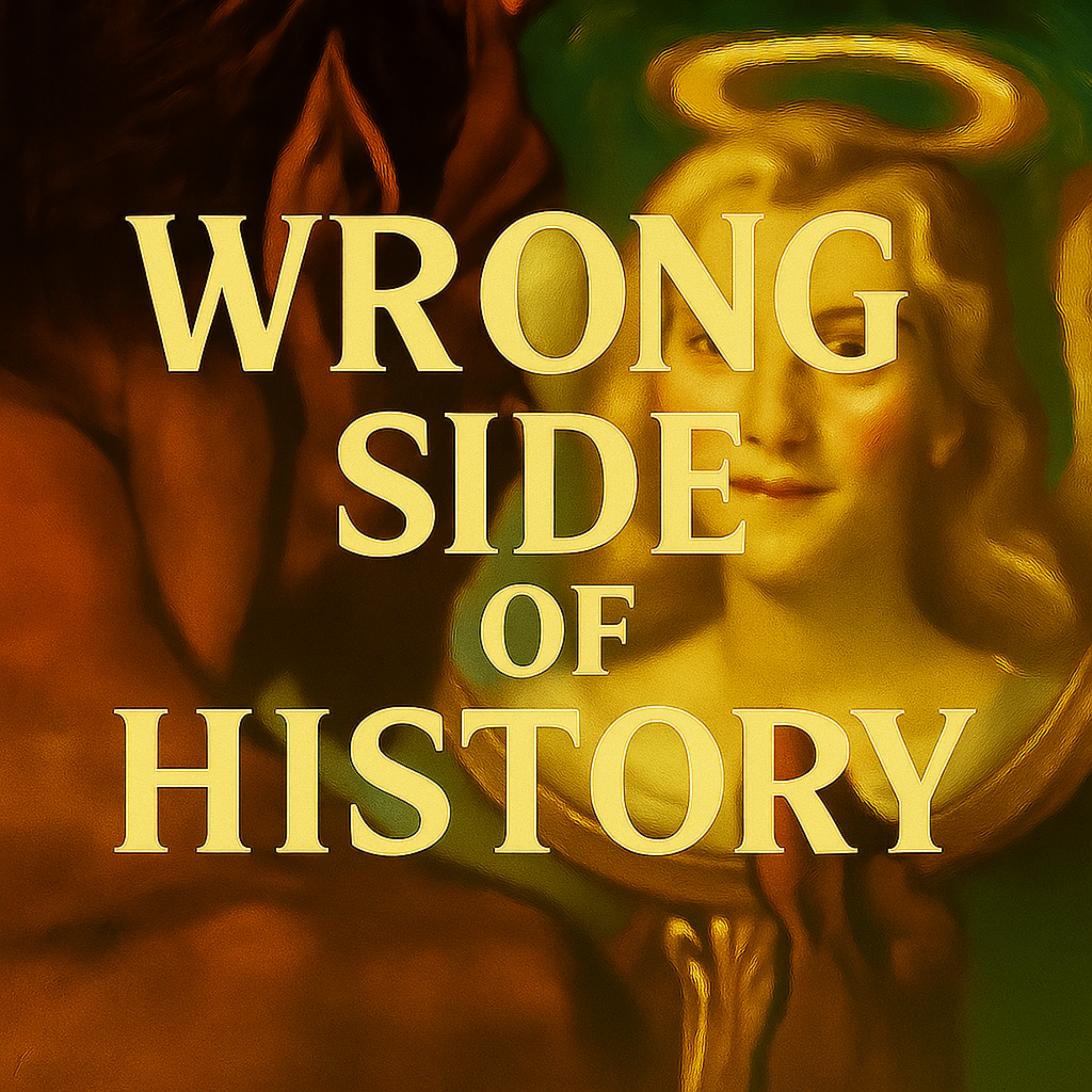
PODCAST · history
Wrong Side Of History
by Jay Singleton
No one thinks they’re the bad guy. No one wakes up and says, “Today I’ll be on the wrong side of history.” So here’s the question: if nobody thinks they’re the villain… what were they thinking?On Wrong Side Of History I try to help you understand history’s bad guys the way they understood themselves. Each season takes the perspective of a person or movement that ended up on the wrong side of history to learn what they feared, what they valued, and why their ideas made sense to them.
-
5
Anti-Suffragist: The Vote Was An Illusion | Part 4
Up until 1916, women’s suffrage was never backed by a majority of American women. In this final episode on the anti-suffragists, we look at why many of them did not see the vote as a natural right, or even as the real source of political power. To them, governments enforced public opinion, men enforced the law, and women’s real influence came through status, moral authority, and shaping the culture upstream of politics.Sources on SubstackIGTik Tok
-
4
Anti-Suffragist: Another Kind of Power | Part 3
In 1895, anti-suffragists in Massachusetts were asked to do something absurd: vote to show they opposed voting. What happened next helps explain one of the strangest ideas in the anti-suffrage worldview; that the vote was only one part...and maybe even the smallest part of the whole political process In this episode, we look at how anti-suffragists understood indirect political power: shaping legislators before a vote, moving public opinion through clubs and committees, and influencing the culture that produced politics in the first place. If politics is downstream from culture, they believed women were already standing at the source.Sources on SubstackIGTik Tok
-
3
Anti-Suffragist: Resisting Modernity | Part 2
In the last episode, we looked at separate spheres (ie. gender roles). In this one, we go deeper into the political role many anti-suffragists thought women already had. Long before the fight over suffrage reached its peak, American women were given a civic calling: republican motherhood. They were told the republic depended on them not as voters, but as the people who formed citizens, guarded virtue, and held together the moral center of the nation. To many anti-suffragists, that was not a consolation prize. It was status, purpose, and power. But by the early 1900s, that world felt under attack. Industrialization, capitalism, individualism, and even socialism seemed to point in the same direction: away from the home, away from interdependence, and away from the kind of work that could not be measured, priced, or made efficient. From their point of view, the vote was never just a ballot. It was a sign that the line between the public and private spheres was collapsing and that the market and the state were moving into places they did not belong. This episode is about why so many anti-suffragists saw themselves not as dupes or victims, but as the last defenders of the moral and relational life that made a republic possible. Full sources and research notes are on SubstackTik Tok Instagram
-
2
Anti-Suffragist: Gender Roles | Part 1
Why did so many women oppose women’s suffrage? Before 1916, suffrage was never backed by a majority of women, and for years men were more progressive on the issue than women were. In this episode, we enter the worldview of the American anti-suffragists and begin with their core idea: separate spheres. To them, the vote was never just a ballot. It was a sign of a much larger social change, one that threatened women’s moral authority, sex-based protections, and the family as the basic unit of society. Many of these women did not see themselves as powerless. They believed they already had influence, just not partisan influence. This episode is about what they feared, what they thought they were protecting, and why their position made sense to them at the time. Sources on SubstackIGTik Tok
-
1
Trailer
No one thinks they’re the bad guy. No one wakes up and says, ‘Today I’ll be on the wrong side of history.’So here’s the question: if nobody thinks they’re the villain… what were they thinking?The Wrong Side of History is a show about understanding history’s bad guys the way they understood themselves: what they feared, what they valued, and why their worldview made sense to them at the time.You probably won’t agree with them. But you may start to see that the stories we’ve known of heroes and villains, saints and bigots, reason and ignorance, are often too simple.
We're indexing this podcast's transcripts for the first time — this can take a minute or two. We'll show results as soon as they're ready.
No matches for "" in this podcast's transcripts.
No topics indexed yet for this podcast.
Loading reviews...
ABOUT THIS SHOW
No one thinks they’re the bad guy. No one wakes up and says, “Today I’ll be on the wrong side of history.” So here’s the question: if nobody thinks they’re the villain… what were they thinking?On Wrong Side Of History I try to help you understand history’s bad guys the way they understood themselves. Each season takes the perspective of a person or movement that ended up on the wrong side of history to learn what they feared, what they valued, and why their ideas made sense to them.
HOSTED BY
Jay Singleton
CATEGORIES
Loading similar podcasts...
URL copied to clipboard!