
EPISODE · Jan 27, 2025 · 16 MIN
Beyond Mergers: Exploring Magnetars as R-process Factories
from Multi-messenger astrophysics · host Astro-COLIBRI
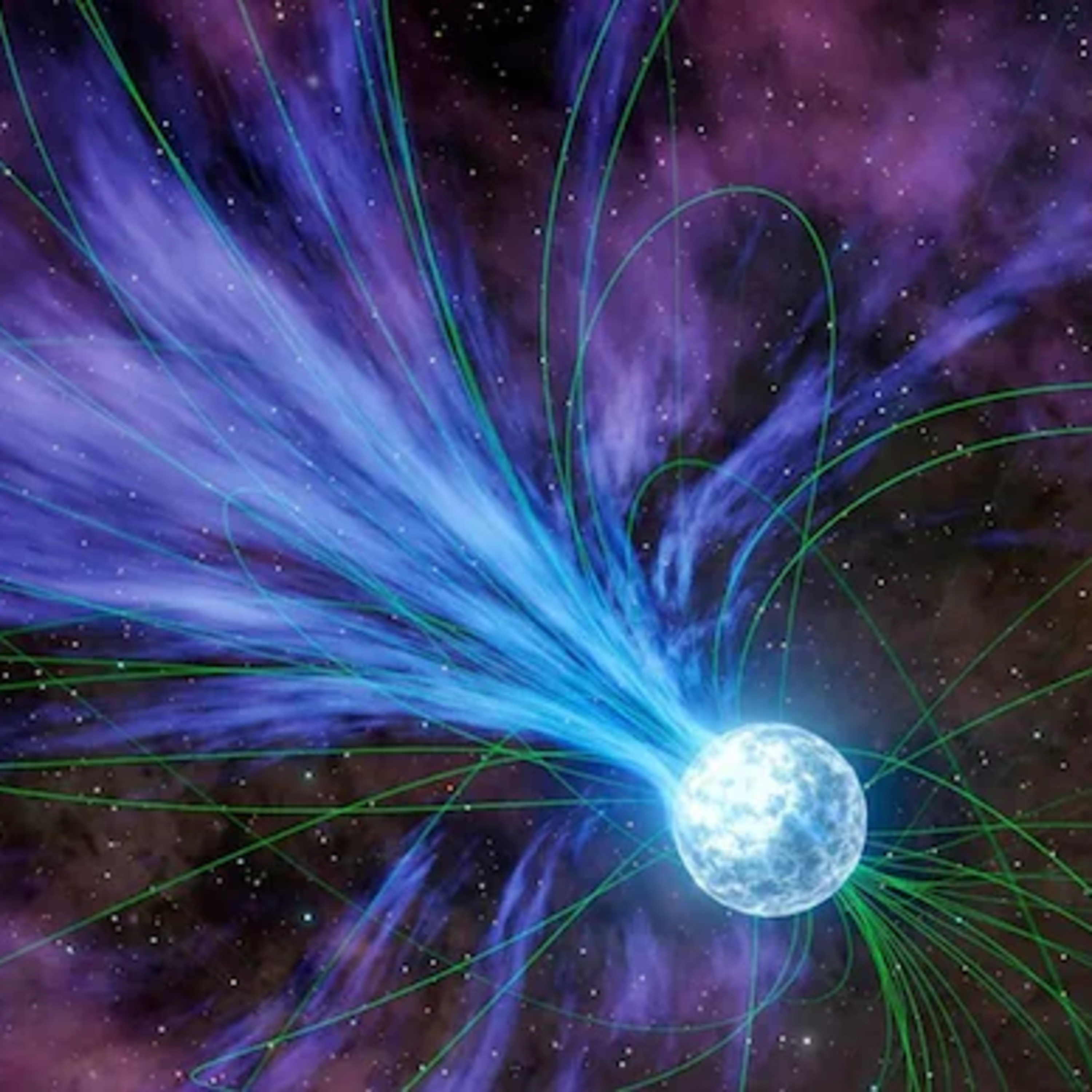
**Reference:** Patel et al., "Direct evidence for r-process nucleosynthesis in delayed MeV emission from the SGR 1806-20 magnetar giant flare" (2025) * **Introduction:** * The origin of heavy elements, specifically those formed through the rapid neutron-capture process (**r-process**), has been a long-standing mystery in astrophysics. * While neutron star mergers have been considered a primary site, evidence suggests additional sources are needed to explain the observed abundance of these elements. * **Magnetar Giant Flares as r-process Sites:** * Recent studies have proposed that magnetar giant flares can eject neutron star crust material at high velocities, creating the conditions necessary for the r-process. * These flares are the most energetic outbursts from magnetars, releasing vast amounts of energy. * **The ejected material is shock-heated, leading to r-process nucleosynthesis**. * **Observational Evidence:** * The 2004 giant flare from the magnetar SGR 1806-20 exhibited a previously unexplained **delayed MeV gamma-ray emission**. * This emission, peaking around 10 minutes after the initial flare, is consistent with the radioactive decay of freshly synthesized r-process elements. * The light curve, fluence, and spectrum of this emission match theoretical predictions for r-process material. * The observed data suggests that approximately **10^-6 solar masses of r-process elements** were synthesized in this event. * **The Mechanism:** * The "α-rich freeze-out" mechanism, facilitated by high entropy and fast expansion rates, allows for the synthesis of heavy elements even when the initial material is not particularly neutron-rich. * The radioactive decay of these nuclei releases gamma-ray lines, which are Doppler broadened by the high ejecta velocities, resulting in the observed MeV spectrum. * **Implications:** * Magnetar giant flares contribute at least **1-10% of the total Galactic r-process abundances**. * They may be particularly significant in the early universe, contributing to the chemical enrichment of low-metallicity stars. * These flares are also implicated as potential sources of heavy cosmic rays. * The discovery of this r-process site has implications for understanding Galactic chemical evolution and the origin of heavy elements. * The synthesized abundance distribution is predicted to be dominated by first-peak nuclei (A~90). * **Future Observations:** * Future missions like NASA's COSI nuclear spectrometer can resolve decay line features to provide further insight into r-process nucleosynthesis in magnetar flares. * Detection of a kilonova-like UV/optical signal (nova brevis) is also predicted, which may be detectable with wide-field telescopes. * **Conclusion:** * The study of the delayed MeV emission from SGR 1806-20 has provided direct observational evidence for **r-process nucleosynthesis in magnetar giant flares**. * This finding challenges current models of heavy element formation and opens new avenues for research. Acknowledements: Podcast prepared with Google/NotebookLM. Illustration credits: NASA
NOW PLAYING
Beyond Mergers: Exploring Magnetars as R-process Factories
No transcript for this episode yet
Similar Episodes
May 12, 2026 ·4m
Apr 28, 2026 ·5m
Apr 20, 2026 ·4m
Apr 13, 2026 ·8m
Apr 6, 2026 ·7m
Apr 1, 2026 ·4m