
EPISODE · Oct 11, 2020 · 0 MIN
Bhaj Govindam Verse 14
from Shruti Says
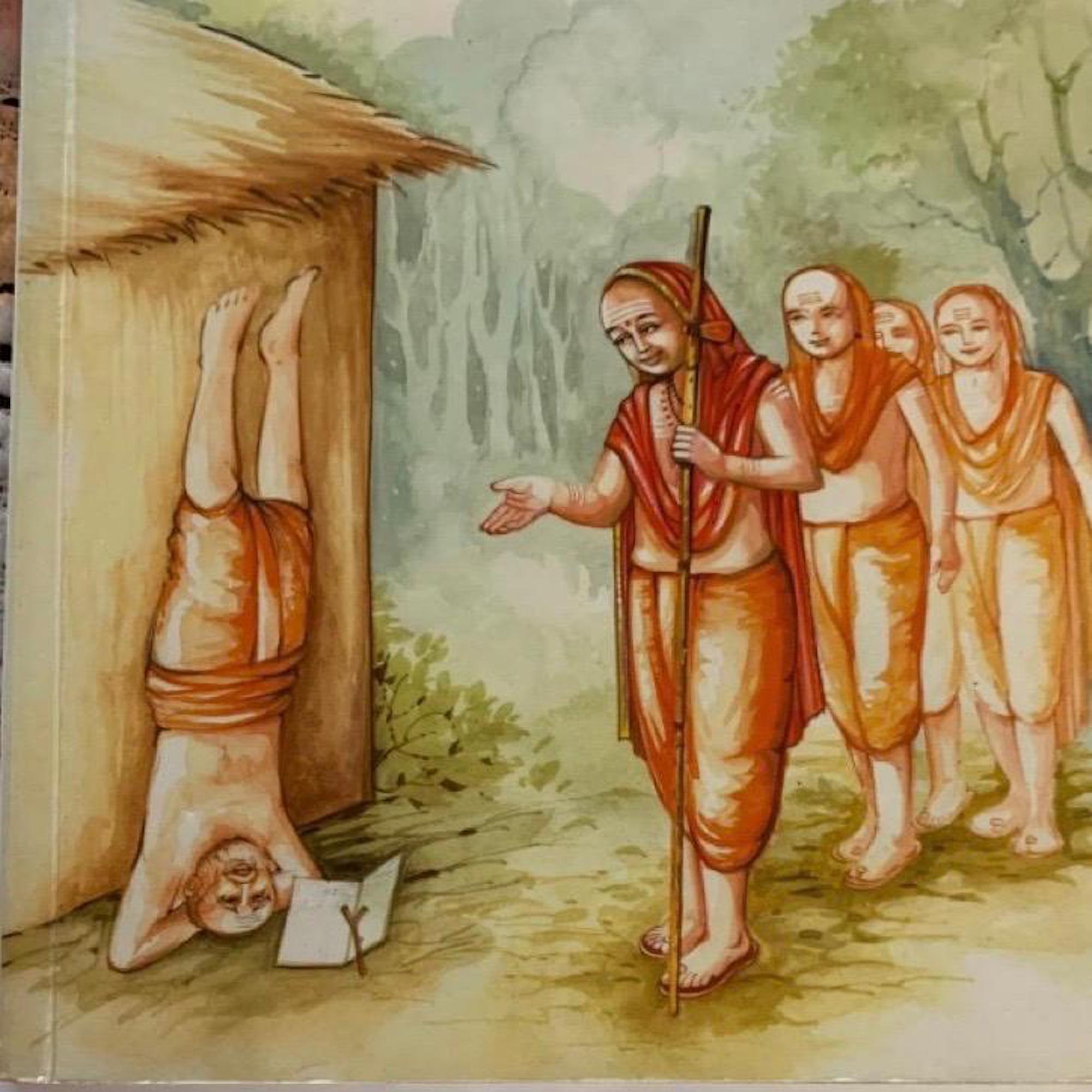
Bhaj Govindam It is rare indeed to find a disciple who is able to take the guru’s work and word forward. There can be a crowd of thousands, yet not one would be able to resonate with the teachings of the guru and the realisation of the self. There is something more that is needed, not just teachings, this we saw when we read about the desperate Guru, who went to the rice picker (with no scriptural knowledge) to make him a successor, inspite of having 500 highly so called, qualified disciples. (refer to Verse 11, Story 2)Guru Shankaracharya was blessed, to have self realised followers. In this verse we will see, how beautifully Guru Padmapada, goes a step forward to explain what his guru said in the precious verse. He has built on and given more clarity on what is not a ‘Sajjan Purush’ and how to keep from being deceived by others and the self. It is important to note - most often we cheat ourselves, and fool the self into believing what we are not.It is also important to mention here that there is often a debate as to which verse is attributed to Shankaracharyaji and which to the students. But, when the teacher and the student both become one with the divine, no difference remains.Verse 14जटिलो मुण्डी लुञ्छितकेशः, काषायाम्बरबहुकृतवेषः।पश्यन्नपि च न पश्यति मूढः, उदरनिमित्तं बहुकृतवेषः॥Jatilo Mundi LuncitakesahKasayambarabahukrtavesahPasyannapi Ca Na Pasyati MudhoHyudaranimittam BahukrtavesahBhaja Govindam Bhaja GovindamThe fourteenth verse said to me - Shruti Says🌷Matted locks, shaven head, hair pulled out one by one,red, ochre coloured robes - so many different get ups.Inspite of seeing the fool does not see,that just to satisfy ones stomach (ego, hunger), various disguises have been displayed.Don’t get fooled - Beware Beware Beware—————————————————Never judge a book by its cover we have often heard. Never let the first impression be the last impression we have been warned. But, it takes a lot of vigilance and alertness to stop the flow of thoughts, which is condition to believe what one sees and is trained to accept what one hears, and often negate what the heart feels and says. Don’t relay on your senses, but see how your heart feels - It is what comes from the heart that goes to heart. But in the rush to be practical, the subtle emotionalities of things are just suppressed.“Something tells me, I can’t say what, but something tells me… is something we more often than not just over look.”Here, there are three kind of deceptions that we are being warned of in the form of outer appearance;An imposter in the garbs of a sageA person who sets out with the heart in place, but strays in the path of SadhanaA person who is fooling the self into believing what he/she is not (This one being the most dangerous)An Imposter in the garbs of a SageEk Ghada tha mota taja,baan baitha jangal ka raja.Kahi sher ka chamda paya,Jhat wesa hi roop banaya.Saab ko khub darata vaan mai,rehta app needar ho main mai.Ek baar jo jee mai aayi,Laga garaj ne dhum macahi.Per ghada garaj ta nahin hai na.This poem is about a donkey who found the skin of a lion, with this on, he fooled and ruled all in the jungle, until, one day when he opened his mouth to roar, we all know what happened. His secret was let out, as he could only bray - hee haw.This was what was happening in the times of Guru Shankaracharya and it is evident today also. In the guise of sages there are so many imposters all around us. It is very difficult to find out who is a realised soul and who is not. Moreover, the picture of the sage which has been itched into our head is the one of a particular outer appearance - Matted locks or shaven head or hair pulled out one by one or red, ochre coloured robes etc.So much so that, that self esteem of a Grihasth (house-holder) has been tampered to so much that, they consider themselves not only lower, but also incapable of God realisation. Them or a person who leads a normal life like them, can never be the one who is a knower of God. Pitiably they say, what to do I am just a householder, I am no a sage.Hence, time and again we get fooled by the get up and the set up. What a sorry state of affairs. ‘One does not have to run away from ones responsibility in the name of God, if you are determined you can be devoted to God anywhere.’There are four Ashrams and each ashram is important and has a decorum. Each ashram prepares us for the next Ashram again if we live a controlled life which is not given to sensual enjoyment. Upyog is never condemned, but upbhog is definitely not encouraged. Most of our greatest Sages have been Grihastas. It was never felt that path of salvation was unattainable by a Grihasta. It is on the house-holder to raise their lives to the level of the divine and save all from the impending doom. ‘’Householder’s life is also a life of Yoga. It is also a life of Brahmacharya. It is a life of Brahmacharya in the sense it is a life of self-restraint and indulgence in moderation. We have always thought that householder’s life is something against Sadhana. No.’ That is not true. The life of a Sanyasi can be compared to an ocean if the life of a householder is compared to a small drop. The Sanyasi is like a blazing Sun, if the householder is like the flame of a candle. BUT, these comparisons are true only between an ideal Sanyasi and a deluded, ignorant, passionate householder. An ideal house-holder is equal to a Sanyasi. All glory to that householder who keeps Realisation as his ultimate aim. He is the ideal of the Gita. He practises Nivritti (renunciation) in Pravritti (life in the world). The householder’s life is based on Anasakti (non-attachment). The householder should have no cravings. His is a life dedicated to service. Such a householder is a Sanyasi.’’ ShivanandajiMoreover,We should remember, that Sanyas Ashram has its own decorum, ones a person has taken to Sanyas and dons the robes, he or she is strictly forbidden from any kind of Sangarah - accumulation. They can not have more than they need in any form, they can not have an ashram or any kind of possessions at all. That is the decorum of Sanyas Ashram. Pot, drinking cup and flask – the three supports, a pair of shoes,a patched robe giving protection – in heat and cold, a loin cloth,bathing drawers and straining cloth, triple staff and coverlet.— Sannyasa Upanishad, 1.4On the contrary, the so called Sanyasis of today just leave one family to join another. They just migrate from a small house and household to a bigger one. This act is not being condemned but the decorum of a sanyasi is not met. Just like the fish being in water is unable to get rid of its smell.Nahay Dhoye kya huva jo maan mail na jae.meen sada jal mai rahe,doye baas na jae.How does it help by taking a bath,when the dirt on the heart does not get cleaned.The fish always stays in the water,however the smell remains.A Sadhak who gets strayedWhat happens to most sadhaks (aspiring devotees) - They get lost in the accolades and in the process lose sight of God. Guru - Are you enjoying what you are doing?Sadhak - Yes, I am enjoying.Guru - Are you enjoying narrating and chanting?Sadhak - Yes, I am enjoying Guru, after multiple question - Are you able to connect to the divine? Enjoyment is not the objective. (Be careful and beware)How true, many a times a Sadhak, forget that all that he is doing is for being able to connect to the Lord and not for further indulgence of the senses. This is a very scary from of delusion, which the sadhak gets trapped in, and it also goes unnoticed. If they are able to over come accolades and move ahead, siddhi becomes an obstacle, which is mistaken for realisation and the Sadhak comes back to the material world to show his achievements. Maaya taje toh kya hua,Maan Taja na jaye. Maan bade munnivar gaye,Maan saban ko khaaye.It is easy to give up wealth,It’s giving up the ego that’s a true task.Even the greatest man have fallen prey to it,The ego never ends and eats all.A person who is fooled by the selfOne day Narad Muni went out on his routine tour around earth. There he saw a Sage submerged in water, he went up to the Sage and did Naman. The sage was very happy to see Narad Muni and he requested Narad Muni to ask God when he would come to meet the Sage. The sage also added that he was sure that God would come soon. Next, Narad Muni saw a cobbler, who jumped up at the sight of Narad muni and did Naman. He was so overwhelmed to Narad Muni. Narad muni stopped, to talk and while taking asked do you have any question for God. The cobbler said, What do I know to ask? But, as you insist, Would I ever be able to meet God? Narad Muni went up to God and narrated both the episodes. God said, Tell the sage, another 100 births before he can even think of meeting me. God Said, Tell the cobbler I can’t wait to meet him too, will be coming soon.Narad Muni was baffled he said, the Sage has been doing so much to please you and the cobbler here does not even have time to pray. God...
NOW PLAYING
Bhaj Govindam Verse 14
No transcript for this episode yet
Similar Episodes
Apr 23, 2026 ·51m
Apr 22, 2026 ·51m
Apr 22, 2026 ·62m
Apr 21, 2026 ·50m
Apr 21, 2026 ·68m
Apr 20, 2026 ·51m