
EPISODE · May 23, 2026 · 1H 3M
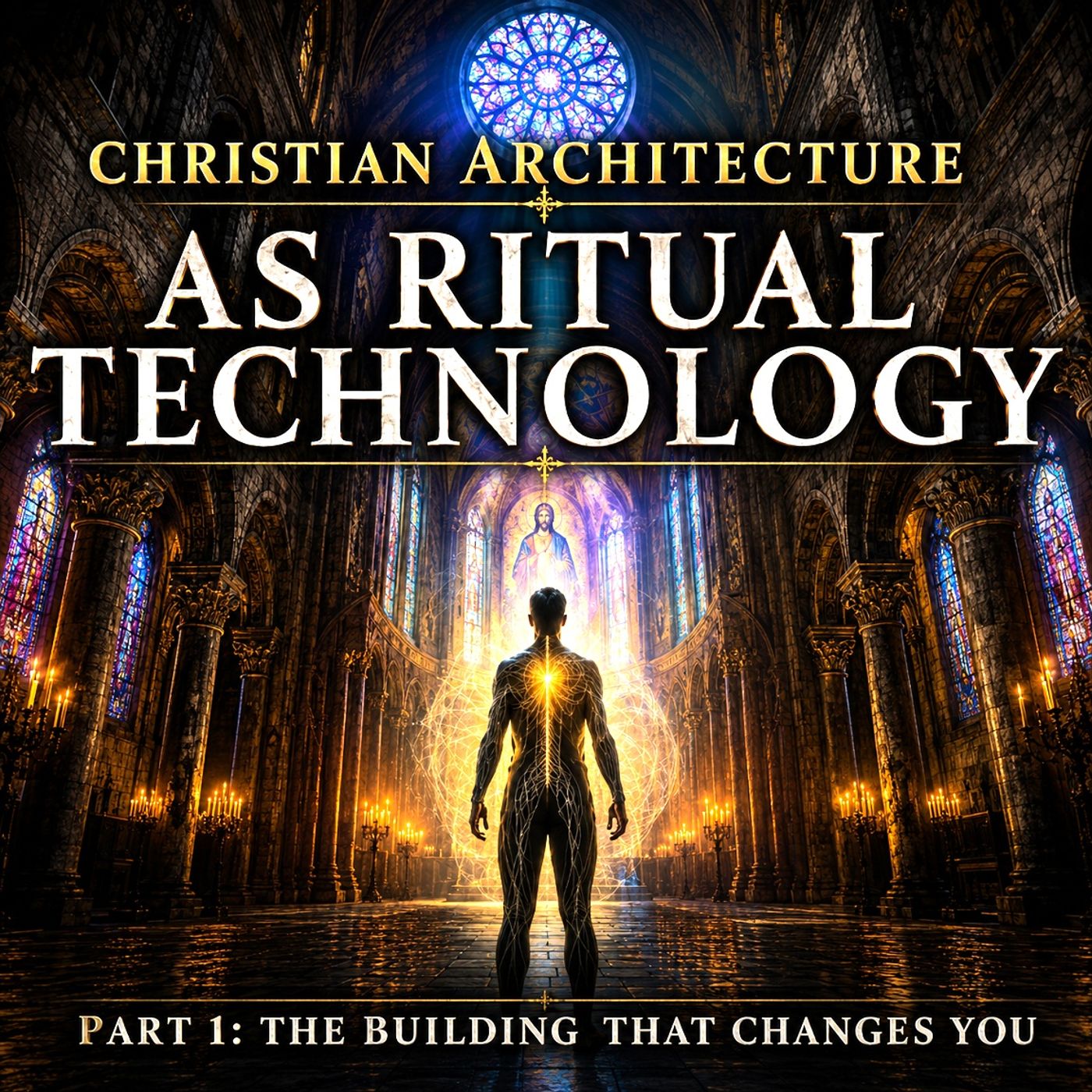
Christian Architecture as Ritual Technology Part 1: The Building That Changes You
from The Occult Rejects · host The Occult Rejects
If you enjoy this episode, we’re sure you will enjoy more content like this on The Occult Rejects. In fact, we have curated playlists on occult topics like grimoires, esoteric concepts and phenomena, occult history, analyzing true crime and cults with an occult lens, Para politics, and occultism in music. Whether you enjoy consuming your content visually or via audio, we’ve got you covered - and it will always be provided free of charge. So, if you enjoy what we do and want to support our work of providing accessible, free content on various platforms, please consider making a donation to the links provided below. Thank you and enjoy the episode!Links For The Occult Rejectshttps://linktr.ee/theoccultrejectsOccult Research Institutehttps://www.occultresearchinstitute.org/Substackhttps://substack.com/@theoccultrejects?r=7auau0&utm_campaign=profile&utm_medium=profile-pageCash Apphttps://cash.app/$theoccultrejectsVenmo@TheOccultRejectsBuy Me A Coffeebuymeacoffee.com/TheOccultRejectsPatreonhttps://www.patreon.com/TheOccultRejectsEPISODE 1 BIBLIOGRAPHYThe Building That Changes YouAckerman, Joshua M., Christopher C. Nocera, and John A. Bargh. “Incidental Haptic Sensations Influence Social Judgments and Decisions.” Science 328, no. 5986 (2010): 1712–1715. Key use: Haptics, touch, weight, texture, hardness, and the idea that physical sensation can influence judgment and social interpretation. This supports the tactile layer of the episode: heavy doors, cold stone, worn rails, kneelers, relic cases, and sacred matter as meaningful contact.Higuera-Trujillo, Juan Luis, Carmen Llinares, and Eduardo Macagno. “The Cognitive-Emotional Design and Study of Architectural Space: A Scoping Review of Neuroarchitecture and Its Precursor Approaches.” Sensors 21, no. 6 (2021): 2193. Key use: Neuroarchitecture, emotional response to built environments, and the idea that architecture can be studied as a cognitive-emotional stimulus rather than only as art or style.Kilde, Jeanne Halgren. Sacred Power, Sacred Space: An Introduction to Christian Architecture and Worship. Oxford University Press, 2008. Key use: Major backbone source for Christian architecture as a system of worship, power, spatial order, and embodied religious experience. Oxford’s description emphasizes Kilde’s argument that church buildings represent and reify different forms of power, especially divine power.Morgan, David. The Sacred Gaze: Religious Visual Culture in Theory and Practice. University of California Press, 2005. Key use: Religious seeing, visual culture, sacred images, and the idea that vision is an active religious practice that can invest images, persons, times, and places with spiritual meaning.Taves, Ann. Religious Experience Reconsidered: A Building-Block Approach to the Study of Religion and Other Special Things. Princeton University Press, 2009. Key use: Helps frame religious experience without reducing it to one fixed category. Useful for the episode’s approach to how experiences become interpreted, named, and treated as religious or sacred.Clark, Andy. Surfing Uncertainty: Prediction, Action, and the Embodied Mind. Oxford University Press, 2016. Key use: Predictive processing, active inference, and the idea that perception is not passive recording but active prediction and model-building. This supports the “brain does not enter a church like a camera” argument.Krueger, Joel. “Extended Mind and Religious Cognition.” 2016. Key use: Extended and embodied cognition applied to religious practice, ritual objects, and environments. Useful for arguing that worship is not only inside the head but supported by bodies, tools, spaces, and shared action.Oxford Academic. “Embodied Cognition in Ecclesial Practices.” In Oxford Studies in Analytic Theology, 2023. Key use: Christian practices, embodied cognition, Eucharistic action, and religious material culture as cognitively significant rather than merely symbolic.Piff, Paul K., Pia Dietze, Matthew Feinberg, Daniel M. Stancato, and Dacher Keltner. “Awe, the Small Self, and Prosocial Behavior.” Journal of Personality and Social Psychology 108, no. 6 (2015): 883–899. Key use: Awe, vastness, the “small self,” and the psychological effects of encountering something perceived as larger than the ordinary self. This supports the cathedral-scale and sacred-vastness argument.Tarr, Bronwyn, Jacques Launay, and Robin I. M. Dunbar. “Music and Social Bonding: ‘Self-Other’ Merging and Neurohormonal Mechanisms.” Frontiers in Psychology 5 (2014): 1096. Key use: Music, synchrony, social bonding, rhythmic action, and group cohesion. This supports the sections on chant, group singing, ritual synchrony, and bodies acting together in sacred space.Ittyerah, Miriam. “Memory for Curvature of Objects: Haptic Touch vs. Vision.” 2007. Key use: Haptic memory, touch-based object recognition, and the idea that touch can produce durable memory traces. Useful for worn rails, thresholds, beads, icons, relic cases, and repeated sacred contact.Lange, Lisa S., et al. “Tactile Memory Impairments in Younger and Older Adults.” Scientific Reports, 2024. Key use: Modern tactile-memory framing; useful for the claim that tactile experience is remembered and retrieved as part of embodied life.Freedberg, David. The Power of Images: Studies in the History and Theory of Response. University of Chicago Press, 1989. Key use: Image response, embodied reaction to sacred or charged images, and why religious images can provoke devotion, fear, destruction, reverence, or bodily response.Plate, S. Brent. A History of Religion in 5½ Objects: Bringing the Spiritual to Its Senses. Beacon Press, 2014. Key use: Material religion, objects, sensory experience, and the idea that religion is encountered through things, not only beliefs.Meyer, Birgit. Mediation and the Genesis of Presence: Toward a Material Approach to Religion. Key use: Material religion, mediation, presence, and how religious traditions use media, objects, images, sounds, and spaces to make the sacred present.Pallasmaa, Juhani. The Eyes of the Skin: Architecture and the Senses. Key use: Architecture as a multisensory experience, especially touch, materiality, atmosphere, and the limits of treating architecture as only visual.Mallgrave, Harry Francis. The Architect’s Brain: Neuroscience, Creativity, and Architecture. Wiley-Blackwell, 2010. Key use: Architecture and neuroscience, built form, emotion, perception, and embodied response to space.Robinson, Sarah, and Juhani Pallasmaa, eds. Mind in Architecture: Neuroscience, Embodiment, and the Future of Design. MIT Press, 2015. Key use: Embodiment, neuroscience, architectural perception, and how built environments shape lived experience.Eliade, Mircea. The Sacred and the Profane: The Nature of Religion. Key use: Sacred space, threshold, center, axis mundi, and the distinction between ordinary space and holy space. This becomes more important in Episode 2, but it also supports Episode 1’s general sacred-space framework.van Gennep, Arnold. The Rites of Passage. Key use: Separation, threshold, and incorporation. Useful for the threshold logic that runs through the whole series.Turner, Victor. The Ritual Process: Structure and Anti-Structure. Key use: Liminality, transition, communitas, and the ritual power of in-between states.Tuan, Yi-Fu. Space and Place: The Perspective of Experience. Key use: Lived place, memory, experience, and the difference between abstract space and meaningful place.Smith, Jonathan Z. To Take Place: Toward Theory in Ritual. Key use: Ritual as place-making; sacred places are produced through repeated action, interpretation, and return.Morgan, David. Visual Piety: A History and Theory of Popular Religious Images. Key use: Popular religious images, devotional seeing, sacred practice, and how visual material becomes part of lived religion.Kieckhefer, Richard. Theology in Stone: Church Architecture from Byzantium to Berkeley. Key use: Church architecture as theology in built form, useful as a broad Christian architectural bridge source.Also want to remind people about the website, if you're into reading we have tons of information by multiple contributors, and we got t-shirts up on the site if you're interested. Fun fact, the art is all based on the eyeball. A
NOW PLAYING
Christian Architecture as Ritual Technology Part 1: The Building That Changes You
No transcript for this episode yet
Similar Episodes
Dec 5, 2025 ·50m
Oct 9, 2025 ·33m
Oct 3, 2025 ·40m
Sep 11, 2025 ·31m
Aug 27, 2025 ·39m
Aug 18, 2025 ·54m