
EPISODE · May 22, 2026 · 8 MIN
Why Lead Contamination in Black Schools Remains a Silent Crisis
from African Elements Daily · host African Elements
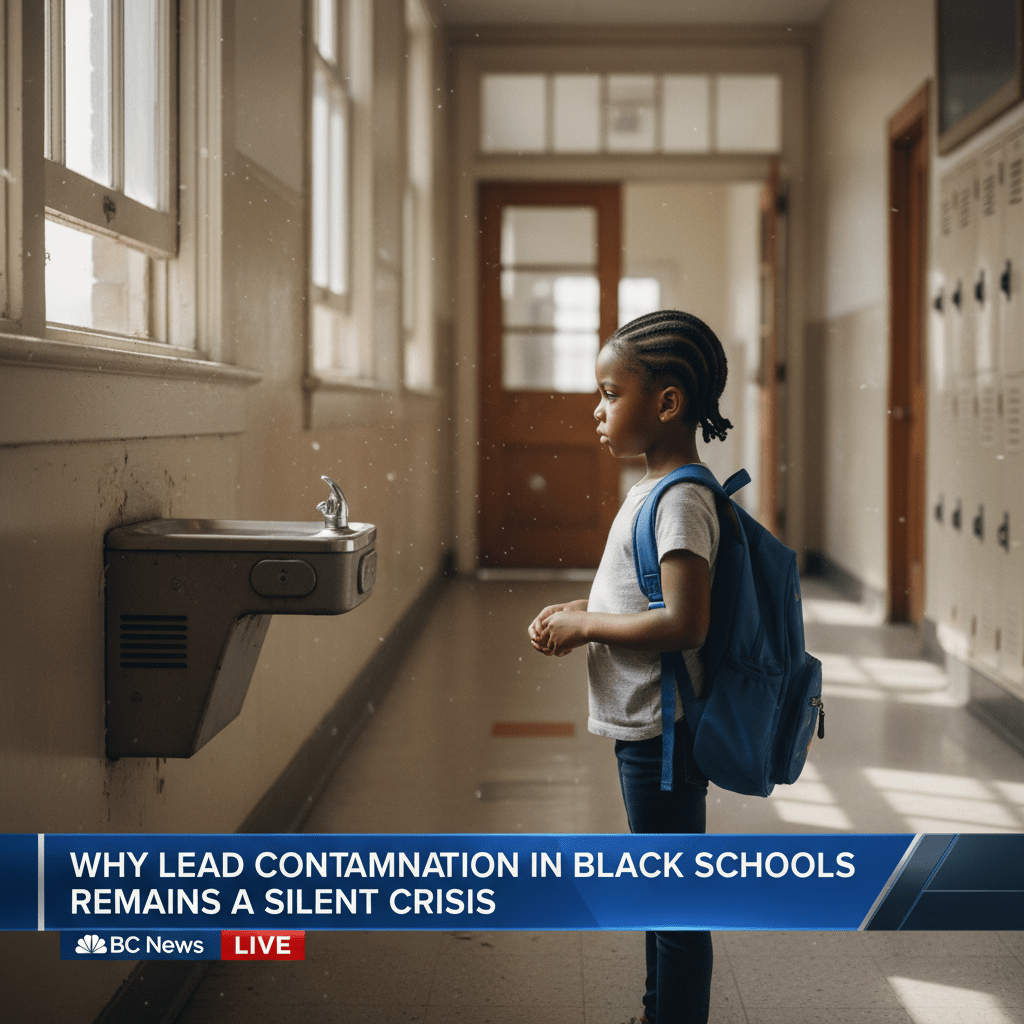
This silent crisis of lead contamination in Black schools impacts health and academic success. Learn about the infrastructure debt and policy gaps driving it. Why Lead Contamination in Black Schools Remains a Silent Crisis By Darius Spearman (africanelements) Support African Elements at patreon.com/africanelements and hear recent news in a single playlist. Additionally, you can gain early access to ad-free video content. The Quiet Poisoning of Black Classrooms Around the nation, children go to school to open their minds. However, many Black students open water fountains that slowly poison them. This silent health crisis is happening right now in Black school districts across the United States. Environmental justice advocates are raising alarms about lead-contaminated infrastructure. The legacy of this pollution directly undermines the physical health and academic success of students of color. Recent news highlights the immediate threat. In 2025, Memphis-Shelby County Schools discovered elevated lead levels. Water tests showed lead above twenty parts per billion across twenty-four campuses (localmemphis.com). In Milwaukee, multiple public schools faced temporary closures. The shutdowns occurred after children tested positive for high blood lead levels linked to peeling paint and older plumbing fixtures (spokesman-recorder.com). Similarly, in places like Oakland, students had to rely on bottled water because fountains were toxic (nrdc.org). These incidents show that lead is still a major problem. It is an issue that continues to impact student lives daily. The Industrial Push for Toxic Plumbing To understand how lead entered these schools, one must look at history. In the early twentieth century, lead was highly valued for its durability. Industry leaders called lead the "Cadillac of pipes." While European nations began banning lead in the 1920s, the United States took a different path. The Lead Industries Association lobbied aggressively to keep lead in municipal building codes (theguardian.com). This powerful trade group successfully convinced local governments to mandate lead pipes. By 1930, nearly seventy percent of major American cities required lead pipes for water service lines (nrdc.org, lslr-collaborative.org). The lobby group suppressed medical warnings about toxicity. They chose corporate profit over public health. Consequently, millions of miles of toxic pipes were buried beneath growing cities. This legacy remains in the ground today, where over nine million lead service lines still exist (theguardian.com). Lead in Water: Safety vs. Regulatory Standards (ppb) AAP Recommended Max for Schools 1 ppb FDA Bottled Water Standard 5 ppb EPA Action Level Limit 15 ppb Immediate Fixture Removal Level 20+ ppb Redlining and the Creation of the Lead Belt Federal housing policies further concentrated this danger. In 1934, the Federal Housing Administration established a practice known as redlining (ncrc.org). This system systematically denied mortgages to Black neighborhoods, marking them as hazardous on maps (ncrc.org, theguardian.com). As a result, Black families were trapped in older urban centers. These neighborhoods contained the highest concentrations of lead paint and lead plumbing. By 1962, the consequences of these policies were clear. Health experts in New York City identified what they called "lead belts" in redlined areas of Brooklyn (theguardian.com). In these zones, every single child diagnosed with severe lead poisoning was Black or Puerto Rican (theguardian.com). These artificial boundaries created a geographic trap. Decades of systemic neglect turned these neighborhoods into toxic environments. This process shows how barriers to academic achievement were built into the physical infrastructure of Black communities. The Regulatory Lag and the School Loophole Federal laws eventually banned lead paint in 1978 and lead pipes in 1986 (nrdc.org). However, these laws did not require the removal of existing infrastructure. The bans were not retroactive. This regulatory gap left older, underfunded schools to serve as toxic reservoirs. Children continued to drink from contaminated pipes. Furthermore, a major legal loophole exists in federal water regulation. The Environmental Protection Agency regulates municipal water systems, but it treats schools as customers rather than water systems (epa.gov). Because schools do not operate their own water sources, federal testing laws do not apply to them. Consequently, school water testing remains voluntary in thirty-four states (nrdc.org). In 2023, more than one-quarter of US states did not test a single school for lead (nrdc.org). This lack of oversight leaves children vulnerable to an invisible hazard. Black communities must continually push for shaping political dynamics to close these dangerous policy gaps. 68% 34 States Do not mandate lead testing in schools (Voluntary only). 26% 26% of States Did not test a single school for lead in 2023. The Severe Academic Toll on Black Children The medical community agrees that there is no safe level of lead in a child's body (centerforhealthjournalism.org). Even small amounts of this neurotoxin can cause permanent brain damage. Symptoms of exposure include hyperactivity, reduced attention span, and developmental delays. Over time, these symptoms lead to severe learning difficulties. Statistical data reveals a stark racial disparity. Black children have nearly three times higher odds of having elevated blood lead levels compared to White and Hispanic children, even when researchers adjust for income (centerforhealthjournalism.org). This disparity directly harms classroom performance. Research from the National Bureau of Economic Research found that lead exposure causes a moderate standard deviation drop in test scores (nber.org). Following the water crisis in Flint, students lost the equivalent of five months of learning progress in math (nber.org). Exposure also leads to an eight to nine percent increase in special education referrals. This academic setback prevents students from achieving economic justice later in life. The Modern Infrastructure Debt of Black Districts The root of this problem is a massive infrastructure debt. Because public school funding relies heavily on local property taxes, districts in formerly redlined areas cannot afford expensive plumbing repairs. Homes in majority-Black neighborhoods are valued at roughly half the price of homes in White neighborhoods. This gap leaves Black school districts with severely limited budgets. Consequently, many children attend school in aging buildings. The National Center for Education Statistics reports that the average public school building in the United States is forty-nine years old (nylcvef.org). Nearly thirty-eight percent of these schools were built before 1970, which predates the major federal lead bans (nylcvef.org). The total investment gap for school facilities is estimated at eighty-five billion dollars (nylcvef.org). This massive debt means that schools cannot replace ancient water lines or toxic fixtures. Even when a city replaces water mains, old brass fixtures inside the school continue to leach lead into the drinking water (rivernetwork.org). The Aging of School Infrastructure & Policy Gap Pre-1970 38% of schools built predating lead paint & pipe bans 1975 Average year of public school construction (49 years old) 1986 Safe Drinking Water Act lead plumbing ban (Not retroactive) Modern Battles and the Filter First Movement In October 2024, the federal government updated the Lead and Copper Rule Improvements (epa.gov). This new rule requires municipal water systems to replace nearly all lead service lines within ten years (epa.gov). Civil rights organizations like the NAACP praised the rule, but they also identified a critical loophole. The federal mandate does not force schools to test or fix the plumbing inside their buildings (nrdc.org). To solve this problem, advocates are pushing for a "Filter First" approach. Michigan became a national leader in 2023 by passing a law requiring schools to install lead-filtered water stations by the 2025–2026 school year (nrdc.org). This method is highly effective and costs much less than replacing every pipe in a building. Specialized water filters can instantly reduce lead levels to below one part per billion (nrdc.org). Historically, community organizations have had to step in to protect children when governments failed. Groups dedicated to advocating for community health have long shown that grassroots action is necessary to force systemic change. Pathways to Environmental Justice This silent health crisis is a clear example of environmental racism. Sociologists have long documented how toxic hazards are disproportionately located in communities of color (centerforhealthjournalism.org). When school water remains toxic, it limits the future of Black children before they even reach adulthood. It is a slow, structural form of violence that requires immediate federal intervention. Parents and community advocates do not have to wait for the government to act. Families can use the Environmental Protection Agency "3Ts" toolkit to check if their local schools are testing water correctly (epa.gov). Parents can also formally request a school's plumbing profile and water test results through public records requests (nrdc.org). Until federal policies require mandatory testing inside school buildings, local communities must remain vigilant to protect their children from this invisible poison. About the Author Darius Spearman is a professor of Black Studies at San Diego City College, where he has been teaching for over 20 years. He is the founder of African Elements, a media platform dedicated to providing educational resources on the history and culture of the African diaspora. Through his work, Spearman aims to empower and educate by bringing historical context to contemporary issues affecting the Black community.
NOW PLAYING
Why Lead Contamination in Black Schools Remains a Silent Crisis
No transcript for this episode yet
Similar Episodes
No similar episodes found.