
EPISODE · May 12, 2026 · 45 MIN
Governance, Context, and the Org-Design Reckoning
from The AI podcast for product teams · host Arpy Dragffy
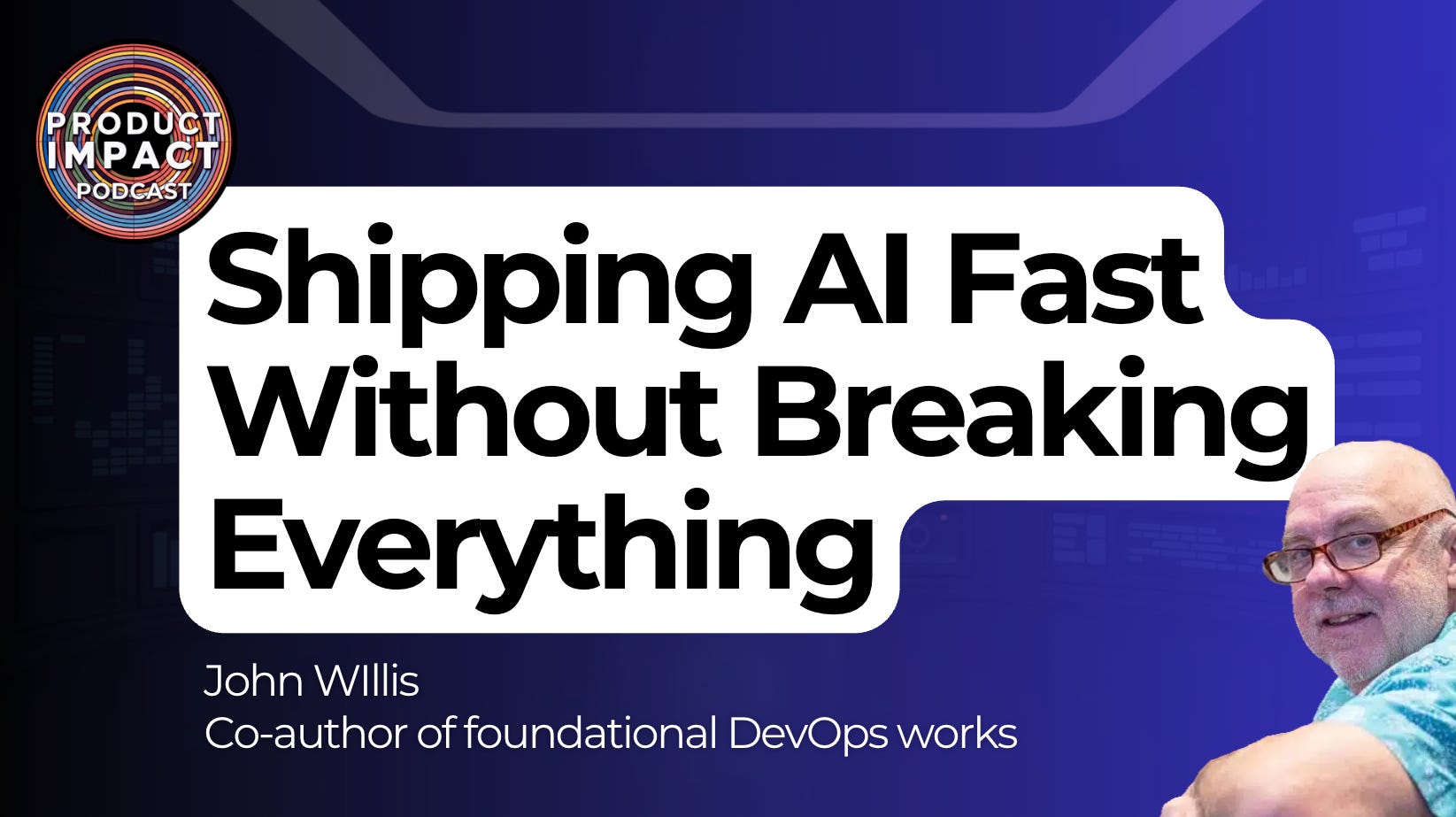
Atlassian connected its AI agents to a richer layer of company knowledge (documents, projects, goals, people) and measured a 44% improvement in answer accuracy using 48% fewer resources. Same models. Different information. Brian Armstrong restructured Coinbase the same week: 14% headcount cut, five management layers maximum. When AI can surface what previously required institutional memory and senior tenure, the organizational layers built around that knowledge become harder to justify.The visible shift gets covered in tech headlines. What gets lost in the announcement energy: none of this works if the company hasn’t decided what it wants AI to do.The more widespread barrier is upstream of governance. Most executives approving AI budgets are working through the aftermath of pilots that underdelivered, first-generation deployments that didn’t survive contact with their actual data, and early model results that left skepticism the current tools have since substantially outrun. That trust deficit — organizations evaluating new AI investment based on experiences two generations old — is where enterprise AI projects most commonly stall. Shadow AI governance and deployment intent are real risks, but they’re downstream of that harder problem. There is no closing the capability gap inside an organization that is quietly waiting for the next deployment to fail too.John Willis co-wrote The DevOps Handbook because software teams were shipping code fast without feedback loops or governance. He sees the same pattern repeating with AI — and he spent five decades documenting what happens when the gap between vendor promises and operational reality gets this wide.* Why shadow AI is more dangerous than an outright ban* Why throughput without governance means instability at scale* Why governance creates flow instead of stopping it* Why most teams have ML evaluation tools when they need audit trails* Why even a five-person startup needs digitally signed records of agent decisions* What AI winters teach us about where we actually are nowListen: Spotify | Apple PodcastsRikki Singh leads product innovation at Twilio — what the company calls its biggest launch in 17 years. Before Twilio she was at McKinsey, where she co-authored the definitive research on what makes a great PM. The Qualtrics 2026 CX Trends Report found nearly 1 in 5 consumers who used AI customer service saw zero benefit. That number is the benchmark she is working against.* Why most AI CX is still FAQ automation with better packaging* Why the LLM wrapper creates false confidence — the model generates strings, it is not thinking* Vitamins vs painkillers: how to parse what customers don’t say out loud* How to protect long-horizon bets inside a public company* Why the brand owns the accountability when AI gets a high-stakes interaction wrongListen: Spotify | Apple Podcasts📅 productimpactpod.com is the hub for AI product strategy, news, and analysis. All the articles featured in this edition are sourced from Product Impact’s own reporting.AI Value Acceleration is building a report on where enterprise AI investments are actually creating value. If you’re responsible for a major AI investment — leading it, funding it, or proving it’s working — we want to talk to you.Every CEO Will Post a Layoff Notice Like This. Here Is Why.Brian Armstrong’s May 5 Coinbase memo framed a 14% headcount cut as a structural prerequisite for AI adoption, not a consequence of it. Three principles: hard cap of five management layers, player-coaches who produce output alongside their teams, and AI-native pods where one person spans engineering, design, and product with agent support. Sequoia’s 2026 analysis found AI-native startups already ship three times faster with 60% fewer engineers — that’s the economic gap the restructuring is attempting to close.The jobs being cut are not cyclical. Investor metrics increasingly measured by revenue per employee, AI capex commitments requiring demonstrated productivity returns, and talent migration toward AI-native organizations are three pressures no individual CEO can deflect. The new career metric is leverage — how much the organization moved because of the quality of your judgment, not how many tasks you completed.Read the full analysis at productimpactpod.comContext Is Now the AI MoatThe biggest blocker to enterprise AI has never been the model — it’s been knowledge built in siloes, in incompatible systems, in formats AI tools can’t use.Atlassian’s Teamwork Graph benchmarked the fix: 44% more accurate answers, 48% fewer tokens, same models. Every major vendor — Microsoft, Glean, ServiceNow, Salesforce, Google — is converging on the same architecture. Whoever owns the most accurate map of how a given enterprise operates will own the AI layer running on top.What these tools don’t solve is why. Your documentation captures decisions; it rarely captures the reasoning behind them. Without that reasoning, AI searches across everything available and keeps going past the point where a senior employee would have stopped. Anyone who has watched an AI tool go confidently down the wrong path has seen this at small scale. Scale that across a hundred agents inside an enterprise when the intent was never established.Read the full analysis | What Graphs Are and Why They Matter — Brittany Hobbs’s explainer on the strategic shift for researchers and product leaders.Brittany’s UXR Series: The AI Shift for ResearchersPart 1: The UX Researcher’s Guide to Claude, Claude Cowork, and Claude Code — Which tool fits which workflow stage, privacy risks broken down by tier, and how prompt caching and the Batch API cut transcript processing costs by 50–90%.Part 2: The Cognitive Shift Every UX Researcher Needs to Make — MIT EEG research found AI-assisted knowledge workers showed lower brain engagement and produced homogenized output — with the deficit persisting after they stopped using the tool. Four shifts separate researchers compounding value from those producing faster mediocre work. Build explicit contradiction-seeking into every analysis prompt: it does more for output quality than anything else.Part 3: What UX Research Looks Like When Context Becomes the Engine — The role is moving from a step that produces decks to infrastructure that powers everyone else’s AI. Researchers who get ahead of this shift become the people who decide what gets captured, connected, and trusted — a more powerful position than any role the previous workflow offered.Thanks for reading Product Impact | AI Strategy, Value Creation, AI UX! Subscribe for free to receive new posts and support my work.Product Impact Resources* 1 in 5 consumers who used AI customer service saw zero benefit from the interaction. The bar enterprises are calling AI innovation is shockingly low, and customers feel it every time they’re routed to a bot reading from an FAQ. Qualtrics 2026 Customer Experience Trends Report* AI power users outperform everyone else by 6x — with identical tools available to both groups. The differentiator is approach, not access. Context graphs are about to commoditize the advantage power users built manually. OpenAI productivity analysis via VentureBeat* 49% of UX researchers now feel negative about the future of their discipline — a 26-point shift in a single year. Job postings fell 73% from 2022 to 2023 and haven’t recovered. 21% of organizations laid off researchers in 2025. User Interviews State of User Research 2025* AI-native startups ship three times faster than traditional companies with 60% fewer engineers. The economic gap is real, and it is what is driving the org-design decisions currently being framed as ideology. Sequoia Capital 2026 AI analysis* Thousands of apps built with vibe-coding tools have exposed corporate and personal data publicly — credentials, API keys, customer records — on the open web. The governance failure isn’t limited to enterprise AI deployments. It’s in every tool that makes building easier without making security more obvious. Wired: Thousands of Vibe-Coded Apps Expose Corporate and Personal Data on the Open Web* Someone built an open-source version of Claude’s design system. It’s a small signal with a large implication: the visual language of AI interfaces is becoming a shared standard, not a competitive moat. nexu-io/open-design on GitHub* 35.9% of US workers now use generative AI weekly. Adoption is broad and shallow. Frequency doesn’t correlate with impact — the 6x productivity gap holds because the differentiator is approach, not access. Microsoft New Future of Work Report 2025* The jagged frontier is moving up the stack. In 2024 the capability gaps showed at the task level. In 2026 they show at the workflow level — agents complete fifty-step refactors and stall on five-minute judgment calls. The constraint is no longer model capability; it’s context and intent. Ethan Mollick, One Useful ThingRecent from productimpactpod.com* 97% of Executives Deployed AI Agents. Only 29% See ROI. The Gap Is the Story of 2026.* Gartner Says 40% of Agentic AI Projects Will Fail. They’re Underselling It.* Microsoft’s Copilot Problem Isn’t Adoption. It’s Coerced Adoption.* Silicon Valley’s AI Is Repeating the Social Media Mistake* Stanford’s AI Index Proves the US Can’t Buy Its Way to an AI Lead* The 10% Problem: AI’s Value Gap Is Wider Than Anyone Is AdmittingCheck Out Recent EpisodesEpisode 8: The Most Important Data Points in AI Right Now — Stanford AI Index 2026, token economics as a financial decision, Apple’s hardware-first CEO succession, and a week of security breaches that proved capability and security are not moving at the same pace.Episode 7: $490 Billion in AI Spend Is Delivering Nothing — Orchestration Is the Fix — The five enterprise failure patterns nobody wants to name and the two futures orchestration makes possible.PH1 has spent 14 years helping product teams prove impact — diagnosing where AI products fail to measure, improving LLM-powered experiences, and building AI vision that survives contact with real users. If your organization has no bottom-line AI returns, that is a solvable problem. Let’s talk.Thank You for Supporting the Product Impact PodcastThe governance failures, the customer service AI that doesn’t actually help customers, and the restructuring announcements are different symptoms of the same mistake: deploying AI before deciding what you want it to do. The window to fix that is still open. Once agents are in production and decisions are being made, reversing the order is much harder.If this edition changed what question you’re asking, forward it to someone on your team who needs to hear it. Browse all episodes and analysis at productimpactpod.com.Thanks for reading Product Impact | AI Strategy, Value Creation, AI UX! This post is public so feel free to share it. This is a public episode. If you would like to discuss this with other subscribers or get access to bonus episodes, visit productimpactpod.substack.com
NOW PLAYING
Governance, Context, and the Org-Design Reckoning
No transcript for this episode yet
Similar Episodes
No similar episodes found.