
EPISODE · Aug 12, 2025 · 1H 40M
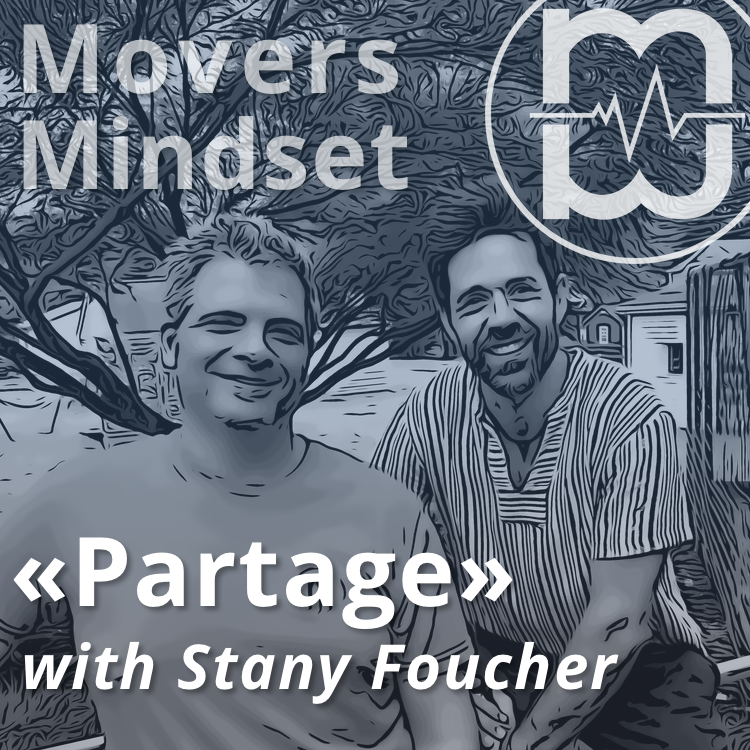
«Partage» with Stany Foucher
from Movers Mindset · host Craig Constantine
What new formats and practices best transmit Art du Déplacement’s culture—beyond technique—so practitioners can reflect, connect, and grow together? Art du Déplacement’s culture is deepened through «partage», reflective practice formats, and distinctive training like vision work and night missions. "Still, I had the fear, but I knew where I was, where I was going, [and] how— I knew myself better, basically. So this very strong experience with my friends, and this strong experience of failure— That was really an in between moment for me. […]There is before that training session at the «Dame du Lac» experiencing all this. And then there is me discovering more about my inner self and being very different in the way I approach fear." ~ Stany Foucher (1:33:00) The discussion frames Art du Déplacement as a living culture rather than simply a set of techniques. Stany's recently published, French-language book is highlighted as a deliberate choice, made with the awareness that language shapes who can engage with the ideas. (Craig and Stany hope that an English translation can eventually be created which captures the subtlety and depth of the material.) The strengths of books—slower pacing and deeper digestion—are compared to the reach and immediacy of video. This leads to exploring audio as a practice medium, with the idea of podcast-led movement sessions modeled on audio yoga classes. The conversation also touches on the value of building shared reference points across the community, so practitioners in different places can connect through common experiences. Practice design is a recurring theme. The Movers Mindset Pause project is discussed as a way to help practitioners form a cycle from discovery to reflection to change. Coaching is discussed as more than sets and repetitions, incorporating environment, questioning, and reframing experiences. Public-space QM is described as a way to normalize human movement in busy urban settings, reducing self-consciousness and building autonomy. The pair note the importance of training “vision” as a standalone capacity, distinct from fear management or technical skill. "Maybe one thing that I’m trying to focus on sometimes is this vision element of the discipline. Vision is really a topic by itself. If you just try to be in an analyzing mode, you know, trying to analyze the environment and be— not measuring, but just feeling— not for the sake of techniques, but just vision for vision. Maybe new things can arise." ~ Stany Foucher (58:00) They describe silent, “night missions” where participants select a distant, barely visible endpoint and navigate to it without touching the ground, focusing on presence, creative pathfinding, and trajectory rather than named techniques. Other modalities—lifting, carrying, climbing, and playing on varied terrain—are folded into practice to broaden capacity. Social aspects like shared meals, walks, and storytelling are recognized as essential for transmitting culture, complementing formal training. "But something that I really get, also from those years of training, and maybe you don’t see it is, all the questioning behind it. I cannot think of a training that would not end with a question— [an] open question from—especially from Jann [Hnautra]—just reflecting on what you did. Why were you in that state of mind when we’re doing this movement? Why did you want to stop when you were doing the QM? Lots of questions and reflecting on what you did. I think this is an important piece of the training." ~ Stany Foucher (28:00) Personal philosophy surfaces through parenting analogies—providing environments where children retain innate movement abilities—and a formative story of a major failure that marked a clear “before and after” in approaching fear. The conversation closes with reflections on building community connection despite geographic distance, testing new formats for sharing practice, and maintaining a loop where ideas, movement, and reflection continually reinforce each other. Takeaways Language shapes reach — Choosing French vs. English determines who can read, hear, and benefit. Books slow the pace — A book supports digestion of concepts that video often rushes past. Podcast as training — Audio sessions can guide live movement for listeners who learn by hearing. Build a reflection loop — Journaling and the Pause practice embed discovery to reflection to efficacy. Coaching beyond technique — The value includes questions, environment, and pointing in the right direction. Normalize movement in public — Holding QM sessions in busy spaces reduces self-consciousness and increases autonomy. Train vision explicitly — Treat “vision” as its own topic, not only fear or technique. Use night missions — Silent, goal-directed traversals cultivate presence and creative pathfinding. Mix natural modalities — Lifting, carrying, climbing, and terrain play (rocks, slopes) broaden practice. «Partage» matters — Sharing stories, meals, and walks transmits culture that classes alone can’t. Parenting reframes coaching — Provide safe environments so kids don’t lose what they already have. Failure as inflection point — A hard setback created a clear “before/after” in approach to fear. Resources https://wiseflow.fr/ — Stany Foucher's website for his book, podcast, and more. Art du Déplacement: Au delà de saut — French-language book discussed as framing the culture beyond movement; available as EPUB globally and in print within Europe. Wise Flow — Stany's French-language podcast. craigconstantine.com — Craig's personal web site with links to everything he does. Movers Mindset's Pause — The new Pause publication is a weekly email publication designed for movement professionals—coaches, teachers, gym owners, and practitioners—who want to slow down and reconnect with their deeper why. Stany Boulifard Mallet: Art du Déplacement, the Yamakasi, and motivation — Stany's first appearance, back in 2018, on the Movers Mindset podcast. Art du Déplacement (ADD) — Information about Art du Déplacement in general. Parkour & Art du déplacement: Lessons in practical wisdom – Leçons de sagesse pratique — Vincent Thibault’s 2015 book discussed in this podcast. The book contains both the French and English text. Don’t confuse it with the similarly named, but completely different book, “Parkour and the Art du déplacement: Strength, Dignity, Community”, published in 2014. There is also a second edition, which is French-language only. Out on the Wire — Book by Jessica Abel recommended by Craig as a book about podcasting, presented as a graphic-novel-style work interviewing leading creators. Meditations — Book by Marcus Aurelius (translated by Gregory Hayes) mentioned by Craig as his most-read book. Quadrupedal Movement (QM) — A practice and movement pattern emphasized in this episode and in Art du Déplacement generally. Communication with Vincent Thibault — Vincent Thibault's episode on Movers Mindset. Move NYC — Public event in New York City mentioned by Craig in reference to normalizing human movement in busy spaces. Joan of Arc Garden, in Quebec City — Location and statue mentioned by Craig as a setting for personal reflection. (Written with help from Chat-GPT.) ɕ --- Hello👋 I'm Craig Constantine. In the Movers Mindset podcast, I talk with movement enthusiasts to learn who they are, what they do, and why they do it. I'm interested in the nature and philosophy of movement and in exploring themes like independence, self-direction, and human excellence. My interests color each conversation and provide some structure to Movers Mindset. But since I like to take the scenic route, every conversation ends up going somewhere unique. The purpose of Movers Mindset is to create and share great conversations with movement enthusiasts. Each conversation feeds my insatiable curiosity, but I share them to turn on a light for someone else, to inspire them, or to give them their next question. I appreciate your time and attention, and I don’t take it for granted. --- Thank you! Want more? Subscribe to the email list for weekly updates—new episodes and archive highlights delivered to your inbox. I invite you to cultivate a meaningful life—through presence, not pursuit. You can learn more about me and all my projects at, https://craigconstantine.com. If you like what I'm doing through Movers Mindset, learn more about becoming a patron. ɕ
NOW PLAYING
«Partage» with Stany Foucher
No transcript for this episode yet
Similar Episodes
No similar episodes found.