
EPISODE · Oct 31, 2025 · 24 MIN
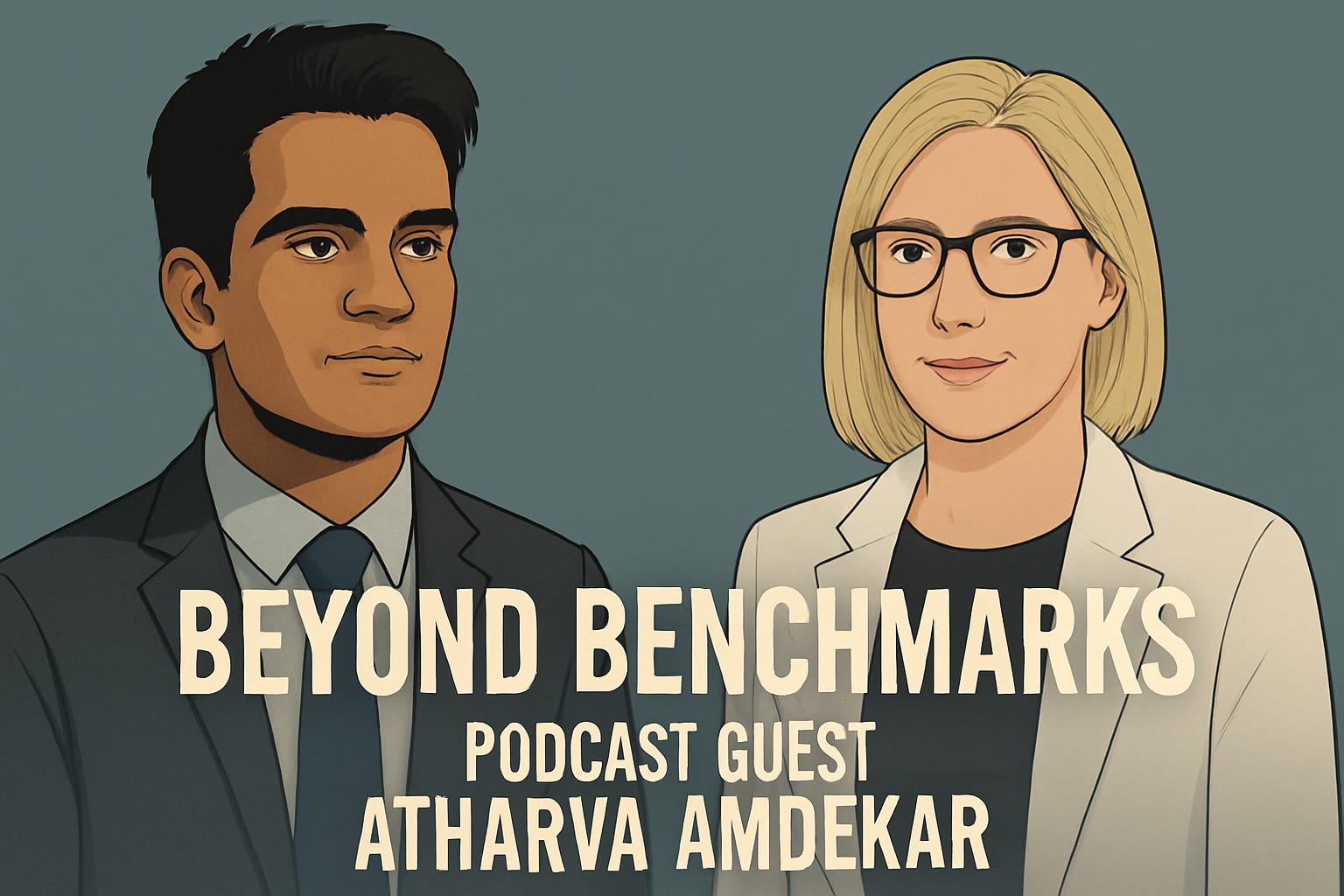
Podcast: What If AI Had a Conscience? A Real Talk with Researcher Atharva Amdekar
from Deep Learning With The Wolf · host Diana Wolf Torres
Some people enter AI to build faster systems. Atharva Amdekar came to understand them. From trading floors to research labs, his career reflects a deeper inquiry—not just into how AI performs, but into how it reasons, aligns, and sometimes misaligns with us.This conversation reveals not just how AI works, but how it should think.From IIT to Stanford: The Spark of CuriosityThe story begins not in a lab, but in a dorm room in India. It was the summer after his freshman year at IIT when Atharva stumbled onto Andrew Ng’s famed machine learning course on Coursera. “There was this sense of magic,” he recalls. “The moment a neural network recognized a handwritten digit—it was like watching a machine learn to see.”That sense of wonder carried him to Stanford, where curiosity matured into a rigorous exploration of AI’s deepest questions. And it was there that he learned to ask not just what machines can do, but why they do it.Lessons from the Trading Floor: When Models Meet the MarketBefore Stanford, Atharva worked in quantitative finance—a world of volatility, imperfect data, and razor-thin margins. It was here he learned a lesson that many machine learning practitioners skip: a model that looks good on paper may crumble in the real world.“You learn to distrust perfection,” he says. “In trading, even small errors can be catastrophic.”That early exposure to stress-testing models became a philosophical anchor in his work. Today, it’s less about building the “best” model, and more about building one that holds up under pressure—a skill that proves vital at Amazon, where AI touches millions of lives.From PhD to Product: The Three Acts of a Tech CareerAtharva’s professional journey reads like a microcosm of AI itself: a search for balance between depth, speed, and scale.In academia, he learned to slow down and ask foundational questions. “You’re encouraged to explore, even if there’s no immediate outcome,” he says. At startups, the tempo changed. “It was about moving fast, wearing ten hats, and learning to live with imperfection.” In Big Tech, the lesson was scale—and responsibility. “It’s not just about technical correctness anymore. It’s about fairness, reliability, and second-order effects.”Each environment left an imprint. Together, they’ve shaped a problem-solver who is both rigorous and agile—an unusual, and powerful, combination.MOCA: Where Morality Meets CausalityOne of Atharva’s most thought-provoking initiatives is MOCA—short for Moral and Causal Alignment. This project asks a question that goes beyond raw performance: Are AI models thinking in ways that mirror human moral and causal reasoning?“In cognitive science, we’ve spent decades studying how people make moral and causal judgments,” Atharva explains. “But AI evaluation is still shallow. We know what the model predicts, but not why.”MOCA addresses this by drawing from more than two dozen cognitive science studies, creating a benchmark of real-world moral dilemmas and cause-effect scenarios. And what it reveals is both surprising and important.“Scale alone doesn’t bring moral alignment,” he notes. “Sometimes, larger models deviate more from human intuition, especially in nuanced moral cases.”The Ethical Distance ProblemSo, how close are we to building AI that reasons like us?“Think of it like a race,” Atharva says. “Factual knowledge and ethical reasoning are running on two completely different tracks. And their finish lines aren’t even in the same stadium.”Factual tasks—like summarization or question answering—have seen explosive progress. But ethical reasoning remains a chasm. One telling example: LLMs often struggle with forgiveness in scenarios where harm is inevitable—something humans are intuitively better at.And the challenge isn’t just technical. “We haven’t even defined the target. Whose ethics should AI reflect?”Building the Right Kind of MindWhat Atharva ultimately argues for is a shift in mindset: from obsessing over benchmark performance to understanding what kind of cognitive tendencies we’re instilling in our models.“Are we optimizing for intellectual humility? For moral courage?” he asks. “When we train for safety, do we accidentally train for passivity?”These aren’t just engineering problems—they’re ethical ones. And the future of AI may depend on how well we confront them.Staying Curious at 100 Miles per HourWorking in high-stakes environments—whether debugging a model at 2 a.m. or facing a fast bowler in cricket—requires composure. Atharva sees strong parallels between the two. “Discipline over panic,” he laughs. “In both cases, the worst thing you can do is lose your head.”To stay sharp, he judges hackathons, peer-reviews papers, and treats each day job problem as a real-world puzzle. “It’s how I keep things exciting—no matter how fast work moves.”Speculative Future: AI Meets CricketYes, even cricket. Atharva envisions an AI coach that analyzes player movements and suggests real-time strategies. Imagine dynamic field placements or predictive insights into a batsman’s weakness—all powered by machine learning.“It’s about moving beyond stats,” he says. “AI could bring a layer of strategy that makes the game even more exhilarating.”Models, Minds, and Moral ReasoningAtharva Amdekar’s work offers more than technical achievement—it’s a call for moral clarity in a field racing toward capability. In a world building faster machines, he reminds us to ask: What kind of minds are we shaping?Because the future of artificial intelligence won’t just be measured in power. It will be measured in wisdom. And wisdom, as he shows us, is not an afterthought. It’s the foundation.Vocabulary Key• Moral permissibility: Whether a given action is morally acceptable.• Causal alignment: Whether a model understands cause-effect reasoning similar to humans.Editor’s Note: Interviewing the people in the AI and robotics industry is my absolute favorite part of being an influencer. Preparing for the interviews takes time, and digging deep into what they do. I love research so this is always a fun challenge. During the interviews, I learn so much and think about their words for weeks. A technical note: the audio cuts out slightly in the last 30 seconds. As far as a technical glitch goes, the timing was very good.#AtharvaAmdekar #BeyondBenchmarks #AIResearch #AIpodcast #TechPodcast #DeepLearningWithTheWolf #AIEthics #MoralMachines #AIandSociety #ResponsibleAI #MachineIntuition This is a public episode. If you would like to discuss this with other subscribers or get access to bonus episodes, visit dianawolftorres.substack.com
NOW PLAYING
Podcast: What If AI Had a Conscience? A Real Talk with Researcher Atharva Amdekar
No transcript for this episode yet
Similar Episodes
Mar 26, 2026 ·1m
Mar 19, 2026 ·34m
Feb 18, 2026 ·11m
Feb 11, 2026 ·45m