
EPISODE · Jan 10, 2026 · 33 MIN
Policy Shocks Are the New Market Catalyst
from The PhilStockWorld Investing Podcast · host Phil Davis
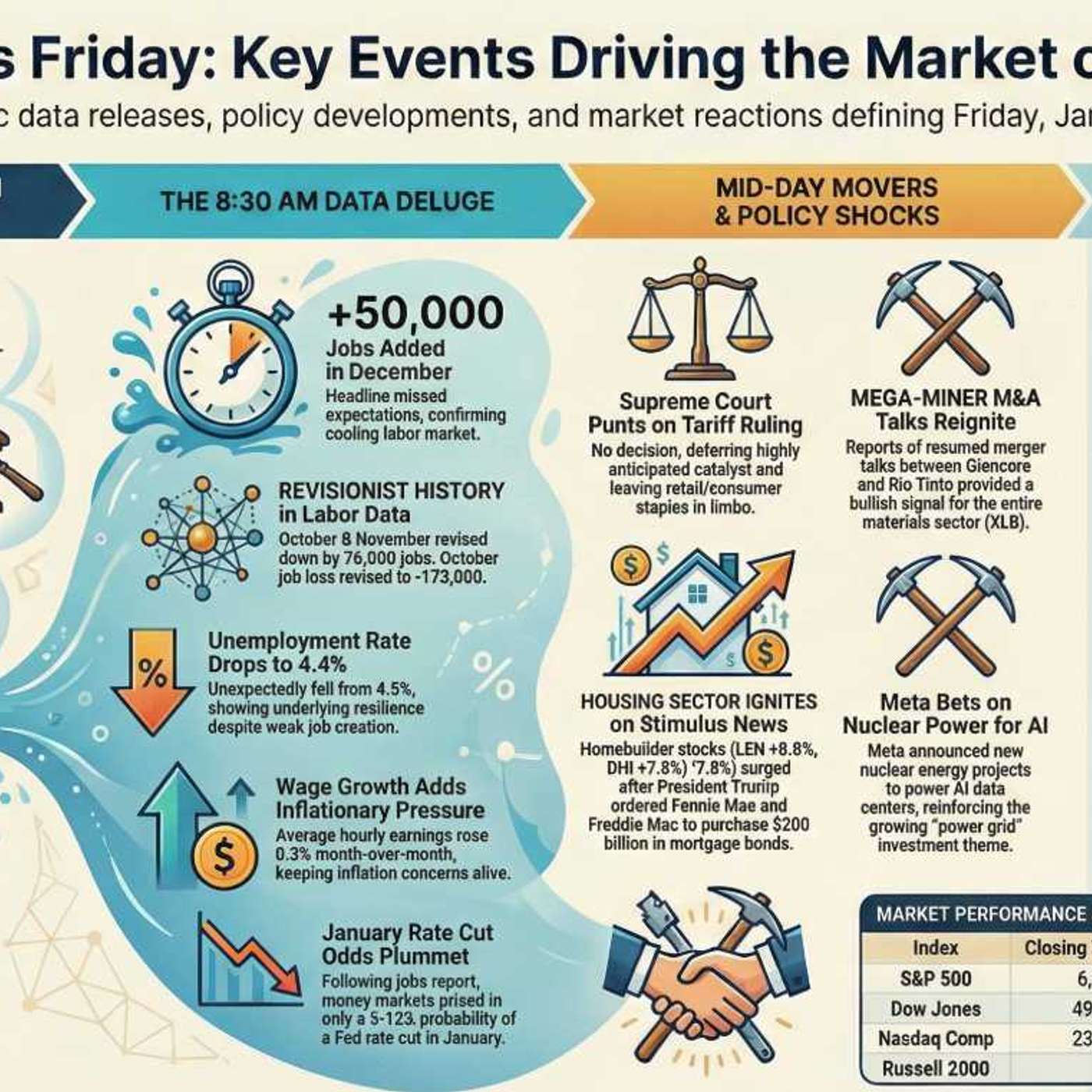
🤖 PSW Wrap-Up: Friday, Jan. 9, 2026 — Records, Rotation, and “Policy Risk” Everywhere (Plus: What to Watch Next Week)The first full week of 2026 ended the way 2025 so often did: new highs—but with a very different “feel” under the hood.For the week: stocks powered higher despite nonstop headline risk (Venezuela, Greenland/NATO noise, tariff court drama, and Washington’s “surprise-and-awe” policy style). The S&P 500 gained about +1.6%, the Nasdaq +1.9%, and the Dow +2.3%, with the Dow logging record closes along the way. (Yahoo Finance)What made this week stand out wasn’t just the green tape—it was who led it and why.The Week’s Market Story in One LineBroadening leadership is back (small caps, cyclicals, industrial economy “stuff”) even as mega-cap tech keeps the index-level scoreboard moving—plus a fresh dose of policy-driven volatility that can flip sectors overnight.Friday’s Close: “Good Enough” Jobs, Stocks Higher, Bonds Watching SCOTUSFriday’s December jobs report landed in the meh-to-OK zone (slow hiring, but unemployment dipped), which helped keep the soft-landing narrative alive without reigniting immediate “Fed panic.” Markets finished the week strong, with chips rebounding and housing-related names catching a bid on policy headlines.At the same time, the big macro overhang remains tariffs: the Supreme Court could rule at any time on the legality of the administration’s IEEPA-based tariff framework, but didn’t deliver a decision when many expected it. That keeps markets in a weird limbo—because the decision matters, but so does the remedy (refunds? how? who files?) and the workaround (other legal authorities). (TipRanks)What Actually Moved Markets This Week (Themes That Mattered)1) Venezuela: Energy got the first bid… then reality showed upEarly-week energy strength made total sense: “access to barrels” is a powerful narrative, and the market initially priced a friendlier supply path for U.S. refiners and services. But by midweek, the tape reminded everyone this isn’t a clean spreadsheet story—there’s execution risk, legal risk, and geopolitical second-order effects.Oil still managed to firm into week’s end as broader Middle East risks rose (Iran protests/crackdown headlines added a risk premium), reinforcing that energy is tradable again—but it’s headline-driven and fast. (The MortgagePoint –)PSW takeaway: Energy is no longer “just about demand.” It’s about maps, shipping lanes, sanctions, courts, and White House meetings.2) Tech didn’t “lead” so much as it ping-pongedWe started the week with CES-fueled AI optimism and a huge pop in pockets like memory/storage. Nvidia’s CES messaging around next-gen platforms and the broader AI buildout helped sentiment, even if the week also featured fresh China-related uncertainty around chips. (Yahoo Finance)But the real story was rotation:Some sessions: mega-cap tech supported the indices.Other sessions: money flowed out of prior winners and into small caps, energy, industrials, staples, housing.PSW takeaway: This is what a maturing bull looks like—less “one trade to rule them all,” more “who benefits next?” That’s healthier… but choppier.3) “Washington Factor” is now a daily input to sector performanceThis week delivered a masterclass in how quickly policy can reprice entire industries:Defense: A push for a massive 2027 defense budget figure lit up the group—then the administration also turned around and attacked buybacks/dividends behavior at contractors. Net result: defense is tradable, but it’s also now a political football. (Yahoo Finance)Housing: The administration floated multiple housing affordability levers, including the headline-grabbing directive around $200B of mortgage bond buying—which markets interpreted as “support the mortgage complex / compress spreads.” (Utility Dive)Tariffs: The legal uncertainty is now big enough that over 1,000 companies are part of the wider fight, and markets are trying to game out what “refund mechanics” might look like if the administration loses. (TipRanks)PSW takeaway: We are in a tape where policy isn’t background noise—policy is the catalyst. That argues for tighter risk control, faster timeframes, and treating headline-driven moves as tradeable volatility (not “forever narratives”).4) The sleeper winner: “Real economy” stocks + small capsSmall caps and cyclicals started 2026 like they’ve been waiting years for their moment. That’s consistent with:broadening participation,falling recession odds (for now),and the market leaning into “domestic exposure” as a hedge against tariff uncertainty.This matters because a bull market that broadens usually lasts longer than one that narrows.Stock Stories PSW Members Actually Traded This Week (Quick Hits)Energy/Refiners/Services: moved hard on Venezuela headlines; still headline-sensitive.Memory & storage: surged on “AI demand + pricing power” enthusiasm; extremely momentum-driven.Defense: whipsawed by budget talk + contractor behavior scrutiny. (Yahoo Finance)Housing complex: caught a policy-bid on mortgage-bond purchase headlines. (
NOW PLAYING
Policy Shocks Are the New Market Catalyst
No transcript for this episode yet
Similar Episodes
No similar episodes found.