
EPISODE · Jun 30, 2025 · 14 MIN
TBM 365: The Problem With Value Hierarchies (Video)
from The Beautiful Mess Podcast · host John Cutler
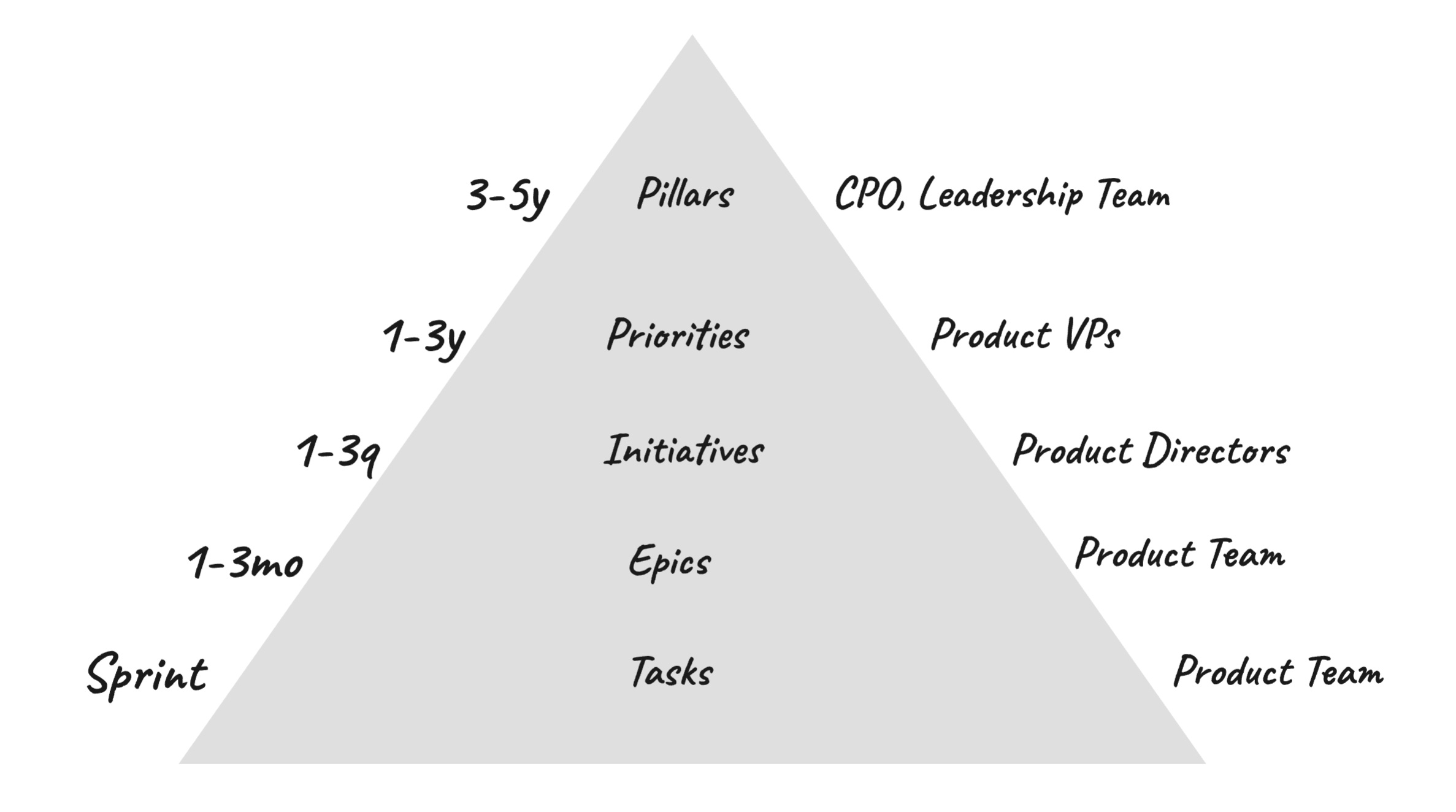
I’m experimenting with Substack’s Video feature. I’m not sure how this will look, appear, or even sound, but giving it a go. Below I include an outline of the video:Outline1. The Familiar Cascade* Many organizations use a hierarchical model: Pillars → Priorities → Initiatives → Epics → Tasks* Timeframes are often assigned at each level (e.g., 3–5 years at the top, sprints at the bottom)* Roles and ownership are mapped accordingly, from executive leadership down to product teams* These models persist because they’re intuitive, visual, and create a sense of order2. Core Limitations of the Pyramid* Assumes one-way flow of informationThe model suggests strategy flows down, but in reality, critical insights flow up from teams engaging with customers and the market* Outcomes are often missing or impliedThere’s no explicit representation of impact or results, even though that’s what ultimately matters* Ignores time-to-impact variabilitySome tasks can generate impact in a week; some initiatives take years. The model fails to show these lags and feedback loops* Pushes teams into execution rolesAs you move down the pyramid, the framing becomes increasingly prescriptive. Teams are expected to deliver “work” without clear problem framing or strategic ownership* Misrepresents the scope and nature of workHigh-impact short-term efforts may not “fit” in the hierarchy, creating friction. It also disincentivizes small, iterative wins3. Temporal Scope and Organizational Culture* Comparing two fictional organizations reveals differences:* Org A’s goals are outcome-driven across time horizons (e.g., 1–3 month engagement goals, 3–5 year market positioning)* Org B’s goals are more output-focused and vague at longer horizons* Ownership of goals varies by company—some give product teams ownership up to the one-to-three quarter range, others do not* The same pyramid diagram can reflect entirely different behaviors depending on definitions, ownership, and cultural orientation toward outcomes vs. activity4. The Need for Multiple Lenses* The pyramid presents a single, strategy-to-task lens, but organizations operate with multiple overlapping views:* Outcome lens – focused on impact and customer results* Work lens – focused on deliverables and execution* Finance lens – focused on costs, forecasting, and ROI* Structure lens – focused on organizational shifts, team structure, and ownership* Each lens has its own rhythm, scope, and patterns of change* These lenses intersect in complex ways that a static pyramid cannot represent5. Real Work Behaves More Like a Fabric Than a Cascade* Work, strategy, and feedback move in all directions—not just top-down* Many artifacts and processes exist at mid-levels of abstraction, not neatly tiered* A more accurate model is a fabric or network of interconnected items with varying temporal scopes and ownership* Strategic influence can originate anywhere, and changes at any level can ripple across the system6. Introducing Artifact Types and Their CadenceTo support this networked reality, artifacts should be understood in terms of their nature and rhythm:* Anchor Artifacts* Have a defined time horizon (e.g., a 12-month roadmap)* Refreshed on a set cadence (e.g., quarterly planning cycles)* Useful for stability and coordination* Intent Artifacts* Represent bets, goals, OKRs, and strategic initiatives* Tend to evolve as work progresses and understanding deepens* Often nested or linked to other artifacts dynamically* Context Artifacts* Reflect shifting knowledge and environmental signals* Can be volatile (e.g., customer feedback) or stable (e.g., competitive analysis)* Drive updates to other artifact types when significant changes occur7. The Role of Rituals* Artifacts don’t stand alone—they are reinforced and refreshed through team and organizational rituals* Effective operating systems clarify:* Which artifacts exist* Who owns them* When and how they are updated* How they relate to each other across different lenses and timeframes* Rituals also provide the opportunity to resolve contradictions and adapt to change8. Final Synthesis* The strategy pyramid is a helpful storytelling tool, especially for presentations or executive alignment* But it is insufficient for designing actual operating models* Effective models recognize:* Multiple lenses (not just one)* Temporal and definitional complexity* The need for dynamic linkages, not static nesting* The interplay of strategy, execution, finance, structure, and learning* Building an effective system means embracing this complexity and supporting it with the right artifacts and rhythms—not oversimplifying it into a cascade Get full access to The Beautiful Mess at cutlefish.substack.com/subscribe
NOW PLAYING
TBM 365: The Problem With Value Hierarchies (Video)
No transcript for this episode yet
Similar Episodes
No similar episodes found.