
EPISODE · Oct 4, 2021 · 4 MIN
The Delta Baryons
from The Field Guide to Particle Physics · host Sean Downes
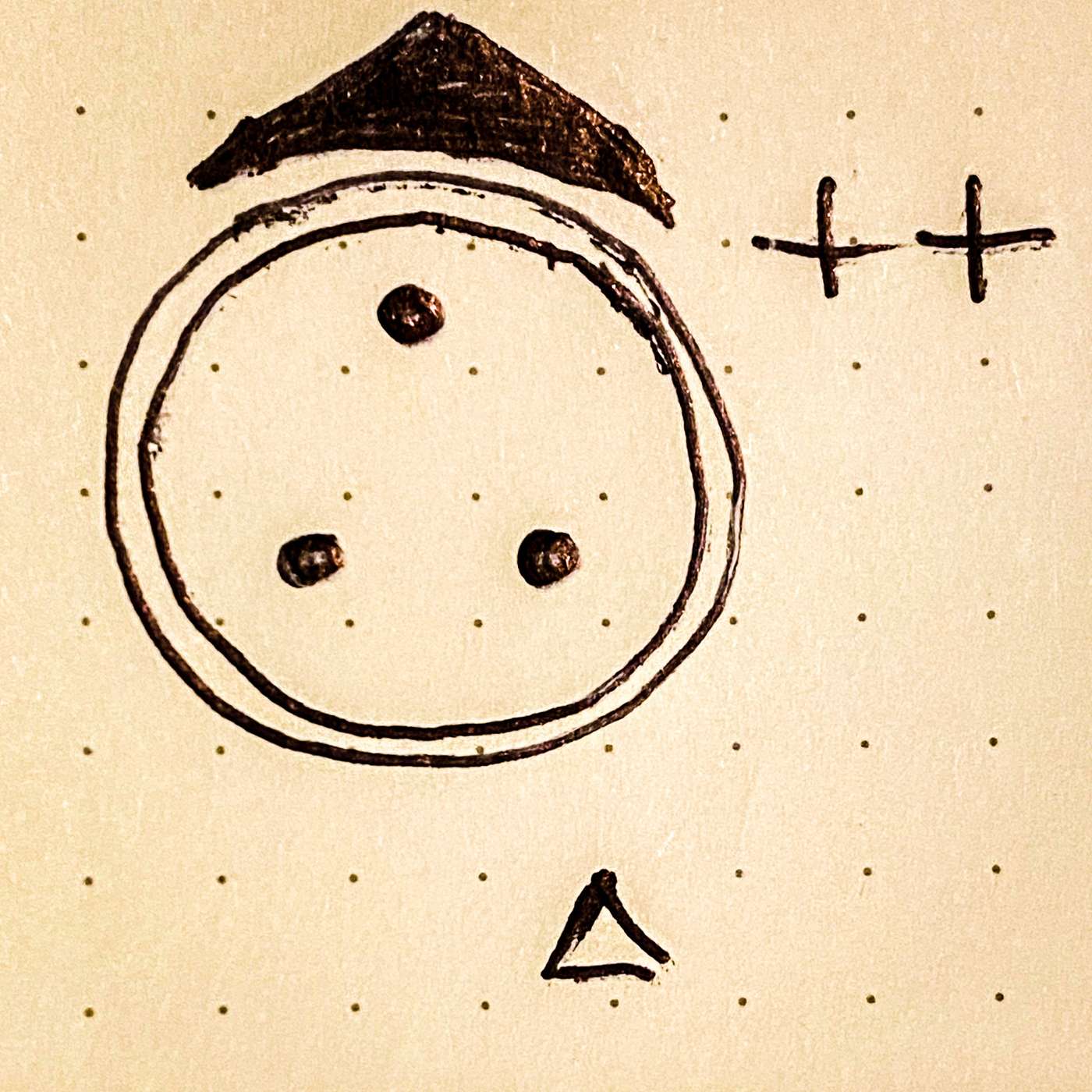
The Field Guide to Particle Physics https://pasayten.org/the-field-guide-to-particle-physics©2021 The Pasayten Institute cc by-sa-4.0The definitive resource for all data in particle physics is the Particle Data Group: https://pdg.lbl.gov.The Pasayten Institute is on a mission to build and share physics knowledge, without barriers! Get in touch.The Delta BaryonsThe Delta baryons are combinations of up and down quarks. They’re like the proton and the neutron, only much more heavy and much less stable. They all seem to have about the same mass - around 1232 MeV, but we don’t really have a good handle on it. That is mostly because the Delta baryons lives are so short. They decay extremely quickly, in 5.6×10^−24 seconds.There are four delta baryons, corresponding to all triplet combinations of up and down quarks:Δ++ = uuu, made from three up quarks, which has an electric charge of +2eΔ+ = uud, made from two up quarks and one down, which has an electric charge of +eΔ0 = ddu, made from two up quarks and one down, which has an no electric chargeΔ- = ddd, made from three down quarks, which has an electric charge of -eWhat makes these combinations different from protons and neutrons is their spin. The uud of the Δ+ might look like a proton, but it has a higher intrinsic angular momentum. The quarks are zooming around each other - and all that subnuclear goo - with more energy than they do in the proton, which explains the higher mass. In other words, Δ-baryons are excited states of the proton or neutron. And excited states decay. They decay so quickly because the strong nuclear force - the same force that holds them together - is so strong.The electron cloud of an atom can be similarly excited: their electrons can bounce up to a higher energy orbital state, often with more angular momentum. When they decay, they tend to emit photons. If you’ve seen glow in the dark toys - or pictures that glow under UV light - you’ve seen electron cloud decays with your own eyes.The Δ-baryons decay similarly, although being bags of quarks they emit pions.Δ baryons play a crucial role in limiting the speed of cosmic rays. Cosmic rays are mostly comprised of protons flying through deep space - some at outrageously high velocities. Once those protons are accelerated up to enough energy - 5×10^19 eV - which is about the kinetic energy of a child walking (contained in SINGLE PARTICLE!) - they tend to collide with the photons left around from the Big Bang. Those collisions, from the perspective of those ridiculously fast protons, are extremely energetic, and Δ-baryons are produced. These of course decay almost immediately into proton, neutrons and pions, effectively converting that stupidly high kinetic energy into pion radiation. In other words, intergalactic friction in the universe is provided by Δ-baryon production and decay.Of course, we still see a few cosmic rays with energies far beyond that limit, so its not a perfect speed limit, but a pretty effective one.
NOW PLAYING
The Delta Baryons
No transcript for this episode yet
Similar Episodes
No similar episodes found.