
EPISODE · Jan 31, 2020 · 14 MIN
The Emerald Tablet ( Episode 1 )
from HERMES paranormal & spiritual research network; documenting the unknown · host HERMES; paranormal & spiritual research Network PODCAST
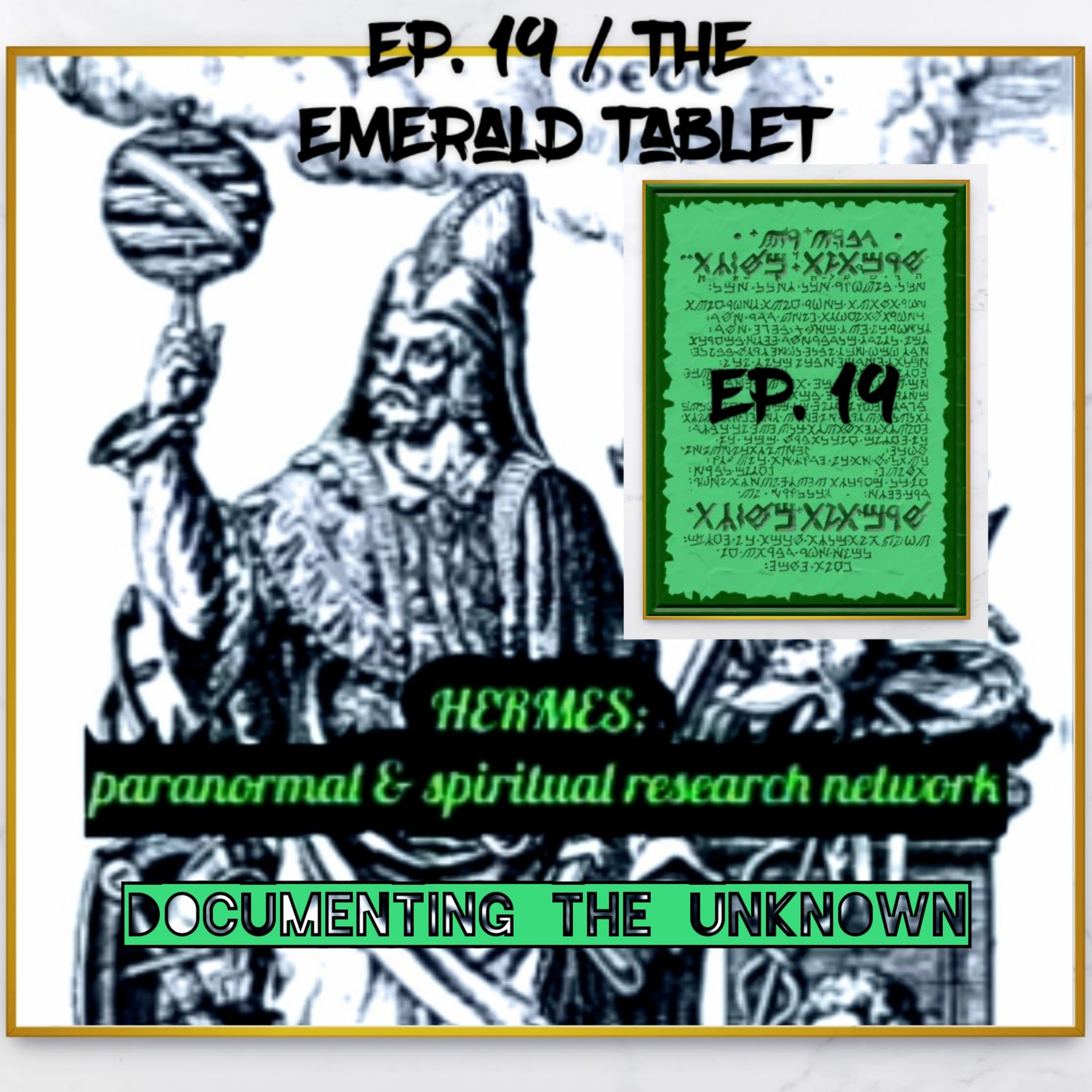
A BRIEF EXPLANATION OF THE EMERALD TABLET (largely summarised by Wikipedia ) The Emerald Tablet, also known as the Smaragdine Tablet, or Tabula Smaragdina, is a compact and cryptic piece of the Hermetica reputed to contain the secret of the prima materia ( a formless primeval substance regarded as the original material of the universe.) and its transmutation. It was highly regarded by European alchemists as the foundation of their art and its Hermetic tradition. The original source of the Emerald Tablet is unknown. Although Hermes Trismegistus is the author named in the text, its first known appearance is in a book written in Arabic between the sixth and eighth centuries. The text was first translated into Latin in the twelfth century.There are numerous Translations of The Emerald Tablet.The Emerald Tablet is believed to be connected to formula to create the legendary Alchemical Element of life, the Philsophers stone, as well as influences and connections with various Hermetic texts.the philosophers stone Is parodied In the book “Harry Potter and the Sorcerer's Stone” HISTORY OF THE TABLET (largely summarised from Needham 1980, & Holmyard 1957) The Tablet probably first appeared in the West in editions of the psuedo-Aristotlean Secretum Secretorum ( Latin for Secrets Of Secrets ) as actually a translation of the Kitab Sirr al-Asar ( Arab for “Secret Of Secrets” )A book advice to kings which was translated into latin by Johannes Hispalensis c. 1140 and by Philip of Tripoli c.1243. The Secretum or Secreta Secretorum, also known as the Sirr al-Asrar, is a pseudoaristotelian treatise which purports to be a letter from Aristotle to his student Alexander the Great on an encyclopedic range of topics, including statecraft, ethics, physiognomy, astrology, alchemy, magic, and medicine. Wikipedia Other translations of the Tablet may have been made during the same period by Plato of Tivoli ( Plato Tiburtinus was a 12th-century Italian mathematician, astronomer and translator who lived in Barcelona from 1116 to 1138. He is best known for translating Hebrew and Arabic documents into Latin, and was apparently the first to translate information on the astrolabe from Arabic. Wikipedia ) and Hugh of Santalla ( Hugo of Santalla [1] was a significant translator of the first part of the 12th century. From Arabic originals, he produced Latin translations of texts on alchemy, astronomy, astrology and geomancy. He is thought to have been a Spanish priest, working in Tarazona.[2] Michael, bishop of Tarazona was a patron. Works attributed to him are translations of Alfraganus[3] Haly, the Liber de secretis naturae of Apollonius of Tyana,[4] De Spatula on divination,[5] and the Tabula Smaragdina.[6] His Liber Aristotilis was an anthology of material with Greek and Persian origins, none of it now attributed to Aristotle. ) , perhaps from different sources. The date of the Kitab Sirr al-Asar is uncertain, though c.800 has been suggested and it is not clear when the tablet became part of this work. Holmyard was the first to find another early arabic version (Ruska found a 12th centruy recension claiming to have been dictated by Sergius of Nablus) in the Kitab Ustuqus al-Uss al-Thani (Second Book of the Elements of Foundation) attributed to Jabir. Shortly after Ruska found another version appended to the Kitab Sirr al-Khaliqa wa San`at al-Tabi`a (Book of the Secret of Creation and the Art of Nature), which is also known as the Kitab Balaniyus al-Hakim fi'l-`Ilal (book of Balinas the wise on the Causes). It has been proposed that this book was written may have been written as early as 650, and was definitely finished by the Caliphate of al-Ma'mun (813-33). ( Abu al-Abbas Abdallah ibn Harun al-Rashid (Arabic: أبو العباس عبد الله بن هارون الرشيد, romanized: Abū al-ʿAbbās ʿAbd Allāh ibn Hārūn ar-Rashīd; 14 September 786 – 9 August 833), better known by his regnal name al-Ma'mun (Arabic: المأمون, romanized: al-Maʾmūn), was the seventh
NOW PLAYING
The Emerald Tablet ( Episode 1 )
No transcript for this episode yet
Similar Episodes
No similar episodes found.