
EPISODE · Oct 5, 2021 · 6 MIN
The Gluon
from The Field Guide to Particle Physics · host Sean Downes
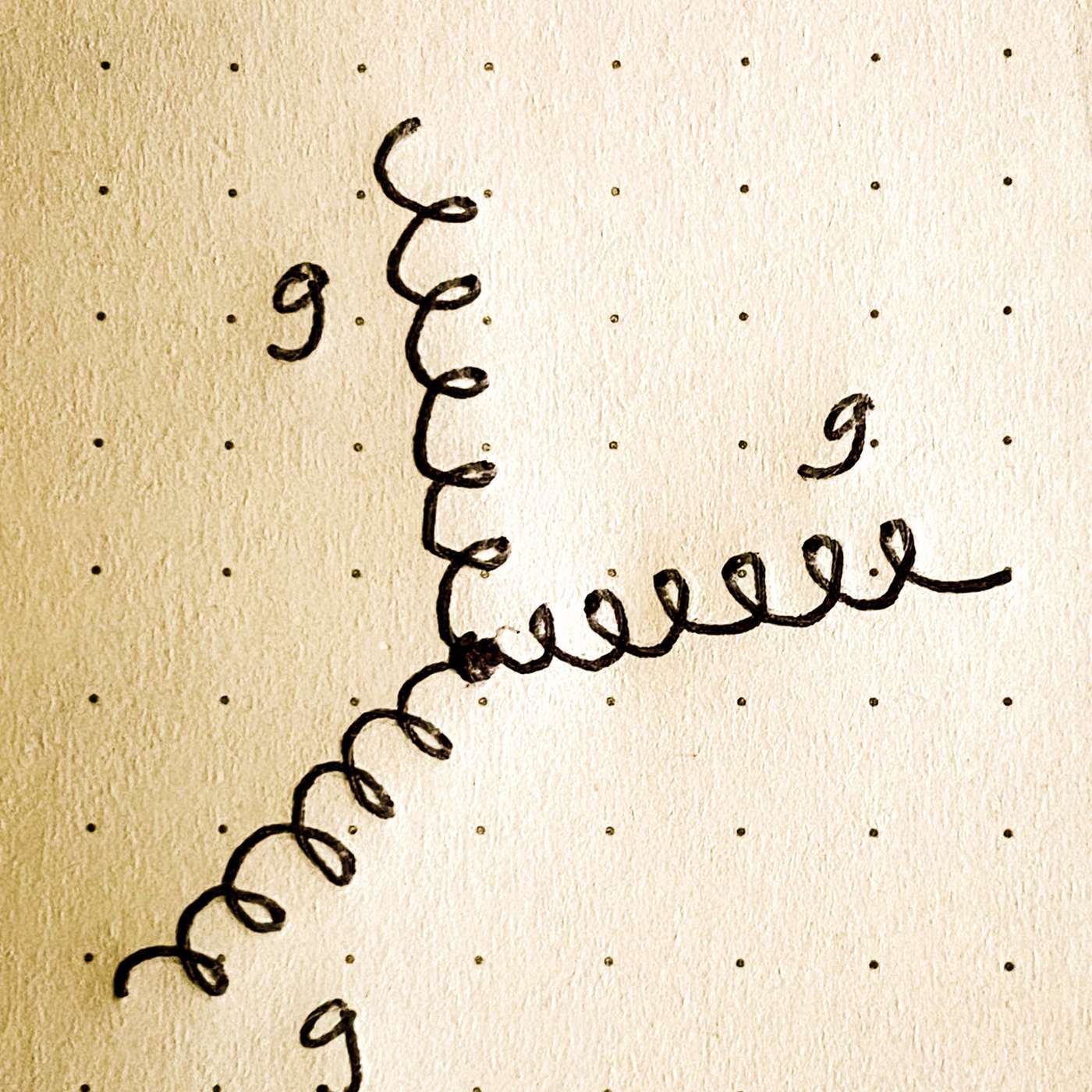
The Field Guide to Particle Physics https://pasayten.org/the-field-guide-to-particle-physics©2021 The Pasayten Institute cc by-sa-4.0The definitive resource for all data in particle physics is the Particle Data Group: https://pdg.lbl.gov.The Pasayten Institute is on a mission to build and share physics knowledge, without barriers! Get in touch.The GluonThe forces of nature are communicated by particles. Electric charges push and pull on each other with photons. Protons and neutrons communicate by pion. How this works involves a bit of mathematics, but a rough analogy often used is two ice skaters on a frozen lake throwing bowling balls back and forth.This is all well and good for particles zooming freely through space. But how to do the quarks locked inside those protons, neutrons and pions communicate with each other? The strong nuclear force - the fundamental force behind the subnuclear junk we find inside the nucleons - is communicated via a particle very similar to the photon. But you’ll have to excuse their name, however apt. The particles that communicate between quarks are called gluons.Yes, as in glue.Like the photon, gluons have no mass. They’re just little packets of nuclear force energy. Unlike the photon, gluon communication is a mess. Photons only communicates between particles with electric charge. Gluons communicate not only with quarks, but also amongst themselves!That’s why nucleons are so messy. The quarks throw out gluons to communicate, but those gluons also through out gluons, who also throw out gluons who also throw out gluons. And any quark or gluon can also receive a gluon. Rather than a nice, orderly dialog between a couple of parties, that nuclear force is a boisterous mob! The force that binds that mob together is really quite strong, whence the name, the strong nuclear force. This is good, because it keeps all that gluonic madness contained inside those neutrons, protons and the pions.The strong force equivalent of electric charge is called color charge. If electric charges come in a spectrum from negative to positive, the color charge comes in three distinct spectra, each from negative to positive. For lack of a better name, these three color charges been called red, green and blue. As you might have guessed, subnuclear naming conventions are pragmatic to a fault.Atoms like hydrogen are electrically neutral combinations of positive and negative electric charge: one positively charged proton, one negatively charged electron. Pions are like this too, and come in pairs like red-antired, blue-antiblue and green-anti green. So are the anti-pions.Big hadrons like protons, neutrons and the Deltas are special. Here the three quarks each have a different color: red, green or blue. To join together, one of each color must be present. Like incandescent light coming from a lightbulb or the sun, sometimes we call this combination colorless. Antiparticles like anti protons have all three anti-colors, which are also colorless.To be clear, this has nothing to do with light. Or actual colors. It’s just a mnemonic physicists invented to explain how a three-dimensional system of charges works.Color charge gives us a simple explanation for why protons and neutrons communicate by pion. These composite particles are all colorless! So their internal structures - all that infinite mesh of nuclear gluon goo - are essentially isolated from one another. In other words, that mess of color charge condenses to form colorless droplets, and those droplets happen to look like nucleons or pions.Like water, that condensation happens when things cool down. Unlike water, the temperature for quark-gluon condensation is extremely high. So high that the universe only really experienced it for the first few minutes after the Big Bang. It’s a temperature that amounts to an average energy of 246 MeV per particle. That is, roughly speaking, twice the mass of a pion. Experiments have achieved these temperatures in the lab and have essentially observed the melting of nuclei.Finally, you might wonder why there are three colors and not four. Or five. Physicists also wonder about this, and so far we don’t know the answer. There are plenty of models that could explain why we have precisely three subnuclear color charges, but all we know is three colors fit the data. A fourth color would mean that protons would have FOUR quarks. It is comforting to know that the basic results of the physics are mostly independent of the number of colors. A strong force with three, four or five colors are fairly similar. Particles would still condense into colorless combinations, although the precise details would depend on the number of colors. Nevertheless, basic quark-gluon modeling software like Pythia are essentially agonistic about the number of colors present.
NOW PLAYING
The Gluon
No transcript for this episode yet
Similar Episodes
No similar episodes found.