
EPISODE · Dec 28, 2025
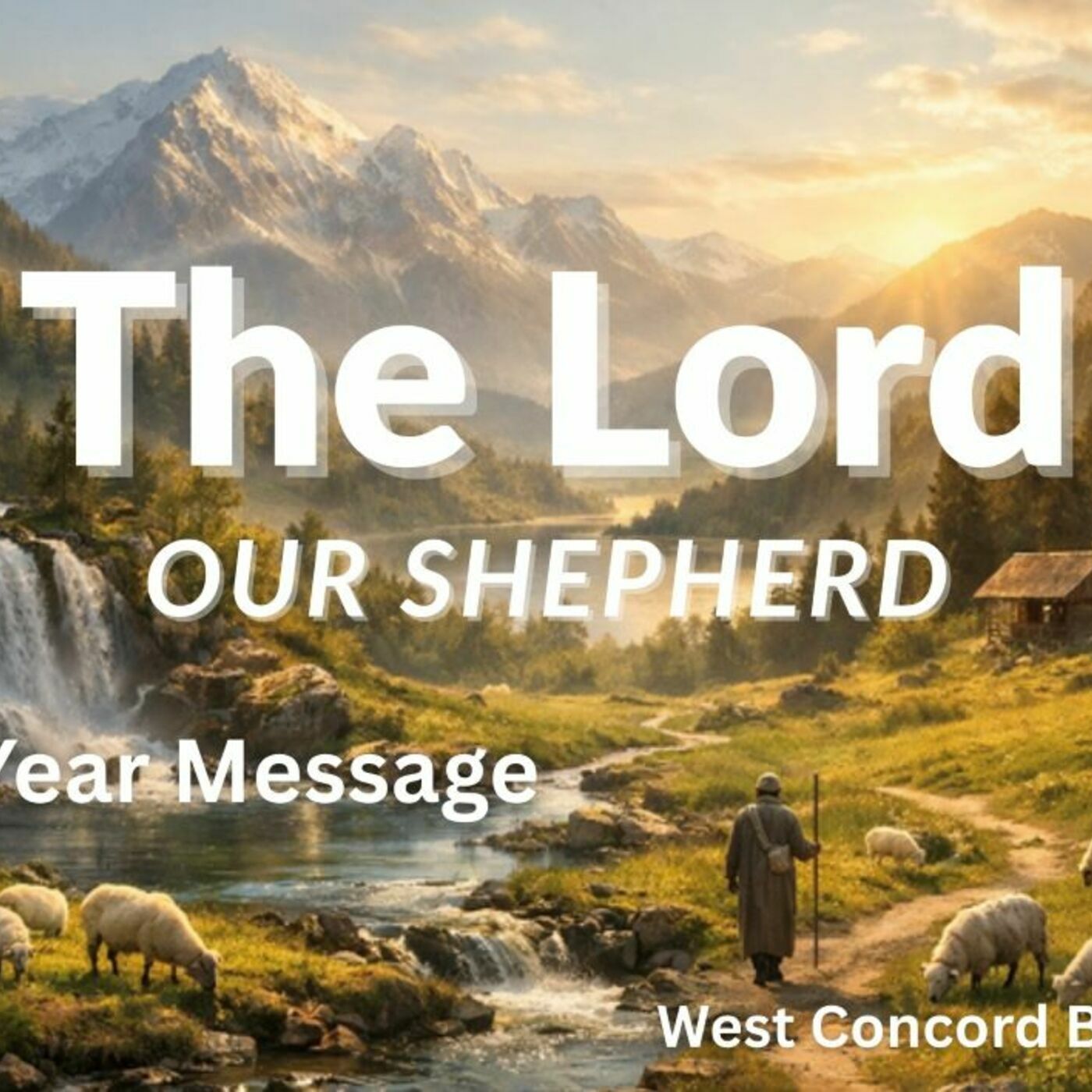
The Lord, Our Shepherd
from West Concord Church · host Dr. Mike Farley
Psalm 23 Our Guide (vv. 1-3) Provision and peace Refreshment and restoration Rightness and reason Our Comforter (v. 4) Protection Correction Redirection Our Provider (v.5) He is our generous Host We are His welcome guests Our Satisfaction (v. 6a) Goodness Mercy Our Redeemer (v. 6b) Our days Our destiny More to Consider The Lord is my shepherd. What condescension is this, that the Infinite Lord assumes towards his people the office and character of a Shepherd! It should be the subject of grateful admiration that the great God allows himself to be compared to anything which will set forth his great love and care for his own people. David had himself been a keeper of sheep, and understood both the needs of the sheep and the many cares of a shepherd. He compares himself to a creature weak, defenceless, and foolish, and he takes God to be his Provider, Preserver, Director, and, indeed, his everything. No man has a right to consider himself the Lords sheep unless his nature has been renewed, for the scriptural description of unconverted men does not picture them as sheep, but as wolves or goats. A sheep is an object of property, not a wild animal; its owner sets great store by it, and frequently it is bought with a great price. It is well to know, as certainly as David did, that we belong to the Lord. There is a noble tone of confidence about this sentence. There is no if nor but, nor even I hope so; but he says, The Lord is my shepherd. We must cultivate the spirit of assured dependence upon our heavenly Father. The sweetest word of the whole is that monosyllable, My. He does not say, The Lord is the shepherd of the world at large, and leadeth forth the multitude as his flock, but The Lord is my shepherd; if he be a Shepherd to no one else, he is a Shepherd to me; he cares for me, watches over me, and preserves me. The words are in the present tense. Whatever be the believers position, he is even now under the pastoral care of Jehovah. C. H. Spurgeon, The Treasury of David: Psalms 1-26, vol. 1 (London; Edinburgh; New York: Marshall Brothers, n.d.), 353354. The house of the Lord is the sanctuary where people worshiped. (The temple, in the Hebrew OT, is usually called beth Yahweh, the Lords house.) After his meditations, David desired to return to that holy place where he could avail himself of the blessing of Gods presence. In the Christian application of the psalm, the hope is for complete communion with the Lord in the abundance of His blessing. While popular thinking often relates this verse to heaven, the phrase in the presence of my enemies (v. 5) suggests an earthly setting, since the believers enemies are not present in heaven. Ted Cabal et al., The Apologetics Study Bible: Real Questions, Straight Answers, Stronger Faith (Nashville, TN: Holman Bible Publishers, 2007), 810811.
NOW PLAYING
The Lord, Our Shepherd
No transcript for this episode yet
Similar Episodes
Mar 3, 2026 ·44m
Feb 21, 2026 ·30m
Dec 17, 2025 ·30m
Dec 11, 2025 ·26m
Dec 11, 2025 ·29m
Dec 11, 2025 ·33m