
EPISODE · Apr 25, 2026 · 9 MIN
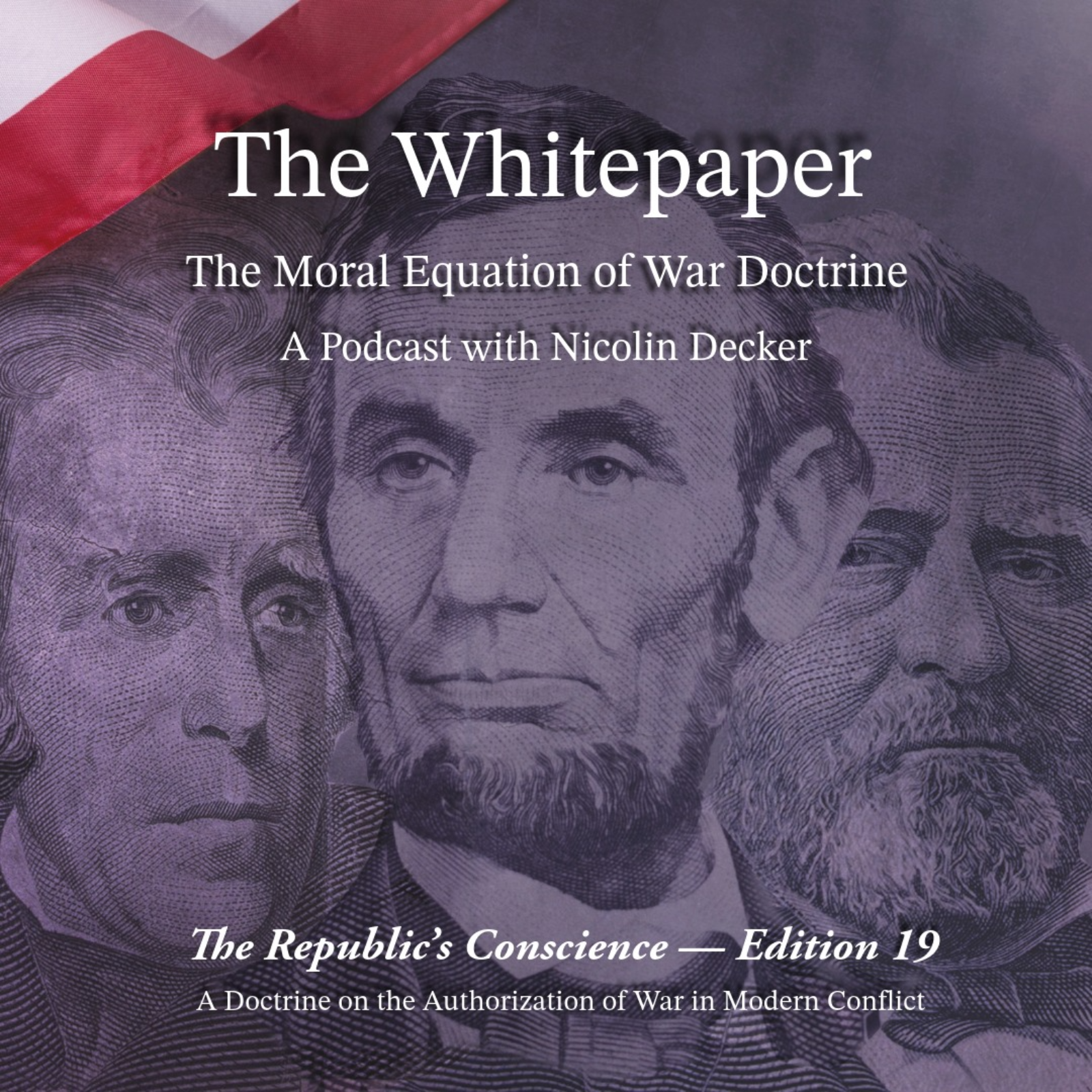
The Republic's Conscience — Edition 19: The Moral Equation of War Doctrine — Part I.
from The Whitepaper
In this special edition of The Republic’s Conscience, Nicolin Decker introduces The Moral Equation of War Doctrine—a structural framework for examining how and why war is authorized within modern constitutional systems.This opening episode presents the Foreword and establishes the central premise of the doctrine: that the legitimacy of war is not determined solely by how it is conducted, nor by its outcomes, but by the moral clarity of its origin. While conflict is often justified in moments of urgency, history evaluates decisions across time—measuring motive, consequence, and character beyond the pressures of the present.Drawing from the leadership of President Abraham Lincoln and General Dwight D. Eisenhower, the episode frames war as a condition of profound responsibility rather than policy convenience. Lincoln’s preservation of constitutional continuity and Eisenhower’s warning regarding the structural incentives of industrialized conflict together establish a dual lens: necessity must be anchored in preservation, and power must remain bounded by vigilance.The episode clarifies a foundational distinction: war may produce economic and political consequences, but those outcomes do not define its justification. When the motive of war shifts—even subtly—from preservation to instrumentality, the moral equation changes. Such shifts may not be immediately visible, but their effects accumulate across generations.From this foundation, the doctrine introduces its central concern: that the moral character of a nation is determined not only on the battlefield, but at the moment force is authorized. The battlefield tests courage; authorization tests wisdom.🔹 Core Insight War is not defined only by how it is fought—but by why it is begun.🔹 Key Themes• Moral Origin vs. Outcome Why the legitimacy of war is determined at authorization, not execution.• Lincoln and Preservation War as a constitutional necessity to sustain the Union and its governing principles.• Eisenhower and Structural Warning The risk that systems built for security may influence the decision to initiate conflict.• Consequence vs. Motive Why economic and political effects of war do not justify its initiation.• Moral Burden of Authorization How responsibility for war resides upstream, before engagement begins.🔹 Why It Matters In modern governance, war is often evaluated through outcomes, strategy, or operational success. This doctrine reorients that perspective by emphasizing motive as the defining variable of legitimacy. By restoring focus to the moment of authorization, it provides a framework for preserving moral clarity in decisions that carry generational consequence.🔻 What This Episode Is NotNot a critique of any specific conflict Not a partisan argument Not a rejection of necessary forceIt is a structural and moral framework for understanding how war must be justified.🔻 Looking AheadIn Day 2, the doctrine introduces its first formal mechanism: the Moral Origin Variable—defining how motive can be identified, structured, and evaluated within modern systems of authorization.Read: The Moral Equation of War Doctrine. [Click Here]This is The Moral Equation of War Doctrine. And this is The Republic’s Conscience.
NOW PLAYING
The Republic's Conscience — Edition 19: The Moral Equation of War Doctrine — Part I.
No transcript for this episode yet
Similar Episodes
No similar episodes found.