
EPISODE · Aug 4, 2021 · 2 MIN
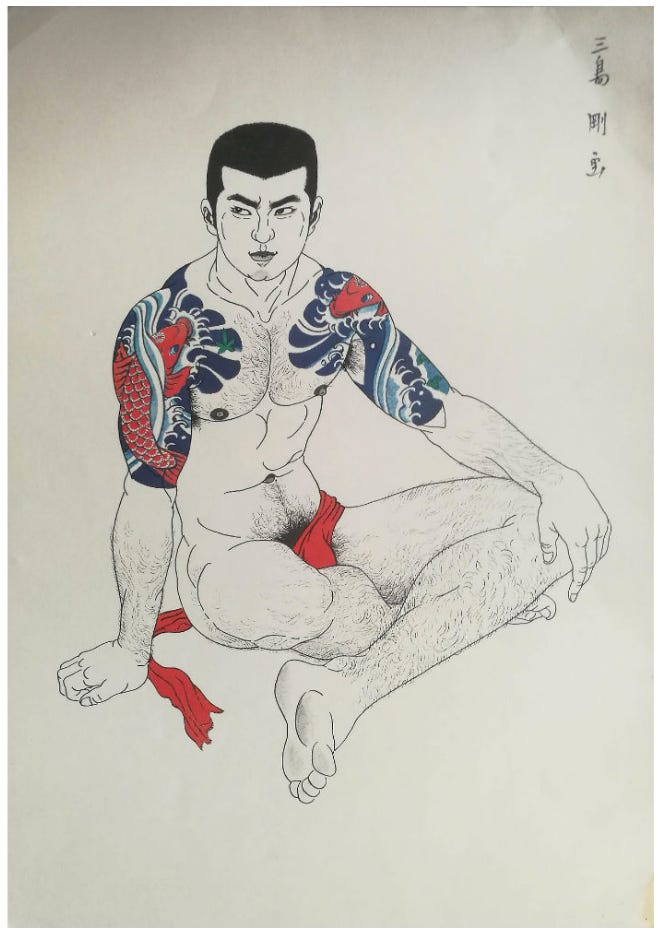
Young Man & Koi Tattoo, 1972
from Gregory Meander · host Gregory Meander
I was recently introduced to the work of Go Mishima. He focused on idealized versions of Japanese men in contemporary time. How do we represent ourselves? I gravitate towards male bodies. I am queer and am attracted to the male body, though representations of the nude male body are seen as taboo. I am attracted to this image for a lot of reasons but chose it mainly because I think Asian men generally face stereotypes in American culture that stem from the deep rooted racism of our country. Do we still consider David the perfect form? What I love about Go’s work is that he elevates the Japanese man into position of focus and vulnerability.Male representations, when naked, are generally placed in the “erotic illustration” category creating a siloed expectation. When it is the female body, they are elevated into great masterpieces. The artist and the female muse is a typical trope found in art history. In an era of more nuanced narratives around the human body, the siloing is unhelpful to our deeper understanding of what it means to be human. I understand categories are the way we learn. But, we need new language, new representations, and allow for new ways of learning. Getting into Go’s work makes me think Hannah Gadsby’s Douglas writes a brilliant joke about artists and how they make their decisions. She focuses on Peter Paul Rubens, The Three Graces, ca. 1635, which hangs in the Museo del Prado in Madrid, Spain. The decision is the bit of silk that is layered through the rear side of the grace in the center of the painting similar to Go’s specific red drape across the male’s genitals. Red makes us look, but there is nothing to see. Reuben’s decision to paint the silk sliding through her crease. “It’s a decision” exclaims Gadsby. The artist thought about how best to represent sensuality, eroticism, and yet being “respectful?” This was the ideal beauty of the day. In contrast, Go dedicates most of his career to a hyper-masculine version of the Japanese male. In this lithograph, he draws decorative carp called koi on the male’s biceps. Koi can be seen in gardens and parks of various countries. Interestingly, the koi were first bred in Japan in the 1820s, to become a delight for an eye. By the 20th century over 20 types of koi were established, varying in color combinations from gold to black. The pallete of this creature includes red, white, yellow, orange, blue, greenish and pearl.Those colorful creatures can be seen practically in all public gardens and parks of China as well, with red and gold koi prevailing over the other types. In Go’s lithograph, two red koi dominate the male’s bicep signaling strength and sensuality. The male is also in a resting positioning, sitting, gazing into the unknown. Go draws his muse in a position of comfort and displays his culture, an adonis, and shows his command of graphic color. This is a public episode. If you would like to discuss this with other subscribers or get access to bonus episodes, visit gregorymeander.substack.com
NOW PLAYING
Young Man & Koi Tattoo, 1972
No transcript for this episode yet
Similar Episodes
May 6, 2026 ·36m
Apr 27, 2026 ·93m
Apr 23, 2026 ·50m
Apr 1, 2026 ·26m