
PODCAST · technology
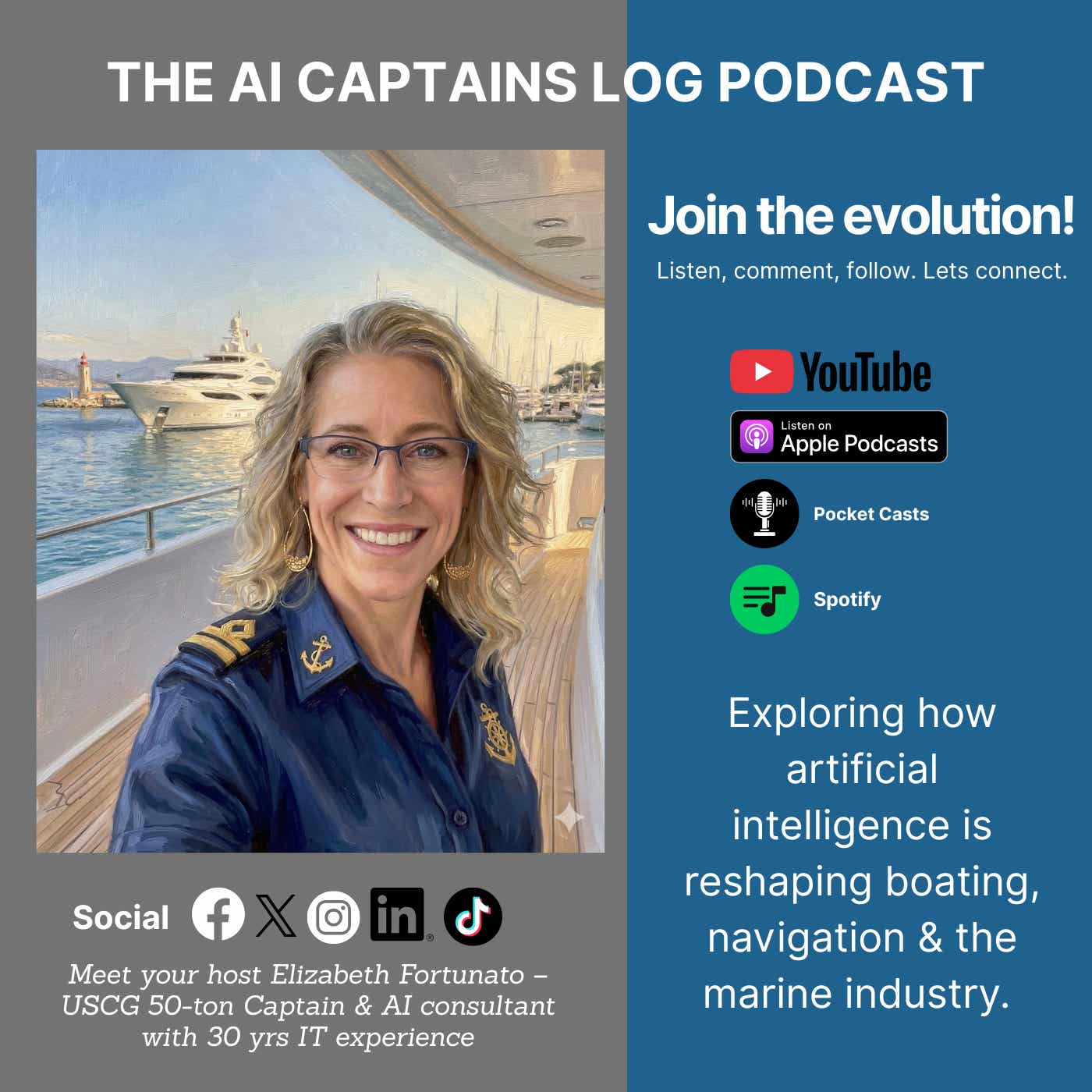
AI Captains Log Podcast
by Boating Re-Programmed
The AI Captain’s Log discusses the transition from analog boating to the AI era, helping boaters skip decades of outdated tech to embrace the "leapfrog" opportunity. From autonomous docking to machine vision, we track the technology that makes the sea safer, smarter, and more accessible. aiboatcaptain.substack.com
-
4
Maneuvering Your Boat in Tight Spaces: Bonus Content
When it comes to boating, one of the most daunting tasks can be maneuvering your vessel in tight spaces, especially in smaller marinas. In this short episode, I’ll walk you through a real-life experience of moving our boat into a narrow slip and share valuable insights on how to handle your boat with precision and confidence.Understanding the Challenge of Tight SpacesManeuvering your boat in a small marina can present unique challenges. With narrow fairways, limited space on either side of the boat, and potentially obstructive neighboring vessels, it requires careful planning and execution. I recently faced this challenge when we moved our boat into a new marina, only to realize we had entered the wrong slip, which was extremely narrow with only a few inches of clearance on either side. Here’s how we managed to navigate this tricky situation.Step 1: Assess Your Surroundings* Why this matters: Before attempting any maneuvers, it’s crucial to understand your surroundings. Identify the layout of the marina, including the width of the slips, the presence of other boats, and any potential obstacles.* How to do it: Take a moment to observe the area and plan your approach. Look for pivot points, such as nearby pylons or other boats, that can aid in your maneuvering process.* Common mistake: Many boaters rush this step, leading to miscalculations when entering the slip.Step 2: Use a Spring Line* Why this matters: A spring line is essential for controlling your boat’s movement when space is tight. It allows you to pivot your boat effectively.* How to do it: We used a long spring line of about 75 feet. As we began to back up, I instructed my husband to pull on the line to help steer the boat. This technique allowed us to use the pylons as pivots while maintaining control of our direction.* Example from my experience: As we were backing up, I focused on the starboard engine, gently bumping it to drift backward while my husband managed the spring line to turn the boat toward the correct slip.Step 3: Communicate Clearly* Why this matters: Coordination is key when maneuvering in tight quarters. Clear communication ensures that both you and your crew are on the same page.* How to do it: Use headsets or hand signals to communicate effectively. Let your crew know when to pull or release lines and when it’s clear to proceed. We picked key words that quickly would communicate any necessary action.* Common mistake: Failing to communicate can lead to confusion, resulting in mishaps or collisions.Step 4: Execute with Confidence* Why this matters: Once you’ve assessed your surroundings, set up your lines, and communicated with your crew, it’s time to execute your plan with confidence.* How to do it: Focus on maintaining a steady pace while adjusting your throttle as needed. Use your pivot points for guidance and remain aware of your surroundings as you complete the maneuver.* Example from my experience: After backing up and pivoting, I could see we had enough room to maneuver the boat into the slip. I was able to ‘spin’ the boat (forward on starboard and reverse on port throttle) to ensure a smooth entry into the correct slip.Key Takeaways from Our Experience* Know your boat’s pivot points: Understanding where your boat pivots helps in executing maneuvers smoothly.* Practice makes perfect: The more you practice in tight spaces, the more confident you’ll become. We also practice on paper whenever we are in a challenging situation. I am also a huge fan of reviewing what went wrong and what we could do better next time. There is a reason the emergency responders and the military practice all the time!* Stay calm and focused: Keeping a level head during tense situations ensures better decision-making.In conclusion, maneuvering your boat in tight spaces can be a rewarding challenge with the right techniques and preparation. By following these steps, you can enhance your docking skills and ensure a safer boating experience.Frequently Asked QuestionsHow can I improve my docking skills?Practice regularly in various conditions and seek guidance from experienced boaters or instructors.What equipment is essential for docking?A good set of fenders, spring lines, and a reliable communication system are essential for safe docking.Are there specific techniques for different boat types?Yes, techniques may vary based on the type and size of your boat; it’s important to understand your vessel’s unique handling characteristics. This is a public episode. If you would like to discuss this with other subscribers or get access to bonus episodes, visit aiboatcaptain.substack.com
-
3
Navigating with dynamically updated AI-enhanced charts
SummaryIn this conversation, Elizabeth Fortunato, the AI Captain, discusses the revolutionary advancements in ocean mapping technologies, emphasizing the transition from traditional static charts to dynamic, living charts created through a combination of satellite imagery, underwater drones, and AI. She highlights the importance of these technologies in enhancing our understanding of the ocean’s depths and conditions, making navigation safer and more efficient.Takeaways* The ocean charts are evolving into living charts.* Satellite technology is crucial for modern ocean mapping.* Underwater drones can operate for over 30 days at sea.* AI is enhancing the accuracy of ocean depth measurements.* The endurance layer captures data that human crews cannot.* Multiple autonomous vessels can map vast areas quickly.* Satellite derived bathymetry allows for depth measurement without physical contact.* Technological advancements are making ocean exploration safer.* Mapping coral reefs is now possible without disturbing them.Chapters00:00:00 Hello, and welcome to the AI Captains Log.00:00:27: But in 2026, the living chart is being built00:00:45: The second layer is the endurance labor,00:01:19: Next layer, the third layer, is the swarm.00:02:07: Now, let’s talk about the first layer from the sky.00:02:27: Using 2026 AI, NOAA analyzes imagery from space to measure how light changes and hits the bottom.00:02:57: What’s the fusion?00:03:17: What’s my take?00:04:14: How does it all hit your helm?00:04:45: If a robot from the Ocean Infinity or Chance identifies a new shoal,00:05:13: The Living Chart is your new silent partner.00:05:36: You can find me on Substack, Spotify, YouTube podcasts.Frequently Asked QuestionsWhat is a living chart?A living chart is a dynamic mapping system that incorporates real-time data from various technologies to provide accurate insights into ocean conditions.How does satellite-derived bathymetry work?Satellite-derived bathymetry uses AI to analyze changes in light as it hits the ocean floor, allowing for depth measurement without direct contact.What are the benefits of using ocean drones?Ocean drones can operate for extended periods, collecting data in challenging conditions, which is essential for accurate mapping and monitoring of the seafloor.How can I access real-time ocean data?Mariners can access real-time ocean data through chart plotters that subscribe to live feeds, providing updates on changing conditions directly to their devices.LinksThanks for listening to the AI Captains Log! Subscribe for free to receive new posts, see full articles, and support my work.https://substack.com/@aicaptainslog This is a public episode. If you would like to discuss this with other subscribers or get access to bonus episodes, visit aiboatcaptain.substack.com
-
2
AI Captain Podcast Introduction
Welcome to the AI Captain's Log, where AI meets the boating and marine industry. Join me on the journey to see how the future of boating will change as we move beyond the AI hype to see how machine logic meets a Captain’s intuition. We aren't just looking at the tech; we’re stress-testing the future to keep you safe, literate, and ahead of the curve. Let’s get underway. This is a public episode. If you would like to discuss this with other subscribers or get access to bonus episodes, visit aiboatcaptain.substack.com
No matches for "" in this podcast's transcripts.
No topics indexed yet for this podcast.
Loading reviews...
ABOUT THIS SHOW
The AI Captain’s Log discusses the transition from analog boating to the AI era, helping boaters skip decades of outdated tech to embrace the "leapfrog" opportunity. From autonomous docking to machine vision, we track the technology that makes the sea safer, smarter, and more accessible. aiboatcaptain.substack.com
HOSTED BY
Boating Re-Programmed
CATEGORIES
Loading similar podcasts...
URL copied to clipboard!