
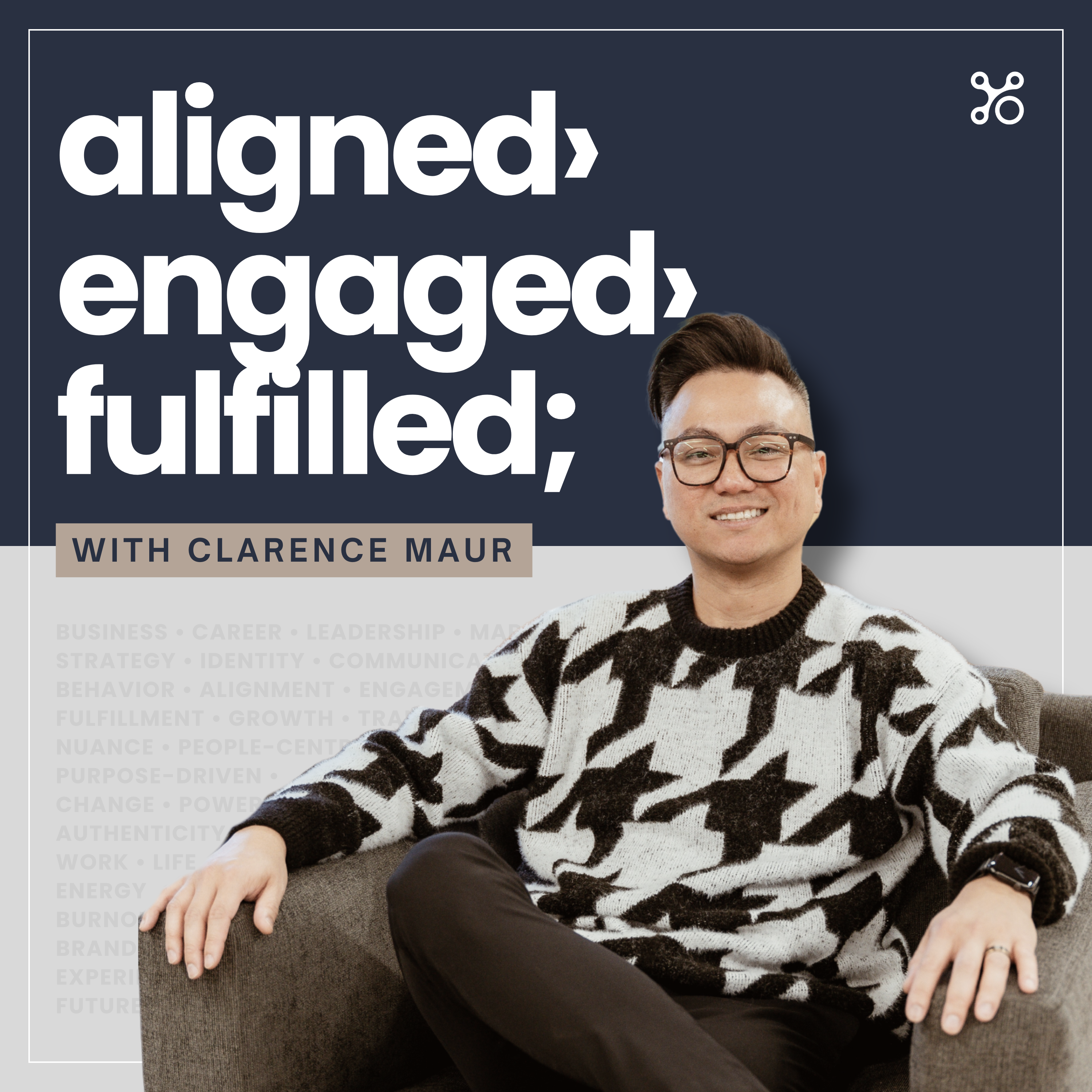
PODCAST · business
Aligned › Engaged › Fulfilled
by Clarence Maur Bongalos
Why do smart, capable, good people still feel misaligned with the work they do? That's the question Clarence Maur has been exploring across every conversation on Aligned > Engaged > Fulfilled—with compensation experts, leadership professors, brand strategists, career coaches, and executives who've been on both sides of the table.This isn't a podcast about careers or business. It's about the human forces underneath both—and what it actually takes to move from just showing up, to truly thriving.If you've ever felt the gap between the work you do and the life you want, you're in the right place.
-
28
Ghosted, Ignored, and Misaligned: Why the Hiring System Fails Everyone
What happens when the people who built the broken system decide to fix it?In this episode, Clarence sits down with career strategist, fractional HR consultant, and Emppowered co-founder Caty Toro for a candid, unflinching look at what's actually broken in today's hiring process and what it's going to take to build something better.Caty was a guest in Season 1, where she and Clarence had a two-part conversation about career change that resonated deeply with listeners. A lot has changed since then. They've become business partners. They've built a platform. And they've had to reckon, honestly, with a truth that changed everything: they were both part of the system they now spend their time trying to dismantle.This episode doesn't offer surface-level advice. It goes straight to the root—the broken incentives, the misplaced blame, the fiction-matching exercise that passes for hiring in most organizations today, and the harder question of what it actually means to stop optimizing for the wrong system and start building a better one.In this episode, Clarence and Caty unpack:Why AI didn't break the hiring system—it just revealed the cracks that were already thereThe blame loop between job seekers and recruiters, why both sides are right, and why both sides are wrongThe difference between being qualified for a role and being aligned with it—and why that distinction changes everythingWhy most job descriptions are fiction, and what that means for every step of the process downstreamThe empathy deficit at the center of the hiring experience—and why it's the one thing AI will never be able to replicateWhat it's actually been like to try to catalyze systemic change in a landscape this complex, this entrenched, and this resistant to itWhy "comfortable hell" keeps so many people—and organizations—from ever starting something differentThe honest admission at the heart of this conversation: Clarence and Caty have both been on the hiring side of the table. They've ghosted candidates. They've passed on résumés without a conversation. They've run the process the way the system incentivized them to run it. And at some point, they recognized they were feeding people through a cycle rather than getting them out of it. That recognition became Emppowered.Connect with Caty ToroConnect with Clarence BongalosLearn more about EmppoweredFind Out What Misaligned Hiring is Costing YouTake the Alignment AssessmentKeywords#hiring #hiringprocess #alignment #misalignment #jobsearch #jobseekers #recruiters #hiringleaders #futureofwork #brokensystems #employeeengagement #jobboard
-
27
Fix the Manager: Why the Generational Divide Is a Leadership Design Problem, Not a People Problem
SummaryThe conversation everyone is having about generational conflict in the workplace is pointed at the wrong problem. Blame has been leveled at Boomers, Millennials, and Gen Z in equal measure—but Clarence and returning guest Lynda Harvey make the case that the real crisis isn't the people. It's the systems we've built around them, and specifically, the manager sitting at the center of all of it.Drawing on the freshly released 2026 Gallup State of the Global Workplace Report, Clarence and Lynda unpack why manager engagement has dropped faster than any other group—the very people responsible for driving culture are the ones checking out first. They expose the paradoxes hiding inside each generation, and the rocky foundation underneath all of it: managers being asked to lead across six simultaneous generational belief systems with zero training, zero support, and zero room to fail.They assert that if you fix the manager, you move the needle on everything else.TakeawaysThe generational divide isn't the problem. The underprepared, undersupported manager in the middle of it is.You're not managing four generations — you're managing six. Traditionalists are still present, and Gen Alpha has already arrived.Manager engagement dropped faster than any other group in the 2026 Gallup data. The people responsible for driving culture are the first ones checking out.Culture isn't something you build and protect — it's a living entity shaped by the people inside it. "We protect our culture" is a red flag, not a selling point.Every generation in history has been called lazy by the one before it. Boomers and Gen Z entered the workforce with nearly identical job tenure averages. The data doesn't lie.There is no universal language — but there is a universal truth: every generation is asking "what's in it for me?" Start there.Gen Z craves in-person mentorship more than any generation right now. We're deploying AI at the exact moment they need human connection most.Dangling a promotion stopped working the day Gen Z watched their parents climb the ladder and still not afford a home.Managing humans and managing AI agents are two completely different skill sets. Treating them as one is how you break both.The first move for any burned-out manager is simple: identify one boundary you've given away and take it back.Chapters00:00 The Complexity of Leadership in a Multi-Generational Environment06:25 The Engagement Crisis and Managerial Challenges13:15 Navigating Generational Paradoxes in the Workplace19:28 Understanding Generational Perspectives and Work Ethic58:02 Integration of AI Agents in the Modern TeamKeywords#manager #management #managerengagement #managerburnout #multigenerationalworkforce #generationaldivide #employeeengagement #leadership #middlemanagement #generationaldifferences #AIintheworkforceLinksLynda on LinkedInIn the Business of Humans PodcastClarence on LinkedIn
-
26
Rewire the Room: How the Language You Choose Builds (or Breaks) Your Capacity to Engage
SummaryWhen we are completely burned out, the idea of having to "rewire our mindset" feels like an exhausting chore. We often blame toxic cultures and broken systems for our disengagement—but what if the exact words we are using to describe our reality are the very things draining our capacity to engage?In this episode of Aligned > Engaged > Fulfilled, Clarence sits down with Stephanie Garcia, an award-winning digital marketing expert and certified Neuro-Linguistic Programming (NLP) Trainer who has coached everyone from MasterChefs to astronauts orbiting the Earth.If our last episode looked at the macro-forces pulling us apart, this conversation zooms in on the micro-forces of the mind. Stephanie breaks down the practical applications of NLP in the workplace, explaining how our internal monologues construct our professional realities.Together, Clarence and Stephanie map NLP techniques directly onto The Maur Method, revealing how leaders and professionals can permanently fix misalignments in their Identity, Behavior, and Communication.TakeawaysCommunication isn't about what you broadcast; it is entirely about how the other person’s neurological wiring receives and interprets it.When you are at zero capacity, shifting your language from "what is the problem?" to "what is the desired goal?" is the fastest way to protect your energy.Using the NLP "Meta Model," we can catch the subconscious scripts (like telling ourselves we are never picked for strategic projects) before they destroy our careers.While broken corporate systems contribute to the 79% of disengaged workers, a massive portion of that disengagement is a direct byproduct of our own negative self-programming.You can use NLP to associate a specific internal response (like confidence) with an external trigger, allowing you to step out of the shadows and command a room even when your nervous system is screaming.There is a profound psychological difference between labeling someone a "performer" (which implies putting on a show) versus an "achiever" (which implies generating a result).True engagement is impossible if there is a gap between your internal values (Personal Leadership) and how you present yourself to the world (Personal Brand).If you are stuck in a rigid behavioral loop at work and aren't getting the outcome you want, you must shift your actions—doing the same thing harder will not yield different results.If marketing is how you build a brand that attracts customers, leadership is how you build an internal culture that magnetizes employees.NLP is a tool for genuine cognitive alignment, not a manipulative corporate tactic to gaslight employees or sugarcoat massive systemic failures.Chapters00:00 Understanding the Neurological Wiring of Our Brains07:06 Outcomes Thinking and Policing Internal Language17:19 Communication Styles and Their Influence32:52 Understanding Communication Styles41:06 Managing Triggers and Behavior47:12 Applying NLP in Leadership and Culture54:05 NLP and Language in Organizational ContextKeywords#neurolinguisticprogramming #NLP #work #communication #employeeengagement #burnout #careergrowth #outcomesthinking #leadership #organizationalpsychology #communicationskills LinksStephanie on LinkedInClarence on LinkedIn
-
25
Surviving the Entropy Economy: How to Fight Burnout and Build Commitment
SummaryAre we trying to fix our people when we should actually be fixing our systems?In today’s workplace, massive invisible forces—market disruption, AI anxiety, and the shift to remote work—are actively pulling our teams apart. The result is a collective burnout that traditional leadership playbooks simply cannot solve.In this episode of Aligned > Engaged > Fulfilled, Clarence sits down with Matt Poepsel, PhD, Vice President and Godfather of Talent Optimization at The Predictive Index, and the author of Expand the Circle. Together, they unpack the reality of the “Entropy Economy” and why relying on superficial engagement tactics is a losing battle.Matt introduces the framework of talent optimization and explains why true commitment is a prerequisite energy, not just an HR outcome.Whether you are an executive trying to keep your team intact or an individual contributor navigating a broken system, this episode provides the exact blueprint to counteract workplace entropy, harness the power of intentional job design, and build a culture where people actually thrive.TakeawaysModern market forces naturally pull human systems apart; leaders must actively generate the counter-energy to hold them together.When an employee struggles, it is often a fundamental failure of organizational design, not individual effort.Superficial participation is easy to fake, but deep commitment is the prerequisite energy required for actual performance.Using behavioral data during the hiring process is the most economic and effective way to ensure mutual fit and prevent future friction.You do not have to sacrifice your people to drive performance; in fact, prioritizing people is the only way to secure long-term results.Employees burn out when the daily cost of navigating tight, rigid, or broken corporate systems exceeds their personal capacity.True self-awareness doesn't happen in isolation; it requires the courage to view your leadership through the exact experience of your team.If you want your team to be committed, you have to shape an identity and a shared future that they actually want to be a part of.A healthy culture requires an equal exchange of value; misattributing blame between employers and employees destroys trust instantly.You do not need an executive title to show up tomorrow morning, recognize a peer, and actively shift the energy of your immediate environment.Chapters00:00 The Entropy Economy09:44 Enlightened Leadership21:33 Talent Optimization and Intentional Design33:30 Reducing Burnout through Hope, Mutuality, Commitment, and Synchrony43:00 Superficial Engagement vs. Meaningful Engagement48:19 Healing Separation in the TeamKeywords#entropyeconomy #talentoptimization #employeeburnout #thepredictiveindex #employeeeengagement #organizationaldesign #leadership #psychology #futureofwork #work #corporatecultureLinksMatt on LinkedInClarence on LinkedIn
-
24
Creating A Borderless Culture: How to Build An Engaged Team Across Different Time Zones
SummaryIn this episode, Brandon Fortino, founder of Fortino Studios, shares insights on remote leadership, building borderless teams, and transforming work culture through systems, trust, and storytelling. Discover how to lead effectively across time zones, foster engagement without micromanagement, and challenge traditional beliefs about work.TakeawaysHow to define culture as a set of shared systems and trust rather than a physical location.Why the "return to office" often fails by forcing an outdated management playbook onto a modern reality.How to foster collaboration by prioritizing over-communication and asynchronous workflows to stay aligned from anywhere.Why even a strong mission will fail if your infrastructure creates friction instead of enablement.How to leverage your human story to turn your personal brand into a magnet for top-tier talent.Why embracing "gray thinking" allows leaders to find the nuance between binary, all-or-nothing workplace models.How to lead by measuring success through outcomes and impact rather than hours spent in a seat.Why radical trust serves as the primary currency for building a high-performing, borderless organization.How to catalyze change by challenging stagnant corporate standards.Why the most successful leaders stop fighting reality and intentionally design systems for the future of work.Chapters00:00 Introduction to Engagement and Leadership02:22 The Power of Storytelling in Leadership11:08 Transformative Experiences and Their Impact on Leadership14:40 The Role of College Experience in Entrepreneurship20:09 Navigating Entrepreneurship Without Traditional Corporate Experience24:54 Leading a Global Team Across Time Zones26:29 Establishing Standards Across Cultures30:01 Building Effective Communication in Asynchronous Teams32:16 Creating a Cohesive Team Culture33:33 Leading Remote Teams Without In-Person Interaction36:47 Navigating Engagement and Trust in Remote Work38:26 Managing Time Zone Challenges40:52 Measuring Engagement Beyond Surveillance46:15 Addressing Turnover in a Borderless Company51:38 Standardizing Operations for Continuity52:04 Learning from Toxic Environments54:47 Crafting a Magnetic Personal Brand58:03 The Importance of Storytelling in Leadership01:04:27 Redefining Work Ethic for Gen Z01:13:01 Challenging Limiting Beliefs in Remote LeadershipResourcesBrandon Fortino on LinkedInFortino StudiosClarence on LinkedInKeywords#remote #leadership #borderlessteams #remotework #team #engagement #systemsthinking #storytelling #entrepreneurship #culture #trust #asynchronous
-
23
Broken on Purpose: Why HR Systems Fail and How to Fix the Infrastructure of Work
SummaryIn the final installment of a trilogy on employee experience, host Clarence Maur shifts the focus from culture and architecture to the "plumbing" of a business: the backend infrastructure. Guest Kasey Devine, a veteran of industry giants ADP and Trinet, pulls back the curtain on why the Professional Employer Organization (PEO) shopping process is "broken on purpose" to profit off business owners' confusion.The conversation explores how clunky payroll, opaque benefits, and compliance friction don't just stress out founders, but trickle down to destroy employee engagement. From building tech in the Midwest to using AI to standardize data, Clarence and Kasey discuss why fixing the "access system" of work and giving leaders their time back is the ultimate form of empathy in a modern, dispersed workforce.TakeawaysYou can't build a magical company culture if your backend infrastructure is burning down around you.HR complexity is often "broken on purpose" to profit off business owner confusion and biased buying processes.Employees can be aligned with a mission but remain unengaged if administrative friction stops them from contributing.Joining a PEO is like a "Sam's Club" model, pooling resources to gain economies of scale for benefits and compliance.If an employee can't easily see or access the value of their benefits, that value effectively does not exist.Reducing the "time tax" on administrative tasks is a high-level form of showing dignity and empathy to your team.Automation should only be used if it improves quality of life by freeing humans to focus on human-centric work.While work is now dispersed, the need for community isn't dead; it just requires new systems to stay connected.Building with a "purpose driving profit" mindset leads to more sustainable "doubles" than "growth at all costs" hype.Peace of mind starts with intentional calendar management to ensure consistent, human communication with your employees.Chapters00:00 The Trilogy of Employee Experience09:04 The Impact of Bad PEO Choice19:23 The Value of Infrastructure and Technology27:21 Understanding Empathy in the Workplace40:26 Balancing High-Tech Infrastructure with High-Touch Human Service48:15 Taking Control of Infrastructure and Psychological ShiftKeywords#employeeexperience #PEO #professionalemployerorganization #organizationalalignment #HR #HRinfrastructure#AI #automation #employeeengagement #futureofworkLinksLearn More About EntraviaKasey on LinkedInClarence on LinkedIn
-
22
Why Pizza Parties Don't Fix Culture: Architecting the Modern Employee Experience
SummaryIn this conversation, Clarence and Natalie discuss the architecture of the employee journey, the impact of brand activation on the employee journey, the silos and fragmentation of the employee journey, the infrastructure of the employee journey, the candidate experience, and the transactional and dehumanized candidate experience.They emphasize the importance of the employee journey as brand activation and highlight the significant impact of the candidate experience on brand equity.TakeawaysYour external promises to the market must perfectly match your internal employee experience.The modern employee experience begins the moment a candidate interacts with your brand.Treating applicants transactionally turns potential talent into vocal brand detractors.When HR, marketing, and management don't align, the employee is forced to navigate a fragmented journey.It’s an iterative, cross-functional process, not a one-and-done whiteboard exercise.Unbiased external facilitators bypass internal power dynamics to uncover what employees are really experiencing.Superficial perks will never overcome the daily friction of broken operational systems.Fumbling the exit process will instantly erase years of accumulated goodwill.Relying on stale, annual engagement surveys creates a massive blind spot for leaders.To succeed, the architect of your culture needs three things: access to leaders, cross-functional influence, and budget.Chapters00:00 The Architecture of Employee Journey09:16 Infrastructure and Employee Journey17:38 The Candidate Experience29:08 Transactional and Dehumanized Candidate Experience35:31 The Power of Curiosity and Questions41:02 Creating Engagement and Change Management50:42 Understanding the Employee Journey55:54 Employee Experience and Brand Activation01:06:15 The Importance of Continuous Listening01:14:16 The Need for a Dedicated EX ArchitectKeywords#employeeexperience #employeejourney #employeeengagement #hiringprocess #candidateexperience #customerexperience #customerjourney #leadership #business #strategy #brandactivation #brandstrategy #brandingLinksNatalie on LinkedInCrescent ConsultancyClarence on LinkedIn
-
21
If Disney Ran Your Business: How to Create A Magical Culture and Increase Engagement
SummaryIn this episode, Clarence Bongalos sits down with John Formica ("The Ex-Disney Guy"), to explore tensions in the modern workplace, the crisis of employee loyalty, and the relationship between employee experience and customer experience as exemplified by Disney's magical culture.The conversation explores the importance of defining purpose, the impact of performance and disdain for a paycheck, creating a great company to work for, striving for magic and humanity, story building in leadership, experience, value, and career change, Disney-level engagement strategies for any business, and changing behavior in leaders to improve engagement.TakeawaysTension between performance and authenticity in the modern workplacePurpose and alignment are crucial for employee engagement and success Defining purpose engages the heart of employees.Striving for magic and humanity in the workplace fosters a positive culture.Chapters00:00 The Tension in the Modern Workplace06:06 Employee Loyalty Crisis20:29 Performance and Alignment31:00 Purpose and Alignment in Disney Culture37:05 Defining Purpose for Small Business Owners45:36 Creating a Great Company to Work For52:49 Story Building in Leadership01:02:56 Disney-Level Engagement Strategy for Small Businesses01:08:59 Changing Behavior in LeadersKeywords#employeeengagement #companyculture #leadership #culture #disney #businessstrategy #customerexperience #employeeexperienceLinksJohn's LinkedIn
-
20
The Storybuilding Framework: How to Align Your Team and Captivate Your Market
SummaryIn this episode, Clarence Bongalos interviews John Elbing, a growth story architect, about the power of story building in marketing and organizational culture.They explore how shifting from storytelling to story building can enhance engagement, authenticity, and alignment within companies and careers.Key TopicsDifference between storytelling and story buildingThe importance of customer perspective in marketingAligning internal culture with external brand storyThe role of authenticity in effective storytellingImpact of story building on leadership and strategyChapters00:00 Introduction to Engagement and Storytelling01:45 Corporate Narcissism and Customer Focus05:14 The Shift from Storytelling to Story Building09:27 Authenticity in Storytelling12:50 The Importance of Customer-Centric Storytelling15:18 The Development of Standpoint and Story Building18:43 Recognizing the Wrong Standpoint21:50 Internal vs. External Storytelling25:12 The Impact of Broken Identity on Engagement26:48 Culture Building through Story Building31:41 Engaging Customers from the Inside Out32:39 The Power of Story Building in Culture34:34 Employee Engagement as a Relationship37:06 Finding Fulfillment in Work38:20 Applying Story Building to Career Development40:35 Building a Personal Brand for Career Success42:34 The Importance of Fulfillment in Life44:43 Work-Life Integration vs. Balance47:35 Emotional Storytelling in Professional Contexts50:12 Generative AI and the Value of Human Storytelling53:12 Understanding Customer Perspectives55:17 The Mindset Shift for EngagementKeywords#storybuilding #engagement #marketing #organizationalculture #authenticity #customerperspective #internalalignment #leadership #branding #storytelling #employeeexperience #engagementLinks & ResourcesStandpoint WebsiteStory Building Book by John ElbingCharting Your Retirement Journey
-
19
Laughter as a Service: How to Increase Engagement Using Improv and Humor
SummaryIn this episode, Clarence Bongalos and Kevin Hubschmann explore how humor, improv, and social intelligence can transform leadership, boost engagement, and create a psychologically safe workplace. Kevin Hubschmann, founder of Laugh.Events, shares practical insights on integrating laughter into corporate culture to enhance productivity and well-being.Key TopicsHumor as a leadership toolImprov and active listening in teamsPsychological safety and vulnerabilityImpact of laughter on stress and bondingRemote work and digital humor strategiesChapters00:00 The Shift in Leadership Post-Pandemic00:12 Introducing Humor and LaaS in the Workplace01:07 Improv Principles for High Engagement Leadership02:33 The Cost of Performative Professionalism02:48 The Ripple Effect of Stress and Resentment05:15 Data on Employee Engagement and Well-being06:32 Laughter as a Solution to Loneliness and Stress09:21 Creating a Culture of Psychological Safety12:43 Physiological Benefits of Laughter and Humor14:18 Long-term Benefits of Laughing and Development17:08 Improv vs. Comedy: Building Team Support17:44 Improv as a Tool for Resilience and Bravery20:29 Active Listening and Empathetic Communication23:20 Alignment and Engagement through Validation28:30 Applying Yes-And in High-Stakes Meetings32:06 Improv and Resilience to Failure36:22 Humor in Remote and Hybrid Work Environments41:42 Safe, Work-Appropriate Humor and Boundaries53:45 Practical Tips for Introverted Leaders58:00 The Role of Self-Awareness and Feedback01:00:08 Rethinking Fun and Engagement in the WorkplaceKeywords#leadership #humor #improv #psychologicalsafety #employeeengagement #corporateculture #socialintelligence #resilience #remotework #softskills #business #leadershipdevelopment #funatworkLinksLaugh.EventsLaughRx NewsletterKevin on LinkedInClarence on LinkedIn
-
18
The Psychology of Pay: Why Money Doesn't Buy Engagement (And What Does)
SummaryIn this episode, Clarence Bongalos and guest co-host Caty Toro engage with compensation expert Vicki Shepard, CCP, SPHR, MHRLR, to explore the complexities of compensation strategies in the workplace. They discuss the stark disparities in pay between executives and employees, the importance of pay transparency, and the need for a solid compensation philosophy that aligns with company values. The conversation delves into the generational differences in attitudes towards compensation, the impact of recognition on employee engagement, and the challenges leaders face in navigating tight budgets while maintaining morale. Ultimately, the episode emphasizes the evolving nature of work and the necessity for organizations to adapt their compensation strategies to meet the needs of a diverse workforce.TakeawaysCompensation disparities can lead to feelings of betrayal among employees.Pay transparency is crucial for building trust within an organization.Job architecture should consider both market data and internal company values.Retention is not the same as engagement; true engagement requires more than just a good salary.Recognition and appreciation are key components of employee satisfaction.Generational differences impact how employees view compensation and job satisfaction.The gig economy is changing traditional compensation models.Companies must be proactive in addressing wage compression issues.Effective communication about compensation strategies is essential for employee morale.Leaders should be prepared to adapt their compensation strategies to future workforce trends.Chapters00:00 Introduction to Compensation Disparity03:29 The Impact of Secrecy in Compensation11:10 Understanding Job Architecture and Pay Structures15:31 Retention vs. Engagement: The Role of Compensation20:01 Exploring Total Rewards and Employee Benefits31:00 The Job Market Shift: Turnover Trends31:43 Performance-Based Pay and Employee Retention33:36 Wage Compression: A Trust Erosion35:49 Navigating Pay Bands and Market Data39:51 Understanding Compensation Strategies44:09 The Impact of Pay Transparency Laws48:27 Generational Perspectives on Compensation58:33 Creating a Family-Friendly Workplace59:37 The Value of Contribution and Compensation01:00:18 Recognition and Performance Management Challenges01:03:17 The Future of Compensation Strategies01:06:30 Adapting to a Fluid Workforce01:10:22 Making Tough Compensation Decisions01:12:58 Salary Transparency and Job Descriptions01:16:56 Debunking Myths: Money and Happiness at WorkKeywords#compensation #paytransparency #employeeengagement #retention #jobarchitecture #generationaldifferences #futureofwork #salarynegotiation #totalrewards #leadershipLinksVicki on LinkedInCaty on LinkedInClarence on LinkedInBureau of Labor StatisticsO*Net Online
-
17
New Rules of Engagement: Leading Through Chaos, AI, and the Generational Divide
SummaryIn this first episode of Season 2 of the Aligned › Engaged › Fulfilled podcast, host Clarence Bongalos welcomes Drs. Lisa and John Gates to discuss the evolving landscape of leadership. They explore the shift from alignment to engagement, the challenges leaders face in a complex world, the need to redefine "leadership" to fit the demands of the current times, and the growing gap between theory and practice.The conversation delves into generational differences in the workforce, the impact of AI on leadership roles, and the necessity of a coaching mindset for effective leadership. The episode emphasizes the need for intentionality, lifelong learning, and the moral dimensions of leadership in navigating today's challenges.TakeawaysLeadership today requires a focus on alignment rather than just engagement.The challenges of modern leadership include political polarization and mental health crises.Authenticity and vulnerability are essential traits for effective leaders.Generational differences in the workforce require tailored leadership approaches.Psychological safety is crucial for fostering open communication in teams.AI can enhance leadership effectiveness but should not replace human interaction.Coaching is a vital skill for leaders to develop their teams.Intentionality in leadership is necessary for navigating complexity.Lifelong learning is essential for adapting to rapid changes in the workplace.Systemic change is needed to address the challenges in leadership today.Chapters00:00 Welcome to Season 2: Setting Intentions01:26 The Shift from Alignment to Engagement04:49 Understanding Leadership in a Complex World10:34 The Friction in Leadership Change12:26 Intentionality and Effectiveness in Leadership16:56 The Importance of Lifelong Learning17:22 Analyzing Leadership Styles in Today's Context21:31 Adapting Leadership Styles to Modern Needs25:07 Creating Psychological Safety in the Workplace28:32 The Evolving Concept of Psychological Safety32:59 Finding Fulfillment in Work and Life38:20 The Nature of Surprise in Leadership39:03 Finding Fulfillment Through Alignment40:21 Challenging the Status Quo42:34 Creating a Lasting Organization44:46 Defining Leadership: Good vs. Bad50:31 Bridging the Gap Between Theory and Practice59:51 Navigating Generational Differences in the Workplace01:04:14 The Role of AI in Leadership01:07:51 The Shift from Manager to Coach01:10:23 Timeless Principles in a Changing LandscapeKeywords#leadership #engagement #psychologicalsafety #generationaldifferences #AI #AIinleadership #coaching #lifelonglearning #organizationalculture #intentionalleadership #systemicchange
-
16
Aligned › Engaged › Fulfilled: How to Build A Life You Can Truly Be Grateful For
SummaryIn this episode, Clarence Bongalos reflects on the journey of his podcast's first season, sharing personal stories and insights about leadership, workplace culture, and the importance of alignment in achieving fulfillment. He discusses the challenges of modern work environments, the crisis of misalignment, and the birth of his consulting firm, The Maur Company, aimed at helping individuals and organizations find their purpose and alignment. The episode concludes with a call to action for listeners to take charge of their careers and lives, emphasizing the need for active participation in creating meaningful change.TakeawaysThe old corporate playbook is broken.Passions are multifaceted and dynamic.Misalignment leads to burnout and disengagement.The pandemic has highlighted workplace crises.Leaving a corporate job is sometimes an act of survival.Alignment is deeper than just knowing how your role fits within the organization.Before you can find fulfillment, you must first achieve alignment.The Maur Method can help you find alignment and be more engaged with your work.The Maur Company was born out of a desire to help others grow and transform.You are the CEO of your own career.Chapters00:00 Introduction to the Aligned › Engaged › Fulfilled Podcast00:09 Exploring the Concept of Alignment00:15 Introduction and Season Reflection02:47 The Journey of Leadership and Passion05:06 The Crisis of Workplace Engagement10:44 Personal Transformation and Misalignment15:21 The Birth of The Moore Company20:01 Understanding Alignment and Fulfillment31:09 The Framework for Personal and Organizational Alignment35:20 Call to Action and Future DirectionsKeywords#leadership #workplaceculture #alignment #personalgrowth #transformation #engagement #fulfillment #coaching #careerdevelopment #careers #organizationalchange #business #employeeexperience #employeeengagement #marketing #strategyLinksConnect with Clarence on LinkedInSchedule A Free Strategy Session with ClarenceClarence's TikTokClarence's Instagram
-
15
Kindness is a Hard Skill: How to Build a Culture Where People Thrive
SummaryIn our penultimate episode, Clarence Bongalos and Christy Pretzinger explore the intersection of people, culture, kindness, alignment, and leadership, summarizing the key themes that have emerged as we explored the foundations of a new world of work in this first season of the show. Christy emphasizes the importance of aligning people with purpose and measuring culture with the same rigor as financials. They discuss the Better Quotient, a framework for self-awareness and improvement, and the role of vulnerability in building trust within teams. The conversation highlights the evolving workplace dynamics, especially in the post-pandemic era, and the necessity for leaders to foster environments where employees can thrive and bring their whole selves to work.TakeawaysSuccess is dependent on aligning people with purpose.Culture should be measured with the same rigor as financials.Kindness is a strategic business driver.Cultural assets can be transformed from liabilities.Self-awareness is foundational for effective leadership.Vulnerability fosters trust in the workplace.Generational shifts are changing the conversation around kindness.The Better Quotient emphasizes being better, not perfect.Engagement is directly tied to workplace culture.Trust is built through consistent behavior over time.Chapters00:00 Thanksgiving Reflections and Community Support01:22 The Importance of Culture in Business06:15 Kindness as a Strategic Business Driver12:45 Generational Shifts in Leadership and Kindness18:21 The Better Quotient: A New Leadership Framework25:05 Aligning People and Environment for Thriving Cultures31:06 Navigating Change in a Post-Pandemic World36:17 The Authentic Self in Work and Life39:32 Building Trust in Leadership42:33 The Impact of Culture on Employee Engagement48:06 Assessing Cultural Assets and Liabilities53:14 The Relationship Between Human Thriving and ProfitKeywords#community #support #purpose #culture #kindness #leadership #selfawareness #BetterQuotient #employeeengagement #trust #vulnerabilityLinksChristy on LinkedInChristy's WebsiteWork with WG ContentThe Better Leader ProjectClarence on LinkedInWork with Clarence
-
14
The Architecture of Impact: Strategy as the Bridge Between Vision and Culture
SummaryIn this episode, Clarence Bongalos engages with Julius Alejandro, an ecosystem strategist, to explore the evolving landscape of workplace culture, strategy, and entrepreneurship. They discuss the importance of viewing businesses and careers as organic systems, the distinction between true strategy and mere tactical planning, and the necessity of integrating diversity, equity, and inclusion (DEI) into the core of business strategy. The conversation also touches on the rise of social entrepreneurship and the role of AI in strategic thinking, emphasizing the need for human intuition and relationships in navigating the complexities of modern business.TakeawaysThe old playbook of workplace culture is broken.Understanding ecosystems is crucial for career and business success.Careers and businesses should be viewed as organic systems, not mechanical ones.True strategy is about the long-term vision, not just short-term tactics.Building strategic infrastructure is essential for achieving goals.Diversification in careers is becoming increasingly important.DEI should be integrated into the strategy, not just treated as a cultural initiative.A strong strategy is necessary for a thriving organizational culture.Social entrepreneurship is on the rise and is becoming a key business strategy.AI should be used as a tool, not a replacement for human strategic thinking.Chapters00:00 Challenging the Status Quo of Workplace Culture01:56 Understanding Ecosystems in Business06:04 The Shift from Mechanical to Organic Systems11:55 Defining True Strategy vs. Tactics15:01 Building Strategic Infrastructure19:43 Navigating the Landscape of Entrepreneurship22:57 The Importance of Flexibility in Strategy31:40 Distinguishing Between Strategy and Recovery Tactics36:42 Aligning Marketing and Strategy39:40 Navigating Leadership and Ego Management43:14 The Interplay of Culture and Strategy48:12 Embedding DEI in Organizational Strategy51:46 The Rise of Social Entrepreneurship55:32 AI as a Tool in Strategic Thinking01:00:05 Bridging Vision and Infrastructure01:07:30 Building Relationships for Future SuccessKeywords#workplaceculture #ecosystemstrategy #organicsystems #truestrategy #strategicinfrastructure #diversification #DEI #strategy #culture #socialentrepreneurship #AI #artificialintelligence #entrepeneurshipLinksConnect with Julius on LinkedInJulius Alejandro ConsultingConnect with Clarence on LinkedInWork with Clarence
-
13
Find Your Purpose: How to Align Life with Your Core Values
SummaryIn this conversation, Clarence Bongalos and Marcus Combs explore the intersection of leadership, self-awareness, and spiritual intelligence. They discuss Marcus's journey from a successful corporate career to founding numbrU, a system that combines numerology with modern strategies to help individuals find alignment, purpose, and fulfillment.The discussion emphasizes the importance of understanding one's identity, the role of safety in engagement, and the need for clarity in decision-making. They also touch on the future of alignment intelligence and the risks of ignoring self-awareness in a rapidly changing world.TakeawaysThe journey to fulfillment often begins with understanding one's purpose.Alignment is crucial for genuine engagement in work and life.Self-awareness is the foundation for making informed decisions.Numerology can provide objective insights into one's identity.Safety is a prerequisite for effective engagement and performance.High achievers often struggle with burnout due to misalignment.Personal branding is essential in today's job market.The Core 4 Compass helps individuals navigate their career paths.AI can enhance self-awareness if used correctly.Spiritual intelligence is becoming increasingly relevant in leadership.Chapters00:00 Introduction to Fulfillment and Alignment03:36 Marcus Combs: From Corporate Success to Spiritual Intelligence06:36 The Journey of Self-Discovery and Purpose09:25 Numerology vs. Traditional Assessments12:14 The Power of Names and Identity15:24 Alignment as a Foundation for Engagement18:19 The Pause, Prepare, and Push Method21:18 Safety and Performance in Organizations24:02 Building Your Personal Brand: The Core Four26:48 The Importance of Structured Diagnostic Methods29:56 Understanding Your Core Four Numbers32:47 Spirituality in Leadership and Self-Discovery36:30 Introduction to Pythagorean Numerology38:37 Decoding Names and Numbers39:26 AI and Alignment Intelligence41:10 Blending Ancient Wisdom with Modern Technology44:21 Navigating Transitions and Transformations44:59 Personalization in Services46:58 Practical Steps for Clarity50:16 The Future of Alignment Intelligence57:07 The Risks of Ignoring Objective Data01:01:08 Conclusion and Call to ActionKeywords#leadership #fulfillment #alignment #selfawareness #numerology #personalgrowth #spiritualawareness #careerdevelopment #coaching #purposeLinksGet Your Core 4 NumbersFollow Marcus on TikTokFollow Marcus on InstagramWork with Clarence
-
12
The Fearless Mindset: How to Find Fulfillment in Living A Life of Agency
SummaryIn this conversation, Anna Bleers shares her journey from a successful career in brand strategy at Energy BBDO to founding her own consultancy, Fearless Strategic Marketing. She discusses the importance of a positive corporate culture, the power of fearlessness in personal and professional growth, and actionable steps for leaders to energize their teams.Anna emphasizes the significance of empathy, understanding, and the impact of relationships in building a successful brand and organization.TakeawaysPositive corporate cultures can exist and lead to success.Fear is often a barrier to personal and professional growth.Leaning into fear can lead to empowerment and new opportunities.Fearlessness can mean staying true to one's values and identity.Culture has to keep evolving to fit the needs of the modern workplace.Change almost always leads you to a better path.Culture transformation isn't about compromising or changing values, it's about evolving the how.Self-reflection is crucial for personal growth and career decisions.Agency over your work and your choices leads to a life of fulfillment.Leadership is about the legacy you build through relationships.Chapters00:00 Introduction to Anna Bleers and Her Journey02:51 The Evolution of Brand Strategy and Personal Agency09:04 The Culture of Energy BBDO: A Case Study in Positivity12:21 The Importance of Sharing Positive Corporate Culture Stories16:23 Defining Fearlessness Through Personal and Professional Challenges25:19 Energizing People to Energize Brands: A New Philosophy32:41 Creative Confidence: Outsmarting Competitors Through Culture36:23 Case Study: The General's Empathetic Branding Strategy44:02 The Power of Creativity in Branding51:08 Transitioning to Solopreneurship56:58 Embracing Fear and Self-Discovery01:00:04 The Impact of Fear on Career Choices01:08:41 Reframing Fear as a Compass01:13:08 Building a Legacy Through Leadership01:17:19 Episode TakeawaysKeywords#Fearless #StrategicMarketing #corporateculture #brandstrategy #personalagency #leadership #marketing #creativity #empowerment #businessgrowthLinksWork with Anna - FEARLESS Strategic MarketingWork with Clarence - Free Strategy SessionConnect with Clarence on LinkedIn
-
11
Changing Careers Part 2: A Tactical Job Search Playbook for Taking Back Your Power
SummaryIn this episode, Clarence Bongalos and career strategist Caty Toro continue their discussion on the evolving landscape of work and career transitions. They zoom in from their previous conversation of the broader career environment and explore the importance of proactive and innovative job search strategies, the impact of AI on career planning, and the concept of portfolio careers as a viable alternative to traditional employment. The conversation emphasizes the need for individuals to take control of their careers, build personal brands, take back their power, and engage in meaningful conversations to create opportunities.TakeawaysCareer changes require deep internal work on identity and values.Proactive job searching is essential in a competitive market.Networking and real conversations can create job opportunities.Rejection should be viewed as redirection, not failure.Treat your career like your business; it's Me, Inc.Building a personal brand is crucial in today's job market.AI is a tool that can enhance human connection, not replace it.Portfolio careers offer flexibility and variety in work life.Job seekers should focus on their unique value propositions.Taking risks can lead to greater career satisfaction.Chapters00:00 Introduction to Transformative Work Culture01:20 Proactive Job Search Strategies11:25 Rethinking the Resume: Personal Branding18:24 Transforming Interviews into Collaborations20:15 Mastering the Interview Process26:09 The Shift in Hiring Dynamics28:02 Reclaiming Your Career Power35:14 Navigating AI in Career Strategy39:20 The Rise of Portfolio Careers43:08 The Importance of Awareness of ChoicesKeywords#career #careerchange #entrepreneurship #worklifebalance #identitycrisis #jobmarkettrends #personalgrowth #valuesandvirtues #modernjobsearch #coaching #selfleadershipLinksCaty on InstagramCaty on TikTokCaty Toro on LinkedInWork with CatyClarence on LinkedInWork with Clarence
-
10
Changing Careers Part 1: How to Strategically Realign Your Work with Your Life
SummaryIn this episode, host Clarence Bongalos and career strategist Caty Toro explore the complexities of career change in today's evolving job market. They discuss the impact of the pandemic on professional identity, the rise of portfolio careers, and the duality of a tightening job market amidst a wave of resignations. Caty shares her personal journey and insights on detaching self-worth from job titles, the importance of aligning values with actions, and modern strategies for job searching. The conversation emphasizes the need for self-leadership and the importance of understanding one's identity in relation to work.TakeawaysThe pandemic has catalyzed a significant shift in career perspectives.Many professionals are experiencing an identity crisis in their careers.Portfolio careers are becoming more common among younger generations.The job market is experiencing a duality of high resignations with low job availability and people leaving the traditional 9-5 to pursue self-employment, leading to a massive skills gap.Self-worth should not be tied to job titles or corporate identity.Creating boundaries is essential for work-life balance.Values and virtues must align for true fulfillment in work.Emotional decisions can lead to immediate regret in career transitions.Understanding personal definitions of success is crucial for career satisfaction.Job search strategies need to evolve beyond traditional methods.Chapters00:00 Introduction to Transformative Work Culture03:04 The Great Resignation and Career Change05:44 The Duality Paradox in the Job Market08:51 Identity Crisis and Career Transitions11:42 The Impact of Personal Life Changes on Careers15:01 Imposter Syndrome and Self-Doubt17:56 Caty's Journey: From Corporate to Coaching20:42 The 3D Method: Disconnect, Detach, Divorce23:38 The Need to Be Needed and Psychological Roots35:06 Navigating Corporate Culture Changes35:59 Values vs. Virtues: Bridging the Gap38:43 The Importance of Self-Leadership42:17 Work-Life Balance: A Myth or Reality?45:00 The Need for Proactive Job Search StrategiesKeywords#career #careerchange #entrepreneurship #worklifebalance #identitycrisis #jobmarkettrends #personalgrowth #valuesandvirtues #modernjobsearch #coaching #selfleadershipLinksCaty on InstagramCaty on TikTokCaty Toro on LinkedInWork with CatyClarence on LinkedInWork with Clarence
-
9
Building the Brand Part 2: Leveraging Community to Build A Sustainable Business As A Creator
SummaryIn this episode, Clarence Maur and Tom Circo continue their discussion about the evolving landscape of brand building and the creator economy. They shift the focus from enterprise brands to the independent creator, discussing the importance of authenticity, community, and a business mindset for those transitioning from corporate to content creator. Tom emphasizes the need for creators to approach their work as a business, highlighting the significance of brand partnerships and influencer marketing. The discussion also touches on the role and impact of AI both in business and the larger social context, the future of branding, and actionable advice for aspiring creators and business leaders.TakeawaysCreators must view themselves as businesses, not just creatives.Authenticity and community engagement are crucial for success.Building a personal brand requires alignment with one's true self.Influencer marketing should focus on long-term partnerships, not one-off campaigns.Branding doesn't just apply to businesses, it also applies to careers.Brands need to humanize themselves to connect with consumers.AI will significantly impact the business, economic, and social landscapes, creating both opportunities and challenges.Creativity will always be a key differentiator in branding.Size of the influencer doesn't always equate to effectiveness; niche matters more.The creator economy is expanding, and traditional education is being challenged.Chapters00:00 Introduction to the Podcast and Guest00:54 From 9-5 to Content Creation01:42 Creators as Businesses: The New Economy09:11 The Importance of Quick Adaptation in Marketing11:04 Authenticity in Content Creation11:35 The Importance of Community Engagement12:01 Influencer Marketing and Human Connection13:09 Building Long-Term Influencer Relationships18:56 The Role of Matchbook in Influencer Marketing21:23 AI's Impact on Branding and Marketing26:28 Advice for Business Leaders and Aspiring Creators35:09 The Power of Creative Resumes36:11 The Shift in B2B Marketing39:15 The Future of Personal Branding40:46 The Changing Landscape of Education45:58 The Impact of the Creator Economy49:20 The Future of Brand TransparencyKeywords#creatoreconomy #personalbranding #influencermarketing #authenticity #communitybuilding #brandpartnerships #AI #marketing #business #businessmindset #contentcreationLinksLearn More About MatchbookBook A Call with TomTom's LinkedInClarence's LinkedInSchedule A Strategy Session with Clarence
-
8
Building the Brand Part 1: Connections as Currency in a Relationship-First Economy
SummaryIn this first half of a 2-part episode, host Clarence Maur speaks with Tom Circo, co-founder of Matchbook, about the evolving landscape of branding and marketing. They discuss the importance of building genuine relationships, the shift from a product-first to a brand-first economy, and how connection and community are the new currencies in business.Tom shares insights from his entrepreneurial journey and emphasizes the need for brands to listen to their customers and be authentic in their messaging. The conversation highlights the significance of community engagement and the role of influencers in shaping brand narratives.TakeawaysExecution and resilience beat theory every time.In 2025, every company should be a brand.Brand equals trust, trust equals conversions.People see you more clearly than you see yourself.Coonections and community are currency in today's economy.Authenticity is informed by being genuine.The shift from attention to connection is real.The brands that win today are the ones that listen.Brands can consistently differentiate by being nimble.The future of branding is people-first and human-centric.Chapters00:00 Introduction to the Podcast and Guest03:21 Tom Circo's Entrepreneurial Journey06:05 The Importance of Genuine Connections08:39 The Shift from Product to Brand10:48 Building Trust in a Skeptical Market13:26 The Role of Storytelling in Branding15:59 The Need for Brand Evolution18:20 Understanding Customer Perception20:53 The Human-Centric Approach to Branding23:15 Connections as Currency vs. Attention as Currency28:48 Building Digital Communities33:35 Shifting from Vanity Metrics to Meaningful Engagement39:33 Authenticity in Brand PartnershipsKeywords#branding #trust #community #relationships #marketing #authenticity #brandstrategy #influencermarketing #businessgrowth #customerengagement
-
7
The People Anchor: How Unforgettable Employee Experience Creates Unbeatable Customer Experience
SummaryIn this episode, we explore how a world-class Employee Experience (EX) is the single biggest driver of an unbeatable Customer Experience (CX) in 2025 and beyond. Manasi Shukla, Founder of Safrela Consulting, and Natalie Jackson, Founder of Crescent Consultancy and CX Strategist at Peak Fractional, join the discussion and share their insights on how investing in employees as primary customers can drive growth and enhance overall brand experience.The conversation covers the importance of experiential leadership, the role of journey mapping in both CX and EX, the need for alignment between internal and external experiences, and the impact of this mindset shift on business growth. Practical steps for leaders to improve both EX and CX are also discussed, emphasizing the need for listening, measuring, and creating a culture of engagement.TakeawaysInvesting in employee experience drives customer satisfaction.The lines between CX and EX are increasingly blurred.Employee onboarding is crucial for engagement and retention.Talent-company fit is as important as product-market fit.Effective training programs enhance both CX and EX.Journey mapping helps identify pain points in experiences.Leadership alignment is key to successful CX and EX strategies.AI can enhance customer education but cannot replace human touch.Understanding employee needs leads to better customer service.Organizational culture impacts both employee and customer experiences.Chapters00:00 Introduction to Employee-Centric Business Models03:24 Defining Customer Experience (CX) and Employee Experience (EX)06:05 The Concept of Employees as Primary Customers08:55 The Impact of Remote Work on Employee Onboarding11:46 Talent Company Fit vs. Product Market Fit14:33 The Importance of Internal Alignment for Customer Success17:25 Differences in CX Solutions Across Industries20:20 Understanding Journey Mapping23:30 Challenges in Implementing Journey Mapping26:07 Ownership of Employee Experience28:53 The Role of Marketing in Employee Experience35:01 The Importance of Customer Experience37:12 Aligning Internal and External Experiences39:01 The Role of Leadership in Customer Education41:50 Ownership and Accountability in Customer Success44:15 People as the Anchor of Experience48:23 AI's Impact on Customer and Employee Experience53:54 Practical Steps for Leaders57:24 The Future of Employee and Customer ExperienceKeywords#EmployeeExperience #CustomerExperience #CX #EX #WorkplaceCulture #TalentOptimization #JourneyMapping #AIinBusiness #Leadership #OrganizationalDesignLinksSchedule A Free 30-Minute Consultation with ManasiSchedule A Free 30-Minute Discovery Call with NatalieSchedule A Free Strategy Session with Clarence
-
6
Redefining Performance: How to Beat Burnout by Managing Your Energy
SummaryMisinformation about burnout fuels it and pulls people further away from overcoming it.In this episode, Clarence Bongalos and Brett Klika delve into the complexities of burnout, exploring its causes, effects, and the importance of energy management in the workplace. They discuss the misconceptions surrounding burnout, the role of personal capacity, and the impact of social media and comparison on energy levels.Brett emphasizes the need for leaders to embrace vulnerability and intentionality in their approach to energy management, while also redefining performance and productivity in a way that aligns with personal values and purpose. The conversation highlights practical steps for reclaiming energy and the future of energy as a key performance indicator in organizations.TakeawaysBurnout is not just about working too hard; it's about capacity and intention.Personal capacity must be addressed to combat burnout.Leaders too often overlook the personal aspects contributing to burnout.High achievers experience unique forms of burnout.Identity is closely tied to work, and misalignment can lead to burnout.Comparison, especially fueled by social media, drains energy.Younger generations face unique challenges with comparison and social media.Martyrdom in corporate culture is a common issue.Intentional recovery practices are essential for energy management.Vulnerability in leadership fosters relatability and connection.Sound Bites"Burnout is an epidemic.""It's not just about working too hard.""Recovery does not have to be long."Chapters00:00 Introduction to Burnout and Energy Management03:19 Understanding Burnout: Capacity vs. Demand08:21 The Personal Side of Burnout10:42 Burnout at the Elite Level14:54 Identity and Its Relation to Burnout22:56 The Evolution of Energy in the Workplace27:35 The Thief of Joy: Comparison and Energy Drain31:07 The Dangers of Comparison32:16 The Quest for Novelty in Entrepreneurship33:09 Social Media's Role in Comparison and Energy Drain36:24 Parenting in the Age of Social Media40:54 Understanding Martyrdom in Corporate Culture46:45 The Impact of Leadership on Martyrdom48:38 Emotional Energy Management in Leadership52:24 Vulnerability as a Leadership Strength01:00:48 The Power of Vulnerability in Leadership01:03:07 Redefining Performance and Productivity01:07:51 Aligning Energy with Purpose01:12:49 Building Recovery into Leadership01:17:25 The Future of Energy as a KPI01:21:02 Reclaiming Energy Through StorytellingKeywords#burnout #energymanagement #leadership #performance #productivity #emotionalintelligence #workplaceculture #vulnerability #comparison #burnoutrecoveryLinksContact Brett at [email protected] Brett's Book, "Energy100" on AmazonConnect with Brett on LinkedInConnect with Clarence on LinkedInFree Strategy Session with Clarence
-
5
The Return of Community: Redefining the Workspace from Cost Center to Strategic Advantage
DisclaimerThis episode experienced a technical issue that affected audio quality. We determined that the organic discussion was too valuable to lose and decided to publish it as is.SummaryIn this episode, Clarence Bongalos and John Lee discuss the evolution of the modern workplace, focusing on the rise of coworking spaces and the importance of community in fostering employee engagement and productivity.They explore the return to office debate, the benefits of hybrid work models, and how workplace design can impact employee habits. John shares insights on the coworking industry, emphasizing the need for flexibility and the role of community in creating successful work environments. The conversation highlights the shift towards a more human-centric approach to work, where employees' needs and preferences are prioritized.TakeawaysThe modern workplace is evolving, not dying.Community-focused workspaces enhance employee engagement.Hybrid work models are becoming the norm and is the answer to the culture problem.Workplace design significantly impacts productivity.Employees value flexibility over rigid office mandates.The coworking industry is still in its early stages.Listening to employee feedback is crucial for workplace success."High-performing" will be redefined in the context of remote and hybrid settings.Stubbornness in leadership can hinder progress.The future of work will prioritize community and collaboration.Chapters00:00 Redefining the Modern Workplace06:14 The Impact of COVID on Work Culture12:06 Return to Office: Mistakes and Misconceptions17:46 Rethinking Office Purpose in 202522:01 Mental Health and Social Interaction26:41 Debunking the Generational Narrative30:02 The Message of Flexible Workspaces33:09 The Future of Office Space Design34:51 Resistance to Change in Business Leadership36:46 Understanding Control and Fear in Leadership39:25 Navigating Remote and Hybrid Work Challenges41:01 Lessons from Business Failures: The Blockbuster Example42:14 The Convergence of Leadership, Marketing, and Strategy43:03 Fostering a Culture of Entrepreneurship44:08 The Role of Coworking Spaces in Innovation45:24 The Importance of Workplace Design47:33 Financial Perspectives on Community and Amenities47:42 The Hybrid Work Model: A Balanced Approach49:11 The Value of In-Person Connections51:30 Understanding Employee Needs in the Workspace51:59 Real Estate Strategy for Modern Workspaces53:35 Creating a Welcoming Workspace Environment55:57 Redefining High Performance in Hybrid Work57:25 The Importance of Community in Workspaces01:00:06 Fundraising for a Cause: The Skinny Gene ProjectKeywords#modernworkplace #coworkingspaces #employeeengagement #hybridwork #workplaceculture #community #entrepreneurship #returntooffice #flexibleworkspaces #businessgrowth #leadership #businessLinksContact John: [email protected] A Tour at Venture X Scripps RanchThe Skinny Gene ProjectFree Strategy Session with Clarence
-
4
Your Leadership Skillset: Moving from Overwhelmed Manager to Authentic Leader
SummaryIn this episode, Clarence Bongalos and leadership expert Lynda Harvey discuss the complexities of modern leadership and management.They explore the challenges faced by new managers, the impact of toxic workplaces, and the importance of authenticity in leadership. Lynda emphasizes that leadership is a skill that can be developed, not just a title, and highlights the need for intentional leadership that prioritizes employee engagement and well-being.The conversation also touches on the current crisis in management, the generational shifts in workplace expectations, and the necessity for organizations to redefine productivity and employee value.TakeawaysLeadership is a skillset developed through experience.Toxic workplaces cannot be fixed by individual effort alone.New managers often feel overwhelmed and unprepared for their roles.The myth of the natural leader is damaging to new managers.Authenticity in leadership requires a balance of personal and professional self.Employee engagement is at an all-time low, largely due to management issues.Companies need to invest in meaningful employee benefits.The manager crisis stems from a lack of development and support.Intentional leadership focuses on the legacy one leaves behind.Understanding workplace bullying is crucial for creating a healthy work environment.Chapters00:00 Introduction to Transformative Leadership03:07 Understanding Toxic Workplaces10:59 Challenges for New Managers14:27 Debunking the Myth of Natural Leaders16:49 Distinguishing Management from Leadership20:19 Defining Leadership for New Managers22:29 Leading with Authenticity28:52 The Importance of Leadership Awareness30:12 The Management Crisis Unveiled31:17 Generational Gaps and Workplace Apathy34:25 The Disconnect Between Companies and Employees36:42 The Development Issue in Management39:31 The Ripple Effect of Manager Disengagement41:01 Intentional Leadership: Making Choices44:59 The Future of Management: Unbossing and Self-Managed Teams47:55 Reconciling Leadership Vacuums and New Trends50:32 Crucial Skills for Transformative Leadership51:30 Employees as Primary Customers54:26 Taking Action as a Leader55:24 Addressing Workplace Bullying58:13 Connecting with Leadership Insights59:19 The Importance of Managerial DevelopmentKeywords#leadership #management #toxicworkplaces #employeeengagement #authenticity #newmanagers #development #intentionalleadership #workplaceculture #careergrowth #careers #businessLinksLynda | Manager Guru on TikTokLynda Harvey on InstagramJoin Lynda's Community on SkoolFree Strategy Session with Clarence
-
3
Your Employees Are Your First Customer: Are You Marketing to Them?
SummaryIn this episode, Clarence continues his conversation with Tanya and Tony Thorson, co-authors of 'Get Off Your Mass!' They explore the connection between the B2A (Business to Anyone) and B2E (Business to Employee) frameworks, emphasizing the importance of treating employees as primary customers and the need for a human-centric approach in marketing.The discussion delves into the internal culture of organizations, the diverse perspectives of the authors, and the future of marketing in an AI-driven world. The episode highlights the significance of authenticity, emotional intelligence, and the human element in effective marketing strategies.TakeawaysThe B2A framework emphasizes treating employees as primary customers.Human-centric marketing is essential in today's business landscape.Internal communication is crucial for effective external marketing.Courage from leadership is necessary to implement new frameworks.Reflecting on personal experiences can enhance marketing strategies.Mosaic marketing involves layering diverse ideas for authenticity.AI can assist but cannot replace the human element in marketing.Building relationships and purpose within teams drives success.The concept of 'smudge' represents the beauty of imperfection in marketing.Success stories can inspire teams to adopt new frameworks.Chapters00:00 The Human Element in Marketing07:47 The Call from Retail Giants09:00 Frameworks for Business and Marketing09:44 The Internal vs. External Marketing Dilemma12:23 Redefining Perfection in Marketing13:55 Courage in Leadership and the B2A Framework15:41 Building Relationships in Business17:30 Precision Meets Human-Centric Marketing19:53 Diverse Perspectives in Co-Authorship22:38 Mise en Marketing: A New Approach26:11 Mindset Shifts for Modern Marketers28:32 The Future Role of Human MarketersKeywords#B2A #B2E #marketing #frameworks #employeeengagement #humancentricmarketing #leadership #AIinmarketing #business #strategy #fulfillment #career #coachingLinks and Contact InfoQuestions & Speaking Engagement: [email protected] "Get Off Your (M)ass!" on AmazonFree Strategy Session with Clarence
-
2
Stop Talking About Yourself: Why the Brands People Love Make Their Customer the Hero
SummaryIn this conversation, Clarence Bongalos speaks with Tanya and Tony Thorson about their book 'Get Off Your Mass' and the B2A (Business to Anyone) framework. They discuss the importance of personalization in marketing (and business), the impact of AI, and the need for emotional intelligence and curiosity in leadership.The Thorsons introduce their POISE framework, which emphasizes personalization, omni-channel strategies, innovation, strategy, and emotional intelligence as essential components for modern marketing. They advocate for a more human-centric approach to marketing that prioritizes understanding the buyer journey and fostering genuine connections.TakeawaysMarketing has lost its human touch due to technology.The B2A framework emphasizes connecting with individuals, not just demographics.Curiosity is essential for effective leadership and marketing.The POISE framework offers a new approach to marketing.Emotional intelligence is crucial in understanding customer needs.AI can enhance marketing but should not replace human connection.Personalization goes beyond just addressing someone by name.Innovative strategies should build on core brand values.The buyer's journey is not linear and should be approached holistically.Chapters00:00 Introduction to Marketing Evolution02:56 The Human Element in Marketing05:48 Rethinking B2B and B2C Dynamics08:34 The Impact of AI on Marketing11:25 Curiosity and Leadership in Marketing14:22 The Contrarian Approach: B2A Strategy16:42 Embracing Human Connection in Marketing28:40 The Importance of Preparation and Adaptability29:48 Unpacking the Poise Framework31:45 Personalization in Marketing35:11 Omni-Channel Marketing Strategies36:32 Innovation and Mosaic Marketing39:00 Strategic Marketing and Customer Focus40:58 Emotional Intelligence in MarketingKeywords#B2A #marketing #personalization #humanconnection #AI #POISE #framework #emotionalintelligence #leadership #innovative #strategies #contrarianLinks and Contact InfoQuestions & Speaking Engagements: [email protected] "Get Off Your (M)ass!" on AmazonFree Strategy Session with Clarence
-
1
Navigating Toxic Work Culture: A Neurodivergent Woman's Journey to Empowerment
SummaryIn this conversation, Clarence Bongalos and Audra Talamantes discuss the challenges faced by neurodivergent women in corporate environments and the journey towards self-employment.Audra shares her experiences of navigating toxic corporate culture, reclaiming the term 'unemployable', and the importance of personal alignment in achieving fulfillment.Together, Clarence and Audra explore the impact of the pandemic on work culture, the concept of masking in corporate settings, and the need for radical leadership that honors individual needs. The discussion also touches on the future of work in the age of AI and the importance of building supportive communities for those transitioning to self-employment.TakeawaysAudra Talamantes empowers neurodivergent women to exit unfulfilling corporate roles.The term 'unemployable' can be reclaimed as a declaration of power.Toxic corporate cultures can lead to severe mental health issues.Self-employment offers a path to fulfillment but comes with challenges.Personal alignment is crucial for success as a founder.Masking in corporate culture prevents authentic self-expression.Radical leadership is necessary for creating supportive work environments.Community support is vital for neurodivergent women in business.AI will significantly impact the future of work and self-employment.It's important to prioritize mental health over corporate loyalty.Chapters00:00 Introduction to Unemployable Women03:00 Audra's Corporate Journey and Awakening06:11 Reclaiming the Term 'Unemployable'10:02 The Cost of Corporate Culture on Mental Health13:14 The Shift from Employee to Founder15:42 Becoming Audra: A Personal Evolution19:57 Identity and Alignment in Business23:11 The Impact of Masking in Corporate Culture24:54 Radical Leadership and Self-Management26:23 Discovering Identity and Alignment29:33 Shifting from Competitive to Collaborative Advantage34:44 The Case for Leaving Corporate America37:59 Navigating the Challenges of Self-Employment40:58 Steps to Transition Out of Corporate45:02 Avoiding Toxic Leadership in Future Roles48:19 Managing People in the Age of AI51:02 Building Community for Neurodivergent WomenKeywords#neurodivergentwomen #corporateculture #selfemployment #toxicworkenvironment #personalidentity #radicalleadership #communitybuilding #mentalhealth #fulfillment #entrepreneurshipLinksUnemployable WomenBecoming Audra on TikTokFree Strategy Session with Clarence
We're indexing this podcast's transcripts for the first time — this can take a minute or two. We'll show results as soon as they're ready.
No matches for "" in this podcast's transcripts.
No topics indexed yet for this podcast.
Loading reviews...
ABOUT THIS SHOW
Why do smart, capable, good people still feel misaligned with the work they do? That's the question Clarence Maur has been exploring across every conversation on Aligned > Engaged > Fulfilled—with compensation experts, leadership professors, brand strategists, career coaches, and executives who've been on both sides of the table.This isn't a podcast about careers or business. It's about the human forces underneath both—and what it actually takes to move from just showing up, to truly thriving.If you've ever felt the gap between the work you do and the life you want, you're in the right place.
HOSTED BY
Clarence Maur Bongalos
CATEGORIES
Loading similar podcasts...
URL copied to clipboard!