
PODCAST · music
Antique Music for New Babies
by Kurt Eifling
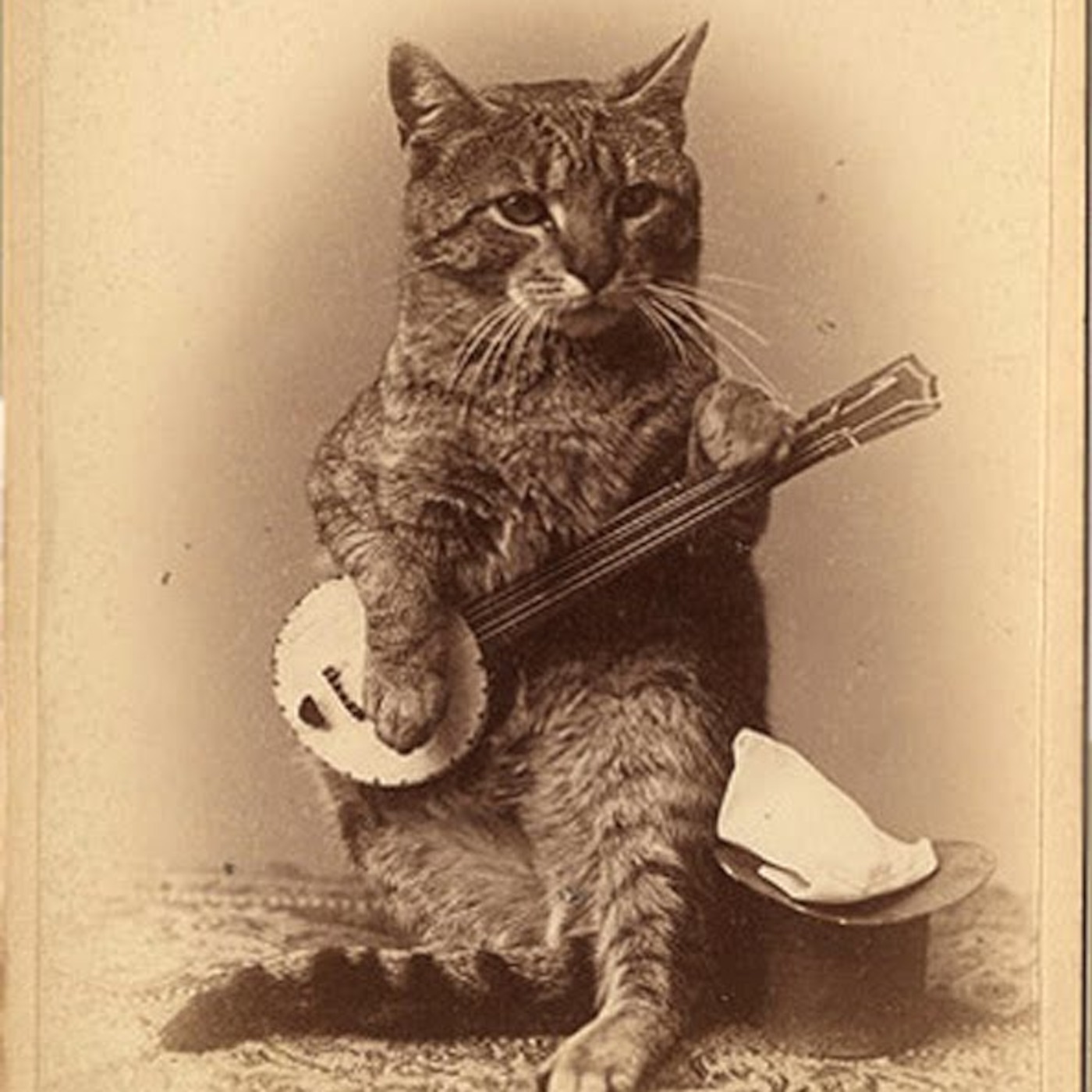
These home recordings are intended to start youngsters on the road to proficiency in old-timey behaviors like knife-fighting, refining lard, and jamming on clawhammer banjo.My 5-string banjo was built by Bart Reiter in Michigan in 2014. The 4-string is a Vega tubaphone, c. 1922.
-
9
John Henry
This episode is to welcome Leo Gibly to the crew! Strap in, kid, you've got some catching up to do. No sleeping. Only listening. John Henry is a black American folk legend, thought to be based on a real guy who helped build railroads in the Appalachian mountains. He outworked everyone and died proving how much stronger people are than machines--his story reminds us of the strength we gain in solidarity and the pride we take in our work. But that pride, if taken to its extreme, can lead to the end of us. Let his death also serve as your first little side-lesson lesson in irony, which was rarely intentionally included in old-timey music, but has emerged over time to be laced all through Old Kentucky. Songs about John Henry usually fall into two categories: ballads (these tell his whole life story from strong baby to powerhouse man) and hammer songs (which have more wandering structure & content and were traditionally sung by poor laborers who were being exploited by wealthy industrialists). This tune's structure is more like the hammer songs than the ballads. Thematically, the lyrics call out to the legends typical of old-timey Appalachia, with their inclusion of railroad bulldogs, pistol killings, the work-crew captain, and the ubiquitous supply of undesirable rednecks. This is in the style of Oliver Swain, who recorded it in 2011.
-
8
Jingle Bells
This song isn't thought of as old-timey but it surely is. A gentleman named James Lord Pierpoint wrote this song in the 1850s in Boston and it became an instant hit. This song was originally presented as "One Horse Open Sleigh", and it rose in popularity through the American civil war, being sung by street choirs and in concert venues. It was first recorded on an Edison device in 1889. Of note, this song was originally written to celebrate Thanksgiving and not Christmas. This suggest to me that babies should bring a tiny hat or mittens when going to Massachusetts any time after August.
-
7
The Arkansas Traveler
Oh Sally and Max, you better settle in because this tune's baggage may one day become your own. This tune was written by Colonel Sanford C. “Sandy” Faulkner, who was very active in Arkansas politics in the 1800s. He was also involved in banking and farming during the 19th century. Supposedly, Faulkner had gotten lost in the Ozarks during one of his many political campaigns. Looking for a place to stay overnight, Faulkner wandered by a small, log cabin where he was given lodging and hospitality. Faulkner explained that the settler was at first bad tempered and uncommunicative but became more welcoming when Faulkner proved able to complete playing the tune that the settler had been playing on the fiddle. Whether that's true, who knows. Several different sets of lyrics have been developed over the years, most of which portray this hillbilly character as lazy and senseless, as viewed by a more sophisticated outsider. One set of such demeaning lyrics were adopted as "official" in 1947 when this became the Arkansas State Song. The whole song, lyrics and all, was demoted to "State Historic Song" in the 1980s, so you're part of the new wave of Arkansans who don't purposely portray themselves as backwards and lazy. Though you can technically be anything you want, please reconsider any thoughts of being deliberately backwards and lazy. Also of note, "The Arkansas Traveler" is an honorific title given by the Governor of Arkansas to people who travel the world and bring honor to our state. Most people who earn respect don't win prizes, so don't get hung up on that. Instead, do the work of a true Arkansas Traveler by seeing the world with humility and always making people from other places feel welcome in your home.
-
6
Wild Bill Jones
Some listeners have given feedback that not all babies are proficient readers, and recommended that I include the babies more fully by singing. So here you go. Wild Bill Jones is a blues ballad, a musically simple song with blues characteristics that focuses on a lowlife protagonist--in this case a man named Bill Jones. The person singing the song may be justified in his claim to the girl in this plot, but it's unclear. In other versions of the song, Bill does not first reach for his own knife yet the singer guns him down, apparently in cold blood. In those versions the singer also admits to being drunk at the time and rots in prison. Once you are old enough, see also #OzHBO. For babies seeking a simple take-home message from this tune, choose between the following: (1) violence is bad and we must stop killing one another for our society to survive. (2) though the singer in this tune winds up lonesome and troubled, the reason he's ultimately getting to sing about this sad story is that he is NOT the guy who brought a knife to a gun fight. When in Old Kentucky, you should be packin.
-
5
Sally in the Garden
This tune used to be mostly sung a hundred years ago, but nowadays it is almost always played as an instrumental. I may know why. The music itself has a thoughtful, classic sound that someone like Sally might enjoy while experiencing gardens for the first time this Spring. The lyrics, unfortunately, feature combinations of Sally working in the garden "siftin' sand," while poor Susie, "is upstairs with a hog-eyed man". Then the singer decides he's going to marry Sally. On the bright side, Sally is getting some fresh air and taking care of the place, and building her reputation as a total catch in Old Kentucky. The audio here also features a cardinal sin common among banjo players: speeding up. Slow, lilting melodies like Sally in the Garden play great on guitars and fiddles that sustain notes well, but they are hard on the banjo as its notes ring out quick and short. Said another way, I'm not good enough at this to make it sound full and smooth at a slow tempo. Banjo players who can are in top form.
-
4
Soldier's Joy
The tune Soldier's Joy is well known across the US and is considered an American classic. Like many great American things, it's actually someone else's and we are just borrowing it. The Scottish came up with this song and have been playing it for at least a couple hundred years. Like lots of stuff Americans borrow, though, we smeared it with street drugs and liquor. This melody has earned many different sets of lyrics, and the best-known ones came to represent substance abuse during the Civil War. In particular, what you could get back then were whiskey (corn liquor), beer (made from who knows what grains at the time), and morphine (from our good friend the opium poppy). Coryza Bell morphine, shown here, is one opium product that was available for medicinal use during the Civil War. The term "soldier's joy" may have been a name for a combination of beer, whiskey, and oral morphine. Lyrics: Gimme some of that Soldier’s Joy, you know what I mean I don’t want to hurt no more my leg is turnin’ green Twenty-five cents for whiskey, twenty-five cents for beer Twenty-five cents for morphine, get me out of here. Chorus: I'm my momma's pride and joy I'm my momma's pride and joy I'm my momma's pride and joy Sing you a song called the soldier's joy. *** For babies seeking further information about drug abuse in war zones, please see Marlon Brando's classic film "Apocalypse Now" or ask me about when I used my pocket knife to cut open a mattress filled with stolen narcotics in southern Afghanistan.
-
3
Angeline the Baker
This tune, often sung as "Angelina Baker," was published by Stephen Foster in 1850 for performance in the Christy Minstrels. This minstrel group performed musical variety shows in New York in the 1840s and 1850s. Their skits and songs often portrayed southern slavery practices positively by displaying a carefree, joyous atmosphere while wearing black face make-up. #slavery #racism #fail After years in the folk music canon, the lyrics no longer pine for a beautiful escaped slave; it is the song of a longing bachelor with the hots for Angeline: 1. Angeline the baker lives in our village green, The way I always loved her beats all you ever seen. CHORUS: Angeline the baker, her age is forty-three, I bought her candy by the peck, and she won't marry me. 2. Her father is the miller, they call him Uncle Sam. I never will forget her, unless I take a dram. CHO. 3. Angeline is handsome, Angeline is tall, They say she sprained her ankle a-dancing at the ball. CHO. 4. She can't do hard work because she is not stout, She bakes her biscuits every day, and pours the coffee out. CHO. 5. I'll never marry no other girl, no matter where I go. I said I'd marry Angeline just twenty years ago. CHO. 6. The last time I saw her was at the county fair. Her father run me almost home and told me to stay there. CHO.
-
2
Snake River Reel (rambling)
This tune was composed by Peter Lippincott, a St. Louis gentleman who plays banjo, calls square dances, and makes pots. Two versions of the A part are included here, one I learned from an Illinois banjo player and one I learned from the internet.
-
1
Red Prairie Dawn (rambling)
This song was composed by Garry Harrison, an Indiana mandolin and fiddle player who died a few years back. This version is in the style of Cahalen Morrison and Eli West, a duo from Washington.
No matches for "" in this podcast's transcripts.
No topics indexed yet for this podcast.
Loading reviews...
ABOUT THIS SHOW
These home recordings are intended to start youngsters on the road to proficiency in old-timey behaviors like knife-fighting, refining lard, and jamming on clawhammer banjo.My 5-string banjo was built by Bart Reiter in Michigan in 2014. The 4-string is a Vega tubaphone, c. 1922.
HOSTED BY
Kurt Eifling
CATEGORIES
Loading similar podcasts...
URL copied to clipboard!