
PODCAST · history
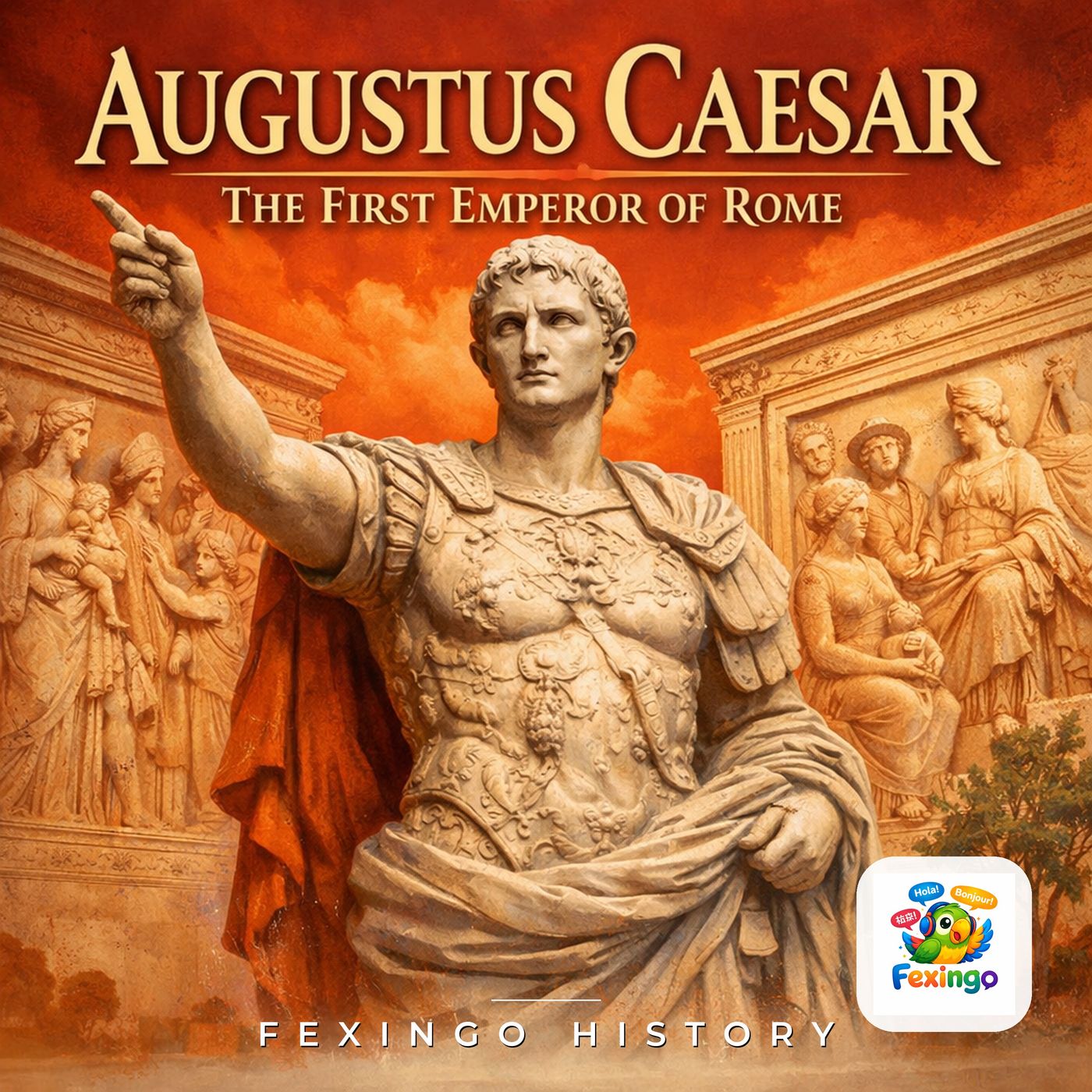
Augustus Caesar: The First Emperor of Rome — Fexingo History
by Fexingo
Augustus Caesar—born Gaius Octavius—transformed a fractured republic into the Roman Empire, setting a template for autocracy that would last centuries. This podcast follows his improbable rise from the chaos of Caesar's assassination through the civil wars against Mark Antony and Cleopatra, culminating in the creation of the Principate. Lucas and Luna explore the artful propaganda of the Res Gestae, the architectural programme that reshaped Rome from brick to marble, and the social engineering of marriage laws meant to revive traditional morality. They dissect the Battle of Actium (31 BCE), the annexation of Egypt, the reforms of the Praetorian Guard, and the bloody purges of political rivals. The show grapples with the paradox of Augustus: a peacemaker who maintained order through military dominance, a restorer of the Republic who dismantled its institutions. Each episode unpacks a facet of his reign—the Ara Pacis reliefs, the development of imperial cult, the frontier wars in Germani
-
34
Augustus and the Augustan Aqueducts: Rome's Water Revolution — Fexingo History
In this episode of Fexingo History's Augustus Caesar series, Lucas and Luna explore the transformative impact of Augustus's water infrastructure projects on the city of Rome. They discuss how, upon becoming princeps, Augustus inherited a city with aging and inadequate aqueducts. They delve into the Aqua Virgo, built by Agrippa in 19 BCE, which brought water to the Campus Martius and later fed the Trevi Fountain. They examine the establishment of the cura aquarum, a permanent water commission headed by a senatorial curator, and the role of Frontinus who later wrote De aquaeductu. The episode covers the expansion of the Aqua Marcia and the construction of the Aqua Alsietina for the naumachia. Lucas explains how Augustus regularized water distribution, creating a hierarchy of public fountains, public baths, and private users. They touch on the social and political implications of controlling water—a tool for winning loyalty. The episode also looks at the maintenance of Roman plumbing, the use of lead pipes (fistulae) stamped with the emperor's name, and the stunning feat of engineering that allowed Rome to thrive as a city of over a million people. Throughout, the conversation weaves in the human side: the slaves who maintained the system, the residents who relied on it, and the political message of a princeps who provided for his people.#Augustus #RomanAqueducts #CuraAquarum #AquaVirgo #Agrippa #AncientRome #RomanEngineering #Frontinus #DeAquaeductu #Naumachia #AquaAlsietina #Fistulae #PaxRomana #RomanInfrastructure #Princeps #History #FexingoHistory #RomanEmpire #AugustusCaesar #PrincipateBecome a supporter of this podcast: https://www.spreaker.com/podcast/augustus-caesar-the-first-emperor-of-rome-fexingo-history--6985275/support.
-
33
Augustus and the Vestal Virgins: Guardians of Rome's Flame — Fexingo History
This episode explores Augustus's relationship with the Vestal Virgins, the priestesses of Vesta whose sacred flame symbolized Rome's eternity. Lucas and Luna discuss how Augustus, as pontifex maximus, oversaw the College of Vestals, used them to legitimize his rule, and involved them in key events like the adoption of Tiberius and the relocation of the Palladium. They delve into the Vestals' unique legal status, their role in state rituals, and how Augustus restored their ancient privileges after decades of civil war. The episode also touches on the Vestal Tuccia and the legend of her innocence, the Vestal Cornelia who was buried alive, and the political scandal of the Vestal Licinia. Discover how these six priestesses became a pillar of Augustan propaganda, embodying both tradition and the new imperial order.#Augustus #VestalVirgins #Vesta #PontifexMaximus #RomanReligion #Tiberius #Palladium #AtriumVestae #RomanEmpire #AncientRome #Priestesses #Tuccia #Cornelia #Licinia #RomanHistory #FexingoHistory #ImperialCult #History #AugustusCaesar #PrincipateBecome a supporter of this podcast: https://www.spreaker.com/podcast/augustus-caesar-the-first-emperor-of-rome-fexingo-history--6985275/support.
-
32
Augustus and the Secular Games: A New Age for Rome — Fexingo History
In this episode, Lucas and Luna explore the Ludi Saeculares, the Secular Games celebrated by Augustus in 17 BC. They delve into the religious and political significance of this ancient festival, which marked the end of one saeculum and the beginning of another. The conversation covers the Sibylline Books, the role of the quindecimviri sacris faciundis, the performance of Horace's Carmen Saeculare, and the symbolism of the ceremonies on the Campus Martius. They discuss how Augustus used the games to legitimize his rule and promote a narrative of renewal and peace after decades of civil war. The episode also touches on the rediscovery of the Acta of the games in the 19th century and the controversies surrounding their interpretation.#LudiSaeculares #Augustus #SecularGames #CarmenSaeculare #Horace #SibyllineBooks #CampusMartius #QuindecimviriSacrisFaciundis #RomanReligion #AugustanPropaganda #17BC #Saeculum #RomanFestival #ActaOfTheSecularGames #FexingoHistory #RomanHistory #AncientRome #History #AugustusCaesar #RomanEmpireBecome a supporter of this podcast: https://www.spreaker.com/podcast/augustus-caesar-the-first-emperor-of-rome-fexingo-history--6985275/support.
-
31
Augustus and the Cura Annonae: Feeding an Empire — Fexingo History
How did Augustus secure the grain supply for Rome's million-plus population without triggering the bread riots that had toppled earlier leaders? This episode dives into the cura annonae, the imperial office that managed the annona — Rome's grain dole. We trace the story from the populist grain laws of the late Republic, through the chaos of the 40s and 30s BCE, to Augustus's establishment of the praefectus annonae, a permanent equestrian prefect to oversee supply from Egypt, Africa, and Sicily. We discuss the logistics of the Portus Ostiae, the Claudian harbor project, and the role of the Classis Alexandrina in transporting Egyptian wheat. Lucas explains how Augustus used the grain dole as a tool of political stabilisation, reducing the number of recipients from 320,000 to 200,000 through a revised census, and how he personally funded grain distributions during crises. Luna asks about the cost, the corruption, and whether Augustus's reforms actually worked. We also touch on the later evolution of the annona under Nero and Trajan, and the enduring image of 'bread and circuses' as a Roman imperial strategy. A story of logistics, politics, and the daily survival of the world's first megalopolis.#Augustus #CuraAnnonae #Annona #GrainDole #PraefectusAnnonae #PortusOstiae #ClassisAlexandrina #Egypt #Rome #RomanEmpire #FoodSupply #BreadAndCircuses #ImperialAdministration #EquestrianOrder #GaiusGracchus #Claudius #Nero #FexingoHistory #AugustusCaesar #PrincipateBecome a supporter of this podcast: https://www.spreaker.com/podcast/augustus-caesar-the-first-emperor-of-rome-fexingo-history--6985275/support.
-
30
Augustus and the Oath of Loyalty: The Coniuratio Italiae — Fexingo History
In 32 BCE, as Octavian prepared for war against Cleopatra and Antony, he demanded a personal oath of loyalty from all of Italy and the western provinces. This coniuratio Italiae was a masterstroke of political theater—a mass swearing-in that transformed regional loyalty into a personal mandate for one man. Lucas and Luna explore how this oath, sworn by thousands at the Temple of Bellona, foreshadowed the imperial cult and bound the Roman people to Augustus before he was even princeps. They discuss the role of the Italian municipia, the propaganda of the clupeus virtutis, and how later emperors from Tiberius to Vespasian revived the oath to legitimize their reigns. They also examine the controversial evidence: was the oath voluntary or coerced? Did it represent genuine popular support or a carefully staged performance? And what does it tell us about Augustus's genius for turning legal fiction into political reality? This episode unpacks a key moment in the transition from republic to empire, where a single act of collective swearing-in changed the nature of Roman power forever.#Augustus #ConiuratioItaliae #Octavian #RomanEmpire #OathOfLoyalty #Cleopatra #MarkAntony #BattleOfActium #TempleOfBellona #ClupeusVirtutis #ImperialCult #RomanPolitics #Propaganda #RomanRepublic #Princeps #Tiberius #Vespasian #History #AugustusCaesar #PrincipateBecome a supporter of this podcast: https://www.spreaker.com/podcast/augustus-caesar-the-first-emperor-of-rome-fexingo-history--6985275/support.
-
29
Augustus and the Temple of Mars Ultor: Vengeance Divine — Fexingo History
In this episode of Fexingo History, Lucas and Luna explore the Temple of Mars Ultor—Mars the Avenger—built by Augustus on the Forum Augustum. They trace its origins to the vow made by Octavian before the Battle of Philippi in 42 BCE, where he and Mark Antony defeated the assassins of Julius Caesar. The temple became a center for Roman military life: standards lost in battle were kept there, and it was the departure point for generals heading to war. Lucas explains how the temple also housed the Parthian standards recovered by diplomatic victory in 20 BCE—a masterstroke of propaganda. The Forum Augustum itself was designed with statues of Rome's great men, the summi viri, linking Augustus to past heroes. Luna asks about the temple's role in daily life, and Lucas describes its use for Senate meetings, coming-of-age ceremonies for young men, and its central place in the Augustan peace ideology. The episode ends by considering the temple's legacy and its echoes in later Roman and even Renaissance architecture.#Augustus #MarsUltor #ForumAugustum #TempleOfMarsUltor #Philippi #JuliusCaesar #ParthianStandards #RomanReligion #ImperialCult #RomanArchitecture #Propaganda #SummiViri #AncientRome #History #FexingoHistory #RomanEmpire #AugustanAge #MilitaryHistory #AugustusCaesar #PrincipateBecome a supporter of this podcast: https://www.spreaker.com/podcast/augustus-caesar-the-first-emperor-of-rome-fexingo-history--6985275/support.
-
28
Augustus and the Death of Drusus: An Heir Lost in Germany — Fexingo History
In this episode, Lucas and Luna explore the untimely death of Nero Claudius Drusus, the beloved stepson of Augustus who was poised to succeed the emperor. Drusus, brother of Tiberius, was a brilliant general who pushed Rome's borders deep into Germania, reaching the Elbe River. His sudden death in 9 BC after a riding accident sent shockwaves through Rome. Lucas discusses Drusus's campaigns, his relationship with Augustus and Tiberius, the political implications for the succession, and how Livia Drusilla her younger son's death. We also touch on his posthumous honors, including the title 'Germanicus' for his family, and the enduring legend of his dying wish to restore the Republic. This episode covers a pivotal moment that shaped the imperial family's fortunes.#Augustus #Drusus #NeroClaudiusDrusus #Tiberius #Germania #RomanEmpire #Elbe #LiviaDrusilla #BattleOfTheTeutoburgForest #RomanSuccession #RomanArmy #RomanHistory #AncientRome #RomanGenerals #ImperialCult #FexingoHistory #History #AncientHistory #AugustusCaesar #PrincipateBecome a supporter of this podcast: https://www.spreaker.com/podcast/augustus-caesar-the-first-emperor-of-rome-fexingo-history--6985275/support.
-
27
Augustus and the Mausoleum: Building an Imperial Tomb — Fexingo History
In this episode, Lucas and Luna explore the construction, symbolism, and afterlife of the Mausoleum of Augustus, the grand tomb built by Rome's first emperor in the Campus Martius. They discuss its design inspired by Etruscan and Hellenistic mausolea, the dynastic message it sent, the ashes of Augustus and his family interred there, its later history as a fortress, garden, and concert hall, and the recent restoration. Along the way, they touch on the Res Gestae, the obelisks flanking the entrance, and the contrast with Augustus's modest house on the Palatine.#MausoleumOfAugustus #Augustus #RomanArchitecture #CampusMartius #ImperialCult #Dynasty #ResGestae #Obelisk #PiazzaAugustoImperatore #BenitoMussolini #Restoration #EtruscanArchitecture #HellenisticArchitecture #RomanHistory #Archaeology #Tomb #History #FexingoHistory #AugustusCaesar #RomanEmpireBecome a supporter of this podcast: https://www.spreaker.com/podcast/augustus-caesar-the-first-emperor-of-rome-fexingo-history--6985275/support.
-
26
Augustus and the Death of Agrippa: Rome's Lost General — Fexingo History
In 12 BC, Marcus Vipsanius Agrippa died at age 51, leaving Augustus without his most trusted general, admiral, and administrator. Agrippa had been the architect of Octavian's victory at Actium, the builder of the Pantheon, the Aqua Virgo, and the first universal map of the Roman world, the Orbis Terrarum. This episode explores Agrippa's career from his humble birth to his role as the princeps' right hand, his military campaigns in Gaul and Pannonia, his building projects, and the dynastic implications of his death. We also discuss his posthumous reputation, including the monument he built for himself, the Mausoleum of Augustus, and the inscription of his map in the Porticus Vipsania. Lucas and Luna examine how Agrippa's death forced Augustus to reconsider the succession, leading to the adoption of Tiberius and the eventual rise of the Julio-Claudian dynasty.#Augustus #MarcusVipsaniusAgrippa #Actium #Pantheon #AquaVirgo #Pannonia #Gaul #PorticusVipsania #OrbisTerrarum #MausoleumOfAugustus #RomanEmpire #RomanHistory #AncientRome #Succession #Tiberius #JuliaCaesaris #FexingoHistory #History #AugustusCaesar #PrincipateBecome a supporter of this podcast: https://www.spreaker.com/podcast/augustus-caesar-the-first-emperor-of-rome-fexingo-history--6985275/support.
-
25
Augustus and the Cimbri: Emulating Marius — Fexingo History
In this episode of Augustus Caesar, Lucas and Luna explore how the first emperor invoked the ghost of Gaius Marius, the populist general who saved Rome from the Cimbri and Teutones. They discuss the strategic and symbolic reasons Augustus chose to restore Marius's Temple of Honor and Virtue, and why he placed a statue of Marius in his own Forum Augustum. The conversation covers the Cimbrian War (113–101 BC), the Battle of Aquae Sextiae, and the Battle of Vercellae, showing how Augustus used the memory of Marius to bolster his own image as a defender of Rome. They also touch on Augustus's uneasy relationship with Marius's legacy as a populares hero, given Augustus's own self-presentation as a restorer of traditional order. This episode reveals the careful political calculus behind Augustus's public monuments and how he controlled the narrative of Roman history.#Augustus #Cimbri #GaiusMarius #CimbrianWar #AquaeSextiae #Vercellae #Teutones #ForumAugustum #TempleofHonorandVirtue #Populares #Optimates #RomanHistory #FexingoHistory #AncientRome #FirstEmperor #Propaganda #RomanEmpire #History #AugustusCaesar #PrincipateBecome a supporter of this podcast: https://www.spreaker.com/podcast/augustus-caesar-the-first-emperor-of-rome-fexingo-history--6985275/support.
-
24
Augustus and the Death of Gaius Caesar: An Heir Lost in the East — Fexingo History
In this episode, Lucas and Luna explore the tragic death of Gaius Caesar, Augustus's beloved grandson and intended heir, in Lycia in 4 AD. They discuss Gaius's mission to the East, his fateful encounter with the Parthian king Phraataces on the Euphrates, the siege of Artagira in Armenia, and the mysterious wound that led to his decline. The conversation delves into the political turmoil surrounding the succession crisis, the role of Livia in maneuvering her son Tiberius back into favor, and the broader implications for the Augustan principate. Listeners will learn about the 'princeps iuventutis' title, the Lex Valia Cornelia, and the strategic importance of the Armenian buffer state. This episode sheds light on a pivotal moment that shaped the future of the Roman Empire.#Augustus #GaiusCaesar #RomanHistory #SuccessionCrisis #Parthia #Armenia #Lycia #Livia #Tiberius #Phraataces #Artagira #PrincepsIuventutis #LexValiaCornelia #AncientRome #Empire #History #FexingoHistory #RomanEmperors #AugustusCaesar #RomanEmpireBecome a supporter of this podcast: https://www.spreaker.com/podcast/augustus-caesar-the-first-emperor-of-rome-fexingo-history--6985275/support.
-
23
Augustus and the Sign of the Zodiac: Capricorn's Cosmic Claim — Fexingo History
In this episode, Lucas and Luna explore how Augustus Caesar used astrology and the zodiac sign Capricorn to legitimize his rule and shape his imperial image. They dive into the role of the astrologer Thrasyllus, the Capricorn coinage minted under Augustus, and the cosmic propaganda that linked the princeps to destiny and divine favor. The conversation examines how Augustus leveraged celestial symbolism to appeal to the Roman populace, weaving astrology into the fabric of his political authority and the Augustan peace.#Augustus #Capricorn #Astrology #RomanEmpire #Thrasyllus #CapricornCoinage #ImperialPropaganda #Princeps #Apotheosis #RomanAstrology #AugustanReligion #CelestialSymbolism #AncientRome #Horoscope #DivineRule #Zodiac #History #FexingoHistory #AugustusCaesar #PrincipateBecome a supporter of this podcast: https://www.spreaker.com/podcast/augustus-caesar-the-first-emperor-of-rome-fexingo-history--6985275/support.
-
22
Augustus and the Praetorian Guard: Emperor's Elite — Fexingo History
In this episode of Augustus Caesar: The First Emperor of Rome, we explore the creation and evolution of the Praetorian Guard, the elite military unit that served as both bodyguard and potential kingmaker. Lucas and Luna delve into how Augustus transformed the republican-era cohortes praetoriae into a permanent, nine-cohort guard stationed in Rome and Italian towns. They discuss the Guard's privileges, its role in imperial politics, and the seeds of its future power. Learn about the Praefectus Praetorio, the castra praetoria built by Sejanus under Tiberius, and the subtle ways Augustus tried to keep the Guard loyal but not dominant. From the Battle of Actium to the murder of Caligula, the Praetorians shaped every emperor's reign.#PraetorianGuard #Augustus #Rome #RomanEmpire #PraefectusPraetorio #Sejanus #CastraPraetoria #Actium #Caligula #Tiberius #Speculatores #GermaniCorpse #CohortesPraetoriae #Donativum #ImperialBodyguard #RomanMilitary #History #FexingoHistory #AugustusCaesar #PrincipateBecome a supporter of this podcast: https://www.spreaker.com/podcast/augustus-caesar-the-first-emperor-of-rome-fexingo-history--6985275/support.
-
21
Augustus and the Ludi Saeculares: Rome's Secular Games — Fexingo History
In 17 BCE, Augustus staged one of the most extraordinary religious and theatrical events in Roman history: the Ludi Saeculares, or Secular Games. This episode unpacks how the first emperor used an ancient Etruscan prophecy to mark the dawn of a new golden age, blending spectacle, sacrifice, and political messaging. We explore the Sibylline Books' cryptic instructions, the three-night ceremonies at the Campus Martius, and Horace's Carmen Saeculare—a choral hymn performed by 27 boys and 27 girls that survives to this day. Learn how Augustus connected his reign to the mythical founding of Rome, why the games were held at night, and what the ritual of the 'saeculum' meant for Roman identity. Featuring details on the Terentum altar, the role of Agrippa, and the careful choreography of imperial ideology, this episode reveals how a single festival redefined time itself for the Roman world.#Augustus #LudiSaeculares #SecularGames #Horace #CarmenSaeculare #SibyllineBooks #CampusMartius #Terentum #Agrippa #RomanReligion #PaxRomana #RomanFestivals #GoldenAge #RomanHistory #ImperialCult #17BCE #AncientRome #FexingoHistory #AugustusCaesar #RomanEmpireBecome a supporter of this podcast: https://www.spreaker.com/podcast/augustus-caesar-the-first-emperor-of-rome-fexingo-history--6985275/support.
-
20
Augustus and the Death of Julia: Rome's Tragic Princess — Fexingo History
In this episode, Lucas and Luna explore the life and downfall of Julia the Elder, the only biological child of Augustus Caesar. Raised as a political pawn, Julia was married three times to advance her father's dynastic ambitions—first to Marcellus, then to Agrippa, and finally to Tiberius. Despite her intelligence and charm, scandal erupted in 2 BC when Augustus discovered her adulterous affairs. Exiled to the barren island of Pandateria, Julia became a symbol of Augustan hypocrisy: the princeps who preached moral reform but destroyed his own daughter. The episode delves into the political machinations behind her exile, the role of her lovers like Iullus Antonius, and the lasting impact on the imperial succession. It also examines how Augustus's own laws, the Lex Julia de Adulteriis, were used to condemn her, raising questions about justice and power in the early empire. A tragic tale of duty, desire, and the brutal cost of empire.#Augustus #JuliaTheElder #RomanHistory #ImperialRome #Pandateria #LexJulia #Agrippa #Tiberius #IullusAntonius #Scribonia #LiviaDrusilla #RomanEmpire #MoralReform #AncientHistory #FexingoHistory #Dynasty #Exile #AugustanAge #AugustusCaesar #PrincipateBecome a supporter of this podcast: https://www.spreaker.com/podcast/augustus-caesar-the-first-emperor-of-rome-fexingo-history--6985275/support.
-
19
Augustus and the Death of Marcus Marcellus: Heir Lost — Fexingo History
In 23 BCE, Augustus faced a devastating blow: his nephew and heir Marcus Claudius Marcellus died of a sudden illness at age 19. This episode explores the political and personal fallout of that death. We discuss Marcellus's swift rise—marked by his marriage to Augustus's daughter Julia, a consulship at an unprecedented age, and lavish games—and the vacuum his death created. Virgil immortalized Marcellus in the Aeneid with a haunting passage read aloud to Augustus and Octavia. The succession crisis that followed reshaped the Augustan regime: Agrippa was recalled from the East, given tribunician power, and married to Julia. We also examine the medical context (the mysterious 'plague' of 23 BCE) and the propaganda machinery that turned a personal tragedy into a national one. Names include Augustus, Marcellus, Livia, Octavia, Agrippa, Julia, Virgil, and the family tomb of the Julii.#Augustus #MarcusMarcellus #RomanEmpire #SuccessionCrisis #Virgil #Aeneid #Octavia #Agrippa #JuliaCaesaris #23BCE #RomanHistory #ImperialHeir #PaxRomana #Plague #TombOfTheJulii #RomanPropaganda #History #FexingoHistory #AugustusCaesar #PrincipateBecome a supporter of this podcast: https://www.spreaker.com/podcast/augustus-caesar-the-first-emperor-of-rome-fexingo-history--6985275/support.
-
18
Augustus and the Ara Pacis: Altar of Augustan Peace — Fexingo History
Lucas and Luna explore the Ara Pacis Augustae, the Altar of Augustan Peace, dedicated in 9 BCE. Lucas explains how this marble monument was both a religious offering and a masterful piece of political propaganda. He walks through the key reliefs: the tellus panel with its fertility goddess, the processional frieze showing the imperial family including Augustus, Agrippa, Livia, and their children, and the mythological panels of Aeneas and Romulus. Lucas unpacks how the imagery linked Augustus to Rome's founding heroes while celebrating the Pax Romana he claimed to have established. He also describes the altar's original location in the flood-prone Campus Martius, near the massive sundial of Augustus, and its modern reconstruction under Mussolini. Luna asks about the absence of Julia and the inclusion of foreign children, and Lucas notes the political subtleties. The episode paints a vivid picture of how Augustus used art to shape his legacy, turning a sacrificial altar into a lasting statement of his new order.#AraPacis #Augustus #PaxRomana #RomanArt #RomanReligion #CampusMartius #Agrippa #Livia #ImperialPropaganda #Tellus #Aeneas #Romulus #Mussolini #AncientRome #RomanSculpture #FexingoHistory #History #RomanEmpire #AugustusCaesar #PrincipateBecome a supporter of this podcast: https://www.spreaker.com/podcast/augustus-caesar-the-first-emperor-of-rome-fexingo-history--6985275/support.
-
17
Augustus and the Roman Legal Revolution: The Shadow Laws — Fexingo History
In this episode, Lucas and Luna explore Augustus's transformation of the Roman legal system, focusing on the shadowy world of the cognitio extraordinaria and the emperor's direct intervention in justice. They discuss the role of the Praetorian prefect as a judge, the creation of the office of the urban prefect (praefectus urbi), and how Augustus used legal reforms to consolidate power. The conversation covers the suppression of the secret tribunals of the late Republic, the impact of the lex Iulia iudiciorum publicorum, and the case of the conspirator Murena. Specific details include the trial of the poet Ovid, the use of the ius respondendi, and the establishment of the imperial chancery. The episode reveals how Augustus quietly built a parallel legal system that bypassed the Senate and the traditional courts, setting a precedent for later emperors.#Augustus #RomanLaw #CognitioExtraordinaria #PraefectusUrbi #PraetorianPrefect #Murena #LexIuliaIudiciorumPublicorum #Ovid #IusRespondendi #ImperialJustice #RomanEmpire #LegalReform #ShadowLaws #Princeps #AncientRome #History #FexingoHistory #LegalHistory #AugustusCaesar #PrincipateBecome a supporter of this podcast: https://www.spreaker.com/podcast/augustus-caesar-the-first-emperor-of-rome-fexingo-history--6985275/support.
-
16
Augustus and the Res Gestae: Rome's Imperial Autobiography — Fexingo History
In this episode, Lucas and Luna explore the Res Gestae Divi Augusti, the first emperor's own written account of his achievements. Discover how Augustus crafted his legacy through this monumental inscription, which survives today as the 'Queen of Inscriptions.' They discuss the text's discovery at the Temple of Rome and Augustus in Ancyra (modern Ankara, Turkey), its structure in 35 chapters covering military conquests, civic benefactions, and political honors, and the subtle propaganda woven into its modest first-person narrative. Lucas explains the 'clupeus virtutis' (shield of virtues) awarded by the Senate, the closing 'exemplum' passage urging imitation of his reign, and how the Res Gestae compares to later imperial autobiographies. They also touch on the role of Tiberius in completing the text after Augustus's death in AD 14, and the stone's survival as a unique window into Augustan ideology. A must-listen for anyone fascinated by how history is shaped by those who write it.#ResGestae #Augustus #RomanEmpire #QueenOfInscriptions #Ancyra #Epigraphy #RomanHistory #ImperialPropaganda #Tiberius #ClupeusVirtutis #Exemplum #MonumentumAncyranum #LatinInscriptions #AugustanAge #Legacy #FexingoHistory #History #Podcast #AugustusCaesar #PrincipateBecome a supporter of this podcast: https://www.spreaker.com/podcast/augustus-caesar-the-first-emperor-of-rome-fexingo-history--6985275/support.
-
15
Augustus and the Mint: The Coinage of Empire — Fexingo History
In this episode, Lucas and Luna explore how Augustus revolutionized Roman coinage to project his image and consolidate power. From the aureus and denarius to the sestertius and dupondius, they trace the minting reforms that transformed money into propaganda. They discuss the shift from senatorial to imperial control of mints, the role of the triumvir monetalis, and the iconic coin types that spread the princeps's message across the empire. Lucas reveals the story of the coin that almost cost a mint official his life, and explains how Augustus's gold and silver issues set a standard that lasted for centuries. The episode also examines the imagery on imperial coins—from Capricorn to Pax—and how the mint at Lugdunum became the empire's powerhouse. A fascinating look at how the first emperor minted his legacy. No prior knowledge required, but fans of earlier episodes will find fresh ground.#Augustus #RomanCoinage #Aureus #Denarius #Sestertius #Dupondius #Lugdunum #TriumvirMonetalis #Propaganda #Mint #PaxRomana #Capricorn #Money #AncientRome #ImperialCult #Numismatics #History #FexingoHistory #AugustusCaesar #RomanEmpireBecome a supporter of this podcast: https://www.spreaker.com/podcast/augustus-caesar-the-first-emperor-of-rome-fexingo-history--6985275/support.
-
14
Augustus and the Roman Navy: Cleansing the Mediterranean — Fexingo History
After the Battle of Actium, Augustus faced a pirate-infested sea and a disorganized fleet. This episode dives into his creation of the Roman imperial navy—stationing fleets at Misenum and Ravenna, establishing the Classis Praetoria Misenensis and Classis Praetoria Ravennatis, and placing them under a praefectus classis. We explore how the navy secured grain routes, suppressed piracy, and projected power from the Black Sea to the Strait of Gibraltar. Lucas and Luna also discuss the social status of sailors, the use of liburnian galleys, and the lasting impact of Augustus's maritime reforms on the Pax Romana. The conversation touches on Sextus Pompeius, the Battle of Naulochus, and the vital role of the port of Ostia. A fresh look at an often-overlooked pillar of Augustan power.#Augustus #RomanNavy #ClassisMisenensis #ClassisRavennatis #PaxRomana #BattleOfActium #SextusPompeius #Naulochus #Liburnian #PraefectusClassis #Misenum #Ravenna #Ostia #Mediterranean #Piracy #RomanHistory #History #FexingoHistory #AugustusCaesar #RomanEmpireBecome a supporter of this podcast: https://www.spreaker.com/podcast/augustus-caesar-the-first-emperor-of-rome-fexingo-history--6985275/support.
-
13
Augustus and the Aqua Virgo: Rome's Water Revolution — Fexingo History
In this episode, Lucas and Luna explore the fascinating story of Rome's Aqua Virgo aqueduct, built by Augustus's right-hand man, Agrippa, in 19 BCE. Discover how this engineering marvel brought fresh water to the Campus Martius, supplied the Baths of Agrippa, and eventually fed the Trevi Fountain. They discuss the technical feat of the specus (channel), the role of Frontinus as curator aquarum, and the enduring legacy of the Virgo. Along the way, they touch on the politics of water distribution, the social impact of public fountains, and how Augustus used infrastructure to consolidate power. A deep dive into Roman hydraulics and urban life.#AquaVirgo #Agrippa #Augustus #RomanAqueducts #CampusMartius #BathsofAgrippa #TreviFountain #Frontinus #CuratorAquarum #Specus #RomanEngineering #AncientRome #WaterDistribution #PublicFountains #RomanInfrastructure #History #FexingoHistory #RomanHydraulics #AugustusCaesar #RomanEmpireBecome a supporter of this podcast: https://www.spreaker.com/podcast/augustus-caesar-the-first-emperor-of-rome-fexingo-history--6985275/support.
-
12
Augustus and the Lex Fufia Caninia: Limiting Freedmen — Fexingo History
In this episode, Lucas and Luna explore a lesser-known but revealing facet of Augustus's social legislation: the Lex Fufia Caninia of 2 BCE. This law restricted the manumission of slaves by testament, capping the number of freedmen a master could free in his will based on the size of his household. Lucas explains the legal mechanics—how the law established proportional limits (e.g., a master with 100-500 slaves could free at most half)—and connects it to Augustus's broader anxieties about demographic change, citizenship dilution, and the integration of former slaves into Roman society. The conversation touches on the so-called 'Augustan compromise' between republican libertas and imperial control, the role of the manumission tax (vicesima libertatis), and the law's long afterlife in Justinian's Corpus Iuris Civilis. Lucas and Luna also consider how the law reflected Augustus's contradictory impulses: a populist who claimed to restore the Republic yet micromanaged family life and status boundaries. A nuanced look at how the first emperor tried to fix Rome's future by policing its most intimate legal act.#Augustus #LexFufiaCaninia #RomanLaw #Manumission #Freedmen #SocialReforms #RomanSlavery #AugustanLegislation #RomanEmpire #RomanSociety #Citizenship #VicesimaLibertatis #Justinian #CorpusIurisCivilis #RomanHistory #AncientRome #History #FexingoHistory #AugustusCaesar #PrincipateBecome a supporter of this podcast: https://www.spreaker.com/podcast/augustus-caesar-the-first-emperor-of-rome-fexingo-history--6985275/support.
-
11
Augustus and the Sign of the Zodiac: Capricorn's Cosmic Claim — Fexingo History
In this episode of Fexingo History, Lucas and Luna explore Augustus Caesar's personal and political use of astrology. They discuss the significance of his zodiac sign Capricorn, the role of the astrologer Thrasyllus, and how Augustus minted coins bearing Capricorn to legitimize his rule. The duo delves into the imperial horoscope, the concept of apotheosis, and the connection between the Capricorn symbol and the month of December. They also touch on the reception of astrology in Augustan Rome and its lasting influence on imperial propaganda.#Augustus #Capricorn #Thrasyllus #RomanAstrology #ImperialHoroscope #CapricornCoin #Apotheosis #Princeps #Luna #FexingoHistory #RomanEmpire #AncientAstrology #Zodiac #AugustanPropaganda #History #AncientRome #Podcast #RomanCoins #AugustusCaesar #PrincipateBecome a supporter of this podcast: https://www.spreaker.com/podcast/augustus-caesar-the-first-emperor-of-rome-fexingo-history--6985275/support.
-
10
Augustus and the Sign of the Zodiac: Capricorn's Cosmic Claim — Fexingo History
In this episode, Lucas and Luna explore how Augustus Caesar used astrology to cement his divine right to rule, focusing on his zodiac sign Capricorn and the famous Capricorn coinage. They discuss the role of the astrologer Thrasyllus, the imperial horoscope, and how Augustus's adopted sign influenced his public image and succession planning. They also touch on the broader context of astrology in ancient Rome, including the Greek roots of the practice and its popularity among the elite. The conversation reveals how Augustus cleverly merged personal belief with political propaganda, creating a cosmic narrative that would echo through imperial iconography for centuries.#Augustus #Capricorn #Astrology #AncientRome #Thrasyllus #ImperialPropaganda #RomanCoinage #Horoscope #PaxRomana #DivineRight #GreekAstrology #Princeps #ResGestae #RomanReligion #Zodiac #History #FexingoHistory #RomanEmperor #AugustusCaesar #RomanEmpireBecome a supporter of this podcast: https://www.spreaker.com/podcast/augustus-caesar-the-first-emperor-of-rome-fexingo-history--6985275/support.
-
9
Augustus and the Via Flaminia: Building Roads to Empire — Fexingo History
In this episode of Augustus Caesar: The First Emperor of Rome, Lucas and Luna explore Augustus's ambitious road-building program, focusing on his restoration of the Via Flaminia, the ancient highway linking Rome to the Adriatic. They uncover how Augustus used the road not just for military logistics, but as a tool of imperial propaganda, with milestones proclaiming his achievements and statues of the imperial family lining the route. The conversation touches on the curatores viarum, the officials appointed to oversee roads, and how the network facilitated the cursus publicus, the imperial postal system. They also discuss Augustus's golden milestone in the Forum, the Milliarium Aureum, which served as the symbolic zero point of the empire's roads. The episode highlights the practical and symbolic role of infrastructure in consolidating Augustus's power and unifying the Roman world, tying into themes of connectivity, control, and legacy.#Augustus #ViaFlaminia #RomanRoads #CursusPublicus #MilliariumAureum #CuratoresViarum #Infrastructure #ImperialPropaganda #Adriatic #MileStones #RomanEngineering #Patronage #Restoration #Empire #AncientRome #Connectivity #History #FexingoHistory #AugustusCaesar #RomanEmpireBecome a supporter of this podcast: https://www.spreaker.com/podcast/augustus-caesar-the-first-emperor-of-rome-fexingo-history--6985275/support.
-
8
Augustus's Urban Reforms: How He Remade Rome — Fexingo History
In this episode, Lucas and Luna explore Augustus's ambitious urban transformation of Rome, focusing on his division of the city into 14 administrative regions, the creation of the cura annonae for grain supply, the establishment of the vigiles for firefighting, and his massive building program including the Forum of Augustus and the Temple of Mars Ultor. They discuss how these reforms centralized control, improved living conditions, and promoted Augustan ideology, referencing specific officials like the praefectus urbi and praefectus vigilum, and key structures like the Aqua Virgo and the Pantheon. The conversation also touches on the social and political implications of these changes, including how they shaped the relationship between the emperor and the populace.#Augustus #UrbanReforms #AncientRome #CuraAnnonae #Vigiles #PraefectusUrbi #ForumOfAugustus #TempleOfMarsUltor #AquaVirgo #Pantheon #RomeRegions #RomanArchitecture #RomanInfrastructure #RomanHistory #FexingoHistory #HistoryPodcast #EmperorAugustus #UrbanPlanning #AugustusCaesar #RomanEmpireBecome a supporter of this podcast: https://www.spreaker.com/podcast/augustus-caesar-the-first-emperor-of-rome-fexingo-history--6985275/support.
-
7
Augustus and the Cult of the Emperor: How Rome Worshipped Its First Emperor — Fexingo History
In this episode, Lucas and Luna explore how Augustus navigated the delicate process of being deified while still alive. They discuss the establishment of the imperial cult in Rome and the provinces, the fusion of Roman and Greek religious practices, and the political necessity of appearing reluctant to accept divine honors. Key figures include the priestly college of the sodales Augustales, the poet Horace, and the Greek city of Pergamon. The episode covers the Temple of Divus Julius, the Altar of Fortuna Redux, and the practice of offering sacrifices to the genius of Augustus. Lucas explains how the cult acted as a unifying force across the empire, allowing subjects to show loyalty to Rome through worship of the emperor. They also touch on the distinction between deification of the living emperor and that of his predecessors, and the later use of the cult by emperors like Caligula and Nero. A nuanced look at how religion and politics intertwined in the early Roman Empire.#Augustus #ImperialCult #RomanReligion #DivusIulius #GeniusAugusti #SodalesAugustales #Pergamon #Horace #AltarOfFortunaRedux #TempleOfDivusJulius #RomanEmpire #EmperorWorship #ProvincialCult #PaxRomana #RomanHistory #AncientReligion #FexingoHistory #History #AugustusCaesar #PrincipateBecome a supporter of this podcast: https://www.spreaker.com/podcast/augustus-caesar-the-first-emperor-of-rome-fexingo-history--6985275/support.
-
6
Augustus and the Fire of Rome — Fexingo History
Before Nero's famous fire, Rome burned constantly. In this episode, Lucas and Luna explore the devastating urban fires of Augustus's era and his unprecedented solution: the Vigiles, a dedicated fire brigade funded by the state. We examine the catastrophic fire of 6 AD that destroyed much of the Forum and the Aemilian Basilica, forcing Augustus to rethink public safety. Discover the innovative fire-fighting techniques—from siphon pumps to fire hooks and vinegar-soaked blankets—and the organizational structure of the seven cohorts of Vigiles, each responsible for two of Rome's fourteen regions. We also delve into the political motivations behind Augustus's reforms: controlling the urban plebs, reducing reliance on private fire-fighting gangs, and securing his legacy as a protector of the people. Along the way, we touch on the architecture of fire prevention, including the stone porticoes of the Augustan building program, and the everyday dangers of city life in ancient Rome.#Augustus #Vigiles #AncientRome #UrbanFire #FireBrigade #RomanArchitecture #AugustanReforms #RomeHistory #ImperialCult #AemilianBasilica #Siphon #PraefectusVigilum #RomeFires #6AD #CampusMartius #FexingoHistory #AncientHistory #Podcast #AugustusCaesar #RomanEmpireBecome a supporter of this podcast: https://www.spreaker.com/podcast/augustus-caesar-the-first-emperor-of-rome-fexingo-history--6985275/support.
-
5
Augustus and the Roman Grain Supply: Feeding an Empire — Fexingo History
In this episode of Augustus Caesar: The First Emperor of Rome, Lucas and Luna explore the monumental challenge of feeding Rome's million-plus population. They delve into the grain dole (annona), the role of the praefectus annonae, the perilous grain fleets from Egypt and North Africa, and the political tightrope Augustus walked to secure popular support. The episode covers the creation of a dedicated grain administration, the use of imperial funds to subsidize supply, and the occasional crises like the grain riots of 22 BC. Specific details include the volume of grain needed (over 200,000 tons annually), the key port of Ostia, and the engineering feats of Claudius and Trajan's harbors, though Augustus's own improvements set the stage. The conversation highlights how control of the grain supply became a cornerstone of imperial power, transforming a republican obligation into an imperial monopoly.#Augustus #RomanGrainSupply #Annona #PraefectusAnnonae #Ostia #EgyptGrain #Rome #ImperialAdministration #GrainDole #PaxRomana #Claudius #Trajan #GrainRiots #MediterraneanHistory #RomanEconomy #FeedingRome #History #FexingoHistory #AugustusCaesar #RomanEmpireBecome a supporter of this podcast: https://www.spreaker.com/podcast/augustus-caesar-the-first-emperor-of-rome-fexingo-history--6985275/support.
-
4
Augustus and Agrippa: The Architect of Empire — Fexingo History
In this episode, Lucas and Luna explore the extraordinary partnership between Augustus and his right-hand man, Marcus Vipsanius Agrippa. They delve into Agrippa's crucial role in the military victories that secured Augustus's power, including the Battles of Naulochus and Actium, and his administrative genius that reshaped Rome. Agrippa oversaw construction of the Pantheon, the Aqua Virgo aqueduct, and the Baths of Agrippa, and he personally commissioned the first map of the Roman Empire. The conversation also covers his political reforms, his marriage to Augustus's daughter Julia, and the tragic succession that led to his sons' early deaths. Along the way, Lucas and Luna touch on Agrippa's unusual name, his rivalry with Maecenas, and how his death in 12 BC marked a turning point for the Principate.#Augustus #Agrippa #MarcusVipsaniusAgrippa #BattleOfActium #BattleOfNaulochus #Pantheon #AquaVirgo #BathsOfAgrippa #RomanEmpire #Principate #OrbisTerrarum #JuliaCaesaris #Maecenas #RomanArchitecture #RomanAqueducts #AncientRome #History #FexingoHistory #AugustusCaesar #ActiumBecome a supporter of this podcast: https://www.spreaker.com/podcast/augustus-caesar-the-first-emperor-of-rome-fexingo-history--6985275/support.
-
3
Augustus and the Founding of the Roman Fire Brigade — Fexingo History
In this episode, Lucas and Luna explore Augustus's creation of the first organized fire brigade in Rome, the Vigiles. After a devastating fire in 6 AD, Augustus established a corps of 7,000 slaves and freedmen commanded by an equestrian prefect. The Vigiles patrolled the streets at night, carried water buckets and axes, and served as a police force. Lucas explains how this pragmatic response to a chronic urban problem also bolstered Augustus's popularity and control. The episode delves into the social status of the firefighters, the equipment they used (siphons, hooks, mattresses), and how the Vigiles evolved into a permanent institution. Luna asks about the political implications and how the system compared to modern fire services.#Augustus #Vigiles #RomanFireBrigade #AncientRome #UrbanHistory #Firefighting #EquestrianOrder #PaxRomana #RomanEmpire #6AD #SocialHistory #PublicWorks #AugustanReforms #RomanSlaves #Freedmen #NightWatch #FexingoHistory #History #AugustusCaesar #PrincipateBecome a supporter of this podcast: https://www.spreaker.com/podcast/augustus-caesar-the-first-emperor-of-rome-fexingo-history--6985275/support.
-
2
Augustus and the Census: Counting Rome's Empire — Fexingo History
When Augustus took control of Rome, he faced a problem no one had solved: how do you tax and govern an empire when you don't know how many people are in it? This episode dives into Augustus's three great censuses—the first in 28 BCE, the second in 8 BCE, and the third in 14 CE—which aimed to count every Roman citizen and assess their property. Lucas and Luna explore the logistical nightmare of registering millions across the Mediterranean, from Gaul to Syria, and how the census data shaped everything from military conscription to grain doles. They also uncover the backlash: rumors of fraud, the resistance of provincial elites, and the quiet anger of those who saw the census as imperial snooping. Along the way, learn about the document called the 'formula provinciae' that standardized how provinces reported their populations, and the role of the 'tabularium' in storing these records. A fascinating look at how the first emperor tried to bring order to a sprawling empire through the simple act of counting.#Augustus #RomanCensus #RomanEmpire #Census #Taxation #RomanHistory #Imperium #ProvincialAdministration #Tabularium #FormulaProvinciae #Lustrum #Censor #MarcusAgrippa #GaiusCensorinus #RomanCitizenship #PaxRomana #History #FexingoHistory #AugustusCaesar #PrincipateBecome a supporter of this podcast: https://www.spreaker.com/podcast/augustus-caesar-the-first-emperor-of-rome-fexingo-history--6985275/support.
-
1
Augustus and the Praetorian Guard: Creating an Imperial Bodyguard — Fexingo History
In this episode, Lucas and Luna explore the origins and evolution of the Praetorian Guard under Augustus. They discuss how Augustus reorganized the existing praetorian cohorts into a permanent, elite bodyguard stationed in Rome, with three cohorts housed in the city and the rest in nearby towns. The conversation covers the Guard's recruitment from Italian veterans, their superior pay and privileges, the role of the two praefecti praetorio, and the balance of power between the emperor and his guard. Lucas explains how Augustus used the Guard not only for protection but also as a political tool, creating a visible symbol of imperial authority while trying to prevent any single commander from gaining too much influence. They touch on the Guard's later role under Tiberius and their infamous influence in imperial politics, including the assassination of Caligula and the auction of the empire. The episode also highlights the difference between Augustus's careful management and the Guard's later abuses, showing how the seeds of Praetorian power were planted during the first emperor's reign.#Augustus #PraetorianGuard #RomanEmpire #ImperialBodyguard #PraefectusPraetorio #Sejanus #Tiberius #Caligula #RomanHistory #AncientRome #AugustanReforms #MilitaryHistory #EliteGuard #Rome #FexingoHistory #History #Podcast #Mediterranean #AugustusCaesar #PrincipateBecome a supporter of this podcast: https://www.spreaker.com/podcast/augustus-caesar-the-first-emperor-of-rome-fexingo-history--6985275/support.
-
0
Ovid's Banishment: Augustus's War on Poetry — Fexingo History
In 8 AD, Rome's most celebrated living poet, Ovid, was suddenly banished to Tomis on the Black Sea by Emperor Augustus. The official reason was never stated, but Ovid hinted at 'a poem and a mistake.' This episode explores the scandalous world of Augustan poetry and the moral crackdown that silenced one of antiquity's greatest voices. We examine Ovid's 'Ars Amatoria' (The Art of Love), a witty guide to seduction that directly mocked Augustus's morality laws, and the mysterious 'error' that may have involved the emperor's granddaughter Julia. We also look at how Augustus used censorship to shape public morality, the role of the exile literature Ovid produced in Tomis, and the long shadow this case cast on imperial patronage of the arts. Through the lens of Ovid's downfall, we see the limits of artistic freedom under Rome's first emperor.#Ovid #Augustus #ArsAmatoria #Tomis #JuliaTheYounger #RomanPoetry #Exile #Censorship #LexJulia #RomanMorality #Patronage #AugustanAge #LatinLiterature #Tristia #EpistulaeExPonto #RomanEmpire #History #FexingoHistory #AugustusCaesar #PrincipateBecome a supporter of this podcast: https://www.spreaker.com/podcast/augustus-caesar-the-first-emperor-of-rome-fexingo-history--6985275/support.
-
-1
Augustus and the Ludi Saeculares: Rome's Secular Games — Fexingo History
In 17 BCE, Augustus staged one of the most elaborate religious festivals in Roman history: the Ludi Saeculares, or Secular Games. These games marked the end of one saeculum (roughly 110 years) and the beginning of another, celebrating the dawn of a new golden age under Augustus's rule. This episode unpacks the ritual's Etruscan and republican roots, the Sibylline prophecy that inspired it, the three days of sacrifices and theatrical performances, and the famous Carmen Saeculare hymn composed by Horace. We also explore how Augustus used the festival to weave together religious revival, dynastic propaganda, and imperial ideology — and why the games were held again by later emperors like Claudius, Domitian, and Septimius Severus. Specific details include the sacrifices on the Palatine and Capitoline hills, the role of the quindecimviri sacris faciundis, the Sibylline oracle's wording, and the involvement of Augustus's family. A fascinating glimpse into how one emperor manipulated time itself to cement his legacy.#LudiSaeculares #Augustus #RomanReligion #CarmenSaeculare #Horace #SibyllineOracles #SecularGames #RomanEmpire #ImperialRome #RomanHistory #AncientRome #AugustanPropaganda #Quindecimviri #PalatineHill #CapitolineHill #EtruscanInfluence #History #FexingoHistory #AugustusCaesar #PrincipateBecome a supporter of this podcast: https://www.spreaker.com/podcast/augustus-caesar-the-first-emperor-of-rome-fexingo-history--6985275/support.
-
-2
Augustus and the Censors: The Moral Purge of Rome — Fexingo History
In this episode, Lucas and Luna explore Augustus's controversial role as censor, wielding the ancient office of the censors to reshape Roman society. They dive into the 18–17 BCE census and lectio senatus, where Augustus purged the Senate of unworthy members, demoting patricians and even forcing a consul to resign. The conversation examines the moral legislation—the lex Julia de adulteriis and the lex Papia Poppaea—that penalized adultery and rewarded childbirth, while also looking at the practical enforcement through the Praetorian Guard and the urban prefect. They discuss the case of Iullus Antonius, Mark Antony's son, who was executed for adultery with Julia, Augustus's daughter. The episode also touches on the tension between public morality and personal hypocrisy, as Augustus exiled his own daughter and granddaughter under these laws. A nuanced look at how censorship and family values were used to consolidate imperial power.#Augustus #Censor #RomanHistory #LexJulia #MoralityLaws #PraetorianGuard #JuliaAugusti #IullusAntonius #LectioSenatus #PaxRomana #RomanSenate #Adultery #SocialControl #ImperialRome #AugustanReforms #History #FexingoHistory #AncientRome #AugustusCaesar #RomanEmpireBecome a supporter of this podcast: https://www.spreaker.com/podcast/augustus-caesar-the-first-emperor-of-rome-fexingo-history--6985275/support.
-
-3
Augustus and the Social Reforms: Morality Laws and Family Values — Fexingo History
In this episode, Lucas and Luna explore Augustus Caesar's ambitious social legislation — the moral reform laws aimed at restoring traditional Roman values after decades of civil war. We dive into the lex Julia de adulteriis coercendis, which made adultery a public crime, and the laws encouraging marriage and childbearing among the senatorial and equestrian classes. How did Augustus enforce morality through legislation? What were the roles of Livia Drusilla and the Vestal Virgins in shaping these policies? We also discuss the backlash from the elite, Ovid's exile, and the tension between public ideals and private behavior. This episode uncovers a less-known side of Augustus: the emperor as moral crusader.#Augustus #RomanEmpire #SocialReforms #LexJulia #MoralityLaws #Adultery #Ovid #Livia #VestalVirgins #FamilyValues #RomanSociety #Senate #EquestrianClass #PaxRomana #AugustanReforms #RomanLaw #History #FexingoHistory #AugustusCaesar #PrincipateBecome a supporter of this podcast: https://www.spreaker.com/podcast/augustus-caesar-the-first-emperor-of-rome-fexingo-history--6985275/support.
-
-4
Augustus and the Ara Pacis: Rome's Altar of Peace — Fexingo History
In this episode, Lucas and Luna explore the Ara Pacis Augustae—the Altar of Augustan Peace—unveiling its intricate carvings and political symbolism. They discuss how Augustus used art and architecture to legitimize his rule after the civil wars, the imagery of the Imperial family, the inclusion of barbarian children, and the controversial location on the Campus Martius. The conversation touches on the altar's role in the new Imperial cult, its rediscovery in the 16th century, and its reconstruction under Mussolini. Specifics include the processional friezes, the panel of Aeneas sacrificing, the goddess Roma, and the Tellus relief symbolizing fertility. Lucas explains how the altar projected an image of a golden age while masking the realities of autocratic rule.#AraPacis #Augustus #RomanArt #ImperialPropaganda #PaxRomana #CampusMartius #Livia #Aeneas #Tellus #Mussolini #RomanSculpture #AltarOfPeace #JulioClaudian #RomanReligion #History #FexingoHistory #AncientRome #AugustanAge #AugustusCaesar #RomanEmpireBecome a supporter of this podcast: https://www.spreaker.com/podcast/augustus-caesar-the-first-emperor-of-rome-fexingo-history--6985275/support.
-
-5
Augustus Caesar, the first emperor of Rome — Fexingo History
On March 15, 44 BCE, Julius Caesar was assassinated, setting off a chain of events that would end the Roman Republic and birth the Empire. In this pilot episode, Lucas and Luna explore how the young and ambitious Octavian, later known as Augustus, navigated a world of civil war, political cunning, and propaganda to become Rome's first emperor. They discuss the Battle of Actium, the strategic adoption of his great-uncle's name, the creation of the Principate, and the manipulation of republican institutions. Lucas explains how Augustus consolidated power without seeming to, and how he launched a cultural revolution that produced poets like Virgil and Horace. The episode also touches on the limits of Augustus's legacy—his exile of Ovid, the moral legislation that sparked resistance, and the enduring paradox of an emperor who claimed to have restored the Republic. This episode sets the stage for a series exploring the man who remade Rome and defined the imperial role for centuries to come.#Augustus #Octavian #JuliusCaesar #RomanEmpire #RomanRepublic #BattleOfActium #PaxRomana #Principate #Cleopatra #MarkAntony #AraPacis #Virgil #Ovid #AncientRome #History #FexingoHistory #Podcast #Mediterranean #AugustusCaesar #ActiumBecome a supporter of this podcast: https://www.spreaker.com/podcast/augustus-caesar-the-first-emperor-of-rome-fexingo-history--6985275/support.
No matches for "" in this podcast's transcripts.
No topics indexed yet for this podcast.
Loading reviews...
ABOUT THIS SHOW
Augustus Caesar—born Gaius Octavius—transformed a fractured republic into the Roman Empire, setting a template for autocracy that would last centuries. This podcast follows his improbable rise from the chaos of Caesar's assassination through the civil wars against Mark Antony and Cleopatra, culminating in the creation of the Principate. Lucas and Luna explore the artful propaganda of the Res Gestae, the architectural programme that reshaped Rome from brick to marble, and the social engineering of marriage laws meant to revive traditional morality. They dissect the Battle of Actium (31 BCE), the annexation of Egypt, the reforms of the Praetorian Guard, and the bloody purges of political rivals. The show grapples with the paradox of Augustus: a peacemaker who maintained order through military dominance, a restorer of the Republic who dismantled its institutions. Each episode unpacks a facet of his reign—the Ara Pacis reliefs, the development of imperial cult, the frontier wars in Germani
HOSTED BY
Fexingo
Loading similar podcasts...
URL copied to clipboard!