
PODCAST · science
Birdsong Serenades
by Rob Porter
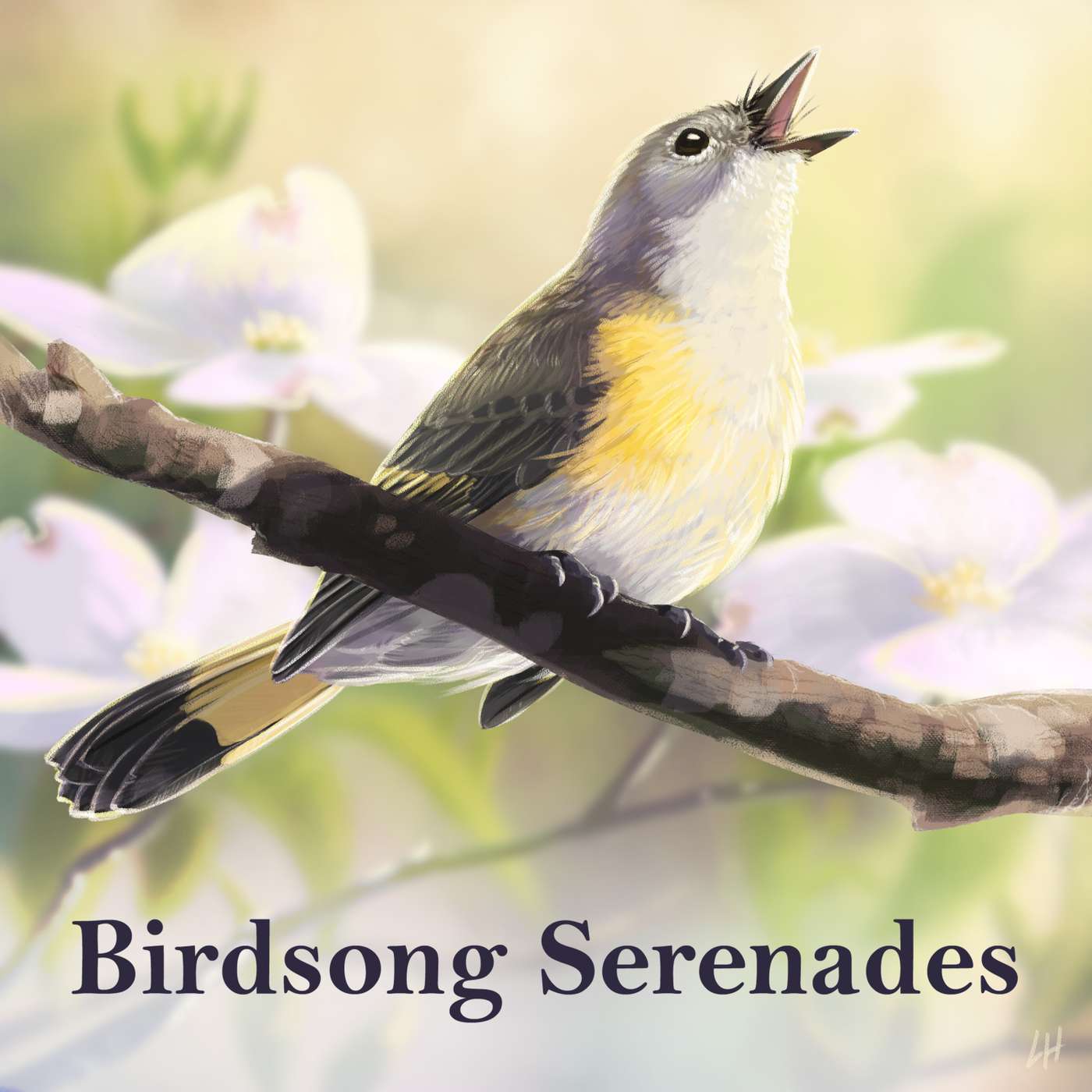
Learning to identify birdsong by ear can be a satisfying skill for anyone who has interest in birds and nature. In this podcast, birdsong recordist Rob Porter introduces you to the songs found in various habitats across North America.Recordings are by Rob Porter. Cover art is by Lauren Helton. https://tinylongwing.carbonmade.com/
-
27
Birdsong Serenades: Western Meadowlark
Let’s say you’re taking a walk down a prairie road in early June. The land is fairly flat, there are few if any trees or shrubs taller than a couple feet.In a field alongside you, you begin to hear this song...It’s faint, and sounds a bit garbled and fast. You’re not quite so sure where this song is coming from, or which of the numerous prairie species this might be. Longspurs, larks, sparrows, meadowlarks — out here they can all sound rather muted and hurried in their song. Luckily, the songster decides to move from its hidden perch on a very low growing shrub to a nearby fence post, and you hear it again...It’s a big bird. Larger than an American Robin, brown in the back, yellow in the front with a bold black bib across its chest.I looked up some mnemonics for this species — one that came up that actually fits well is “Hey, why don’t you come to me?” Of course, this species can have plenty of variations in its song, so your mileage may vary.One thing always stands out to me though — is just how strongly flutelike the voice of the Western Meadowlark sounds. It tends to be a much bolder song, when compared to the other songbird species it is often found alongside with. And, if you’re used to the Eastern Meadowlark, it is a much more rushed and much less contemplative of a song.Let’s listen to the rapid warbles of the Western Meadowlark!
-
26
Serenades: Eastern Wood-Pewee
It’s late in the bird breeding season. Very late.. perhaps early September, somewhere in the Great Lakes region.Many species stopped singing with any regularity weeks ago, but on a late evening hike, you’re hearing one bird singing, even after it starts getting dark.Pee uhhh weeeThe Eastern Wood-Pewee can be heard singing until the day they leave their forest breeding territory.Of course though, this is not the only time you hear them singing. They are commonly heard alongside our previous species, the Red-eyed Vireo. Enough so that once and a while, the Red-eyed Vireo is known to mimic the song of the Eastern Wood-Pewee.You can hear this species from twilight to dusk, though the song is much more enthusiastic in the early morning.
-
25
Serenades: Red-eyed Vireo
Imagine that it is mid-June, and you’re hiking in a forest. You hear this one birdsong. With very few (if any) breaks between these repeated phrases.You’re not sure, but you think there might be several of these birds.What you can tell for certain though, is that the song has a repetitive pattern to it. And it’s coming from the canopy — the upper parts of the trees. And, try as you might, you can’t quite see any of these birds that are singing this song.What you’re hearing is the Red-eyed Vireo.One of the most common ways of remembering their songs is recognizing that their song sounds like its asking, and answering, questions.“Where are you? Here I am.”But there’s one other trick that works.Once again, we could (we can) use a mnemonic that focuses on rhythm and syllables instead.Vireo? Vireo.This trick also works for some other vireo species, such as Blue-headed, Yellow-throated, and Philadelphia Vireos who have the same rhythm but different tones and qualities to the sounds they produce.Birdsong Serenades is Songbirding Studios production, and is recorded, engineered, narrated and created by me, Rob Porter.
-
24
Serenades: Common Yellowthroat
The Common Yellowthroat is more heard than seen.A typical encounter might be something like this:You’re hiking a trail somewhere, and you hear this song.You look over to where it came from and see a patch of cattail reeds, probably surrounding a small pond. Approaching this pond, you begin to see a small bird dart from reed to reed — perhaps sometimes even perching sideways on the reed — its feet clasping the stalk while the bird looks at you sideways.It sings: witchataw, witchataw, witchataw. Or at least, that can be a decent analogue. We call this kind of matching with human language a mnemonic.But a mnemonic doesn’t necessarily have to match exactly with how the bird sounds — in reality, most mnemonics are “close enough” at best.Their job in this case is just to connect a song with a species identification.So how about this instead: by sheer coincidence, the main phrase repeated in their song has the same number of syllables as the name “yellowthroat” itself.Yellowthroat, yellowthroat, yellowthroat.So if you want a mnemonic that is more of a rhythmic & syllabic match, just remember “yellowthroat, yellowthroat, yellowthroat”.CreditsBirdsong Serenades is Songbirding Studios production, and is recorded, engineered, narrated and created by me, Rob Porter. From this point forward, you'll hear only the soundscapes.
-
23
Serenades: Wood Thrush
This episode will focus on the Wood Thrush. You may notice a bit of a tweak to the format of this series, it’s something new I’d like to try, and if feedback is positive I’d like to begin re-releasing episodes with the newer format. For feedback, as always you can contact me through Patreon, Discord, or email rob [at] songbirding.com.It’s late June, and you’re on an evening hike through a deciduous forest. The birdsongs are less dense, more subdued at this time of day, and this next species’ song fits right in with that lazy late evening mood.Peer-o-lay-dee!The Wood Thrush has a slow, flute-like melody. It is the quintessential relaxed, chilled sounding birdsong.And in my experience, this is a species that stands out more in the evening, not necessarily because it is more active leading up to dusk, but because it is just as active as any other time of day. Hermit Thrush and Eastern Wood-Pewee are like this as well, for example. In contrast, any given warbler or sparrow species will be likely be less active than they are in the morning.Being a forest thrush species, these birds are more earthen in colour tones, and in the case of the Wood Thrush spend their time on the ground feeding, but also perch in the lower canopy of a forest when singing, treating the forest as their own personal auditorium as their song echoes far and wide.They are not the only thrush to sound so calming. The Hermit Thrush could also be argued to be also a very calm, lazy sounding song.This is where the mnemonics can come in handy, comparing the Wood Thrush’s flutelike peer-o-lay-dee vs the Hermit Thrush’s less describable flurry of notes.Memorizing this distinction is not easy though… especially considering you’re only likely to hear these species’ songs through a quarter of the year, and that’s assuming you live somewhere that you might have regular access to both of these species. When hearing one of these two after 8 or 9 months of not hearing either, one could not be blamed for readily misidentifying these songs.For more Hermit Thrush songs to compare with, there is previous Birdsong Serenades episode with extensive recordings to compare with. An upcoming episode will have a mix of both, so you may contrast and compare these two songful thrushes.CreditsBirdsong Serenades is recorded, engineered, narrated and created by Rob Porter.
-
22
Serenades: Ruby-crowned Kinglet
The Ruby-crowned Kinglet has a lengthy and fascinating song for such a tiny songbird.It starts off with soft high notes, then break into a musical twittering, and concludes with a loud series of phrases.It’s a strange song, and a loud one for such a tiny bird. Most people will only get a chance to hear this song during spring migration as most of their breeding territories are far away from heavily populated areas.
-
21
Serenades: Northern Cardinal
To many in North America, the Northern Cardinal is the first birdsong of the season one will hear. If you listen often enough though, you might hear one singing at any time of the year.The song can be a “purr deep purr deep” phrase repeated, or a “freep freep tick tick tick tick tick”. This species can vary quite a bit throughout its wide range, and both females and males are known to sing, though males do so more often.
-
20
Serenades: American Robin
The American Robin is very common songbird found across North America, and is often considered the quintessential “sign of spring” for many people.Their song is complex, but can often be boiled down to variations upon the mnemonic “cheery, cheerio, cheer-ily”, repeated in rolling phrases.
-
19
Serenades: Eastern Towhee
The Eastern Towhee has one of the most famous mnemonics of all of North America's songbirds. "Drink Your Tea" describes the most common song of this species, though it has some variations to this.Its' call, interestingly enough, can sound like its name "towhee", but some describe this call instead of "chewink".
-
18
Serenades: Hooded Warbler
The Hooded Warbler's range just barely touches into southern Ontario, and is usually associated with the extreme south -- the forests near the shore of Lake Erie.This yellow warbler with a distinct black hood is a Carolinian Forest species, and has a couple different songs, it's primary song sounding like a-weeta-weeta-weeteeoo.
-
17
Serenades: Eastern Meadowlark
The Eastern Meadowlark is a bright, loud, and cheery presence in tallgrass prairies and farmland across eastern North America, the Central Americas and parts of South America.The male’s song generally consists of 3-5 plaintive whistles, slurred together into a single melody. Generally they sing from an exposed perch, but have been known to sometimes sing in flight.
-
16
Serenades: Hermit Thrush
The Hermit Thrush is a forest songbird with a drab brown plumage, and well-known melancholy song.They lurk in the understories of northern forests in the summer, and the southern forests in the winter.Their song begins with a sustained whistle, and follows with echoing tones that sound like they drift away at the end.
-
15
Serenades: Chipping Sparrow
The Chipping Sparrow has what can be called in most regions a cryptic song. What is meant by this, is it can sound very similar to some other species.Its trill is similar to Swamp Sparrow, Dark-eyed Junco, Pine Warbler, and Worm-eating Warbler.So how can you tell it apart?For me, this song is sharper, and more consistent in its trills, in volume, frequency, and speed.The song of a Chipping Sparrow a tricky one to identify completely by sound, but there are some hints you can get from the environment the bird spends its time in.Chipping Sparrows are common in urban environments — which is only also true for the Dark-eyed Junco, but only outside of breeding season when they are not singing very much.Outside of the urban environments, you will find them in edge habitats — somewhere between two distinct habitats, such as forest and prairie. Perhaps this is why they tolerate urban environments, as they tend to have plenty of habitat edges.
-
14
Serenades: House Wren
The House Wren is a small but powerful and frequent singer.Both males and females will sing during breeding season. The songs are bubbly, and abruptly move from note to note. To me they can be reminiscent of a warbler song.
-
13
Serenades: Yellow Warbler
The Yellow Warbler is one of the most widespread of all the warblers of North America, and are well-known by their bright colour and cheery song.Their most common song is a loud “sweet sweet sweeter than sweet”, but their song can vary quite a bit, and you’ll hear some of this in the following recordings. They typically sing from a tree or other high perch.
-
12
Serenades: Field Sparrow
The Field Sparrow is a small warm-coloured brown bird found in tallgrass priaries, and old fields with shrubs and small trees.Their song starts off with slow, repeated notes, then accelerates to the point where it almost blurs into a solid note. This rhythm is akin to a ping-pong ball being dropped onto a hard surface.
-
11
Serenades: Rusty Blackbird
The Rusty Blackbird was once an abundant, common blackbird species.In the last fifty years, its population has had a rapid decline, losing between 85 and 99 per cent of its population.If you've never heard one or seen one before, this might be why.Their song is a bit hard to describe, but can sound like rusty hinges.They’re often found in mixed flocks with other blackbird species, so listening carefully when encountering flocks of Red-winged Blackbirds, Common Grackles, or Brown-headed Cowbirds can be key in finding these birds.
-
10
Serenades: Red-winged Blackbird
The Red-winged Blackbird is one of the most recognizable and abundant birds in North America.The males show bright red-and-yellow epaulets upon their wings, in stark contrast to their otherwise charcoal appearance. When you find one of these birds, it is usually not difficult to identify them.But with that said, it can still be very helpful to understand and learn the songs and calls of this abundant species, as it will help you pick less common species songs and calls. It is generally quite typical for Red-winged Blackbirds to be in mixed flocks with many blackbird species. Often I’ll listen for Red-winged Blackbird flocks so I can more easily find the less common Rusty Blackbirds.The song of the Red-winged Blackbird can be described as a harsh ru-conk-a-lee, and their calls a mix of harsh checks, and descending “tew” sounds.For feedback you can contact me through Patreon, Discord, or email [email protected]. Each episode is a paid subscriber exclusive. If and when I get more soundscape recordings of a species, I will go back and add the new content to the existing episode, so a given episode may grow in length over time.
-
9
Serenades: Swamp Sparrow
The Swamp Sparrow has what can be called in most regions a cryptic song. What is meant by this, is it can sound very similar to some other species.Its trill is similar to Chipping Sparrow, Dark-eyed Junco, Pine Warbler, and Worm-eating Warbler.So how can you tell it apart?For me, the song is brighter, bolder, and has more of a ringing to it. The frequency of the trill itself can vary a fair bit - from a slow trill where each note is distinguishable, to a faster trill that almost but never quite reaches that of a buzzing sound. It also helps that this would be a song you would expect in a wetland, so habitat hints can be used as well.The swamp sparrow is also more likely to sing from an exposed perch, where it can be clearly seen.
-
8
Serenades: Northern Waterthrush
The Northern Waterthrush has a rather deceptive name: while it is true that the species looks a lot like a thrush, it is in reality, a type of wood warbler. As is also implied by the name, they are found near water, specifically in wet, swampy areas within forests. They can hide very well, but if you do spot one, you’ll often notice them bobbing their tails up and down when foraging.While the song of this species varies somewhat, generally it starts out with a slower sweet sweet sweet eventually morphing into a faster chew chew chew. There is usually a 10 second or longer pause between each song, and the song is much more common at dawn or dusk than it is throughout the day, though earlier in the season they may be heard more readily during the daytime.For feedback you can contact me through Patreon, Discord, or email [email protected]. Each episode is a paid subscriber exclusive. If and when I get more soundscape recordings of a species, I will go back and add the new content to the existing episode, so a given episode may grow in length over time.
-
7
Serenades: Indigo Bunting
The Indigo Bunting is a brilliant blue bird with a lively and complex song.For this song, some use the mnemonics like "Fire, fire, where, where, here, here, put-it-out, put-it-out”, but you can come up with your own phrase with the same rhythm, and that would work as well. Also, you may need to adjust it for variations on the song in different regions, as there can be quite a bit of variability.Later in the season, the Indigo Bunting song becomes abbreviated, and you will hear in these recordings some examples of that.For feedback you can contact me through Patreon, Discord, or email [email protected]. Each episode is a paid subscriber exclusive. If and when I get more soundscape recordings of a species, I will go back and add the new content to the existing episode, so a given episode may grow in length over time.
-
6
Serenades: Brown Thrasher
Brown Thrashers are mimics, and like their catbird and mockingbird cousins, has a large repertoire of songs they can make.The sounds they make are easily confused with Northern Mockingbird in particular, but one difference that can stand out is that they tend to sing phrases in doubles - one note or phrase repeated once - whereas mockingbirds will tend to use triples.There are many other qualities that make a Brown Thrasher sound different that are hard to describe exactly — the tone, speed, and intervals, but this may be highly subjective, affected by acoustics of an environment, and might just be best be understood better purely through exposure and experience listening to each species.For feedback you can contact me through Patreon, Discord, or email [email protected]. Each episode is a paid subscriber exclusive. If and when I get more soundscape recordings of a species, I will go back and add the new content to the existing episode, so a given episode may grow in length over time.
-
5
Serenades: Bobolink
The Bobolink has a unique song.Not much else sounds like it, perhaps the closest thing I can think of is the garbled mess one might hear when a digital sound file from a compact disc or music file is damaged.These blackbirds of the tallgrass prairies often sing from the air, but might also sing from a perch in a tree, or hidden on the ground. Typically one will see and hear the black-white-and-yellow males for the most part, and the light brown females will hide, blending in with any dried grasses. These birds will also form colonies, so it is not unusual to find a number of breeding males singing at one site.Their song is most active from the time of their arrival on breeding territory until their broods are fledged.For feedback you can contact me through Patreon, Discord, or email [email protected]. Each episode is a paid subscriber exclusive. If and when I get more soundscape recordings of a species, I will go back and add the new content to the existing episode, so a given episode may grow in length over time.
-
4
Serenades: Grasshopper Sparrow
The Grasshopper Sparrow can be a tough bird to hear. They are rather quiet, and are present in tall grassy areas. Their song is quite buzzy, and seem more like an insect sound than a bird song.Even thought they are quiet, they always look like they are making far more sound than they are. Should you get a chance to see one singing, you might expect a much louder sound out of this bird.They can be found along side some other sparrow species, such as the Field Sparrow, Song Sparrow, and the Clay-colored Sparrow. Of those sparrows, the Grasshopper and Clay-colored are the more quiet and buzzy sounding.For feedback you can contact me through Patreon, Discord, or email [email protected]. Each episode is a paid subscriber exclusive. If and when I get more soundscape recordings of a species, I will go back and add the new content to the existing episode, so a given episode may grow in length over time.
-
3
Serenades: American Redstart
The American Redstart is a cheery, friendly warbler that vocalizes in a lot of different ways.It can be hard to nail down this song as it varies so much, but generally it is always a short song, and tends to end abruptly or with an accent. It is a fairly persistent singer though, as you will hear -- and the pause between each song is usually only a few seconds long.A few times in these following soundscapes it may even sound like the redstart is mimicking other warbler species. But, do be aware, some of these recordings actually do contain other species.For feedback you can contact me through Patreon, Discord, or email [email protected]. Each episode is a paid subscriber exclusive. If and when I get more soundscape recordings of a species, I will go back and add the new content to the existing episode, so a given episode may grow in length over time.
-
2
Songbirding Serenades: Orchard Oriole
The Orchard Oriole has a curious song. Much like the Baltimore Oriole, each bird might have a slightly different song, with their own unique phrases.One difference I find with the Orchard Oriole is that is usually sounds like it is frequently interupting its own songs with harsh interjections. Also, I find its song to be more similar to a Warbling Vireo, except for the interjections.This may be entirely anecdotal, but I also find that the second-year males are much more frequent singers than the full adults. This species’ males do not get their full adult plumage until late in their second year, and instead are yellow with a dark black throat when they arrive for their first breeding season.For feedback you can contact me through Patreon, Discord, or email [email protected]. Each episode is a paid subscriber exclusive. If and when I get more soundscape recordings of a species, I will go back and add the new content to the existing episode, so a given episode may grow in length over time.
-
1
Songbirding Serenades: Ovenbird
Happy 2021 patrons!I'll have more news coming soon, but I thought I'd share with all of you -- no matter what tier you are signed up for -- the pilot of a new bonus content series for the bonus content tier."Songbirding Serenades" will be series of long-play soundscape recordings with a focus on a single study species each episode. After a brief intro in an episode, the content is authentic uninterpreted soundscapes of songbirds in their breeding habitats, with only minimal editing done.The first episode, "Ovenbird" provides almost 15 minutes of this species. Some episodes may be much longer, and I will likely go back and add more content to episodes as I garner more clean soundscape recordings of a species.Let me know what you think.
No matches for "" in this podcast's transcripts.
No topics indexed yet for this podcast.
Loading reviews...
ABOUT THIS SHOW
Learning to identify birdsong by ear can be a satisfying skill for anyone who has interest in birds and nature. In this podcast, birdsong recordist Rob Porter introduces you to the songs found in various habitats across North America.Recordings are by Rob Porter. Cover art is by Lauren Helton. https://tinylongwing.carbonmade.com/
HOSTED BY
Rob Porter
Loading similar podcasts...
URL copied to clipboard!