
PODCAST · business
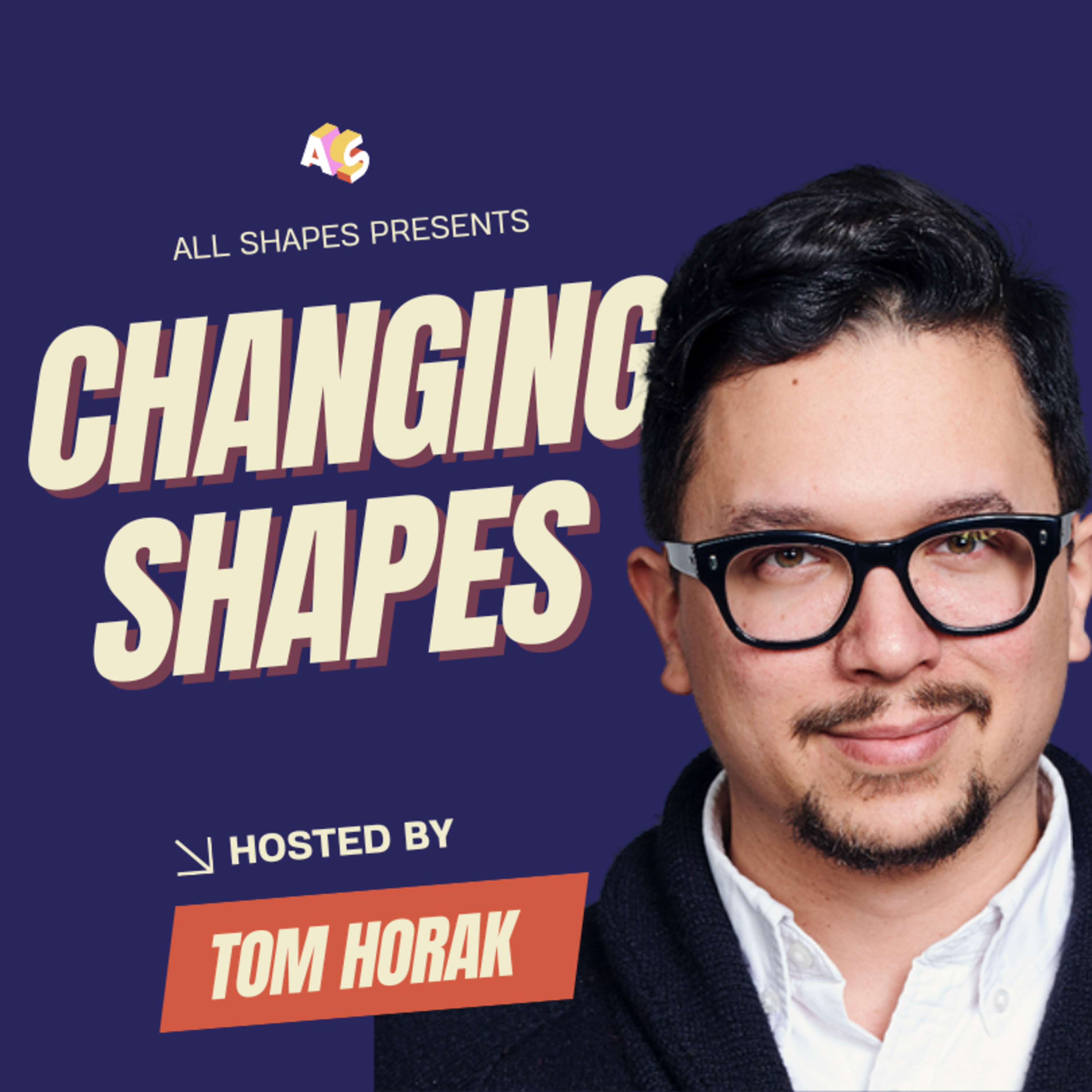
Changing Shapes
by Tom Horak
Every product creates a relationship between the people who build it and the people who use it. Changing Shapes is a podcast for founders, builders and operators who want to make things that connect with the people who use them.Host Tom Horak, founder of All Shapes (allshapes.io), talks with people who have built that relationship between product and audience, and gets them to walk through exactly how. Tom founded the studio behind Five Minute Journal and The Doctor’s Kitchen. He started his career in fine art and has spent over a decade thinking about what makes that relationship hold up.New episodes weekly.
-
20
Why AI Can’t Replace Friendship (for People Who Build Products)
AI can show us what a good friend looks like, but it can’t teach us how to be one. In this episode, Clicqui founder Cynthia Mensah‑Neglokpe and host Tom Horak unpack why AI cannot replace friendship, what most brands get wrong about “community,” and the small mechanics of hosting that actually make people feel seen.“I really just love people… Every person I talk to gives me a little bit of a puzzle piece to a world I don’t know.” Cynthia has built one of Europe’s most interesting women‑only IRL communities, with curated 12‑person dinners and gatherings in Berlin, Paris, Copenhagen, Munich and beyond, and together they map what her practice means for the digital products and communities founders choose to build next.Changing Shapes is a podcast for founders, builders and operators who want to build things that connect with the people who use them. Host Tom Horak, founder of All Shapes, talks with people who have built that relationship between product and audience and gets them to walk through exactly how. Recorded at The Social Hub Berlin.
-
19
How Art Changes Brand Strategy Inside Big Systems (with Onika Simon)
“Strategist and artist Onika Simon explains how art can change brand strategy from the inside of big systems. After years at global agencies and B Corps, she shows founders and operators how artists see the ‘first touch’ with customers that businesses keep missing. If you care about design, strategy, and art in business, this conversation is for you."Brands are like systems trying to find a way to talk to people. Art is how people talk to other people about systems."Onika Simon spent the first half of her career inside the big global strategy agencies (WPP, advertising on Madison Avenue), and the second half building B Corps and running interventions for the BMW Foundation.She tells Tom Horak why most expert rooms are missing the most important person, what artists know about the first touch that specialists keep missing, and why most entrepreneurs could never be artists.For founders, builders and operators who want to build things that connect with the people who use them. Host Tom Horak, founder of All Shapes, talks with people who have built that relationship between product and audience, and gets them to walk through exactly how.Follow Tom on LinkedIn and subscribe for new episodes.Recorded at The Social Hub Berlin.
-
18
How Investors Evaluate Founders (Before They Read Your Deck) | Angeley Mullins
“In this episode, investor and operator Angeley Mullins explains how investors evaluate founders before they even read your pitch deck. She shares what she listens for in the first meeting – resilience, grit, whether you’re a decent human – and why real traction means one thing: has anyone actually paid you?”"My first and primary motive is to make sure I'm backing good people. Then we go to the business piece." Angeley Mullins has scaled seven companies, including one unicorn and one IPO, and she runs every first meeting in that order.She tells Tom Horak what she listens for in a founder before the deck comes out, why ten thousand email subscribers is not traction until someone has paid, and the ten-second read that tells female founders and founders of color how a VC meeting is going to go.For founders, builders and operators who want to build things that connect with the people who use them. Host Tom Horak, founder of All Shapes, talks with people who have built that relationship between product and audience, and gets them to walk through exactly how.Follow Tom on LinkedIn and subscribe for new episodes.Recorded at The Social Hub Berlin.
-
17
EP 17: Rising above the median trap - with Ben Perreau
Most AI tools are trained to give you something. An answer, a rewrite, a suggestion. But what if that helpfulness is quietly pushing everyone toward the same voice, the same style, the same median?Ben Perreau is a former journalist, founder and CEO of Parafoil — a leadership intelligence tool that uses real meeting transcripts to help managers understand how they’re actually leading, not how they think they are. He started his career in newsrooms during the shift from analog to digital, then built startups in music tech before landing here.In this conversation, Tom and Ben explore:Why journalism taught him to separate stories from evidence — and why that skill now matters more than everHow most LLMs push you toward the median when leaders need to be differentiatedThe risk of AI becoming a crutch that atrophies skill rather than building itWhy chatbots are incentivised to always give you something, even when nothing was neededWho gets to define the “better version” of a leader that a tool optimises towardWhy he thinks chat interfaces are like drinking your whole meal through a strawHis contrarian take: this is actually the best time in decades to start building things yourselfBen also shares why he named his company Applied Humanity, how Parafoil avoids the surveillance trap by keeping data private to the individual, and why liberal arts degrees still matter.If you’re thinking about how AI is reshaping management, wondering whether these tools make us sharper or just smoother, or building anything that touches how people work together — this one gets into it.LinksParafoil: A leadership intelligence platform that turns real conversations into insight, helping managers improve through evidence rather than heuristics.Ben Perreau: Founder and CEO of Parafoil (Applied Humanity, Inc.). Former journalist and radio presenter, with a background spanning BBC, NME, Sky Television, and music tech startups Synkio and Gigulate.Thomas Horak is the founder of All Shapes, a design and product studio working with founders, scale-ups and innovative enterprises to build meaningful digital tools that last. All Shapes blends craft, culture and human clarity — helping teams move from early concepts to high-performing, values-aligned experiences.Subscribe for more conversations at the intersection of culture, values, and technology.
-
16
EP 16: If AI does the thinking, what is left to learn? - with Khairunnisa Mohamedali, PhD
Most tools today are designed to remove friction. AI writes the essay, surfaces the answer, smooths the path. But what if that’s precisely the problem?Dr. Khairunnisa Mohamedali is a social anthropologist, MD and Chief Innovation Officer at the Smarty Train — an award-winning learning, onboarding and behaviour change agency. She works at the intersection of human-centred design, the science of how people grow, and the hard reality of shifting organisational cultures at scale.In this conversation, Tom and Khairunnisa explore:Why AI fluency isn’t the same as AI literacy — and what organisations keep getting wrong when they train for itHow convenience erodes the skills we don’t realise we’re losingWhy the best learning design makes everything except the moment of discomfort frictionlessHow to get from base-level competence to higher-order thinking when AI has already automated the base levelThe difference between inclusion and belonging — and why the entry point to that conversation matters as much as the conversation itselfWhy you can’t change minds with facts, and what you actually need insteadThe case for optimism about human resilience — and the responsibility that comes with itKhairunnisa also shares her own system for navigating discomfort: how she wrote her PhD 2,500 words a day (borrowing a method from Stephen King), why self-awareness is the most under-invested skill in most workplaces, and what belonging actually feels like when you encounter it versus when you only perform it.If you’re building learning cultures, navigating a career in an increasingly AI-shaped world, or just wondering whether convenience is quietly making us worse at thinking — this conversation is worth sitting with.LinksThe Smarty Train: The Smarty Train An award-winning learning and development agency specialising in early talent, organisational culture, and human-centred design.Dr. Khairunnisa Mohamedali, PhD. MD and Chief Innovation Officer at The Smarty Train. A social scientist by training, she uses methodological rigour and a holistic systems approach to lead the design and delivery of experiences that have impact, embed learning, and change behaviours. She is a published methodologist, an award-winning innovator, and was selected as a Woman of the Future 2018.Thomas Horak is the founder of All Shapes, a design and product studio working with founders, scale-ups and innovative enterprises to build meaningful digital tools that last. All Shapes blends craft, culture and human clarity — helping teams move from early concepts to high-performing, values-aligned experiences.Subscribe for more conversations at the intersection of culture, values, and technology.
-
15
EP 15: Jules Olcer - We're Connected But Not Close: Inside Village, the Relational Intelligence App
Most of us have that guilt—forgetting to check in, meaning to reach out but postponing. Jules (Gulin) Olcer, founder of Village, believes we've passed a cultural tipping point where connection tools need to evolve.Tom and Jules explore why 93% of our Instagram time isn't spent with people we actually know, how AI can facilitate (not replace) human connection, and why Village is building what Jules calls a "relationship operating system." From her sabbatical reading about systemic crises to a scrappy ChatGPT experiment that sparked the product, Jules shares the journey of creating a social app designed to reduce guilt, not maximise screen time.Learn why vulnerability needs frequency, how Village measures success without addiction metrics, and what it means to build a product where time-in-app isn't the goal.LinksVillage: https://www.villagesocial.app/Village is building what they call a “relationship operating system”—a private space where you can track, nurture, and show up for your 5-150 meaningful relationships. Unlike traditional social networks optimised for time-in-app, Village measures success by how well it helps you maintain connections without guilt or overwhelm.Jules Olcer on LinkedIn: https://www.linkedin.com/in/gulinolcer/ Jules is the founder of Village, a social app designed to help people show up for the relationships that matter most. With a background in psychology and experience in creative industries and climate-related projects, Jules brings a systems-thinking approach to solving the loneliness epidemic. Village uses AI to send contextual nudges that facilitate deeper human connection without replacing it.Tom on LinkedIn: https://www.linkedin.com/in/thomas-horak/Tom is the founder of All Shapes, a design and product studio working with founders, scale-ups and innovative enterprises to build meaningful digital tools that last. All Shapes blends craft, culture and human clarity — helping teams move from early concepts to high-performing, values-aligned experiences.Subscribe for more conversations at the intersection of culture, values, and technology.
-
14
EP 14: The Speed of Safety: Why Healthcare Can't 'Move Fast and Break Things'
Most software for clinicians gets built twice - once for compliance and then again when teams realize clinicians and patients won’t actually use them.Tom and Hiba break down what separates the winners from the expensive rebuilds. We examine real examples—C the Signs in primary care, Viz.ai in imaging, Tempus in oncology—and extract six actionable design principles that healthtech builders can implement immediately.Learn why privacy must be the default (not the disclaimer), how to make consent contextual instead of legalistic, and why explainability builds more trust than sophistication. These tools are turning health records into early warning systems, but only when both patients and clinicians actually trust them.Perfect for CPOs, product leaders, and founders building in the patient data space.LinksHiba on LinkedIn: https://www.linkedin.com/in/hibaganta/ The Needful is Hiba’s newsletter on cultural intelligence for sharper, human-led product decisions. It’s for indie founders and small teams who want clarity without the AI hype. Expect pragmatic strategy, mental models, and cultural research that lift your team’s thinking. Hiba reads features, stories, and signals in one go — from product to org culture — so you can ship with craft, protect user trust, and keep real judgment in the loop.Tom on LinkedIn: https://www.linkedin.com/in/thomas-horak/ Tom is the founder of All Shapes, a design and product studio working with founders, scale-ups and innovative enterprises to build meaningful digital tools that last. All Shapes blends craft, culture and human clarity — helping teams move from early concepts to high-performing, values-aligned experiences.Subscribe for more conversations at the intersection of culture, values, and technology.Subscribe for more conversations at the intersection of culture, values, and technology.
-
13
EP 13: Where Documentation Ends and Care Begins – Wish I Thought of That
How AI, logistics, and thoughtful design are reshaping the humanity of careThis week’s Wish I Thought of That digs into a part of healthcare most people never see: the admin. Clinicians today spend 30–50% of their time documenting, coding, chasing insurance forms or navigating clunky digital systems — a staggering shift that’s reshaping both patient care and contributing to clinician burnout. In this episode, we explore why this burden has grown, what it means for the human experience of medicine, and how a new generation of tools is quietly changing the story.We break down three emerging layers of “clerk-class” health tech: AI scribes like Voize that turn speech into structured documentation, practice OS platforms like Nelly that streamline onboarding and paperwork, and Uber-like logistics tools that coordinate in-home care more efficiently. Together, these products aren’t replacing clinicians — they’re giving them time back. And they raise a bigger question: what happens to clinical judgment, empathy and connection when the system finally reduces its drag?Along the way, Tom and Hiba examine the design principles behind tools that actually make healthcare more human, not less. From “don’t make me think” UX to contextual workflows, they explore why empathy has to be engineered into the invisible moments of care, not sprinkled on top. They also look at how structured admin data fuels early-detection tools like C the Signs, which has already helped detect over 65,000 cancer cases by spotting patterns in the data.This episode asks a simple but consequential question:If we redesign the admin layer of healthcare, do we unlock better medicine — or risk turning care into an industrial process?If you work in health, design, or tech, or you’ve ever felt processed instead of cared for in a clinic, this one will resonate.Key themesThe 30–50% admin burden and how it reshapes careThe rise of AI scribes, practice OS tools and care-logistics platformsDesigning tools that reduce cognitive load, not empathy“AI as the clerk-class”: freeing humans for human workWhy context matters more than features in clinical UXStructured admin → early detection → life-saving outcomesMaking healthcare more human through better systems, not shinier appsLinksHiba on LinkedIn: https://www.linkedin.com/in/hibaganta/The Needful is Hiba’s newsletter on cultural intelligence for sharper, human-led product decisions. It’s for indie founders and small teams who want clarity without the AI hype. Expect pragmatic strategy, mental models, and cultural research that lift your team’s thinking. Hiba reads features, stories, and signals in one go — from product to org culture — so you can ship with craft, protect user trust, and keep real judgment in the loop.Tom on LinkedIn: https://www.linkedin.com/in/thomas-horak/Tom is the founder of All Shapes, a design and product studio working with founders, scale-ups and innovative enterprises to build meaningful digital tools that last. All Shapes blends craft, culture and human clarity — helping teams move from early concepts to high-performing, values-aligned experiences.Subscribe for more conversations at the intersection of culture, values, and technology.Subscribe for more conversations at the intersection of culture, values, and technology.
-
12
EP 12: The Hidden Work Behind Tools That Help You Change Your Life - Wish I Thought of That
How trust, empathy and lived experience shape better digital toolsThis week’s Wish I Thought of That opens a mini-series on health and wellbeing by asking a blunt question: why do so many health apps feel clever, but not caring? We dig into the messy, human side of health-tech design — from journaling tools to nutrition platforms to long-term coaching systems — and what it takes to build products people trust with their bodies and inner lives.We explore why trust must be earned before someone even downloads an app, and why that trust is lost instantly through clumsy UX, overblown promises or gimmicky “delight.” Tom breaks down the principles behind products like Five Minute Journal, RNT Fitness and The Doctor’s Kitchen: clarity over cleverness, empowerment over dependency, and features that feel like an attentive friend rather than a dopamine trap.Along the way, they tackle the myth that AI can replace mid-level product thinking. Lived experience, emotional nuance and narrative discipline are the invisible backbone of any tool meant to support real change. And we argue that the real magic happens when everyone on the team, from backend engineers to designers, can feel the user’s stakes.This episode asks what happens when we treat digital health not as engagement optimisation, but as long-term companionship. Can a product support someone through difficult change without pretending to replace a human? And how do you design tools that fit the complexity of real lives, not just tidy user journeys?If you want a nudge to rethink how your team builds trust, care and context into products, this one is worth your time.Key themesBuilding trust before the first tap and how quickly it can be lost.Clarity over cleverness: why “delight” is never enough in health tech.Designing empowerment instead of dependency loops.Human nuance as the irreplaceable layer AI can’t simulate.Health tech as long-term support, not engagement farming.Why lived experience matters more than generic AI-generated specs.LinksHiba on LinkedIn: https://www.linkedin.com/in/hibaganta/The Needful is Hiba’s newsletter on cultural intelligence for sharper, human-led product decisions. It’s for indie founders and small teams who want clarity without the AI hype. Expect pragmatic strategy, mental models, and cultural research that lift your team’s thinking. Hiba reads features, stories, and signals in one go — from product to org culture — so you can ship with craft, protect user trust, and keep real judgment in the loop.Tom on LinkedIn: https://www.linkedin.com/in/thomas-horak/Tom is the founder of All Shapes, a design and product studio working with founders, scale-ups and innovative enterprises to build meaningful digital tools that last. All Shapes blends craft, culture and human clarity — helping teams move from early concepts to high-performing, values-aligned experiences.Subscribe for more conversations at the intersection of culture, values, and technology.Subscribe for more conversations at the intersection of culture, values, and technology.
-
11
EP 11: "Wish I Thought of That” – Can AI Help Us Be Friends Without Doing It For Us?
How emotional intelligence in design might help rebuild human connectionIn this week’s Wish I Thought of That, we explore Village, a quietly ambitious app using AI to help small circles of people stay connected. After years of isolation and algorithmic noise, we’ve lost some skills on how to stay connected IRL. Village asks whether technology can help us remember.We look at what happens when AI moves from productivity to empathy, not just helping us work faster, but nudging us to care. Can a machine remind us to call a friend without replacing the human impulse to notice? When does a tool become a teacher, and when does it cross into emotional outsourcing?From training wheels vs balance bikes to measuring connection in real-world touchpoints, Tom and Hiba unpack the fine line between AI-assisted empathy and AI as empathy proxy. Along the way, they break down three layers of emotionally intelligent design — reactive, proactive, and contextual — from therapy bots to mindset-aware tools like Duolingo and Five Minute Journal, to context-sensitive apps like Headspace, N26, and Apple Photos.This episode asks a simple question with cultural weight: can technology help us feel more human — or just simulate the feeling of it?Key themesRelearning connection in a post-pandemic, AI-mediated world.Human connection as infrastructure — can it exist without AI?Training wheels vs balance bike: when should AI “leave the room”?Measuring success through offline outcomes, not engagement time.Emotional intelligence in apps: reactive, proactive, contextual.The cultural vacuum and why emotional resonance is the next UX frontier.LinksHiba on LinkedIn: https://www.linkedin.com/in/hibaganta/The Needful is Hiba’s newsletter on cultural intelligence for sharper, human-led product decisions. It’s for indie founders and small teams who want clarity without the AI hype. Expect pragmatic strategy, mental models, and cultural research that lift your team’s thinking. Hiba reads features, stories, and signals in one go — from product to org culture — so you can ship with craft, protect user trust, and keep real judgment in the loop.Tom on LinkedIn: https://www.linkedin.com/in/thomas-horak/Tom is the founder of All Shapes, a design and product studio working with founders, scale-ups and innovative enterprises to build meaningful digital tools that last. All Shapes blends craft, culture and human clarity — helping teams move from early concepts to high-performing, values-aligned experiences.Subscribe for more conversations at the intersection of culture, values, and technology.Subscribe for more conversations at the intersection of culture, values, and technology.
-
10
EP 10: “Wish I Thought of That” – GPS for the Mind: AI Browsers and the Cost of Convenience
How AI-first browsers are reshaping information literacy, trust, and product design.In this week’s WITOT, we ask what happens when the browser starts “driving.” With OpenAI’s Atlas and Perplexity’s Comet, AI agents can remember your sessions, act across tabs, and deliver confident answers… fast. But speed isn’t the same as sense. If we outsource the route-finding, we risk losing the mental map that helps us judge sources, bias, and authority.We draw a line between two kinds of truth: settled facts (where a single answer is useful) and perspective questions (where you need a platter of viewpoints). Today’s agentic browsing often collapses both into one “final” output. Great for convenience, risky for judgment. We also dig into permission creep and incentives: when an agent has to see everything to be useful and will be able to do the driving, who is the customer and who becomes the product?It’s not all doom. We sketch a more human pattern: provenance on by default, an off-switch for automation, and design that surfaces primary sources before conclusions. Plus a hopeful twist: “geocaching for AI.” How can using agents widen discovery and spotlight the long tail rather than narrow it.This is a conversation about values in product craft: keeping the speed and keeping our information sense.Key themesSpeed vs sense: convenience taxes information literacy.Fact Mode vs Perspective Mode: different questions need different UX.Agent “babysitting,” provenance by default, and the off-switch.Permissions & power: customer or product: who benefits from your data?Brand as primary source: why credibility will matter more in an AI-mediated web.“Geocaching for AI”: designing for serendipity and the long tail.LinksHiba on LinkedIn: https://www.linkedin.com/in/hibaganta/The Needful is Hiba’s newsletter on cultural intelligence for sharper, human-led product decisions. It’s for indie founders and small teams who want clarity without the AI hype. Expect pragmatic strategy, mental models, and cultural research that lift your team’s thinking. Hiba reads features, stories, and signals in one go — from product to org culture — so you can ship with craft, protect user trust, and keep real judgment in the loop.Tom on LinkedIn: https://www.linkedin.com/in/thomas-horak/Tom is the founder of All Shapes, a design and product studio working with founders, scale-ups and innovative enterprises to build meaningful digital tools that last. All Shapes blends craft, culture and human clarity — helping teams move from early concepts to high-performing, values-aligned experiences.Subscribe for more conversations at the intersection of culture, values, and technology.
-
9
EP 9: “Wish I Thought of That” – Play Without the Pull: Designing for Independence, Not Dependence
How children’s toys are teaching us better product design.In this week’s episode of Wish I Thought of That (WITOT), Hiba Ganta and I look at what innovation really means in the space of children’s play — and what it reveals about how we design technology for adults.The conversation starts with a simple idea: healthy play in the age of addictive screens. From Bluey to Yoto and Lovevery, we explore products that respect attention rather than exploit it, and how those same design principles could reshape digital products everywhere.We talk about how tools for kids often get the basics right, clear beginnings and endings, calm pacing, tactile control, while adult tools chase engagement at any cost. The question running through the episode: what would happen if software was designed like a good toy?It’s a conversation about values in design: autonomy, clarity, and care. And about the responsibility of builders to create tools that nurture independence, not dependence.Design for independence, not dependence: the line between empowering and exploiting users.Parent OS: how great children’s products quietly serve both the parent (operator) and child (beneficiary).Offline innovation: why the best tech sometimes steps out of the screen.From play to product: how Montessori thinking and real-world tactility inspire better UX.Cultural shift: the growing movement toward phone-light childhoods and intentional tech use.LinksHiba on LinkedIn: https://www.linkedin.com/in/hibaganta/The Needful is Hiba’s newsletter on cultural intelligence for sharper, human-led product decisions. It is for indie founders and small teams who want clarity without the AI hype. Expect pragmatic, experience-grounded strategy, mental models, and cultural research that lift your team’s thinking. Hiba has led product, designs hands-on, and works on engagement and internal culture, so she reads features, stories, and signals in one go. Subscribe if you care about shipping with craft, protecting user trust, and keeping real judgment in the loop.Tom on LinkedIn: https://www.linkedin.com/in/thomas-horak/Tom is the founder of All Shapes, a design and product studio working with founders, scale-ups and innovative enterprises to build meaningful digital tools that last. All Shapes focuses on products that blend craft, culture, and human clarity — helping teams move from early concepts to high-performing, values-aligned experiences.🧠 Subscribe for more conversations at the intersection of culture, values, and technology.
-
8
EP 8: "Wish I Thought of That" - Chat as Interface (?)
When a UX experiment became the world’s default way to talk to AIIn this first episode of our new weekly segment Wish I Thought of That (WITOT), Hiba Ganta and I explore how chat became the interface for everything, and whether it should stay that way.We talk about why ChatGPT’s text box was never meant to be the final form of AI interaction, and how a design experiment scaled into a global pattern that’s shaping everything from education tools to enterprise workflows.From there, the conversation moves into how voice, visuals, and chat each change the way we think, and what that means for people building products today.This episode is a reflection on product sense, human expectations, and the danger of forgetting what makes good design intuitive. It’s also about trust: the trust we place in interfaces, in data, and in ourselves when we work through new tools that can both empower and mislead.The interface we choose doesn’t just change what we do, it changes how we think.KEY THEMESChat as accident that scaled: how an early UX choice defined a generation of AI tools.Voice vs. visuals: how each mode of interaction triggers a different kind of thinking.Fact-checking the machine: designing for trust, not just output.Product sense for everyone: why taste and intent matter more than ever.Building with intent: avoiding homogenisation by grounding in human habits and values.LINKSHiba on Linkedin: https://www.linkedin.com/in/hibaganta/The Needful is Hiba’s newsletter on cultural intelligence for sharper, human-led product decisions. It is for indie founders and small teams who want clarity without the AI hype. Expect pragmatic, experience-grounded strategy, mental models, and cultural research that lift your team’s thinking. Hiba has led product, designs hands-on, and works on engagement and internal culture, so she reads features, stories, and signals in one go. Subscribe if you care about shipping with craft, protecting user trust, and keeping real judgment in the loop.Tom on LinkedIn: https://www.linkedin.com/in/thomas-horak/ Tom is the founder of All Shapes, a design and product studio working with founders, scale-ups and innovative enterprises to build meaningful digital tools that last. All Shapes focuses on products that blend craft, culture, and human clarity — helping teams move from early concepts to high-performing, values-aligned experiences.Tom also hosts Changing Shapes, a podcast about how technology changes the way we design, create, and connect and how to build tools that stay human as they scale.🧠 Subscribe for more conversations at the intersection of culture, values, and technology.🔗 Past episodes and articles available at tomhorak.substack.com.
-
7
EP 7: Tim Weinheimer – Innovation with Integrity and the Human Side of AI
A conversation about leading with care in competitive spaces, building AI hackathons that mix speed with friction, and how communicators can balance hype, trust, and authenticity in the age of AI.Changing Shapes – Episode 7I sat down with Tim Weinheimer, Chief Marketing Officer at Hahn, to explore how he’s navigated decades of agency change — from the early digital days to today’s AI-powered campaigns — while holding fast to a simple but powerful value: caring.Tim has led award-winning public health initiatives, built cross-disciplinary teams to experiment with AI, and authored The Robot Apocalypse: How Brands Can Survive and Thrive in the Age of AI back in 2018, well before the current hype wave. His outlook combines data, ethics, and storytelling in a way that feels both pragmatic and deeply human.Our conversation explores:How to bring success and care together in leadership, and why small acts of connection matter in a distributed workforce.What Hahn’s AI hackathons revealed about using generative tools for creativity without losing friction or emotional resonance.Where we are in both the AI hype cycle and the trust cycle, and how brands should navigate each.Why personalization and “extreme listening” may shape the next wave of technology and social platforms.The cultural fatigue with social media and what might emerge to replace it.It’s a conversation about speed and care, hype and trust, innovation and authenticity — and how to build communication that remains both cutting-edge and human.Tim Weinheimer on Linkedinhttps://hahn.agency/
-
6
EP 6: Alex Platonov - Worlds, Agents, and the Human Touch
A conversation about simulated worlds, agents that find clever exploits, and building call-centre AI that’s faster, kinder, and still human-centred.Changing Shapes – Episode 6In this episode, I sit down with Alex Platonov, a UX engineer and former technical artist who spent eight and a half years at DeepMind, to unpack how simulated worlds train real capabilities, why agents find exploits humans miss, and what “values in product” actually looks like when you’re shipping. Today he’s building an AI-driven call-centre platform at a stealth startup.Our conversation explores:A self-taught path from architecture and graphic design into front-end engineering, then DeepMind, then technical art building 3D worlds for agents.What front-end and simulation tooling enable in research: experiment dashboards, organisational visibility, and environments that both agents and humans can interpret.Agents in simulated worlds: reward design, emergent “bug-finding”, and why sim speed and scale matter before taking skills to robots.Sim-to-real and the near-term horizon for embodied AI, plus a candid take on uncertainty, timelines, and what to teach our kids now.Craft and culture in an AI era: why offline making, woodcarving, and tangible artefacts feel more valuable amid ubiquitous generative media.The new venture: standing up AI call-centre agents with prompts, instant iteration, human hand-off, and why agility beats static scripts.Values in practice: reducing user frustration, creating small moments of joy, and choosing work with real impact over “pretty for pretty’s sake.”Breaking into AI now: bring curiosity, learn the basics, use LLMs as leverage, and understand what they produce so you can correct and direct.It’s a conversation about building worlds for machines and meaning for people — speed and safety, tools and taste, and where human touch still sets the standard.Alex on Linkedin: https://www.linkedin.com/in/platonovs🧠 Subscribe for more conversations at the intersection of culture, values, and technology.🔗 Past episodes and articles at tomhorak.substack.com
-
5
Hiba Ganta – Chaos, Friction, and the Soul of Product Design
A conversation about AI tools, cultural shifts, and why products still need a human touch to feel alive.Changing Shapes – Episode 5“Finding meaning in the mess of product design.”In this episode of Changing Shapes, I sit down with Hiba Ganta, a Berlin-based product builder and writer whose career spans startups, community, no-code, and design, to talk about what it means to work fast, embrace chaos, and still create products with soul.Hiba shares how a startup incubator in Montreal set her on a path of “professional mess cleaning,” why she’s drawn to intense environments, and how experimenting with AI prototyping tools like Lovable and Replit changed the way she builds.Our conversation explores:Why friction is essential to good work, even in an age obsessed with efficiencyWhat AI can accelerate, and where only human creativity adds the magicHow the definition of MVP is shifting when anyone can “vibe code” a prototypeWhy craftsmanship and intentionality will always have a market, online or offHow unexpected people becoming “designers” could refresh the whole fieldIt’s a conversation about chaos and systems, speed and standards, and the cultural value of products that still carry a human touch.—Hiba’s brilliant Substack is The Needful 👇 The number one takeaway from this podcast should be you go subscribe to that. The Needful is Hiba’s newsletter on cultural intelligence for sharper, human-led product decisions. It is for indie founders and small teams who want clarity without the AI hype. Expect pragmatic, experience-grounded strategy, mental models, and cultural research that lift your team’s thinking. Hiba has led product, designs hands-on, and works on engagement and internal culture, so she reads features, stories, and signals in one go. Subscribe if you care about shipping with craft, protecting user trust, and keeping real judgment in the loop.Highlights:Weird Advantage 01: Protecting Originality — aliveness, tension branding, mental models.The Accidental Interface We All Copied — a demo UI set AI defaults; redesign for exploration.One Sprint in the Vibe-Coding Trenches — build one thin slice yourself to set standards.Hiba on Linkedin: https://www.linkedin.com/in/hibaganta/🧠 Subscribe for more conversations at the intersection of culture, values, and technology.🔗 Past episodes and articles available at tomhorak.substack.com.
-
4
Episode 4: Evan Yudell – Trust, Creativity, and the Future of Leadership
How a jazz drummer turned SaaS founder leads with trust, creativity—and a healthy dose of humility.Changing Shapes – Episode 4“Wonder. What if. Let’s try.”In this episode of Changing Shapes, I speak with Evan Yudell—founder and CEO of Sales Made Simple—about what it takes to build trust in teams, navigate failure, and lead creatively in a world increasingly shaped by AI.Evan left a corporate leadership career to bootstrap his own SaaS company, not because he always wanted to be a founder, but because someone asked him a question at the right time—and he had the vision (and humility) to say yes.Our conversation explores:Why real trust takes time, humility, and inclusionThe creative side of leadership (and why jazz drumming might be the best training for it)What AI can and can’t replace when it comes to human connectionThe danger of skipping hard lessons when juniors are replaced by language modelsWhat advice Evan gives to the next generation of leaders in a post-AI worldWe also talk about how his own neurodivergence shaped his leadership style, why he avoids "us vs them" hierarchies, and how he builds loyalty by letting people into the process—because, as Evan puts it, “asking for someone’s opinion is one of the clearest signals that you trust them.”This one’s full of hard-won wisdom, punchy honesty, and plenty of unexpected moments.—🧠 Subscribe for more conversations at the intersection of culture, values, and technology.🔗 Past episodes and articles available at tomhorak.substack.com.
-
3
Episode 3 - Onika Simon: AI, Ethics & Cultural Intelligence
🎙️ Episode OverviewIn this episode of Changing Shapes, Tom Horak sits down with Onika Simon—cultural strategist, brand thinker, philosopher by training, and co-founder of creative studio OK Sorted. With a career spanning two decades across New York, London and Berlin, Onika brings a singular voice to how we should think about creativity, ethics, and the role of technology in shaping culture.From walking away from Oxford at 17 to starting her career in New York the day before 9/11, Onika has always been driven by big questions. This conversation explores the ethics of AI, the meaning of excellence, and why artists might be the best teachers for business leaders navigating change.🔍 In This Episode, We Discuss:✔ Why philosophy, not business, may be the best training for navigating AI✔ What it really means to “show up in culture” when AI is part of your brand toolkit✔ How to define excellence and why not everything deserves to exist✔ The triple bottom line – what “good growth” looks like in the age of automation✔ Why ethics aren’t corporate—they’re human, and that’s where the responsibility lies✔ The difference between authenticity, adaptation and alienation when adopting new tools✔ Her insider’s view on Berlin, London, and New York’s very different responses to AI✔ Advice for young creatives: the importance of workplace hygiene, insubordination—and learning to ask better questions🎧 Listen Now:📌 Spotify: https://open.spotify.com/show/2TmkhnKwaBlN2adTHJWTDE?si=60f7e6b9dd844906📌 Apple Podcasts: https://podcasts.apple.com/ro/podcast/changing-shapes/id1804432666📌 Substack: https://substack.com/@thomashorak ✨ Key Takeaways:• AI is the sum of everything we’ve made—but excellence still matters. Not all outputs are equal, and not everything should be monetised.• Creative industries have a moral obligation. If we say we’re here to inspire and uplift, then ethics must be more than a line in the brand book.• Good growth doesn’t sacrifice people or planet for profit. If AI is to be part of the future, it must serve more than the already powerful.• Companies aren’t ethical—people are. And the true danger is when decision-makers dodge accountability behind the mask of technology.• Young people should feel empowered to challenge systems. The future needs polite insubordination more than passive compliance.🔗 Links & References:• OK Sorted Studio – https://www.oksorted.com/• Onika’s LinkedIn – https://www.linkedin.com/in/onikasimon💬 Join the Conversation:📢 Share your thoughts on LinkedIn → https://www.linkedin.com/in/thomas-horak/📩 Subscribe for more cultural insight → https://substack.com/@thomashorakIf you enjoyed this episode, subscribe, rate, and leave a review—it really helps us grow. Until next time, ask better questions, stay human, and remember: not everything deserves to exist.
-
2
Episode 2: Felix Rossknecht: AI, Startups & the Future of Growth
🎙️ Episode OverviewIn this episode of Changing Shapes, host Tom Horak talks with Felix Rossknecht—a fractional CMO, growth strategist, and advisor to over 50 companies across e-commerce, consumer tech, and health innovation. Felix grew up in a family business, spent years honing his expertise in global markets, and has now turned his attention to how AI is changing the foundations of product building, marketing, and even healthcare.From the rise of automated content generation to hyper-personalised health coaching, Felix offers a measured, real-world perspective on what AI does well—and where human intuition and creativity still reign supreme.AI & Startup Development: How generative AI tools lower barriers for new entrepreneurs, and whether AI could ever act like a “co-founder.”Speed vs. Substance in Marketing: Why the automation of ad targeting, influencer outreach, and SEO isn’t replacing humans but shifting their roles.Search Engine Optimisation in Flux: Why chatbots and conversational search might leave traditional SEO behind—and what truly matters for discoverability now.Healthcare Innovation & Prevention: How AI scribes can free doctors to focus on patients, and why Felix believes prevention and coaching may be AI’s next big frontier.Advice to New Entrepreneurs & Marketers: Balancing cutting-edge tools with timeless fundamentals—empathising with customers, validating real needs, and embracing steady growth over hype.Spotify: [Link to Spotify]Apple Podcasts: https://podcasts.apple.com/us/podcast/changing-shapes/id1804432666Substack: https://substack.com/@thomashorakAI Unlocks Speed, But Strategy Still MattersRapid prototyping and automated marketing can jump-start a venture, but founders must still test real-world needs and cultivate genuine insights.The Search Landscape is ShiftingChat-based tools are edging out traditional Google ranking, making it crucial for brands to deliver concise, high-quality information that AI can parse and recommend.Health Tech’s Real Opportunity Lies in PreventionFrom AI scribes to personalised coaching, Felix sees untapped potential for tech that nudges people toward healthier habits—without replacing human care.Not Just Automation—It’s AdaptationAI in marketing doesn’t remove the need for marketers. Instead, it changes the skill set required, focusing on brand storytelling, creative direction, and ethical data use.Focus on the Human Side of GrowthWhether you’re a solo founder or leading a team, true differentiation comes from understanding your customer’s world—and using AI as a tool, not a crutch.Felix’s LinkedIn – https://www.linkedin.com/in/felixrossknechtFelix’s Substack – https://righteffort.substack.com/Tom’s LinkedIn – https://www.linkedin.com/in/thomas-horak/Subscribe for more cultural insight → https://substack.com/@thomashorakIf you found this episode valuable, please subscribe, rate, and leave a review. Until next time, stay curious, embrace new tools—and remember that genuine innovation always starts with real human needs.🔍 In This Episode, We Discuss:🎧 Listen Now:✨ Key Takeaways🔗 Links & References💬 Join the Conversation
-
1
Episode 1: Amy Daroukakis
Amy Daroukakis: AI, Culture & The Future of Human Insight🎙️ Episode Overview:In this episode of Changing Shapes, Tom Horak sits down with Amy Daroukakis, a cultural strategist and global trends expert who has spent over 20 years decoding the future for brands like Google, LVMH, and Airbnb. Amy doesn’t just observe trends—she sees the cultural forces shaping them before the rest of us even realise what’s happening.From AI’s impact on human connection to the crisis of authenticity in the digital age, this episode is packed with insightful, thought-provoking discussion. We explore why AI can’t truly replace cultural intelligence, how algorithmic bias is shaping our world, and why the most valuable skill of the future is simply being human.🔍 In This Episode, We Discuss:✔ AI’s cultural zeitgeist – why 2023 was the biggest shift in AI perception we’ve ever seen✔ The hype vs. reality of AI in business and culture – are we automating too much, too fast?✔ How brands are misusing AI and where it’s actually useful✔ The crisis of authenticity – why many consumers no longer trust online content✔ How AI is flattening creativity – and the real opportunities that exist beyond the hype✔ The future of human interaction – how the loss of in-person touchpoints is reshaping culture✔ Getting lost on purpose – why the best insights don’t come from data, but from the real world🎧 Listen Now:📌 Youtube: https://youtu.be/N4w2jdzMHhk📌 [Apple Podcasts]📌 https://substack.com/@thomashorak✨ Key Takeaways: • AI is a mirror, not a replacement for culture. It reflects what we value and what we overlook—and unless we actively shape it, it will reinforce biases rather than challenge them. • We’re at a turning point between AI being helpful and AI replacing too much. Businesses are outsourcing thinking, but in doing so, they’re flattening creativity and stripping away the human element. • Authenticity is the new currency. With AI-generated content flooding the internet, people are craving realness—this is where businesses and creators can stand out. • Your biggest advantage is being deeply human. AI can synthesise data, but it can’t ask about someone’s divorce or form relationships. The future belongs to those who know when to use AI and when to rely on human intuition. • True insight comes from real-world experience. AI models are built on existing data, but the most valuable cultural insights come from being out in the world—observing, engaging, and getting lost on purpose.🔗 Links & References: • Amy’s Open-Source Trend Report Collection • Culture Connectors Podcast • Amy on LinkedIn💬 Join the Conversation:📢 Share your thoughts on LinkedIn → @TomHorak📩 Subscribe to the newsletter for more insights → [Substack]If you enjoyed the episode, subscribe, rate, and leave a review—it really helps us grow. Until next time, stay curious and don’t be afraid to get lost on purpose.
No matches for "" in this podcast's transcripts.
No topics indexed yet for this podcast.
Loading reviews...
ABOUT THIS SHOW
Every product creates a relationship between the people who build it and the people who use it. Changing Shapes is a podcast for founders, builders and operators who want to make things that connect with the people who use them.Host Tom Horak, founder of All Shapes (allshapes.io), talks with people who have built that relationship between product and audience, and gets them to walk through exactly how. Tom founded the studio behind Five Minute Journal and The Doctor’s Kitchen. He started his career in fine art and has spent over a decade thinking about what makes that relationship hold up.New episodes weekly.
HOSTED BY
Tom Horak
CATEGORIES
Loading similar podcasts...
URL copied to clipboard!