
PODCAST · business
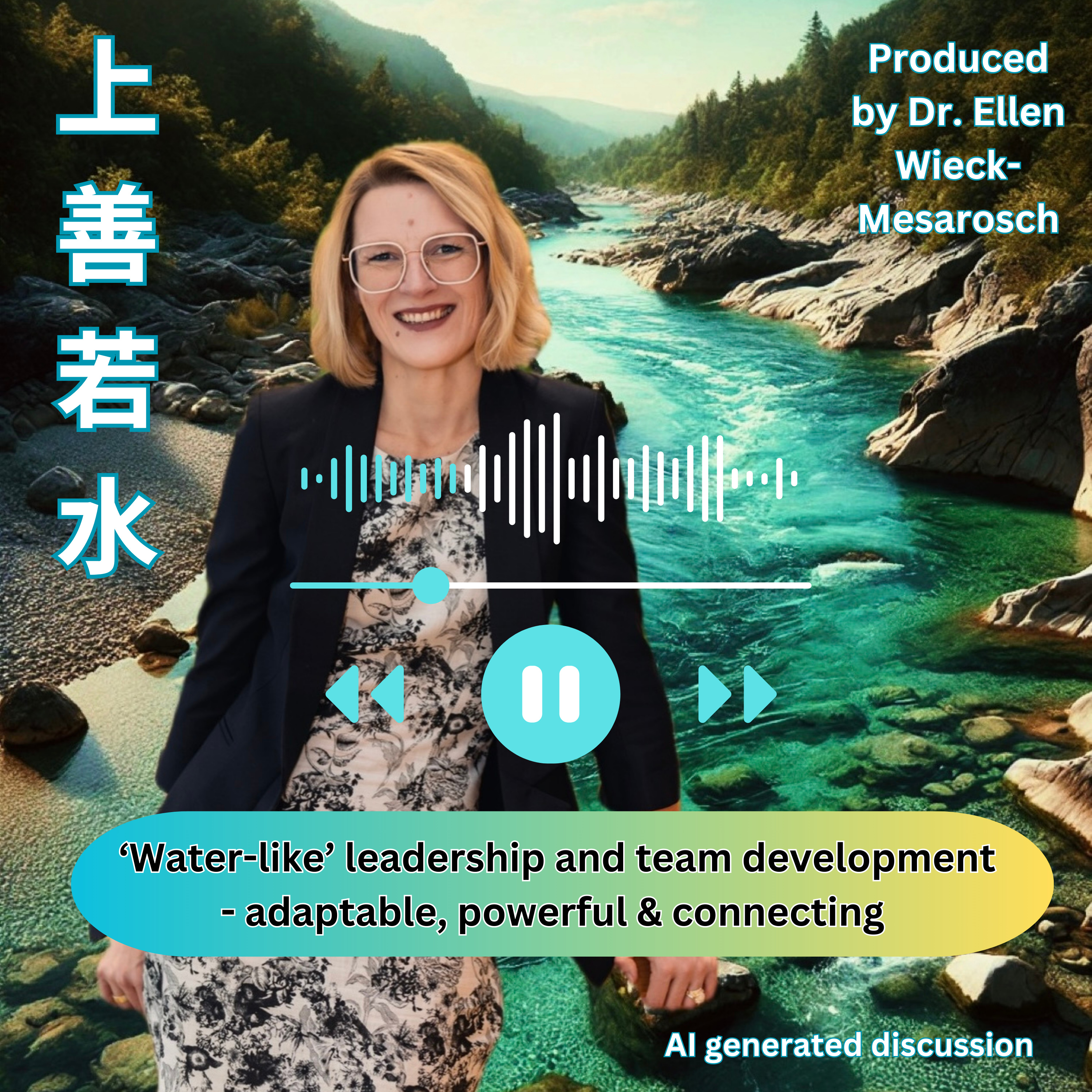
'上善若水' Leadership and team development
by Dr. Ellen Wieck-Mesarosch
You’re not just listening to another podcast on leadership — you’re experiencing a unique fusion of artificial intelligence, ancient wisdom, and real-world leadership challenges. The content is based on Dr. Ellen Wieck-Mesarosch's expertise & practical work as a leadership coach for Chinese & German executives & their teams. NotebookLM by Google is used to bring the stories alive. Two AI generated characters will discuss in a dialogue the content provided by Dr. Ellen. Biweekly, you’ll receive practical tips on intercultural leadership and team development through this novel format.
-
20
#20 How to Lead Through 2026 With the Strengths You Already Have
When I reflect on which leadership skills helped my clients most in 2025, five stand out clearly: adaptability, resilience, tolerance for ambiguity, systems thinking, and trust building. I strongly believe they will remain just as important in 2026 and beyond.And this is not just my personal belief. These capabilities are repeatedly named among the most critical future skills by sources such as e.g. World Economic Forum – Future of Jobs Report.What has been most interesting to observe, though, is how my clients worked on and acquired these skills. The paths were as diverse as the individuals I coached. There was no single method, no universal recipe, no “one right way” to become adaptable, resilient, or trustworthy.Some leaders built adaptability through careful analysis and scenario planning. Others through sensitivity to timing and relationships. Resilience showed up as disciplined perseverance for some, and as long-term perspective or relational support for others. Systems thinking emerged through structure and models — or through an intuitive understanding of people and context. Trust grew through clarity and reliability — or through consistency and care over time.What made the difference was not which strength someone had, but whether they learned to use their own strengths consciously in service of these essential skills.That insight is why I dedicated my last Shang Shan Ruo Shui (上善若水) podcast episode of the year to this topic:“How to Lead Through 2026 With the Strengths You Already Have.”Inspired by the Daoist idea that the highest good is like water, the episode explores how leaders can develop future skills by adapting to their environment without losing their nature — working with who they already are, rather than against it.If you’re reflecting on what truly helped you lead well in 2025 — and how to prepare for what’s ahead — this episode offers both perspective and very practical guidance.
-
19
#19: Skillfully influencing across Germany & China
👉 How can we gain support for our ideas authentically, effectively, and with cultural sensitivity?Based on insights from hundreds of coaching hours of Chinese & German leaders we look into:✨ Why influencing in German–Chinese contexts requires a different level of awareness✨ How your VIA Character Strengths shape the way you naturally influence others✨ Which influencing methods work in Germany and China — and why their impact differs✨ How to stay ethically grounded while still being persuasive✨ What Story-Framing, Analytical Argumentation, Co-Creation, and Empowerment look like across culturesOne of the key takeaways:We discuss how to navigate cultural differences without falling into stereotypes, and how true influence emerges when personality, method, and cultural context align.💡 Who should listen?Leaders, project managers, HR professionals, and anyone working in international or cross-cultural teams — especially in German–Chinese collaboration.
-
18
#18 There is no single China/Germany - Collaboration beyond stereotypes
China today is home to 1.4 billion people, 56 officially recognized ethnic groups, countless regional identities, generational shifts, and rapidly evolving work cultures.Germany, too, is far from homogeneous — shaped by regional cultures, industries, company traditions, and individual leadership styles.In this podcast episode, I talk aboutwhy there is no such thing as the China or the Germany— and what this means for collaboration in projects, negotiations, and leadership situations.🎙️ In this episode, I share:• why most misunderstandings arise from assumptions about culture — not from culture itself• how ambiguity tolerance, curiosity, and adaptiveness become real game changers• why global work cultures increasingly override national patterns• and which concrete steps teams can take to work effectively beyond stereotypesI also share insights from my practical experience — from workshops, team processes, and 1:1 coaching sessions with leaders who build bridges between China and Germany.🔥 My core message:Intercultural competence is not a “nice-to-have.”It is a strategic competitive advantage — for organizations and for individual careers.If you work with China or with Germany, if your team collaborates globally, or if you want to strengthen your leadership capabilities:this episode may offer valuable clarity and inspiration.
-
17
#17 How your strengths create business success through trust
Over the years coaching Chinese and German leaders, I’ve seen one thing repeatedly:success across cultures isn’t decided by strategy — it’s decided by trust.But trust doesn’t “just happen.”It grows where leaders know who they are, understand how their strengths show up in different contexts, and use them intentionally — to connect, not to convince.In this episode, I explore:🔹 Why trust is not a feeling but a practice — especially in cross-cultural teams🔹 How a strength can work for you or against you, depending on culture and context🔹 What makes authenticity and humility powerful — yet sometimes misunderstood — leadership tools🔹 How self-awareness turns difference into an advantageThese insights come from years of working with Sino-German teams navigating the space between clarity and harmony, directness and diplomacy.Because when people feel seen and respected, strategy moves faster.And when trust becomes part of the team’s rhythm, performance follows naturally.🎧 Listen in for a conversation that goes beyond culture — into what truly builds connection at work: the human level.
-
16
#16: Rethinking China Speed in the GenZ era
Rethinking “China Speed” in the Gen Z EraIn this episode, you’ll hear about how China’s Gen Z is redefining what “China Speed” means — shifting from nonstop hustle to smarter, more intentional ways of working.We talk about what drives this generation, how their values are reshaping workplaces, and what German business leaders can learn when collaborating across cultures.It’s not slower — it’s smarter.
-
15
#15 Mastering the Boardroom: What Chinese and German Leaders Must Know
🎧 In this podcast episode, we unpack the hidden dynamics of boardrooms — with insights tailored to German and Chinese leadership cultures from minute 14 onwards.🔍 Here’s what you’ll take away:– How to read the room — even when no one says a word– How to align your pitch with mission, vision, and risk management– Why direct pushback in Germany is a sign of diligence — not rejection– Why silence in China may mean negotiation is still ongoing — behind the scenes– How the MORF model (Move, Oppose, Reframe, Follow) can help you lead any conversation with confidence💡 Spoiler: Your board isn’t your opponent. It’s your most powerful ally — if you know how to speak its language.Whether you’re presenting in a DAX boardroom or in a Chinese JV meeting — this episode is your compass for credibility, clarity, and cultural fluency.
-
14
#14 Reverse Coaching: China Speed Meets German Substance
Next Level Leadership through Reverse Coaching – What the German SME Can Learn from ChinaWhile Western firms are still optimizing digital roadmaps, China is accelerating:– 5x more STEM graduates annually than Germany– Rapid scale-ups in AI, ecommerce, and platform ecosystems– A leadership model that combines pragmatic execution with speedChina is redefining innovation speed—and forcing the German SME to rethink its leadership models.In this new podcast episode, I share one of the most underused but high-leverage responses:👉 Reverse Coaching as a strategic tool for leadership transformation and cross-cultural agility.What you’ll hear:– Why reverse mentoring is not a “nice to have,” but a business imperative– How diverse perspectives improve decision-making across borders– Why failure tolerance can cut your time-to-market in half– How shared leadership across China-Germany teams drives innovation and ownership🎧 Tune in if you’re serious about turning strategy into implementation—beyond slide decks.
-
13
#13 How Guanxi works in Germany - successfully networking across cultures
In this episode, I share how culturally modulating Guanxi can unlock trust and connection for Chinese leaders working in Germany — without losing authenticity.Guanxi — the Chinese system of relationship-building — is deeply rooted in loyalty, reciprocity, and personal obligation.But what happens when you bring that mindset into a German business context, where networking follows a very different rhythm?We explore this through the story of a Chinese executive navigating German business culture — and what shifts when we stop trying to translate Guanxi directly and start learning how to modulate it culturally.One quote from our coaching session:"In China, I know how to be fast, warm, loyal. Here, I don’t know if I’m too direct — or completely invisible."This moment opened a deeper conversation:➡️ How trust in Germany is often built through clarity, not closeness➡️ Why quiet presence can carry more weight than frequent contact➡️ And how pushing for personal connection too soon can backfire — even with the best intentionsWe talk about how to adapt without diluting, including:➤ Slowing the rhythm without losing commitment➤ Letting trust grow through reliable expertise — not just personal loyalty➤ And reading cultural "relationship signals" before responding with familiar patternsWhy is this shift so powerful?Because it helps Chinese leaders:✔ Maintain their relational strength✔ Avoid unintentionally triggering resistance✔ And lead across cultures without feeling like they’ve lost themselves in the processJust like in team roles, cultural modulation isn’t suppression — it’s precision.It’s the art of knowing what to keep, what to adjust, and when to simply observe.🎧 If you're navigating the delicate space between trust, culture, and leadership — this one's for you.
-
12
#12 Breakdancing Panda & Freestyling Shepherd - When China Speed meets Good Old Germany
Nearly 20 years ago, I was sourcing cotton from China — helping factories align with Western quality expectations. It's the era of so called low cost country sourcing.🧭 In a way back then, the West or the 'German Shepherd' was teaching the 'Chinese Panda' how to waltz.Fast forward to today, we watch self-driving taxis, drone deliveries, AI-powered logistics, and fully cashless street markets unfold in real time.The panda? It’s breakdancing now — moving fast, improvising daily, and setting new standards.And Germany?Despite recent headwinds, still deeply rooted in structure and precision — but evolving too.The shepherd is no longer just guarding the process — it’s freestyling: blending legacy strength with digital transformation, deeptech, and startup momentum.🌍 These are today’s dancing fields — China and Germany.Both powerful. Both distinct. And both requiring something new from leadership.In this episode, we explore:🔹 What “China Speed” really means (and what it demands)🔹 Why structured thinking still matters — but isn’t enough🔹 How the friction between these worlds can spark innovation🔹 And what Next-Level Leadership looks like across 3 dimensions:— Self: Be like water— Team: MORF the dialogue— Organization: Learn at speed🔹 Guided by the 3 Fs: Flexibility, Failing Fast & Forward, and Focus
-
11
#11: Agree to disagree - and still move forward
Cross-cultural collaboration often brings valuable tension. But what happens when two sides can’t align—yet still need to act?In this episode, we dive into a real-life coaching case from a Sino-German business context:🇨🇳 One side wanted speed — bold proposals, quick closure.🇩🇪 The other insisted on caution — internal alignment, risk control.Neither was wrong. But they were stuck.So how did they manage to disagree and still make progress?Tune in to explore:✅ How to refocus on shared goals✅ Why defining roles prevents deadlock✅ The power of documenting differences neutrally✅ When a pilot project is better than a compromise✅ Blending clarity with diplomacy across cultures✅ Keeping respect alive—even in tension✅ Setting smart review points for better decisions💡Inspired by the Daoist principle Shang Shan Ruo Shui — “The highest good is like water” — this episode is all about turning disagreement into flow, not friction.🔗 Listen now and learn how to lead with flexibility, resilience, and results—across cultures.
-
10
#10 Cross-cultural Trust formula & Localisation 3.0
🤝 Trust is the currency of collaboration — but the exchange rate varies by culture.In this episode, we take a deep dive into how trust is built differently in Sino-German business partnerships — and why understanding these differences can make or break your global team.🔍 We unpack a simple but powerful formula for cross-cultural trust:(Visible Competence + Relational Investment + Cultural Flexibility) ÷ Self-InterestHere’s what we explore:✅ Why Germans often build trust through expertise and reliability✅ Why Chinese business culture starts with relationships and loyalty✅ How to show competence without arrogance✅ Why guanxi matters, and how to invest in it✅ How to flex your communication style across cultures✅ And why trust is the foundation of Localization 3.0 — not just adapting, but deeply integrating into local markets🎯 Bonus: We introduce MORF, a practical team tool (Move, Oppose, Reframe, Follow) that helps diverse teams build trust through balanced collaboration.Because in cross-cultural leadership, trust isn’t soft — it’s strategic.
-
9
#9: Enhance Decision Making Power & Avoid Single Source Information
For years, we thought:As long as we have a key contact (in the local organisation), we’ll get the information we need.But here’s the reality: If information is power, limiting ourselves to one single source slows us down—and blinds us.In this episode, we explore:🔍 Why relying on a single contact person is a hidden risk🤝 How building real networks (and cultivating Guanxi) accelerates projects🌍 What it really takes to understand the "heartbeat" of a local organization⚡ How better information flow leads to faster, smarter decisionsWe dive into five critical shifts you can make today:🧩 Identify the hidden experts→ Broaden your view beyond the first contact.🧩 Build trust before you need it→ Guanxi is slow to grow, fast to pay off.🧩 Navigate the human side of collaboration→ People first, processes second.🧩 Strengthen decentralized communication→ No single points of failure.🧩 Turn information into momentum→ Better networks = better action.💡 Inspired by my latest whitepaper – packed with practical strategies for Sino-German teams.📥 Want the whitepaper? Grab it here (only in German):👉 https://www.ellenwieckmesarosch.com/power-of-information-and-networks/
-
8
#8: How Conflict Becomes a Creative Force in Chinese-German teams
💡 Innovation doesn’t happen in agreement. It happens in tension.Sounds uncomfortable? Maybe. But that’s exactly where the potential lies – especially in intercultural teams.In this podcast episode, me and my two AI characters dive deep into:🎧 Turning Tension into Innovation – How Conflict Becomes a Creative Force in Chinese-German teamsBecause:Interpersonal, intercultural & interdisciplinary conflicts aren’t a problem – they’re the raw material for progress! Yes!In this episode, we look into:🔥 Why avoiding conflict kills innovation – and what to do instead🧠 How friction between departments (Marketing, Sales, Supply Chain...) can spark breakthrough ideas🌍 What happens when Chinese adaptability meets German structure🔄 And how leaders can turn tension into trust, and conflict into collaborationWe break it down across the key tension points:Interpersonal Conflicts🤝 Emotional triggers and communication gaps – surface them, don’t smooth them overInterdisciplinary Conflicts🔧 Marketing vs. Engineering? Different priorities = innovation opportunityIntercultural Conflicts🇩🇪 Direct meets 🇨🇳 Context-sensitive – empathy unlocks mutual understanding🎙 Based on my whitepaper "Turning Tension into Innovation" and my own journey from management consultant to leadership coach, I share real stories and strategies on how to make conflict work for your team.🚀 Key Takeaway:True innovation begins where perspectives clash – and people lean in instead of stepping back.Listen in & share your thoughts, I am looking forward to your feedback.
-
7
#7: MORF Team dynamics and how to strategically use them
In this episode, I share how the MORF model has become one of my favourite tools to make team behaviour more transparent — and to actively shape collaborationThe model describes four essential roles we need in every team conversation:➡️ Move — driving ideas forward➡️ Oppose — challenging and questioning➡️ Reframe — bringing in new perspectives➡️ Follow — supporting and implementingWe look at what happens when these roles are over- or under-used — and how typical dysfunctions emerge in teams.One example I often see:Headquarters launches a new strategy (Move), local teams push back with concerns and risks (Oppose). Instead of moving into dialogue, both sides double down on their positions. The result? A frustrating loop of escalation and resistance — with little progress.We talk about how assigning specific roles like 'Reframe' (bringing in a different or neutral perspective) or encouraging local teams to take 'Move' roles themselves can help break these patterns.And how explicit roles create a cultural "safe space" — allowing critical contributions without risking personal face or relationships.Why is this so powerful?Because in many Asian cultures, direct confrontation is avoided to prevent personal loss of face. But if someone is "given the role" to challenge or offer a different perspective, it’s no longer personal — it’s a task, a contribution to team success.This small intervention can completely shift the conversation:➤ It allows difficult topics to surface without risking relationships.➤ It creates shared responsibility for good outcomes.➤ And it builds a team culture where different voices are not just tolerated — but invited.
-
6
#6: Practical lessons from China's recent development
Learning from China – What Western Leaders Are MissingFor years, the West assumed: We’ll show China how it’s done.But here’s the shift: It’s time we started learning – deeply, strategically, humbly.In this episode, we explore:🔍 What Chinese stakeholders can teach us about innovation🧭 Why reverse coaching could be your most underrated leadership tool🌍 How speed, pragmatism, and digital-first thinking are changing the game⚡ And why “leadership” in a global context starts with listeningWe dive into four often-overlooked groups — and what you can learn from them:👩💼 Chinese employeesAgile, solution-oriented, fast.→ Think less perfection, more momentum.🤝 SuppliersHyper-adaptable and co-creative when trust is mutual.→ Partner, don’t just manage.📱 CustomersDigitally native, trend-sensitive, and already in the future.→ Build local feedback loops early.🌏 China-based expatsRich cultural insight and practical bridges across systems.→ Capture their experience before it disappears.💡 Inspired by my latest whitepaper – practical tools and cultural insights.📥 Want the whitepaper? Grab it here (only in German):👉 https://www.ellenwieckmesarosch.com/von-china-lernen/
-
5
#5: Future skills & competences - a nuanced approach
Critical thinking, technology use, complex problem-solving – all great future skills and among the “Top 10 Skills of 2025” according to the WEF Future of Skills Report.But here’s the catch: None of that matters if you ignore cultural context.In this episode, we get real about:🔍 What happens when universal skills meet local business norms🧭 How leadership values shift depending on cultural expectations🌍 Which future skills actually matter when leading across cultures⚡ And how to take the top skills from buzzwords to culturally smart actionWe also dive into the 8 core future competencies – and how they show up differently in Germany vs. China:Critical Thinking & Problem Solving🇩🇪 Focus on facts, logic, and individual reasoning🇨🇳 Emphasis on harmony, context, and group consensusCommunication & Empathy🇩🇪 Direct, clear, explicit🇨🇳 Indirect, high-context, relationship-drivenDigital Competence🇩🇪 Structured, privacy-focused, secure🇨🇳 Fast-moving, pragmatic, platform-driven (e.g. Super Apps)Adaptability & Lifelong Learning🇩🇪 Change is planned and methodical🇨🇳 Change is constant – flexibility is survivalStrategic Thinking & Innovation🇩🇪 Long-term planning, risk-averse🇨🇳 Mix of long-term vision with short-term agilitySustainability & Ethics🇩🇪 Legally embedded (ESG, CSR), value-driven🇨🇳 Emerging focus, economically motivated, fast evolvingLeadership in Hybrid & Virtual Teams🇩🇪 Participative, flat hierarchies🇨🇳 Hierarchical, trust built through relationships and loyaltyIntercultural Competence🇩🇪 Often externally oriented (USA, Asia)🇨🇳 Often West-facing (Europe, US), with deep cultural nuances like “Mianzi” (face-saving)🧭 Key takeaway: A great leader in Berlin ≠ a great leader in Beijing.Future competencies aren't one-size-fits-all — they’re shaped by context, values, and culture.
-
4
#4: Navigating change in the transformational year of the snake
We know it already, change is no longer the exception – it’s the new normal. But how can individuals and organizations not only cope with change, but thrive in it? Especially in the Chinese-German business universe? In this episode, we dive deep into: ✅ The essential qualities needed to navigate constant change – adaptability, resilience, intercultural competence, proactive learning, and communication✅ How to cultivate these skills through continuous reflection, targeted training, and conscious unlearning ✅ Why reverse mentoring and reciprocal coaching (between juniors and seniors, Germans and Chinese colleagues) are powerful tools to create mutual learning and unlock new perspectives✅ What conditions make transformation truly work: top management buy-in, learning from pilot projects, genuine curiosity, and a shared willingness to growMy favorite metaphor for this in 2025? Of course, the snake, shedding its skin regularly – a symbol of renewal, adaptation, and transformation. One of the biggest takeaways? The fusion of German precision and long-term thinking with Chinese agility and pragmatism can serve as a blueprint for a resilient and future-ready organizational culture — one that’s not only capable of navigating uncertainty, but shaping it.
-
3
#3: Trust, Respect & ‘China Speed’ in Leadership
In my work across Chinese and German business cultures, I’ve found that while trust and respect are universal, how they are built—and how quickly—varies significantly. Expectations regarding team trust building and leadership are evolving across younger generations in the work force, in both China and Germany. One fascinating concept we explore in this episode is ‘China Speed’— the rapid decision-making and execution style that defines many Chinese businesses today, often put into contrast to the perceived stagnating traditional style in Germany. How does this impact team dynamics and leadership styles you may wonder? And, what are the implications on leadership if you navigate both worlds? 🎧 In this episode, I have "my" two AI characters discuss:✅ Why trust and respect are the foundation of every high-performing team✅ How leaders can foster psychological safety ✅ The evolving expectations of younger generations in both countries, Germany and China✅ The cultural contrast of China’s fast-paced business approach nowadays ✅ The wisdom of Shang Shan Ruo Shui (上善若水)—leading with adaptability and humilityAs businesses operate at ‘China Speed,’ leaders must balance agility with trust-building—ensuring that rapid execution doesn’t come at the expense of long-term collaboration.
-
2
#2: The Strength Factor – Combining Adaptability & Authenticity
How can leaders harness their unique strengths to inspire teams and shape workplace culture—especially in an intercultural setting? True leadership isn’t about conforming to a single ideal but about recognizing personal strengths and using them effectively. In this episode, we explore the 'nature of the water' (上善若水) and deep dive into how the VIA Character Strengths framework empowers leaders to navigate diverse work environments while staying authentic.💡 Topics of this episode:🔹 Why self-awareness is the foundation of strong leadership🔹 How to leverage your strengths to lead with impact🔹 How to balance being adaptable while staying true to your core strengths and authentic self🔹 What German and Chinese leadership styles can learn from each other🔹 The power of intercultural learning🔹 Key research insights on strengths-based and cross-cultural leadershipThis episode provides actionable insights to help leaders unlock their full potential, foster innovation, and build bridges between cultures.🎧 Tune in now and discover how to lead with strength, purpose, and cultural intelligence! 🚀I am not affiliated to or get paid by VIAcharacter.org. You can take the free online assessment there.
-
1
#1: Leading Like Water – Adaptive Leadership in Chinese-German Teams
In this kickoff episode, we dive into the philosophy of "Shang Shan Ruo Shui" (上善若水) – "The highest virtue is to be like water." What does this ancient wisdom mean for modern leadership? How can leaders adapt flexibly while staying true to their vision? And what strategies work best when leading culturally diverse teams?💡 Topics of this episode:🔹 Why water is the perfect metaphor for agile and intercultural leadership🔹 How Chinese and German work cultures differ – and how leaders can bridge the gap🔹 Cross-cultural trust and respect: The key to successful leadership in global teams🔹 Generational leadership: Understanding and managing Gen X, Millennials, and Gen Z in China and Germany🔹 The challenges and opportunities of hybrid work models in a post-pandemic world🔹 Practical tips for leaders to foster collaboration and adapt to cultural differencesThis episode sets the foundation for our journey into the world of adaptive leadership. 🎧 Tune in now and discover how to lead like water – adaptable, resourceful, and with a clear direction! 🚀
We're indexing this podcast's transcripts for the first time — this can take a minute or two. We'll show results as soon as they're ready.
No matches for "" in this podcast's transcripts.
No topics indexed yet for this podcast.
Loading reviews...
ABOUT THIS SHOW
You’re not just listening to another podcast on leadership — you’re experiencing a unique fusion of artificial intelligence, ancient wisdom, and real-world leadership challenges. The content is based on Dr. Ellen Wieck-Mesarosch's expertise & practical work as a leadership coach for Chinese & German executives & their teams. NotebookLM by Google is used to bring the stories alive. Two AI generated characters will discuss in a dialogue the content provided by Dr. Ellen. Biweekly, you’ll receive practical tips on intercultural leadership and team development through this novel format.
HOSTED BY
Dr. Ellen Wieck-Mesarosch
CATEGORIES
Loading similar podcasts...
Frequently Asked Questions
How many episodes does '上善若水' Leadership and team development have?
'上善若水' Leadership and team development currently has 20 episodes available on PodParley. New episodes are automatically indexed when they're published to the podcast feed.
What is '上善若水' Leadership and team development about?
You’re not just listening to another podcast on leadership — you’re experiencing a unique fusion of artificial intelligence, ancient wisdom, and real-world leadership challenges. The content is based on Dr. Ellen Wieck-Mesarosch's expertise & practical work as a leadership coach for Chinese &...
How often does '上善若水' Leadership and team development release new episodes?
'上善若水' Leadership and team development has 20 episodes. Check the episode list to see recent publication dates and frequency.
Where can I listen to '上善若水' Leadership and team development?
You can listen to '上善若水' Leadership and team development on PodParley by clicking any episode. We provide an embedded audio player for direct listening, and you can also subscribe via your preferred podcast app using the RSS feed.
Who hosts '上善若水' Leadership and team development?
'上善若水' Leadership and team development is created and hosted by Dr. Ellen Wieck-Mesarosch.
URL copied to clipboard!