
PODCAST · society
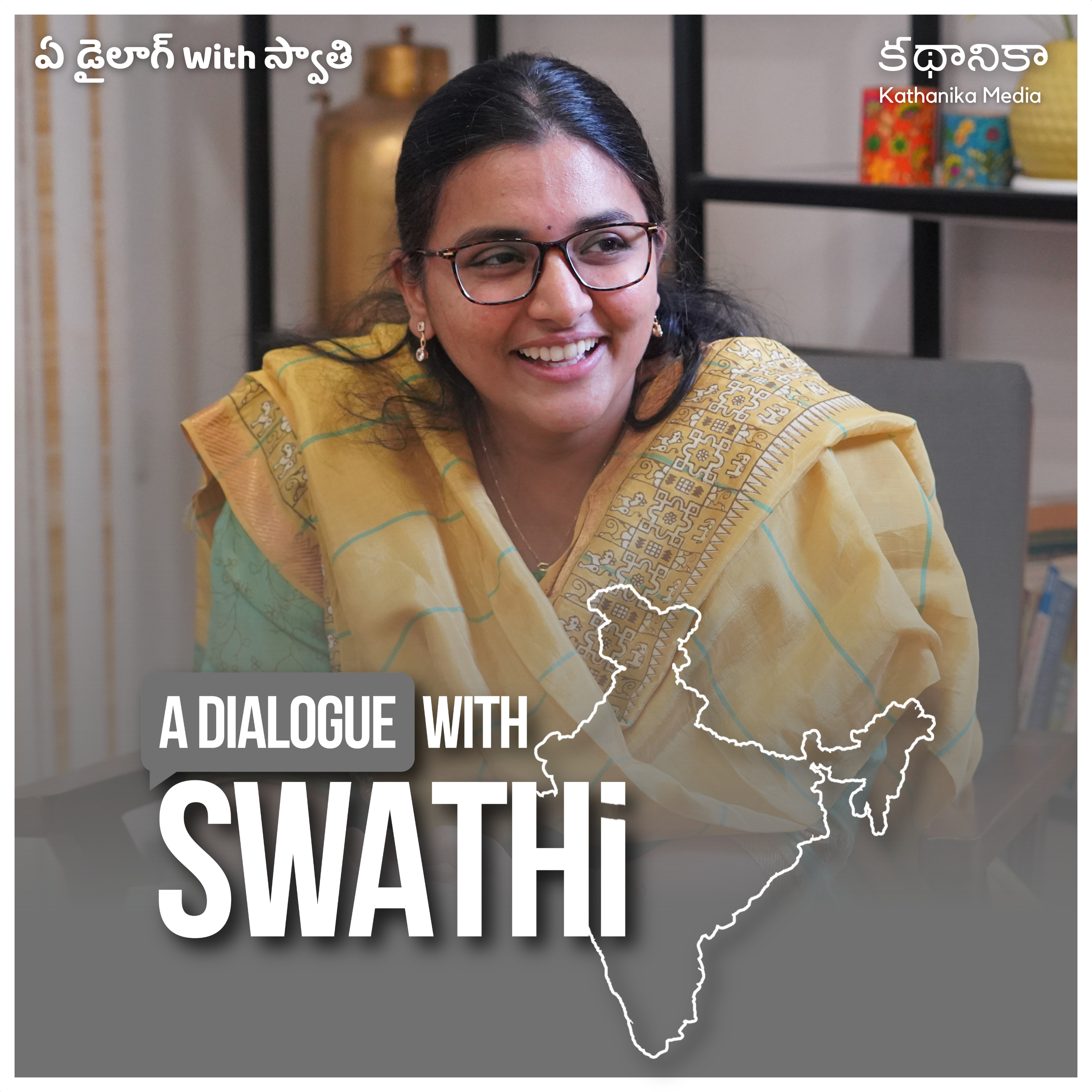
A Dialogue with Swathi
by Kathanika Media
'A Dialogue With Swathi' aims to bring a more reflective lens into India’s political discourse. Choosing dialogue over debate.
-
3
RSS rejects democracy? with Hari Gopal
Idea of India • Hindutva • RSS • Caste • Economy • Hindu Rashtra • Islam • DemocracyIs India a nation? A civilisation? A political experiment?Or a failed dream we are still trying to understand?In this long-form dialogue, Prof. G. Haragopal traces the evolution of the Idea of India — from Gandhi, Nehru and Ambedkar to liberalisation, Hindutva, and the rise of cultural nationalism.This is not a debate.It is a slow excavation.We discuss:• Was India ever politically one?• Why did Nehru choose democratic socialism?• Did the Constitution promise social revolution — or only legal order?• Did economic liberalisation change the moral structure of society?• Is religion being used to manage economic unrest?• What exactly is the RSS’s critique of democracy?• Can Hindu Rashtra move India backward?• Was Buddhism consciously erased?• Why does caste consciousness seem stronger today?• Is Modi a product of cultural revival — or neoliberal economics?• What kind of India do we want tomorrow?Timestamps 00:00 - Introduction: Rediscovering India02:11 -The Polarized Debate: India's Identity04:04 - Princely States & Diversity Before Unification07:49 - Gandhi vs. Nehru on Culture & Modernity13:30 - Social Inequality & The Freedom Movement16:42 -The State's Role in Social Transformation20:49 -The 1967 Crisis & Regional Movements28:26 -1991 Liberalization & Economic Shift31:50 - The Rise of Hindutva Politics43:26 - Analyzing RSS Ideology: Caste, Women & Constitution53:24 - Karma Theory vs. Structural Change56:06 - The Suppression of Buddhism in India58:39 - Hindu-Muslim Relations: Unity & Conflict01:05:37 - Addressing Historical Violence by Invaders01:17:28 - Is India Becoming Fascist?01:25:34 - Modi's Rise: Corporate Backing vs. Cultural Revival01:33:24 - India’s Global Image: Culture vs. Market Power01:44:00 - The Sanatana Dharma Debate01:52:32 - Vision for Future India: Egalitarianism01:57:38 - The Contradiction of Hindu Rashtra02:02:21 - Philosophical Hinduism vs. Political Hindutva02:08:28 - Savarkar, Gandhi, and the "Tolerance" Debate02:18:37 - Muslim Integration & Cultural Distinctiveness02:21:10 - Triple Talaq, UCC & Genuine Reform02:33:45 - Minority Rights vs. Appeasement02:41:15 - Conclusion: Diversity as StrengthFrom Manusmriti to Ambedkar.From Naxalbari to Gujarat.From caste census to Sanatana Dharma.From Gandhi’s assassination to the future of pluralism.Prof. Haragopal calls it a dream that was slowly abandoned — and whose consequences are now being harvested.This episode also reflects on:• Hinduism’s strengths and internal contradictions• The relationship between Islam and Indian democracy• The politics of patriotism• Universities and democratic backsliding• Media narratives and power• Economic inequality and national prideThis conversation examines foundations.Prof. G. Haragopal is a political thinker, civil liberties activist, and peace negotiator who has engaged both governments and Maoist groups in dialogue. His work spans questions of state power, social movements, caste, democracy, and constitutional morality.About the ChannelA Dialogue With Swathi exists to reclaim politics as a moral and intellectual pursuit.We use long-form dialogue to explore difficult political and civilisational questions — slowly and reflectively.If you believe democracy requires depth — you are in the right place.Join with us through our WhatsApp channel:https://whatsapp.com/channel/0029VbCU5Ry6BIEazkHZAI08You can always write to us at: [email protected]
-
2
What is Hinduism? with Kancha Ilaiah
Is it a religion, a civilisation, a social order, or a political identity?And who gets to define it?In this long-form dialogue, we speak with Kancha Ilaiah Shepherd, political scientist and Dalit–Bahujan intellectual, to examine Hinduism and the contemporary Hindu national project from a Dalit–Bahujan lens.This conversation asks deeper questions:* What does Hinduism look like when viewed from lived experience rather than scripture?* How is Hinduism prone to multiple attacks?* How should we understand Islam, Buddhism and Christianity, in comparison to Hinduism?- Can a caste-based social order claim moral equality?* How did the word “Hindu” come into use, and what did it originally mean?* How is Hindutva different from Hinduism?* What do Buddhism, Christianity, and Islam say about society, equality, and the nation?* And what political imagination is available for our current time?The dialogue moves across philosophy, history, religion, and politics, engaging figures such as Ambedkar, Gandhi, Savarkar, Phule, and key texts from Hindu, Buddhist, Christian, and Islamic traditions.This is an attempt to understand religion, politics, power, and some contemporary political debates in Indian society, and to examine how we can better inform the political discourse.We invite viewers to listen patiently, think critically, and engage respectfully. Timestamps - 00:00 Introduction01:35 Why talk about Hinduism today? Religion, Nation, and Power02:25 Defining the difference: Hinduism ≠ Hindutva 03:20 The three strands: Spiritual, Aggressive Nationalist, and Dalit–Bahujan 04:13 The unseen side of Hinduism: Kautilya and Manu 05:27 Analysis of Shanti Parva 06:12 Social order and control in the Arthashastra 09:49 Understanding Buddhism’s Dhamma 11:20 Understanding Hinduism’s Dharma 12:15 Why Dhamma and Dharma are not the same 12:45 Shudras and the absence of religion in the household 13:45 Exploring the core of Buddhism 14:10 Sri Krishna, the Yadava birth, and support for Kshatriya power 17:25 The absence of equality in Hinduism 18:46 Buddhism vs. Hinduism: The section card 20:10 Why Hyderabad is a BJP campaign center 20:35 The origins of the “Hindus are one” campaign 20:44 The impact of Mandal Reservations 20:55 Sharad, Lalu, and Mulayam: The Mandal protests 21:55 The Mandir–Masjid issue 23:15 Why I wrote ‘Why I Am Not a Hindu’ 24:03 Savarkar and the definition of Hindutva 24:05 Debate: Should Savarkar be part of the syllabus? 25:35 Why Gandhi used the word “Hindu” in Hind Swaraj 27:35 How Hindutva seeks to establish a Hindu dictatorship 28:23 Savarkar as a Macaulay-ite 30:05 Where did the name “Hind” come from? 30:20 Al-Biruni and the concept of Al-Hind 32:05 “Hind” as a geographic term 32:10 Raja Ram Mohan Roy and Vedic thought 32:20 – Gandhi’s view on Inclusiveness 32:45 Phule’s ‘Gulamgiri’ and the non-existence of Hinduism 36:00 Purusha Sukta and the heart of creation 37:31 Creation in the Bible vs. Creation in the Quran 40:27 Why the Quran does not allow democracy 42:10 Democracy in Buddhism: Tribal republics and the Sangha 44:14 The moment Buddha lost a vote on a women’s issue 48:40 The Brahmin lifestyle and the concept of menstruation as untouchability 50:20 Why only Brahmins truly call themselves Hindus 1:00:05 Ambedkar: Caste as graded inequality 1:01:18 Shudras and land rights under Muslim kings 1:04:12 Challenging the Vishwa Guru campaign in the US 1:07:35 The violent nature of Hindu gods 1:10:25 Why Hindu civilization declined after the Indus Valley 1:15:05 Different heavens for different castes 1:18:15 Why Sanatana Dharma is not a religion 1:27:05 Why Hindutva leads to military dictatorship 1:30:15 Varna Dharma and the cow as a goddess 1:43:07 Why Hinduism did not spread globally 1:55:36 How Muslim invaders occupied India easily 2:10:07 – The RSS project vs. the Pakistan project
-
1
Questions India Avoids | Dialogue with Swathi
Questions India Avoids is the opening episode of Dialogue with Swathi, a show focused on slow, thoughtful conversations about Indian politics, ideology, and identity.India is full of political opinions, arguments, and strong positions. Yet, there are important questions we rarely pause to ask. This episode begins an exploration of those unasked questions, moving beyond elections and party politics to examine the ideas that shape our public life.After over a decade of engagement with Indian politics, especially Telugu politics in Andhra Pradesh and Telangana, I realized that politics is not only about power or victory. It is deeply influenced by how we think about religion, caste, secularism, the Constitution, nationalism, and belonging.Dialogue with Swathi is not a debate and not an attempt to offer final answers. It is an invitation to reflect, listen, and engage in meaningful dialogue.If you believe India needs deeper questions and calmer conversations, you are welcome to join this journey. First episode coming soon. Social media links Host : instagram.com/swathi gls Crafted by : instagram.com/ Kathanikamedia
We're indexing this podcast's transcripts for the first time — this can take a minute or two. We'll show results as soon as they're ready.
No matches for "" in this podcast's transcripts.
No topics indexed yet for this podcast.
Loading reviews...
Loading similar podcasts...
Frequently Asked Questions
How many episodes does A Dialogue with Swathi have?
A Dialogue with Swathi currently has 3 episodes available on PodParley. New episodes are automatically indexed when they're published to the podcast feed.
What is A Dialogue with Swathi about?
'A Dialogue With Swathi' aims to bring a more reflective lens into India’s political discourse. Choosing dialogue over debate.
How often does A Dialogue with Swathi release new episodes?
A Dialogue with Swathi has 3 episodes. Check the episode list to see recent publication dates and frequency.
Where can I listen to A Dialogue with Swathi?
You can listen to A Dialogue with Swathi on PodParley by clicking any episode. We provide an embedded audio player for direct listening, and you can also subscribe via your preferred podcast app using the RSS feed.
Who hosts A Dialogue with Swathi?
A Dialogue with Swathi is created and hosted by Kathanika Media.
URL copied to clipboard!