
PODCAST · society
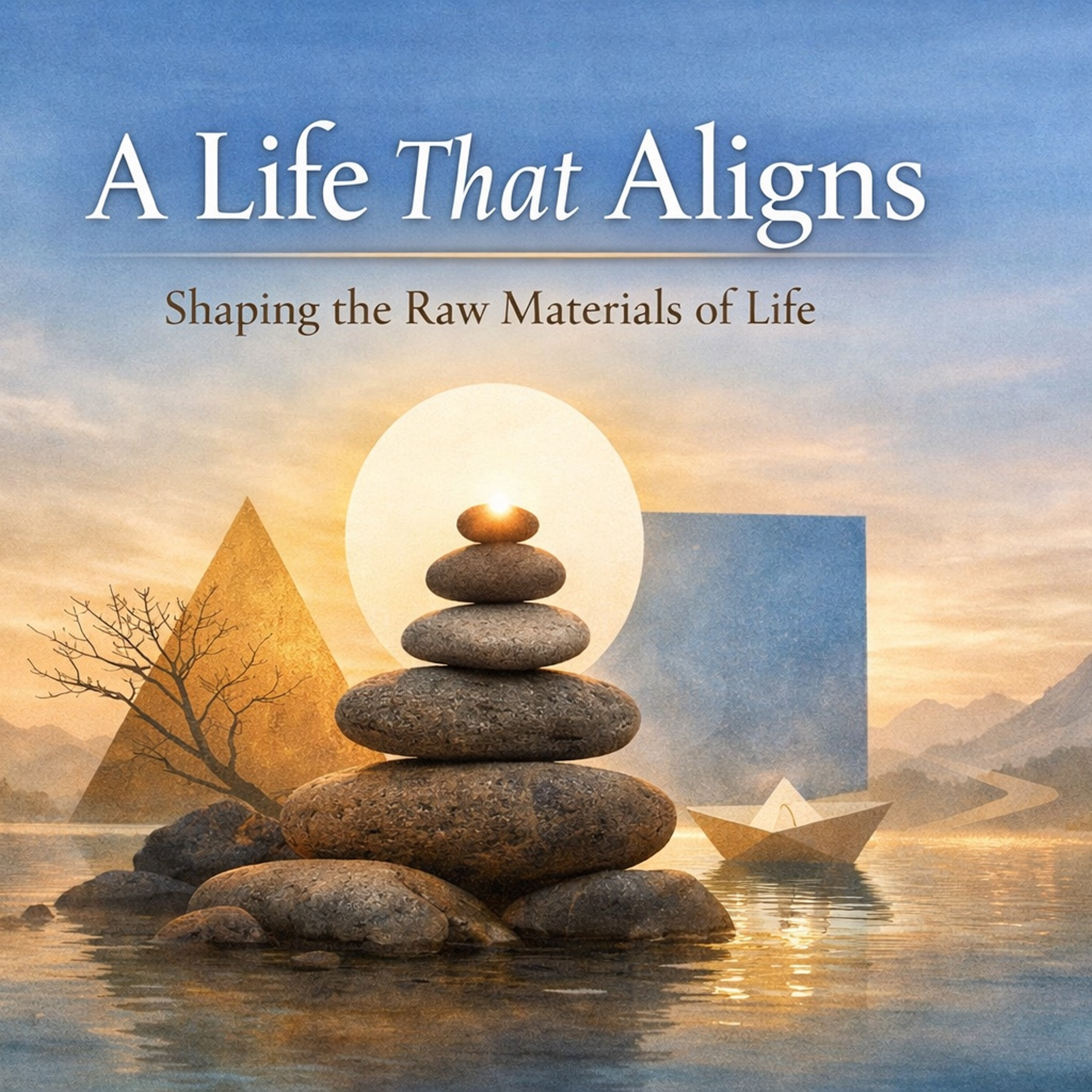
A Life That Aligns: Shaping the Raw Materials of Life
by Only Life After All
What a well-lived life is aiming at? How a mind carries the weight of life? What principles help orient that life?
-
15
Chapter 14. Closing Reflection: Shaping the Raw Materials of Life
Every life begins with the same basic materials.Joy and suffering.Time and work.Love and loss.These elements arrive whether we invite them or not. They are not distributed evenly, and they rarely appear in the order we expect. Some seasons bring abundance and ease. Others bring difficulty that tests the strength of everything we thought we understood.In this sense, life resembles a craft more than a plan.The materials are given.What varies is what we make from them.
-
14
Chapter 13. The Quiet Side Effects of Alignment
Much of modern life encourages the pursuit of emotional states.People search for happiness.They strive for fulfillment.They try to cultivate joy.Entire industries promise techniques for achieving these experiences more consistently.But many of the qualities people most desire in life do not respond well to direct pursuit.They tend to appear indirectly.
-
13
Chapter 12. Enough in Time, Energy, and Attention
If money is a resource, time is a condition of existence.Every person receives roughly the same daily allotment—twenty-four hours. Yet the experience of time varies dramatically from one life to another.Some lives feel hurried and fragmented, as if time is constantly slipping away. Others feel spacious and inhabited, even when the hours are full.The difference rarely lies in the number of commitments alone.It lies in the relationship between time, energy, and attention.
-
12
Chapter 11. Enough in Money
Money occupies a curious place in human life.It is not the ultimate goal of living. Yet it powerfully influences the conditions under which a life unfolds.With too little money, daily existence becomes dominated by insecurity. Basic needs—shelter, health, stability—demand constant attention. The mind has little space left for reflection, creativity, or long-term thinking.With sufficient money, something different becomes possible. Certain pressures ease. Choices widen. Time and attention can be directed toward things that matter beyond immediate survival.In this sense, money functions less as a measure of life and more as an enabling condition for living well.
-
11
Chapter 10. Enough in Relationships
Human life is deeply relational.No matter how independent a person becomes, much of the meaning and texture of life emerges through relationships—with partners, family, friends, colleagues, and communities.Yet relationships are also one of the places where the pursuit of “more” most easily creates dissatisfaction.People compare their relationships to idealized images of connection: perfect compatibility, endless excitement, complete emotional understanding.Real relationships rarely resemble those images.They involve misunderstandings, compromises, changing needs, and the ordinary frictions of life lived together.A wise life therefore requires learning what “enough” looks like in relationships.
-
10
Chapter 9. Capacity
Every life must be carried by a mind.And like any system, the mind has limits.It can focus on only so many things at once.It can absorb only so much stress.It can sustain only a certain level of complexity before fatigue begins to appear.Yet modern life often encourages the opposite assumption—that more is always better. More commitments, more information, more goals, more stimulation.The result is that many people live at a pace where the demands placed upon the mind continually exceed what it can comfortably hold.When that happens, the symptoms appear quickly.Attention becomes scattered.Decisions feel exhausting.Irritation and anxiety rise.Even small problems begin to feel overwhelming.The common interpretation is that something is wrong with the person.But often the real issue is structural.The system is simply overloaded.
-
9
Chapter 8. Identity
If attention determines what we notice about the world, identity determines what we believe about ourselves.Identity is the quiet answer each person carries to a simple but powerful question:Who am I?The answer rarely appears as a clear sentence in the mind. Instead, it lives as a set of assumptions about what we are capable of, what roles we belong in, and what kind of life feels possible.These assumptions form an invisible boundary.Inside that boundary, action feels natural. Outside it, even obvious opportunities can feel strangely inaccessible.
-
8
Chapter 7. Attention
Every life is built from the same basic material.Not money.Not time.Not opportunity.The most fundamental material of a life is attention.Attention determines what we notice, what we think about, and ultimately what kind of world we experience.
-
7
Chapter 6. Meaning
If enough gives a life orientation, and values provide direction, meaning answers a deeper question:Why does any of it matter?Human beings are unusual in this regard.Other creatures live, strive, reproduce, and die without needing a philosophical justification for their existence. But humans possess a peculiar awareness. We know that life is finite. We know that time is limited. And we know that the choices we make shape the small portion of existence we inhabit.That awareness inevitably raises a question:What makes a life meaningful?For centuries people have tried to answer it in different ways.
-
6
Chapter 5. Values
If the question of “enough” gives a life orientation, values give it direction.They answer a quieter but equally important question:What matters enough to guide my choices?Every life is shaped by decisions.Some are dramatic turning points. Most are small and ordinary: what work to pursue, how to spend time, what relationships to invest in, what compromises to accept, what lines not to cross.But beneath these countless decisions lies something deeper.A set of priorities—often implicit—that determine how trade-offs are resolved.These priorities are what we call values.
-
5
Chapter 4. Enough
Every life eventually confronts the same quiet question:How much is enough?Enough money.Enough success.Enough recognition.Enough security.At first, the question seems simple. Most people assume the answer lies somewhere beyond where they currently stand. Just a little more income, a little more progress, a little more safety—and the feeling of sufficiency will arrive.But something strange tends to happen.The horizon moves.
-
4
Chapter 3. The Ultimate Target
If you ask people what they want from life, the answers vary endlessly.Some speak of happiness.Others of success.Others of love, freedom, impact, security, or fulfillment.The words change.The surface goals differ.But beneath the variety, something quieter is happening.Most people are not actually chasing a hundred different things.They are trying—often without realizing it—to construct a life that fits.
-
3
Chapter 2. The Three Tensions Every Life Must Hold
Once we recognize the materials of life, another pattern begins to appear.Life rarely pulls in only one direction.More often it pulls in two directions at the same time.
-
2
Chapter 1. The Raw Materials We Are Given
Every life begins with materials already on the table.We do not choose them.They simply appear as the conditions within which our lives unfold.
-
1
0. Preface & Opening Reflection
Over time, certain questions return again and again in a person’s life.Not necessarily dramatic questions, and not always philosophical ones. Often they appear quietly, in moments of reflection after a long day, or during conversations with people we care about.Questions such as:What kind of life am I trying to build?What does it mean to live well?What is actually enough?And how should I spend the limited time and attention I have been given?
No matches for "" in this podcast's transcripts.
No topics indexed yet for this podcast.
Loading reviews...
Loading similar podcasts...
URL copied to clipboard!