
PODCAST · education
AAC Access All Areas
by Ali Battye and Ruth Jones
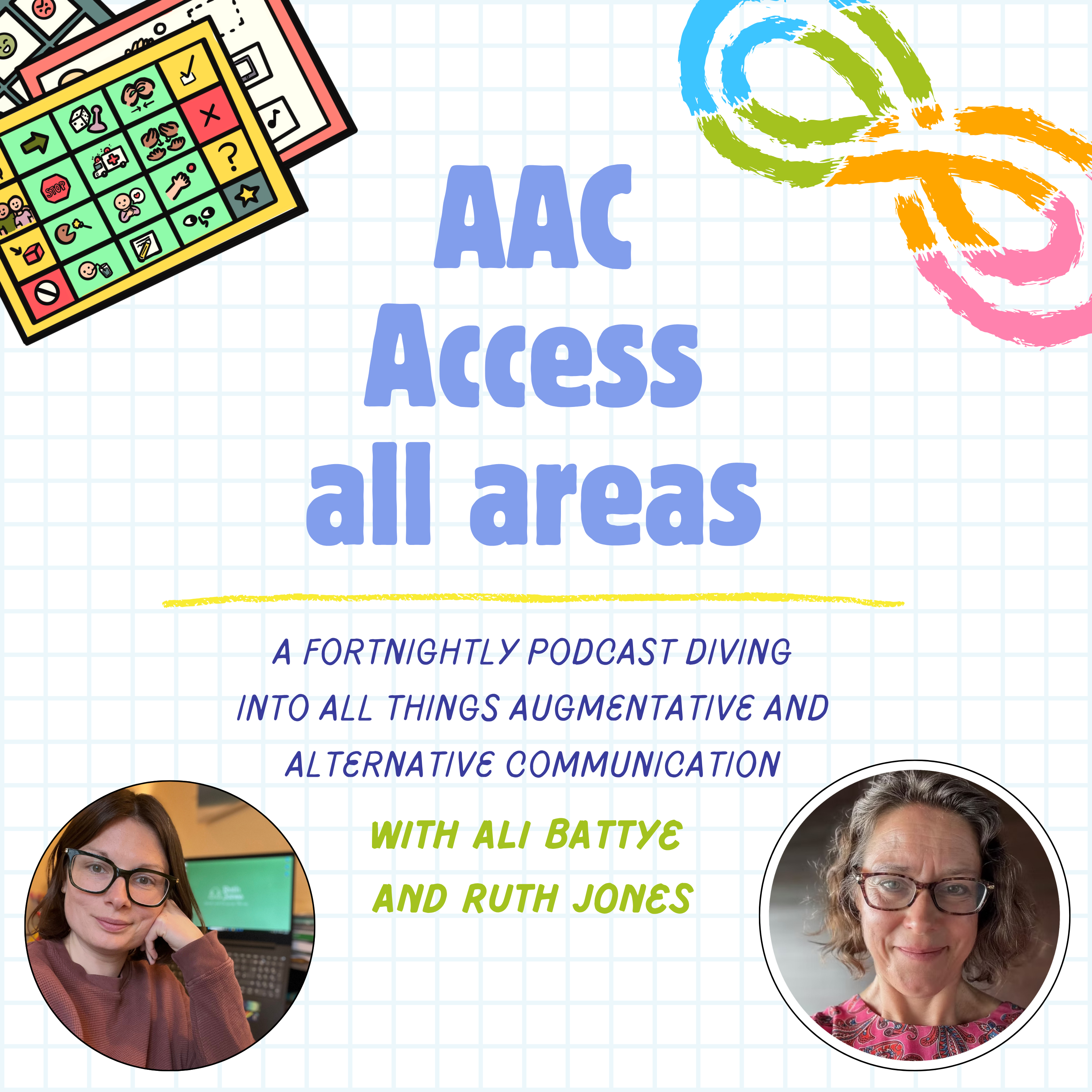
Ali Battye and Ruth Jones discuss all things neurodiversity affirming and augmentative and alternative communication (AAC). We explore specific questions about what AAC is, where to get it, how to use it. Sharing knowledge and experience along the way to support individuals, families and support teams across education, health and social care to integrate inclusive communication practices to enable AAC users.Got a question? Send it in and we will focus an episode on it to answer!
-
12
What are the reasons for communication?
This episode explores the diverse reasons for communication beyond requesting, emphasizing the importance of connection, joy, and meaningful interaction in AAC and speech therapy. Ruth and Ali discuss models, misconceptions, and real-life examples to deepen understanding and practice.The means, reasons and opportunities model of communication - Resource Library - Sheffield Children's NHS Foundation TrustFind us on Instagram:@ali_battye_speech@ruth_jones_slt
-
11
How do I set up AAC for a Gestalt Processor?
This episode explores Gestalt language processing in children, how it influences AAC setup, and practical strategies for supporting language development. Hosted by Ali Battye and Ruth Jones, it offers insights into tailoring AAC systems to meet the unique needs of Gestalt language processors.Find us on Instagram:Ali - @ali_battye_speechRuth - @ruth_jones_slt
-
10
What language should I add to an AAC tool?
This episode explores the essential aspects of AAC language, including robust vocabulary, core and fringe words, and effective communication strategies. Hosts Ruth and Ali discuss how to optimize AAC systems for speed, personalization, and meaningful interaction, emphasizing the importance of tuning into individual needs and preferences.Key topics:Robust vocabulary and its importanceCore words and their universal role in AACFringe words and personalizationStrategies for efficient AAC communicationThe role of phrase-based language and shortcutsObserving and tuning into individual communication needsRuth's Instagram: https://www.instagram.com/ruth_jones_slt/Ali's Instagram: https://www.instagram.com/ali_battye_speech/
-
9
I've Got the Device and App - What Now?
SummaryThis episode explores the practical aspects of choosing, setting up, and personalizing AAC apps like Proloquo and TD Snap. Ruth and Ali discuss how to optimize vocabulary, app settings, and voice options to support meaningful communication for children with AAC needs.Key TopicsDifferences between Proloquo and Proloquo2GoGrid size and vocabulary customizationUsing crescendo to gradually increase complexitySymbol vs photograph for personalizationVoice selection and customization in AAC appsImportance of respecting app design and structurePersonalizing vocabulary based on child's interestsMonitoring and adjusting app settings over time
-
8
Where can I get an AAC device?
In this episode, Ruth and Ali discuss the various avenues for obtaining AAC devices, particularly for families who may not qualify for specialized services. They explore the importance of accessibility, the practical setup of AAC devices, and the role of communication in supporting AAC users. The conversation highlights the significance of protective measures for devices, funding options, and the supportive roles of educators and families in fostering effective communication for AAC users.TakeawaysMany families struggle to access AAC services due to eligibility issues.Standard tablets can be used for AAC by those without complex needs.Purchasing devices and apps directly is a common route for families.iPads are often recommended due to their robust app ecosystem.Insurance and protective cases are essential for AAC devices.Refurbished devices can be a cost-effective option for families.Grants and charities can help fund AAC devices for those in need.Schools can play a crucial role in supporting AAC users.Communication needs should be honored and supported in educational settings.Building connections is key to effective communication for AAC users.Ruth's Instagram: ruth_jones_sltAli's Instagram: ali_battye_speech
-
7
What AAC Apps are there?
The conversation covers the top AAC apps in England, including Proloquo2Go, Proloquo, and Grid for iPad. It also delves into the comparison of AAC apps, symbol sets, vocabulary personalization, robust vocabulary, language growth, considerations for choosing AAC apps, app pricing, free options, visual appearance, app functionality, editing and personalization of vocabulary, and professional reflection on AAC experience.TakeawaysTop AAC apps in EnglandConsiderations for choosing AAC appsGet started with Grid for iPad - Smartbox AACProloquo2Go - AAC app with symbols - AssistiveWareTD Snap Core First Page Set - Tobii Dynavox UKRuth's Instagram: ruth_jones_sltAli's Instagram: ali_battye_speech
-
6
Who is AAC for?
In this episode, Ruth and Ali explore the evolving landscape of Augmentative and Alternative Communication (AAC) and its significance for various users, particularly children with complex communication needs. They discuss the importance of presuming potential in AAC users, the role of AAC as a communication tool, and the challenges and misconceptions surrounding its use. The conversation emphasizes the need for universal design in communication environments and celebrates real-life success stories of AAC implementation, highlighting the transformative impact of AAC on users' communication abilities.TakeawaysAAC has broadened to include a wider range of users.Presuming potential is essential for effective AAC use.AAC can serve as a dictionary or thesaurus for users.Children with complex needs can still have language in their heads.AAC should be integrated into everyday communication practices.The perception of AAC as a last resort is changing.Universal design in classrooms can enhance AAC accessibility.Children may need time to adapt to AAC tools.Success stories highlight the effectiveness of AAC in communication.AAC can support children with situational mutism and developmental language disorders.Ruth's Instagram: ruth_jones_sltAli's Instagram: ali_battye_speech
-
5
AAC What Factors to Consider?
In this episode, Ruth Jones and Ali Battye discuss the critical considerations when choosing Augmentative and Alternative Communication (AAC) systems. They explore various factors such as feature matching, editability, and the importance of cultural representation in AAC symbols. The conversation also delves into the practical aspects of AAC technology, comparing iPads to dedicated devices, and emphasizes the need for support from app developers. The episode concludes with reflections on the evolving nature of AAC technology and the importance of ensuring that AAC systems are accessible and representative for all users.TakeawaysChoosing AAC involves multiple stakeholders and considerations.Feature matching helps identify the best AAC solutions.Editability of vocabulary is crucial for effective communication.iPads can be a cost-effective alternative to dedicated AAC devices.Portability and durability are key factors in device selection.Cultural representation in AAC symbols enhances user experience.AAC technology is evolving, requiring ongoing adaptation.Support from app developers is essential for users.Vocabulary must grow and adapt as users age.Diversity in symbols is still an area needing improvement.Ruth's Instagram: ruth_jones_sltAli's Instagram: ali_battye_speech
-
4
Who Decides on AAC?
In this episode, Ali Battye and Ruth Jones discuss the complexities surrounding who decides which Augmentative and Alternative Communication (AAC) tools to use. They explore the hub and spoke model of AAC assessment, the challenges faced by families in accessing AAC, and the role of speech and language therapists. The conversation also addresses common myths about AAC, the importance of parental involvement, and the need for effective communication partners in the AAC journey.TakeawaysThe hub and spoke model of AAC assessment was established around 2015.Access to high-tech AAC has historically been unequal.Paper-based AAC tools are easier to access but may lack quality.Speech and language therapists often feel unprepared to work with AAC.Parents should not feel they need permission to introduce AAC to their child.There are myths surrounding AAC that can hinder its use.The choice of AAC tool should be individualized based on the user's needs.Communication partners play a vital role in the success of AAC.Training and resources for AAC can vary significantly across regions.Parental involvement is crucial in the decision-making process for AAC.Ruth's Instagram: ruth_jones_sltAli's Instagram: ali_battye_speech
-
3
Types of AAC
In this episode of AAC Access All Areas, Ruth and Ali discuss the various types of Augmentative and Alternative Communication (AAC) systems, their evolution in practice, and the importance of providing diverse language access for children with communication needs.They explore the shift from traditional paper-based systems to more modern, technology-driven solutions like iPads, emphasizing the need for individualized approaches based on each child's unique preferences and needs.The conversation highlights the significance of modeling language, the importance of patience in the AAC learning process, and the various tools available to support effective communication.Ruth's Instagram: ruth_jones_sltAli's Instagram: ali_battye_speech
-
2
What is AAC?
Ali and Ruth discuss what augmentative and alternative communication is. Diving into what it stands for and what kinds of things we might think about when we hear the term AAC.We explore AAC and how it enriches the lives of those who communicate differently.💡 Key Insight: Effective communication is about understanding and connecting with one another, no matter the method!Ali's AAC Book: Who's Afraid of AAC?: The UK Guide to Augmentative and Alternative ComRuth's Instagram: ruth_jones_sltAli's Instagram: ali_battye_speech
-
1
AAC Access All Areas Trailer
A brief introduction from Ali and Ruth on who they are and what the podcast hopes to deliver to listeners.
We're indexing this podcast's transcripts for the first time — this can take a minute or two. We'll show results as soon as they're ready.
No matches for "" in this podcast's transcripts.
No topics indexed yet for this podcast.
Loading reviews...
ABOUT THIS SHOW
Ali Battye and Ruth Jones discuss all things neurodiversity affirming and augmentative and alternative communication (AAC). We explore specific questions about what AAC is, where to get it, how to use it. Sharing knowledge and experience along the way to support individuals, families and support teams across education, health and social care to integrate inclusive communication practices to enable AAC users.Got a question? Send it in and we will focus an episode on it to answer!
HOSTED BY
Ali Battye and Ruth Jones
Loading similar podcasts...
URL copied to clipboard!