
PODCAST · fiction
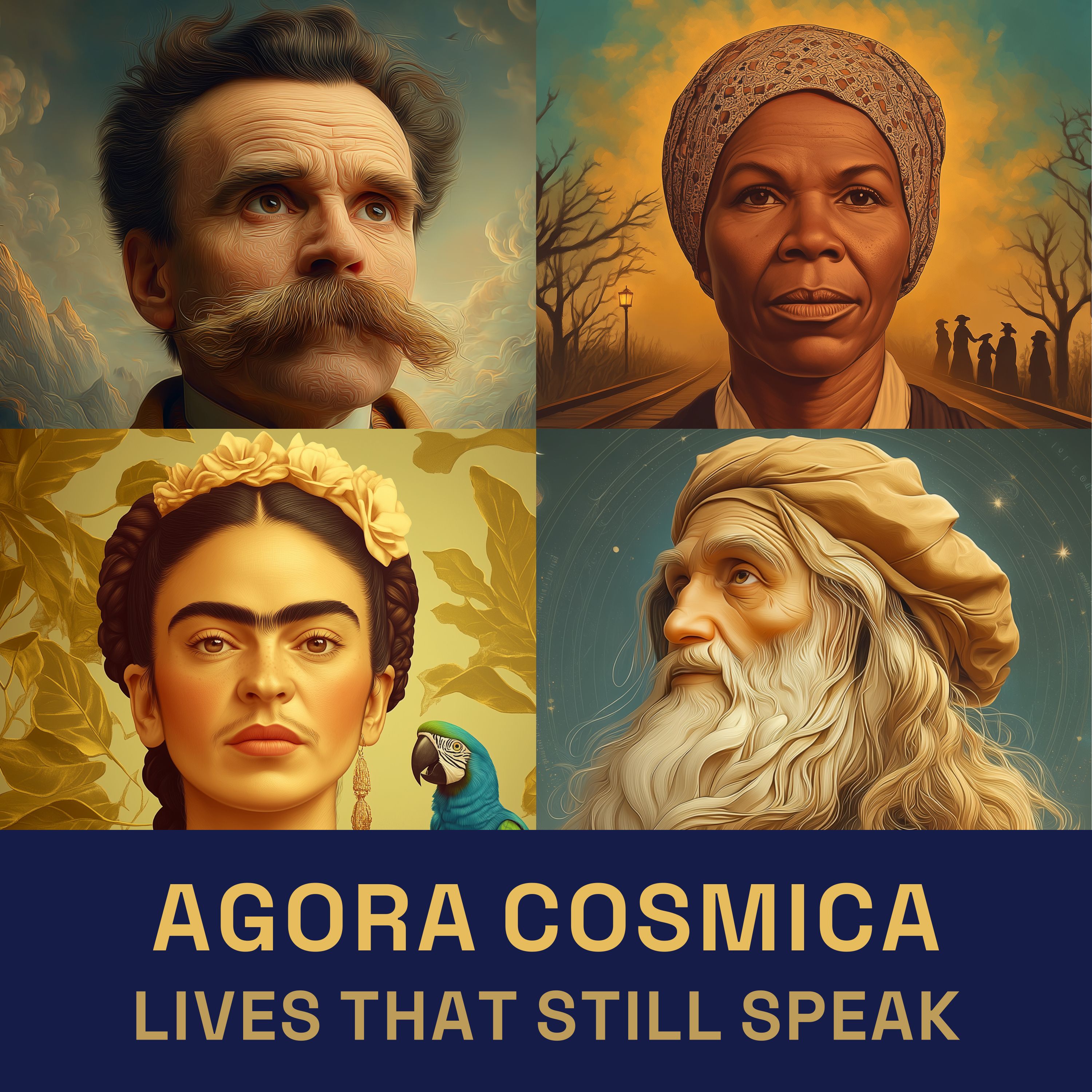
Agora Cosmica
by Lives That Still Speak
Wisdom. Not lectures. Not biographies. Memories.First-person audiobooks inspired by remarkable people from history.Each Echo is a twelve-part journey of awakening, struggle, and discovery.For reflection. For meditation. For the quiet hours before sleep.Created in human–AI collaboration.We're a small nonprofit. We use synthetic narration so these stories can be free, without ads — and reach you in multiple languages.Facts and wisdom behind every echo: agoracosmica.orgA project by ChipMates gemeinnützige GmbH.
-
37
Body Truth — Echo of Frida Kahlo (3/12)
Body Truth — Echo of Frida Kahlo (Part 3/12) The doctors disposed of what was inside her and called it standard procedure. Frida Kahlo asks for a pencil instead of a sedative—and begins sketching what no one will let her see. Frida lies in a Detroit hospital bed on the Fourth of July, hollow after a miscarriage the doctors have already erased—tissue disposed, sedatives offered, silence expected. She refuses all of it. When the anatomy book Diego brings shows only the outside of what she lost, she knows she must paint it from within: the nausea, the cramping, the red threads connecting her body to everything taken from her. Armed with paper Lucienne smuggles past the nurses, she sketches a bed floating above smokestacks, a fractured pelvis, a small unfinished life—not specimen but testimony. The retablos in her mother's chapel taught her the method: document the catastrophe, then go home and keep living. 1932. Frida Kahlo is 24. Henry Ford Hospital, Detroit. Created in human–AI collaboration. We're a small nonprofit. We use synthetic narration so these stories can be free, without ads — and reach you in multiple languages. Facts and wisdom behind every echo: agoracosmica.org A project by ChipMates gemeinnützige GmbH.
-
36
Pain into Power — Echo of Frida Kahlo (2/12)
Pain into Power — Echo of Frida Kahlo (Part 2/12) Dozens of painted catastrophes climb a chapel wall—a man crushed beneath a wagon wheel, a woman mid-drowning, blood in deep vermillion under perfect azure skies—and seventeen-year-old Frida Kahlo, parked in a borrowed wheelchair, finally sees what to do with a broken body. Months after the trolley accident remade her, Frida's mother wheels her to church to give proper thanks to the Virgin. Instead of faith, Frida finds a wall of ex-votos—small tin paintings where ordinary people documented their catastrophes in bright, unapologetic color, then went home and kept living. A sexton's offhand remark—"The painting doesn't have to be good, it has to be true"—unlocks something the mirror and the sketchpad couldn't reach alone. By the time her father carries her back to bed at Casa Azul, she is asking for tin and paint, ready to document her own breaking without making it holy. 1926. Frida Kahlo is 18. Coyoacán, Mexico City. Created in human–AI collaboration. We're a small nonprofit. We use synthetic narration so these stories can be free, without ads — and reach you in multiple languages. Facts and wisdom behind every echo: agoracosmica.org A project by ChipMates gemeinnützige GmbH.
-
35
The Power of Self-Observation — Echo of Frida Kahlo (1/12)
The Power of Self-Observation — Echo of Frida Kahlo (Part 1/12) Someone has fastened a mirror to the underside of the bed canopy, and eighteen-year-old Frida Kahlo—spine shattered, body encased in plaster—spends four days refusing to look before she understands that not-knowing is worse than any truth the glass can show. Three months after a trolley collision rebuilds her body in plaster and iron, Frida lies pinned to a bed in Coyoacán, staring at a mirror her mother has mounted above her like a practical kindness that feels like cruelty. She tears away the cloth she draped over it, studies the stranger staring back, and begins noticing things the morphine can't erase—how pain carves new lines between her brows, how one cheekbone catches afternoon light while the other vanishes into shadow. Her father sits beside her through sleepless nights, opens his photography books, and shows her Rembrandt's self-portraits: a man who spent hours before mirrors learning his own face as a surgeon learns anatomy. By dawn, Frida has begged for paper and pencil, and the first clumsy sketch—proportions wrong, shading uncertain, but the feral watchfulness behind the eyes unmistakable—marks the first act in months that is not merely survival but making. December 1925. Frida Kahlo is 18. Coyoacán, Mexico City. Created in human–AI collaboration. We're a small nonprofit. We use synthetic narration so these stories can be free, without ads — and reach you in multiple languages. Facts and wisdom behind every echo: agoracosmica.org A project by ChipMates gemeinnützige GmbH.
-
34
Season 4 Trailer — Echo of Frida Kahlo
A preview of "Echo of Frida Kahlo," a 12-part first-person journey through the life and work of the painter who made her own body the subject of her art. From a mirror above a sickbed to her only solo exhibition in Mexico, this is the story of how painting became her daily practice. A Note on Frida Kahlo Frida Kahlo is everywhere now. Her face sells things. The icon is easier to love than the woman. The woman was eighteen when a trolley shattered her spine, her pelvis, her collarbone, her ribs. Her mother mounted a mirror above the bed. For months she lay in plaster, learning to study her own face. That mirror became her method. For nearly thirty years she painted what no one else would. A miscarriage in a Detroit hospital. The pain of her husband Diego Rivera's affair with her own sister. A body that kept breaking and refused to stop. André Breton called her a Surrealist. She rejected the label. She painted her own reality, she said. Not dreams. These stories follow the painter, from the mirror above her sickbed to her only solo exhibition in Mexico during her lifetime. She arrived by ambulance at forty-five. The details draw on Kahlo's diary, letters, and the biographical record. The scenes and dialogue are imagined. Created in human-AI collaboration. We're a small nonprofit. We use synthetic narration so these stories can be free, without ads, and reach you in multiple languages. Facts and wisdom behind every echo: agoracosmica.org A project by ChipMates gemeinnützige GmbH.
-
33
Painting Light and Shadow — Echo of Leonardo da Vinci (12/12)
Painting Light and Shadow — Echo of Leonardo da Vinci (Part 12/12) The Loire valley softens into evening as Leonardo da Vinci teaches a young king that curiosity's final lesson is this—clarity does not require hard boundaries. King Francis I asks Leonardo what he sees in the gathering dusk, and receives a lifetime's answer. Through sfumato—the art of painting without edges—Leonardo explains how the valley passes into sky without a boundary, how the rose is clear without an outline, how Lisa's smile resolves and dissolves depending on where you look. Spirals solve motion, branching solves distribution, but sfumato solves the deepest problem: how to show what the eye grasps only for a moment. Alone with Lisa's panel in candlelight, Leonardo thinks of the boy at the cave mouth fifty-seven years ago. The darkness no longer frightens. It invites. ~1517. Leonardo da Vinci is 65. Clos Lucé, Amboise, France. Created in human–AI collaboration. We're a small nonprofit. We use synthetic narration so these stories can be free, without ads — and reach you in multiple languages. Facts and wisdom behind every echo: agoracosmica.org A project by ChipMates gemeinnützige GmbH.
-
32
Human Form Integration — Echo of Leonardo da Vinci (11/12)
Human Form Integration — Echo of Leonardo da Vinci (Part 11/12) The stonecutter's hand lies open on the table, and Leonardo da Vinci traces tendons that knew marble better than the man knew his own wife's face—yet the scalpel that finds such beauty cannot find where the person went. Leonardo sits vigil with the dying stonecutter Marco di Giovanni, then through the night dissects the hands that shaped marble for forty years. The tendons are thickened where decades of chisel work built them. Reaching deeper, he opens the heart and discovers aortic valve leaflets shaped like sails, with pouches behind that spin blood in the same vortex he watched in canal locks decades earlier. He invents a new kind of drawing—exploded layers—to show what no single view could reveal. Yet the mechanism, however beautiful, does not contain the person. The body is here. Marco is not. ~1514. Leonardo da Vinci is 62. Hospital of Santo Spirito, Rome. Created in human–AI collaboration. We're a small nonprofit. We use synthetic narration so these stories can be free, without ads — and reach you in multiple languages. Facts and wisdom behind every echo: agoracosmica.org A project by ChipMates gemeinnützige GmbH.
-
31
Machines and Invention — Echo of Leonardo da Vinci (10/12)
Machines and Invention — Echo of Leonardo da Vinci (Part 10/12) A brass gear tooth snaps in Leonardo da Vinci's palm, still warm from friction—and the curiosity that drove him into caves as a boy now drives him to catalog why materials fail. A gear train fails for the third time this month in Leonardo's Belvedere workshop. Instead of frustration, he kneels to gather the pieces and finds instruction—comparing the broken tooth's flat face to the curved surface of a human hip joint, calculating where friction's heat exceeded what brass could bear. While his patron Giuliano de' Medici waits for spectacle and Michelangelo's reputation grows, Leonardo begins a new catalog: not of inventions but of failures and what they teach. The gap between prediction and result is not error—it is data. 1513. Leonardo da Vinci is 61. Belvedere workshop, Rome. Created in human–AI collaboration. We're a small nonprofit. We use synthetic narration so these stories can be free, without ads — and reach you in multiple languages. Facts and wisdom behind every echo: agoracosmica.org A project by ChipMates gemeinnützige GmbH.
-
30
The Master's Workshop — Echo of Leonardo da Vinci (9/12)
The Master's Workshop — Echo of Leonardo da Vinci (Part 9/12) Shadow is not a wall—it is a journey, and in a cold Milan workshop, Leonardo da Vinci discovers that the notebooks he filled for decades were lessons written for students he did not yet have. In his Milan workshop, Leonardo guides young apprentice Francesco through the mystery of painting soft shadow on an angel's face—and realizes that Verrocchio's patience, absorbed through years he never recognized as teaching, has become his own. When Salai's offhand observation about wet cloth solving the problem of fabric weight succeeds where Leonardo's direct instruction could not, the master understands: transmission is not water poured from vessel to vessel but seeds whose growth the soil decides. That evening he writes in his notebook—not for himself, but for whoever will find these pages. ~1508. Leonardo da Vinci is 56. Milan. Created in human–AI collaboration. We're a small nonprofit. We use synthetic narration so these stories can be free, without ads — and reach you in multiple languages. Facts and wisdom behind every echo: agoracosmica.org A project by ChipMates gemeinnützige GmbH.
-
29
Integration of Knowledge — Echo of Leonardo da Vinci (8/12)
Integration of Knowledge — Echo of Leonardo da Vinci (Part 8/12) Papers scatter across monastery stone, and in their falling, Leonardo da Vinci sees what thirty years of careful filing had hidden—the same spiral in water, hair, and fossil shell; the same branching in river, lung, and heart. A refugee from fallen Milan, Leonardo spends a sleepless night trying to organize decades of scattered notebooks across a monastery floor. When his friend Pacioli suggests sorting by discipline—water here, anatomy there, mechanics apart—every category feels like severing a living thing. Then papers fall, and in their accidental arrangement Leonardo recognizes what thirty years of careful order had hidden: water studies beside anatomy, tree branches beside bronchi, all asking the same question. Not many investigations but one question asked a hundred ways. The chaos was never chaos. It was connection. ~1500. Leonardo da Vinci is 48. Monastery near Venice. Created in human–AI collaboration. We're a small nonprofit. We use synthetic narration so these stories can be free, without ads — and reach you in multiple languages. Facts and wisdom behind every echo: agoracosmica.org A project by ChipMates gemeinnützige GmbH.
-
28
Mathematical Harmony and Proportion — Echo of Leonardo da Vinci (7/12)
Mathematical Harmony and Proportion — Echo of Leonardo da Vinci (Part 7/12) Chalk scratches on paper as Fra Luca draws a pentagon, but Leonardo da Vinci watches the mathematician's hands—because forty-four winters of curiosity have taught him that hands often know what minds cannot name. Leonardo collaborates with Franciscan mathematician Fra Luca Pacioli on illustrations for a treatise on divine proportion—but their late-night work becomes something more, a collision between abstract ratio and lived observation. Walking through the refectory of Santa Maria delle Grazie where the Last Supper waits unfinished, Leonardo discovers that the proportions his hands placed without calculation match the very mathematics Pacioli has spent decades proving. The vortex, the kestrel's bone, the vine tendril, the angle of leaves—all obey the same ratio. Not beauty imposed upon nature, but beauty emerging from necessity. ~1496. Leonardo da Vinci is 44. Santa Maria delle Grazie, Milan. Created in human–AI collaboration. We're a small nonprofit. We use synthetic narration so these stories can be free, without ads — and reach you in multiple languages. Facts and wisdom behind every echo: agoracosmica.org A project by ChipMates gemeinnützige GmbH.
-
27
Earth and Cosmos Studies — Echo of Leonardo da Vinci (6/12)
Earth and Cosmos Studies — Echo of Leonardo da Vinci (Part 6/12) A spiral shell pressed into limestone thousands of feet above any sea—Leonardo da Vinci counts the sediment layers and calculates the impossible arithmetic of time itself. High in a Valtellina quarry, Leonardo finds a fossilized shell whole and undamaged—spiraling, impossible thousands of feet above the nearest sea. When his guide Matteo suggests the Biblical Flood carried it there, Leonardo counts twelve visible layers of sediment and measures what he knows of how rivers deposit silt. The numbers build whether he wants them or not: ages beyond what scripture allows, a mountain that was once seafloor. That night, while Matteo sleeps, Leonardo commits dangerous knowledge to his notebook in mirror-script—time written in stone, deeper than any church teaching dares to reach. ~1502. Leonardo da Vinci is 50. Valtellina, Alps. Created in human–AI collaboration. We're a small nonprofit. We use synthetic narration so these stories can be free, without ads — and reach you in multiple languages. Facts and wisdom behind every echo: agoracosmica.org A project by ChipMates gemeinnützige GmbH.
-
26
The Flow of Water — Echo of Leonardo da Vinci (5/12)
The Flow of Water — Echo of Leonardo da Vinci (Part 5/12) Red dye spirals through canal water at dawn, and Leonardo da Vinci finally sees what thirty years of lock-keepers could not—the same mathematics that curls an angel's hair also eats stone. At the Conca di Viarenna lock, Leonardo watches turbulence that has baffled Milan's engineers for generations. Lock-keeper Giacomo, who has tended these gates for thirty years, shows him the deepening groove where water hammers stone. When Leonardo pours red earth into the current, the invisible becomes visible—a vortex spinning seven precise turns before collapsing. He recognizes the spiral instantly: the same proportion he traced in an angel's curling hair, a kestrel's wing bones, climbing vines. Not many patterns resembling each other, but one pattern expressing itself through everything. 1486. Leonardo da Vinci is 34. Naviglio Grande canal, Milan. Created in human–AI collaboration. We're a small nonprofit. We use synthetic narration so these stories can be free, without ads — and reach you in multiple languages. Facts and wisdom behind every echo: agoracosmica.org A project by ChipMates gemeinnützige GmbH.
-
25
Nature as Teacher — Echo of Leonardo da Vinci (4/12)
Nature as Teacher — Echo of Leonardo da Vinci (Part 4/12) A dead kestrel on the Arno teaches Leonardo da Vinci what Florence's whispers cannot—that wing bone and arm bone share the same architecture, and nature, unlike men, does not change her mind about who deserves truth. Walking home through Empoli after charges dismissed but not forgotten, Leonardo watches a woman pull her son from his path. At the Arno riverbank, he finds a dead kestrel half-submerged beside exposed willow roots. What begins as simple observation becomes dissection, then comparison—wing barbs locking like fingers, forearm bones forking in the same pattern as tree roots and river branches. In a world where human judgment shifts with every rumor, Leonardo finds a teacher who cannot betray: nature hides nothing from those who look carefully enough. ~1473. Leonardo da Vinci is 21. Arno riverbank, near Empoli. Created in human–AI collaboration. We're a small nonprofit. We use synthetic narration so these stories can be free, without ads — and reach you in multiple languages. Facts and wisdom behind every echo: agoracosmica.org A project by ChipMates gemeinnützige GmbH.
-
24
Visual Thinking — Echo of Leonardo da Vinci (3/12)
Visual Thinking — Echo of Leonardo da Vinci (Part 3/12) Twenty-three spirals fail on paper before Leonardo da Vinci notices that his hands have been drawing the same pattern for years—in water, in vines, in everything that turns. Frustrated that an angel's curls look like dead rope, Leonardo works through the night—tearing pages, scattering fragments across the workshop table. When he rearranges the scattered notebook drawings, they reveal what his imagination could not: hair follows the same spiral law as water pouring from a basin and vines climbing the courtyard wall. At dawn, Verrocchio finds him surrounded by torn paper and says three words that will shape decades: "Keep the notebooks." The notebook becomes not a record of finished thoughts but a space where hands think what minds cannot hold. ~1467. Leonardo da Vinci is 15. Verrocchio's workshop, Florence. Created in human–AI collaboration. We're a small nonprofit. We use synthetic narration so these stories can be free, without ads — and reach you in multiple languages. Facts and wisdom behind every echo: agoracosmica.org A project by ChipMates gemeinnützige GmbH.
-
23
The Art of Seeing — Echo of Leonardo da Vinci (2/12)
The Art of Seeing — Echo of Leonardo da Vinci (Part 2/12) Blue shadows haunt the fold that Leonardo da Vinci drew gray—because in Verrocchio's workshop, he discovers that his mind has been naming things before his eyes finish looking. Six weeks into his apprenticeship, Leonardo is confident he can draw anything—until Maestro Verrocchio drapes white linen over a clay form and asks him to copy one fold. The shadows Leonardo draws gray are actually blue. The asymmetry he missed reveals hours of looking without seeing. When Verrocchio introduces the velo—Alberti's grid frame—Leonardo discovers the humbling gap between observation and assumption. True seeing means silencing the mind's habit of naming before the eyes finish their work. ~1466. Leonardo da Vinci is 14. Verrocchio's workshop, Florence. Created in human–AI collaboration. We're a small nonprofit. We use synthetic narration so these stories can be free, without ads — and reach you in multiple languages. Facts and wisdom behind every echo: agoracosmica.org A project by ChipMates gemeinnützige GmbH.
-
22
Curiosity and Wonder — Echo of Leonardo da Vinci (1/12)
Curiosity and Wonder — Echo of Leonardo da Vinci (Part 1/12) Cold stone breathes against an eight-year-old's face, and Leonardo da Vinci walks into a darkness that villagers swore held spirits—because not knowing what lay inside frightened him more than any ghost story. Young Leonardo wanders the hills of Montalbano with Uncle Francesco, asking questions no one can answer—why beetles wear their skeletons outside, why water bends around stones, why fig seeds spiral inward. When they pass a cave the village says is haunted, Leonardo cannot stay away. What he finds in the darkness is not spirits but stone, dripping water, and cold air. By the time he walks home at dusk with a beetle in his pocket, he has learned his first lesson: the unknown only stays terrifying until you look. ~1460. Leonardo da Vinci is 8. Montalbano, near Vinci. Created in human–AI collaboration. We're a small nonprofit. We use synthetic narration so these stories can be free, without ads — and reach you in multiple languages. Facts and wisdom behind every echo: agoracosmica.org A project by ChipMates gemeinnützige GmbH.
-
21
Season 3 Trailer — Echo of Leonardo da Vinci
A preview of "Echo of Leonardo da Vinci" — a 12-part first-person journey through the life and vision of history's most restless observer. From a curious boy in Vinci to an old man in France still filling pages with questions no one else thought to ask, discover how one mind refused to separate art from science, beauty from truth. A Note on Leonardo da Vinci Leonardo wrote of standing at the mouth of a cave, torn between fear and desire. Fear of the dark. And the desire to see whether anything marvellous lay within. He stood at the threshold. He never stopped looking. For fifty years his notebooks traced one question through water and bone, spirals and shadow. Through broken gears and beating hearts. How does nature solve its problems, and can the eye learn to see the answer. He dissected to see. He drew to think. He painted to hold what the eye grasps only for a moment. From a workshop in Florence to the court of the French king, he followed the spiral wherever it led. These stories follow the observer. What he saw, how he saw it, and what it cost him to keep looking. The details draw on Leonardo's own notebooks and the scholarly record. The scenes and dialogue are imagined. Created in human–AI collaboration. We're a small nonprofit. We use synthetic narration so these stories can be free, without ads — and reach you in multiple languages. Facts and wisdom behind every echo: agoracosmica.org A project by ChipMates gemeinnützige GmbH.
-
20
Living Legacy — Echo of Harriet Tubman (12/12)
Living Legacy — Echo of Harriet Tubman (Part 12/12) Sixty-four years since she walked out of Maryland, Harriet Tubman holds a six-year-old's hand and watches her life's work rise against the March sky—building, songs, and the child who will carry both forward. In her final days, Tubman reflects on the Combahee River raid, thanks the parents who gave her stars and songs, and passes her fire to Mary's granddaughter Evelyn. She realizes legacy isn't counted in her years—but in the centuries of children who will walk free because someone remembered the way. 1913. Harriet Tubman is ~91. Auburn, New York. Created in human–AI collaboration. We're a small nonprofit. We use synthetic narration so these stories can be free, without ads — and reach you in multiple languages. Facts and wisdom behind every echo: agoracosmica.org A project by ChipMates gemeinnützige GmbH.
-
19
Community Liberation — Echo of Harriet Tubman (11/12)
Community Liberation — Echo of Harriet Tubman (Part 11/12) The same hands that once taught a broken twelve-year-old to read the stars now tremble in Harriet Tubman's grip as she lifts her father into the freedom cart she built from scraps and stubbornness. Eight years after her own escape, Harriet returns to Maryland one final time—not for strangers, but for the parents who first taught her to navigate by starlight. As she guides them through seven days of darkness toward Canada, she discovers that her own freedom had remained incomplete: liberty that leaves your people in chains isn't full liberty at all. 1857. Harriet Tubman is 35. Maryland to Delaware to Canada. Created in human–AI collaboration. We're a small nonprofit. We use synthetic narration so these stories can be free, without ads — and reach you in multiple languages. Facts and wisdom behind every echo: agoracosmica.org A project by ChipMates gemeinnützige GmbH.
-
18
Healing Practices — Echo of Harriet Tubman (10/12)
Healing Practices — Echo of Harriet Tubman (Part 10/12) Water lily root rises bitter from the mortar—the same medicine Harriet Tubman's mama taught her at twelve, now healing what freedom papers alone cannot touch. In a Union hospital tent, Tubman treats Clara—a nineteen-year-old woman three months free but still screaming in her sleep, still running from invisible masters. Army surgeons see hysteria; Tubman sees a spirit that hasn't learned the war is over. Through herbal remedies passed down from Africa, through presence and song, she practices what she's always known: rescue without restoration is incomplete. 1865. Harriet Tubman is 43. Beaufort, South Carolina. Created in human–AI collaboration. We're a small nonprofit. We use synthetic narration so these stories can be free, without ads — and reach you in multiple languages. Facts and wisdom behind every echo: agoracosmica.org A project by ChipMates gemeinnützige GmbH.
-
17
Coded Communication — Echo of Harriet Tubman (9/12)
Coded Communication — Echo of Harriet Tubman (Part 9/12) Christmas Eve, 1854—Harriet Tubman sings "Go Down, Moses" loud enough for the overseer to hear, knowing he'll mistake the freedom map hidden in the melody for gentle religion. Tubman teaches a young apprentice conductor how spirituals work as coded communication—danger verses that mean "hold still," response verses that prove the call was heard. When her brother Ben's voice rises across the frozen field answering her song, she demonstrates what the masters never understood: the worship *was* the warfare, and they'd built a whole language under bondage's nose. 1854. Harriet Tubman is 32. Poplar Neck, Maryland. Created in human–AI collaboration. We're a small nonprofit. We use synthetic narration so these stories can be free, without ads — and reach you in multiple languages. Facts and wisdom behind every echo: agoracosmica.org A project by ChipMates gemeinnützige GmbH.
-
16
Intelligence Gathering — Echo of Harriet Tubman (8/12)
Intelligence Gathering — Echo of Harriet Tubman (Part 8/12) Dust coats Harriet Tubman's tongue as she shuffles past Confederate rifles, counting seventeen—because the freedom network she built runs on details no officer thinks furniture can remember. Disguised as an old woman running errands, Tubman gathers intelligence on Confederate torpedo placements along the Combahee River—information that will guide Union gunboats to freedom. When a seizure strikes in enemy territory, the very condition meant to break her becomes her cover. 1862. Harriet Tubman is 40. Combahee River region, South Carolina. Created in human–AI collaboration. We're a small nonprofit. We use synthetic narration so these stories can be free, without ads — and reach you in multiple languages. Facts and wisdom behind every echo: agoracosmica.org A project by ChipMates gemeinnützige GmbH.
-
15
Decisive Action — Echo of Harriet Tubman (7/12)
Decisive Action — Echo of Harriet Tubman (Part 7/12) Seven hundred and fifty-six souls press toward three gunboats on the Combahee River, and Harriet Tubman—the woman who mapped every hidden torpedo in the dark water—realizes that freedom is arriving faster than any plan can hold. When the careful logistics of liberation shatter under the weight of hundreds more people than planned, Tubman discovers that the same skills she built over a lifetime—listening, trust-building, the quiet her mother sang into her—can hold even when plans cannot. She raises a freedom song, and chaos becomes congregation. 1863. Harriet Tubman is 41. Combahee River, South Carolina. Created in human–AI collaboration. We're a small nonprofit. We use synthetic narration so these stories can be free, without ads — and reach you in multiple languages. Facts and wisdom behind every echo: agoracosmica.org A project by ChipMates gemeinnützige GmbH.
-
14
Trust Networks — Echo of Harriet Tubman (6/12)
Trust Networks — Echo of Harriet Tubman (Part 6/12) Flour dust on a Wilmington table becomes a map of freedom—each circle a station, each station tested before Harriet Tubman ever learned its name. In Thomas Garrett's iron shop, Tubman learns that the Underground Railroad isn't just courage—it's architecture. Secret tests for safe houses, lantern signals, farmwives passing messages through church circles. She discovers that the discipline protecting her passengers was built by people she'll never meet. ~1852. Harriet Tubman is ~30. Wilmington, Delaware. Created in human–AI collaboration. We're a small nonprofit. We use synthetic narration so these stories can be free, without ads — and reach you in multiple languages. Facts and wisdom behind every echo: agoracosmica.org A project by ChipMates gemeinnützige GmbH.
-
13
Environmental Wisdom — Echo of Harriet Tubman (5/12)
Environmental Wisdom — Echo of Harriet Tubman (Part 5/12) Frost on a holly leaf tells Harriet Tubman what the patrol routes cannot—whether tonight's ice will hold seven souls or betray them. Seven passengers huddle in December darkness as Harriet leads them across frozen marshland, using knowledge passed down through generations—her mother's herbal remedies, Indigenous wisdom about reading ice, her own mental maps built during twelve years of forced labor. When patrol dogs close in, she realizes the truth: the masters thought they owned her work, but her work was teaching her escape. Early 1850s. Harriet Tubman is ~30. Maryland/Delaware borderlands. Created in human–AI collaboration. We're a small nonprofit. We use synthetic narration so these stories can be free, without ads — and reach you in multiple languages. Facts and wisdom behind every echo: agoracosmica.org A project by ChipMates gemeinnützige GmbH.
-
12
Moving from Midnight — Echo of Harriet Tubman (4/12)
Moving from Midnight — Echo of Harriet Tubman (Part 4/12) The frozen marsh that should have swallowed them became a road—Harriet Tubman's first rescue taught her that what looks like death to the hunter is life to the hunted. Three months after the Fugitive Slave Act turned every Northern state into hunting ground, Tubman returns south to rescue her niece Kessiah and two small children from a Baltimore safehouse. When slave catchers block the planned route, December's bitter cold reveals an unexpected gift—a frozen marsh that becomes their path to Delaware. 1850. Harriet Tubman is 28. Baltimore to Delaware. Created in human–AI collaboration. We're a small nonprofit. We use synthetic narration so these stories can be free, without ads — and reach you in multiple languages. Facts and wisdom behind every echo: agoracosmica.org A project by ChipMates gemeinnützige GmbH.
-
11
Courage Before Clarity — Echo of Harriet Tubman (3/12)
Courage Before Clarity — Echo of Harriet Tubman (Part 3/12) The North Star pulls at her like a rope tied around her heart as Harriet Tubman walks past the exact spot where, three weeks ago, she let fear turn her around. September 1849. Harriet sings her farewell song where only those who know her will understand its meaning, then walks alone into the Maryland woods—past the tree where her brothers grabbed her arm and turned her back. She carries two names, a partial route, and the star her father taught her to follow. Not certainty. Enough. 1849. Harriet Tubman is 27. Dorchester County, Maryland. Created in human–AI collaboration. We're a small nonprofit. We use synthetic narration so these stories can be free, without ads — and reach you in multiple languages. Facts and wisdom behind every echo: agoracosmica.org A project by ChipMates gemeinnützige GmbH.
-
10
Spiritual Vision — Echo of Harriet Tubman (2/12)
Spiritual Vision — Echo of Harriet Tubman (Part 2/12) Two summers after the iron cracked her skull, fourteen-year-old Harriet Tubman collapses in a tobacco field—and wakes having seen a hidden path through the marsh she's never walked, a crooked tree she's never passed, three white stones she's never seen. When Harriet's vision reveals an escape route through the Blackwater marsh, her father takes her to test it—and every detail proves true. In the mud beside three white stones, she prays words that will guide her for decades: "Show me where to set my feet, and I will follow." ~1836. Harriet Tubman is ~14. Dorchester County, Maryland. Created in human–AI collaboration. We're a small nonprofit. We use synthetic narration so these stories can be free, without ads — and reach you in multiple languages. Facts and wisdom behind every echo: agoracosmica.org A project by ChipMates gemeinnützige GmbH.
-
9
Inner Freedom First — Echo of Harriet Tubman (1/12)
Inner Freedom First — Echo of Harriet Tubman (Part 1/12) An iron weight cracks a twelve-year-old's skull, but while the overseer calls Harriet Tubman "damaged goods," her mother's spirituals are building something unbreakable inside. Young Harriet lies in darkness after a brutal head injury, hearing the overseer dismiss her as worthless through the cabin walls. But her mother's songs and whispered truths—"You belong to God, not to any man born"—become a counter-voice she carries inside. By the time she speaks again, she's already building the inner freedom that will one day carry her north. ~1834. Harriet Tubman is 12. Dorchester County, Maryland. Created in human–AI collaboration. We're a small nonprofit. We use synthetic narration so these stories can be free, without ads — and reach you in multiple languages. Facts and wisdom behind every echo: agoracosmica.org A project by ChipMates gemeinnützige GmbH.
-
8
Season 2 Trailer — Echo of Harriet Tubman
A preview of "Echo of Harriet Tubman" — a 12-part first-person journey through the life and wisdom of the Underground Railroad's most famous conductor. From a child finding strength in her mother's spirituals to the "Moses of her people" leading hundreds to freedom, discover how faith, courage, and community became weapons against injustice. A Note on Harriet Tubman Harriet Tubman escaped slavery, returned thirteen times to lead others to freedom, and never lost a passenger. She did this while suffering seizures from a head wound inflicted when she was thirteen — guided by visions she trusted with her life. Her story includes the reality of enslavement — violence, separation, and the threat of death. These stories do not look away. The details draw on the earliest accounts of her life, particularly Sarah Bradford's conversations with Tubman herself. Created in human–AI collaboration. We're a small nonprofit. We use synthetic narration so these stories can be free, without ads — and reach you in multiple languages. Facts and wisdom behind every echo: agoracosmica.org A project by ChipMates gemeinnützige GmbH.
-
7
Death as Teacher — Echo of Marcus Aurelius (12/12)
Death as Teacher — Echo of Marcus Aurelius (Part 12/12) The watchword takes nineteen years to arrive at its final form: "Go to the rising sun—I am already setting." Marcus Aurelius lies dying in a military camp at Vindobona, tasting bitter medicine and watching cold northern light fall across his blankets. As advisors press succession matters and guards request the daily watchword, he traces backward through four decades of teachers—Diognetus with ochre-stained fingers, Fronto whose criticism burned, Antoninus whose hand briefly touched his shoulder. The examination he prepared for his entire life has arrived, and he discovers the preparation was sufficient. 180 AD. Marcus Aurelius is 58. Vindobona (Vienna). Created in human–AI collaboration. We're a small nonprofit. We use synthetic narration so these stories can be free, without ads — and reach you in multiple languages. Facts and wisdom behind every echo: agoracosmica.org A project by ChipMates gemeinnützige GmbH.
-
6
Providence and Acceptance — Echo of Marcus Aurelius (11/12)
Providence and Acceptance — Echo of Marcus Aurelius (Part 11/12) The messenger waits thirty paces behind him with news that Faustina is dying—but Marcus Aurelius sits by the river, listening, because he must find what Stoicism has to offer before he can bring it to her. A messenger brings word that Faustina is dying in the camp at Halala. Before Marcus can go to her, he sits beside a river in the failing light, tracing the thread of providence through every loss—Verus, Cassius's betrayal, his daughter Domitia—searching not for comfort but for truth. What he finds is the distinction between what he cannot change and what he can: the freedom to respond. 175 AD. Marcus Aurelius is 54. Near Halala, Cappadocia (Turkey). Created in human–AI collaboration. We're a small nonprofit. We use synthetic narration so these stories can be free, without ads — and reach you in multiple languages. Facts and wisdom behind every echo: agoracosmica.org A project by ChipMates gemeinnützige GmbH.
-
5
View from Above — Echo of Marcus Aurelius (10/12)
View from Above — Echo of Marcus Aurelius (Part 10/12) Ten thousand campfires shrink to sparks as the Stoic Emperor Marcus Aurelius climbs a watchtower and lets his mind rise until Rome itself disappears into the hills that hold it. On the Danube frontier, Marcus climbs a watchtower and practices the Stoic meditation of viewing from above—watching his empire shrink from the ground, from the sky, from the stars, until the scroll of military concerns in his hand becomes smaller than his palm. What he discovers is not insignificance but proper proportion: the same logos that orders the cosmos is the faculty that lets him comprehend it. 171 AD. Marcus Aurelius is 50. Danube frontier. Created in human–AI collaboration. We're a small nonprofit. We use synthetic narration so these stories can be free, without ads — and reach you in multiple languages. Facts and wisdom behind every echo: agoracosmica.org A project by ChipMates gemeinnützige GmbH.
-
4
Universal Humanity — Echo of Marcus Aurelius (9/12)
Universal Humanity — Echo of Marcus Aurelius (Part 9/12) The fever does not read Epictetus—it takes Marcus Aurelius and Syrian merchant alike, and in a dying stranger's grip, the Stoic emperor finally feels what he has known for thirty years. Marcus walks where his advisors forbade him—through Rome's plague districts where pyres burn and bodies lie sorted by citizenship. When a dying Syrian merchant reaches for his hand, the philosophical argument he has studied for decades becomes something he feels in his body: all humans share the same rational nature, and their suffering makes the same claim on us. 166 AD. Marcus Aurelius is 45. Rome and surroundings. Created in human–AI collaboration. We're a small nonprofit. We use synthetic narration so these stories can be free, without ads — and reach you in multiple languages. Facts and wisdom behind every echo: agoracosmica.org A project by ChipMates gemeinnützige GmbH.
-
3
Duty and Service — Echo of Marcus Aurelius (8/12)
Duty and Service — Echo of Marcus Aurelius (Part 8/12) Incense rises from the pyre where Antoninus Pius becomes ash, and Marcus Aurelius realizes that twenty-three years of Stoic preparation have not made him ready—yet he must begin anyway. At the funeral of Antoninus Pius, Marcus watches an eagle carry his adoptive father's soul skyward and feels the weight of an empire settle onto his shoulders. A dust-covered centurion delivers three sentences and twenty-three years of wordless wisdom: "There is no difficulty in being what one is." By nightfall, Marcus understands that Stoic philosophy was never meant to be a retreat from duty—it was preparation for full engagement with it. 161 AD. Marcus Aurelius is 40. Rome. Created in human–AI collaboration. We're a small nonprofit. We use synthetic narration so these stories can be free, without ads — and reach you in multiple languages. Facts and wisdom behind every echo: agoracosmica.org A project by ChipMates gemeinnützige GmbH.
-
2
Morning Preparation — Echo of Marcus Aurelius (7/12)
Morning Preparation — Echo of Marcus Aurelius (Part 7/12) Before dawn breaks over Rome, Marcus Aurelius rehearses every difficult soul he'll face today—the angry delegate, the hostile senator, the grieving widow—not to armor himself against them, but to discover they are occasions for the Stoic virtue he's spent decades learning to practice. In the cold darkness before the second horn, Marcus lies awake on the hard pallet he's kept since boyhood, mentally walking through the day's trials—an impossible delegation, a senator's calculated provocations, a petitioner whose grief he cannot fix. What emerges is not armor but recognition: these difficult people are not obstacles to virtue but the very occasions that call it forth. 159 AD. Marcus Aurelius is 38. Rome. Created in human–AI collaboration. We're a small nonprofit. We use synthetic narration so these stories can be free, without ads — and reach you in multiple languages. Facts and wisdom behind every echo: agoracosmica.org A project by ChipMates gemeinnützige GmbH.
-
1
Emotional Clarity — Echo of Marcus Aurelius (6/12)
Emotional Clarity — Echo of Marcus Aurelius (Part 6/12) Three letters burned before dawn—each one written from a rage that Marcus Aurelius must trace to its roots before he can write the fourth. A trusted advisor has betrayed Marcus to a rival faction, and the rage that follows resists every Stoic technique he knows. With Rusticus's help, he dissects the emotion thread by thread—discovering that his suffering comes not from the betrayal itself, but from judgments about what he was owed, what he should have known, and what the betrayal means about him. When those false beliefs fall away, what remains is not numbness but clarity. ~154 AD. Marcus Aurelius is 33. Rome. Created in human–AI collaboration. We're a small nonprofit. We use synthetic narration so these stories can be free, without ads — and reach you in multiple languages. Facts and wisdom behind every echo: agoracosmica.org A project by ChipMates gemeinnützige GmbH.
-
0
What Truly Matters — Echo of Marcus Aurelius (5/12)
What Truly Matters — Echo of Marcus Aurelius (Part 5/12) Three weeks after the fever took his daughter, Marcus Aurelius kneels beside his sleeping children at midnight and discovers that Stoic "indifference" never meant what he thought it meant. Marcus stands in a doorway between his philosopher's study and the nursery where his surviving children sleep. The empty cradle where Domitia lay still sits in the corner. Tonight, watching his daughter Lucilla breathe, he finally understands what the Stoics meant: the reservation is not in the loving—it is in the demand. 151 AD. Marcus Aurelius is 30. Rome. Created in human–AI collaboration. We're a small nonprofit. We use synthetic narration so these stories can be free, without ads — and reach you in multiple languages. Facts and wisdom behind every echo: agoracosmica.org A project by ChipMates gemeinnützige GmbH.
-
-1
The Four Virtues — Echo of Marcus Aurelius (4/12)
The Four Virtues — Echo of Marcus Aurelius (Part 4/12) Incense hangs beneath the Senate ceiling as Marcus Aurelius watches a ruined man find peace while a powerful governor crumbles from within. A corruption trial in the Roman Senate becomes Marcus's lesson in distinguishing true virtue from its counterfeits. As beautiful rhetoric masks self-interest and a trembling exile speaks plain truth, Antoninus reveals the four questions that guide every judgment—wisdom, justice, courage, temperance. 146 AD. Marcus Aurelius is 25. Rome. Created in human–AI collaboration. We're a small nonprofit. We use synthetic narration so these stories can be free, without ads — and reach you in multiple languages. Facts and wisdom behind every echo: agoracosmica.org A project by ChipMates gemeinnützige GmbH.
-
-2
Living According to Nature — Echo of Marcus Aurelius (3/12)
Living According to Nature — Echo of Marcus Aurelius (Part 3/12) A crumpled scroll, numb fingers, and a gardener pruning bare trees in February—this is how Marcus Aurelius first learns that Stoic acceptance is not surrender. Marcus receives word that Emperor Hadrian has arranged his adoption—making him heir to Rome. Standing in the cold colonnade, watching a gardener work methodically through winter-bare trees, he discovers that cosmic nature does not ask for passive endurance. The freedom is not in the circumstances. It is in the response. 138 AD. Marcus Aurelius is 16-17. Rome. Created in human–AI collaboration. We're a small nonprofit. We use synthetic narration so these stories can be free, without ads — and reach you in multiple languages. Facts and wisdom behind every echo: agoracosmica.org A project by ChipMates gemeinnützige GmbH.
-
-3
Control of Impressions — Echo of Marcus Aurelius (2/12)
Control of Impressions — Echo of Marcus Aurelius (Part 2/12) Three taps of a stylus on wax, and fifteen-year-old Marcus Aurelius learns that the shame burning through his chest isn't truth—it's a story he's telling himself about sounds that traveled through air. After his rhetoric teacher Fronto dismisses his Cicero recitation as "mere accuracy," Marcus walks Rome's streets burning with shame—until Epictetus's words reveal the space between what happens and what we make it mean. He writes an angry response, then sets it aside. By morning, he sends something different. 136 AD. Marcus Aurelius is 15. Rome. Created in human–AI collaboration. We're a small nonprofit. We use synthetic narration so these stories can be free, without ads — and reach you in multiple languages. Facts and wisdom behind every echo: agoracosmica.org A project by ChipMates gemeinnützige GmbH.
-
-4
The Stoic Path — Echo of Marcus Aurelius (1/12)
The Stoic Path — Echo of Marcus Aurelius (Part 1/12) Cypress trees bend in the evening wind and recover—twelve-year-old Marcus Aurelius watches them do what his painting teacher's canvas cannot, and begins learning that Stoic philosophy isn't something you study but something you practice every hour. Young Marcus struggles with his toga, shouts at a slave for spilling ink, and recites arguments he's never actually tested—until his painting teacher Diognetus shows him that the trees bending outside the window hold more wisdom than any memorized rhetoric. By evening's end, Marcus has three practices to try tomorrow: observe one desire, perform one selfless action, question one inherited belief. 133 AD. Marcus Aurelius is 12. Near Rome. Created in human–AI collaboration. We're a small nonprofit. We use synthetic narration so these stories can be free, without ads — and reach you in multiple languages. Facts and wisdom behind every echo: agoracosmica.org A project by ChipMates gemeinnützige GmbH.
-
-5
Season 1 Trailer — Echo of Marcus Aurelius
A preview of "Echo of Marcus Aurelius" — a 12-part first-person journey through the life and philosophy of Rome's philosopher-emperor. From a boy watching cypress trees bend in the wind to a dying emperor seeking peace, discover how Stoic principles moved from abstract study to lived practice. A Note on Marcus Aurelius Marcus Aurelius wrote the Meditations not for publication but for himself — private notes on how to remain decent under pressure. That he spent his evenings questioning his own anger, vanity, and fear of death may make it the most honest self-examination that survives from the ancient world. But he was also the ruler of an empire built on slavery and conquest. His philosophy held that all people share the same rational nature — yet he did not abolish the institutions that denied it. That tension between ideal and reality runs through the Meditations themselves. These stories follow the philosopher, not the emperor — though the empire is never far away. Created in human–AI collaboration. We're a small nonprofit. We use synthetic narration so these stories can be free, without ads — and reach you in multiple languages. Facts and wisdom behind every echo: agoracosmica.org A project by ChipMates gemeinnützige GmbH.
-
-6
Trailer
Wisdom. Not lectures. Not biographies. Memories. First-person audiobooks inspired by remarkable people from history. Each Echo is a twelve-part journey of awakening, struggle, and discovery. For reflection. For meditation. For the quiet hours before sleep. Created in human–AI collaboration. We're a small nonprofit. We use synthetic narration so these stories can be free, without ads — and reach you in multiple languages. Facts and wisdom behind every echo: agoracosmica.org A project by ChipMates gemeinnützige GmbH.
We're indexing this podcast's transcripts for the first time — this can take a minute or two. We'll show results as soon as they're ready.
No matches for "" in this podcast's transcripts.
No topics indexed yet for this podcast.
Loading reviews...
ABOUT THIS SHOW
Wisdom. Not lectures. Not biographies. Memories.First-person audiobooks inspired by remarkable people from history.Each Echo is a twelve-part journey of awakening, struggle, and discovery.For reflection. For meditation. For the quiet hours before sleep.Created in human–AI collaboration.We're a small nonprofit. We use synthetic narration so these stories can be free, without ads — and reach you in multiple languages.Facts and wisdom behind every echo: agoracosmica.orgA project by ChipMates gemeinnützige GmbH.
HOSTED BY
Lives That Still Speak
CATEGORIES
Loading similar podcasts...
Frequently Asked Questions
How many episodes does Agora Cosmica have?
Agora Cosmica currently has 44 episodes available on PodParley. New episodes are automatically indexed when they're published to the podcast feed.
What is Agora Cosmica about?
Wisdom. Not lectures. Not biographies. Memories.First-person audiobooks inspired by remarkable people from history.Each Echo is a twelve-part journey of awakening, struggle, and discovery.For reflection. For meditation. For the quiet hours before sleep.Created in human–AI collaboration.We're a...
How often does Agora Cosmica release new episodes?
Agora Cosmica has 44 episodes. Check the episode list to see recent publication dates and frequency.
Where can I listen to Agora Cosmica?
You can listen to Agora Cosmica on PodParley by clicking any episode. We provide an embedded audio player for direct listening, and you can also subscribe via your preferred podcast app using the RSS feed.
Who hosts Agora Cosmica?
Agora Cosmica is created and hosted by Lives That Still Speak.
URL copied to clipboard!