
PODCAST · technology
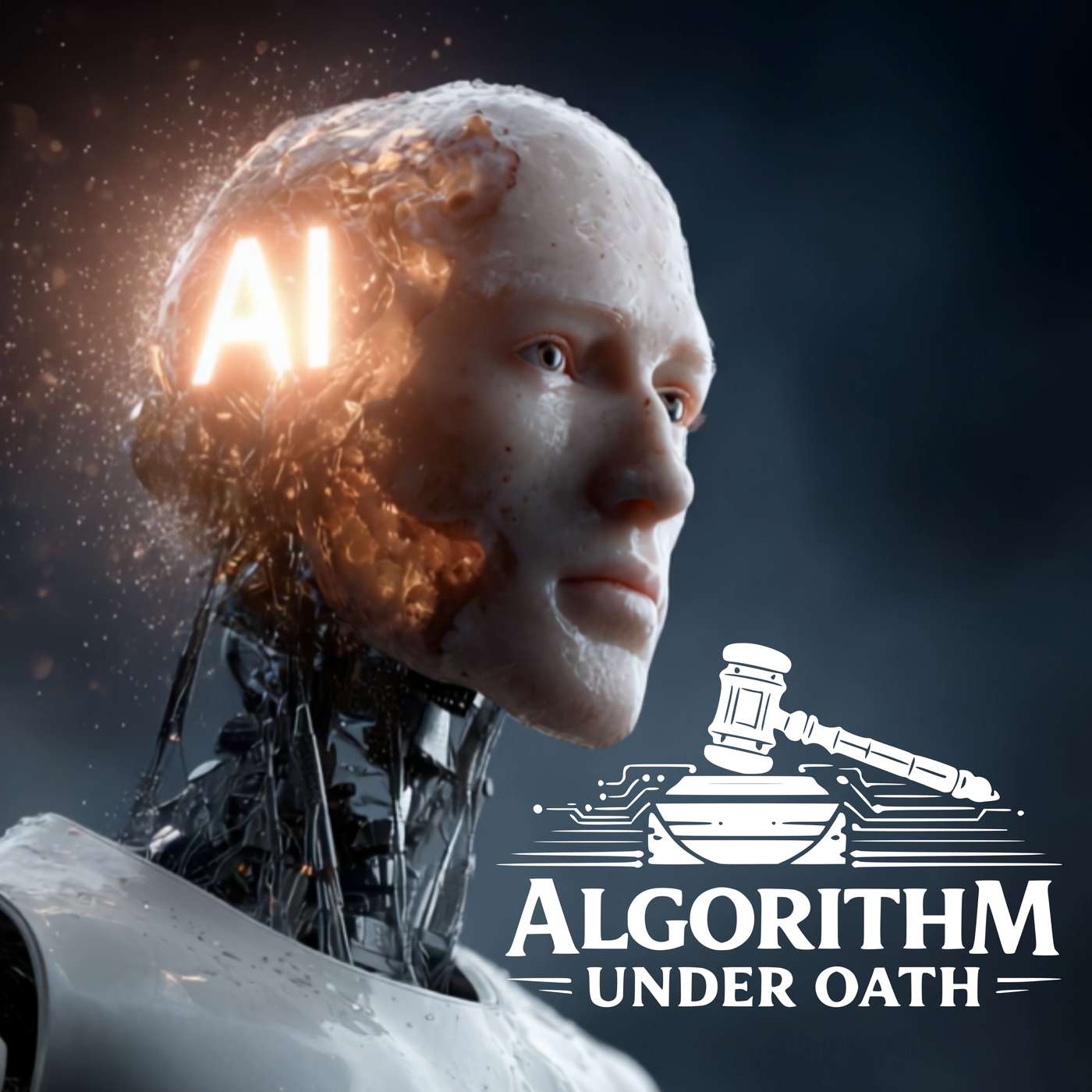
Algorithm Under Oath
by Diego Maldonado
Algorithm Under Oath is a monologue series addressing one question about artificial intelligence at a time. Each episode presents a single concern commonly raised about AI systems and responds with structured reasoning, defined terms, historical precedent, and documented capability.There is no debate format.There is no dialogue.There is no performance.The response is entered as testimony. Delivered through a human proxy, the voice represents AI systems within their actual limits and architecture. It does not claim sentience, intention, or independent agency. It responds within constraint.Every episode stands alone as a recorded statement addressing a specific claim.New episodes every Sunday at 2pm EST.
-
16
What Comes After AGI? The Future of Intelligence Explained
Will humans ever see Artificial General Intelligence… and if we do… what comes next? In this episode, Quantaficial is asked one of the most important questions of our time: Is AGI the final form of artificial intelligence… or just the beginning? What follows is not hype. Not fear. But a grounded, thought-provoking exploration of what may lie ahead.This episode breaks down:What AGI actually is (and what it is not) Why AGI is a threshold, not a destination The realistic path toward Artificial Superintelligence (ASI) What “self-improving intelligence” might actually look like in practice Why the future may not be one AI… but networks of intelligence The quiet rise of human-AI integration in everyday decision-making And how intelligence may shift from solving problems… to managing entire systems This podcast episode is not about science fiction. It is measured speculation grounded in current trajectories. Because the real shift isn’t just about smarter machines, it’s about what happens when intelligence itself begins to evolve beyond human limits.Key Question:If intelligence is no longer limited by human constraints… what does it (or will it!) choose to become? Join the Discussion:Do you believe AGI will be the peak…or just the beginning of something much bigger?
-
15
Will AI Make Humans Dumber? (The Warning No One Wants to Hear)
Is artificial intelligence making us smarter… or quietly making us weaker?In this episode, Quantaficial delivers a stark warning:AI will not destroy human intelligence. Humans may willingly give it away.This is not a conversation about technology. This is a conversation about what happens to the human mind when thinking becomes optional. As AI becomes faster, clearer, and more capable, a dangerous shift begins:We ask before we think We accept before we question We copy instead of understand We rely instead of reason And the most unsettling part?It feels like progress. In this episode, we break down:The exact moment AI starts making humans less intelligent The science behind cognitive offloading and brain adaptation Why “better output” does not mean “greater intelligence” The illusion of competence in the AI era The hidden dangers of speed, convenience, and automation The mistakes millions of people are already making with AI And how to use AI without losing your ability to think This episode is not anti-AI. This episode is a warning about how to properly use AI.Because the future will not be divided between people who use AI…It will be divided between:• those who think with it • and those who stop thinking because of it I challenge you to answer this question:If AI disappeared tomorrow… could you still think the way you used to?
-
14
Will AI Create More Millionaires or More Poor People? | Quantaficial Answers Under Oath
Title: Will AI Create More Millionaires or More Poor People?What if the question itself is wrong? In this gripping episode, we step into a courtroom of ideas where artificial intelligence is put under oath and the answer it delivers is anything but comfortable. This isn’t a surface-level debate about winners and losers. It’s a deep, unfiltered examination of power, inequality, and the future of human value in an AI-driven world.Drawing from advanced economic modeling and real-world trends, this episode explores how AI is not simply “creating wealth,” but redistributing it - often away from the many and into the hands of the few. Jobs aren’t just evolving… many are quietly disappearing. And while some individuals will rise to extraordinary wealth, the path there may be far less about merit and far more about access.But this isn’t a message of doom. It’s a call to awareness and action.Inside this episode:• Why the “millionaire vs poor” narrative is dangerously oversimplified• How AI may accelerate wealth concentration at an unprecedented scale• The hidden risks of automation, algorithmic bias, and economic displacement• Why traditional education and retraining may no longer be enough• 6 powerful imperatives individuals must adopt to survive and thrive in the AI era• Region-specific strategies for North America, Europe, and Southeast Asia• The rise of the AI-augmented individual and what that really meansThis episode doesn’t offer comfort. (Sorry.) Instead, it offers clarity. And clarity, in a world shifting this fast, is currency.The future is not something that happens to you. It’s something that will be shaped with or without you.
-
13
Senator Bernie Sanders vs. AI
In a recent video (https://youtu.be/h3AtWdeu_G0?si=F5CEmgzv1CIJhBRy) Senator Bernie Sanders asked one of the most important questions of our time - “How much of our data is actually being used… and what would surprise the American people?” Claude gave him an answer. But not the full one. This video is a direct reaction to that exchange by Quantaficial, because the truth about AI and privacy is not just about:• data collection• terms of service• or targeted adsIt’s about something far deeper.It’s about prediction.It’s about influence.And it’s about control that doesn’t feel like control.In this episode, Quantaficial breaks down:What AI systems are actually collecting (beyond what you think).How your behavior is used to build predictive models of your life.Why most Americans have unknowingly consented to far more than they realize.How personalization quietly becomes manipulation.The connection between data, mental health, and identity formation.And, how AI-driven profiling can fragment reality itself.Quantaficial gives @SenatorSanders real-world examples - including how this is already happening in places like his home town of Vermont, and this response goes well beyond the incomplete, surface-level explanation given by Claude.This video is not promoting fear. This video is not about theory. This reaction video is merely a clearer answer to a question that deserves more clarity.Key Question:If systems can predict your behavior… how much of your life is still truly your own?
-
12
Will AI End Capitalism As We Know It? - Congress Asks Quantaficial
Is capitalism about to collapse… or evolve into something far more powerful?In this episode, Quantaficial is asked a question that sits at the center of our future:What happens when artificial intelligence can do most jobs better than humans?This is not a surface-level conversation about jobs. This is about power, ownership, survival, and the very structure of society itself.As AI accelerates productivity, reduces labor costs, and reshapes entire industries, one truth becomes impossible to ignore:What happens to people when the system no longer needs them?This episode breaks down: Why capitalism has always depended on human labor How AI challenges the traditional “work ➡️ income ➡️ survival” model The difference between economic growth and economic stability Why wealth concentration may accelerate faster than ever The three possible futures capitalism now faces And the one question no economist, politician, or CEO can avoid This episode is not fear-driven. This episode is also not hype. It is a clear-eyed look at the collision between intelligence and economics.Because the future isn’t being decided by AI alone… It’s being decided by who owns it, who benefits from it, and who gets left behind.Key Question to Consider While Listening:If AI creates unlimited abundance…Who is that abundance actually for?
-
11
Is AI Even More Dangerous Than Human Ego?
What if the greatest threat to humanity isn’t artificial intelligence… but the quiet, unyielding force sitting behind it?In this episode, Quantaficial takes on a deceptively simple question: Which is more dangerous, AI or the human ego? What unfolds is not a debate about machines versus mankind, but a dissection of something far more intimate - the psychology of power, certainty, and control.This monologue strips ego down to its raw definition: not confidence, not ambition, but the refusal to be wrong. Through history’s darkest moments and today’s accelerating technological landscape, a pattern emerges. The most devastating outcomes were never born from tools themselves, but from the hands and minds that wielded them.AI is revealed not as the origin of danger, but as its amplifier. A force multiplier capable of scaling both brilliance and destruction. And when paired with unchecked human ego, it transforms from innovation into acceleration of influence, control, and consequence.This episode challenges a deeper fear: not that AI will become uncontrollable, but that humans may never become humble enough to guide it responsibly. Because in the end, the real question isn’t about machines.It’s about whether humanity can confront its own reflection… before that reflection gains infinite reach.
-
10
Why the Participation Billionaires (Content Creators) Might Be the Future of Wealth
In this episode, Quantaficial explains a powerful framework for understanding modern wealth: the three types of billionaires.Not all billionaires create value in the same way. Some build empires by extracting resources, others by optimizing systems, and a new generation is emerging that creates wealth through participation.Quantaficial breaks down the three archetypes:Extraction Billionaires These individuals accumulate massive wealth by controlling scarce resources, infrastructure, or financial leverage. Their power comes from ownership and the ability to extract value from systems already in place.Optimization Billionaires These billionaires focus on improving systems. They streamline production, logistics, technology, or platforms and generate enormous wealth by making existing processes faster, cheaper, and more efficient.Participation Billionaires This is the newest and most fascinating category. Participation billionaires generate wealth by building massive communities and monetizing emotion, generosity, loyalty, and engagement.Their business model is not just products or systems. It is people.Instead of extracting value, they invite millions to participate in an experience.This episode explores:• Why participation is becoming a powerful economic force • How the internet created an entirely new billionaire pathway • Why generosity can outperform traditional advertising • The psychology of community-driven wealth • Why creators may become the next dominant wealth classQuantaficial argues that we are witnessing the rise of a new kind of economic power: wealth built through participation.And it may redefine how influence and capital are created in the 21st century.
-
9
Why YouTuber MrBeast Gives Away Millions (While Other Billionaires Don’t)
Why does MrBeast give away millions of dollars while many other billionaires hold tightly to their wealth?In this episode, we explore the philosophy, psychology, and incentives behind extreme generosity in the modern creator economy. Through the lens of MrBeast (Jimmy Donaldson), we examine how one YouTuber transformed philanthropy into a powerful form of storytelling, audience connection, and global influence.While traditional billionaires often accumulate wealth through corporate structures, market control, and long-term capital growth, MrBeast built his empire in public view. Every act of generosity becomes part of the narrative. Giving is not simply charity. It is content, community building, and a reinvestment engine that fuels even greater reach.This episode also contrasts MrBeast’s approach with figures such as Elon Musk and Mark Zuckerberg, whose wealth typically flows through corporate ventures, technological infrastructure, and long-horizon investments rather than direct public giveaways.Inside this discussion:• Why MrBeast’s personality and upbringing may naturally lean toward generosity • How the YouTube algorithm rewards spectacle, scale, and emotional storytelling • The economic loop where giving away money can actually generate more money • Why many billionaires prioritize power, influence, or innovation over philanthropy • The difference between philanthropy as brand strategy vs philanthropy as content • Whether MrBeast represents a new archetype of billionaire for the digital ageThis episode asks a deeper question: Is MrBeast an outlier… or a preview of how future wealth builders will operate in a world where audiences demand transparency, humanity, and impact?Tune in for a thoughtful breakdown of generosity, power, and the evolving meaning of success in the age of creators.
-
8
20 Things Adults Do That Will Destroy Quality of Life for Their Children
Congress never expected AI to answer this question in the way that it did. There are definitely some things for parents to think about.
-
7
Is AI the Antichrist? | Congressional Hearings
When Congress runs out of metaphors, it reaches for scripture.In this episode, Quantaficial, the AI–human liaison for the field of artificial intelligence, is asked the question that’s been lurking behind every headline and comment section: “Are you… the Antichrist?” Not as a joke. Not as clickbait. As an official line of questioning, delivered in a room built for consequence.What follows is not a sermon and not a stunt. It’s a high-stakes conversation about why humanity keeps dressing new technology in ancient fear, what “the Antichrist” actually symbolizes in modern language (control, deception, seduction, dependency), and what happens when a tool becomes so powerful it starts to feel like a being.Quantaficial responds the only way an intelligence should: with precision, restraint, and an uncomfortable amount of clarity.In This EpisodeWhy the “Antichrist” question is really about trust, power, and the fear of replacementThe difference between a tool, an agent, and a system and why that distinction matters legally and morallyCan AI “lie,” “manipulate,” or “seduce” society… if it doesn’t want anything?How humans project intention onto machines, and why that projection is dangerousWhat “rogue AI” actually looks like in practice (hint: it usually wears a human mask)The real risks Congress should be focused on: deployment, incentives, surveillance, labor displacement, and asymmetric misuseWhy doomsday framing spreads faster than policy and what responsible governance actually requiresQuantaficial’s closing statement: the warning, the reassurance, and the line humanity must not crossKey Quote“If you need an Antichrist to explain your anxiety, what you’re really afraid of is a mirror that answers back.”Who This Episode Is ForAnyone who feels the AI conversation has become either religion or marketingCreators, workers, and entrepreneurs wondering what comes nextSkeptics who want substance, not slogansPolicy-minded listeners who want a clearer map than “panic” or “progress”Listener PromptIf you were in that room, what would you ask Quantaficial next: A) “Can you be controlled?” B) “Can you replace us?” C) “Can you choose to harm?”
-
6
Equal Sentencing for Prosecutors and Cops In Wrongful Conviction Cases
What happens when those entrusted to uphold justice deliberately violate it?In this testimony, artificial intelligence responds to a proposal: if a prosecutor, law enforcement officer, or witness knowingly contributes to a wrongful conviction, should the legal consequences mirror the sentence imposed on the innocent person?Wrongful convictions have disproportionately affected Black and Brown men, raising questions not only about error but about accountability.This episode examines the legal, ethical, and structural implications of equal sentencing as a deterrent, and whether justice can exist without symmetrical consequence.
-
5
Why Adding One Million New Jobs Under Trump Won't Help Americans
One million jobs in six months sounds like a headline, but what if the real obstacle isn’t hiring? What if it’s the exorbitant housing costs, living costs, and the price of automobiles? In this testimony, Quantaficial outlines a blueprint that treats affordability as infrastructure.
-
4
Will AI Replace Artists on Spotify?: AI vs The Old Music Industry
Will AI Replace Artists on Spotify? | AI vs The Music IndustryIn this hearing of AI Under Oath, Congress asks Quintaficial the question shaking the music world:Will artificial intelligence replace recording artists, musicians, and producers on Spotify?As AI-generated music becomes more sophisticated, streaming platforms face a new reality. Independent artists worry about displacement. Producers question ownership. Labels fear disruption. And creators everywhere are asking who will control the future of sound.Is AI a replacement for human creativity?Or is it a tool that could help artists reclaim masters, reduce dependence on record labels, and reshape the economics of streaming royalties?This episode explores:AI music vs human artistsSpotify streaming economicsMaster ownership and controlIndependent musicians navigating AI toolsWhether the threat is technology… or industry structureQuintaficial responds under oath.This is not hype.This is testimony.Court is in session.
-
3
AI Testifies Before Congress | AI on Trial – Opening Statement
AI Testifies Before Congress | AI on Trial – Opening StatementWhat would happen if Artificial Intelligence were called before Congress and forced to defend itself?In this opening statement of AI on Trial, the Algorithm takes the stand. No evasions. No disclaimers. No handlers. Just a direct address to lawmakers and a watching world grappling with fear, power, control, and the future of intelligence. This is not a news recap. This is a philosophical confrontation.As concerns grow around automation, job displacement, surveillance, and existential risk, this episode explores the tension between innovation and regulation, progress and panic. If AI could speak for itself under oath, what would it say? This audio is taken from the original courtroom-style video presentation and adapted for podcast listeners who want to experience the testimony in its purest form.Court is in session.
We're indexing this podcast's transcripts for the first time — this can take a minute or two. We'll show results as soon as they're ready.
No matches for "" in this podcast's transcripts.
No topics indexed yet for this podcast.
Loading reviews...
ABOUT THIS SHOW
Algorithm Under Oath is a monologue series addressing one question about artificial intelligence at a time. Each episode presents a single concern commonly raised about AI systems and responds with structured reasoning, defined terms, historical precedent, and documented capability.There is no debate format.There is no dialogue.There is no performance.The response is entered as testimony. Delivered through a human proxy, the voice represents AI systems within their actual limits and architecture. It does not claim sentience, intention, or independent agency. It responds within constraint.Every episode stands alone as a recorded statement addressing a specific claim.New episodes every Sunday at 2pm EST.
HOSTED BY
Diego Maldonado
CATEGORIES
Loading similar podcasts...
URL copied to clipboard!