
PODCAST · history
Andrew's History Notes
by Andrew Parker
Echoes of the Goldfields: History in Story and SongStep off the beaten track and into the hidden past of Central Victoria. Beyond the guidebooks and the main roads lie the ruins, the relics, and the forgotten corners of Australia’s heartland—places that still whisper of the gold rush, the struggle, and the triumph of days gone by.Join us as we explore the region’s most amazing historic sites, unearthing the true stories etched into the landscape. But we don’t just tell you the history; we sing it. Every episode features an original ballad written exclusively for this channel.
-
12
Linton - Gold and Fire
Podcast and the song ‘Written in Ash’ written and produced by Andrew Parker 2026Linton, Victoria, is described as a "geological and historical layer cake" that hides a dramatic past beneath its quiet, rural appearance. The town’s history began with the 1854 gold rush at Emu Hill, which drew a massive population and led to the establishment of a resilient Chinese community. To avoid a discriminatory £10 entry tax, thousands of Chinese miners walked hundreds of kilometers from Robe, South Australia, eventually becoming the town's economic backbone by working difficult "wet flats" that European miners had abandoned. The dangers of this era are highlighted by the 1881 Argyle mine disaster, where eight miners survived nearly a week trapped in a dark, underground air pocket following a sudden flood.Beyond gold, the region is a global hub for "white gold," or kaolin clay, which is processed at a unique facility in Pitong. This incredibly pure clay is used in diverse products such as glossy paper, paint, and pharmaceuticals, and it is currently being used to create "green cement" to reduce the carbon footprint of the construction industry. Historically, these heavy materials were transported via the Ballarat-Skipton railway, an "iron spine" featuring impressive engineering like the timber trestle Nimmon’s Bridge. The most profound modern layer of Linton's history is the 1998 bushfire tragedy, where a sudden, early wind change trapped two fire crews, resulting in the deaths of five volunteer firefighters. This event fundamentally transformed firefighting safety, leading to the development of the Linton Safety Interval (LSI), mandatory low-water alarms on trucks, and the global observance of International Firefighters Day.SourcesGeological and Mining RecordsGeological Survey of Victoria Notes: These provide technical descriptions of the "intombed" gold and the volcanic activity that created the deep leads 6 million years ago 4-6.19th-Century Mining Reports: Used to track the "basalt barrier" and the difficulties encountered by specific groups like the Great Western and Woady Yaloak Junction company 1, 2, 7.Modern Seismic Surveys: These function like an "ultrasound" for the ground, confirming that gold remains in ancient river channels past the depths reached by historical miners 10.Victorian Census and Population Data: These records track the demographic shift from a European majority to a significant Chinese workforce in the 1850s 11, 12.Government Archives on Immigration: Records detailing the £10 entry tax imposed by the Victorian government and the subsequent overland trek from Robe, South Australia 13-15.Business Records: Documents relating to Chinese-owned businesses in settlements like China's Flat, including those run by Sin Kee (Sini) and James Wong Chung (Wong Jong) 16-18.Linton Cemetery Records: These provide physical evidence of the Chinese community that lived and died in the district 18, 19.Railway Archives and Freight Manifests: These documents track the Ballarat-Skipton line as a heavy industrial artery for gold, wool, and kaolin clay 1, 2, 20.Coronial Inquest Reports: Heavy emphasis is placed on the extensive legal investigations following the 1998 Linton bushfire, which are among the longest in Victorian history 1, 2, 26-28.Meteorological Data: Weather forecasts and reports from December 2, 1998, are used to explain the timing and lethality of the sudden wind change 29-31.Firefighting Safety Manuals: Modern safety doctrines, including the Linton Safety Interval (LSI) and "Dead Man Zone" protocols, are cited as direct results of the 1998 tragedy 32-34.Product Research: References to metakaolin and "Colrete," a green cement technology currently being trialed by the Victorian government 36, 37.Notes on International Observances: Specific notes regarding the inspiration for and establishment of International Firefighters Day on May 4th 38, 39.
-
11
The History of U3A - The Golden Years
Podcast and song 'Welcome to the Golden Years' written and produced by Andrew Parker 2026.Updated: 17.02.2026The provided sources examine the global University of the Third Age (U3A) movement, a lifelong learning initiative designed to provide intellectual and social engagement for retirees. These texts contrast the French model, which is typically university-led and formal, with the British model, which emphasises self-help and peer-to-peer teaching. Australian case studies, such as U3A Whyalla and U3A Ballarat, illustrate how these organisations adapt to local needs through campus partnerships or digital migrations. Beyond educational outcomes, the movement is credited with promoting active ageing and mental well-being while combating social isolation among seniors. The documents also highlight the logistical realities of these groups, including their reliance on volunteers and the philanthropic support of organisations like the Osher Foundation. Ultimately, the collection portrays a diverse, international network dedicated to the philosophy that learning remains a vital pursuit throughout the entire human life course.Sources:A founding visit - u3a: A news item regarding the visit of Professor Francois Vellas (son of the founder) to the UK Third Age Trust.A Mutually Beneficial Relationship - UTS ePress: An academic article detailing the partnership between U3A Whyalla and the University of South Australia.Active Ageing: Using an ARCON Framework to Study U3A in Australia: A research paper analyzing Australian U3A groups using a collaborative network model.An International Perspective of the University of the Third Age: A 1995 paper by Swindell and Thompson contrasting the French and British U3A models globally.China's Universities for the Aged: State-Led Lifelong Learning: A summary of the scale, governance, and curriculum of China's state-supported U3A model.Differences And Similarities Between The French And British Versions Of U3A: An article outlining the structural and philosophical differences between the two primary U3A models.Four decades of Universities of the Third Age: past, present, future: An article by Marvin Formosa analyzing the development and future challenges of the U3A movement.Lifelong learning - Wikipedia: An overview of the concept, history, and definitions of lifelong learning.Lifelong Learning Landscapes: Global Models of the Third Age: A comparative summary of U3A models in China and Australia.Michael Young & Peter Laslett - Wikipedia: Biographical entries for two of the founders of the British U3A model.Our history/story - u3a: Official history pages from the UK's Third Age Trust.Previous News - IAUTA: A news archive from the International Association of Universities of the Third Age.The French and British Models of the University of the Third Age: A Socio-Historical Analysis: An academic paper by Marvin Formosa detailing the origins of the two main U3A models.The Global Evolution of Educational Gerontology: A comprehensive history of the U3A movement.The Relationship Between Ballarat City Council and U3A Ballarat: A document outlining the partnership between the local council and the U3A group.The Structural and Pedagogical Evolution of U3A Ballarat: A detailed report on the governance, technology, and curriculum of U3A Ballarat for 2026.The University of the Third Age in the UK: An Interpretive and Critical Study: An article analyzing why the UK developed a model different from the French.Tom Holloway - U3A Communities: A biography of the digital pioneer for U3A.u3a - Yesterday, Today, Tomorrow: An event listing from the Institute of Historical Research.u3a matters Spring 2024: A screenreader edition of the UK u3a magazine featuring member stories and news.U3A in China - U3A international: A report on the scale and nature of U3As in China.U3A Signposts: Newsletters from 2018 and 2019 detailing global U3A activities.
-
10
Lost Children of the Victorian Goldfields
This podcast as well as the song 'Little Ones Lost' were produced by Andrew Parker 2026Fully revised and updated 28.1.2026Sources:Historical Newspaper Articles (Trove)"ANOTHER CHILD LOST." – Queanbeyan Age, 2 November 1867 1."THE CHILDREN LOST AT DAYLESFORD." – The Argus, 5 July 1867 2."THE LOST CHILDREN AT DAYLESFORD." – The Ararat and Pleasant Creek Advertiser, 5 July 1867 3."THE LOST CHILDREN FROM DAYLESFORD." – Geelong Advertiser, 17 September 1867 4."THE LOST CHILDREN OF DAYLESFORD." – Illustrated Australian News for Home Readers, 19 October 1867 5."THE LOST CHILDREN OF DAYLESFORD." – Illustrated Australian News for Home Readers, 26 October 1867 6.Academic and Socio-Historical Reports"Bush-lost children's place in new 'moral communities': the emergence of a cultural rite in colonial Victoria (and across Australia), 1850s–1890s" – Rural History, Cambridge University Press (2022) 7, 8."The Three Lost Children of Daylesford: A Comprehensive Socio-Historical Report on Colonial Tragedy and Cultural Memory" 9."The Tragedy of Jesse McIntosh: A Cultural and Historical Analysis of the 1867 Buninyong Disappearance" 10."Christine Cheater reviews Peter Pierce, Country of Lost Children" – Sociology.org 11."The Lost Boys of Daylesford" – Macquarie University (Media contribution regarding the ABC Radio National program) 12.Government and Local History Documents"City of Ballarat Roads and Open Space Historical Index" 13."Ballarat Roads & Open Space Index: History & Key Dates" – Studylib 14, 15."The Cornish Association of Victoria Inc. Ballarat Branch - Kernow Goth" (Newsletter, April 2023) 16."Aboriginal tracker" – Wikipedia 17.Blogs and Articles"Daylesford's Lost Boys" – Lost Magazine 29."The Lost Children" – Daylesford Macedon Life 30."The lost children of Daylesford" – Australian Geographic 31."Shepherd's Daughter's Grave, Lal Lal" – Hiking Fiasco 32."Lost Children's Tree" – Victoria's Forests & Bushfire Heritage 33.Short Documents/PDFs"Jesse McIntosh- The Lost Child of Buninyong.pdf" 39."The Shepherd’s Daughter’s Grave.pdf" (U3A Ballarat Hiking Group) 40.
-
9
Jubilee Lake, Wombat Reservoir and a Timber Tramway
The podcast as well as the song ' Where the Wombat Waters Flow' were produced by Andrew Parker 2026Fully revised 04.02.2026Please let me know if you enjoyed this podcast and you would like me to make more. It is a lot of work to make these, so any encouragement helps.The interconnected history of three landmarks in the Daylesford region—Jubilee Lake, the Henderson Tramway, and Wombat Reservoir—linking them through the industrial evolution of Wombat Creek Jubilee Lake (Hepburn Goldfields Reservoir)Originally created in 1861 to supply water for gold mines and local townships, the reservoir suffered an early embankment failure before being rebuilt and enlarged. It was renamed Jubilee Lake in 1887 to honour Queen Victoria . By 1890, the water was deemed unfit for consumption, leading the site to transition into a recreational hub for boating, fishing, and picnicking . It remains a popular location for trout fishing and camping, and features a mineral spring discovered near the creek around 1900 .The Henderson TramwayThis timber infrastructure operated during two distinct eras. Robert Henderson first established a sawmill and a horse-drawn tramway with engineered cuttings in 1879, which operated until the area was logged out in 1891 . The site was revived in 1942 by the Orr brothers to meet World War II timber demands, continuing until the land was required for the Wombat Reservoir . The former tramway route is now a walking track where historical relics, such as log landings, are still visible .Wombat ReservoirConstructed in 1964 on the site of the former sawmills, this 586-megalitre reservoir serves as the major domestic water supply for Daylesford and Hepburn Springs . Located within the messmate and peppermint forests of the Wombat State Forest, it is strictly managed to protect water quality; consequently, boating and wading are prohibited, though shore-based fishing is permitted .Sources:Primary Text"Heritage of the Wombat: Timber, Gold, and Water Gates" (Excerpts)This document serves as the central synthesis of historical, environmental, and technical data for the region 1. It covers the chronological development of the water bodies and the timber industry 1.The primary text draws upon specific historical records to substantiate its claims. These include:Mining and Water Supply Records (1861–1887):Reports detailing the formation of the Hepburn Goldfields Reservoir, the embankment failure during the July 1861 storm, and the subsequent reconstruction and renaming to Jubilee Lake in 1887 2.Local Government and Council Minutes (1914–1929):Records from the Borough Council regarding the management of Jubilee Lake, including complaints about "boys bathing" in 1914 2. This also includes grant applications for the improvement of the mineral spring and records of the bore drilling in 1929 2.Forestry and Sawmill Operations Records (1879–1960s):Historical data tracking the lease and operations of Robert Henderson’s sawmill (1879–1891) and the Orr brothers' revival of the site during World War II (1942) 3.Water Management Infrastructure Data (1964–Present):Technical specifications regarding the construction of Wombat Reservoir in 1964, including capacity (586 ML) and catchment area (916 ha) statistics The Henderson Tramway draws on conflicting accounts identified in our conversation history and the text:Walking Maps and Historical Summaries:These sources constitute the basis for the claim in the provided text that the tramway was "likely built to a gauge of 3 feet (0.91 metres)" 3.Historical Records and Official DocumentsTechnical and Conflicting Sources (Tramway Gauge)Article in Light Railways (Pioneer Tramway Technology):Acknowledged in our conversation history, this source offers an alternative technical perspective, asserting that Henderson used a distinct 4ft 6in gauge to accommodate local soil conditions, differing from the standard 3-foot gauge mentioned in other summaries.Trove Newspaper Archive
-
8
The Ballarat to Daylesford Railway
Podcast + Song 'Timber Spuds and Spas' produced by Andrew Parker 2026Fully remastered 07.02.2026The history, engineering, and cultural legacy of the North Creswick to Daylesford railway in Victoria. Constructed in the 1880s, this line was an expensive and complex infrastructure project that navigated the steep terrain of the Great Dividing Range to link major regional networks. The documents describe its vital role in the "Timber, Spuds, and Spa" industries, while also recounting tragic accidents and technical challenges like its notably steep gradients and short turntables. Following the line's gradual decline and closure between 1953 and 1986, portions have been repurposed for modern heritage and recreation. Today, the corridor lives on through the Daylesford Spa Country Railway tourist service and the Wallaby Track, a popular trail for hikers and cyclists. Together, these records provide a comprehensive look at how a nineteenth-century industrial lifeline transformed into a significant site for regional tourism and preservation.SourcesTrove Newspaper Archives
-
7
Buninyong Gold: The importance of Buninyong in the Victorian gold rush
Podcast and song 'In the Shadow of the Mountain' produced by Andrew Parker 2026 Fully revised and updated 28.01.26Second full revision 13.02.26Tracing the development of the Victorian goldfields surrounding Buninyong, Ballarat, and the Golden Plains from the initial discoveries in 1851. They chronicle the transition from individual prospectors like Thomas Hiscock to large-scale corporate operations that utilised advanced steam engines, puddling machines, and deep-lead mining techniques. Detailed historical records highlight the governmental response to the rushes, including the introduction of mining licenses and the establishment of local infrastructure. Geological surveys and archaeological assessments from the 1990s describe the physical remains of these sites, such as mullock heaps, shafts, and battery foundations, which still mark the landscape today. Through various excerpts, the sources provide a comprehensive look at the economic yields, technological evolution, and social order that defined this influential era in Australian history
-
6
Jubilee Reef and Italian Gully - The town that lived and died twice.
Podcast and song: Where the Golden River Ran - Produced by Andrew Parker 2026Fully revised and updated 26.1.2026These sources document the rich history and physical remains of the Jubilee Mine and the nearby Italian Gully township in Victoria. They describe the area's evolution from its 1850s gold rush origins through to the peak of large-scale quartz reef mining between 1899 and 1913. Visitors can explore a heritage walking track that features preserved foundations of cyanide plants, steam boilers, and mechanical extraction systems like horse-driven whips and whims. The texts also provide a social timeline of the settlement's decline, noting how the township vanished as residents relocated and materials were salvaged during the Depression and world wars. Today, the site is recognised by Heritage Victoria for its archaeological importance and innovative contributions to the state's industrial mining technology. Maps and guided walk notes included in the collection offer practical directions for modern explorers to navigate these historic ruins and re-growth forests.Please leave a comment if you enjoyed this and would like me to make more of these.Research:Andrew ParkerGordon TalbettSources include: Trove Newspaper ArchivesParksVic Goldfields GuideHeritage Council of Victoria
-
5
The Canadian Rifle Range: How this Ballarat rifle range is an insight into the era.
Podcast and song: A Fob Watch in the Dust - Produced by Andrew Parker 2025Fully revised and updated 25.1.2026The evolution and eventual decline of the Australian rifle club movement, specifically focusing on the historic Canadian rifle range. During the early 20th century, rifle shooting was a pervasive cultural and defensive activity in Australia, though clubs often struggled with logistical hurdles and occasional tragic accidents. Historical documents highlight a 1903 meeting regarding range accessibility and a 1921 fatality that underscored the inherent dangers of the sport. While the movement was once a vital component of national security, its military relevance faded after the World Wars. By 2002, the sale of the Canadian range by the Department of Defence marked the end of a 160-year tradition, significantly impacting the social lives and sporting opportunities of local marksmen. Visual records, such as photographs from 1925, serve as a final testament to the community spirit that once defined these local institutions.If you enjoyed this, please leave a comment. Let me know if you would like me to make more of these.Software Resources:NotebookLMSunoAISources include: Trove Newspaper ArchivesBallarat CourierFriends of the Canadian Corridor
-
4
Ballarat-Buninyong Railway: The ‘Bunny Hop’
Podcast and song: Poetry In Steel Produced by Andrew Parker 2025Fully revised and updated 31.01.2026The provided sources document the history and engineering of the Buninyong railway line, which officially opened in September 1889. Through a collection of historical photographs, maps, and newspaper reports, the materials illustrate the challenging topography of the route, featuring steep gradients, deep cuttings, and significant trestle bridges. Architectural details of the various stations and infrastructure, such as the Victoria Street bridge and the Buninyong terminus, are highlighted alongside archival timetables and fare schedules. Data from the early 20th century reveal a steady decline in passenger numbers and goods tonnage, ultimately leading to the removal of buildings in the 1930s. The line eventually ceased operations in 1947, leaving behind a record of its role in connecting the local communities of the Ballarat district.If you enjoyed this please leave a comment and let me know if you would like to hear more of these.Research: Andrew ParkerSoftware Resources:NotebookLMSunoAISources: 'Catching the Bunny' Peter KervarecTrove Newspaper ArchivesState Library of Victoria
-
3
Bodens Water Races. The amazing story of how essential water races were for gold extraction.
Podcast and song: 'Race for Water' Produced by Andrew Parker 2026Fully revised and updated 01.02.2026These records examine the rich history of gold mining in the Ballarat region of Victoria, specifically detailing the evolution of extraction methods from basic panning to complex steam-powered shaft mining. Geological reports identify the natural formations that made this area so productive, such as the famous deep leads buried beneath layers of volcanic basalt. Personal family histories provide a vivid portrayal of the harsh realities faced by pioneers, including the significant physical and financial risks associated with the 1850s gold rush. The documents also highlight the commercial scale of the industry through extensive lists of mining companies and historical investment records. Modern perspectives are included via walking trail maps that allow visitors to explore remaining landmarks like Boden’s Water Race. Ultimately, the collection illustrates how the pursuit of gold shaped the local economy, infrastructure, and demographic landscape of regional Victoria.If you enjoyed this please leave a comment and let me know if you enjoyed it and if you would like me to make more of theseResearch:Andrew ParkerGordon TalbettSources include: Government Purchase Correspondence (1878): These primary documents detail the water crisis in Smythesdale, Browns, and Scarsdale following Boden's death. They include Mining Surveyor John Lynch's assessment, which valued the estate at £1,660 due to its potential profitability, contrasting this with the widow's sale price of approximately £800 because she lacked the necessary management skills.Heritage Databases and Geological Reports: These sources, including the Golden Plains Shire Heritage Database and Ferdinand M. Krause's 1889 surveys, provide the operational timeline and geological context of the "Hard Hills". They describe the difficult "cement" ground Boden worked and the "Otway Enclave," a man-made microclimate in the open cuts that now supports rare flora like orchids and mosses.Technical Descriptions: These documents explain the engineering precision required for the races, specifically the critical "1 in 500" gradient necessary to prevent erosion or silting. They also detail the manual labor involved in digging the races during summer months and the use of hydraulic sluicing and mercury to recover gold.Walking Guides: Modern guides for the "Woady Yaloak Goldfields Water Race Walking Trails" map the current site, including a 5.1km walking loop. They interpret physical remnants for visitors, explaining that the "breached dams" were intentionally cut to retrieve pipes and noting the significant dimensions of the original timber fluming.
-
2
Lal Lal Ironmine: It’s rise and fall.
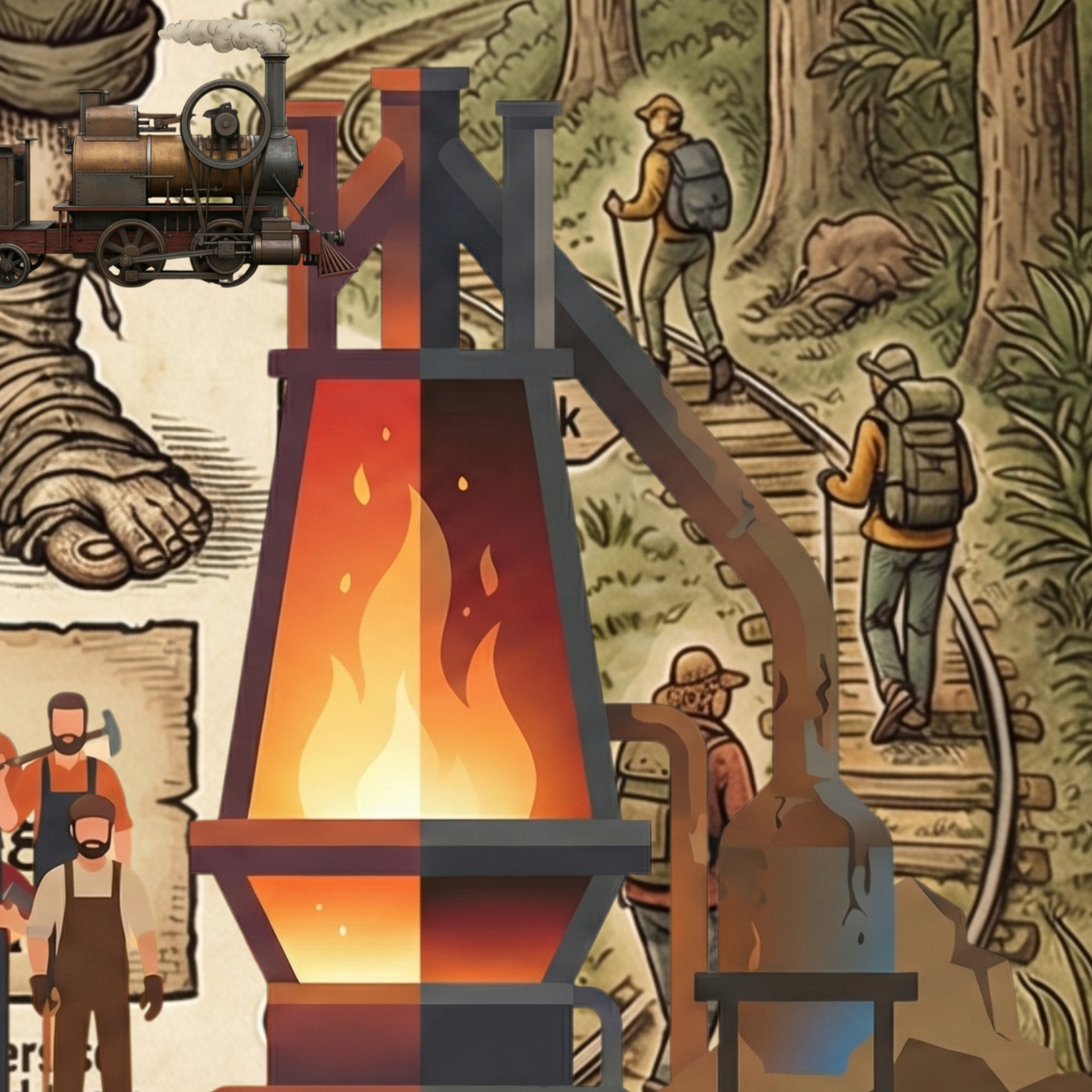
Podcast and song: 'Tower of Fire' Produced by Andrew Parker 2025This report examines the historical and industrial significance of the Lal Lal Blast Furnace, a unique 19th-century ruin located in Victoria, Australia. The document details the site's technological legacy, highlighting it as the only surviving colonial-era furnace of its kind in the Southern Hemisphere. Beyond the structural analysis, the text explores the regional iron industry's evolution, its connection to the gold rush, and the local production of charcoal and lignite. Detailed assessments from metallurgists and engineers provide recommendations for preserving the furnace's deteriorating stonework through modern conservation techniques. The sources also document the area's natural landscape and social history, including its importance to Aboriginal communities and early pastoralists. Ultimately, the report serves as a comprehensive guide for transforming the site into a protected educational heritage reserve.If you enjoyed this please leave a comment and let me know if you would like to hear more of these.Research:Andrew Parker Gordon TalbettSoftware Resources:NotebookLMSunoAISources include: Trove Newspaper ArchivesParksVic Heritage Council of VictoriaLal Lal Blast Furnace Report 1976: Peter S. Staughton & Robert W.P. Ashley• Academic and Professional Experts: The report recognizes individuals such as Professor Hill W. Worner of the University of Melbourne and Neil Cossons of the Ironbridge Gorge Museum Trust for their specialized expertise.• Government Departments and Agencies: Assistance was provided by the Victorian Mines Department, the Lands Department, the Forest Commission of Victoria, and the West Moorabool Water Board.• Libraries and Archival Institutions: Research involved a wide network of institutions, including the Latrobe Library, the Public Records Office (Melbourne), and various state and international libraries in New South Wales, South Australia, Tasmania, and New Zealand.• Historical and Research Societies: Significant data was contributed by groups such as the National Trust of Australia (Victoria), the Ballarat Historical Society, and specialized groups like the Light Railway Research Society of Australia.• Local Government and Community Groups: The authors thanked the Ballarat City Council, the Shire of Buninyong, the Lal Lal State School, and the citizens of Lal Lal and Hindmarsh Tiers.• Educational Institutions: Support was gathered from the Ballarat School of Mines, RMIT, and the Mt. Helen Institute of Advanced Education.• Individual Contributors and Firms: A diverse group of private citizens and professional firms, such as Gutteridge Haskins and Davey, provided specific assistance to the project.
-
1
Andersons Mill and Tramway Barkstead
Podcast and song: 'Tracks and Sawdust'Produced by Andrew Parker 2025Fully revised 02.02.2026The provided sources chronicle the industrial legacy of the Anderson brothers, who established a pioneering timber operation in Victoria's Wombat Forest during the mid-to-late 19th century. Driven by their engineering expertise, the brothers moved beyond traditional animal-powered transport to develop the first steam-powered locomotives used in the Victorian timber industry. Their extensive 23-kilometer tramway system and the massive Barkstead mill supported a thriving community but eventually declined due to resource exhaustion and legal disputes with rival loggers. Later, the site became known as the "Toe Rag" mill, a name reflecting the extreme poverty of workers who used rags as makeshift socks. Today, the area is recognized for its archaeological and historical significance, with physical remnants like deep cuttings and a massive sawdust footprint still visible along modern walking tracks. These documents combine technical diagrams and archival photos with historical reports to preserve the story of this ambitious but ultimately doomed timber empire.If you enjoyed this please leave a comment and let me know if you would like me to make more of these.Research: Andrew Parker 2025Sources include: Trove Newspaper ArchivesGreat Dividing Trail AssociationParksVic Heritage Council of Victoria
We're indexing this podcast's transcripts for the first time — this can take a minute or two. We'll show results as soon as they're ready.
No matches for "" in this podcast's transcripts.
No topics indexed yet for this podcast.
Loading reviews...
ABOUT THIS SHOW
Echoes of the Goldfields: History in Story and SongStep off the beaten track and into the hidden past of Central Victoria. Beyond the guidebooks and the main roads lie the ruins, the relics, and the forgotten corners of Australia’s heartland—places that still whisper of the gold rush, the struggle, and the triumph of days gone by.Join us as we explore the region’s most amazing historic sites, unearthing the true stories etched into the landscape. But we don’t just tell you the history; we sing it. Every episode features an original ballad written exclusively for this channel.
HOSTED BY
Andrew Parker
CATEGORIES
Loading similar podcasts...
Frequently Asked Questions
How many episodes does Andrew's History Notes have?
Andrew's History Notes currently has 12 episodes available on PodParley. New episodes are automatically indexed when they're published to the podcast feed.
What is Andrew's History Notes about?
Echoes of the Goldfields: History in Story and SongStep off the beaten track and into the hidden past of Central Victoria. Beyond the guidebooks and the main roads lie the ruins, the relics, and the forgotten corners of Australia’s heartland—places that still whisper of the gold rush, the struggle,...
How often does Andrew's History Notes release new episodes?
Andrew's History Notes has 12 episodes. Check the episode list to see recent publication dates and frequency.
Where can I listen to Andrew's History Notes?
You can listen to Andrew's History Notes on PodParley by clicking any episode. We provide an embedded audio player for direct listening, and you can also subscribe via your preferred podcast app using the RSS feed.
Who hosts Andrew's History Notes?
Andrew's History Notes is created and hosted by Andrew Parker.
URL copied to clipboard!