
PODCAST · history
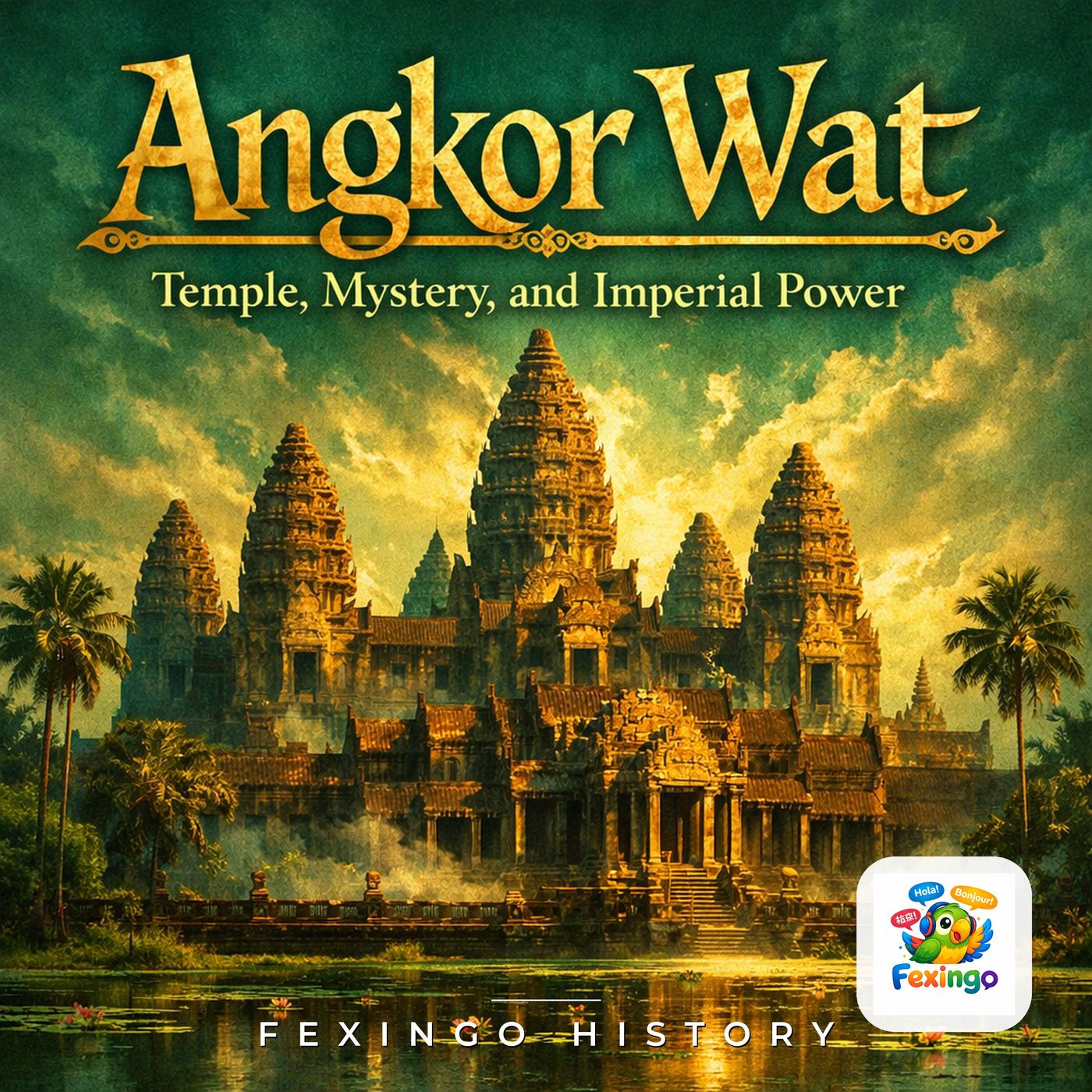
Angkor Wat: Temple, Mystery, and Imperial Power — Fexingo History
by Fexingo
Angkor Wat, the sprawling temple complex in modern-day Cambodia, stands as both an architectural marvel and a symbol of imperial ambition. This show explores the rise and fall of the Khmer Empire, from its 9th-century origins under Jayavarman II to its zenith under Suryavarman II, who built Angkor Wat in the 12th century as a state temple and microcosm of the Hindu universe. We delve into the cosmic design of the five lotus-bud towers, the vast baray reservoirs that sustained a hydraulic city, and the transition from Hinduism to Theravada Buddhism under Jayavarman VII, who constructed the enigmatic Bayon with its 216 smiling faces. Lucas and Luna guide listeners through the inscriptions of Yaśovarman I, the role of the devaraja cult, and the empire’s eventual decline after the Siamese sack of Angkor in 1431. We also examine modern debates over heritage management, looting, and tourism, as well as the enduring mystery of Angkor’s ‘disappearance’ into the jungle. Why does this temple con
-
35
The Churning of the Ocean of Milk: Cosmic Myth at Angkor — Fexingo History
In this episode, Lucas and Luna explore the famous bas-relief of the Churning of the Ocean of Milk at Angkor Wat. They unpack the Hindu creation myth, its symbolism in Khmer architecture, and how Suryavarman II used it to legitimize his rule. The discussion covers the devas and asuras churning the cosmic ocean, the role of Vishnu in his Kurma avatar, and the celestial treasures that emerged, including the apsaras. Lucas explains how the relief is not just a decoration but a cosmic map aligning Angkor Wat with Mount Meru. They also touch on later inscriptions that reveal the temple's dedication to Vishnu and the king's posthumous name Paramavishnuloka. This episode dives into the intersection of religion, art, and imperial propaganda, offering a fresh lens on Angkor Wat's most iconic imagery.#AngkorWat #ChurningOfTheOceanOfMilk #HinduMythology #Vishnu #SuryavarmanII #KhmerEmpire #BasRelief #Apsaras #MountMeru #Paramavishnuloka #Devas #Asuras #Kurma #Cambodia #SoutheastAsianHistory #FexingoHistory #History #ArtHistory #JayavarmanVII #BayonBecome a supporter of this podcast: https://www.spreaker.com/podcast/angkor-wat-temple-mystery-and-imperial-power-fexingo-history--6985258/support.
-
34
The Vyadhapura Revolt that Reshaped Angkor — Fexingo History
In the late 14th century, Angkor faced a rebellion from its own eastern provinces, led by a Khmer commander named Kambuj. The Vyadhapura revolt threatened the devaraja cult and forced King Ponhea Yat to abandon the city. This episode examines the revolt's causes, the role of Theravada Buddhism, and how it accelerated Angkor's decline. We explore the sparse inscriptional evidence, the shifting power dynamics with Ayutthaya, and the eventual move to Phnom Penh. Lucas and Luna discuss the little-known figure of Kambuj, the sack of Angkor in 1431, and the enduring legacy of this internal fracture.#Vyadhapura #Kambuj #PonheaYat #AngkorDecline #TheravadaBuddhism #Ayutthaya #PhnomPenh #Devaraja #AngkorThom #14thCentury #KhmerEmpire #CambodianHistory #Revolt #Inscriptions #Buddhism #History #SoutheastAsianHistory #FexingoHistory #AngkorWat #SuryavarmanIIBecome a supporter of this podcast: https://www.spreaker.com/podcast/angkor-wat-temple-mystery-and-imperial-power-fexingo-history--6985258/support.
-
33
Suryavarman II and the Building of Angkor Wat — Fexingo History
Angkor Wat is the world's largest religious monument, but who built it and why? In this episode, we explore the reign of King Suryavarman II, the ambitious 12th-century ruler who commissioned this masterpiece. We discuss his military campaigns against the Cham and the Dai Viet, his consolidation of power, and the Hindu cosmology that shaped Angkor Wat's design—a terrestrial representation of Mount Meru. We also touch on the temple's original dedication to Vishnu, its later transformation into a Buddhist site, and the controversies surrounding Suryavarman II's own death and afterlife. Drawing on inscriptions and Chinese sources, we piece together the life of a king who built for eternity but whose end remains a mystery.#AngkorWat #SuryavarmanII #KhmerEmpire #Angkor #Cambodia #Hinduism #MountMeru #Vishnu #Champa #DaiViet #SoutheastAsianHistory #TempleArchitecture #12thCentury #MedievalHistory #WorldHeritage #History #FexingoHistory #AncientCivilizations #JayavarmanVII #BayonBecome a supporter of this podcast: https://www.spreaker.com/podcast/angkor-wat-temple-mystery-and-imperial-power-fexingo-history--6985258/support.
-
32
The Leper King: Madness and Myth at Angkor Thom — Fexingo History
In this episode, Lucas and Luna explore the enigmatic figure of the Leper King, whose haunting statue sits on the Terrace of the Leper King at Angkor Thom. They delve into the historical and mythological layers surrounding this mysterious king: was he Yasovarman I, who suffered from leprosy, or Jayavarman VII, whose compassion for the sick led to hospitals? They examine the yantra inscriptions, the raja karma concept of kingly duty, and the Tantric Buddhist influences that may have shaped the image. The conversation also touches on Zhou Daguan's 13th-century account of a king who recovered from leprosy and the later 'leper prince' legend. Finally, they peer into the Terrace's hidden second wall, which suggests the site was a cremation ground for kings. This episode offers a nuanced look at how history, myth, and religious symbolism intertwine at Angkor.#LeperKing #AngkorThom #YasovarmanI #JayavarmanVII #ZhouDaguan #TantricBuddhism #KhmerEmpire #TerraceOfTheLeperKing #RajaKarma #Yantra #Avalokiteshvara #Devaraja #SiemReap #CambodianHistory #AncientMysteries #SoutheastAsianHistory #FexingoHistory #History #AngkorWat #SuryavarmanIIBecome a supporter of this podcast: https://www.spreaker.com/podcast/angkor-wat-temple-mystery-and-imperial-power-fexingo-history--6985258/support.
-
31
Angkor Wat's Invisible Enemy: The 1177 Cham Invasion — Fexingo History
In 1177, the Khmer Empire suffered its greatest humiliation: a Cham naval raid up the Mekong and Tonlé Sap rivers that sacked Angkor itself. Until then, no enemy had ever breached the capital. Lucas and Luna explore how King Tribhuvanadityavarman's complacency, a devastating battle on the Great Lake, and a fleet of swift Cham boats brought the empire to its knees — and how a young prince named Jayavarman would rise from the ashes. They also examine the Chams' war culture, the role of monsoon winds in the attack, and why Angkor Thom was built as a defensive response. This episode covers the lead-up, the raid, and its aftermath, drawing on Chinese accounts and Khmer inscriptions to reconstruct one of the medieval world's most stunning reversals.#ChamInvasion #AngkorWat #KhmerEmpire #JayavarmanVII #Tribhuvanadityavarman #Champa #TonleSap #MekongRiver #MedievalWarfare #SoutheastAsianHistory #1177 #PreahKhan #AngkorThom #NavalRaid #HinduBuddhism #History #FexingoHistory #LucasAndLuna #SuryavarmanII #BayonBecome a supporter of this podcast: https://www.spreaker.com/podcast/angkor-wat-temple-mystery-and-imperial-power-fexingo-history--6985258/support.
-
30
Suryavarman I and the Conquest That United Angkor — Fexingo History
Before Suryavarman II built Angkor Wat, before Jayavarman VII raised the Bayon, another king transformed the Khmer Empire: Suryavarman I. In this episode, Lucas and Luna explore the reign of a usurper who seized the throne of Angkor in the early 11th century, conquered the Mon kingdom of Lavo (modern Lopburi in Thailand), and expanded Khmer rule into the Chao Phraya River valley. They discuss the shifting religious landscape — from Hinduism to Mahayana Buddhism — and the king's diplomatic outreach to the Chola Empire of South India. Lucas explains the construction of the Preah Vihear temple atop a cliff in the Dângrêk Mountains, and how Suryavarman I's inscription at the Sdok Kok Thom temple records the devaraja cult. The conversation also touches on the mysterious death of his predecessor, Jayaviravarman, and the civil war that preceded Suryavarman's consolidation of power. This episode offers a fresh look at a pivotal but often overlooked ruler whose conquests and policies laid the groundwork for Angkor's golden age.#SuryavarmanI #KhmerEmpire #Angkor #Lavo #PreahVihear #SdokKokThom #Chola #MahayanaBuddhism #Devaraja #11thCentury #SoutheastAsia #Cambodia #History #FexingoHistory #Temple #Conquest #Mon #ChaoPhraya #AngkorWat #SuryavarmanIIBecome a supporter of this podcast: https://www.spreaker.com/podcast/angkor-wat-temple-mystery-and-imperial-power-fexingo-history--6985258/support.
-
29
Angkor and the Chola Navy: A Forgotten Raid — Fexingo History
When we think of Angkor's enemies, the Cham and the Ayutthaya usually come to mind. But in the 11th century, a far more distant power struck the Khmer coast: the Chola Empire of South India. In this episode, Lucas and Luna explore a little-known raid that sent shockwaves through Southeast Asia. We follow the Chola king Rajendra Chola's naval expedition against the Srivijaya Empire—and his lesser-known attack on the Khmer port of Tambralinga. We examine the evidence from Tamil inscriptions, Khmer chronicles, and Chinese records, and ask why the Cholas came, what they took, and why this story was nearly forgotten. Along the way, we discuss the maritime Silk Road, the rivalry between the Khmer and Srivijaya, and the geopolitics of the Indian Ocean in the 11th century. This episode sheds light on a crucial but overlooked moment in Angkor's long history of foreign contact.#Angkor #CholaEmpire #RajendraChola #Srivijaya #Tambralinga #NavalRaid #IndianOceanTrade #KhmerHistory #MedievalSoutheastAsia #TamilInscriptions #MaritimeHistory #11thCentury #SilkRoadOfTheSea #Archaeology #ForgottenHistory #Cambodia #India #FexingoHistory #AngkorWat #KhmerEmpireBecome a supporter of this podcast: https://www.spreaker.com/podcast/angkor-wat-temple-mystery-and-imperial-power-fexingo-history--6985258/support.
-
28
Angkor Wat's Restoration: The French Conservation Legacy — Fexingo History
In this episode of Fexingo History, Lucas and Luna explore the often-overlooked story of Angkor Wat's conservation—a saga of colonial ambition, archaeological discovery, and ethical debate. The conversation centers on the École française d'Extrême-Orient (EFEO) and figures like Henri Marchal and Jean Commaille, who pioneered anastylosis in the 1930s to reconstruct Banteay Srei. They delve into the controversial restoration methods of Angkor Wat itself, including the use of cement and the removal of sandstone blocks, and the impact of French colonialism on Khmer heritage. The discussion also touches on the post-Independence era, the 1993 UNESCO World Heritage designation, and the ongoing challenges of balancing tourism, preservation, and local community rights. Lucas weaves a narrative that questions who gets to decide the fate of a sacred temple and how restoration can be both a scientific endeavor and a political act.#AngkorWat #Conservation #EFEO #Anastylosis #HenriMarchal #JeanCommaille #BanteaySrei #FrenchColonialism #UNESCO #WorldHeritage #Restoration #Archaeology #KhmerHeritage #Cambodia #Temple #History #FexingoHistory #SoutheastAsia #KhmerEmpire #SuryavarmanIIBecome a supporter of this podcast: https://www.spreaker.com/podcast/angkor-wat-temple-mystery-and-imperial-power-fexingo-history--6985258/support.
-
27
The Apsaras of Angkor Wat: Divine Dancers in Stone — Fexingo History
More than 1,800 celestial dancers, known as apsaras, adorn the walls of Angkor Wat, each with a unique hairstyle, jewelry, and expression. This episode explores who these divine beings were in Hindu and Buddhist mythology, how Khmer artisans carved them with astonishing individuality, and what they reveal about courtly life, fashion, and religious devotion in the 12th-century Khmer Empire. Lucas and Luna discuss the elusive devata figures, the techniques used to carve them, and the mystery of why some apsaras appear unfinished or damaged. They also touch on Zhou Daguan's 13th-century observations of dancers at the royal court and the connection between earthly performance and celestial art. A fresh angle on a familiar temple—this episode looks not at kings or battles, but at the silent, smiling women who have watched over Angkor for nearly a millennium.#Apsaras #AngkorWat #KhmerEmpire #Devata #CelestialDancers #SuryavarmanII #ZhouDaguan #Cambodia #HinduMythology #BuddhistArt #StoneCarving #BasRelief #12thCentury #SoutheastAsianArt #TempleArchitecture #History #FexingoHistory #Podcast #JayavarmanVII #BayonBecome a supporter of this podcast: https://www.spreaker.com/podcast/angkor-wat-temple-mystery-and-imperial-power-fexingo-history--6985258/support.
-
26
Angkor Wat's Bas-Reliefs: History Carved in Stone — Fexingo History
In this episode, Lucas and Luna explore the vast narrative bas-reliefs of Angkor Wat's third gallery. Spanning over 600 meters, these stone carvings depict the Churning of the Ocean of Milk, the Mahabharata wars, and the historical procession of King Suryavarman II. They discuss the military campaigns against the Cham, the balance between celestial myth and earthly power, and how these reliefs served as political propaganda. The conversation also touches on the unfinished panels, the identity of the carvers, and the recent conservation efforts using digital photogrammetry. Listeners will learn about scenes like the battle of Kurukshetra, the judgment of Yama, and the heaven and hell panels, all while understanding how the Khmer Empire used stone to assert divine authority.#AngkorWat #KhmerEmpire #BasRelief #SuryavarmanII #ChurningOfTheOceanOfMilk #Mahabharata #Champa #Hinduism #MountMeru #Cambodia #TempleCarving #StoneMasonry #Archaeology #DigitalConservation #SoutheastAsianHistory #CulturalHeritage #History #FexingoHistory #JayavarmanVII #BayonBecome a supporter of this podcast: https://www.spreaker.com/podcast/angkor-wat-temple-mystery-and-imperial-power-fexingo-history--6985258/support.
-
25
The Rise of Angkor: Jayavarman II and the Sacred Mountain — Fexingo History
This episode explores the founding of the Khmer Empire under Jayavarman II, the god-king who declared independence from Java and established the devaraja cult on Phnom Kulen. We examine the political and religious innovations that turned a collection of scattered principalities into the mighty Angkorian state. Lucas and Luna discuss the contested history of Jayavarman's early life, the symbolic ascent of Phnom Kulen to consecrate the linga, and how this mountain became the blueprint for Angkor Wat's temple-mountain design. They also delve into the creation of the first capital at Hariharalaya, the role of the Brahmin priest Hiranyadama, and the legacy of the devaraja that would shape Southeast Asian kingship for centuries. Fresh details include the Sanskrit inscriptions of the Sdok Kok Thom stele, the mystery of Jayavarman's exile in Java, and the enduring power of Mount Meru as a cosmic model.#JayavarmanII #PhnomKulen #Devaraja #KhmerEmpire #Angkor #SdokKokThom #Hariharalaya #SanskritInscriptions #MountMeru #Java #Independence #Linga #Hiranyadama #9thCentury #SoutheastAsianHistory #TempleMountain #History #FexingoHistory #AngkorWat #SuryavarmanIIBecome a supporter of this podcast: https://www.spreaker.com/podcast/angkor-wat-temple-mystery-and-imperial-power-fexingo-history--6985258/support.
-
24
The Sacred Sandstone of Angkor: Quarries, Transport, and the Lives of Stonecutters — Fexingo History
We know the temples of Angkor — but what about the stone they're built from? In this episode, Lucas and Luna trace the journey of Angkorian sandstone: from the quarries of Phnom Kulen, down canals and rivers, to the construction sites where thousands of Khmer stonecutters, laborers, and artisans shaped the empire's monuments. They explore the geology of the stone, the logistics of moving multi-ton blocks, the brutal conditions of quarry work, and the evidence of occupational disease found in skeletal remains. They also discuss the religious and symbolic significance of sandstone, the role of elephants in transport, and the environmental cost of deforestation for temple building. Drawing on recent archaeological studies, including the identification of specific quarry sites via petrology and GIS mapping, this episode reveals the hidden infrastructure and human toll behind Angkor's stone masterpieces. Lucas and Luna also touch on the little-known role of women in stonework and how the decline of quarrying mirrored the empire's fall.#AngkorWat #SandstoneQuarries #PhnomKulen #KhmerEmpire #Stonecutters #AncientEngineering #Archaeology #Geology #Elephants #ConstructionLogistics #HumanCost #SkeletalRemains #Petrology #SoutheastAsia #History #FexingoHistory #AncientLabor #EnvironmentalImpact #SuryavarmanII #JayavarmanVIIBecome a supporter of this podcast: https://www.spreaker.com/podcast/angkor-wat-temple-mystery-and-imperial-power-fexingo-history--6985258/support.
-
23
The Leper King: Madness and Myth at Angkor Thom — Fexingo History
In this episode, Lucas and Luna explore the strange and haunting story of the Leper King, the enigmatic figure behind the Terrace of the Leper King at Angkor Thom. They dive into the historical mystery: was he King Yasovarman I, a 9th-century ruler with leprosy, or a later king like Jayavarman VII? They discuss the statue itself, the Khmer belief in leprosy as divine punishment, and the conflicting accounts from Chinese diplomat Zhou Daguan. The episode also examines the role of yantra—mystical inscriptions on stone, and how later kings, including the Buddhist Jayavarman VII, may have reinterpreted or appropriated these older sacred sites. Lucas explains how the terrace was both a royal cremation ground and a staging area for military processions, and how the leper king story may have been a political tool to legitimize power. The conversation ends with a reflection on how myths preserve deep truths, even when the facts are lost.#Angkor #LeperKing #YasovarmanI #JayavarmanVII #AngkorThom #TerraceOfTheLeperKing #ZhouDaguan #Yantra #KhmerEmpire #Leprosy #Cambodia #SoutheastAsianHistory #MedievalHistory #Mythology #Archaeology #History #FexingoHistory #Podcast #AngkorWat #SuryavarmanIIBecome a supporter of this podcast: https://www.spreaker.com/podcast/angkor-wat-temple-mystery-and-imperial-power-fexingo-history--6985258/support.
-
22
The Women of Angkor: Queens, Consorts, and Power — Fexingo History
While Angkor's history is often told through its god-kings, this episode shifts the focus to the women who shaped the empire from behind and sometimes in front of the throne. Lucas and Luna explore the roles of royal consorts, powerful queens, and the everyday lives of women in Khmer society. They discuss Indradevi and Jayarajadevi, the learned wives of Jayavarman VII who were scholars and patrons in their own right, and the enigmatic Queen Jayarajadevi who may have ruled briefly. They also examine the Devatas, the thousands of female celestial carvings at Angkor Wat that offer clues about fashion, status, and ideals of beauty. Zhou Daguan's writings provide rare glimpses into women's lives in 13th-century Angkor, including their economic roles and relative freedoms. The episode also touches on the controversial practice of temple maidens and the Devadasi tradition. This is a nuanced look at gender and power in one of history's great empires, revealing that the story of Angkor is incomplete without its women.#AngkorWat #KhmerEmpire #WomenInHistory #JayavarmanVII #Indradevi #ZhouDaguan #Devata #GenderRoles #SoutheastAsia #Cambodia #QueenJayarajadevi #Devadasi #TempleCarving #12thCentury #13thCentury #FexingoHistory #History #Podcast #SuryavarmanII #BayonBecome a supporter of this podcast: https://www.spreaker.com/podcast/angkor-wat-temple-mystery-and-imperial-power-fexingo-history--6985258/support.
-
21
The Mysterious Disappearance of Angkor's Inscriptions — Fexingo History
In Episode 10, Lucas and Luna explore a lesser-known mystery of Angkor: the sudden halt in stone inscriptions after the 13th century. While earlier kings like Suryavarman II and Jayavarman VII left hundreds of Sanskrit and Old Khmer carvings detailing everything from royal lineages to temple inventories, later centuries produced almost none. Lucas explains how this silence coincides with the shift from Mahayana to Theravada Buddhism, the decline of the devaraja cult, and the rise of a new literacy on palm leaves—fragile, perishable, and largely lost. They discuss the last major inscription at Angkor Wat in 1327, the role of Thai invasions in disrupting traditions, and what the absence of stone records means for understanding the empire's final centuries. The conversation touches on specific stelae like the Sdok Kok Thom and Preah Khan, and wrestles with how historians reconstruct a civilization when its own voice goes quiet.#Angkor #KhmerEmpire #StoneInscriptions #Sanskrit #OldKhmer #TheravadaBuddhism #Devaraja #SdokKokThom #PreahKhan #1327 #PalmLeafManuscripts #Epigraphy #SoutheastAsianHistory #MedievalHistory #Archaeology #HistoricalMystery #FexingoHistory #History #AngkorWat #SuryavarmanIIBecome a supporter of this podcast: https://www.spreaker.com/podcast/angkor-wat-temple-mystery-and-imperial-power-fexingo-history--6985258/support.
-
20
The Chinese Visitor Who Documented Angkor — Fexingo History
In 1296, a Chinese diplomat named Zhou Daguan arrived at Angkor as part of a Mongol-sponsored mission. He spent a year in the Khmer capital and wrote 'The Customs of Cambodia', a first-hand account of everyday life, politics, religion, and trade in the late 13th-century empire. This episode explores Zhou Daguan's observations: the bustling markets, the king's grand processions, the role of women, the practice of Theravada Buddhism, and the stark contrasts between the wealthy elite and common people. It also reflects on his legacy as the only surviving written source from inside Angkor before its decline. Through his eyes, listeners will gain a vivid, personal glimpse of a civilization at its peak, just decades before the shifts that led to its eventual abandonment.#ZhouDaguan #AngkorWat #KhmerEmpire #MongolYuan #CustomsOfCambodia #13thCentury #MedievalTrade #ChineseDiplomat #TheravadaBuddhism #AngkorThom #EverydayLife #HistoricalSources #SoutheastAsianHistory #Cambodia #YuanDynasty #SilkRoadOfTheSea #History #FexingoHistory #SuryavarmanII #JayavarmanVIIBecome a supporter of this podcast: https://www.spreaker.com/podcast/angkor-wat-temple-mystery-and-imperial-power-fexingo-history--6985258/support.
-
19
The Silk Roads of the Sea: Angkor's Maritime Trade Empire — Fexingo History
When we think of Angkor, we picture rice fields and stone temples. But the Khmer Empire was also a maritime powerhouse, plugged into a vast network of sea routes stretching from China to the Indian Ocean. In this episode, Lucas and Luna explore how Angkor's ports, like the now-vanished city of Koh Ker, connected the empire to the world. They discuss the role of Chinese merchants, the trade in luxury goods like cardamom and eaglewood, and the political influence of foreign ships. Special focus on the 13th-century Chinese diplomat Zhou Daguan, whose travelogue 'The Customs of Cambodia' gives us an eyewitness account of bustling markets and foreign quarters. The conversation also touches on the controversial 'water management' theory as a driver of maritime trade, and the irony that the same waterways that made Angkor rich also contributed to its decline. A fresh look at an empire not just of stone, but of sea.#KhmerEmpire #MaritimeTrade #SilkRoads #Angkor #ZhouDaguan #KohKer #IndianOceanTrade #ChineseMerchants #Eaglewood #Cardamom #Ports #SoutheastAsia #TradeRoutes #WaterManagement #13thCentury #AngkorHistory #History #FexingoHistory #AngkorWat #SuryavarmanIIBecome a supporter of this podcast: https://www.spreaker.com/podcast/angkor-wat-temple-mystery-and-imperial-power-fexingo-history--6985258/support.
-
18
The Cham Invasion of 1177 That Shattered Angkor — Fexingo History
In 1177, the Khmer Empire suffered a devastating blow: a Cham fleet sailed up the Mekong and Tonlé Sap rivers, sacked the capital of Angkor, and killed the reigning king. This episode explores the little-known Cham invasion that forced the Khmer to rebuild their capital under Jayavarman VII. We discuss the naval battle on the Great Lake, the political fragmentation of the Cham kingdom of Champa, and how this humiliation spurred Jayavarman to construct Angkor Thom and its massive moat — a defensive response that reshaped Khmer architecture. We also examine the controversial role of the Chinese Song dynasty in regional trade and the lasting enmity between Khmer and Cham that culminated in further wars. Drawing on the stele inscriptions at Preah Khan and the writings of Zhou Daguan, we paint a vivid picture of a kingdom nearly lost, then reborn.#ChamInvasion #Angkor1177 #JayavarmanVII #KhmerEmpire #Champa #NavalBattle #TonleSap #AngkorThom #MekongRiver #SongDynasty #PreahKhanStele #ZhouDaguan #SoutheastAsianHistory #MedievalCambodia #NavalWarfare #EmpireCollapse #History #FexingoHistory #AngkorWat #SuryavarmanIIBecome a supporter of this podcast: https://www.spreaker.com/podcast/angkor-wat-temple-mystery-and-imperial-power-fexingo-history--6985258/support.
-
17
The Devaraja Cult: God-Kings and Power at Angkor — Fexingo History
A deep dive into the Devaraja cult, the divine mandate that underpinned Khmer kingship for centuries. Lucas and Luna trace the origins of this concept from early Hindu influences to its formalization under Jayavarman II on Phnom Kulen. They explore how the devaraja was more than a title—it was a political and religious tool that centralized power, justified massive construction projects like the barays and temples, and evolved with the empire's shift from Hinduism to Buddhism. The episode also examines the practical consequences: how the cult demanded immense resources, shaped succession crises, and may have contributed to Angkor's decline. Specific evidence includes inscriptions from Sdok Kok Thom temple detailing the ritual, records of the sacred linga that embodied the king's divine essence, and comparisons with other Southeast Asian god-king traditions. Listeners will gain a nuanced understanding of how belief systems and power structures intertwine, and why the devaraja remains a key to decoding Angkor Wat's mysteries.#Devaraja #KhmerEmpire #JayavarmanII #PhnomKulen #SdokKokThom #AngkorWat #GodKing #Hinduism #Buddhism #SuryavarmanII #JayavarmanVII #Baray #Linga #SoutheastAsianHistory #MedievalHistory #AncientCivilizations #History #FexingoHistory #Bayon #AncientCambodiaBecome a supporter of this podcast: https://www.spreaker.com/podcast/angkor-wat-temple-mystery-and-imperial-power-fexingo-history--6985258/support.
-
16
The Water That Built Angkor: Engineering an Empire — Fexingo History
In this episode, Lucas and Luna explore the hydraulic engineering that sustained the Khmer Empire. Long before Angkor Wat rose, the Khmer were reshaping their landscape with massive reservoirs called baray, intricate canals, and a sprawling water management system that allowed them to feed a city of nearly a million people. Lucas explains how the West Baray alone held 40 million cubic meters of water, how the Siem Reap River was diverted to supply Angkor Thom, and why this complex network may have contributed to the empire's decline. They also discuss the role of the devaraja cult in legitimizing these projects, the labor force that built them, and how satellite imagery has revealed the full extent of Khmer hydrology. It's a deep dive into the hidden infrastructure that made Angkor possible.#KhmerEmpire #AngkorWat #Baray #HydraulicEngineering #SiemReap #AngkorThom #WestBaray #EastBaray #Indravarman #Yasovarman #JayavarmanVII #Devaraja #SuryavarmanII #PhnomKulen #SoutheastAsianHistory #WaterManagement #History #FexingoHistory #Bayon #AncientCambodiaBecome a supporter of this podcast: https://www.spreaker.com/podcast/angkor-wat-temple-mystery-and-imperial-power-fexingo-history--6985258/support.
-
15
The Hidden Suffering Behind Angkor Wat's Stones — Fexingo History
Angkor Wat is one of the world's most breathtaking monuments, but its construction came at a staggering human and environmental cost. In this episode, Lucas and Luna explore the realities behind the temple's grandeur: the forced labor of hundreds of thousands of workers, the vast deforestation that remade the landscape, and the intricate logistics of feeding and housing a workforce larger than many medieval cities. They discuss the sandstone quarries of Phnom Kulen, the massive baray reservoirs used for both irrigation and spiritual symbolism, and the dark side of the devaraja cult that justified absolute power. The conversation also touches on the tension between Hindu and Buddhist traditions at Angkor, and how modern archaeology is uncovering the lives of ordinary Khmer people through laser scanning and excavations. This is Angkor Wat not as a postcard, but as a living, breathing—and often brutal—human endeavor.#AngkorWat #KhmerEmpire #ForcedLabor #SandstoneQuarries #PhnomKulen #Devaraja #SuryavarmanII #Hinduism #Buddhism #Baray #Deforestation #Archaeology #Lidar #SoutheastAsia #Cambodia #AncientEngineering #History #FexingoHistory #JayavarmanVII #BayonBecome a supporter of this podcast: https://www.spreaker.com/podcast/angkor-wat-temple-mystery-and-imperial-power-fexingo-history--6985258/support.
-
14
Jayavarman VII: The Builder King of Angkor — Fexingo History
In this episode, we dive into the reign of Jayavarman VII, the most prolific builder in Khmer history. After decades of chaos following the Cham invasion of 1177, Jayavarman VII reclaimed Angkor and launched an unprecedented building campaign. We explore his massive projects: the temple-mountain of Bayon with its eerie face-towers, the sprawling city of Angkor Thom, and the network of hospitals and rest houses that stretched across the empire. We also examine the controversies surrounding his rule — did his grand ambitions strain the empire's resources and contribute to its later decline? We discuss the shift from Hinduism to Mahayana Buddhism under his reign, the role of the state cult of the Buddha-king, and the enigmatic smiling faces of the Bayon that may represent either the Buddha or the king himself. Along the way, we touch on the daily life of commoners, the logistics of temple construction, and the enduring legacy of a king who remade the Khmer Empire in stone.#JayavarmanVII #AngkorThom #Bayon #KhmerEmpire #MahayanaBuddhism #AngkorWat #Cambodia #12thCentury #MedievalSoutheastAsia #ChamInvasion #TempleConstruction #StateCult #BuddhaKing #SmilingFaces #HospitalsAndRestHouses #KhmerHistory #History #FexingoHistory #SuryavarmanII #AncientCambodiaBecome a supporter of this podcast: https://www.spreaker.com/podcast/angkor-wat-temple-mystery-and-imperial-power-fexingo-history--6985258/support.
-
13
The Fall of Angkor: Climate, War, and the Great Abandonment — Fexingo History
In this episode, Lucas and Luna explore the dramatic collapse of the Khmer Empire in the 15th century, focusing on the little-known figure of King Ponhea Yat, who fled Angkor for Phnom Penh. They delve into the role of climate change—decades of drought followed by intense monsoon flooding—that crippled the vast water management system of barays and canals. The episode also covers the devastating Ayutthaya siege of 1431, the sacking of Angkor Thom, and the gradual shift of power to the south. Lucas explains how archaeological evidence from tree rings and sediment cores reveals a perfect storm of environmental stress and military pressure, challenging the old myth of a single catastrophic battle. The conversation ends with a reflection on how empires can fade not with a bang, but with a long, quiet retreat.#AngkorWat #KhmerEmpire #PonheaYat #Ayutthaya #ClimateChange #Hydrology #Baray #AngkorThom #PhnomPenh #15thCentury #SoutheastAsiaHistory #Collapse #Drought #Monsoon #HistoricalMystery #Archaeology #History #FexingoHistory #SuryavarmanII #JayavarmanVIIBecome a supporter of this podcast: https://www.spreaker.com/podcast/angkor-wat-temple-mystery-and-imperial-power-fexingo-history--6985258/support.
-
12
Angkor Wat: From Hindu Temple to Khmer Throne — Fexingo History
Lucas and Luna step into the year 1116 CE, at the construction site of Angkor Wat under King Suryavarman II. They explore how this vast temple complex was built as a terrestrial replica of Mount Meru, the Hindu axis of the cosmos. Lucas explains the engineering marvel of the moat, the five lotus-bud towers, and the 800-meter bas-reliefs that chronicle epic battles and royal processions. The conversation touches on the shift from Hinduism to Theravada Buddhism, the decline of the Khmer Empire, and the temple's rediscovery by French naturalist Henri Mouhot in 1860. They preview future episodes covering the hydraulic city of Angkor, the reign of Jayavarman VII, and the temple's modern role as a symbol of Cambodia. No vague generalities—just the stones, the kings, and the centuries of change.#AngkorWat #KhmerEmpire #SuryavarmanII #MountMeru #Hinduism #TheravadaBuddhism #HenriMouhot #SiemReap #TempleMountain #BasRelief #JayavarmanVII #AngkorThom #ChurningOfTheOceanOfMilk #Vishnu #12thCentury #Archaeology #History #FexingoHistory #Bayon #AncientCambodiaBecome a supporter of this podcast: https://www.spreaker.com/podcast/angkor-wat-temple-mystery-and-imperial-power-fexingo-history--6985258/support.
No matches for "" in this podcast's transcripts.
No topics indexed yet for this podcast.
Loading reviews...
ABOUT THIS SHOW
Angkor Wat, the sprawling temple complex in modern-day Cambodia, stands as both an architectural marvel and a symbol of imperial ambition. This show explores the rise and fall of the Khmer Empire, from its 9th-century origins under Jayavarman II to its zenith under Suryavarman II, who built Angkor Wat in the 12th century as a state temple and microcosm of the Hindu universe. We delve into the cosmic design of the five lotus-bud towers, the vast baray reservoirs that sustained a hydraulic city, and the transition from Hinduism to Theravada Buddhism under Jayavarman VII, who constructed the enigmatic Bayon with its 216 smiling faces. Lucas and Luna guide listeners through the inscriptions of Yaśovarman I, the role of the devaraja cult, and the empire’s eventual decline after the Siamese sack of Angkor in 1431. We also examine modern debates over heritage management, looting, and tourism, as well as the enduring mystery of Angkor’s ‘disappearance’ into the jungle. Why does this temple con
HOSTED BY
Fexingo
Loading similar podcasts...
URL copied to clipboard!