
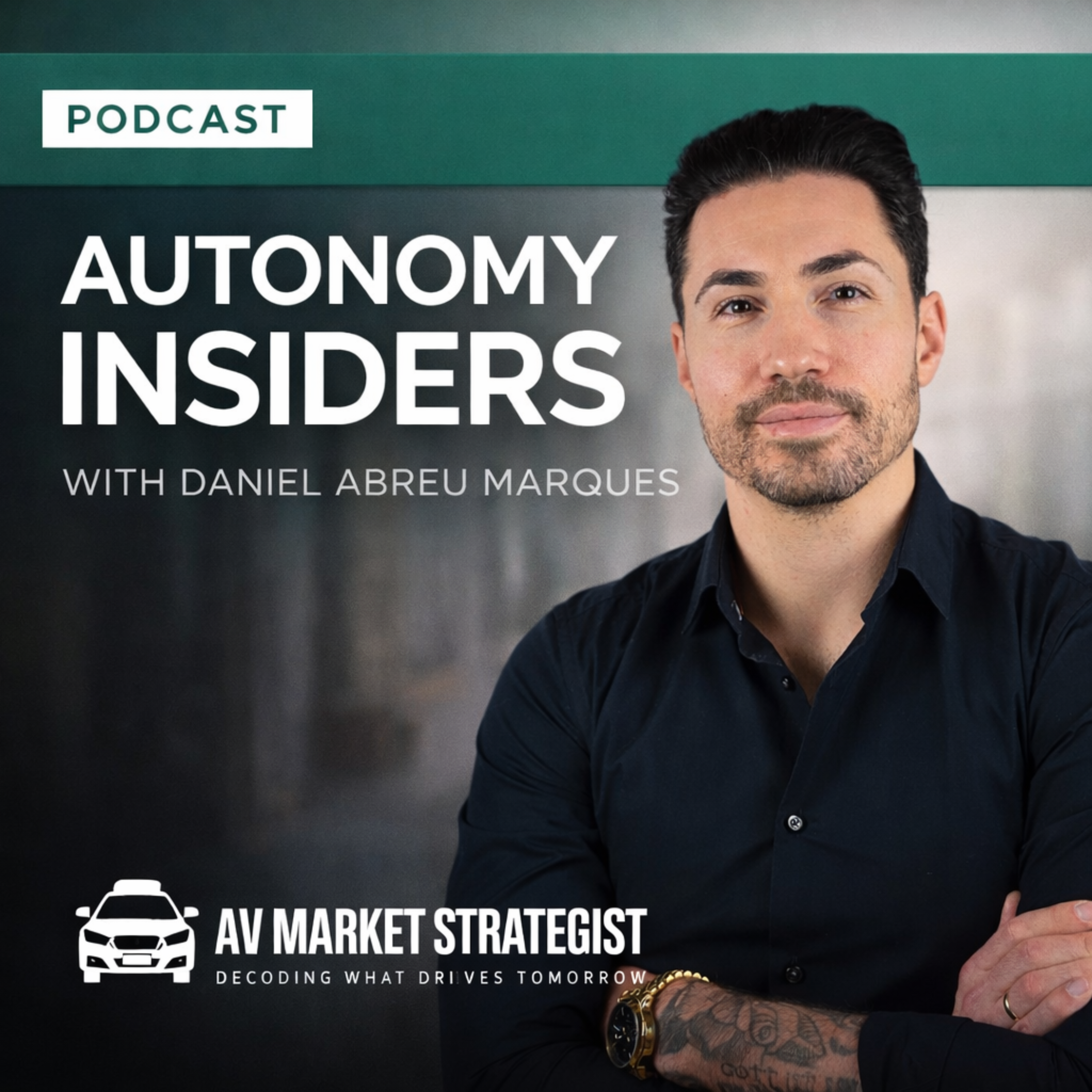
PODCAST · technology
Autonomy Insiders
by Daniel Abreu Marques
Autonomy Insiders is the weekly podcast for people who need a clear view of autonomous driving, not recycled takes.Each episode features interviews with leaders across the autonomy ecosystem: robotaxi operators, OEMs, platform players, regulators, and investors. We go deep on Europe and China, markets that are often under-covered, and we always connect back to the US so you can compare playbooks.We talk about what changes outcomes: deployment constraints, unit economics, partnership strategy, safety cases, regulation, and the real work of scaling fleets and operations. You will hear what leaders are optimizing for, where they are stuck, and what they think is coming next.If you follow autonomous vehicles, this is built for you.
-
12
Flexdrive: Lyft's Secret Weapon in Autonomous Mobility
When people talk about Lyft's autonomous strategy, the conversation usually starts and ends with Waymo. Underneath that headline sits FlexDrive, Lyft's wholly owned fleet management subsidiary and one of the most underestimated assets in the AV industry today.In Episode 9 of Autonomy Insiders, Daniel Abreu Marques sits down with John Parks, CEO of FlexDrive, to unpack how Lyft is quietly building the operational backbone for AV deployment at scale. FlexDrive runs 15,000 vehicles across 24 US locations with fewer than 200 people, which makes it the fifth or sixth largest rental car company in the US. It is now the fleet partner for Waymo's Nashville launch, the first where FlexDrive owns the depot.The conversation goes deep on what fleet management actually means in the AV era. John walks through the three commercial models FlexDrive offers AV partners, from full vehicle ownership to pure demand generation. He details the Nashville Depot's 80,000 square foot footprint, its 40+ charging stalls, and the roughly twelve months it took to build. He explains why half of the new Nashville hires are former Lyft drivers, and breaks down David Risher's claim that vertical integration delivers 20% additional cost efficiency per mile.The second half turns to Europe. John discusses Lyft's 175 million euro acquisition of FreeNow, the Hamburg MOU for Level 4 deployment, and FlexDrive's role in operating Baidu's Apollo Go robotaxis in London next year. For anyone trying to understand who keeps an autonomous fleet running once the software works, this is essential listening.Timestamps:00:00 - Introduction to Autonomy Insiders and guest John Parks00:17 - Differentiating autonomous vehicles from consumer electronics00:26 - Overview of Nashville Depot: structure and components01:06 - The underestimated importance of FlexDrive in Lyft's autonomous strategy01:34 - FlexDrive's operations, scale, and management of 15,000 vehicles02:40 - FlexDrive's growth from a rental provider to autonomous fleet management03:09 - The strategic rationale behind Lyft's acquisition of FlexDrive04:37 - How FlexDrive manages its operations as part of Lyft's ecosystem06:22 - Revenue model and responsibilities for vehicle ownership, maintenance, and charging07:18 - Different models of AV fleet operation and partnerships (Waymo, Baidu, May Mobility)08:55 - The competitive advantage of FlexDrive's integration with Lyft's marketplace09:20 - Managing demand and supply in traditional vs. AV fleet operations10:19 - Cost efficiencies driven by technology and automation, e.g., tire management11:24 - Community and employment benefits: hiring former Lyft drivers18:02 - Nashville AV depot specifics: size, infrastructure, and construction timeline19:15 - Daily operations and shifts for AV vehicles in Nashville20:47 - Incident response protocols for AVs in Nashville25:14 - Expansion plans: International growth in Europe, London, Hamburg, and regulatory challenges32:03 - Market pace and competition: FlexDrive vs. other fleet management partners33:34 - Scaling from dozens to hundreds of AVs: infrastructure and organizational needs36:16 - Building charging infrastructure and partnerships to support future growth39:02 - Common misconceptions about AV fleet operations and industry realities41:00 - Vision for FlexDrive in five years: global presence, safety, and ubiquity
-
11
Germany's Only Full-Stack Level 4 AV Startup: Inside MOTOR Ai
Germany has one company building a full Level 4 autonomous driving stack from scratch. Not an ADAS feature. Not a highway assist. A complete autonomous driver, developed in-house in Berlin.That company is MOTOR Ai, and it is pursuing EU type approval with 20 million euros in seed funding.In Episode 8 of Autonomy Insiders, Daniel sits down with Roy Uhlmann, CEO of MOTOR Ai to unpack what it actually takes to build a sovereign European AV company, why the EU's strict regulatory process is a moat rather than a drag, and why no company in the world (not even Waymo) has a type-approved Level 4 vehicle yet.Topics covered:Why MOTOR Ai owns the full value chain: software, HD maps, drive-by-wire, and technical surveillanceThe modular vs. end-to-end architecture debate and why MOTOR Ai rejected generative AI approachesHow EU type approval works and why regulators review your actual source codeWhy US AVs (including Waymo's) cannot legally operate in the EU without major reworkWhat "technological sovereignty" really means for German critical infrastructureTimestamps:00:00 - Introduction to Autonomy Insiders and today's focus on European AV regulation and strategy00:14 - Guest Roy Uhlmann introduces himself and MOTOR Ai’s mission00:23 - The European approach to safety and regulation differs from the US01:06 - Overview of MOTOR Ai’s full-stack Level 4 AV system01:42 - Mobility service and fleet deployment model02:13 - Regulation’s impact on product development in Europe03:25 - Building hardware components and HD maps in-house04:51 - Differences between OEM systems and mobility services06:09 - Ownership models for autonomous vehicles07:04 - The architectural stance: modular systems versus end-to-end neural networks08:09 - Layered safety validation process09:25 - Cost advantages of a modular approach10:07 - Sensor stack and hardware selection11:14 - Vehicle platforms tested (up to 6 meters)12:06 - Cost components and scaling considerations13:16 - European regulation’s strict safety and redundancy standards14:10 - Challenges in German and European AV approvals15:16 - Impact of AFGBV legislation and testing processes16:50 - European standards as a competitive advantage17:31 - Importance of safety-first approval processes18:53 - The role of regulation in operational safety and liability20:13 - Building systems tailored to EU market needs21:11 - Collaboration with regulators and shaping standards22:13 - What it means to be the only German Level 4 AV developer23:02 - Building independence through in-house solutions24:20 - Resilience and capital efficiency as strategic advantages25:27 - Funding and growth plans26:42 - Future roadmaps and type approval milestones27:06 - The importance of sovereignty and local hardware/software control28:13 - European market advantage and strategic autonomy29:43 - Future vision: autonomous fleets and infrastructure31:23 - Current deployment status and real-world testing environments33:35 - Local challenges like lack of GPS and varied terrain35:43 - Comparing progress with US giants like Waymo36:54 - The importance of operational readiness in autonomous driving38:18 - Vision for the next five years39:49 - Closing remarks and future outlook
-
10
AV Charging Infrastructure: How Terawatt Is Building the Physical Layer Autonomous Fleets Need
Everyone talks about the sensors, the software, and the regulation behind autonomous vehicles. But almost nobody talks about where these fleets actually charge. In Episode 7 of Autonomy Insiders, host Daniel Abreu Marques sits down with Peter Cohen, General Manager for Autonomous Vehicles and Rideshare at Terawatt Infrastructure, a company that has raised over $1 billion to build fleet charging hubs across the United States.Peter explains what it actually takes to develop a charging depot for autonomous fleets, from acquiring scarce real estate with the right zoning and grid capacity, to navigating utility timelines that can stretch beyond two years. He reveals that only 3% of the sites Terawatt evaluates survive the full filter of location, power, zoning, and fleet economics, and explains why charging infrastructure could become the single biggest constraint on how fast autonomous vehicles scale globally. Peter also shares how Terawatt works with partners like Waymo, why Uber's $100 million charging investment signals the strategic importance of this layer, how the build-versus-buy decision plays out for fleet operators, and why Terawatt is now actively looking at European cities as the next frontier. This conversation makes the case that the AV revolution will not be won by software alone. It will also be won by megawatts, real estate, and grid connections.Timestamps:00:00 - Introduction to the importance of charging infrastructure in AV scaling 00:14 - Peter Cohen explains Terawatt’s mission and services 01:06 - Why early consideration of charging is crucial for fleet operations 01:43 - Common misconceptions about AV infrastructure 02:01 - Terawatt's full-stack development of EV charging hubs 03:06 - Characteristics of a typical charging hub: size, layout, amenities 04:36 - Cost and timeline breakdown for building a charging site 05:41 - Economics of infrastructure: capex vs. operational expenses 08:12 - The low success rate of site acquisition and main constraints 09:50 - The importance of site proximity to demand centers 10:30 - Types of fleet customers and their needs 11:56 - Differences between autonomous ride-sharing and trucking sites 12:51 - Expansion prospects into hybrid fleet segments 13:50 - How customer relationships with Terawatt start 15:48 - Managing long lead times for grid connection and site planning 16:50 - Strategic pre-work with cities and utilities to streamline deployment 17:44 - Charging infrastructure as a potential industry bottleneck 19:16 - The criticality of operating reliable charging sites 22:51 - Comparing fleet charging infrastructure to data centers 25:05 - The impact of autonomous fleets owning their charging infrastructure 26:15 - First-mover advantages and potential for industry consolidation 28:15 - Why fleet operators should outsource infrastructure development 29:59 - The enormous capital needs for industry-wide charging deployment 31:02 - Europe's market readiness and expansion timeline 32:02 - Operational differences in European markets 33:27 - Site selection considerations in highly dense cities like London 35:22 - The risk of grid constraints hindering AV adoption 36:47 - Future vision of Terawatt in 2031 38:57 - Key industry misconceptions and overlooked challenges 40:27 - Why early infrastructure planning accelerates fleet scaling 41:23 - Final takeaway: proactivity in charging infrastructure planning Resources & Links: LinkedInTerawatt Infrastructure
-
9
Inside MOIA: Autonomous Turnkey Solution for Europe
In this episode, Daniel sits down with Rainer Becker, Director of Business Development at MOIA, the autonomous mobility arm of VW, to unpack how MOIA is building Europe's most ambitious autonomous ride-pooling operation. They cover: MOIA's turnkey solution model with its three pillars (autonomous vehicle, fleet management platform, and operator enablement), how the autonomous ID Buzz AD is built on the same production line as the series vehicle with deeply integrated sensors, and why MOIA is pursuing what could be Europe's first EU type approval for a driverless vehicle by 2027. Rainer walks through the current test fleet of roughly 100 prototypes across Hamburg, Munich, Austin, LA, Berlin, and Oslo, the strategic partnership with Uber in Los Angeles and how it differs from European public transport deals, and the configurable "service triangle" that balances profitability, service quality, and political transport goals for each city. Timestamps:00:00 - Introduction to Autonomy Insiders and today's guest, Rainer Becker01:00 - MOIA’s three-pillar "Turnkey Solution" - vehicle, platform, operator enablement02:15 - Evolution from Hamburg’s ride pooling to autonomous fleet integration03:45 - The significance of European type approval and homologation plans for 202704:50 - City partnerships: Oslo, Munich, LA, and Austin — setup and goals05:55 - How MOIA’s approach differs from US/Chinese markets07:15 - The importance of impactful projects to build public trust and accelerate adoption08:30 - Vehicle hardware: factory-integrated sensors and VW ID Buzz AD09:50 - The exclusive partnership with Mobileye for self-driving systems11:00 - Regulatory challenges and the homologation process in Europe12:20 - Lessons from pilot projects and the importance of large-scale impact13:35 - US partnerships, especially with Uber, and the cross-learning process14:55 - Criteria for selecting cities and local customization strategies16:10 - Current fleet sizes and deployment scale across regions17:20 - Safety driver removal timelines and testing edge cases in diverse environments19:00 - Key technical hurdles before full safety driver removal20:40 - The LA deployment with Uber and the vehicle management integration22:00 - Partnering with public transportation: focus on impact and funding considerations23:15 - Europe's innovation culture, risk aversion, and the potential for leapfrogging in AV tech24:55 - Responses to Chinese competitors entering the European market26:15 - Ride pooling optimization and customer acceptance thresholds28:00 - Building public confidence: transparency, workshops, and safety statistics30:25 - The role of public trials and demonstrating safety benefits32:00 - The importance of rational, emotion-free communication to foster acceptance33:45 - The European AV ecosystem: strengths, weaknesses, and strategies to catch up36:20 - Impact of regulatory approaches and culture on innovation pace38:15 - Concerns about international competitors and the importance of localized expertise39:55 - Scaling impact through lighthouse projects and government-funded initiatives45:00 - Proposal for Europe's accelerated adoption via impactful projects and policy support46:30 - Final thoughts: the promising future for autonomous ride pooling in Europe and beyondABOUT AUTONOMY INSIDERS: Autonomy Insiders is the podcast where global industry leaders in autonomous driving unpack their real-world insights. Hosted by Daniel Abreu Marques.Newsletter: The AV Market Strategist LinkedIn: Daniel Abreu Marques
-
8
Baidu Apollo Robotaxis in Switzerland: Inside PostAuto's AmiGo Project
In this episode, Daniel sits down with Martin Neubauer, Head of Autonomous Mobility at PostAuto AG, to unpack how Switzerland's largest public transport operator is deploying autonomous vehicles in rural and alpine regions where traditional bus services are becoming unsustainable.They cover: Why PostAuto chose Baidu Apollo as its autonomous driving partner, how the AmiGo project works with 25 Level 4 vehicles in Eastern Switzerland, the full ownership model where PostAuto controls the vehicles, operations, and all data, and why remote operators must be based in Switzerland rather than offshore.Martin walks through the real challenges of operating autonomous vehicles in Swiss conditions, including fog, snow, ice, and roads with few sensor reference points. He explains the timeline for removing safety drivers (target Q1 2027), the federal approval process with its staged safety milestones, and why the current 1:1 remote operator ratio makes a business case impossible for now. They also discuss why a direct cost transfer from China to Switzerland doesn't work, how PostAuto handles data governance and cybersecurity with a Chinese partner, and why 90% of local residents responded positively before vehicles even hit the road.Martin also shares his view on what Europe needs to move from pilots to real deployment, laying out four specific policy changes: reducing national fragmentation, stronger political commitment beyond experimentation, cross-border operations, and a harmonized type approval process.Timestamps: 00:00 - Introduction to Autonomy Insiders and today's guest, Martin Neubauer 00:17 - Overview of PostAuto's role in Switzerland's mobility system 02:37 - Why autonomous driving matters for PostAuto 03:10 - Historical context of autonomous trials in Switzerland since 2016 04:33 - Challenges of driver shortages and operational costs in rural areas 05:08 - The strategic importance of autonomous mobility in low-demand regions 06:12 - The scope and goals of the AmiGo project with Baidu 07:03 - The technical validation process for Swiss conditions 08:41 - Potential fleet size and scaling considerations for AmiGo 09:42 - Partnership selection criteria for Baidu Apollo 12:00 - Vehicle adaptations for Swiss weather and road conditions 13:33 - Testing under snow, rain, and fog for safety validation 15:08 - Timeline and milestones for removing safety drivers 16:23 - Ownership and data control of autonomous vehicles 17:15 - Cost structures: China vs. Switzerland 18:42 - Regulatory approval journey and safety standards 22:54 - The approval process and stakeholder involvement 25:15 - European market readiness and safety culture 26:05 - Future scaling plans and local integration 27:20 - How autonomous shuttles complement existing transit 28:21 - Community outreach strategies for local support 30:00 - App integration and user experience 32:27 - Europe's path from pilots to deployment 33:09 - Regulatory harmonization and cross-border potential 35:16 - Depot infrastructure and operational logistics 36:23 - The future of around-the-clock autonomous serviceABOUT AUTONOMY INSIDERS: Autonomy Insiders is the podcast where global industry leaders in autonomous driving unpack their real-world insights. Hosted by Daniel Abreu Marques, focusing on the markets others overlook: Europe, China, and the Middle East.Newsletter: The AV Market Strategist LinkedIn: Daniel Abreu Marques
-
7
Autonomous Driving in Switzerland: Regulation, Pilots, and Why Chinese Players Chose Swiss Roads
In this episode, Daniel sits down with Oliver Nahon, Director of Operations at the Swiss Association for Autonomous Mobility (SAAM), to break down what's really happening on the ground in Switzerland's fast-moving autonomous driving ecosystem.They cover: Switzerland's new ordinance on automated driving (Level 3 and Level 4), the three conditions for driverless vehicle deployment, why remote supervisors must be based in Switzerland, and how 33 autonomous vehicles have already been deployed across Swiss roads, with a target of 100 within two years.Oliver walks through the key pilot projects, including PostAuto's partnership with Baidu Apollo (25 driverless vehicles), WeRide in the Zurich region, Loxo's validated middle-mile delivery model, and on-demand autonomous shuttles in Geneva. They also discuss why Chinese AV companies are choosing Switzerland, how data compliance works under Swiss GDPR, and why Oliver believes Europe is closer to AV readiness than most people think.If you're in the AV space and near Switzerland, Daniel and Oliver will both be at the Automated Mobility Summit on May 4-5 in Zurich, the first European event with live driverless vehicle showcases.Timestamps:00:00 – Welcome to Autonomy Insiders: Exploring Swiss autonomous driving innovation00:17 – Why autonomous mobility is crucial for Switzerland’s saturated transport system01:06 – The evolution of Switzerland’s autonomous vehicle regulation and key legal pillars02:10 – The role of SAAM in fostering autonomous vehicle projects and policymaker engagement02:22 – Key pilot projects: From Navia shuttles to driverless logistics solutions03:56 – Regulatory specifics of Switzerland’s ordinance: level three, driverless vehicles, and remote supervision04:48 – How remote supervision in Switzerland enhances safety and jobs05:41 – Collaborations, pilot projects, and the path to large-scale deployment10:34 – Active pilot projects across Switzerland and their use-case diversity13:04 – Business models behind autonomous shuttle and logistics solutions15:22 – Autonomous buses, on-demand shuttles, and future urban mobility scenarios18:17 – Transition from free pilot trials to commercial fare-based services19:01 – Influence of Chinese AV players like Baidu and WeRide in Switzerland’s ecosystem20:48 – Why Swiss regulatory and innovation landscape is attractive for international companies23:20 – Data regulation, privacy, and GDPR compliance in Swiss autonomous vehicle projects25:39 – Public transport operators’ perspectives and the job impact of AVs in Switzerland29:14 – Europe’s AV ecosystem: current status, challenges, and the potential for harmonization34:29 – The outlook for 2026: European milestones, new associations, and major events like the Zurich Summit37:38 – Final thoughts: Building a collaborative autonomous mobility future in EuropeABOUT AUTONOMY INSIDERS: Autonomy Insiders is the podcast where global industry leaders in autonomous driving unpack their real-world insights. Hosted by Daniel Abreu Marques, focusing on the markets others overlook: Europe, China, and the Middle East.Newsletter: The AV Market Strategist LinkedIn: Daniel Abreu Marques
-
6
$41 Billion in Physical AI: What Investors Need to Know About Robotaxis & Humanoid Robots
AI is leaving the screen and entering the real world.In this episode, Martyn Briggs, Director at Bank of America Global Research, breaks down what "Physical AI" actually means, why $41 billion was invested in it last year, and what comes next.We cover:World models and the shift from generative AI to physical AIWhy vehicles are being redesigned as robotic platforms, not mechanical onesThe 158+ active robotaxi deployments worldwide and the path to commercial scaleHow to value AV companiesChina vs. the US: two very different playbooks for scaling autonomyWhy Uber, Lyft, and others are locking in AV supply through offtake dealsCould AV fleets be financed like REITs?Humanoid robots entering automotive factories, and why OEMs could become producers, not just buyersThe bottlenecks that could slow everything down: regulation, vehicle supply, public acceptanceTimestamps:00:00 - Introduction to physical AI and autonomous driving02:00 - Defining physical AI: perception, reasoning, action in the real world04:00 - Technologies enabling physical AI: sensors, models, edge compute06:00 - World models: what they are and their importance beyond GPT-like models08:00 - Who leads in developing world models: startups vs. hyperscalers10:00 - From software-defined to AI-defined vehicles: design implications for OEMs12:00 - Supply chain and chip ecosystem shift towards centralized compute14:00 - Cross-industry transfer: trucks, mining, agriculture, defense16:00 - Commercial deployment pace of robo-taxis and delivery vehicles18:00 - Valuations and investment metrics for AV companies20:00 - Cost reduction trends in sensors, especially LiDAR22:00 - China's rapid scaling of AVs and international geopolitical implications24:00 - International expansion and regional regulatory differences26:00 - Valuations: milestones and fleet economics28:00 - Asset light vs. asset heavy models: pros and cons30:00 - Private ownership and shared mobility convergence32:00 - Financing, autonomy REITs, and infrastructure investments34:00 - Broader applications: humanoid robots in factories and logistics36:00 - Overlap between automotive and robotics supply chains38:00 - Commercialization challenges: regulation, energy, consumer acceptance40:00 - Future tech: simulation, synthetic data, accelerating deployment45:00 - Key players in humanoid robotics and their strategic moves48:00 - Cost trajectory for humanoid robots and industrial applications50:00 - Business models: leasing, service, and integration strategies52:00 - Critical constraints for autonomous driving: regulation, energy, public acceptance55:00 - Major innovations to watch: simulation and synthetic data56:00 - Final thoughts and upcoming innovations in physical AIABOUT AUTONOMY INSIDERS: Autonomy Insiders is the podcast where global industry leaders in autonomous driving unpack their real-world insights. Hosted by Daniel Abreu Marques, focusing on the markets others overlook: Europe, China, and the Middle East.Newsletter: The AV Market Strategist LinkedIn: Daniel Abreu Marques
-
5
Autonomous Driving Chips: Tesla, Xpeng, Rivian and the In-House Revolution
Most automakers are racing to master the most critical component of autonomous driving: the semiconductor. Augustin Friedel, Associated Partner at MHP and an expert in software-defined vehicles, advanced driver assistance systems, and AI-enabled mobility, exposes how industry giants like Tesla, Rivian, and Chinese OEMs are not just buying chips—they’re designing their own to unlock better performance, lower costs, and greater control. But what does it really take to build a competitive chip program? And why are industry-wide collaboration and strategic control points the future of automotive silicon? In this episode, Augustin breaks down the complex landscape of chips powering tomorrow's vehicles. You'll discover why high-performance systems on a chip (SoCs) are vital to processing the massive amounts of sensor data—LiDAR, radar, cameras—that autonomous vehicles rely on for real-time decision-making. We delve into the competitive dynamics among global chip providers—Nvidia, Mobileye, Qualcomm—and how regional geopolitics shape the supply chain. Augustin reveals why automakers are increasingly pushing toward in-house chip development, with companies like Xpeng and Rivian seeking to reduce dependency on Western suppliers, while others form joint ventures to share the hefty R&D costs.Why does chip scarcity shape strategic decisions? Augustin discusses the wake-up call from the recent semiconductor shortages and what it means for securing supply chains in an uncertain geopolitical climate. Plus, he explores the evolving role of Tier 1 suppliers, the ecosystem lock-ins created by software layers, and the choice OEMs face between vertical integration and modular solutions.Get ready to understand the race for automotive silicon leadership—because in autonomous driving, chips aren’t just components, they’re the foundation of the future.Timestamps00:00 - Introduction to the role of chips in autonomous driving00:17 - Why OEMs are driving in-house semiconductor programs01:53 - What is a System on a Chip (SoC) and why is it critical?03:08 - The importance of high-performance chips for self-driving cars04:00 - Criteria for choosing autonomous driving chips: performance, energy efficiency, thermal management07:12 - Major players in autonomous driving computing platforms besides Nvidia08:20 - Regional differences in chip providers: Nvidia, Mobileye, Chinese local players09:23 - Distinguishing between SAE Level 2+, Level 3, and Level 4 chips10:31 - Cost considerations and chip price ranges for autonomous vehicles11:44 - Why OEMs are developing in-house chips (Tesla, Rivian, Xiaopeng)13:16 - The role of scale and volume in chip design investments15:22 - Vertical diversification: robotics and other verticals feeding into chip strategy16:27 - Competitive landscape: Will Nvidia and Mobileye maintain dominance?18:17 - Software ecosystems and integration lock-in effects in chip selection20:38 - OEMs' differentiation strategies: performance, cost, supply security22:43 - Market penetration of high-performance chips in current global vehicle fleets24:16 - Regional differences: China’s lower-speed focus and localized chip strategies25:27 - The geopolitical aspects of in-house chip development in China33:33 - Ecosystem of semiconductor design: TSMC, foundries, and supply chain dependencies36:41 - Can OEMs produce chips entirely in-house? The necessity of foundries like TSMC37:45 - Why smaller node sizes (4nm vs 6nm) matter for performance and energy efficiency39:24 - The challenge of selecting the "best" chip for Level 4 autonomous vehicles41:18 - Strategic questions for OEMs: build, partner, or buy?44:54 - Final thoughts: navigating the complex semiconductor landscape for sustainable growth
-
4
Inside Bolt's Autonomous Strategy: 100K Robotaxis for Europe's Streets
Charlotte Eisner, Head of Commercialization and Partnerships at Bolt, joined Daniel Abreu Marques on Autonomy Insiders to discuss Bolt's autonomous strategy, strategic partnerships with Pony AI and Stellantis, and their ambitious plan to deploy 100,000 autonomous vehicles across Europe by 2035. The operational backbone of Bolt’s strategy is leveraging strategic partnerships and policy expertise to overcome the challenges of homologation and regional disparities in autonomous vehicle adoption. By collaborating with Pony AI for software and Stellantis for vehicle platforms, Bolt aims to create a scalable, safe, and efficient autonomous fleet without building its own technology from scratch.In the field, Bolt is rigorously preparing to apply its strategy across various European cities, navigating complex regulatory environments and ensuring data sovereignty. Bolt’s approach focuses on creating a seamless integration of autonomous technology into urban mobility, enhancing safety and operational efficiency.Looking ahead, Charlotte envisions a future where Bolt's autonomous fleet significantly contributes to making cities more livable, reducing the number of vehicles on the road, and providing sustainable mobility solutions. This evolution aims to transform urban transportation by integrating autonomous vehicles into everyday life, enhancing safety, and providing efficient mobility options.Chapters00:00 Intro00:44 Introduction Guest05:06 Charlotte's Mission in Mobility09:33 Challenges in the European Autonomous Vehicle Market12:44 The Global Context of Autonomous Vehicles25:36 Bolt's Strategic Intent in Autonomous Driving30:02 Bolt's Ambitious Goals for Autonomous Vehicles34:59 The Power of Demand and Data36:43 Navigating Regulations and Market Complexity40:43 Strategic Partnerships and Technology Integration41:59 Addressing Data Sovereignty Concerns46:03 Collaborating with Stellantis for AV Platforms48:33 Liability in Autonomous Vehicle Operations50:15 Preparing for City Deployments53:16 User Experience in Autonomous Rides55:30 The Role of ECAVA in European Mobility58:42 Europe's Position in the Global AV Landscape01:00:52 Future Projections for Autonomous Rides01:03:18 Summary & Closing Thoughts
-
3
Welcome to Autonomy Insiders
Welcome to Autonomy Insiders!Autonomy Insiders goes behind the headlines of the autonomous vehicle industry. Your Host Daniel Abreu Marques talks to the leaders shaping AV, with a special focus on the markets most media ignores.
We're indexing this podcast's transcripts for the first time — this can take a minute or two. We'll show results as soon as they're ready.
No matches for "" in this podcast's transcripts.
No topics indexed yet for this podcast.
Loading reviews...
ABOUT THIS SHOW
Autonomy Insiders is the weekly podcast for people who need a clear view of autonomous driving, not recycled takes.Each episode features interviews with leaders across the autonomy ecosystem: robotaxi operators, OEMs, platform players, regulators, and investors. We go deep on Europe and China, markets that are often under-covered, and we always connect back to the US so you can compare playbooks.We talk about what changes outcomes: deployment constraints, unit economics, partnership strategy, safety cases, regulation, and the real work of scaling fleets and operations. You will hear what leaders are optimizing for, where they are stuck, and what they think is coming next.If you follow autonomous vehicles, this is built for you.
HOSTED BY
Daniel Abreu Marques
CATEGORIES
Loading similar podcasts...
URL copied to clipboard!