
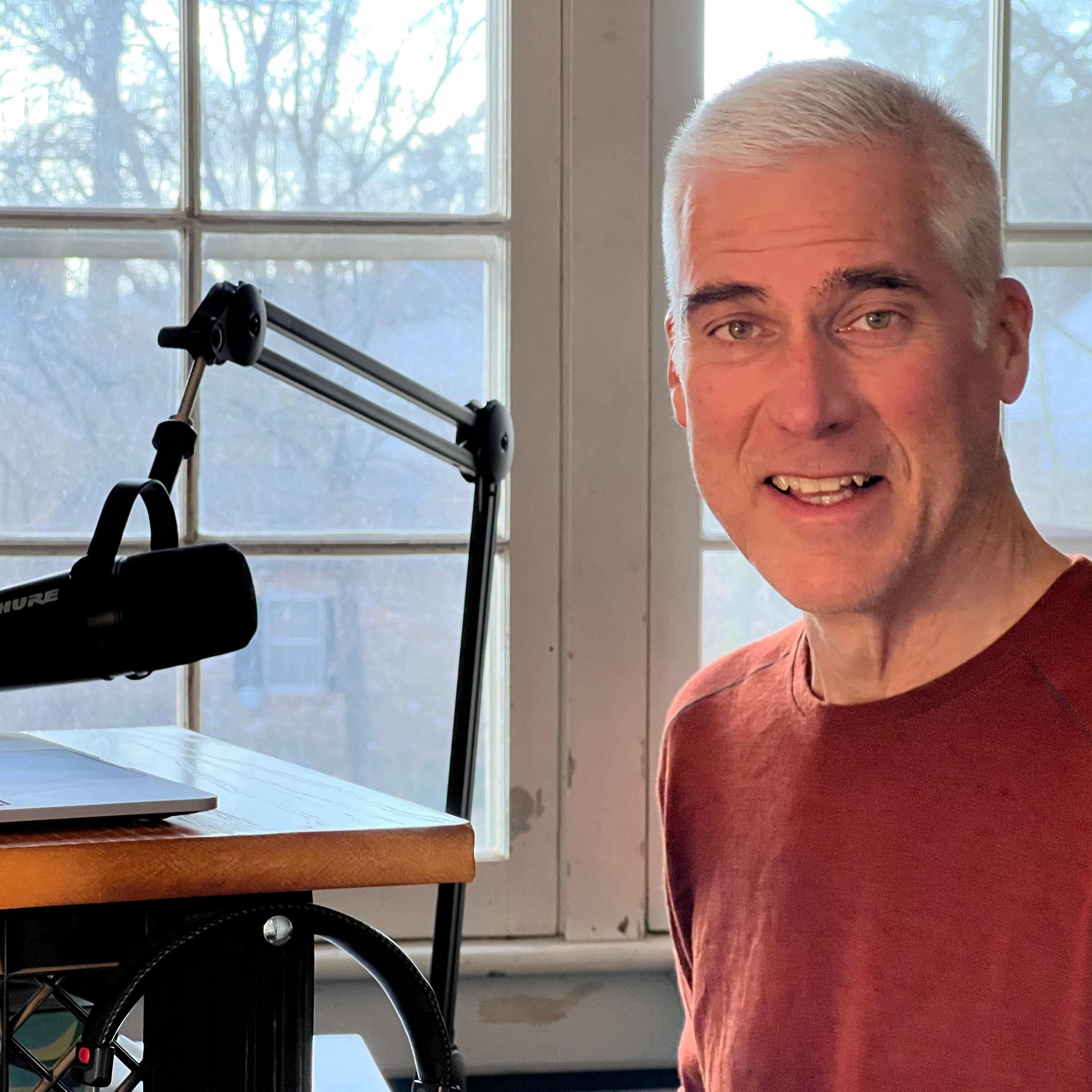
PODCAST · business
Becoming a More Conscious Leader Podcast
by Gregg Kendrick
Insights & guidance to become a more conscious leader, a way of leading that values the dignity of human beings & of life. greggkendrick.substack.com
-
9
Embracing the living energy of human needs
Audio Clip Highlight“We’re not after the meaning of life. We’re after the rapture of the experience of being alive.”—Joseph CampbellThe process of practicing Needs-Based Communication (NBC) invites us to a place where we energetically connect to aliveness, and can express from that aliveness. The process invites us to embrace whatever aliveness is within us, that flows from human needs, whether it be joy … or anguish. Whenever we are willing to embrace it, to be with it — even when it is painful —there’s an expansiveness that happens within us. We’re connecting to life, and life draws us out the other side. We are nurtured and emerge in a more refreshed, alive state.It completely eliminates the sense that there are “positive” and “negative” emotions.Becoming a More Conscious Leader is a reader-supported publication. To receive new posts and support my work, consider becoming a free or paid subscriber. Get full access to Becoming a More Conscious Leader at greggkendrick.substack.com/subscribe
-
8
Embodying the Energy of Human Needs
Audio Clip HighlightThe potency of Needs-Based Communication is its capacity to move us toward human connection. Initially, by using a language that is free of blame, focusing on words pointing to somatic feelings and human needs.And more deeply, by expressing from the embodied energetic fullness of the life-serving need.Becoming a More Conscious Leader is a reader-supported publication. To receive new posts and support my work, consider becoming a free or paid subscriber. Get full access to Becoming a More Conscious Leader at greggkendrick.substack.com/subscribe
-
7
What is Needs-Based Communication?
Needs-Based Communication,* aka Nonviolent Communication™ or NVC, is a potent process that can support us when we are having — or need to have — challenging conversations that matter to us ...* like giving authentic feedback to a co-worker or friend,* or listening to someone at work or at home when we disagree with what they are saying,* or how we respond when we perceive ourselves as being "attacked" in a conversation,* or expressing clearly our personal or professional boundaries when a colleague or friend has stepped beyond them,* or what we do when we feel anger rising in ourselves and we know we will likely regret the words we are about to say,* or when we've just expressed something in a conversation or meeting that really matters to us, but no one seems to have heard us,* or when we're too scared to speak up at all.Needs-Based Communication (NBC) guides us to move beyond blame.* To recognize our own reactivity.* To understand our reactivity in terms of what matters to us.* To see another person's reactivity in terms of what matters to them.In this new way of perceiving the situation, we are better able to respond consciously in a way that is likely to create mutual understanding.In that understanding, we can make choices and take actions that are more likely to support all of us in moving toward what matters to each of us.NBC enhances our human connection with others — and with ourselvesHere are some of the skills and benefits of using Needs-Based Communication in the workplace ... or at home:* listening — so that the other person has an experience of being heard, even if we don't agree with what they are saying* empathy — the basis of care and compassion — recognizing the weird ways that we unconsciously ask for empathy* expressing disagreement without blame — an integral skill of conscious feedback and mutual accountability* recognizing our own unconscious reactions and limiting beliefs — these are what diminish our relationships and effectiveness, especially as leaders* seeing conflict as something to be harvested, not avoided — learning to "lean into" conflict instead of away from it, learning to hear the underlying essence of what matters to the people involvedNBC invites us to expand our perception, so that we see ways to bring connection amidst conflict.At the core of this expanded perception is the skill to focus our attention on the underlying human needs that are seeking to be nurtured in any moment, both within ourselves and within the people around us.In every moment, we are each trying to fulfill our own human needs.These underlying human needs are the motivation for our actions and our words ... the "why" behind what we do or say. Because we all share the same human needs, when we bring them into explicit focus, they tend to stimulate understanding and draw us closer in connection.The potency of NBC is in its pragmatic simplicity.There are FOUR PARTS of Needs-Based Communication:* Observations, free of evaluation* Feelings, free of thoughts* Human Needs, free of strategies* Requests, free of demandsAnd there are FOUR CORE SKILL SETS of Needs-Based Communication:* Enhanced awareness of our own reactivity … and choosing to pause* Connecting to our own feelings and human needs* Authentically expressing our own feelings and needs* Empathically listening to the feelings and needs of othersThe first two of these skill sets focus on our own internal self-connection. These are the core skills that enable us to show up differently, and are a required first step before we are ready to create the connection we desire with others.The last two of these skills sets focus on how we interact with others.In any moment, including a moment of conflict, there are two ways to enhance connection & understanding with another person:* authentically express our own feelings & needs, or* empathically listen to the feelings & needs of the other.These are radically different choices than we are accustomed to experience when we are in conflict or in a reactive state: namely, the unconscious reactions of “fight, freeze or flee.”An example of an authentic expression might look like this:“When I see you look down at your phone and begin typing in the midst of our conversation, I feel surprised and disappointed because I value mutual consideration. Would you be willing to connect with me before you begin a message on your phone?”Or like this:“When I remember you saying ‘don’t be stupid,’ I feel upset because I want understanding. Would you be willing to share how you feel hearing what I’m saying?”Note the structure of observation, feeling, need and request.An example of an empathic listening guess might sound like this:“Are you angry because you value mutual respect?”Or this:“Are you disappointed because including everyone in the conversation matters?”Note the structure of guessing a feeling and a need that the person might be experiencing.As a final distinction about what Needs-Based Communication is, I want to be clear what it is not ...* NBC is not about being nice; it's about being real. The human connection it creates is both gentle and fierce.* NBC is not about stifling intensity, but transforming it.* NBC is not about changing other people or getting them to do what we want. It's about changing ourselves, so that we inspire the quality of communication and relationship that we want.* NBC is not a technique or formula. It's a process that helps guide our consciousness to a new awareness around human needs.The challenge of NBC is to overcome our cultural conditioning.While simple in concept, Needs-Based Communication is often challenging to embody because we are so deeply conditioned to perceive each other through judgments and blame.The concepts themselves can be learned in a one- or two-hour workshop session, or by reading a book, such as "Nonviolent Communication: A Language of Life," by Marshall B. Rosenberg.But the true potency of Needs-Based Communication is in its power to not only transform our language, but to transform our perception of and energetic connection to the human beings around us and the human being within us. This level of embodiment of NBC is a mindfulness practice — not unlike practicing yoga or a martial art like Aikido — that requires consistent practice over time to develop the fullness of the skills, awareness and consciousness implicit within it.We designed the Conscious Leader Program to be a structure and a community to support people who want to deepen their embodiment of the Needs-Based Communication process, especially in the context of leading groups or teams (or families or classrooms, etc.). The first course within the Program focuses on the foundations of NBC. Typically, participants “spiral” through the course multiple times, each time practicing and applying the skills at ever deeper levels of awareness and embodiment.Learning the foundations of NBC involves:* Owning our own reactivity by being aware of it, choosing to pause, and transcending the underlying reactive thinking that is the source of it.* Owning our own feelings and needs by being aware of the many ways that our language makes it easy to unconsciously interject blame and judgments into our conversations — and transforming what we say to stimulate human connection through an authentic expression of our own feelings and needs.* Owning our own choices by being aware of language that denies our own autonomy — and transforming what we say to honor our autonomy and ignite our self-empowerment.* Supporting other people to own their own reactivity, feelings, needs and choices through the extraordinary and rare skill of empathic listening.* Expanding our somatic awareness and our vocabulary of body sensations, feelings and human needs — learning to engage and trust our “right-brain.”As you gain competence in these foundations, the goal is to have ease and confidence in creating strong human connection in most of the conversations and situations that you encounter.* Needs-Based Communication (NBC) is based on the work of Marshall Rosenberg, which he called "Nonviolent Communication™" or NVC.I have chosen to call the process Needs-Based Communication (NBC) for two reasons:* First, human needs are the heart of the process.* Secondly, I have wanted to avoid the common initial reaction from people in organizations that "... we're not a violent place."Within this publication and in related references, any of these names or acronyms may be used, and they all refer to the same process.Gregg Kendrick has been a Certified CNVC Nonviolent Communication™ Trainer since January 2006.Becoming a More Conscious Leader is a reader-supported publication. To receive new posts and support my work, consider becoming a free or paid subscriber. Get full access to Becoming a More Conscious Leader at greggkendrick.substack.com/subscribe
-
6
Reactive Emotions are a "red-light" signal
Common wisdom often suggests “don’t make a decision from your emotions.” But it is a disservice to emotions to lump them all together and to say a blanket statement like that.Certain emotions — namely anger, guilt and shame — indicate that we are in a reactive state. They serve as a “red-light” warning that if we speak or act from this reactive state, we are likely to stimulate fear and diminish the relationships around us, including the connection with ourselves.“When you make a decision out of anger, guilt or shame, rarely will you meet the needs of anyone — not your needs, not the needs of the people around you, not the needs of the organization.”The Needs-Based Communication process invites us to be conscious of our reaction, and to process it and to express it with its full potency, but in a connected way (from our underlying human needs) rather than a disruptive way (from our reactive thinking).When we connect to the quality of being alive within the energy of human needs (e.g. being seen, being heard, etc.), we connect to something bigger: the life-force that holds and connects us all. Thanks for reading Becoming a More Conscious Leader! This post is public so feel free to share it.Becoming a More Conscious Leader is a reader-supported publication. To receive new posts and support my work, consider becoming a free or paid subscriber. Get full access to Becoming a More Conscious Leader at greggkendrick.substack.com/subscribe
-
5
A Program to Nurture the "Conscious Leader" in All of Us
updated Tue Feb 24, 2026A New Spiral of Learning is about to begin …Are you ready to take action to become a more conscious leader?Summer 2026 Cohort of the Conscious Leader Program | June 10 - Sep 9The next 13-week spiral in the journey to deepen skills & mindsets of conscious leadership within a mutually supportive learning community ... begins June 10th!It meets weekly on Wednesdays from 1:00pm to 2:20pm EDT (6:00pm to 7:20pm BST; 10am to 11:20 PDT). Enroll by Wed June 3rd!How you show up in your day-to-day conversations and interactions matters. It has impact on the way other people show up around us. Whenever we use language that has even a nuance of blame or guilt in it, then we instill fear, reaction and resistance in the people around us.And yet, the common language that each of us uses every day is typically filled with judgments and blame, whether we intend it or not.We are all called to leadWhen I use the word “leader” in the title of this article, I mean it in the broadest sense. We are all called to lead in different ways, in different aspects of our lives … as parents, as coaches, as teachers, as head of a committee or a social group. Of course, we also choose to accept more clearly designated leadership roles within workplaces or government: project leader, team leader, supervisor, manager, director, Executive Director, CEO, or board member.And — what may be the hardest leadership role of all — each of us is called to be the leader of our own beings. Taking responsibility for how we show up.The default cultural model of leadership is “Domination” leadershipFor hundreds of generations including our own, we have been conditioned to a “domination” mindset of leadership that puts the needs of one human being above another. Whomever the person in power — the king, the boss, the teacher, the parent, the priest, the government official — their choices and their will are imposed on those they lead.Over the millennia this domination mindset has been built into our language, our thinking, our culture, our families, our institutions, our laws, our policies — perpetuating the mindset so that it becomes pervasive, invisible and subconscious. We say “that’s just the way the world is” … “that’s just what a leader is.”“Conscious” leadership sees another way.A way based on trust and care, rather than blame, guilt and fear.In the political and business landscape we live in today, I believe there has never been a more critical moment to demonstrate that there is a different way to lead. A way that values the dignity of people while also valuing fulfillment of purpose and sustainability. A way that refuses to coerce or manipulate or harm to get what we want, and instead inspires by connecting to what matters. A way where people expand and come alive into their highest potential rather than contract in fear.My yearning is to build a nurturing community of conscious leader practitioners to enliven this journey for all of us.A place that stimulates each of us toward new self-awareness and pragmatic skills that have real impact on how we each show up as a leader. A place where each of us can interact with others who share our quest and develop mutually supportive relationships. A place that becomes a living example of the consciousness and culture we each want to create within our own team or group.The core of this nurturing community we are building is the Conscious Leader Program.In 2024, we created a new evolution of the Conscious Leader Program that harvests the wisdom and learnings from our experiences over the last three decades, both in content and in structure.Here are a few highlights:* An expanded intended audience to include the broadest sense of “being a leader.” Though originally designed for leaders within workplace settings, it is equally applicable to leaders in other social settings as well: in the family (parents, partners), in schools (teachers, coaches), in community groups, etc.* Publicly available to individual leaders. Formerly available in its full form only privately within workplace organizations, it is now available as a public offering so any individual leader can enroll and participate.* Fueled by the potency of human needs as a catalyst for transformation. Needs-Based Communication* (aka Nonviolent Communication™ or NVC) continues to be at the heart of every aspect of the Program.* Organized in 3-month (13-week) “terms.” Each Course or Spiral within the Program lasts 13 weeks. You can choose to take only one course/spiral, or several. You can choose to continue in a consecutive term, or pause until you are ready to continue.* Active engagement in a Conscious Learning Community. A "cohort" is a community of people who meet weekly at the same time and day of each week. Each cohort includes members with different levels of skills and experience. The community itself becomes an environment of trust and mutual support that invites authenticity and vulnerability which accelerates your development.* Weekly 80-min group facilitator-led sessions. Interact weekly in-person (via zoom) with your specific learning community of peers and experienced practitioners. Plan to spend another 80-90 minutes each week in prep or practice activities.* An online portal provides access to discussion groups, learning materials, recordings of live in-person sessions, and a step-by-step process of activities for each session of the Course.* Bonus Benefits* Monthly facilitator-led Group Coaching calls on zoom.* Complimentary 3-month paid subscription to this publication and community on Substack: Becoming a More Conscious Leader* Program pricing is structured as a monthly subscription with monthly fees between $150 (Four-Term Plan) and $180 (One-Term Plan).* Special Discount for new participants in the CLP program: For new participants in the CLP program, we are offering a 17% DISCOUNT on Course 1 within the Program’s One-Term Plan. That reduces the monthly fee from $180/mo to $150/mo for the 3-month term of the course.* Use this Coupon Code to receive the discount when enrolling: COURSE1WELCOME* NEW! A scholarship may be available for the Summer 2026 Cohort. The funding, provided by the Weingarten Fund, will provide a partial scholarship for participants in the CLP who are in need of funding in order to participate.* Note: I don't want the cost of the program to be a barrier to participating in it. If it is a good fit for your needs, I am open to exploring creative options to make the finances work.A New Spiral of Learning is about to begin …Are you ready to take action to become a more conscious leader?Summer 2026 Cohort of the Conscious Leader Program | June 10 - Sep 9The next 13-week spiral in the journey to deepen skills & mindsets of conscious leadership within a mutually supportive learning community ... begins June 10!It meets weekly on Wednesdays from 1:00pm to 2:20pm EDT (6:00pm to 7:20pm BST; 10am to 11:20 PDT). Enroll by Wed June 3rd!I invite you to enroll.Have a look at the details of the Conscious Leader Program to see if it is a good fit for you. We would love to have you as an active participant in our Conscious Leader community.And if you know someone who might be a good fit for the Program, I encourage you to share this post with them.Have questions or want to talk in person about the Program?I invite you to attend a monthly live in-person information session focused on the "Conscious Leader Program: Q&A with Gregg.”* Thu Apr 30 | 1:00 PM - 1:50 PM EDT* Thu May 28 | 1:00 PM - 1:50 PM EDTOr contact me directly …Future Cohorts Dates …* Fall 2026 Cohort | Sep 9 - Dec 16 * Winter 2027 Cohort | Jan 6 - Mar 31* Spring 2027 Cohort | Mar 31 - Jun 23* Needs-Based Communication (NBC) is based on the work of Marshall Rosenberg, which he called "Nonviolent Communication™" or NVC.I have chosen to call the process Needs-Based Communication (NBC) for two reasons:* First, human needs are the heart of the process.* Secondly, I have wanted to avoid the common initial reaction from people in business that "... we're not a violent place."Within this post and in related communications, any of these names or acronyms may be used, and they all refer to the same process.Gregg Kendrick has been a Certified CNVC Nonviolent Communication™ Trainer since January 2006.Becoming a More Conscious Leader is a reader-supported publication. To receive new posts and support my work, consider becoming a free or paid subscriber. Get full access to Becoming a More Conscious Leader at greggkendrick.substack.com/subscribe
-
4
My Adventure on Substack Begins …
I am thrilled and a little nervous as I launch this publication on Substack.Thrilled because I yearn to shine the light on the beauty and the potency that I have experienced in over two decades of supporting leaders to become more conscious leaders and to create more conscious cultures.Thrilled because I sense a hunger for hope and for a stark alternative to the fear-based domination leadership that seems to be rising at the top levels of business and political leadership around the world.Thrilled because I want to be a catalyst of community and of learning for those who want to embrace this journey of becoming a more conscious leader.And finally, I am thrilled because Substack is a platform that celebrates and supports the direct relationship between a writer and those that subscribe to the writer’s publication. I experience a trust through that relationship that enlivens me. A trust that is rare among public social media platforms.My nervousness stems from embarking on this new activity of writing and posting publicly on a consistent basis. Something I haven’t done since I was the “Feature Article Editor” for a weekly newspaper in Greene County, Virginia, shortly after graduating from college, over 40 years ago. I knew back then that I wanted to be a writer, but I sensed it would be something I would come back to after I had enough life experiences to have something to write about.Well, now would be that time. I feel full with things I want to share now.Another part of my nervousness is that I feel changes going on in my body, changes that are easy to attribute to aging. I feel a few pangs of doubt … that I won’t be able to articulate with the ease, the clarity and the fullness that I would like.And yet, I realize that I can only express from where I am, and this is a journey that matters to me, so here I go!Thanks for reading Becoming a More Conscious Leader! This post is public so feel free to share it.Becoming a More Conscious Leader is a reader-supported publication. To receive new posts and support my work, consider becoming a free or paid subscriber. Get full access to Becoming a More Conscious Leader at greggkendrick.substack.com/subscribe
-
3
Conscious Terminations
In my prior business, a colleague stepped into my office and said, “Gregg, I thought you’d want to know this. I just overheard John telling another employee that he didn’t make any sales calls yesterday & has no intentions of doing anything this week.”At the time, John was one of three salespeople for the office, and he was the most experienced of the three. John & I had had a conversation a few days earlier where he requested time off with pay, even though he had used all of his vacation & personal leave days.I offered that he was welcome to take the days off, but declined his request for them to be with pay because I wanted our policies to be mutually applied to everyone. I didn’t want certain people to get privileges that others did not get. John had left my office visibly disappointed and angry that his request was not granted. He said he had worked hard and deserved recognition for his work by getting some days off with pay.So now, as I reflected on the words of my colleague, I was observing what was going on in me. I was angry.I was telling myself “How can he do this kind of crap at a time when we really need some sales?! … So I’m paying him to sit back there and tell other people that he’s not going to do anything?! … that S.O.B. … can’t he see the bigger picture?! … I don’t have time for crap like this! … He’s got to go! …”I could have acted out of the anger that I felt, and he likely would have been fired and out of the building within a few minutes.In my anger I would have voiced my judgments of him, fired him, and ended our mostly positive four-year relationship — and lose our most experienced salesperson. And it likely would have led to diminished trust and increased fear among other staff as well.But I didn’t.Instead as I was aware of my anger, and the rush of heat & punishing energy that was flowing through my body, I paused long enough to remember: “anger is an alarm … a warning that I am not connected to my needs.” I realized I had a choice as to what to do next. But what is my need? I struggled to become aware of it, but it came.I needed understanding for how hard it was to keep the business sustained in the midst of an industry recession … I wanted solidarity in our mission … I needed trust that everyone was engaged in the task at hand.As I focused on these needs, I noticed my feelings of anger were gone, replaced by disappointment and concern.It was at this point that I asked John if he would join me for a conversation. Once he sat down, I shared what my colleague had said, and let him know that I wanted to understand what was going on. He told me he was still angry about the earlier conversation we had had … how he wanted recognition for the years of work he had contributed to the organization in this very simple way: 2 days off with pay.I said, “So you want recognition for the years of service you’ve had here. You want to know that your work is valued and appreciated. Is that right?”“You bet. And all I want for it all is a measly two days off with pay. That’s all.”“So you want to trust that your work here is valued, and what would really help you have that trust is if you could get 2 days off with pay.”“That’s right!”I asked him, “Is there anything more that you want me to hear?”“I guess that’s it … I just want two days off with pay.”I paused a few seconds to see if he had anything to add. Then I said, “John, when I hear your request for two days off with pay, I feel a knot in my stomach because I want our policies to apply to everyone mutually. I don’t want certain people here to have privileges that aren’t available to everyone. … Would you tell me what you’re hearing me say?”“You’re saying you don’t value my work enough to give me two measly days off.”“Thanks for telling me what you heard. I’m wanting to express something different than that. It’s about me, not you. It’s about how I’m feeling tied in knots because I value mutuality here in our workplace. … Are you hearing that it’s about me?“Yeah,” he paused for a moment. “That you want the rules to apply the same to everybody.”“That’s it. And I get worried if it sounds like somebody is getting special privileges because I value a workplace where the rules are applied to all.”“I hear what you’re saying, but it still seems like a pretty small request …”“Do you want understanding that your request is reasonable, in fact, more than reasonable?“Yeah, I mean I’m not asking for a pay raise or a company car … just two days off with pay.”“Well, I’m wondering if you would be willing to explore with me if we can find a way to meet both your need for recognition of your value here, and my need for the rules to be applied mutually. Would you be willing to try that? …”————Notice how different this dialogue is than the one where I might have fired him out of anger … which, by the way, I had done on a number of occasions in my 19-year tenure as CEO of my company.When we develop the skills to notice our triggers of disconnection and consciously choose to connect to the mutual needs involved, then everyday workplace situations like the example above become transformative moments of heightened mutual understanding and trust.As it turned out with the example above, it became increasingly clear to me over the next few weeks that John fulfilling the role of salesperson was not working out, and I chose to terminate the employment relationship with John only three weeks after the above conversation.But when that happened, it came from a place of sadness and disappointment, not anger. I was also able to give space to hear John’s reaction, and to hold John’s needs as he transitioned to a new workplace. Though that work relationship ended, we have remained in contact over the past six years where we have explored other potential work relationships together and referrals into other workplaces. The relationship is still strong.(Originally published on medium.com on Feb 24, 2020)Thanks for reading Becoming a More Conscious Leader! This post is public so feel free to share it.Becoming a More Conscious Leader is a reader-supported publication. To receive new posts and support my work, consider becoming a free or paid subscriber. Get full access to Becoming a More Conscious Leader at greggkendrick.substack.com/subscribe
-
2
The Often Unseen Human Need for Empathy
How does the human need for empathy show up in the workplace?I facilitated a conversation recently among a group of seven nurses and CNAs, along with the nursing supervisor and nursing director. It is a group I’ve been meeting with twice a month for about six months.The intention of the meetings has been to invite them to take ownership of co-creating the culture they want, to take responsibility for how they are showing up, especially in those moments of reactivity in themselves or in the people with whom they work.At one point, a nurse said “I wasn’t going to speak, but I just need to say this … when I come to my supervisor and tell her that I’m overwhelmed and need more support on the floor, I don’t want to hear a response of ‘you don’t have anything to complain about … our nursing coverage is much higher than most facilities even when we’re short handed.’”“I don’t feel heard when you say that, and I get even more frustrated. I want to hear that you understand how overwhelmed I am, how frustrated and disappointed I feel to not be able to provide the quality of care I want to.”This nurse is describing a moment in her work day when she has a human need for empathy.The human need of empathy is a core need for all of us.When our emotions are surging — whether in joy or frustration — we have a yearning for another human being to be present to us, to understand what is going on in us. Not to try to fix us, or make us better, or to try to distract us from it, but simply to be present to us.Empathy has several close cousins, the simplest of which is the need to be heard. How rare in our work day (or anywhere else for that matter) do we encounter another person who is willing to give us their attention and to listen with understanding. Ahh … to be understood … another close cousin of empathy.Amazingly, when we are heard, when we are understood, when we get nurtured with the empathy that we need, then we have a sense of being valued, of mattering.One of the challenges around the need of empathy is that it is often unseen.We don’t recognize it either in ourselves or in the people around us. We don’t name it. We don’t ask for it. We aren’t aware of the common ways that people “ask” for empathy.Very often in the workplace, when staff is reaching out for empathy, the supervisor or manager instead hears it as “complaining,” or “whining,” or making excuses, or simply “bad behavior.”Another nurse spoke up, “I appreciate that I can call the nurse supervisor and ask her if I can just vent for a few minutes so I don’t explode, and she gives me the space to do it, and afterward says ‘I can really hear your frustration of how hard it is to work with this patient.’ … That helps a lot. Otherwise, I think I would probably take it out on my co-workers and on the patient.”When I asked a CNA who had been quiet to check in, she paused for a moment, and said “I don’t really have anything to say … I’m here … I’m doing my job … but I’m not really here.”I asked her, “Are you saying that you’re getting your job done, but that there’s stuff going on in your life that’s keeping you from being as present as you would like?”“Yeah, it’s not about what’s going on at work … I’m fine here … it’s even good to be here. But I’ve had so much going on …” She went on to name three people close to her that had died in the last month, one of which had literally died in her arms. “The people here are so supportive of what I’m going through … they give me a hug and say ‘I’m sorry’ … it really helps.”The need for empathy is pervasive … it arises in multiple moments, in every day, in every one of us.We’re more likely to get that need nurtured when we recognize it, and ask for it. In fact, recognizing one’s own need for empathy and asking for it are milestones of development in becoming a Conscious Leader.Of course, unless there is someone available to you who is skilled in empathic listening, then you might not get the quality of presence that nurtures the need of empathy. Empathic listening is one of four core skill sets within Needs-Based Communication (NBC), and part of the foundational training for a Conscious Leader.Create structures that support empathyIf we are to nurture the human need for empathy in our workplace environments, then we not only need the skills of empathic listening, but we also need structures that support people in their need for empathy.For the group of nurses and CNAs I mentioned above, one of their key structures is the bi-monthly meetings that we have together.They are also coached to support each other: To notice when a colleague is in a reactive state, to invite the person to pause and take some deep breaths, and to meet their colleague with some empathic listening.As another example of a workplace structure to foster empathy, in my prior IT business, we had a special room called the “Gold Room.” It got its name from the color of the walls that were a contrast to the off-white walls throughout the rest of the office space.We set it up with comfortable seating, plants, soft lighting and a sound system. Noticeably absent were telephones, computers or desks. It was a place where people could go to step out of the work environment for a moment to connect with themselves or with another person.Summing it up …Empathy is a core human need.* I invite you to learn to recognize it — in yourself and in others — and to name it.* I invite you to learn the skill of empathic listening to nurture it.* I encourage you to create structures within your work environment that are conducive to empathic connection.(Originally published on medium.com on Feb 10, 2020)Thanks for reading Becoming a More Conscious Leader! This post is public so feel free to share it.Becoming a More Conscious Leader is a reader-supported publication. To receive new posts and support my work, consider becoming a free or paid subscriber. Get full access to Becoming a More Conscious Leader at greggkendrick.substack.com/subscribe
-
1
Leadership that Honors the Dignity of Human Beings
For hundreds of generations including our own, we have been conditioned to a “domination” mindset of leadership that puts the needs of one human being above another. Whomever the person in power — the king, the boss, the teacher, the parent, the priest, the government official — their choices and their will are imposed on those they lead.The domination mindset of leadership is based on fear: “do what I say, or else I will use my power to harm you” (a “punishment”).And I have language that I can use so that you — not I — are responsible for the harm I do to you: “you deserve it.”The more benevolent leaders in this mindset emphasize giving you something you want (a “reward”) if you do what they say.Either way, the person in power is using the extrinsic motivation of rewards and punishments to manipulate and coerce the people they lead to do what they say.At the core of this domination leadership is a mindset of “I matter — and you don’t.”Over the millennia this domination mindset has been built into our language, our thinking, our culture, our families, our institutions, our laws, our policies — perpetuating the mindset so that it becomes pervasive, invisible and subconscious. We say “that’s just the way the world is” … “that’s just what a leader is.”“Conscious” leadership sees another way.A way based on trust and care, rather than fear.It flows from a mindset of “I matter AND you matter.”I am reminded of a children’s book by Douglas Wood called Old Turtle and the Broken Truth. The story highlights the contrast in living from the “broken” truth of “you are loved …” with the “whole” truth of “you are loved … and so are they.” In the broken truth, we see ourselves as being more valuable than others. In the whole truth, we see each other as equally valuable in our humanity.For the conscious leader, people are valued intrinsically because each person has a sacred dignity which is grounded in a divine core.Conscious Leadership, as I am defining it, is not a different style of leadership, nor is it a new set of tools and techniques to put in your leadership tool kit.Conscious Leadership challenges the underlying and hidden mindset from which all domination leadership flows.Namely, if human beings are valued, then any use of coercion, manipulation, rewards, punishment or harm diminishes the value and dignity of the human being, and has no place.Instead, a conscious leader leads by igniting people’s intrinsic motivation to contribute and belong to something bigger than themselves which they mutually value.If human beings are truly valued, its pragmatic expression is to value human needs.For example, when an organization values the human need “to be heard,” you would observe people having conversations that value being heard, as well as organizational structures and processes that value being heard.You would see leaders, for instance, avoiding the tendency to dismiss what another person is saying by labeling it as “complaining” or “whining.” And meetings would include a structure such as rounds where each person has an explicit opportunity to speak and be heard.The first step toward conscious leadership then, is to embrace the new mindset of “I matter AND you matter.”I value you and your human needs as much as I value myself and my own human needs.To embrace the mindset is to move toward it, starting from wherever you are. It’s the yearning to lead from this new mindset that propels the conscious leader forward in her own development. It’s the openness to embrace the new language, the new thinking, and the new way of being that this mindset invites.What matters is not to be a conscious leader, but to become a more conscious leader. It means an ongoing commitment of authentic self-discovery to see where domination still lives within you, and to consciously practice new thinking and new language in alignment with “I matter AND you matter AND we matter.”What does leadership look like when the needs of the leader and the needs of those being led are valued equally?What does leadership look like that refuses to use coercion, manipulation or punishment to get work done? What does “strength” look like in such a leader? What does “accountability” look like in this environment?I hope to shine a light on such questions in the weeks to come to create more clarity around what it means to be a conscious leader.(Originally published in The Startup on medium.com on Feb 3, 2020)Thanks for reading Becoming a More Conscious Leader! This post is public so feel free to share it.Becoming a More Conscious Leader is a reader-supported publication. To receive new posts and support my work, consider becoming a free or paid subscriber. Get full access to Becoming a More Conscious Leader at greggkendrick.substack.com/subscribe
We're indexing this podcast's transcripts for the first time — this can take a minute or two. We'll show results as soon as they're ready.
No matches for "" in this podcast's transcripts.
No topics indexed yet for this podcast.
Loading reviews...
ABOUT THIS SHOW
Insights & guidance to become a more conscious leader, a way of leading that values the dignity of human beings & of life. greggkendrick.substack.com
HOSTED BY
Gregg Kendrick
CATEGORIES
Loading similar podcasts...
Frequently Asked Questions
How many episodes does Becoming a More Conscious Leader Podcast have?
Becoming a More Conscious Leader Podcast currently has 9 episodes available on PodParley. New episodes are automatically indexed when they're published to the podcast feed.
What is Becoming a More Conscious Leader Podcast about?
Insights & guidance to become a more conscious leader, a way of leading that values the dignity of human beings & of life. greggkendrick.substack.com
How often does Becoming a More Conscious Leader Podcast release new episodes?
Becoming a More Conscious Leader Podcast has 9 episodes. Check the episode list to see recent publication dates and frequency.
Where can I listen to Becoming a More Conscious Leader Podcast?
You can listen to Becoming a More Conscious Leader Podcast on PodParley by clicking any episode. We provide an embedded audio player for direct listening, and you can also subscribe via your preferred podcast app using the RSS feed.
Who hosts Becoming a More Conscious Leader Podcast?
Becoming a More Conscious Leader Podcast is created and hosted by Gregg Kendrick.
URL copied to clipboard!