
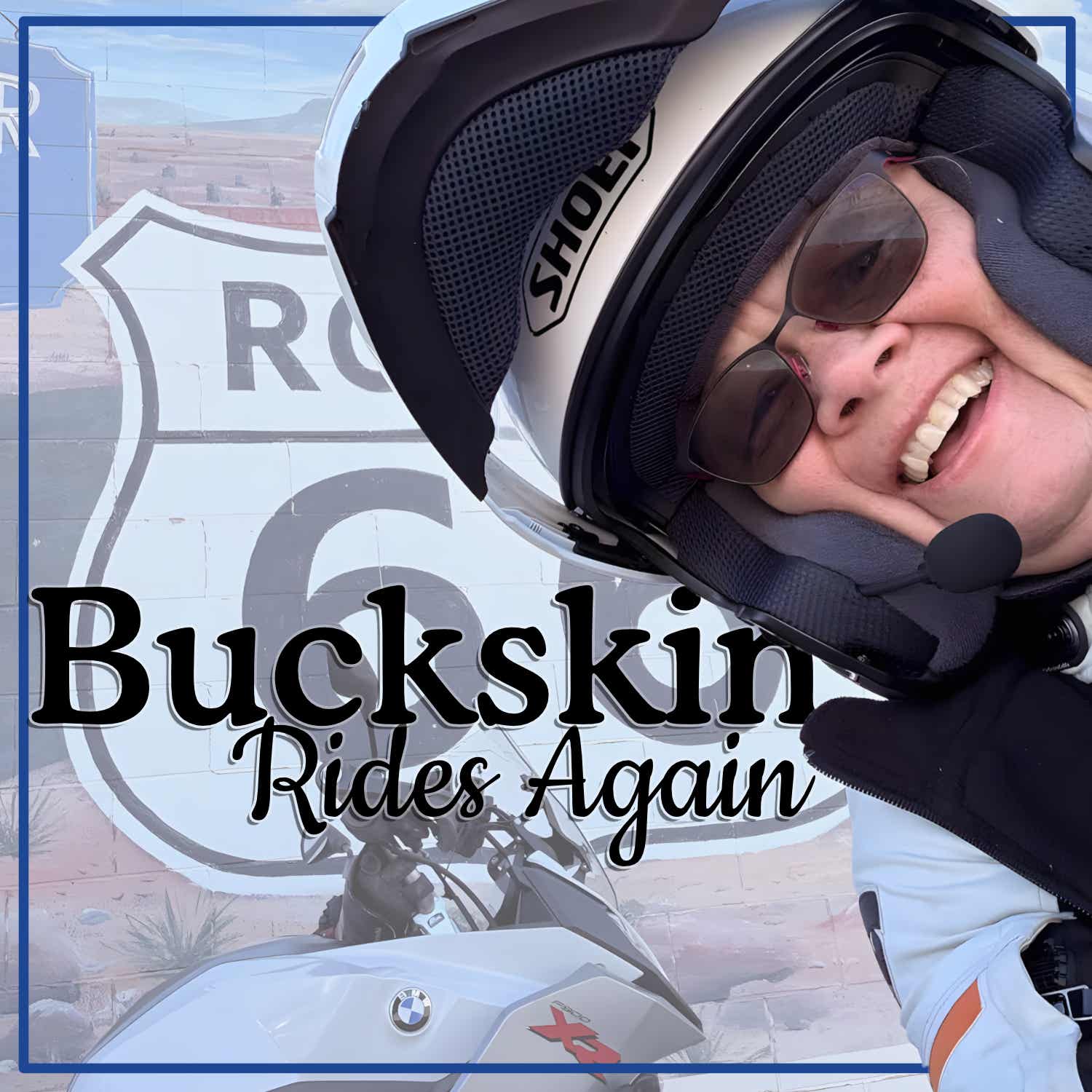
PODCAST · society
Buckskin Rides Again
by Tamela Rich
At sixty-three, Tamela Rich—aka “Buckskin”—set off solo on her motorcycle for a cross-country ride: 4,820 miles through eleven states and decades of family memory.Along the way, she encounters a host of road-trip characters—from gas-station prophets and drivers hauling questionable cargo to park rangers and old men making honor bets. Buckskin Rides Again is not just a ride across America. It’s a journey through the deeper lines laid down by family, history, and time. tamelarich.substack.com
-
26
[Dispatch #24] The Re-Entry Zone (and the final dispatch)
When I got home, everyone said the same thing: You must’ve had the time of your life!And yes, I did. But the tone in their voice tells me they picture my experience through the lens of leisure. No one imagines the reality: a woman on a motorcycle, sweating through her gear, scanning mirrors, reading crosswinds, and burning 175 to 200 calories an hour just to stay upright—about the same as an hour of circuit training, rowing, or a moderate hike in the woods.It looks fun—and it is fun—but it’s also work: physical, mental, emotional. The road asks something of me every minute. I’m not complaining; I love the demand. To the world it’s an escape. To me, it’s deep engagement.There’s a gender dynamic at play, too. When women go away—especially middle-aged women (and older)—we’re assumed to be taking a (likely self-indulgent) break. A break that isn’t entirely copacetic. People wonder whether Matt and Tristan will eat properly, and don’t I feel a little guilty? If Matt went fly-fishing in Montana for a couple of weeks, no one would wonder whether I’d be malnourished when he got back. Truth is, both Matt and Tristan are good cooks and know how to sort colors from darks and whites in the laundry room. I do not criticize the house when I return, and they don’t apologize—they have nothing to apologize for. Life goes on, and I’ll eventually find the drawer where that top ended up after coming out of the dishwasher.As I always do after a long trip, I’d scheduled a post-trip service appointment for my bike and timed my dealership arrival to miss the worst of rush hour. This allows me to avoid an extra trip to the dealership, since it’s on my way to the condo. I planned to ride-share home with my detachable luggage but Matt insisted on picking me up—which was lovely in theory, but the route from his office to the dealership is one of the city’s busiest. Sometimes we can’t do right by someone else without doing wrong by ourselves.He was late in picking me up, but I gave him grace—which, in fairness, was easy; my system always needs a few days to relearn how to belong inside a shared life, and I suspect his system feels the same.Once we pulled into the parking garage of our condo, I went on autopilot, offloading my bags and gear onto a shopping cart while Matt parked. My across-the-hall neighbor, Judy, joined us in the elevator and said how happy everyone would be to know I was home safe and sound.“Did you help your parents find a new place?”I laughed. “Long story, but the short answer is no.” The elevator stopped at our floor. “Let me catch up with myself and I’ll tell you all about it.”Judy, ever the patient one, smiled. “I’ll be right here when the time is right.”I never expected to love multifamily living, but my floormates are like sorority sisters—pitching in with an extra COVID test or a referral to a good electrician whenever the need arises. As a writer and editor, I’m very good at hunkering down, and I think I’d lose my social skills entirely if I lived in a single-family house where it would be so easy to disappear.Matt opened the door wide as I rolled the cart into the foyer.I called out,“Hey, Lovie—I’m home.”Tristan was up from the couch before I could set the brake, all grown man now but still calling me Mama. He wrapped me in his signature bear hug and held it long enough to let me know he meant it. Hard to believe I let him live to adulthood—I wouldn’t have guessed it during the tantrum years.“Let me take that back down for you,” he said, nodding toward the cart.Matt said, “I’ve got it. I know you want to check on your plants.”Matt and Tristan are gracious in the re-entry, not clingy. We’ve learned this rhythm over fifteen years—letting one another come and go. The living room, all glass and light, opens onto a balcony, where ferns, annuals and succulents spill over the railing. At first it was my garden, my place to settle when the day’s noise got too loud. But somewhere along the way it became Tristan’s too. When I travel, he keeps it alive—watering, pruning, sending me photos so we can revel in our cultivated beauty. We experienced some flora casualties in earlier trips, but I give him credit for staying the course.He had texted a picture just last week, so I wasn’t surprised to see that the giant taro—Colocasia gigantea—had thrown up three new “flowers,” the kind that look like peace lilies only supersized. We bent close to study the spadix, and a tiny anole darted between the leaves. “Ahhh,” we said in harmony.We live in a no-pet building, so we take our animal joys where we can find them. Anoles, for one.After I hauled my cargo into the proper rooms and tossed my clothes in the laundry hamper, I finally took that long-awaited shower with my own soaps and conditioner. The smell of homecoming. Years ago I decided hotel amenities were “good enough” for “helmet hair” and stopped packing my own, but standing there under familiar water pressure, I felt the small luxury of being known by my own things again.On the road, I never have to clean a tub or fold a towel—just rinse the bugs off my visor and go. Home has its comforts, but the road gives me one priceless thing: freedom from daily housekeeping.Matt and I found our way back as a couple and even slipped away for a few quiet beach days before the next family chapter began—his shark’s-tooth hunts and surf casting, my naps and wandering, both of us in sync in our own ways.Out in the world, I choose to be the unseen observer; back home, I’m a main character. In that role, I’ve worked to be less the glue that holds us together than the strand of raffia that keeps us aligned—a loose tie that allows for movement and growth without forcing the plant upright. There’s a difference between connection and control, between love as presence and love as management. These days, I practice the quieter art of letting go with love, as the saying goes.Back in Arizona, Dad was still prepping for the wedding trip east. He and Mom were sure they’d make the drive, and I believed them—mostly. We texted a few times about routes and hotel chains, and I realized I’d need to play more of a daily, on-call role once they hit the road. But first, Dad needed tech support. I didn’t want him pulling over every twenty miles to double-check the road atlas and make sure he hadn’t missed a turn. JJ and I came up with a plan. I’d text Dad a Google Map each evening with the next day’s turn directions. We looped in Bebe, who has taken a few road trips with them in a tech support role. She got him practicing with the app and reassured him: yes, the minivan’s screen would sync with his phone even without cell service, and no, he didn’t need to print out MapQuest directions “just in case.”Stagecoach was still in. Still bright-eyed. Still ready. And for now, it was the next generation carrying him forward.Once Matt and I got home from the seashore, we ate at Carter’s restaurant, a French café where he’s the lead bartender. The moment we walked in, the staff called out their greetings. The hostess smiled wide and said, “Welcome back, Mrs. Rich! How was your trip?”I hadn’t realized they’d been following the journey all along—Carter had been carrying pieces of my story into his world, and I was touched to find traces of it waiting for me there.He spotted us from behind the bar and broke into a grin. “Mom! That tan is gorgeous!” he said, coming around to give me a hug that smelled faintly of citrus peel; his cheek tasted of salt.“That’s Carter’s parents,” one of the bar patrons whispered, noting our status as minor local celebrities.For a second I saw myself through their eyes—sun-touched, self-possessed, and wholly at ease in my son’s world. The truth is, when Carter was in high school, I used to wonder what the other parents thought of us. We weren’t stellar—just determined, doing our best to stay upright through the storms. I wish I could tell that younger mother she’d make it here—that love, even imperfect, would outlast the years.Later in the evening, when the rush slowed, Carter slipped away from the bar and joined us for a few minutes. That’s when I noticed he was already wearing his wedding band. It choked me up a bit, the love he has for Katie.While I was still on the road, Carter had told me that their best-laid plans for a simple courthouse ceremony had been thwarted when they learned only two witnesses would be permitted in the judge’s chambers. They wanted intimate, but two was minuscule. Matt and I quickly offered them our condo’s garden gazebo and community room, and they took us up on it.We offered space; they kept the ceremony small. Everyone stayed in their lane.At about that point, Carter had had enough of decisions—locations, clothes, shoes, officiant costs. “Hell, I’d marry Katie by the side of the road,” he said. “Nothing else matters.” And they say romance is dead.In one of our late-night phone calls while I was on the road Matt asked what we should be doing besides offering our home. There was a time I’d have had a list: seating chart, color palette, garlands for the gazebo, maybe even a photographer to capture what I thought they’d want to remember. I came by that instinct honestly.At my own wedding, Mom orchestrated something she believed my brother and I would both cherish—JJ singing during the ceremony. She told each of us the other wanted it. Neither of us did. It was her way of pre-arranging meaning, making sure the day would carry emotional weight. We unraveled the plan in time, but the lesson lingered: sometimes love overreaches. I can’t remember how it resolved. Maybe that’s because I’ve put it in a lockbox. I’m good at that.Sitting in the café’s low lighting, admiring my handsome son, I treaded gently. “Have you picked out what you’re wearing for the wedding?”He rolled his eyes, good-natured but weary of all the talk. “Mom,” he said, drawing the word out just enough to make me laugh. “I’m sick of thinking about it, but yes, I’ve picked it all out.” He pulled his phone from his back pocket and flipped through the pictures to show me his choices—trousers, a vest, crisp white shirt, and a tie to match the pink of Katie’s dress.It was everything I’d once hoped for both of my sons: that love wouldn’t feel like a performance, just a quiet alignment between two people who already understand each other. I smiled, knowing the road had brought me home to this—to a son already sure of his direction, even as the map ahead of me kept changing.I just didn’t know the next turn would be the real test.Thanks for going along for the ride and for every comment, like, and share. I’ve loved every minute. This post is public so feel free to share it.And I have an announcement: “the next turn” I mentioned will be part of the book Buckskin Rides Again. I’m finalizing the final edits and will tell you more about it in a couple of weeks. Get full access to Narrative Mileage with Tamela Rich at tamelarich.substack.com/subscribe
-
25
[Dispatch #23] Warning Signs and Warbonnets
I left Mississippi with my grin intact. By the time I crossed into Alabama, my edges were fraying. I’d logged 1,500 miles since my last real rest in Santa Fe, continuously battling the wind.I managed to dodge the rain until the last five minutes when I turned left into the Hampton Inn on the edge of town, where I fell easily into sleep after dinner. By morning, I thought I’d found my balance again. I hadn’t. Fatigue lingers in disguise.Down in the guest lounge, the buffet attendant was overfunctioning in his attempts to connect with the bleary-eyed guests. He couldn’t read the room, and I found myself both annoyed and sorry for him. It wasn’t just his lack of confidence—it was something else. Like the volume of his friendliness was turned up too high to hear what anyone else was saying, or in my case, thinking.My family—salespeople—prized extroversion, same as American culture. Quick with a story, wired for rapport. Sure, I inherited the family charm, and I can turn it on in the right company—as I did with the nuclear engineer in Santa Fe—but it’s not my fuel. What refuels me is quieter: a good sentence, a long ride, a day where I don’t have to answer to anyone.I’ve gotten pretty savvy navigating this strain of social terrain: I started my hot tea at the table I’d chosen but didn’t sit down—that’s a trap.So is eye contact—interpreted as willingness to listen to the attendant’s story about his daughter finishing nursing school (which is exactly what happened to the feckless guest who gave off open vibes). As soon as he locked in on his mark, I made my break for the reconstituted eggs and bacon.Look, I know that feeling—the reach, the trying too hard—but I didn’t have the kindness or the time to spare that morning. Back in my room, the silence felt heavy after all that forced cheer. That’s when JJ called.My brother doesn’t sleep much, so I wasn’t surprised to get a call at seven o’clock his time. His tone was soft, but I could feel something loading behind it. This wasn’t just a check-in.“Well, I have to tell you what happened last night,” he said.JJ was waiting for Mom and Dad to come over for a family dinner, but they didn’t arrive. He kept trying to hail Dad on his phone, then Mom, to no avail. He can usually find them using Apple’s tracker, so he figured out they were at Lowe’s. An errand. (She loves squeezing in an errand). But this one took much too long. What was going on? Finally, Mom called from home to say they weren’t coming. She said she‘d just needed something for the patio garden—just a quick in-and-out at Lowe’s while Dad waited in the car. But she took his phone by mistake, disappeared into the store, lost track of time, and never found what she’d come shopping for.“She left him sitting there with no way to reach her,” he hissed. “Dad didn’t know what to do—just waited, hoping she hadn’t gotten lost or fallen or…”. JJ trailed off. “She finally came back.”That’s when his voice cracked. “Tam, she was scared. She said, ‘I don’t recognize myself sometimes.’”I don’t recognize myself sometimes.The words landed with the weight of both truth and prophecy—what she feared now, what I’d feared for years. I didn’t know what to say to that, and for a moment the whine of emotional static scrambled my thoughts. It was a dagger in my heart, clean and quiet.In my predictable avoidance pattern, I mounted up, trusting the road to work its old magic—or at least to nudge something brighter to the surface.But the thoughts clung, hovering around me like Pigpen’s dust cloud in Peanuts. By the time I rolled into Scottsboro, Alabama, early that afternoon, they were still swirling. I was running on fumes and looking for lunch, a second wind, and maybe a little mercy under the overcast sky with its (blessedly) light breezes.I’d long wanted to visit Unclaimed Baggage—the country’s only thrift store that sells the contents of lost airline luggage—but I didn’t have it in me. Not that day.I passed the corridor of chain restaurants along State Highway 79 looking for local fare--there had to be some near downtown, since Scottsboro is Jackson County’s seat, and every county courthouse I’ve ever seen has a local diner within walking distance. Where else are lawyers supposed to argue over pie before they argue in court?Three blocks later, I nearly blew through a stop sign. A big red one. Clear as day. And somehow, I didn’t see it until the last second. That’s how it starts—the slow fade between alert and autopilot. You run the same systems for too long, start cutting corners without realizing it. You tell yourself you’re fine, you’ve done this before, you’ve got muscle memory.But fatigue’s a shape-shifter. It slips in sideways and settles behind your eyes. Maybe that’s how Mom experiences it too.I stopped, barely. Pulled into a parking space just beyond the sign, hit the kill switch, and just sat there, staring at the faded white perimeters of my safe spot. By some unknown grace, the driver crossing my path had seen me coming and didn’t try to gun it. I once lost a friend to that very scenario.That’s when it hit me: the road high was gone. Not a giddy high—just that steady hum of purpose and forward motion that had carried me west, then north, then south again. What remained was the long slide down the other side: the final push east, and the re-entry zone waiting for me.In time, I forgave myself. Shook out my hands and shoulders. Coasted the few blocks into downtown, where I found what I’d been looking for: a proper local joint with an old-school Coca-Cola mural blazing across the side of a brick building.Payne’s Sandwich Shop and Soda Fountain didn’t dabble in branding—it mainlined it. The interior was a Coke-themed shrine: every square inch decked out in red-and-white kitsch from the farthest reaches of the company’s marketing imagination.I have a soft spot for anyone willing to triple-down on what matters in life—even if what matters is carbonated nostalgia and a bottle opener screwed into the counter. Places like Payne’s don’t just sell lunch and a heroic array of ice cream flavors. They sell a feeling—one bite of Americana at a time. Have a Coke and a smile. Tell yourself the myth still holds.And just for grins—why is it that Pepsi can’t hold a candle to Coke when it comes to cornering the American spirit? It apparently wins all the blind taste tests, but people still prefer Coke.My fling with chile rellenos was behind me now, and I ordered a proper Reuben—corned beef, not the pastrami pretender or, God forbid, turkey. Why restaurants think they can get away with calling something with turkey a Reuben is beyond me. That’s false advertising. Do I make myself clear?The guys to my right were business associates whose conversation had dipped into the personal. The younger one was shaky about his relationship, and the elder had thoughts. My writerly instincts usually compel me to tune in—I’m a sucker for an unexpected turn of phrase or a glimpse of vulnerability at the edge of a meal—but there was nothing here worth tuning into. The hum of my own thoughts was louder anyway.I’d had enough secondhand doubt for one day—plenty of my own to sort. I paid the bill, stepped back into the heat, and swung a leg over the bike. Time to ride.The land began to rise—an ascent that echoed the shift happening inside me. The lowland stretch of my journey, both literal and emotional, was giving way to something else: elevation. I’m not sure if the rising road lifted my spirits or just gave them permission to rise—but it felt like alignment, either way.Any rider knows that shift in elevation—not just in the road, but in the body. You get the chance to lean. A quick series of twisties here becomes switchbacks at higher elevation, then a mountain valley where Black Angus raise their heads to follow the sound of your engine. Somewhere between the ridgelines and the filtered light, the mountains were mine again.The climb is always my favorite part. Second or third gear, right in the power band, where even a slight roll of the throttle changes everything. No shifting needed—just that sweet, responsive zone where engine and intention move as one.When I hit the angles just right, the ride becomes a sentence—each curve a clause feeding the next. The exit of one flows clean into the entry of another. No corrections. No overthinking. Just lean, throttle, trust. The engine growls low and steady. The scent of the mountains drifts in and out. Nothing exists beyond the next turn—and that’s the point.When the curves finally straightened, the world returned in slow motion: traffic lights, shopfronts, the smell of barbecue smoke. Just ahead of the golden hour—which comes a little earlier in the shadow-casting mountains—I pulled into the temporary parking space at the Hampton Inn in Blue Ridge, Georgia, and there it was: just five feet in front of me, a gleaming passenger railcar bearing the warbonnet of the old Santa Fe Super Chief. The emblem belonged out west, not here in the Southern Appalachians. And yet, it fit.It wasn’t entirely out of place. My hotel sat beside a historic rail corridor known as the Hook & Eye Line—famous for sharp curves and switchbacks that once moved timber, tourists, and textiles through the Appalachians. These days, it’s a scenic rail route using vintage cars like this transplanted Super Chief. The hotel leaned into the theme with historic maps in the lobby and a rooftop bar named after the line.I took a photo without thinking—instinctively. Not because it was rare (though it was), but because it reminded me of Dad. Stagecoach had been different since I set out a month earlier. Brighter. Lighter. Maybe it was just the novelty of riding shotgun with Buckskin from afar. But I think it was more than that.Dad isn’t a train guy. Not in the memorabilia sense. The Super Chief emblem reminded me of him because the railroad was part of the story he came from. After high school, his dad and uncles got him in at the Barstow yard doing undercarriage work. Not his calling, exactly, but it came with union possibilities and the kind of physical work he’d been raised to respect. Dad didn’t have much in the way of guidance growing up. His own father—my grandfather—wasn’t much of a model, but a man named Charlie Fontaine filled part of that space. Mid-fifties, lean and muscled, Charlie was what people called a health nut. He believed in clean living, vitamin C, and the medicinal properties of fruits and vegetables.Dad has a way of telling a story that makes it unfold like a scene from a film. He becomes the other guy—jutting his chin like Grandpa—with just enough exaggeration to be funny, never cruel. He never mocks. But he has a comic’s eye for detail, the physicality of someone who’s watched the world closely and remembered how men moved—how they grumbled or swaggered or dragged cigarette smoke down to their toenails.That’s his gift—the kind that doesn’t seek a stage but finds one anyway. He doesn’t perform so much as channel, as if the stories passed through him on their way to somewhere else. Suddenly I wasn’t just hearing about a guy named Charlie—I was in the break room with him, watching grease-stained hands slice an orange like it held the meaning of life.The light doesn’t shine on Dad because he asked for it. It beams because he knows how to hold it without breaking the spell.Dad still tells the story of how Charlie took him to one of those proto health food stores, where everything cost three times as much as it should. Dad spent a week’s wages on two bags of groceries because Charlie said pure food was “pure fuel.”One of the items was beans. Charlie gave careful instructions: soak them overnight, pour off the water, rinse, then cook with salt, pepper, and onions for a couple of hours until tender.But Mom, ever resourceful—and unwilling to waste a single drop of anything she’d paid so dearly for—used the soaking water to cook the beans. She figured there had to be nutrients in it. But the beans came out tasting like regret. Even a toothbrush couldn’t remove the grit.That was them in a nutshell: Dad, the starry-eyed believer. Mom, the one left to salvage the plan. Every time he brings up the railroad—“Back when I was working under railcars”—Mom chimes in, deadpan: “That’s where all the body parts fell out.” She means it literally. When someone was hit by a train, the remains got caught up in the undercarriage and axles, then dropped into the inspection pit where the mechanics worked. The gore was real, but Dad never talks about that part. What he remembers is Charlie Fontaine.Dad didn’t stay in the yard. Said he wanted to be in business, so he got a job in collections for Pacific Finance—apparently repossessing muscle cars felt more promising than working his way up to union shop boss. But when he talks about finding his way in the world, it’s Charlie who comes up—the blue-collar philosopher, the strongman with a jar of vitamin C in his lunch box. Not because he preached anything, but because he was his own man. In a shop full of hangovers and hard luck, Charlie had clarity—a quality Dad still admires and sometimes borrows when he tells those stories.Later that evening, I texted him the photo of the warbonnet and it didn’t take five minutes for the phone to ring. “Hey, where’d you find that beauty?” A beauty it was, a western echo in Appalachian pines.He was proud of me for taking this trip—this solo trip. Said he and Mom had been praying for my safety every day. Our nightly check-ins gave him something to look forward to. He was excited about their own trip back east and had already scheduled the minivan for service. Said he wanted me to help plan their route and overnights once I got home.But I could tell there was a restlessness under the surface. Retirement suits him—and it doesn’t. He’s not bored, exactly, but he’s never been a man with a five-year plan beyond what work and family required. Mom has always set their pace. He grumbles about her endless to-do lists, but he doesn’t have a competing one of his own. Her drive pulled him along for decades. And now, it’s love that keeps him moving, even when he’d rather coast.My trip was something different. A jolt of forward motion, minus the weight of responsibility. I was giving him a vicarious thrill—an undemanding spark he could tap into from a distance. He could still feel the thrill of motion in my joy. That’s the kind of man he is—soft-footed, generous with his attention, and quick with a laugh. The light finds him, even when he’s not asking for it.Mom used to say—half joke, half truth—that we all loved him best. “I did all the work,” she’d mutter, “and he got all the love.” It was said with a wink, but sometimes it had teeth. She carried the weight of all she’d done—unseen, unpraised—and Dad, with his natural buoyancy, always seemed to float above it.She wasn’t wrong about the workload. But Dad has always had a way of making things lighter. He still does.Download Craft Tips and Memoir Prompts here Get full access to Narrative Mileage with Tamela Rich at tamelarich.substack.com/subscribe
-
24
A Rest Stop with Buckskin
This isn’t a full dispatch—just a pause at the rest stop. The holidays are a time when everyone’s attention scatters, including mine, and I want the final miles of Buckskin Rides Again to land when you’re actually able to take them in.The last two dispatches arrive on January 4 and January 11.Before I pull off the road, I want to show you something I didn’t have when I first wrote about it.Visiting my parents after Thanksgiving, I finally took a photograph of the Victorian sleigh that lives in their home—the one Dad had restored for Mom and she has carried with her from home to home since the early eighties.Seeing it again in person reminded me how much our family stories are carried in objects we keep trying to make whole. During my visit, my nephews came for dinner and I suggested getting a few family pictures in it. Their eyes lit up, “Great idea! It’s been years since we did that.”If you’d like to revisit the scenes where the sleigh appears, here are the two dispatches:Buckskin returns January 4 and 11 for the final two dispatches. I’ll also be sharing a few behind-the-scenes surprises—including something I’ve been sitting on for months.Wishing you warmth…Tamela Get full access to Narrative Mileage with Tamela Rich at tamelarich.substack.com/subscribe
-
23
[Dispatch #22] The Shoo-Fly Wave
I crossed the Arkansas–Mississippi line on a long, hot stretch of two-lane and stopped at a four-pump gas station in the middle of nowhere—a place where the snack aisle leans hard toward pork rinds and Little Debbies.Three men, well past seventy-five, had hauled their aluminum lawn chairs outside the store to watch the traffic go by. A couple of younger guys—grandsons?—stood behind them in a kind of social solidarity. I pulled in under the canopy, gave them a wave, and fueled up, checked my chain lube, and grabbed a couple of dollars for a snack.As I came out, the youngest codger—flannel shirt, John Deere cap—called out, “Where ya headed?”“Ultimately home to North Carolina. But tonight, Alabama.”The men erupted in knee slaps and laughter as the youngest elbowed the oldest. “See! I told you she was headed for Alabama!”I looked at the oldest man and lowered my voice like we were in on something. “What’d you lose on that bet?”His face made it clear—he was not a betting man. So I added, “Ah. An honor bet.” He smiled with his whole face, and gave me a nod.I rolled out of the station smiling, thinking about those lawn chairs and that honor bet. It was the kind of exchange that sits right—easy, good-natured, the kind of moment that stays with you longer than you’d expect. Road magic.Not every stop goes down that easily.Later that afternoon, I pulled into a busy Exxon in Walnut, Mississippi—93 miles west of Florence, Alabama. A few Harley riders were fueling up, clearly on a group ride. I nodded, and they nodded back, as per the two-wheeled custom.The man leaning against the ice machine had plenty to say about my choice of marque. He was all warmth from the start—camouflage shirt, MAGA hat, a wire-wrapped cross on a thong around his neck. Missing a few teeth, sure, but his smile was genuine. He lit up at the sight of a woman on a motorcycle—especially one riding something unexpected. He struck me as the sort who’d rather see me on a big V-twin, but could appreciate the anomaly.“Well now,” he said, admiring the bike. “That’s a real nice Beemer. Didn’t expect to see a lady out here on one of those.”After a few friendly words I started toward the store. He added, almost like a benediction: “Well, I sure hope you got a gun somewhere on you. You need to carry.”I didn’t stop walking. Gave his shoulder a light punch—friendly enough, but firm. “No, no. We’re not talking about guns today.”He blinked, caught off guard. “What? You need a gun!”I kept it light, kept moving, waved from the glass door as I stepped inside.“It’s crazy out there,” he called after me. “You need a gun.”My refusal to talk about guns probably gave him whiplash. People assume that because I’m a woman on a motorcycle—even one in riding gear that makes me look more like an astronaut than a cowboy—I must still fit the biker-chick stereotype: tough, rebellious, dangerous, full of masculine energy that naturally includes firearms. Even on a wimpy European model instead of a big American twin, the assumption sticks.When I retell this story, people ask, “Weren’t you afraid?” No, I wasn’t. He was a man of conviction—certain that safety is a personal responsibility. And that certainty felt familiar to me. I was raised by a mother who was always attuned to the current of danger. Her parents made sure of it. They’d each learned to read danger in their own way—the hard way.Her mother, Mamaw, didn’t finish high school—hardly anyone in the coal camp did—but she had a head for numbers and a nose for when someone was getting cheated. Neighbors brought her their pay stubs and bank statements to see if the math lined up. It often didn’t. While Mamaw’s mind was her weapon, Papaw leaned on physical readiness. He trained himself to write with his left hand, just in case he needed his right to protect one of us. The penmanship drills were sweet, a little dramatic, and everyone understood the good intentions behind them.It’s no surprise Mom took that instinct of protecting one’s own and ran with it. When I was in high school, Mom trained to become a police officer. She enrolled at the community college, bought a gun before it was fashionable, and turned out to be a crack shot from the start. To hear her tell it, she even out-shot a deputy sheriff on the range. Dad tried talking her out of a career in law enforcement, but Papaw was the big gun. She gave his opinion the final say, and when he warned her about bad guys coming after cops’ families she stepped back. I think that decision left a crack she never fully sealed. It’s probably why she went civilian vigilante.Eventually—in her late forties or early fifties—she turned her passion to karate and earned a black belt. Before long, she was teaching self-defense classes to women. When my boys were little and stayed at Grammyland, she made sure they took lessons too.Somewhere along the way, her self-defense training made her an evangelist for the square-handled ice pick—not the round kind, mind you; too slippery if you meet your mark. She explained, “You want one with edges, so it doesn’t spin loose if it gets… messy.” There’s one of them in every room of her house. Just in case.Her readiness always felt theatrical—like she was preparing for a scene that hadn’t started yet. It was Mom’s way of claiming control in a world that rarely handed it over freely—especially to women. She wasn’t waiting to be rescued. She was ready to do the rescuing, and one time she even did so at a big box store.From out in the parking lot, Mom saw a shoplifter shove past the teenage security guards. Then in her sixties, she dropped her bags, hustled Mamaw into the car, and sprinted back to the entry apron behind the bollards—where the rent-a-cop was flailing. She pinned the thief to the tarmac with a knee to his shoulders—and used what I’ve always called the Vulcan Death Grip near his neck.She had a real name for the move, but I never remembered it. “Death Grip” fits her style. That might be why she never corrects me when I tell the story. Nothing lights her up like the chance to go full vigilante.The older I get, the more I recognize the logic in her intensity. It was her version of safety. Her version of love. What she did was about staying ready—safe, in control. She moved through the world ready for it to turn on her.I admire her decisiveness—how instinct took over, how fast she moved. But we trained our instincts in different directions. What I do is about staying open. Present. Connected. I move through it hoping it will change me.But what about that ponytail holder I picked up back in Amarillo, the one with tiny plastic guns sitting in little tooled-leather holsters? I wasn’t drawn to it as a weapon; I was drawn to the contradiction of being a young girl with guns in her hair. Even then, safety and danger were braided together in ways I didn’t fully understand.Now, this might surprise you, but I actually agree with the gun guy on one point: it is a shitshow out there. But that word means different things depending on who’s saying it—and what they fear. These days, we’re all using the same vocabulary to describe completely different realities. That’s the real danger: thinking we’re talking about the same thing. I stay wary too—just not about what he’s worried about.Maybe that’s why today I ride alert—aware of the energy in a room, along a roadside, in a man. I don’t say what I’m carrying. Let them wonder.People call us both badass—my mother for her martial arts, me for riding solo cross-country. But what we do—and why we do it—comes from different places. She stays ready. I stay open. And if anything edges too close—including weaponry—I give it the shoo-fly-wave with a breezy grin. Get full access to Narrative Mileage with Tamela Rich at tamelarich.substack.com/subscribe
-
22
[Dispatch #21] Pretty Disreputable, Apparently
Become a free subscriber and you’ll never miss a thing.Two hours after I left the person I’ve come to call “Jaguar man,” I outran the storm that had chased me all day and rolled into Norman, Oklahoma. The sky had cleared, but the unease lingered—what I’d shaken off in weather still clung in thought.Pulling under the hotel canopy as the light shifted to gold, I could see at least three decent restaurants within walking distance. After days of eating what Mom always called “starch bloat,” I was ready for real food—hard-core greens, no cheese, no fryer oil.The lobby’s air-conditioning hit me first—sharp and sterile after the plains. As I took off my helmet, the young woman behind the front desk, braid swinging, face lighting up like she’d spotted a long-lost friend cried out: “Oh! You’re a fellow motorcyclist.”I smiled at her phrasing and gave her her due. “Yes, I am. What do you ride?”Without hesitation, she pulled out her phone and flipped open the photo app. Beaming, she held up a picture of a Kawasaki Ninja. “My boyfriend’s bringing it home for me tonight. It was his brother-in-law’s and he just got a bigger bike. I can’t wait!”Her excitement was contagious, even after a long day on the road. Instead of lamenting high winds, drivers who texted at 75 mph, and road grime, I leaned into her joy. “Is this your first?”She nodded, practically bouncing. “Yes! I just passed my motorcycle endorsement and I’ve been riding his around in parking lots. I can’t wait to ride my own!”Another guest came through the sliding doors, snapping her back into employee mode. But in between key-charging and data entry, she asked where I’d been and where I was headed.“Oh, someday I’d love to take a trip like that,” she said wistfully.“Then promise yourself you will,” I told her. “Make it happen.”Upstairs, I took a hot shower, rinsing off the grit of the plains, and opened my email. There was a long, thoughtful note from Stephanie waiting—updates on her latest draft. I told her I’d look at the pages after dinner and we scheduled a call for the next morning.Then my brother called. “You’re not going to believe this,” he said. “Mom and Dad decided they’re driving to Carter’s wedding.”“What? I thought they were flying.”“Nope. The way they put it was—hang on—‘This will be our last big road trip.’ And they want to follow your route back east. Your exact route. Even La Posada in Santa Fe.”There was a kind of poetry in that—and perhaps a kind of peril, too. Part of me was moved—Dad had been so engaged, tracking my progress, asking about the roads and the weather. And Mom, well, she wanted to bring a box of family mementos along so she could watch us unwrap it like kids on our birthdays. JJ said they were happy, even energized, by the idea of being back on the road.But another part of me hesitated. My mind flashed to that moment near Panhandle, Texas—when the U-Haul brakes failed to disengage the cruise control on the exit ramp. Would their past catch up to them on the open road? And would I know—really know—when it was time to take the keys away?We had talked about that one day in Phoenix, JJ, Dad, Mom, and I on their spacious patio with the overhead fan whirring. Between the two of us, JJ and I called it the “omnibus aging conversation,” where we gently brought up everything from medical power of attorney to long-term driving plans. We’d been calm, collaborative, full of love.JJ was the one who brought up driving. Dad volunteered: “Oh yes, someday we won’t be able to drive. We know that.” Mom nodded along—it was that kind of afternoon for her.But “someday” is a slippery word. It lives safely in theory—until it doesn’t. I could almost hear the word surface, like a buoy rising through water.Alongside the warmth I felt—the sweetness of their reversal from “We’re done road-tripping” to a two-week trek east—came a ripple of dread. My body registered it before my brain did: a clench behind the ribs, a subtle tilt toward caution.I didn’t want to be the killjoy, so I stayed quiet. Someday had just arrived.And in the back of my mind, the Greek chorus began again—soft but insistent:Sometimes, something tragic happens.The next day on the road was uneventful, other than passing through Johnny Bench’s hometown of Binger, Oklahoma. I didn’t stop to tour the museum. I rolled into Hot Springs in the late afternoon, grateful that the boring part of the trip was behind me. I should mention that I rarely make room reservations in advance and with few exceptions, this has worked perfectly. It gives me the flexibility to duck in early for weather or extend the day.But I never even considered that Hot Springs had a casino and a racetrack, so imagine my shock when, on a Saturday night, every brand-name chain was full, and even the motor lodges’ neon signs glowed “No Vacancy.” I wasn’t about to take my chances on the sketchy ones—flickering fluorescent lights, curtains that didn’t close, parking lots with too many loiterers and too few lights. Not tonight. I had plenty of options to the east, so I rode on.The moment reminded me of a night years ago in North Dakota, when I didn’t have an option.I’d planned to reach Montana before nightfall, but a storm was building west of Dickinson. I pulled into a gas station to check the skies and figure out my next move. A local man inside—one of those guys with real-time radar access and an easy authority—told me I should stay put.“There’s nowhere to stay,” I said, staring.He shrugged. “I know a place.” He called to a 12-room motel up the road and told them a solo rider might need a room—or a patch of grass for her tent. In those days I always carried a tent.The place was across from a row of silos and a grain elevator, and my first instinct was suspicion. Meth lab? I told myself to settle down. Don’t be such a city slicker, Tam.The woman who ran the place was funny and warm. She brought ice cubes from her own kitchen and sat with me outside while the sky settled. As we talked, she told stories about trying to keep hunters from cleaning game in their rooms—said she finally had to put up a sign that read, “No cleaning game in your room!”I should’ve taken a picture of it. But I was too busy feeling grateful. The room was newly redone, the mattress soft, and the storm passed without a drop. I slept like a baby.So why didn’t I take a chance on one of the more colorful joints in Hot Springs? The honest answer? I still had options in Arkansas, where I didn’t in North Dakota. And maybe there’s a deeper answer, too—something reptilian. I trust the dodginess of a 12-room motel in the middle of grain country more than the same setup in a city with a vice economy. I’d like to think I’m above that kind of bias. I’m not.An hour later, I found a Holiday Inn Suites within a bustling shopping center and had already identified my restaurant before I checked in. For the second time in a few days, after asking if they had a vacancy for one night, the desk clerk looked me over and said,“Yes, but we’re expensive.” Twice in one week—that was new. In all my years on the road, no one had ever felt the need to warn me I might not belong.How disreputable can an old broad like me really be? Pretty disreputable, apparently. And deeply reputable in other ways—reliable, watchful, practiced in the art of showing up. I’ve earned my reputation through miles and weather, through work done well and people cared for. It’s not always visible at first glance—but then again, most durable things aren’t.The desk clerk, it turned out, was a doll. Once she realized I could swing the rate, she took me under her wing and did her best to retrieve my not-so-frequently-used rewards number. I couldn’t hold a thing against her.I took the room, ate another salad, and felt the fatigue set in.Later, after returning from the restaurant, I called down to let her know there was a big puddle of water in the elevator.She sighed. “Those little league families…” Get full access to Narrative Mileage with Tamela Rich at tamelarich.substack.com/subscribe
-
21
[Dispatch #20] Two Loads and a Long Road
I left Canyon in the late morning since I had to wait for the final remnants of the storm to clear. Somewhere east of Amarillo, the crosswind hit me sideways. A steady push, not gusty—almost like it had intent. I gritted my teeth, leaned hard, and watched a truck in the distance rock and settle—like it had reconsidered its loyalties. As the highway straightened near a sign for Panhandle, Texas, a different kind of memory broke loose, one that everyone in my family has tried to forget.Back in 2020, five years before this ride, I was standing in my kitchen in North Carolina, mid-dinner prep, when my phone buzzed. Mom’s name on the screen. I wiped my hands and answered brightly, trying to summon good news.“We sold both of the houses over the weekend,” she said.At that time, my parents had owned two homes, one in Ohio and another in Las Vegas, and the real estate market that summer moved like quicksilver. “Wow,” I said. “When do you have to be out?”“That’s the problem,” she replied. “Las Vegas closes in three weeks. Ohio closes in five.”What followed was a month of chaos—of scrambling to close out two lives in two places, so they could consolidate it all in their new Arizona house—the one that wasn’t quite finished. I pushed my editorial deadlines ahead, rented the largest SUV available at the airport, and made one last pilgrimage to Ohio. I’d done that drive a hundred times since leaving in 1982, but this would be the last time my parents would meet me at the other end of the road.I pulled into the driveway five days later, half-expecting to see the house as stripped down inside as the front yard now looked without the giant Norway maple where our last family photo had been staged. No such luck, I would soon learn.My dad—his Johnny-Carson good looks now dulled by exhaustion—dragged a full garbage tote to the curb. “You’ve got to help your mother get rid of stuff,” he said. “I’m not gonna rent a storage unit in Arizona.”Mom’s not a hoarder; she’s a preservationist with a militant sense of order. She’d long warned us, “Don’t part with any of this. It’ll be worth more than memories one day.” I was never sure about that—nothing in her collection looked like the treasures that fetched stratospheric prices on Antiques Roadshow. I decided to just fill the SUV with whatever she wanted me to have and deal with it later. Out of sight, out of mind.The house wasn’t the one I’d grown up in, but it was full of echoes. With each move, Mom had culled what no longer pleased her and carefully boxed what she believed would one day hold value: Heisey glass, Occupied Japan figurines, and a chalkware Catholic monk that exhaled incense through its mouth—a novelty that peaked in the mid-’70s, alongside fondue pots and macramé owls.My friend Jill came from Akron the next day. She had no attachment to any of it and showed me how to start listing furniture on Facebook Marketplace. Mom was scandalized by the prices. “It’s worth more than that!”“Turn this around, Mom. People are paying you to haul this off.”Dad grinned. “Yeah, this is good business!”She didn’t admit defeat, not exactly. But I could feel her letting go—if not of the objects themselves, then of the need to be right about their worth. The woman who’d spent decades making things happen—clipping poodles, selling Decorama, running an ice cream shop, building an insurance agency with my dad—finally stepped into the passenger seat. I took the wheel, wondering how long I’d get to hold it before my own sons reached for it.Dad had hired one moving company for Las Vegas and another for Ohio. Somehow, the infamous Victorian sleigh squeaked in as the last item the movers’ van could accommodate.I’d done my part by hauling a load home to North Carolina in an overstuffed SUV—but it still wasn’t enough to make a proper dent in the volume. A few days later, they rolled out of Ohio in a two-car convoy: Dad in a rented 26 foot U-Haul, Mom behind him in the Sienna van, carrying what couldn’t fit in the other vehicles—and the quiet weight of six decades, packed with care.That’s how they ended up in Panhandle, Texas.They’d exited for gas near a Love’s Truck Stop, and something went wrong with the U-Haul. The cruise control didn’t disengage, the exit ramp curved too hard, and the load was too high and too heavy. Mom, in the van behind him, saw it happen: the truck tipped, skidded, and slid—on its side—for at least 70 yards before coming to a stop. Ten feet more and he’d have hit the steel poles holding up the Love’s sign.She thought she was witnessing his death.As she walked toward the wreck, bracing for the worst, she later told me that a small woman of Asian descent appeared—out of nowhere—and said, calmly, “He’s going to be okay.” Whether it was an angel, a bystander, or an apparition doesn’t matter. In that moment, she believed it. And it steadied her. Every time she retells the story, it includes this vital detail.Truckers raced over from the diesel bays, volunteer first responders in ball caps and reflective vests. They smashed the windshield to get my dad out.Dad’s life must have flashed before his eyes—mine did, just hearing the story.Dad’s life must have flashed before his eyes—mine did, just hearing the story.I didn’t see the slide, but I saw the video Mom took of the recovery. I watched it more than once—not out of morbid curiosity, but because some part of me needed to believe the ending. To witness the outcome. To reassure myself that he really was okay.They both walked away with bruises, mostly the emotional type—a fact that still feels impossible to me. Within days they were back behind the wheel, tracing the same desert routes as if muscle memory could outdrive time. It was like they filed the UHaul wreck away under “close call” and kept moving. Maybe they kept moving because stopping—really stopping—would’ve meant reckoning with all the ways their lives were shifting. The crash should’ve been a reckoning, but for Dad it was another near-miss folded into the narrative of luck. He’s always believed that if you just keep moving, the road will clear.After all, every miracle has a half-life.I’ve never stopped admiring their grit. It’s just harder now, watching that same grit turn inward, against the tide. Mom still drives, but it’s no longer a given that she’ll remember where she’s headed—or who’s with her. Once, she pulled away from a rest stop while Dad was still in the bathroom. She came back. But what if she hadn’t? What if he’d left his phone in the van? There are too many variables now. Scary math.Dad doesn’t watch her every move. Nobody can, and she’d pick up on the surveillance if they did. So he fades out, sometimes, to a place where he doesn’t have to think about what might go wrong. YouTube is his codependent.We used to joke about my great-grandfather—Dad’s Grandpa White. We called him Mr. Magoo, after the old cartoon character who wandered through construction zones with a walking stick and bowler hat, blissfully unaware of the danger around him. Nearsighted to the point of farce, but somehow, everything always worked out.As Dad ages, I see more of that in him too. He’s not oblivious; he’s selective. He has a gift—or maybe a curse—for ignoring unpleasant things until they resolve on their own. Once he does see something and it lands, though? He can be like a dog with a bone. A sleeping giant, wide awake.For all my talk about being an observant little girl, I have that Magoo quality too. When it comes to uncomfortable truths right in front of me, I tell myself I’m watching the long arc, when it’s really a form of denial. That’s probably why I ignored all the early signs of Mom and Dad’s aging. Not because I didn’t care, but because I didn’t want it to be true. I kept looking down the road, convinced there would be more time. More clarity. More warning. That’s the Magoo way, after all—blind luck and forward motion.Trying to stay present doesn’t always mean taking charge. Sometimes it just means letting the blurry bits come into focus—and resisting the urge to squint past them.Easier said than done.By the time I crossed back into my own lane of the present, the road had stretched into an endless gray ribbon, wind tugging at my sleeves again. Seventy-five miles east of the infamous Panhandle truck stop, I stopped at the Mesquite Canyon Steakhouse—a joint that’s survived since the Eisenhower era and plans to outlive us all. I ordered the Texas Tater and took a seat at a resin-coated table embedded with cowboy poetry and old postcards. The table itself felt like a time capsule.I was torn between two motivations: one, to get back on the road and outrun the rain I’d seen gathering on the radar; the other, to linger and let my meal convert to heat. Looking at Google Maps, expediency won. I didn’t want to be caught in what was coming—a cold front in the rain is the worst kind of motorcycle misery. I can ride in cold. I can ride in drizzle. But riding in both, when the wind cuts through every layer and the road loses traction? It burrows into my spine and doesn’t leave.I geared up, paid my bill, and went out to the bike. I hadn’t mounted up yet; instead, I turned the bike with my body toward the gravel lot’s exit to give me a straight shot for the road.A not-so-late-model Jaguar sedan pulled in behind me, angled so the driver could speak to me directly through his window. He was probably in his fifties, sharply dressed in a fitted green t-shirt, wearing a good bit of jewelry on his hands and neck. Not dusty, not down-and-out; he’d probably showered that morning. But his voice—East Coast, New York state or thereabouts—carried tension under the polish.“Are you local?” he asked. “I need to find a tire shop.”Then he added, more to the windshield than to me, “I’m shredding the tires with this load. Don’t think I can make it to a city for new ones. Was hoping there was some country place around here that might have some ideas.”I pointed back at my license plate. “North Carolina. Sorry. No idea.” Then an afterthought: “You could try looking it up online.”He hesitated—like that hadn’t occurred to him, or like he didn’t want to. He nodded, sort of, and looked away.Another idea occurred. “You might be safer riding along the old Route 66,” I offered. “It’s parallel to I-40, and you won’t have to keep highway speeds.”He gave a faint, distracted nod.As he shifted into gear, I looked inside his car as closely as good manners would permit. Everything was covered by blankets, but one of them had the unmistakable outline of a home safe. Through a slight seam between two of the blankets, its digital keypad caught the light. What in the world?He pulled away, slow and awkward, the Jaguar straining under its cargo.I didn’t feel great about my response—but I didn’t feel bad either. Did he really expect a random stranger in a gravel parking lot to hold the key to his problems? Nah. He wasn’t asking for help, not really—he just needed someone to confirm what he already knew: the wheels were coming apart, and the road ahead might not take him where he thought he was going.I appreciate the balance of two wheels. Not just for the ride, but for what it teaches: every load is felt. Every shift in weight, every corner, every wind. Pack light, or pay for it. I’ve talked myself out of buying something plenty of times, just knowing I couldn’t haul it home. That doesn’t make me a paragon of virtue—I’ve also shipped things home when I couldn’t resist—but you take my point.Sometimes more is just more, and a bit of enforced discipline is a gift from the gods.It hit me as I merged back onto the interstate a couple of miles later: I’d faced two kinds of weight that day—one from the past, one in the present. Neither was mine to carry, but both stayed with me. The difference was, I’d gained experience with leaving a load behind.Five years ago, it was my parents heading west from the wreck in Panhandle with a van stuffed to the gills. This time, it’s just me, headed the other way. And I’m the one trying to balance the load as I head back to North Carolina—not just what’s strapped to the bike, but what’s strapped to me: the memories, the unfinished business, the ache of watching roles reverse.I didn’t fully register it at the time, but those stories my neighbors shared back in Dispatch One about aging and declining weren’t just nostalgic laments. They were quiet road signs. Gentle flags planted by people who’d already crossed into this terrain of reversed roles and slow grief.My neighbors weren’t trying to stop me—just preparing me gently: the road ahead gets rougher. But maybe that’s what it means to keep riding anyway—to balance the load, feel the drag, and keep moving through the wind. Get full access to Narrative Mileage with Tamela Rich at tamelarich.substack.com/subscribe
-
20
[Dispatch #19] Murals, Rail Lines, and a Rattlesnake Under Glass
Buckskin Rides Again is FREE! Subscribe so you don’t miss a thingIf you remember Pixar’s Cars movie (2006), you’ll remember Radiator Springs—the dusty little town bypassed by the interstate, fading until someone slowed down long enough to see its charm. Tucumcari, New Mexico, isn’t Radiator Springs exactly, but Pixar clearly had places like it in mind.The town wears the same stubborn hope, its civic pride painted straight onto stucco. More than a hundred murals brighten Main Street and back alleys—cowboys, longhorns, diners, the ghosts of Route 66 motels. They may look spontaneous, but most are part of a plan. Murals declare: We were here. We mattered. We still do.And they whisper: Please stop and spend a little money.As life gets faster, meaner, more expensive, and more extractive, nostalgia becomes our refuge—and our trap. Maybe that’s why the murals got to me: they weren’t just decoration; they were defense. Don’t just take my word for it—sociologists have tracked the same trend. It’s a global reflex: vinyl records in Europe, Mao-era kitsch in China, vintage Vespa cafés in Vietnam.But in the U.S., nostalgia is baked right into capitalism; it’s one of our most infectious exports. We don’t just remember—we monetize. The American model turns memory into experience, and experience into product. We brand the past so we can buy it back. And nobody does that better than Disney.As a connoisseur of roadside kitsch (including murals) Tucumcari was a must-see. I doubt my family ever stopped there, and if we did, mural tourism hadn’t yet been invented. In the late ‘60s early ‘70s we were after comfort, not nostalgia. And comfort was hit-or-miss, with air conditioning more conceptual than real.I remember the metal water barrels along the loneliest stretches of Route 66 in Arizona, New Mexico, and west Texas—set out to keep cars from overheating, or to revive them after they had. Drivers could ladle water into their radiators or leave jugs for the next traveler. Some barrels were tended by local agencies, others by the kindness of strangers.Mamaw and Papaw took jobs where they could find them, based largely on the advice of other family members, some of whom had settled in California. Somewhere in my family’s archives is a story about Papaw rigging his own version of roadside mercy for the car—an evaporative cooler strapped to the passenger window, burlap-lined and fed by a leaking water bladder. The store-bought versions, often Firestone or Thermador, used balsa shavings or porous pads, but Papaw was handy and broke, so he built his own. Unlike some of his jury-rigged contraptions (of which there were dozens), this one actually worked—long enough to make the desert a little more bearable.Maybe those barrels—and Papaw’s homemade cooler—were the real Radiator Springs: proof that strangers and tinkerers once looked out for each other on the long, hot road.If I’d pulled into town an hour earlier, I’d have had time to tour the Tucumcari Railroad Museum, housed in the old Santa Fe depot—white stucco, red tile roof, and a long row of arched windows that still catch the late sun just right.Instead, I idled at the depot fence, watching freight cars shimmer past in the heat—steady and indifferent, just like they were when this town mattered to travelers.Echoes from the paternal pastThat rail line is where my dad’s family history starts to echo. His mother’s family—the Whites—followed the Santa Fe west from Fort Madison, Iowa, to Barstow, California. My grandmother’s parents made that journey too. Her mother, my great-grandmother White, died in her fifties of what they then called “sugar diabetes,” a term that sounds folksy now. Her strong genes show up in both my grandmother and Dad—the same almond-shaped eyes, the same wide smile that still turns up in family photos.Dad reminded me of that illness, a little wistfully, when we were learning to monitor his glucose. He believed his grandmother probably had access to insulin by then, but working-class women didn’t always get timely care—especially in desert towns like Barstow.On Dad’s father’s side—the Cummins side—there’s a different kind of legacy. I recall seeing a photo of me and my brother standing beside our great-grandfather Cummins in Iowa. He stayed put in Fort Madison, where the Santa Fe built one of the first railroad bridges across the Mississippi and helped turn the town into a major rail hub.Great-grandpa Cummins worked as a Santa Fe Railroad detective—part cowboy, part lawman, part company enforcer. His job was to ride the line, settle disputes, protect cargo, and put down unionization efforts.If you’re my age—or a connoisseur of vintage cartoons—you probably remember that old Looney Tunes series with Ralph Wolf and Sam Sheepdog. Ralph trying to steal the sheep, Sam thwarting him at every turn. But come noon, they shared a sandwich. And at five, they punched the clock and walked home together like old friends. I imagine that’s how my great-grandfather—the Santa Fe special agent—felt about the other side of the family, his in-laws. They followed the rails west to Barstow, read contract language like scripture, and stood firm with the union.Still, they all worked the same line—just from opposite sides of the track.Dad never said much about the divide—railroad detective on one side, union men on the other. But by the time I was coming up in the ’70s, when union-busting was gaining traction as the national sport, I could sense his angle. He gave the stink-eye to slowdowns and “not pitching in.” He respected grit more than grievance, but he never mounted his high horse.Mom would’ve weighed in. She’s always believed in law and order—but she also roots for the underdog. I used to think those instincts were at odds. Now I think she gave her allegiance to whoever deserved it—a case-by-case call based on circumstance and character.Where do I fall on that spectrum? For starters, I have an MBA, which means I’ve read the anti-union case studies. I was raised to believe in effort, not excuses—and I still do. But somewhere along the way, my compass shifted.These days, I side with the union by default and I’m rarely convinced otherwise. The wildcat strikes and sabotage I remember from the ’70s are gone, which makes it easier. It’s hard not to root for people who organize for something better. Who take risks. Who do the slow work of community-building.What I’ve come to admire most are the unions that form quietly, without theatrics—movements of caretakers rather than combatants. Take the 43,000 home-based daycare providers in California—mostly women of color, running child care businesses out of their homes. Technically independent. Chronically underpaid. Routinely overlooked.In 2019, they voted to unionize. Two years later, they secured a contract with the state: 20% raises, retirement and health funds, and—most important—formal recognition of their work. No wildcat strikes. No sugar in gas tanks. Just organizing, lobbying, and showing up.It worked. It changed lives. Stories like that help me keep the faith.That’s why I still believe in solidarity. Because I’ve seen too many people do everything right and still get steamrolled. Because I’ve spent enough time as a freelancer to know what it means to get stiffed—and to rely on my spouse for that most American of luxuries: health insurance.Small-Town SolidarityTucumcari tried solidarity once. When the federal interstate plans were announced, highway officials insisted that bypasses guaranteed prosperity. Locals didn’t buy it. Mayors, merchants, and ordinary residents linked arms to protect their one dependable economy: the slow, steady stream of Route 66 travelers. Like so many workers I’ve known, they weren’t fighting modernity—they were fighting disposability.Solidarity became their only strategy, though even solidarity rarely stops the kind of progress that’s already been promised to someone else. Sometimes collective action buys time; sometimes it becomes the record of who refused to disappear.Either way, solidarity is always an argument against erasure.I ate a chile relleno in a small café downtown, turning over how solidarity is still needed today—though the battleground has shifted. It’s no longer fought primarily through labor unions or factory gates, but through whatever means a community can muster to stay viable in this new, 21st Century Gilded Age.Leaving Tucumcari, I eventually had to merge onto I-40—the very interstate that siphoned travelers away and starved the motels and cafés I had just spent the afternoon admiring. I-40 hummed like a future I might’ve welcomed once, dazzled by the promise of growth and jobs. But I’ve lived long enough to recognize the echoes—the same breathless claims now made by tech bros promising AI data centers, endless prosperity, and somehow endless water.The bypass didn’t just reroute traffic; it rerouted identity, economy, and time. But, like time itself, the wind never stops; it only changes direction and velocity. Weather systems move, and I moved with them.Skipping The Big Texan Steak RanchI set my course for Canyon, Texas, deliberately avoiding Amarillo—not only because it’s bigger, louder, and paved with parking lots, but because I’ve been there before. Many times, back in my original Buckskin days.Stagecoach and Running Deer always stopped for dinner at the Big Texan Steak Ranch in Amarillo, home of the infamous 72-ounce steak challenge. Eat the whole thing—steak, roll, salad, shrimp cocktail, baked potato—in under an hour, and it’s free. Even as a kid, I couldn’t stand the spectacle. The eating theatrics are a blur—but I never forgot the gift shop.That’s where I found it: a ponytail holder with tiny plastic pistols in tooled leather holsters. I still have it—proof that kitsch endures the test of time. I didn’t want to be Annie Oakley, but I was drawn to the drama of small things made serious—and powerful things rendered trifling. Even then, I understood the strange pull of symbolic power.There was also a rattlesnake behind glass, caged for spectacle. I remember feeling sorry for it, coiled and staring in its artificial habitat. Wild things deserve to be wild—and maybe, even then, I knew that included me. Not that I was some untamable rebel—I was a good student, an animal lover, a kid with a conscience. But I had parts of me that refused to be subdued. A mind that wandered to more interesting topics. Beliefs that didn’t bend easily. A distaste for performance—especially when it was demanded, not chosen.That’s probably why I ride solo. Why I freelance. Why I choose the projects—and the people—that let me keep my edges sharp. Somewhere along the line, I stopped letting myself be put on display in someone else’s enclosure.Thirty minutes later, I-40 leveled out and the light turned silvery, the trees doing that eerie sway. I could smell the static in the air before I felt the shift—the scent of dry grass meeting ozone. Then the air went metallic, and I began to play that familiar game: outrun the rain. I reached Canyon just ahead of the first drops, parked at the Hampton Inn, and stood for a moment in that thin tension between motion and storm.Front desk clerks usually let motorcyclists park under the canopy for safety’s sake, and that night the safety wasn’t from vandals. A huge storm raged through, including a few buckets of hail, from the way it sounded on the roof. Inside, the place was buzzing again with teenaged athletes—boys and girls in warm-up jackets, hauling coolers and duffel bags, there for some kind of regional basketball tournament.I stayed in that night—not just because of the storm, but because I had pages due for Stephanie.The road clears your mind, but the work always rides pillion—waiting for you under the next storm canopy.Download Craft Tips and Writing Prompts here. Get full access to Narrative Mileage with Tamela Rich at tamelarich.substack.com/subscribe
-
19
[Dispatch #18] Strong Backs, Circling Minds
Missed a Dispatch? They’re all right here.It took me a bit longer than expected to get out of Santa Fe. I’d meant to tip the housekeeper but realized too late that I was down to thirty-five dollars in cash to get from New Mexico to North Carolina. I spent most of the morning trying to get money without an ATM card ( I don’t travel with one)—discovering, belatedly, that banks don’t really do cash advances anymore. When I finally found one that did, my card wasn’t on the right network.I’m officially a relic of another age.I left with a guilty conscience for stiffing the housekeeper, but figured it would be just my luck to hit a gas station or diner without network service, and I wasn’t about to risk it. I told myself I’d repay the debt somewhere down the road. Still, I couldn’t stop thinking about the imbalance—the same one that keeps widening everywhere. My small lapse in tipping the housekeeper felt like a crack in a larger system. Work deserves pay that covers rent and groceries—that’s just basic dignity. I hate tip culture.Wage and dignity still travel together elsewhere in the world; we’re the ones who keep separating them.With that on my mind and only thirty-five dollars in my pocket, I turned back to the road. Less than an hour away was Glorieta Pass, site of the last major battle of the Civil War in the New Mexico Territory. Other than a brown highway marker, I couldn’t find much evidence from the road that anything out of the ordinary had ever taken place there.I’d been looking for a battlefield; I found a throughline instead.Corridors and ConscienceAt Pecos National Historical Park, an ever-helpful ranger told me how to find the general area of the battle “if you really try—but you’d have to know what you’re looking at.”I didn’t try. What I was looking for wasn’t coordinates but continuity. I was more interested in what endures than what was lost. Inside the park’s exhibit halls, the story wasn’t war but passage—centuries of travelers sharing the same corridor: Pueblo traders, Spanish missionaries, Anglo soldiers, the Santa Fe Trail, the railroad, Route 66, I-25. One road stacked upon another. My own eastward ride felt like claiming an inheritance.As I left the park, the skies were overcast, and the wind vexed me. I was traveling between 7,500 to 8,000 feet, where cold wind and stunted piñon-juniper and ponderosa forests dominate. (Back home, Mount Mitchell, North Carolina, peaks at 6,684 feet.) The cold and thin air cast a shadow over my spirits as I left the high-altitude remnants of the Southern Rockies, headed again toward the flat plains for what I assumed would be a couple of dull travel days before reaching the Southern Appalachians.Then—boom—the land fell away to reveal the Pecos River Valley, a long, erosion-carved corridor where the highlands yielded to the Great Plains. Broad, sweeping passes opened one after another—sheer mesa walls above, an unexpected valley floor below. I dropped from the mountain zone to basin-and-range foothills, skimming the edge of the Raton-Clayton Volcanic Field farther east. I was in a worn-down portion of the Great Plains margin, riding atop layers that were once near-shore seabeds, laid down ~250 million years ago.I hadn’t expected such beauty; there wasn’t a hint of green on Google Maps to warn me. I don’t know if my eyes or my lungs were happier during those miles. Within thirty minutes, I was unzipping my jacket collar to feel the breeze. Whew.Oasis and InheritanceBy the time the road leveled near Trementina—around 5,500 feet—I’d surrendered the mountains. What came next was pure high plains: windblown, wide open, and suddenly interrupted by water.The Conchas River cuts a gorge through the land, forming a surprise oasis: low cliffs, wide water, a fringe of green. The dam here was built in the 1930s—not for profit, but for public good. One of thousands under the WPA, it helped reshape the American landscape.The ethos rang familiar. This was the kind of work my grandfather—Papaw—did during the Great Depression, laying stone in Kentucky with the Civilian Conservation Corps. He was the fourth child of twelve and his paycheck was $30 a month—$25 of it sent straight home.That split might not fly with teens today—maybe not even with labor law. But it fed his family, and it helped shape a country that once believed in shared work and shared reward. I wouldn’t be here without the CCC.The thought brought me back to Hot Springs and those grand old bathhouses—another relic of a Progressive Era that valued public health, beauty, and structure. Somewhere along the way, we decided income was the prerequisite for healing. If a new CCC were proposed now, it would probably need a corporate sponsor and a media campaign to justify itself.We don’t build for the public good anymore. We still spend public money—but only if there’s a ribbon-cutting, a sponsor logo, a photo op in hard hats. Otherwise, good luck.Even now, Congress jockeys for political cover while dismantling the very systems that once held families like mine together—families who survived only because those programs existed. America has gone beyond austerity for the poor and fallen straight into social murder. Not metaphorically, but structurally. When a government withdraws food, shelter, and healthcare from the vulnerable while protecting the powerful, that is not neutral policy—it’s murder, written into law.The Shape of Their LaborMy grandfather’s legacy was built with stone and sweat. I always think of him doing something outdoors, even though he had a civil service job. His real love was animals, and husbandry was his other full-time occupation. Calving and planting hay and straw in spring, then harvesting alfalfa and Timothy continuously from early summer through October. Year-round repairs. Always in motion.The torch passed quietly from stone to spirit. My mother’s labor was of a different kind, but like her father, she was always in motion. She labored by force of will—physically and socially. Always scanning for what could be improved—made more useful, beautiful, meaningful. Mom saw the world as something to be elevated, and she carried that mission like a calling.They each labored in their own way—Papaw with his hands, Mom with her convictions. Papaw’s bridges are probably still standing, and Mom’s convictions live on in her descendants.I labor too, but mine is quieter: the work of noticing, of pattern and meaning. I don’t shape stone or command a room; I gather what’s overlooked and thread it into stories that hold.Maybe that’s why I sense the subtle changes first—the flickers in Mom’s recall, the gentle fray in her precision. I don’t want to see it, but I do. It strikes me that tending the mind—our own or another’s—is invisible but relentless work.Speaking of the mind, Papaw died from complications of Alzheimer’s, and my mother has always said that’s her worst fear for anyone she loves.I used to think she meant the heartbreak of watching someone disappear. But now I think she fears being the one who vanishes—who loses her edge, her authority, her grip on the story.She’s never been quick to say, “I don’t remember.” If the details slipped, she often filled them in with what she believed should have happened—what aligned with her values or her sense of justice. The version she told became the version. Not to deceive, but because the world should run a certain way—and someone had to hold the line.What I CarryOne moment stands out—a story she’s told many times, and always in the same way: my high school club hazing. In 1978, club initiations were just thinly veiled abuse that you tolerated so you could dish it out as an upperclassman. Mom was furious when she found out about one of the initiation requirements. She marched into the school, confronted the gym teacher who sponsored the club, and then the principal who had looked the other way.Of course, I was mortified. What teenager wants their mother barging into school, making a scene? Even though Mom was right—which I couldn’t see then—I didn’t want reform. I just wanted to survive the week unscathed.In her telling, she got the teacher fired—with thanks from the principal for standing up to cruelty. That’s not what happened; they both retired years later. But in Mom’s mind, she had taken a stand and won. Her version wasn’t anchored in fact so much as justice—the story she needed to be true. For years I told it differently, too—my version focused on the embarrassment, not the courage.Looking back now, I see the shape of her loyalty. Fierce, public, and unyielding. But I also see how much it meant to her to be the one who knew what to do. To not just protect her children, but to be recognized for doing it well.I sometimes think Mom and I share the same internal siren, tuned to injustice but calibrated differently. Hers goes off at the sight of a bad actor, mine at the sound of a bad system. She likes to be the hands of retribution—swift, decisive, righteous. I’m slower. I build my case, try to understand what produced the mess before I touch it. The only time I move first and think later is when an animal’s in trouble. Then instinct wins every time.These days, when something she considers important escapes her, I can see Mom wrestle with it—her mind reaching, her words circling, pride trying to hold steady. This isn’t just about trying to stay organized; she’s trying to stay legible to herself—to keep the story straight so the world still makes moral sense.I recognize the gesture in myself—small hesitations, the wrong word arriving just ahead of the right one. This prelude of the inevitable isn’t alarming—yet. It’s just a faint draft that wasn’t there before. It’s enough to make me wonder if the drift begins this quietly.Download your Craft Tips and Writing Prompts here. Get full access to Narrative Mileage with Tamela Rich at tamelarich.substack.com/subscribe
-
18
[Dispatch #17] Restoration in a City of Art
Missed a Dispatch? They’re All Here!I traded my riding gear for capris, a tunic, and espadrilles, and followed the scent of woodsmoke to the fire-pit patio for dinner at La Posada. The post-sunset chill had thinned the crowd to two other couples and a handbag-sized King Charles Spaniel they called The Enforcer. Apparently, he’d earned the name for his nightly patrol—barking at the feet of anyone still out of bed after 10:30.I have thoughts about dogs in restaurants, but at least this one had manners—and a purpose in life. By the time I finished my pozole, they’d paid the waitress and posed for a photo, The Enforcer front and center. I wasn’t with my own friends or family, but I was basking in that energy all the same. I could savor it without having to summon my own depleted reserves to participate.I felt settled. Satisfied.The next day brought a different kind of satisfaction. After a long and productive editing session with memoir client Stephanie, I felt that rare clarity that comes when good work aligns with good company. I admired her discipline—she’s the only client who actually followed my advice and read every word of her book aloud, yielding not just sharper sentences but deeper insight for her readers. It would be easy for someone of her stature to phone it in, knowing she’d hit the bestseller list, but her effort to give readers the best she had within her is the embodiment of integrity.When we signed off the Zoom call late in the afternoon, the air outside had turned cool and gusty—too blustery for a soak or a swim—so I decided to wander into town and see about dinner. Exiting the casita, I caught the faint, metallic sweetness of rain on dust—the name for it is petrichor—so I walked over to my bike to fetch rain gear and an umbrella.Barstool Science and Road MagicMy oversized Bass Pro Shop rain jacket—roomy enough to go over my armored riding gear—made me look a bit like a walking tent, but kept me dry. I’d tried to get into Café Pasqual’s, winner of the James Beard Foundation’s America’s Classics Award in 1999. But word of its renown had gotten out long before I showed up. They didn’t even have a seat at the community table. The hostess said dinners were booked for the next two days, but if I came for breakfast or brunch, I’d have better luck.The Shed had also been on my list, so I moved it to the top and was rewarded with a corner seat at the bar after being told the wait could be 30 minutes or more.Road magic!Perched at the angle of the bar, I found myself in conversation with a nuclear engineer from Virginia and, improbably, a couple from North Carolina who had once lived just down the street from me. We’d never met, but it reminded me how small the world can feel when we’re open to it. We began peppering the engineer with questions about Three Mile Island and whether the old SNL skit “The Pepsi Syndrome” had a kernel of truth. He took it all in stride, holding forth with clarity and good humor.Somewhere between steam generators and spent fuel rods, I turned to him and asked, “Are you always the most interesting man at the bar?”We all cracked up. He blushed a little but kept right on explaining isotopes with the delight of someone who rarely gets to talk shop outside the lab. As I nursed the last sips of my iced tea, I mused: Everyone deserves a night like this—a night to be listened to, delighted in. A night to feel like the crowd had come out just for them. I deserved a night like this too—a night to listen, to nudge, to take delight in someone else’s joy.Midway through our shared laughter, Matt FaceTimed. I answered without hesitation, tilting the screen so he could take in the scene—the bar, the plates, the easy smiles of strangers who felt like friends and waved at him. He could see it on my face: I wasn’t just okay, I was glowing. He smiled back—that soft, relieved look he gets when he knows the road is giving more than it’s taking.We didn’t talk long, but it was enough to share the joy. After we hung up, I turned back to the bar, where the conversation was still in full swing.Cabrito and the Facts of LifeAt some point, I asked the bartender if there was anywhere in town to get cabrito. I’d only had it once—in Dallas—and it had been tender and earthy, unforgettable. The tatted and mustachioed bartender explained that cabrito is a springtime dish, served once the male goats are old enough to leave their mothers. It took a second for that to register. When it did, I winced, and let my jaw hang open. I’d assumed roasted goat was just goat. You know, like goat-goat. But now the business logic was laid bare: dairy operations don’t need many males. The rest—well, they’re “wasted,” as they say in the horseracing world.Unsettling moments like that one carry truth, and I’m not going to deliver a TED Talk here, but it’s absolutely true that eating a baby goat carries gravitas that eating an adult does not. Will I eat cabrito if I ever see it on a menu? Time will tell.I woke the next morning with that rare feeling of having been both entertained and restored. My boots were still dusty, but my spirit had settled. Santa Fe was doing what I’d hoped it would—offering space.The Balanced Stroll of a Fearless GunslingerI walked to Café Pasqual’s just as the sun began slicing through the wind, passing through the main square where a couple of schools were evidently taking field trips. The students carried little clipboards for making notes as they scampered from one statue or fountain to the next.A woman standing outside one of the adjacent shops called out, “Hey, lady, I love your outfit! You look like a tennis player!”She wasn’t wrong: I was wearing my “skort” and a lightweight tunic that had seen me through more than one travel day. I grinned and waved, taking it as a compliment—even though part of me wondered if she was just trying to lure me into the store. I’ve spent enough time being pitched to, flattered, and handled to question motives.But her timing and tone were so pitch-perfect, I didn’t care if I was her mark. She reminded me of Englishman Troy Hawke, whom I follow on Instagram. He floats around in a purple smoking jacket, tossing out theatrical compliments delivered with deadpan authority: “You have the vibe of a former president.” And my personal favorite: “You have the balanced stroll of a fearless gunslinger.”It used to be hard for me to believe compliments like that (although I’ve never been called a gunslinger)—especially the ones about how I looked. But on this day, in this breeze, I felt good in my body. Not flawless—never flawless. Just... comfortable.My spirits soared with the breeze.Café Pasqual’s with Marsha and JamesThe restaurant was cozy and eclectic, with bright tilework, colorful papel picado banners strung across the ceiling, and framed posters celebrating past Día de los Muertos festivals.I struck up a conversation with a New Hampshire couple to my left—Marsha and James—who seemed oddly delighted by me. When Marsha leaned in and said, “Are you famous?” I nearly spit out my breakfast beans.“Hardly,” I laughed, then explained that apparently the breakfast hostess had mentioned I’d been turned away the night before, and word had gotten around. Everyone checked in on me like I was someone. It was that rare kindness that travels along the grapevine when someone sees your disappointment and quietly does what it takes to turn it around. My heart.I wasn’t used to being noticed like this—for nothing in particular. Not for my work, not for holding a family together, not for being the cool-headed one. Just for showing up, apparently glowing a little. It startled something tender in me.Stephanie sometimes tells me what it’s like to be recognized—even decades after her television career ended. People stop her in grocery stores to share details about their lives as if they’ve known her forever. “We were pregnant at the same time as and our daughters have the same name!” She’s always gracious about it, but just hearing the stories exhausts me. The pressure to match someone’s projected meaning of you—to smile, connect, reciprocate—it sounds like a constant performance, especially in a social-media world where one slip on your part could land you in the doghouse.What happened there at Café Pasqual’s was something else. When Marsha asked if I was famous, it was playful—a vacation question, not a real one. Who doesn’t want to sit next to “someone” at breakfast? But once I said I wasn’t, the conversation didn’t fade—it deepened. Being two “nobodies” was a kind of relief. There was no role to live up to, no image to maintain. Just warmth exchanged across a table, nothing riding on it.Sometimes that’s the rarest kind of recognition—the kind that doesn’t ask for anything back.O’Keeffe’s Later Years and My OwnI felt at home in Santa Fe, despite the many cultural differences from the East Coast. On the other side of me, a table of women in their sixties and seventies were talking animatedly about the news, asking smart questions, poking fun at the absurd. I didn’t join their conversation, but I didn’t need to. Their presence alone—their confident opinions, their curiosity—was balm enough. I felt included by proximity.I took the long way to the Georgia O’Keeffe Museum, browsing the little shops and galleries along the plaza and taking dozens of pictures—street art, murals, sculptures, fountains. Santa Fe isn’t just a city with art; it’s a city of art. The nation’s oldest capital, it’s also one of its most creatively alive, with more galleries per capita than almost anywhere else in the U.S.As I stood in line for a ticket at the museum, there were James and Marsha again, waving like we were old friends. We fell into step together in easy familiarity.I’d never considered myself a devotee of O’Keeffe—of any artist, really—but the museum invited me into her world in a way that surprised me. I lingered over her color studies, her bone-and-blossom compositions, but it wasn’t the paintings that stayed with me. It was the photos of her later years—her angular profile, the lined skin she made no attempt to disguise. She looked proud. Powerful. Unapologetically herself.I’ve always said I wouldn’t “get work done,” and here was a woman decades ahead of me who modeled what that could actually look like. She wore what she wanted, even took her Siamese cat camping—a detail that captured both her eccentricity and her self-possession. O’Keeffe saw what she saw, and made others see it too.Each woman must define for herself what self-possession means, and there are definitely generational influences. For O’Keeffe it meant solitude; for my mother and her contemporaries, it meant poise under scrutiny. Each version requires courage and resilience. The girls and women coming up now face a different challenge altogether—the pressure to stay unflaggingly on.The point, for me, is to choose a lane. Change lanes when you need to pass or be passed, but try not to mistake difference for superiority.Thinking about all this brought me back to my client Stephanie, who maintains her original hair color and keeps her teeth camera-ready, knowing the spotlight could return at any moment. When we worked on her manuscript while I was in Phoenix, I told her my mother admired her—“She’s always a lady,” Mom had said, which was her highest form of praise.Stephanie slipped into her public self without missing a beat. “Please tell your mom I admire the daughter she raised.” The compliment had been like a note passed between two dignitaries while I held the envelope.Stephanie, like my mother, knows how to hold her own—and has carved out her lane. She likes it, she’s good at it, and that’s enough for me. I just worry about the people who dream of being influencers; many will find, in the end, that the price of visibility is too high.O’Keeffe didn’t perform or put on a charm offensive. She didn’t need to. Her power came from deciding how she’d be remembered—before anyone else got the chance.I learned this about myself back in my dance-recital days—rouge on my cheeks, hair lacquered into place—but it took a lot of growing up to own it. I liked the movement, the music, the excitement; what I didn’t like was trying to adopt a stage persona. It took years to understand that I could love expression without loving the stage.That’s likely why the morning at Café Pasqual’s had felt so restorative. Once Marsha and I cleared up my lack of fame, I didn’t have to be somebody. I just had to show up. That’s when road magic materializes.When I stepped outside the museum, the wind had finally died down. The air was still fresh but no longer insistent. I walked back slowly, savoring the quiet. That evening, I slipped into the hot tub and finally took a swim—my body warm, my limbs buoyant, my breath steady.The road would call again in the morning. But for now, I let the water hold me. Cleansed. Restored. Ready.Never miss a dispatch! Subscribe here for free.Download your free Craft Notes and Writing Prompts here. Get full access to Narrative Mileage with Tamela Rich at tamelarich.substack.com/subscribe
-
17
[Dispatch #16] Riding the Rim of What Remains
Missed a Dispatch? They’re all right here.The road rose and fell through the high desert like a long exhale. Dust, water, and the faint sweetness of horse dung drifted through my helmet vents from Farmington, New Mexico’s McGee Park, where Thoroughbreds and Quarter Horses were taking their morning laps. That’s where I turned onto U.S. 550 South, headed for the tiny town of Cuba and, beyond it, the volcanic rim of the Valles Caldera.The number 550 tugged at memory. Years earlier, I’d ridden its Colorado stretch—the Million Dollar Highway between Ouray and Silverton, all cliffs and hairpins—motorcycle catnip. But this section, gentler at 6,600 feet, suited me fine. I was decompressing after eleven days in Arizona with my parents, reveling in memories of road trips past and getting reacquainted with their changing lives.I’d spotted Valles Caldera the night before in my Farmington hotel room consulting Google Maps with the practiced eye of a two-wheeled traveler. I always take the bird’s-eye view, scanning for patches of green and elevation wrinkles.In this case, I noticed how the roads bent to skirt a circular depression. That told me something: the land had collapsed in on itself long ago, now dictating how every road around it would bend. I didn’t know I was reading more than topography; I was tracing the shape of my own fatigue in a landscape that mirrored how I felt—hollowed, spent, reshaped by forces I hadn’t yet reckoned with. Something had given way inside me, and I was still figuring out what might grow in its place.She Called Me MijaA couple of hours later I pulled into Cuba, low on gas and ready for a break. What I found—besides fuel—was El Bruno’s Restaurante y Cantina, which beckoned me with a mural of a woman in a broad-brimmed hat, cradling a basket of vegetables, standing amid rows of green chile fields. The red chile ristras framing the scene felt like punctuation marks, exclaiming: Come and get it!I parked the bike and stood in front of the mural for a minute, admiring the craftsmanship. A couple who looked to be my age pulled alongside and got out of their car. Rounding the corner, we looked at the OPEN sign on the glass door and grinned at each other. El Bruno’s is a roadside surprise that feels like coming home—even if it’s your first time there. From the moment I arrived, the place radiated warmth—a living heritage that felt like celebration. The exterior is pure Northern New Mexico: stuccoed adobe walls, and a rustic bell tower over a painted door honoring Our Lady of Guadalupe. The meal would nourish me, yes—but so would the pause, the setting, the sense of place—all of it feeding something quieter I hadn’t yet named.Inside, the glow of terracotta tiles and worn leather chairs welcomed me like an old friend. I was seated by a sunny window as the room quickly filled up under the watchful gaze of Virgin Mary portraits and chile ristras.I didn’t know it yet, but the next day I’d see a monument in Santa Fe’s Cathedral Park—bronze figures cast in a circle: a conquistador, a friar, a farmer. The official version of New Mexico’s roots. But here, in Cuba, the story didn’t need a pedestal. It was alive and ongoing—tucked into every bowl and every glance.I ordered a Mexican Coke (cane sugar!), poured it over ice, and watched the sunlight bend with the bottle’s curve. The waitress called me mija, and I could tell it was a term of endearment. The moment was simple, but layered—like the food, the land, the place itself.Tracing the Emotional WakeWaiting for my chile relleno, I took out my journal. I didn’t write much—just enough to trace the emotional wake of my call with a friend I’ll call Tracy the night before. I’d been giving Matt daily updates all along, but Tracy hadn’t heard anything since I left North Carolina.I gave her the full download. In telling it, I felt the weight for the first time—how quickly the roles between my parents and me had reversed, how long I’d been holding back tears, and how little time there really was to make the best of what remained.I paid the waitress and went outside to the café’s courtyard to sit facing the sun. The winds still blew, but the walls gave me shelter, so my bones could throw off the cold. For the first time all day, I felt held. Grounded.I left Cuba with warmth in my chest and a heaviness I couldn’t name, the road unspooling toward higher ground.By the time I reached the Valles Caldera, I was climbing into air so thin and bright it felt scrubbed clean. The road curved along the rim of a caldera—once a volcano. Steam still rises from its seams. Wildflowers have taken root where magma once boiled: a land still breathing in its sleep.The Rhythm That Carries MeI passed a line of horse trailers and felt myself back in my teens, driving a baby-blue Beetle to Mamaw and Papaw’s farm to ride my chestnut mare, Lucinda. We showed in the hunter-jumper division, but my favorite rides were bareback in the fields. I’d whistle and she’d trot over. With a rock or fence post to boost me up, off we went. These days I pat the gas tank instead. Different mount, same medicine.That remembered rhythm with Lucinda was a clue to what I needed now: not escape, but return—to motion, to presence, to something strong enough to hold me upright.When the adrenaline finally wore off, I was left with the tremble that follows a long vigil—alert but emptied, exhausted not physically but cellularly.Aftermath as TeacherMore than a million years after the implosion, the caldera lives on in traces of aftermath—steam, springwater, shifting soil—like someone who’s weathered a crisis and is learning how to live in its wake. Like me.I parked for a while and listened to the wind moving through the pines, unable to miss the reflection: too many years had quietly vanished between me and my parents while I was busy raising children and keeping my own life afloat. Still, the land offered a counterpoint—emptiness isn’t the end. Even spent ground can regenerate. After a fire, meadows bloom.And maybe that’s why the caldera felt familiar—not in its shape, but in its state. I wasn’t just riding through it. I was riding with it.Two vessels, hollowed but intact. Still breathing. Still becoming.After the volcanic silence of Valles Caldera, I descended into the promise of Santa Fe—charged by its high-desert air, creative pulse, and gentle pace. It was my first visit to Santa Fe, the nation’s oldest capital—a fact no one bothered to teach me. My destination was La Posada, a resort a couple of blocks from the plaza’s shops and historic attractions—close enough to wander on foot, yet tucked away from the constant hum of visitors.There, I would finally have room to feel it all.All of what?Whatever came up.My first encounter with the staff came in the person of its chief valet, Richard, who wore a black felt cowboy hat and the expression of a man who understood his mission. I pointed to the sign advising that all vehicles must be turned over to the valet and, assuming he didn’t know how to ride one, said with a grin, “Uh huh, you’re not parking my bike.”He burst into a big belly laugh, but the joke was on me: he’d just sold his own motorcycle and was already pining to get back in the saddle. He let me park in a plum spot under a huge cottonwood.I would see him several times over the course of my stay, and each time he greeted me by name—a small gesture that hit me hard. Most people don’t or can’t pronounce it correctly. But he did. My heart.Sunlight and a SoakAll La Posada guests stay in a casita, each of varying styles and sizes. Mine was a single-story adobe made up of three Artist Suites embracing a shared courtyard. Inside, I dropped my bags in the red-tiled foyer and stepped down into the bed-sit. First, I peeled off every layer, then collapsed on top of the bed while sunlight spilled across my bare skin. It wasn’t just about warmth. It was about healing. Sunshine is a balm, and I needed it down into my bones.The buffeting winds echoed in the tightness of my neck, stiff from days of bracing. In time, I slipped out my retainers and let my jaw unclench, then reached for the remote to quiet the overhead television.I wanted silence. But silence is never absolute. The more I strained to hear it, the more insistent the subtle sounds became: the tic-tic of heat against the window sash, the low surge of electricity beneath the bathroom sink keeping the water hot, the thunk-thunk of the housekeeper’s cart bumping across the pavers outside. My body was learning to relax, but my mind resisted.Even in quiet, the world hums on.As I lay there, the sun inched across the edge of the duvet, marking not just the passage of light but the passage of time itself—spent and never to be regained. Like the eleven days I’d spent with my parents, already reduced to memory.I hadn’t wanted to leave, not when I could see how much they appreciated the extra pair of hands and the fresh perspective I brought to current events. JJ even said it was nice having me around because his phone wasn’t ringing off the hook with requests for password assistance. Being there mattered. And I loved it. But I had to leave.And the relief I felt in that decision carried the weight of guilt, because neither of my parents can take a vacation from aging or the demands they place on each other. Dad’s the one I most worry about because he has built his world around smoothing the path for Mom. His relief comes in the hours she meanders the aisles at Costco but it’s fleeting—soon replaced by the worry she should have been home by now.Watching the sunlight creep across the room, I felt his exhaustion in my own body. It echoed how motherhood once taxed me: the endless vigilance, the constant talking, the little maintenance issues that never stopped. Love was always at the center, but so was fatigue. Both true at once.And once I opened that door, my mind knew where to go. The reel began to play: me hurrying my boys along—through diapers, through tantrums, through the endless mess of childhood. Other mothers cried on the first day of school; I took a deep breath.Babies, to me, were what you endured on the way to meeting the interesting adults they would become. I loved them fiercely, nursed them for years, poured myself into their survival. But the sheer intensity of those days overpowered me, and it took years before I could miss them properly.Lying there, letting that motherhood reel fade, I knew I wasn’t finished. The memories had opened something larger. That’s when I realized I needed to extend my stay in Santa Fe. I didn’t grant myself formal permission, but I knew it was necessary—to suspend the motion long enough to let everything settle. To breathe into this new normal: being a woman who had let her relationship with her parents drift.They’d let it drift too, absorbed easily into JJ’s orbit and the life of their only granddaughter, Bebe. But that was no excuse.The sun against my skin underscored the truth—what feels endless is always running out. Matt’s been orphaned for a couple of years now, and my time will also come.Yet here I was, in a resort where every need could be met with a phone call, in a city that had been waiting centuries for people simply to stop and listen. It struck me as an outrageous luxury to lie in that patch of sun and ask nothing more of myself than to be.The longer I stayed, the more I understood that stillness, too, is a kind of work—the kind that lets the deeper truths rise to the surface.When the sun reached my toes, I was ready to move again. I stepped into the bathroom and ran the water then flicked on the weather channel, worried about the severe storms churning across Texas, Oklahoma, and Arkansas. Another sign that Santa Fe was the perfect layover, a chance to catch my breath until the skies cleared.But wait. Was I just indulging the lazy woman who wanted to lie in the sun for a few days? The answer was no—but the very fact that I had to interrogate myself told me how little permission I give to stillness.The skies would clear soon enough. The storms inside would take longer.Yes, the confrontation was inside: a wrestling match with myself. With the girl who had been impatient to grow up. With the young mother who rushed her toddlers along just to get a break. With the daughter who had let distance grow between herself and her parents. And also with the woman I was still becoming, who wanted to believe that stillness could be a form of strength, not a failure of will.Then came the bath. Not a shallow tub insert, but a full-sized soaking tub. My last real soak had been weeks ago in Hot Springs, Arkansas, where my attendant, Shadow, wrapped me in towels at the Buckstaff baths like I’d earned a moment of grace. Here in Santa Fe, I gave myself that same permission.The water, the quiet, the walls holding me—it all felt like something between prayer and exhale.Download Craft Tips and Writing Prompts Based on this Dispatch. Get full access to Narrative Mileage with Tamela Rich at tamelarich.substack.com/subscribe
-
16
[Dispatch #15] Care and Kinship on Navajo Indian Route 12
Missed a dispatch? They’re all right here.I left the Painted Desert behind with the wind still buffeting my body, daring me to press on when it would’ve been easier to pull over and wait it out. But “waiting it out” might take a couple of weeks—who was I kidding?This is where I should mention the small but mighty invention of heated grips. I’ve learned over time that if I keep my hands and neck warm, my core temperature will stabilize. I may still be chilly from all that wind, but my teeth don’t chatter uncontrollably. Of course, this is much more difficult when the ambient temperature is below 55F.I took the first opportunity to get off I-40 and head north toward Farmington, New Mexico, after a brief hesitation about traveling through the Navajo Nation. I was a tourist, of course, and wanted to be “the right kind.” What I’ve learned after sixty-three years on the planet is to listen more than speak, and to err on the side of humility. Fortunately, I don’t ride a noisy bike or have a great need to speed or trespass.I hoped that counted for something.Riding with ReverenceI didn’t see much evidence of human habitation for several miles, other than the paved road and some pasture fencing. To be honest, I was braced for the stereotypes I’d absorbed—images of neglect, want, and disrepair.Reservations aren’t just waypoints on a map; they’re sovereign nations with their own stories, struggles, and ways. I know this through my friendship with Annette Saunooke Clapsaddle, an enrolled citizen of the Eastern Band of Cherokee Indians and a novelist whose work often wrestles with what it means to belong—to land, to people, to story.She lives in Cherokee, North Carolina, within the Qualla Boundary—a 57,000-acre land trust held by the U.S. government for the Eastern Band. From Annette, I’ve learned that tribal lands are not relics and their cultures are not fixed in the 1700s. They’re contemporary, sovereign spaces, alive with intention, culture, and complexity.To me, travel is a form of continuing education—wherever it takes me, whatever it shows. I turned onto a road that some sources call Indian Route 12, others Navajo Route 12. The first reflects federal nomenclature, the second the Nation that maintains it. I’ll go with both: Navajo Indian Route 12. It’s part of the Dinetah Scenic Byway, which includes both Route 12 and Route 64, offering access to various points of interest within the reservation.I didn’t want music or podcasts that afternoon—just the hum of the bike and the quiet awareness that I was a guest. Gas was scarce. Cell service, spotty. I stayed in the moment and rode.I’d plotted my route using Google Maps like always, favoring green spaces and curving roads wherever I could find them. This stretch didn’t come with roadside attractions or Instagrammable cafés. It offered juniper-scrubbed mesas, sun-bleached signage, and a windswept landscape that demanded respect.I filled up at a station inside reservation boundaries and noticed a small decal on the pump that referenced tribal revenues being retained by the Navajo Nation. It struck me as more than a bureaucratic footnote—it felt like a declaration of sovereignty in gasoline and service. My puny three-gallon fill-up wouldn’t make much difference, but it felt good to do business there.I pulled the bike to the edge of the tarmac so others could use the pumps, then ducked inside to use the bathroom. On my way back out, I passed three men standing just outside the door. I’m used to men watching me as a female motorcyclist, and there’s something reptilian about the vigilance that kicks in—I’d be foolish not to clock them. My body did what it always does—braced, quickened my pace, eyes on the bike. But when they didn’t break their stream of conversation, I realized they were probably at the crossroads for companionship, gossip, or simply to rest awhile—ordinary reasons, like anyone. I kept walking, noticing the gap between reflex and recognition, a little ashamed at how quickly my body had cast them as a threat.When I passed the Fort Defiance Indian Hospital Board, I slowed a bit. The Tsehootsooi Medical Center stood like a statement of purpose—its broad archway, clean lines, and well-kept grounds suggesting care shaped by community, not commerce. I thought—not for the first time—about how a care system grounded in place and culture, even with fewer resources, might do a better job of honoring its elders than the one my parents rely on.Care Beyond the CodeDo you know how Dad’s doctor reacted to his Type 2 diabetes diagnosis? He wrote a prescription for Metformin and gave him a virtual pat on the head with this sendoff: “Cut the carbs and sugar.” That was it. I got Dad a glucose monitor and learned how to use it right along with him, found an app to help track his readings, meals, and meds, and wrote to his doctor through the patient portal—starting with the dreaded words, “My daughter is here from North Carolina…” and ending with a request for a referral to a clinical dietitian who could walk him through better food choices and menu planning.We spent hours on the phone with United Healthcare, trying to get a medication review—denied because the company hadn’t reimbursed enough on Dad’s prescriptions yet. That’s right: his care hadn’t cost them enough to trigger preventive measures.Wondering where I stand on for-profit health insurance? Here’s a clue. This isn’t about bad actors on the other end of the phone. It’s about a system built without a conscience. For-profit health insurance doesn’t care if you’re sick. It cares if you’re billable.And let’s be honest: I didn’t step in because I love glucose monitors. I stepped in because I couldn’t stand the thought of my parents trying to navigate that system alone. Dad gets the brunt of it now—because diabetes has numbers. It has charts, protocols, prescriptions. It’s the kind of condition Western medicine knows what to do with.The Cost of ComfortBut Mom’s the one I worry about. If her mind really starts to slip—and I suspect it already has—it won’t show up on a lab report. There’s no tidy metric for memory loss, no universally respected protocol for ambiguity. In our culture, the body is treated with science. The mind? With suspicion. Psychiatry and psychology still occupy a not-quite-reputable domain—soft sciences, whispered about.We treat mental decline like we’re still half in the Dark Ages—first with denial, then with shame. As if confusion were contagious. As if madness still needed to be put down. It’s a stigma with long roots—tied to centuries of fear, misdiagnosis, institutional abuse, and religious interpretations that cast mental illness as possession, punishment, or shame.Even today, we’re more comfortable discussing blood sugar than brain fog, more likely to seek medication than meaning. And when it comes to the elderly, we often conflate forgetfulness with failure.Mom will keep performing competence until the wheels come off. That’s how she’s built. And I’ll keep doing triage from a distance—reading between the lines, checking with JJ before I try filling in the gaps.Still, it’s not just her stubbornness I’m tracking now. Something else feels off. I wonder how much of her change in personality is chemical. She’s been on gabapentin for years—prescribed for restless leg syndrome, though studies have shown it can impair cognition, behavior, and memory over time. I didn’t know that until recently. None of us did.We treat women’s discomfort like a nuisance to be medicated, not a clue to something deeper. And we rarely talk about what those medications might cost in the long run. It’s not just about side effects—it’s about how much we’re willing to dampen a person’s clarity to preserve everyone else’s comfort. To keep them quiet. To make them “more manageable.”That’s the setup we give ourselves. And it’s a stark contrast to what I’d just passed on Navajo land.A Different Kind of ElderhoodI didn’t know what kind of care people received inside that Navajo medical center’s walls, and I wasn’t going to assume. But from the outside, it looked like a place that belonged to the people it served—not just a stop on a PPO network map.From what I’ve heard and read, the Indian Health Service, underfunded as it is, operates on a care model that’s fundamentally different from the private system I had briefly navigated on behalf of my parents. In Cherokee, North Carolina, the Eastern Band of Cherokee Indians runs its own health system—the Cherokee Indian Hospital Authority—under a self-governance model. In 2021, they became the first Native nation to launch a Medicaid-managed care entity: the EBCI Tribal Option. Housed within their hospital system, it focuses on relationship-based care, community trust, and culturally relevant services.No system is perfect, but this is a deliberate effort to align care with identity and place—something that feels a world away from the siloed, impersonal systems my parents face. It’s closer, in some ways, to the VA: centralized, eligibility-based, with both local clinics and larger regional hospitals. But unlike the VA, many IHS and tribally run facilities weave cultural practices and community ties into patient care. Not every tribal system has the same resources or outcomes. Still, the ones that do it well offer a glimpse of what’s possible—care shaped not just by budget, but by belonging.Maybe that’s what I sensed—that possibility. That care could come from somewhere deeper than billing codes and fifteen-minute windows. That you could be treated as kin, not as overhead. That maybe, just maybe, intention matters as much as budget.I don’t pretend to understand the full cultural framework behind Indigenous models of elder care. I only know what I’ve been told—that in some communities, aging doesn’t strip a person of worth. There’s reverence, or at least recognition, that growing older isn’t just a decline in utility.Elderhood has its own purpose—for the individual and for society, if we will only choose to see it.Yet in America we tend to sideline the elderly once they’re no longer productive, especially if they’re inconvenient or slow. I feel the tension myself—between compassion and exhaustion, between love and the question no one wants to say out loud: How long will this go on like this?I remember standing in the garden in Duncan, Arizona, watching Deborah feed the cats. After ushering the two fat ones inside to their dishes so the others could eat in peace, she reached for the garden hose and, lowering her voice, said with quiet certainty, “We live too long, Tamela. I believe that. Medicine has pushed us too far, and society can’t keep up.”I didn’t disagree. How could I disagree?But on further reflection, maybe the problem isn’t that we live too long—maybe it’s that we haven’t embraced what those final years demand of us. The inconvenience, the surrender, the intimacy. Maybe we haven’t reckoned with the character-forming nature of caring for the infirm. Or being willing to be cared for.By the time I pulled into Farmington, the sun was well on its way below the horizon. I showered and walked to a pizza joint, cupping my hand around my earbud to keep the wind from whisking my voice away as I checked in with Matt.I didn’t have the words yet—not even for him. But something had begun to shift inside me, quiet and deep, like the pressure animals feel before the ground gives way.Something real that didn’t yet have a name.If you’re not “subscribed” you might miss a dispatch. It’s free, so what are you waiting for?Download Writing Prompts and Craft Tips based on this dispatch. Get full access to Narrative Mileage with Tamela Rich at tamelarich.substack.com/subscribe
-
15
[Dispatch #14] Misreading the Map
Missed a dispatch? They’re all right here.A few days earlier, JJ and I had been scrolling Zillow listings—single-story homes close to shopping and health care—as if the right floor plan in the right location could fix the future.Now, rolling through the admission gate at Painted Desert National Park, I could still feel that conversation humming under my skin.Dad’s energy to move was flagging while Mom’s resistance was rising. He can shoulder a lot before stepping in, but when he does, it’s decisive. He wasn’t there yet. Not even close.What I felt on the road was what I felt at their house: throttle versus wind.Ghosts of Route 66When I stopped at the ranger station—as I always do—the man at the desk helped me plan my stops. I vaguely remember visiting the park when I was a girl and buying a striped red piece of petrified stone with a jump loop drilled through the top. I’d mounted it on my charm bracelet when I got back home. I wonder what became of it—maybe Mom tucked it away, the way she saved so many things, holding memory in objects as an anchor in time.I inherited that same impulse. When we downsized from our house to a condo, I threw away preschool macaroni art and paper-plate handprints. It nearly broke me. I had to learn that memory can’t all live in objects. Some of it has to live in presence—the way you show up, the way you stay.I didn’t want to miss the little strip of Route 66 that the park had preserved, and the ranger told me, “Look for the line of telephone poles that still marks the roadbed. Can’t miss it.”Route 66 was officially struck from the U.S. Highway System in 1985, after decades of declining traffic and bypass construction that rendered it obsolete in function—but not in memory. We took it several times in the late ’60s and early ’70s, riding long days toward my dad’s side of the family in what’s now called the Inland Empire of California.We got one shot at a motel on the trip west and another headed east, so we kids became discerning judges of our options. Cool neon signs helped us make the first cut, then we judged diving-board heights. If the pool had a slide too? “Pull over, Dad!”If a motel had air conditioning, it would say so in big, bold signage, but the real prize awaited us indoors: Magic Fingers under the mattresses. Drop in a quarter and the whole bed vibrated like a carnival ride, making our voices sound like we were singing into a box fan. Too young to form our own theories about how others used the beds, we kids were convinced we were being pampered like movie stars.Back then, Route 66 felt like a playground for the whole country—a line stretching from Chicago to LA, across time zones and regional AM radio signals, stitched together by local flavor. It wasn’t just a road—it was the trip.By late morning, the whole region was under fire watch, and the wind at the Route 66 exhibit was so fierce I worried my bike might blow off its kickstand. I’m not kidding. A woman pulled alongside my bike in a minivan wearing a sun visor. She was so concerned about me she mouthed, You OK? I nodded from inside my helmet, though I wasn’t sure the movement even registered with all the buffeting. I added a thumbs-up to be sure.Standing there at the Painted Desert, I-40 roaring a few miles off, I felt the difference in my bones. Route 66 was where you paused. I-40 is where you bypass. The interstate forced travelers to speed up, not slow down. It even trained the wildlife not to wander too close.Maybe that’s why I started thinking about my own family’s shortcuts—the ways we sometimes rush past the moments that matter.Carter’s kind of WeddingI was eager for the next stop, at the Painted Desert Diner. I’d already burned off the powdered eggs and instant oatmeal from the Best Western. That’s when JJ had called.“Tam, what’s this about Mom and Dad driving to North Carolina after Carter’s wedding? After? You’re okay with that?”Carter, my 36-year-old eldest son, was getting married in a month. Courthouse steps, a simple lunch—no registry, no videographer, no expectations. Just show up. He’d said when invited my parents, It’s no big deal if you can’t come to the ceremony, but I want you to meet Katie.It was the kind of phrasing I admire—not pushy, not needy, but gracious and clear. The emphasis wasn’t on him being celebrated. It was on Katie. On who she is, and how much she matters to him.I don’t know where he learned that restraint; I certainly didn’t model it back when I was in the trenches raising him.By the time Mom and Dad got his call, they already had other events on the calendar—the kind of invitations that had been preceded a year ago by a save-the-date postcard. Somehow, the simplicity of Carter and Katie’s nuptials scrambled the usual cultural signals.JJ and I both saw the irony: if Carter and Katie had gone full production—matching outfits, drone footage, personalized hashtags—our parents would’ve cleared their calendars without hesitation.I’ve long believed American wedding culture lost its mind, but that’s just me editorializing. The truth is, there is clarity in all that spectacle. People rise to the occasion. They book the flights, they buy the shoes, they smile for the camera.JJ was determined to make things right. “If they don’t go,” he told me, “they’ll regret it the rest of their lives.”His voice was measured, steady—like it gets when he’s trying to hold everyone’s future in place before something snaps.I told him I agreed, but I wasn’t going to guilt-trip them. “They are taking Carter at his word—meeting Katie is more important than when they meet her.”“Well, if this were Bebe’s wedding I’d be livid.”He asked me not to roll out yet, to wait until he got to their house and put them on speakerphone. I don’t remember everything that was said—something about keeping promises. About how showing up matters more when no one demands it.There wasn’t a lot of back-and-forth. No negotiation. Just a quiet pause, and then Dad said: “We’ll be there.”That was it. Just a turn in the road—small at the moment, but it changed the map.I pulled into the Painted Desert Diner, tucked between two sturdy RVs for windbreak. The diner is within the Painted Desert Visitor Center. Designed by Richard Neutra and Robert Alexander as part of the Mission 66 initiative, the place has the vibe of a mid-century desert mirage—flat roofs, wide eaves, steel beams holding up the sky. Even the ketchup bottles seem architecturally placed.Some visitor centers are beige and forgettable, but this one in turquoise and orange had a kind of quiet cool to it. Neutra wanted harmony with the landscape. Maybe that’s why I found a little of my own there.I’d just taken the top bun off my Hatch green chile cheeseburger when my phone buzzed.It was Dad. Just checking in—where I was, how the weather was. Normal stuff.His voice sounded lighter than it had earlier on speakerphone, but we didn’t talk about the wedding. That decision had already been made. Stare decisis—the matter was settled.We slipped back into familiar rhythm, like rerouting onto the old road after a stretch of high-speed bypass. Slower, less direct. But known.I’ve always admired the way he could step back once the decision was made, without rehashing or pressing. I had to learn that the hard way. But I did.Eventually.Never miss a dispatch! Become a subscriber.Download your Craft Tips and Writing Prompts based on this dispatch. Get full access to Narrative Mileage with Tamela Rich at tamelarich.substack.com/subscribe
-
14
[Dispatch #13] Everything Rises, Everything Falls
Missed a dispatch? They’re all right here.I broke gravitational pull from Phoenix on a crisp Saturday morning. That’s the only way I can describe it—breaking free not just from the pull of geography, but from the ambient sorrow of watching my parents age, and the quiet ache of leaving my brother behind to carry so much.But mercifully, for the next few hours, I wouldn’t be leaving him at all.We’d trailered the bikes to Fountain Hills to skip the mundanity of riding a semi-beltway. You should see JJ’s truck (bed uncluttered, wheels polished) and trailer (if he doesn’t have a strap or gizmo in there, it’s unnecessary). My brother has an unerring eye for quality—in clothes, real estate, cars—everything, right down to gasoline. Where I’m thrilled over finding pure gas, he’s got his own stash of racing fuel. Looking back to our childhood, I never would have expected him to turn out this way.The One Who LeftI’ve said it before: I was the “junior mother” of our family, three and five years older than my two siblings, and tasked with babysitting them on the evenings that Dad was out selling life insurance and Mom was on the home décor sales circuit. They didn’t leave us alone for more than a couple of hours, but one night that was long enough for hell to break loose.I was in fifth grade—and they were going at each other like honey badgers in a tight pen. I can only describe my state as overwhelmed. I had to get the crazy behind me. And so I walked off, wandered the cornfields behind our little cluster of houses until I could feel my soul catch up to my body.When it did, I knew I was in a heap of trouble. Hours had passed since I “ran away from home,” as everyone called it. That phrase was everywhere in my childhood, but I don’t think people use it today. Anyway, I knew that’s not what I’d done. I hadn’t packed a suitcase or a sandwich, I’d just walked away from chaos.That was a pretty dramatic break from a situation outside my emotional pay grade, but it wouldn’t be the last. I tend to dissociate when the going gets tough if I can’t make a clean physical exit.Back when I was a kid, most houses had three-sided ladders bolted to the side to support rooftop TV antennas. This was before cable and Wi-Fi, when snowy channels were brought to life through turn-dials and rabbit ears, and those ladders were everywhere.I’ve always been a nimble climber, never afraid of heights. I don’t know what made me try it, but sometime in seventh or eighth grade, I climbed that ladder straight up to the roof. I loved it up there.From that perch, high above the flat Ohio farmlands, I could see for miles. Cornfields stretched wide, with a single giant oak at the center, rimmed by white outbuildings, and a Mail Pouch tobacco barn. It was blissfully quiet up there—away from my younger siblings, away from the hum of the afternoon movie or vacuum cleaner. I could think my own thoughts. Find my own peace.No one knew to look for me on the frigging roof. One day, a neighbor spotted me from her garden and tossed me a big juicy tomato. “Enjoy!” I don’t think she ever told my parents, bless her.These days, road-tripping gives me the same feeling—minus the elevation. When I’m out there—just me, the bike, the road, and the sky—I feel like that girl again. Not hiding, exactly. Just claiming some space. Looking for a view no one else thought to climb toward.A Peace Sign and a TollBebe would be riding pillion with her dad that day. At twenty, she’d grown into her mother’s riding gear, and was practically bouncing in her motorcycle boots when we pulled into the Target shopping center parking lot to launch our route to Payson. JJ promised to bring Mom a treat from a place called Pie in the Pines in Heber-Overgaard just beyond, then we would part ways.The last time I saw her on a bike, Bebe was about four, sitting between JJ’s knees on his dirt bike, her little braids flicking his jacket like tassels. “Faster, Daddy!” she’d hollered, holding on to the crossbar between the handlebars—and he obliged, grinning like a man who couldn’t believe his luck of the genetic draw.Time, you sly magician—you grant us miracles when we’re not looking. Just yesterday, she was a blur of braids and baby teeth. Now, her hand flashed the peace sign to every rider headed the other direction—low and casual, like a natural-born motorcyclist. I felt it in my chest. Time is a genie, all right. But there’s always a toll. In time, it will be paid. The genie gives you a beautiful day in the mountains with your brother and niece. The thief reminds you that your parents won’t be here forever.The day felt charmed, but the winds were fierce and fire-danger meters dotted the shoulder of Arizona 87 North. About forty miles in, Google Maps pinged me with a crash report and a ten-minute delay. No big deal.We slowed behind a tangle of stopped traffic before realizing, hey, we don’t have to put up with this on motorcycles! We filtered through the lines of cars and made for the shoulder, just as I’ve done in Europe—where no one clutches their pearls about a motorcycle bypassing gridlock. It’s not rude. It’s resourceful. Efficient.At the top of the line, a first responder gave us the lay of the land. “You can wait if you want,” he said, “but we’ve got seven units on the way. Could be a while.” We made the turn.The Leader of the PackBack at Target, where we’d started, JJ peeled off his helmet and walked toward me. Tall, lean, calm. “Well,” he said, “I can trailer you back up north of Phoenix and you can end the day near Flagstaff, or you can stay over with us again and head out early. Or…” he tipped his head toward the sun, “…you can try the other route through the White Mountains. Whatcha want?”That’s when it hit me—all I’d been holding. Guilt, gratitude, grief. The ache of realizing I was leaving him with the messiness of life as the one who stayed—the one who steadied—and the quiet shame of realizing how long he’d already carried it. JJ was the leader of the pack now, and had been for decades. I’d left home at twenty, thinking I was the brave one, but it didn’t look like that from the Target parking lot. He’d circled ’round our Ohio hometown most of his adult life and semi-retired to Arizona with our parents five years ago. He knew their moods, their rituals, where they hid the guns. He knew everything.I had just dipped a toe into the terrain he’d long since mapped. And I was worn out by it. I couldn’t go back. Not even for another night. “I’m going,” I told him. “Even if I only make it a hundred miles.”And so I turned east—into the fullness of what that direction has always meant. Reentry. Reclamation. Reckoning. I couldn’t hold back the tears, so I lifted my face shield and let the wind do its thing. Sometimes it feels good to let your heart ache.Once I peeled off toward Superior, the sky opened. JJ and I had avoided this route earlier, knowing there was bridge and road construction on US 60, and nobody enjoys that kind of stop-and-go hassle. But taking it now, alone, turned out to be one of the best surprises of the entire trip.The construction bottleneck gave me time to sit still on the bike and drink in the landscape. Devil’s Canyon unspools in a series of sandstone folds—steep, narrow, and almost theatrical in its scale. The rock faces are ribbed and rust-colored. Even with construction equipment, the place felt sacred and watchful as the Salt River meandered through. I wouldn’t have slowed down for it on my own. But being made to wait gave me a better gift: time to look.This was once known to the San Carlos Apache as Ga’an Canyon, or “Angels Canyon,” a sacred place in their tradition. Then came the settlers, who renamed it Devil’s Canyon—as they did with so many harsh or imposing landscapes across the United States. The name usually meant it was hard to get through, hard to tame. What was sacred to one group became ominous to another.Around Miami, surface mines yawned across the earth—time-lapse scars of the Anthropocene, where human ambition mimics tectonic force. Everything rises, everything falls.In Miami proper, I pulled off at Guayo’s El Rey, a family-run restaurant I’d visited just a week earlier with my parents and Bebe. I ordered the chile relleno—same waitress, same booth—and let the familiar food and blend of languages wrap around me like a clean cotton sheet. I hadn’t known how much emotional labor I’d been carrying until I stopped long enough to feel the absence of it.Memento Mori, Memento VivereWhen I mounted up again, I was headed for one of the most stunning stretches of the trip: the climb into the Sevenmile Mountains along US 60. Geologists call this area the Arizona Transition Zone—where desert meets mountain, where rock uplifts and fractures—but I wouldn’t learn that until I sat down to pen this account. Riding through it, I was in a transition zone in every sense.I could do my part for Mom and Dad from afar—pushing their doctors to provide the care my parents deserved via medical portals, texting Dad to cut his vegetables each morning so they’d be ready to roast at dinner—but it wasn’t the same as being on the front line like JJ. Still, this time I’d shown up. I had witnessed what I came to see—and now I needed to move forward without fleeing it.The Sevenmile Mountains don’t climb and fall like a roller coaster so much as spiral—like soft-serve ice cream. The elevation came in waves, switchbacking through pine-shadowed air that felt cool and holy. This was no straight shot—it was a pilgrimage through time and space.Climbing that mountain was a lesson in geology, yes—but also in grief. The landscape told a tale of uplift, erosion, collapse, and plates that shifted beneath the surface, mirroring the slow pressure building in me.At the top, I stopped at Becker Butte Lookout. Two motorcycle helmets crowned roadside memorials there—crosses driven into the soil, plastic flowers faded in the sun. I dismounted and stood for a while, letting the silence settle. I lingered longer than I expected, and the swaggering Harleys I’d passed miles ago lumbered by.I went back to my bike, but didn’t mount up. Instead, I reached into the handlebar pouch and pulled out my silver medallion etched with a skull and crossbones. Memento mori, it whispered: “Remember you must die.” The reverse side also held a truth: Memento vivere. “Remember you must live.”So I did remember. I wasn’t just thinking about where I had to be, or what was waiting. Just the wind and the weight of a lifetime of memories, which I scanned like the cornfields from my childhood rooftop.The Low Card WinsEventually, I replaced the medallion in its pouch and swung a leg over. Descending out of the sacred hush of the Sevenmiles and into an earthbound joy of small-town oddities and road signs when I reached a town named Show Low.Yes, it’s an odd name. According to legend, the name originated with a poker game that settled a land dispute. The two men who had co-owned the land agreed whoever could “show low” in a cut deck of cards would win. One man turned over the deuce of clubs. “Show Low it is,” he said, and the name stuck.It’s a funny origin story that makes people smile. But like so many American folk tales, it skips the part where the land was already lived in, already loved—long before colonial ideas of private property turned territory into something to be won by contract or card draw.Before it became a Mormon ranching outpost, this region was part of the ancestral homeland of the White Mountain Apache. The nearby Forestdale Valley had long been a seasonal settlement where Apache families planted crops, hunted game, and told their own origin stories under those same stars.When the Mormon settlers arrived, they believed they were claiming unused public land. At first, they welcomed the Apache who returned each spring. But as fences went up, water was diverted, and fields were planted, the uneasy coexistence fell apart. Eventually, the Apache insisted they leave. And unlike most stories of the western migration, these settlers actually did.It’s a rare outcome—but not exactly a redemptive one. The Apache were eventually displaced. The land was still changed. Just without bloodshed. And if you think about it, blood isn’t the only way to erase a culture or unsettle a people. Even my presence here is part of that legacy.A white woman of sixty-three with bugs on my face shield and a memento mori medallion still scanning the horizon.If you’re not a SUBSCRIBER you might not see the whole series. It’s free, so subscribe!Download Craft Tips and Writing Prompts based on this dispatch. Get full access to Narrative Mileage with Tamela Rich at tamelarich.substack.com/subscribe
-
13
[Dispatch #12] The Enthusiast
Missed a dispatch? They’re all here.My brother JJ and I had colluded before I arrived in Phoenix, and Dad was on board.We wanted to help our parents downshift into a simpler life. One that didn’t depend on Dad maintaining the air conditioner via YouTube tutorials, or Mom dusting curio cabinets filled with memories no one else knew what to do with. The first step was neighborhood shopping.Now my brother is an enthusiast. He can get you excited about choosing floor mats for a car you don’t even drive—that’s his gift. He brings people into his orbit by making them part of the process. When he says, “Hey, how ‘bout going with me to pick up my bike? Just got a new suspension,” even Mom has a hard time refusing him.JJ and his daughter Bebe rolled in one afternoon, full of that shopping energy. “Hey, let’s take an afternoon drive. See some other neighborhoods.”Mom sniffed a rat. “You all go ahead. I’ve got laundry to do.”Dad said, “Oh come on. JJ’s just looking ahead, in case he and Christi want to downsize. We might find something we like too.”Mom pursed her lips and let her eyes go dead.I could never have pulled this next trick off. “You’ll be lonely if you stay behind,” JJ said with a grin, opening the front door. Then the stroke of genius: “Besides, we need your opinion.” It was a gentle fiction, but a strategic one. It framed Mom not as the object of concern, but as a woman whose opinion still shaped the future. He’s so good at this stuff.She took the bait, but cautiously. “Well, I don’t mind helping you look, but don’t talk to me about moving. I’ve had a back and two knee surgeries since we moved here,” she reminded us. “We just got this place the way we like it.”JJ and Dad exchanged glances of relief and solidarity and Dad said, “Okay then, get your purse. I’ve already got a couple bottles of water.”Different Kinds of MakingFirst stop: the original Sun City, built in 1960. People my age appreciate the Mid-Century Modern aesthetic, calling it “retro,” but Mom could barely keep her nose from tipping upward. This was not fun and edgy, it was downscale.“You all go. I’ll wait.” Unspoken: nothing to see here.My niece Bebe had been crocheting a summer top for herself, and said she’d keep Grammy company while she finished the current row.Mamaw taught me to crochet when I was five or six, and, like Bebe, I took to it—duck to water. I’ve always loved fiber arts. There truly is something about the rhythm of the hands that steadies the mind. It’s one of the few ways I can stay in the room even when part of me wants to slip away.Mom never really took to crochet or knitting, though she tried. I remember finding that unfinished yellow acrylic sweater when we cleaned out the Ohio house—still on the needles, abandoned mid-sleeve. She preferred a different kind of making. She always doodled. On hold with a company? Doodle on the back of an envelope. Watching a show that didn’t carry her attention? Doodle caricatures of the actors.Her true joy is painting. She’s got a couple neighbor girls who come by for lessons, and she treats it like a finishing school. If one of them says huh or yeah, she stops them cold. “Excuse me? It’s not huh, we say please repeat that,” and “We don’t say yeah. Ladies say yes.” There’s artistry in the brushwork, sure—but the real lesson is posture, diction, poise. She’s not just passing along a craft. She’s shaping character.But that afternoon in the van, Mom had no brush in hand, no lesson to teach, no part to play. Bebe had her yarn. I had my inner monologue. Mom had only the quiet hum of an agenda she hadn’t chosen. She wasn’t angry. She wasn’t sulking. But she wasn’t herself either—and when she’s quiet like that, I worry. Stillness doesn’t suit her. She needs something to push against, something to shape or improve.More Than Square FootageNext, we visited a newer development, Sun City Grand—polished, well-appointed, with every amenity imaginable. Lots of choices, condos, duplexes, single-family homes, but, unlike the original Sun City development, this one lacked a continuity-of-care model I favor, the kind that could accommodate both independence and future needs.Dad said, “Wow, I could see us living here.” Mom may not have heard that, but if she did, she ignored it.We toured an open house that I thought was perfect—plenty of light, beautiful kitchen, smart layout. I would have signed an offer on the spot.“I can’t live in 1,700 square feet,” Mom sniffed, crossing her arms. “I need at least what we have now.”I lowered my voice and said optimistically, "You know, Mom, if you move here you won't need your own art studio. You can paint at the community center and save a lot of money on the mortgage."She didn’t even pause. “I need my creative space to myself.”Checkmate.JJ managed the day just right. He didn’t push—just promised we’d go out again tomorrow and look at a neighborhood where they’d all attended political fundraisers and community events and knew a few residents. It wasn’t my first choice—no continuity of care, and at least fifteen years older than The Grand—but both Mom and Dad perked up at the established homes and landscaping—amazing how tall some cactus grow!I pulled up Zillow and started reading off listings in the area, limiting the filter to homes over 2,000 square feet. I live in a 1,600-square-foot condo—plenty for us—but for Mom, square footage wasn’t about comfort. The move wasn’t about physical labor. It was about letting go of something she’d pursued most of her life and lovingly personalized.More than once, she said, “I can’t even think about starting over…”We kept circling the subject of the move. JJ and I weren’t pushing, exactly—but we were trying to hold up a mirror. Mom clung to her domestic routines like they were life preservers, and in some ways, they probably were.And then it occurred to me—what if she wasn’t resisting just because of pride, or fear, or her usual need for control? What if she was simply… worn out? What if all those years of keeping the show running—of keeping us scrubbed, the furniture polished, and selling enough insurance to earn a trip to Australia—had used her up in ways she didn’t know how to name?What if this wasn’t resistance at all—but the quiet cost of carrying so much, for so long?The Rhumba MomentThat night, the Rhumba stopped working. (It’s actually a Shark, but we all call them Rhumbas now—like Kleenex or Thermos.) The whole point of buying it was to save her time and effort, to automate a daily burden. Apparently, the filters needed cleaning so she dug into that like a gopher. Then the battery wouldn’t hold a charge. One frustration stacked atop another. Her face was pinched in that way I now recognize: the quiet panic of not being able to keep up.I heard the clicks and sighs, the replayed YouTube video. I’ve never had one of those vacuums, but owed it to her to see if there was anything I could do. I lifted the unit gently, and without really thinking, must have properly positioned it near the charging dock. The magnet caught. The light blinked on. It started charging.Mom looked relieved and humiliated at the same time. I hadn’t earned the ease, but I got it. It was just dumb luck that my hand moved the right way. And yet I’d solved something she couldn’t. That’s the quiet cruelty of aging in a so-called convenience economy: tools arrive too late to use with ease—and help, too late to ask for without shame.The Shark wasn't the only device acting up that week. The next day, in the van between retirement communities, Mom was tapping at her phone and sucking her teeth the way she does when something’s off. “I’ve got to renew this phone storage plan,” she muttered.A Scam Wrapped in MemoryDad caught the edge in her voice from the front seat. “Lemme see, Gloria,” he said gently and held his hand out, palm up.He doesn’t like to admit it, but he’s tired of being tech support, and he's not even that good at it—only by degree. He’s tired of settings and subscriptions and troubleshooting on tiny screens with fingers that don’t work the way they used to. Tired of the way so-called “smart” devices make people feel dumb. I’m just a few years behind them. My boys are the digital natives who shake their heads at my gaffes.Mom handed the phone over. I watched him squint and scroll, watched her try not to hover while pretending she didn’t need his help. I imagined the quiet panic roiling inside her—the same kind I’d seen the night before with the vacuum. A panic not about the task, but about becoming the person who needs help. She always tried to be the problem solver, anticipating them, warding them off whenever possible.These things—phones, vacuums, smart speakers, thermostats—they’re supposed to make life easier. But for my parents, they often do the opposite. Each one asks for an update, a new password, a subscription plan, a firmware refresh. Each one, in its own way, reminds them they’re not built for this pace.The phone message wasn’t just tech fatigue—it was a scam. One of those predatory pop-ups disguised by a livery of legitimacy, warned that her storage was full, her memories in peril. Renew now, it said. Just $7.99 to keep your photos safe.Dad talked her down gently that time, walking her through what was real and what wasn’t. But the next day, I watched it happen again when I took her out to do a couple of errands. The same panic bloomed. The same held breath as she squinted at the alert, her thumb hovering over the screen.“But if I don’t, they’ll be gone,” she whispered. “Everything will be gone.” For Mom, it wasn’t about storage plans. It was about the thousands of photos and videos that tether her to the life she built. The faces of grandchildren, of dogs now buried, of rooms she decorated, parties she hosted and family members long gone. Every one of them had been saved for a reason. Each was proof that she’d made something beautiful of her life.I wanted to scream. I wanted to find the people who build these traps for aging minds and take a square-handled ice pick to their servers. I’m not a violent person, but there’s something in me that rages when memory is weaponized against the people who treasure it most.What these scams exploit isn’t ignorance. It’s love.And there’s no antivirus for that.I didn’t fix much that week. Not really. JJ was the steady hand, the one who’d been in the trenches all along. He knew when to nudge, when to let it go, and how to keep things light even when they weren’t.But I showed up. I listened. I stayed in the room when it got uncomfortable. And when I wanted to change the subject—or the outcome—I usually didn’t. I am still learning how to stay present without trying to fix what can’t be fixed, or outrun what hurts to see.If you’re not a subscriber, you might miss some dispatches. It’s free, so sign up:Writing prompts and craft tips are available at this link. Get full access to Narrative Mileage with Tamela Rich at tamelarich.substack.com/subscribe
-
12
[Dispatch #11] The House That Holds Them
Missed a dispatch? They’re all right here.My parents’ home is built in the architectural language of controlled ease—desert-toned stucco, stacked stone, and tidy xeriscaping, built for light, comfort, and low maintenance. You might imagine what it looks like inside and think: neutral palettes, clean surfaces, a ceiling fan slowly turning over an open-concept living space. Something equally streamlined and uncluttered.There’s some of that, but my mother’s taste leans more collected than minimalist, more storied than spare. Let’s be clear: the house isn’t cluttered, but it is full—of framed prints from their travels, decorative trays, small sculptures, and carefully composed vignettes. Everything feels deliberate. Chosen. Held onto not just for beauty, but for memory.More Than OrnamentAnd right inside the front door, anchoring the foyer like a piece of living memory, is a black lacquered Victorian sleigh. Fully restored with red upholstery, hand-striped in gold, trimmed with painted medallions, it looks like something straight out of a Currier and Ives print. Heck, for all I know, it might have been in a print. Or at least, that’s the effect.No one needs a sleigh in Arizona. It’s a whisper from another time, another world—anachronistic, but not ironic. Just a beautiful thing that insists on being seen.It was my mother’s treasure from the Ohio days. Dad found it somewhere and had it restored by Amish craftsmen because she loves Victoriana. He commissioned every detail, which must have cost a fortune.To understand that sleigh—and her instinct to preserve it—you have to understand what Victorian beauty meant to my mother. The Victorian era offered a template for how life ought to be: genteel, orderly, feminine. The women in idealized portrayals had parlor chairs and fresh flowers, velvet cushions and quiet authority. They presided over pretty rituals of domesticity. In that imagined world, dignity didn’t require a college degree—it required poise. Lace curtains could signal refinement. A sleigh could signal status—or survival.That vision of womanhood came from antique shops, gift catalogs, and from the homemaking traditions of those who longed for beauty but didn’t inherit it. The magazine Victoria reinforced this fantasy, and Mom is a longtime subscriber. For someone who grew up with little, the appeal of Victoriana lay in its promise: you didn’t have to be born into grace—you just had to evoke it.The movie Gone with the Wind sealed the deal. Scarlett’s hoop skirts and house-pride may have opened the story, but what really struck Mom was her comeback. Scarlett rebuilt from the rubble—through grit, cunning, and sheer force of will. For my mother, that film wasn’t a problematic relic cultivating sympathy for the Lost Cause, it was a blueprint for how to rise. Using Scarlett’s example, you didn’t have to be born into luxury—you just had to act the part, and refuse to let go of the dream.You can see that ethos on full display in the curio cabinet across the hall from the sleigh: a glassed-in archive of grit and grace. It holds Japanese porcelain Geisha dolls, a lotus shoe from China worn by a woman whose feet had been bound to toddler size, Depression glass, and carved figurines of horn, jade, and ivory. Nothing matches—it didn’t come as a set—but everything tells a story.She didn’t inherit these things—she acquired them slowly, piece by piece, with commissions she earned selling real estate and insurance, and credit card airline miles. The cabinet is a testimony to what she’d made of her life. It’s delicate and defiant—worldly and domestic. As much about resilience as refinement.All things considered, I understand why, when someone offered to buy the sleigh before they moved to Arizona, she would not hear of it. Dad pushed gently, but she was an immovable object.This is how their marriage worked. He’d spent a lifetime knowing which fights to pick and which ones to let go, while she’d spent a lifetime curating her sense of self through objects. Refusing to sell the sleigh wasn’t just about sentiment—it was a refusal to let go of what it had cost her to get here. And to really understand what it took—to appreciate this sleigh as more than an ornament—we have to go to the beginning of their lives together.From Barstow to the Bonus RoomMy first home was a drafty rental duplex in Barstow, California, likely subsidized by my grandparents. Dad was still in high school then, hustling through a string of entry-level jobs—selling Fuller Brushes and Cutco Cutlery door-to-door, anything to get a foothold. He later earned a union apprenticeship with the Santa Fe railroad and even took community college classes in mechanical drawing. But his sights weren’t on railroads. He wanted to be a businessman. Collecting payments for a finance company gave him his opening, and soon that job granted him the transfer east that would tie our lives to Mom’s family.Their first house came in a sweetheart deal from Mamaw and Papaw, but what they built inside it was pure mid-century hustle. Mom turned the basement into a dog grooming salon, and Dad sold insurance from a booth in the local Sears department store for Allstate. At night, our living room filled with laughter and catalogs as she hosted Tupperware parties, Sarah Coventry jewelry showings, and whatever new multi-level craze one of her friends had taken up. They returned the favor when she sold Decorama on the party plan and she eventually achieved enough success that she gave up grooming poodles and schnauzers in the basement.Days were for packing orders, hustling referrals, and corralling three kids on a shoestring, while Dad’s reputation—and his insurance commissions—slowly grew.As the eldest, and a perceptive little observer, I remember the tough times. I’ve already mentioned riding a horse, which might sound out of step with our hand-to-mouth years. In truth, Papaw bought her for a song after she scarred her leg on barbed wire and the owners didn’t want her anymore. He kept her on his farm, and I loved her. A few lessons and a 4-H group taught me the rest. Riding wasn’t a luxury; it was another example of how we stretched scraps into something that looked like more.College was next. I attended with the help of Pell grants and a modest student loan of $2500 (which was actually possible in America once upon a time). Just as I left for good—hungry to build something of my own, something that didn’t rely on keeping up appearances—their hard work finally paid off.Dad was steady, likeable, the kind of man people trusted with their policies and their worries. Mom hustled and charmed. By the time I finished high school, they had bought a Baskin-Robbins franchise, which she ran. After I left for college, she turned to real estate and before long was outselling everyone else in her brokerage. And once I was grown and gone, she became an Allstate agent herself.They were a great team: Mom the enthusiast, Dad the steady hand. Clients liked having both personalities at the helm and called on either of them, not just the man of the agency. Together, they traveled the world on sales-promotion junkets—not just because Dad won them, but because Mom did too, in her own right. Step by step, her hustle carried her from dogs to party plans, to ice cream, to real estate, then to insurance. As a child I expected it as if her energy had no limit. Only later did I see the extraordinary woman she was.Her vigor and his steadiness, woven together over decades, left their imprint not just on their clients’ lives but on the rooms they live in now. When you pass the sleigh and curio cabinet in the foyer, the décor begins to conform to expectations—a great room with a kitchen island, high ceilings, carefully styled seating zones. One wall of glass frames a patio worthy of a lifestyle magazine. The granite counter is spotless. A seasonal towel lies perfectly folded by the sink. The air carries a faint scent of lemon polish—and something else, harder to place. Not just cleanliness. Not just pride. The illusion of ease, built on my mother’s unrelenting work—steadied all along by my dad’s quiet hand.The Buddha Bowl MomentOver the next eleven days, I practiced the art of hanging around—helping, observing, trying not to be impatient or judgmental. Every corner of this house says stability. Every drawer is in order. But beneath the neatness was a quiet unraveling.Mom had spent the better part of a week getting the guest room ready for me. Not just buying fresh sheets and arranging flowers on the nightstand—she’d organized its closet within an inch of its life. Labeled bins, lined-up hangers, a beautiful new basket for extra blankets.I’d barely rested my travel bags on the floor when she asked, “Did I send you a picture of the Christmas closet?” Of course she did, by email and text. I unclenched my teeth. Followed her from room to room, nodding, admiring the changes she’d made since my last visit, keeping my voice warm.These decorating and organizational projects weren’t just chores. They were proof. That she still had her flair for hospitality. That she wasn’t losing ground. That if everything had a place, maybe she did too.For years, I rolled my eyes at this sort of thing—her obsession with tidiness, her refusal to rest. But this time, I saw something else: a woman quietly, stubbornly fighting back the tide.Which brings me to the Buddha Bowl.We were out on the patio after a lunch of roasted vegetables in an improvised Buddha Bowl. I was trying to get my parents hooked on them. Mom had slipped back into the house—like a wraith—to answer the call of the clothes dryer. One thing led to another—per usual—and she was gone for a while. I went looking and found her fussing with something on her phone.“C’mon outside, Mom. We’re having all the fun without you.”“Okay, just let me finish deleting this junk mail.”Dad and I were laughing over some ancient shared memory when she came through the door, threw her hands up, and said through gritted teeth, “Am I losing it?”Dad and I thought she was joking. Who hasn’t asked themselves that question?I said, “We all are, Mom. Come over here and tell us about it.” I figured she couldn’t find a bill. Or the stapler. She’s often juggling the physical mail too.She looked directly at me, her eyes suddenly sharp with defiance. “You’ve been here. You’ve seen me. I’m asking you seriously: Am I losing it?”That moment lingered as I did the mental calculus of being honest in a gentle spirit that might reach her. I took a breath. “I couldn’t manage your life if I tried. Your house is huge, your cleanliness standards are hospital-grade, and you always have a new project on the horizon. Things would slip for me if I tried to do everything you do, Mom.”I’d spent much of my adult life dodging the gravitational pull of their homes—densely curated, thick with meaning. But here I was, trying to be present, to be kind, to bear witness without condoning the burden she lovingly bore.She looked at me like an earnest little dog, tilting her head as if trying to take it all in. Maybe she did take it all in. Maybe dogs do. I dunno.Missed, Misread, MisjudgedIt wasn’t the first time she’d tried to tell me something. The rambling conversations. The long-winded updates that never got to a point. The odd tangents about Costco rotisserie chicken or whether a neighbor’s Christmas lights were LED or incandescent. I’d been annoyed with her rambling for years because, honestly, annoyance is my go-to emotion for her. I told myself she was too chatty. A little self-absorbed.I never considered that she couldn’t follow the thread sometimes. That she couldn’t track a conversation the way she used to. That the constant verbal stream wasn’t about me, or our dynamic, or even the topic—it was about her grasp slipping.But instead of seeing it, I chalked it up as another idiosyncrasy. Sometimes I’m a real a*****e.Soon enough, the topic pivoted from Mom’s organizational accomplishments back to the rhythm of ordinary conversation. Dad, steady as ever, quietly resumed his role as ballast for Mom’s ship on stormy seas. “How about that Christmas closet? She poured everything she had into that.”Dad’s never been into the keepsakes and multiple sets of dinnerware. But he’s always been a realist. He doesn’t like seeing her run herself ragged, but he also knows that trying to get her to do something against her will—like downsizing—will only unsettle her more. So he waits in love.He may not think about it this way, but deep down he must know he benefited from the social gender roles of his generation. No one questioned his long hours or his emotional distance while she clipped poodles in the basement, yelled at kids to go play outside, and pulled together a meager meal of leftovers. He wasn’t lazy—he was following the model handed to him, the one that said a good man worked hard and didn’t interfere.Dad’s choose-your-battles philosophy may have been forged in love, but it was tempered in the fire of cultural permission. That strategy—his long fuse, his quiet endurance—is probably what kept our family from going under.But none of that—the roles, the rhythms, the unspoken bargains—diminishes the choice he makes every day: to be there in the way she needs him now.He holds the ladder, installs the shelving, troubleshoots the tech. Not just support, but devotion—expressed in power tools and patience.This house, though—it’s hers. Her museum of memory. Her fortress of proof. And yet, she couldn’t do it without him. Nearly every project she dreams up—of which there are always dozens—requires his time, his tools, his stamina. He’s tired, but he keeps going. Because staying busy steadies her. Because his labor wards off the moment when she might ask—again—Am I losing it?And so, the house becomes theirs—not by aesthetic, not by equal affection for it—but by the quiet agreement that holding her up is his way of holding on.And me? I’m learning that staying close doesn’t have to mean giving myself away. That presence—offered freely, not out of duty or defense—isn’t just a gift to them. It’s a radical shift in me. One that’s been a long time coming.Download writing craft tips and writing prompts based on this dispatch.Never miss a dispatch! Claim your free subscription. Get full access to Narrative Mileage with Tamela Rich at tamelarich.substack.com/subscribe
-
11
[Dispatch #10] The Rendezvous
Missed a dispatch? They’re all right here.Back at Gila Valley Feed & Hardware Store, while I waited for Deborah and Clayton to open the Simpson Hotel, I had momentarily considered pressing on to Globe, two hours northwest of Duncan. I ran the idea past the hardware proprietor and his eyebrows shot up. “That’s not a good road at this time of day,” he warned. Highway 70 runs through the San Carlos Apache Reservation, and evening brings a higher risk of collisions—cars, elk, and free-roaming horses.I’m glad I waited. The road I took the next morning rose and fell through a series of cool, pine-shadowed elevations before opening onto wide golden valleys flanked by soft red buttes. These are not show-off mountains; they provide a landscape that calms your pulse. What I most remember was the air—crisp, fresh, and blissfully free of chemicals or grit.My journey that day would be blessedly short after so many in a row that topped 250 or 300 miles. I’d arranged to meet Mom and Dad—along with JJ’s daughter Bebe—at a little restaurant just off the highway they were coming in on. They were late. Of course.Timing as a Family TraitTime management had always been a struggle for our family as I grew up. Part of it was Dad, who consistently underestimated what was required before takeoff. But most of it was Mom, who refused to leave the house in a mess—or with a plugged-in curling iron. I think this was common among women of her generation, the same cohort that worried about being in a car wreck with dirty underwear. She used to have this little tic of flicking the light switches in each room multiple times before we left. To make sure the lights would stay off? She never could explain it.I became an adult who doesn’t want to waste perfectly productive time that I could be doing something interesting. Why arrive half an hour early when the only thing to do is wait? “On time” means you’re there at the appointed time.I bet you can anticipate this next marital revelation: for Matt, “on time” means “almost late.”Anyhow, I arrived at our meetup ten minutes early and called to see not if they were late, but by how much. I had to wade through Mom’s story about a missed turn and road construction and something about signage before finally getting the bottom line from twenty-year-old Bebe in the back seat: “Grammy, tell her we won’t be there for another forty minutes.”Whew. Thanks for cutting to the chase, Bebe.Listening with New EarsThis was the first time I’d get to know Bebe as a young woman. She’d always been present at family gatherings, but as the youngest adult, she was often edged out by the louder voices and long-established rhythms of the oldsters. Now, here she was—riding shotgun with her grandparents, quick with a straight answer in a calm tone. And for the first time, I wasn’t just watching her grow up—I was listening to who she was becoming.I’d only had a bite of toast with tea that morning—my stomach still hovering somewhere between East Coast and Central time. When I’d learned they’d be forty minutes late, I went ahead and ordered. Chef salad, hold the croutons. I didn’t need to start the reunion hangry, especially when I was already teetering between old habits and new understanding.When I’d finished, I still had time to call the Phoenix BMW dealership to get an appointment for a new back tire and a general checkup before making the long trip back east. And let the record show I am not relieved when faced with a chirpy recorded message saying, “...our menu items have changed” and “...we are experiencing unprecedented call volume at this time.” Trust me, businesses, after decades of listening to this script, we’ve memorized it.I was on interminable hold with the dealership when I saw my family come through the front door. I’d already claimed a corner booth and stood so they’d see me. Bebe stayed behind Dad to hold the door for Mom. I pointed to my earbuds and blew them kisses, letting them know I couldn’t greet them properly just yet.Dad reached me first and gave me the side-hug we’ve all adapted when the other person is on the phone. I was relieved to see he’d lost a bit of his paunch since his Type 2 diabetes diagnosis and Metformin prescription. When he was in his thirties, strangers sometimes asked if he was Johnny Carson, the late night host of The Tonight Show. I didn’t know who Johnny Carson was as a kid, but the resemblance is unmistakable, even today.Mom entered looking a bit unfocused and Bebe pointed out our table. Mom gave me a little wave and made a beeline for the restroom. She’s always been a scrupulous hand washer before meals—a ritual that once felt like good manners and now feels like an anchor. I watched her go, trying to read the cues—was she road weary or was it something more?The Evaluator’s DilemmaNoticing her hand-washing ritual made me realize I’d developed a new habit I hate to acknowledge: scanning for signs, tallying what’s changed since last time. I don’t want to be her evaluator. I want to be her daughter. Figuring out how to be both was my next frontier. Then there’s Bebe—sharp-eyed, steady, scanning the table like a mission brief. She gave me a side-hug with a little bounce and slid into my side of the booth, already reaching for the QR code menu before anyone else even sat down.While waiting for Mom to return from the restroom, my call finally made it to the top of the dealership’s phone queue. I stepped outside so I could hear the service rep—no way I wanted to go back into the queue again.When I came back, everyone was seated, and the waitress was taking drink orders. Mom beamed her signature smile—the one her father taught her back when he was an itinerant pony photographer, circa 1945. Papaw went door to door with a pinto pony and a dress-up kit: chaps, toy pistols, a cowboy vest. Kids posed on the saddle while he captured the moment. That’s where Mom learned it—that perfectly composed, show-ready grin that can light up a football stadium. She’s always had movie star teeth and never needed veneers. Everyday Grace NotesThe waitress left to fetch their drinks and I got to hear about the drive again. Missed turns, delays, and who said what about when they should have left. I stopped myself from doing the eye roll, even an internal one. Annoyance had no place in our new reality. As the waitress came our way with a tray of beverages, Bebe nudged, “Grammy, did you figure out what you want to eat yet?”That was my first clue about her sixth sense with Mom.Mom startled, like she’d just been roused from a quick doze, and turned to Dad. “I dunno, Jim. Wanna split something?”I saw it for what it was. Overload. Too many voices. Too much menu. Too many steps between intention and action. And even though I tried not to catalog what I was seeing, I couldn’t help it.I knew what was coming. Mom’s dining protocol has always started with inspecting the silverware. Something is usually found lacking. This time, it was her coffee spoon. She held it up, tilted it toward the light, turned it in her fingers like she was reading a label.In earlier years, she might’ve flagged the waitress and suggested someone in the back needed retraining. This time, she said nothing. Just reached across and took Dad’s spoon instead, which—miraculously—passed the test. After decades of watching her run the table, now she seemed to be navigating it instead.Dad had acknowledged her taking the spoon with a smile that wordlessly said, “Glad that one works, sweetheart.”Later, after we’d paid the bill, Bebe pulled out her phone. “Okay,” she said, “so here’s what I was thinking...”Neither of us had known the other had done homework on Globe and nearby Miami, but we’d landed on almost the exact same list of sights and destinations. We laughed at the unanimity of it.I handed her the virtual baton. “Hey Bebe, what if you mapped out the next two days based on where we are right now? Group things by geography—maximize time, minimize zigzags.”“You got it, Aunt Tam!” she said, already scrolling.It was such a small thing, but I felt it—relief, admiration, and a little quiet joy. She was our backstop.Writers: Download your writing prompts and memoir craft tips here. Never miss a dispatch! Get a free subscription to Buckskin Rides Again. Get full access to Narrative Mileage with Tamela Rich at tamelarich.substack.com/subscribe
-
10
[Dispatch #9] Waiting for the Simpson
Missed a dispatch? They’re all right here.Descending the piney heights of Ruidoso, New Mexico, I left the cool shadow of the Lincoln National Forest and came into the wide-open hush of the desert. The air warmed. The land flattened. Green gave way to gold. Within an hour, I was skirting the blinding dunes of White Sands, a surreal stretch of gypsum desert that looks more like snowdrifts than sandbanks. From there, I followed long, empty roads across southern New Mexico, the terrain widening into the northern fringe of the Chihuahuan Desert—wind-scoured basins, distant mesas, and that particular kind of silence you only find in places where very little grows. As I curved toward Duncan, Arizona, the land softened. The Gila River had carved out just enough fertility for agriculture to make this valley prosper—until labor politics and immigration enforcement began to unravel that legacy.As I rolled into Duncan, population 670, I had my heart set on the Simpson Hotel—an old place I’d flagged during route planning, promising charm and character. But when I got there, the door was locked. No note. No lights on inside. A black cat blinked her yellow eyes serenely through the storefront window, unperturbed, even when I cupped my hands around my face to see if anyone else was at home.The Door Was Locked, But I StayedSome travelers would’ve taken the hint and left town right then. But I wanted to sleep in the classic territorial building that opened its doors in 1914 as the Hotel Hobbs.I shrugged out of my riding jacket and sauntered across the street to the Gila Valley Feed & Hardware. Its facade is classic midcentury: a long stretch of front-facing windows framed in aluminum, beneath a flat blue awning that shaded the sidewalk just enough. Inside, I found a display of Case knives, horse halters and riding gear, and the kind of handwritten signage that tells you everything you need to know:Discontinued—get ’em while they last.Back-ordered, but Amazon doesn’t have them either.I quickly identified the proprietor, a slim man wearing the desert uniform of boots, jeans, snap shirt, and cowboy hat. “They were here earlier,” he said, when I asked about the hotel owners. “Probably just out for a bit.”He offered me a chair by the window, and customers came and went—there was a big run on black sunflower seeds that afternoon.Thanks to the imprint of road magic on my early life as Buckskin, a missing innkeeper was nothing to be alarmed by—at least not yet. I still get a thrill from pulling into a new town, from the promise of unknown cafés and creaky beds to conversations with strangers. Younger people who never grew up road-tripping—they fly everywhere, rent a car, then fly out—will never get the chance to experience these thrills.Road Magic and a Question from HomeWhen I texted Matt and my grown boys a picture of the hotel’s facade, his vigilant response was instant: Are you sure this is a good idea?I was. I’d seen enough to trust the place—and the hardware store owner, who had already started calling around town to see if anyone else had seen the hotel’s owners, wasn’t giving me the side-eye or nudging me toward the next town down the road.I watched the hotel the way you watch someone napping in a sunbeam—quietly, without worry. I occasionally glanced up from a game I played on my iPad, but I didn’t feel stuck—I felt rooted.Eventually, a dusty white minivan pulled into view, and out stepped Deborah and Clayton, owners of the Simpson. They’d been a few towns over buying a water heater and thanked me for waiting.Deborah got my room ready with air-dried linens and a thoughtful touch in every corner. As she worked her magic indoors, Clayton and I sat in the garden, enveloped in the scent of desert dusk after he’d watered the herbs and roses. His garden is a patchwork sanctuary—half desert whimsy, half outsider art installation. Cats lounged on sun-warmed stones and slipped through gaps in the walls like smoke, except for Malachy, the queen of them all. She took her rightful place on my lap and permitted me to stroke her beautiful gray tortoiseshell back.When I texted Matt a photo of her in a state of bliss, he replied: You’ve found heaven.Tableaus made of found objects peeked out from the shade of olive trees and vines. One corner featured a mural with a wide-eyed face and a Latin phrase painted in red: Hic habitat felicitas—“Here lives happiness.” And for that night, it was a truth.A Past Adventure, a Shift in DadAfter a shower and shampoo, I saw I’d missed a text from Dad. “Where are you? Did you land okay or are you still on the road? What’d you see today?”He was concerned about my safety, of course—but more than that, he was emotionally invested in the journey itself. What it meant to me. This was a turning point in our recent history—it had been a dozen years since we last traveled together.Back in 2013, I was promoting a book I’d written, and the tour brought me to Las Vegas, where Mom and Dad had a winter home. After my speech and book signing, I stayed on for a few days, and the three of us—Mom, Dad, and me—decided to visit Death Valley National Park. I was born a couple of hours from there, in Barstow, California, which is also in the Mojave Desert. Desert people love a desert vacation.As the skies began to purple over an area called Racetrack Playa, the dry lakebed where the famous sailing stones are found, we consulted our map for a shortcut back to The Atomic Inn motel. Thinking we’d found one, we followed an unmarked gravel road. We took a promising fork, then another. Each fork seemed to lead forward—until the road simply gave out in a desert cul-de-sac, the gas gauge dropping fast.I remember the relief when we finally rolled into a gas station on fumes. But I also remember the laughter. We’d come close to being rattled, but never tipped into panic. We were alive in that particular way only a brush with real consequences can deliver.We made it,” Dad said, shaking his head like it was the most fun he’d had in years. And it was. Even Mom—who, as you recall, hates a gas gauge under half—kept her cool.That was when they were still game—curious, hungry for experience. I didn’t know it then, but I’d miss that version of them. I’d carried that version with me—hoping it would flicker back.So when Dad later said, “We’re done road-tripping, Sweetheart,” it landed hard. The part of them that once said yes had started saying no.But something shifted in Duncan. Dad couldn’t get enough of the Simpson Hotel, asking questions, imagining possibilities like meeting there for a family reunion. It felt like the tide was turning. Just a little.Maybe he was beginning to see himself differently. Not as someone who’d stopped, but someone who could still start again.I hated to cut him off when he was enjoying his tour of the Simpson’s garden, but dinner was non-negotiable—”a must is a must,” as he used to say.“Dad, I’ve got to get something to eat. There’s a pizza place in town, but it closes in half an hour.”I walked fifty paces to Humble Pie, a no-frills pizza joint painted the same dusty blue as the evening sky. The sign was hand-cut, the windows a little fogged, and there was no dining room—just a flickering OPEN sign and the warm smell of melted cheese and oregano. The pizza wasn’t transcendent, but it was hot, honest, and sustaining—just like the place itself. In a town with few options, it was exactly what it needed to be.Holding Space for ContradictionI brought my pepperoni-mushroom back, then I had my hosts all to myself. We spent the evening talking. Clayton had been part of Andy Warhol’s Factory crowd in New York, while Deborah came from civil rights roots—her father had marched in Selma. They were artists and thinkers and caretakers of a place that could’ve crumbled, but instead vibrated with life.As the evening deepened, so did the conversation. We talked about the state of small towns since the pandemic, how even places like Duncan—places you might think would be insulated—had absorbed the same divisive currents as everywhere else. They spoke of neighbors with warmth and history, but also with weariness—the kind that comes from trying to hold a community together across painful differences brought on by COVID and a bitter political climate. There was no neat bow on that part of the conversation. No need for speeches. Just the shared reality that goodness and ignorance, love and prejudice, often live uncomfortably close together.The evening reminded me that the road doesn’t just offer escape—it offers perspective. And sometimes, the balm of conversation is to simply sit with the contradiction.The next morning, I took some photos of the garden, patted the two bronze javelinas that flanked the front door for good luck, and made the turn for the old mining town of Globe, about a hundred miles away in the Sonoran Desert. Headed north on Highway 70, I held a quiet gratitude for that magical evening with my new friends.My night at the Simpson Hotel was a reminder that stillness has its own pace, that solitude isn’t the same as loneliness, and that sometimes, the road leads you exactly where you need to be—if you’re willing to stop. And wait.Download writing craft tips and writing prompts based on this dispatch.Never miss a dispatch! Claim a free subscription. Get full access to Narrative Mileage with Tamela Rich at tamelarich.substack.com/subscribe
-
9
[Dispatch #8] Where the Ground Doesn’t Hold
From Roswell, I took Highway 380 west, eventually merging with 70. Somewhere near Picacho, New Mexico, I laughed out loud in my helmet.The name reminded me of when my boys were little and obsessed with the Pokémon card game and cartoon. One of the characters—Pikachu—sounded close enough to this dusty town to trigger a flood of memories.Grammyland and PikachuI thought about the endless games, the breathless show-and-tell moments, the way their entire world could be held in a plastic binder. My mom never learned to play the game with them, but she made sure they had stacks of cards and a place to spread out.We live in North Carolina and my parents lived in Ohio at that time. Mom and Dad would take the boys for summer breaks and school holidays, and the boys came to call it Grammyland—part chaos, part Disneyland, and all love. Swimming, karate, zoo trips, meals served in front of the TV (which their mean mother would never allow).Later, when my parents moved to a Las Vegas suburb, the spoiling continued for a few more years—until the boys hit middle school and decided they’d rather spend summers at camp or with their friends. But for a while there, it was magic. The love they feel for each other still is.Soon after Picacho the land started to rise—slowly at first, then with more intention. The scrub opened into something greener, the sky still stretched wide, but the road itself was changing—more curves, more climb, more places where you could feel the temperature drop by a few degrees in the span of a mile.Horses and the Harder TruthsCivilization became more dense when I passed Ruidoso Downs, a Quarter Horse racetrack tucked right against the edge of town. Even from the road, I could see the grandstands and the long, narrow oval stretching into the distance. I was always what’s called a “horsey girl,” reading any book with a horse on the cover and riding a chestnut mare over fences—back when my parents paid for it.Most of what I know of racing is from the Thoroughbred world, where off-the-track horses could end up in show barns, if they’re lucky. Very lucky.Quarter Horse racing has its own version of that same throwaway ethic as all blood sports: breed many, discard most. The industry lauds horses in marketing as “noble beasts,” which they certainly are, but the reality belies the pretty language. When speed is the only thing that counts, animals that fall short are often quietly “wasted” to use the industry euphemism. I didn’t dwell on it as I passed by, but I felt it in my gut.Ruidoso's landscape doesn’t shout the way the Rockies do. It doesn’t roll like the Appalachians either, lush and layered and humming with green. The Sacramento Mountains, a high-desert range shaped by tectonic stretching, created uplifted blocks and dropped valleys. The cliff faces reminded me of a microscopic picture of a man’s curly beard with plenty of skin between the follicles. They’re high enough to catch snow and satisfy winter sports fans, rising out of the high desert like something coiled and watchful.I was completely under the spell of the mountains—so much so that I could overlook the fact that the town itself was an upscale tourist trap, catering to visitors with art budgets. But the setting? Unbelievable.A Room with a RidgelineDad called just as I’d checked into my room at the Hotel Ruidoso. I’d snapped a photo of the closest ridgeline and texted it to him, but that wasn’t enough. “Let’s FaceTime,” he said. So I stepped outside and walked around with the camera pointed uphill, letting him catch the way the light caught the folds of the mountains.He felt the romance too. His face lit up like he could feel the air through the screen. I think we both needed that.The next morning over breakfast, I was surrounded by a high school golf team from Carlsbad, New Mexico. The kids created an air of palpable drama. I couldn’t tell who was flirting with whom or who was icing someone out, but it was happening. Growing up in the pre-digital age, we were much noisier than these kids, who were texting each other instead of speaking.I took one look and thought, Thankfully I’m not raising teenagers anymore. I was really bad at it, as you’ll eventually learn.This was the point when I started noticing sports teams in all my hotels. Year-end school tournaments, I guess. We never traveled overnight for high school sports. Not even the boys’ teams. I know, I know—community spirit and all that—but I’ve got opinions. Bigger sports budgets shouldn’t come before smaller class sizes or paying teachers what they’re worth. Do all parents think their kid will get a college scholarship? Is that what this sports boom is about? Given the price of tuition, I can see where they’d at least give it a try.I rolled out of Ruidoso feeling good. I wasn’t in a rush. The air was cool and the road called softly. I had a reservation waiting in Duncan, Arizona—a town I picked half on instinct, half on the promise of a decent bed and no chain stores.When the Sky Breaks OpenI never would have guessed that three months later, the same ridgeline I’d FaceTimed to Dad would be on the national news—flash‑flood sirens, mud in the streets, three lives lost. The Rio Ruidoso rose from just under two feet to over twenty in less than an hour.Three years ago, I’d been in a similar situation in eastern Kentucky, where I attend a writer’s workshop each summer. We’d experienced rain off and on all week, but somewhere between one and two in the morning of July 28, the area experienced a 1,000-year rainfall event. This doesn't mean it only happens every 1,000 years, but rather it is a statistical term describing the low probability of such an intense rainfall. The waters had nowhere to go, trapped between ridges just hundreds of feet apart.Troublesome Creek, which bisects the Hindmen Settlement School’s campus rose more than twenty feet, taking my motorcycle with it. The program director had woken me up to say I should try to save it—only three months old—but by the time I reached it, the water had risen high and fast. I barely jumped to safety before my bike tilted and floated away with the current. Hindman is a small town of 600, with 39 of them losing their lives that night.I know what floodwater smells like, especially when it’s been sitting in ditches for a week—ripe with rot and diesel and the lives it swept up. I didn’t lose my life in Kentucky. Just a bike. But I carry that night with me—a reminder of how quickly the ground can shift.Not just under my tires. Not just in the forecast.Just… everywhere.Download craft tips and memoir prompts based on this dispatch Get a free subscription and never miss a thing. Get full access to Narrative Mileage with Tamela Rich at tamelarich.substack.com/subscribe
-
8
[Dispatch #7] Faith, Fire, and Flying Saucers
I could tell Roswell was close—not just because the mileage signs spelled it out, but because little green men and flying saucers started popping up in yards, storefronts, and even mailbox stands—long before I hit the city limits.If you’re unfamiliar with the Roswell story, I’ll make it brief: In the summer of 1947, a strange object fell from the sky into the New Mexico desert near the city. What followed was a tangle of conflicting reports, military secrecy, and the birth of America’s most enduring UFO legend.Less Alien Crash Site, More Civic PrideComing in from the east on Highway 380, I expected to see a town built on tinfoil dreams—including some patchouli-scented head shop energy or a few desert mystics hawking crystal skulls. But Roswell surprised me. The city unfolded in methodical blocks, as grounded as anywhere else. Many of the buildings were a warm, dusty sandstone which reflected the late-morning light. Shade trees lined the sidewalks, and public art dotted the medians and pocket parks. It was less a city frozen in an alien crash site than one built on civic pride—like someone who’d made peace with the family secret and now kept it framed on the mantel.The road keeps teaching me: the story you think you’ll find is rarely the one waiting for you.A Proper Chile Relleno with Mexican CokeI parked my bike right out front of La Gran Victoria, a cheerful eatery I’d found thanks to a little pre-trip reconnaissance. I was one of the first lunch patrons through the door, and the place greeted me with yellow and turquoise walls, Mexican blankets for blinds, and a vibe that promised comfort. My waitress had just started her shift—pep in her step, restaurant T-shirt tucked into bedazzled jeans.I didn’t need to open the menu. A place with this décor was obviously going to serve a proper chile relleno. When I asked, she nodded enthusiastically, pencil poised.“What to drink?” she asked.“Are you a Coke or Pepsi shop?”That’s when she broke into a full smile. “Which one do you want?”“Coke.”She tucked her pencil behind her ear so she could gesture with both hands, spacing them apart to mimic the long glass bottle. “You want the bottled Coke?”“Mexican Coke? With real sugar?”She grinned. “Medio litro.”I nearly fell out of my chair with delight.The folks at the table next to me chuckled—clearly drinking soda from the gun, so what did they know?My waitress left me with a roll of silverware and disappeared to place the order. The relleno was, indeed, fantastic, and she even let me substitute half an avocado for the usual guacamole without a fuss or an upcharge.By the time I was halfway through, the place was filled with locals—sheriff’s deputies, a politician and his entourage, uniformed staff from the nearby military academy, and a couple of real estate agents.Friends, if you find a place where the locals eat, you’re gonna love it. Check out the vehicles in the parking lot: if the plates are local, so are the people. Trust them with your taste buds.For my column in the BMW Riders Association magazine, On the Level, I wanted to get a picture of me wearing my riding boots and jacket with the little green alien just outside the restaurant’s front door. A beefy sheriff’s deputy in a ten-gallon hat pulled up in a shiny Lariat truck. I met my mark.“Officer, may I ask you to do something off duty?”He tipped his hat back but restrained himself from saying, “What can I do ya for, little lady?” Instead he just said, “Sure thing.”I texted the pictures to my editor, who approved, then thanked the deputy.“Where you headed next?”“The museum, of course!”The persistent winds had taken a break so I decided to explore the area on foot to see if things took a turn from civic pride to full-on fringe as I got closer to the city’s main attraction.Chariots of the Gods?The International UFO Museum and Research Center was several pleasant blocks away. En route I saw some college-aged kids headed in that direction and watched them take selfies with the window art along the main drag; they seemed to be there for entertainment, not seeking enlightenment—same as me.The museum lives inside a retrofitted movie theater—8,000 square feet of UFO history, pop culture, and a surprising amount of science. It didn’t feel kitschy or self-important. Rather, it felt grounded in the mission to present photos, interviews, and timelines without proselytizing. The research center brimmed with books and archives, lending the place unexpected gravitas.I was eager to come to my own conclusion about what had happened in 1947, so I took my time in the exhibits that explored the many options, reading testimonies and official analyses. The official record says it was a high-altitude balloon from a classified project. The unofficial record—still hotly defended—insists the wreckage was otherworldly. I have staked out a middle ground: willing to believe there was more to the incident than what the government revealed, but not that the debris came from an alien spacecraft that deposited its crew to walk among us. In fairness, the exhibits didn’t make the latter claim, but good old American marketers knew how to take the ball and run with it.There were some interesting stories of other UFO sightings and encounters, as well as exhibits on aliens in entertainment and pop culture—from the 1994 movie Roswell to 1951’s black-and-white sci-fi film, The Day The Earth Stood Still, and an actual set from the 2011 reality TV show, Making Monsters, on Travel Channel.That mix of fact, fantasy, and spin wasn’t new to me. I’d seen it before, in the 1970s, when Erich von Däniken’s book Chariots of the Gods? blew minds across the country—my adolescent one included. The book (and later the movie of the same title) suggested that ancient aliens may have tutored our ancestors in engineering and spirituality, with their spaceships mistaken for chariots and their knowledge preserved as divine revelation.Plenty of things in the ’70s sparked outrage and fear, but extraterrestrials never did. LSD on postage stamps? A menace. Suggestive lyrics on the radio? Practically the devil’s work. But alien engineers guiding early civilizations? That slipped under the radar—maybe because it didn’t threaten earthly authority, only asked us to look skyward.The ’70s came rushing back as I toured the museum: Nazca lines, Mayan glyphs, and the question that had hooked me decades ago—what if we’re not the architects of our own brilliance?I rounded a corner and there it was: a replica of the lid of Pakal’s tomb, just like the Chariots of the Gods? promos that once blared across ABC, CBS, and NBC. I remembered it distinctly—a reclining figure ringed by glyphs and carvings. Archaeologists say it shows a Mayan king descending into the underworld, but in the ’70s I saw what von Däniken saw: a man at the controls of a spaceship, jet flames beneath him, head tilted back for liftoff.I never went to the film or read the book, but honestly, I’m still open to the possibility that beings from another galaxy helped the Egyptians raise the pyramids. If God created everything, what’s the heresy in that?I’d always assumed von Däniken had faded into fringe status—until years later, on a motorcycle tour through the Alps, when my guide pointed out his reserved seat on the terrace of a hotel near Interlaken, Switzerland. Suddenly, he was back in orbit—this time around my own memory.Eventually, I left the UFOs behind and wandered into the museum gift shop—because of course I did. I always buy a refrigerator magnet and a postcard from places like this. It’s a silly ritual, a way of pinning the ephemeral to something I can carry in my panniers.Roswell offered the usual kitsch—aliens in cowboy hats, glow-in-the-dark keychains—but I settled on a simple magnet: the stylized sun from New Mexico’s flag, with a green alien head at its center. I also picked up a postcard for my friend John, who runs the parts and accessories department at my motorcycle dealership—and was born in Roswell. Oh, and I smashed a penny. I have a whole collection of those flattened copper souvenirs, each one a small, silly artifact of where I’ve been and don’t want to forget.I had a few designs to choose from at the penny press—each a different nod to Roswell’s lore. I picked the classic: three ships orbiting the stars with “1947” stamped above. That year, that puzzle, that story.From the gift shop, I stepped out into the bright sun—(and isn’t that a metaphor?)—the magnet and postcard tucked in my purse, the smashed penny between thumb and forefinger like a talisman. I slipped it into my jacket pocket and retraced my steps toward the bike, still warmed by sun and memory. The displays hadn’t demanded belief so much as they laid out competing stories—reminding me that faith takes many forms. Roswell’s stories weren’t so different from the ones I grew up with—competing accounts, each with its own set of believers.My thoughts drifted—past flying saucers and childhood myths, toward something older and deeper. Where does belief come from? What does it ask of us?Mine came from two directions at once.Two American Geographies of BeliefOn my mother’s side, religion meant coal-camp theology—order-driven, fear-based. The coal operators didn’t just own the land and housing—they owned the pulpits, too. Preachers were permitted so long as their sermons didn’t disrupt the social order.Mom was born a couple generations removed from the worst of that unholy alliance between commerce and religion, but its grip endured. No wonder she was drawn, later in life, to the Catholic image of a merciful Jesus.My dad’s roots were Midwestern Protestant—more cultural than devotional—but they may have traced back to Mennonite ancestors a few generations earlier. His older sister recalls their elders as plain and very stern—faith expressed through restraint, not joy. When his family moved to the Mojave Desert, Catholic missions and adobe sanctuaries dotted the horizon, but those traditions never touched his upbringing.Like many parents, Mom and Dad felt the need to raise their brood as believers. Generically speaking, as Christians, but we got a broad sampling of the many belief systems that term encompasses. By the time I was grown I’d seen it all: the carefully choreographed sit-stand-kneel of liturgy, the fire and spectacle of revival tents, and church camps where modesty was policed with measuring sticks.I noticed early that women were only vessels, temptresses, helpmeets—never the ones mentioned at the pulpit unless it was to birth someone more significant. That contradiction left its mark, and I’ve flinched from religious hierarchy ever since.It took years before I found a spiritual framework that felt consistent with both intellect and experience. In my thirties, I came to appreciate the Baha’i teaching that science without religion descends into superstition, and religion without science into materialism. The two are meant to work in harmony, like wings of the same bird—lifting us toward truth.Walking back to my bike, it struck me that Roswell’s museum hadn’t asked me to choose between fact or fantasy, only to sit with both. My own faith journey has been the same: not certainty, but coexistence.I took a short spin through town before pointing the bike toward my evening stop in Ruidoso. Roswell was utterly normal. Surprisingly neutral. And that was exactly what I needed—not another mystery to solve, but a reminder that even the strangest stories can find equilibrium.Roswell had found its balance, and maybe I was finding mine.Writers, here are craft tips and memoir writing prompts based on this dispatch.Get a free subscription and never miss a thing. Get full access to Narrative Mileage with Tamela Rich at tamelarich.substack.com/subscribe
-
7
[Dispatch #6] Crosswinds, Flashbacks, and Finding the Line
Missed a dispatch? They’re all right here.The Arkansas-Oklahoma forecast hadn’t lied—crosswinds were already flexing by the time I rolled out of Mena, Arkansas. I kept my expectations low: make decent miles, stay upright, and find fuel and food where I could.I started the morning with the second two.The Ozark Inn didn’t offer breakfast, which was fine by me. I’d had enough powdered eggs from hotel buffets already. A quick search pointed me toward Bledsoe’s Diner, two hours west in Atoka, a town within the Choctaw Nation in Oklahoma. I was craving a counter stool, a realtor-sponsored mug, and real butter.Bledsoe’s was weathering the perfect storm: big Sunday crowd, short staff, and a loud argument over whether the busser should scrape plates before handing them off to the dishwasher. The busser quit—mid-shift, mid-volume—and walked out the front door.The head waitress didn’t flinch. She didn’t run after the recalcitrant employee, didn’t make a show of it. She just walked over to my table, met my eyes, and said she’d get to me as soon as she could. I would walk through fire for a woman like that. Waiting for breakfast was nothing.B-Trains in the WindThe passing lanes in Texas stretch for miles, providing a longer runway for the semi-trucks pulling two cargo trailers, officially referred to as a "B-train.” I mistrust those setups in even the best conditions, but the thought of two trailers doing “the wobble” like a sidewinder is the stuff of nightmares.The winds picked up hard when I crossed into the plains, just as the forecast warned. LED signs blinked HIGH FIRE DANGER in urgent orange. They didn’t spell it out, but I could feel it: heat in the nineties, gusts topping forty.Here’s the math: at 75 mph, a 50-mph crosswind doesn’t just buffet your helmet—it can shove 700 pounds of bike and rider off course.Riding in these conditions isn’t about bravery; it’s about not tempting physics. I had to ride consciously, max out at fifty-five, resist white-line fever. Adjust lean angle, keep both hands firm, cut the daydreaming. And watch the fuel.I hit a fuel catch-22: not enough gas to return to the town behind, not quite enough to guarantee the next one ahead. Then the bike’s computer told me I had about forty miles left. With Google Maps I found a middle-of-nowhere station, but to get there I had to ration the throttle—no coasting in that kind of wind.Yes, I made it, but with only nine miles to spare. What a rookie mistake.Runnin’ on EmptyRunning out of gas has its own legacy in my life. Entering my senior year, I finally got permission to drive myself the seven or eight miles to school in the family’s 1973 baby blue Super Beetle. That car taught me to drive a stick shift—a skill that later made motorcycling second nature. It also introduced me to the quirks of a faulty gas gauge. More than once I coasted to the shoulder on fumes. No, I’m not saying the Bug’s fuel gauge was broken; it simply didn’t register the final third of a tank.Much to Mom’s chagrin, that car taught me Dad’s "beat the gas" game. She never trusted a car with less than half a tank, and Dad never brought his home with more than that. He wasn’t so much a gambler as absent-minded, and he never seemed to leave enough time in his schedule to fill up.Then again, those were the days of gas rationing, when your license plate determined which day you could fill up. If you were in line on the wrong day, someone might drag you out of your car. People were desperate, and everyone had a hair trigger (some of them literal, but guns weren’t so prevalent then). Sometimes you’d wait in line for twenty minutes only to see the car in front of you buy the last drop. Pull away, find another line, and wait.Even after gas supply stabilized, Dad and I were still the ones stretching the tank and betting we’d make it.Psychologists wouldn’t be surprised I married someone with Mom’s wiring. Matt loves a reliable plan, plenty of gas in the tank, and a known rhythm. I get it. And thankfully he provides it. But part of me still runs with Stagecoach, figuring the solution will reveal itself just in time, and that the best stories live a little beyond the edge of the plan.I’ll admit: I am not easy to make a life with.Sequins and ScrutinyThe Texas plains weren’t giving up much in the way of visual poetry. Mesquite trees dotted the landscape—scraggly, uneven, a little desperate-looking. At first, I thought they were wild, but they kept appearing in such regular patterns—rows, even spacing—that they felt planted. Not quite like a farm, but not untended either. I later learned this wasn’t uncommon in West Texas: mesquite has spread so prolifically across the plains that it often takes on the look of intention. It’s often labeled ugly—short, thorny, scrubby. Landowners call them “trash trees” or “devil trees,” and have spent decades trying to wipe them out. Even when it’s unwanted, it keeps showing up—rooting deep, fixing nitrogen, feeding wildlife, sheltering the land. It survives by being useful, not pretty.Now, this is how my mind works: one minute I’m taking in the twisted limbs of a mesquite tree, and the next I’m thinking about girlhood—mine, and the world that shaped it. A world where the girls who sparkled got the attention, while the rest of us learned to measure our value in quieter ways. Like mesquite, we rooted deep and endured—useful more than pretty.I took dance lessons—tap, jazz, a little ballet—so I knew what it meant to be dressed up for someone else’s idea of girlhood. I liked the movement, the challenge. But the recitals? The itchy sequins, the lacquered hair, the woman-child makeup? That felt like wearing someone else’s skin. I couldn’t name it then, but I knew the mismatch. I wasn’t there to be a showgirl; I was a sharp little girl who happened to be good at things. But “good” wasn’t enough. You had to beam on command.Part of that pressure came from home, but not in the way you might imagine. In the late ’60s and early ’70s, a woman without credentials or a family pedigree had few sanctioned ways to feel accomplished. A well-turned-out child was one. Mom pushed for the leotards, lessons, and recitals so she and Dad could prove they’d raised a daughter who embodied middle-class girlhood.I sensed the sacrifice and wanted to please them, even when part of me just wanted to learn the moves and skip the sparkle. I couldn’t have named it then, but the performance wasn’t really mine. It was theirs—an investment in how I reflected back on them. That truth didn’t land until I was grown.Tiers of GirlsI was never an “it girl.” I didn’t dazzle. But I wasn’t invisible either. Like my mother, I had charm, wit, and a precocious knack for adult conversation. That landed me in the second tier of girlhood. The first belonged to those who sparkled on sight. I was the clever one. The competent one. The girl who could hold her own in a grown-up room but didn’t turn heads in the hallway.I was a B+ student without much effort. I could have pushed for A’s, but other things called to me more than grades—my horse, the books I chose for myself, and a free spirit that needed room to breathe. I was smart enough for the fields open to girls then, but not wired for teaching, nursing, or clerical work. Restless, impatient, I liked knowing lots of things—not keeping up with them.Now I see something shifting. Women my sons’ age—and their daughters—are being raised for strength, purpose, agency. Maybe that’s the long tail of Title IX. Maybe that’s why the backlash is so fierce. I came from the generation just before, that taught a girl’s greatest asset was a pretty face and a pleasing personality—pleasing to others, often at our own expense. Being liked was the highest form of currency, at least for a white, Midwestern, middle-class girl like me.And it always—always—came at a cost.I’ve since come to value depth over dazzle. Utility over ornament. Which is why mesquite made sense to me: quietly doing its job.What the Wind Blew InAfter checking into my Lubbock hotel, I kicked off my boots and slumped in front of the evening news. My body needed a moment to register the day. After a shower and dinner, I stretched out on the bed and opened my laptop.There was an email from one of my memoir clients—a woman I’ll call Stephanie. A pioneer for women in broadcast journalism, she went on to reinvent herself several times after leaving the daily grind. Her manuscript traced that arc but also circled back to her girlhood. She’d been a tier-one girl—baton twirler, stage presence from an early age—and believed it was part of becoming someone: competing, winning, taking up space. She doesn’t claim a direct line from the dance studio to the anchor desk, but the throughline is there.Her take is a valid counterpoint. But I never felt that way. I leaned into the things I loved—horses, words, figuring things out—and found my spotlight elsewhere. Early in her career, just as she was gaining regional prominence, Stephanie was mocked in print as a “baton-twirling beauty queen.” I saw the cruelty in that: for some, beauty and presence are a stage; for others, a bullseye.As I helped her shape her story, mine was nudging forward too—through phone calls, memories, and miles.After about an hour at the keyboard, I talked to JJ. Mom and Dad were open to touring a Sun City–style community with us the following week. Dad was all for it, apparently—the first I’d heard of him saying so. Maybe it was practicality. Maybe he was just tired. Or maybe—like me—he’d been on the road long enough to know when it’s time to take a turn.I tucked that news into the panniers of my mind. I had miles to go—and, hopefully, a few answers waiting down the line.Download a couple of writing craft tips and writing prompts based on this dispatch here. Never miss a dispatch! Get a free subscription to this entire series. Get full access to Narrative Mileage with Tamela Rich at tamelarich.substack.com/subscribe
-
6
[Dispatch #5] Mountains and Middle Distances
Did you miss a dispatch? Catch up here.The Buckstaff bathhouse left me lighter, clearer, scrubbed clean inside and out. Something in me shifted forward and I felt the road calling me again, asking not for reflection, but motion.I wanted to put myself within reach of Wichita Falls, Texas, the next day—somewhere near Mena, Arkansas, would do. That afternoon’s ride through the Ouachita Mountains was transcendent—miles of gentle sweeping curves unfolding beneath a soft spring sky with enough big trees on either side of the road to buffer whatever wind came along. I hadn’t known until then that the Ouachitas ran east to west, unlike the north-south spines of the Appalachians and Rockies. The experience was custom-made to remind me to exhale and thank my maker for such a beautiful landscape.Real Gas and Good RoadsAs the sun slipped behind the hills, I pulled into a country gas station on the advertised promise of unleaded, non-ethanol fuel—what I call “real gas.” It’s easier to find near marinas and in energy-producing states like Arkansas and Texas—places where folks understand what small engines need. If I have to settle for the modern corn cocktail, I carry an additive to blunt the damage it can do to metal parts and rubber components like fuel lines and gaskets.I applied lube to the chain and checked my rear tire. So far, so good, but I expected I’d need to replace it in Arizona for the return journey.When I first started riding in 2010, plenty of people warned me I didn’t know enough about motorcycle engines to be safe out there on my own. But I don’t know much about car engines either, and nobody tried to scare me out of driving. I carry basic tools and roadside assistance. If I get into trouble, I’ve got a phone and enough good will in the universe to find someone who knows what they’re doing. So far, it’s worked. Once, when a bearing went bad in my engine, fellow riders in Saint Louis hosted me over the July 4 weekend while waiting for a part to ship from Germany.I aimed for Mena’s Ozark Inn on the strength of its four-star reviews, most praising its cleanliness and firm mattresses. It turned out to be a throwback roadside gem, clearly once part of a national chain. I shared the parking lot with a group of side-by-side riders vacationing in the Ouachita National Forest. Their rigs were muddy, their laughter easy. I was firmly in Ozark country now.Belonging, Under SurveillanceThe motel was run by a South Asian family, likely from the Indian subcontinent. This is common in the American motel industry, but I still marvel at the sheer courage it must take to start a business far from one’s cultural home. I couldn’t help but wonder what it’s like for them in a small town like Mena—population 5,618—where, if anti-immigrant sentiment existed, it didn’t need to be loud to be felt. Did they worry about belonging? Or had they become good immigrants in the eyes of their neighbors, proving themselves through cleanliness, efficiency, and quiet industry?Earlier that day, walking toward Bathhouse Row, I’d met another family navigating questions of belonging. The wife, somewhere in her thirties, was clearly delighted to see a woman motorcyclist, and stopped to say hello. Her accent placed her from Central America—Guatemala, as her white husband revealed when introducing everyone to me by name.I smiled warmly, proud to represent the sisterhood of riders. “I hope people are treating you well here,” I said to her.Her husband jumped in before she could answer. “Here in the South, we judge people by their character. Not skin color. Not accents. She’s here legally. Did everything right. They won’t come for her.”He said it with force, like he’d practiced the line.I tried to meet the moment gently. “That’s good to hear. It just seems a bit crazy out there right now. I saw a story about a green-card holder mistakenly deported to El Salvador.”“What they’re doing is essential,” he said of the ICE agents. “There’s a lot of bad hombres out there, and they all need to be rounded up. If they sweep up a good guy or two in the process, I’m sure they’ll return them.”I changed the subject. But I think about that woman often. She was warm, curious, open, and perhaps naive. Or was it more that she felt protected?The juxtaposition of those two families—one running a business in a rural town, the other on vacation—stayed with me. They were both carving out lives in places where they might never be fully at ease. Showing up. Working hard. Smiling when it may have been easier to avert their eyes from my gaze.Riding Shotgun to BuckskinOnce I was settled into my motel room, Dad called. He’d been doing that since Day One—calling or texting for updates and check-ins.“How was the ride?”“Did you get rain?”“Should your mother and I plan to visit Hot Springs sometime?”His questions weren’t just about logistics. They were his way of being on the ride with me, this time riding shotgun to Buckskin.I didn’t remind him of our earlier conversation—how I’d tried coaxing him and Mom to meet me in southeastern Arizona to tour some of the ghost towns, mining exhibits, and history museums we’d long talked about: Tombstone, Bisbee, Gleeson. I’d suggested we base ourselves at a hotel or Airbnb nearby.But he’d declined. “It’s just more comfortable for us to stay here where we have everything we need.”I knew what he meant: CPAPs, medications, routines. Towels and washcloths Mom could trust were clean. Still, I took it like a gut punch.The sting of his no wasn’t about missing the ghost towns. It was about realizing something fundamental had changed. My parents, who once reveled in the open road, had chosen to stay put. And if it could happen to them, it could happen to me someday. Mom and Dad are just eighteen years older than I am, so the horizon that always seemed so distant was suddenly closer. Too close to ignore.But now Stagecoach the old war horse, was getting a sniff of gunpowder, as the saying goes. He had his road atlas out, asking questions about the route, the views, the forest. What did this portend? Would he change his mind about taking one last road trip?As night fell in Mena, the voices from the side-by-side crowd drifted across the parking lot. I pulled the covers up and tried to hold it all—beauty and unease, movement and stillness, love and loss—just long enough to fall asleep.Did someone send this to you? Get a free subscription and never miss a thing.Writers, download craft tips and memoir writing prompts based on this dispatch at this link. Get full access to Narrative Mileage with Tamela Rich at tamelarich.substack.com/subscribe
-
5
[Dispatch #4] Bathhouse Rituals and Family Ghosts
If you’ve missed a dispatch, catch up here at this link.By the time I pulled into the Hampton Inn just outside Little Rock, the wind had finally quit—but it had left its mark. The women at the front desk looked at me like I’d just walked out of a storm cellar. “You rode through all that?” one of them asked, shaking her head. “We were watching those trees bend.”I smiled, but my head was still swimming. After days of wrestling crosswinds, I was grateful for a room that didn’t sway. I flopped onto the bed, let the ceiling steady me, then peeled off the day with a long shower and walked to a nearby restaurant. Enough motorcycle travel for one day.The next morning, I had less than an hour of easy riding ahead. Hot Springs. A town that once promised healing waters and high society. I didn’t know it yet, but this place would have its own way of revealing what still clung. In the air. In the walls. In me.President Clinton grew up there. Rumor has it that while his mother went to the racetracks on Sundays, Bill went to church with his grandmother, where he first heard the gospel music he came to love. That detail stuck with me—not because it’s quaint, but because it speaks to dualities: sacred and profane, seen and unseen.Where the Curtain LiftsI’ve always had an eye for places where surface and substance diverge—where the velvet curtain lifts just enough to show the fly system, the ropes and sandbags, the offstage jumble that brings audiences to their feet on the other side. Bathhouse Row is exactly that kind of place. All theatrical arches and striped awnings on the outside, but beneath the tile and steam lies a buried creek—Hot Springs Creek—piped underground in the late 1800s to hide its sulfur stink and stagnant pools. Once a raw artery through the center of town, now it’s a landscaped promenade—Lombardy poplars, decorative fountains. But the locals say the smell still seeps up in places.That tension between surface and buried history isn’t confined to architecture. Hot Springs is a town that once sold itself as a place of genteel health and rejuvenation—even as it operated as an open-air boardroom for organized crime. Now the Gangster Museum of America sits just blocks from the bathhouses, preserving that parallel narrative. The contradiction isn’t hidden. It’s a feature. This is a town where healing waters flowed beside corruption, and where past and present still bargain with each other in full view.That morning, I was drawn to The Buckstaff—not because of the name, but because a friend had recommended it. Built in 1912, it still uses its original equipment and its original bathhouse protocol. The exterior is unmistakable: a Doric colonnade, flat white pediment, tan brick walls trimmed in arched windows and blue-and-white striped awnings. It doesn’t whisper luxury. It asserts purpose.Inside, the architecture is sturdy and the decor continues the blue-and-white palette in its hand-set tile floors, high ceilings, and furniture that looks like it remembers Prohibition and the Harding Administration. A real human operates the elevator’s levers.The Work of CleanBuckstaff is not a spa, not in the modern sense. There are no whispered mantras or tea blends curated for your chakra type. The women who work there aren’t estheticians in dusty pink uniforms made for the Instagram age. They’re workers—dressed for labor in blue-and-white company T-shirts and sneakers, their demeanor professional and grounded.Modern spa culture often feels like theater—soothing lights, hushed tones, curated playlists. But at the Buckstaff, there’s no stagecraft. No illusion. Just women doing real work—the kind that supports families and leaves shoulders sore by shift’s end. They don’t peddle transcendence or glow. Their mission was to get me clean and exfoliated. And I respect that.Shadow, my attendant, and the rest of the team moved us patrons through the five-step process with skill and efficiency, preserving our modesty as a first priority. First, the porcelain claw-foot tub with a small turbine in the corner to move the water—deep and steamy, set to 102 degrees. I opted for the loofah mitt scrub, of course, and between the swirling waters and the treatment, I sloughed off more than dead skin. Then came the hot packs—steamed cloths wrapped around my limbs and laid across my back, contrasting with an icy compress on my forehead as I reclined, cocooned in towels. The sitz tub followed—more practical than glamorous, but deeply restorative. And then the steam cabinet: a metal box where only your head pokes out.Even in that odd little chamber, I could feel the echo of history. Not just the bathhouse’s, but my family's.Mom was born in a Kentucky coal camp owned by Henry Ford, where a weekly bath meant heating pots of water on a stove before pouring it into a tin washtub. My grandparents climbed out of that life step by step, their ambition matched by exhaustion. But they didn’t do it alone. Their ascent was made possible by scaffolding built during the Progressive Era, when the first protections for working people took root. That foundation grew stronger under FDR’s New Deal, when Papaw found his first foothold in the Civilian Conservation Corps during the Great Depression.I’ll tell that story more fully later, when the landscape opens up and his memory rides with me through New Mexico. But even here, wrapped in towels and steam, I could feel the arc of it—the way policy becomes possibility. The way dignity is built, one job, one generation at a time.She Wanted AirEventually, both of my grandparents landed civil service jobs—modest, but stable. They were grateful. But for my mother, that kind of stability wasn’t the goal—it was just the launchpad. She was driven, yes, but also marked by shame. In her world, being poor wasn’t just hard. It was embarrassing. It meant outhouses, and hand-me-downs. Falling behind. And in postwar America, poverty was framed as a moral failure. If you were still struggling, it was because you hadn’t tried hard enough.Mom wanted polish. Proof. Some visible marker that she'd made it. She had drive, yes—but also a kind of restlessness. She wanted air. Distance. The chance to step beyond what she'd come from and into who she might become.And once she found that life, she held on tight. I suspect that’s why she placed so much faith in personal initiative and grew uneasy with public programs. As if turning back might undo her progress. As if remembering the help might reopen the door to shame.When I was finished with my bath I went upstairs for a facial in a treatment room with just enough space to wedge the spa bed into the corner at an angle. It felt like something out of Upstairs, Downstairs (or its modern analog, Downton Abbey)—a former servant’s quarters where the beds weren’t even twin-sized.I suppose the young woman who worked on me had been trained not to be too chatty with the guests, so she answered my questions with reserve. When I asked why there were so many children out and about on a school day, she explained that several school districts in Arkansas, including Hot Springs, are now on four-day weeks. She’d graduated from a local high school with about 25 other seniors and went on to a subsidized county cosmetology program before joining the Buckstaff. Her daughter’s care and preschool education are provided by a Head Start program.Same Uphill ClimbThe young facialist—quiet, competent, and stretched a little thin—made me think about class tension again as she ministered to my face. My mother would’ve respected her drive and admired how she was making a life for her daughter.Mom may not have recognized her own youth in that young mother applying citrus-scented toner to my brow—but I did. A different decade, a different path, but the same uphill climb. That young woman wasn’t asking for handouts—she was doing exactly what Mom had done once: working hard and leaning on the government scaffolding that made life possible. If Mom had met my facialist, she might have overtipped her, offered a grocery card, or even mailed a children’s book for her daughter. But if that same support came from the government? She’d call it a handout.I’ve seen this in others of her generation: personal generosity, paired with deep skepticism about public systems. A belief that help should be earned. And chosen.I wanted to tell the facialist I hoped her daughter’s preschool program would survive the political headwinds—that she and her daughter deserved more, not less—but I didn’t want to sound like a woman just passing through with opinions she wouldn’t be around to act on. Still, the truth pressed in on me: America is being gutted by people who will never have enough. Their morality knows no cellar and their greed knows no roof. Programs designed for families without bootstraps—or even boots—are first in line for the chopping block.What We Choose to KeepI left the Buckstaff with my skin flushed and my face still faintly slick with the distinctive smell of SPF. By the time I got to BubbaLu’s, a family-owned joint across the street, I had to wipe around my mouth so I wouldn’t taste sunscreen with my hand-pressed all-Angus cheeseburger.BubbaLu’s is the kind of place I always gravitate to. I can count on the walls to tell a story through pictures—kids with jack-o’-lantern smiles, scouting uniforms, ballerina tutus, and kisses for their grandparents. I recognized the man behind the grill from those pictures and knew he had to be the owner.I left a nice tip under the napkin dispenser, gathered up my things and headed to my parking space, crossing paths with a National Park Ranger—Hot Springs is part of the system, after all. I asked for directions, and she pulled a map from her cross-body bag and offered it to me as a keepsake. She was generous with her time, cheerful in the way rangers usually are.As I removed the locking cable that ran through my riding jacket and helmet and tethered it to the bike, I found myself wondering if she’d still have a job by summer. I’ve visited dozens of national park sites over the years, and they’ve taught me more about this country—its landscapes, contradictions, and history—than any textbook ever did. What kind of nation treats its stories, its teachers, and its public lands as expendable?I swung a leg over the bike, settled into the saddle, and thumbed the ignition.The answer was clear as day: A nation that has not just forgotten—but is dismantling—what it owes the people who built it.Did someone send this to you? Get a free subscription and never miss a thing.Attention writers. Download your craft tips and memoir writing prompts here. Get full access to Narrative Mileage with Tamela Rich at tamelarich.substack.com/subscribe
-
4
[Dispatch #3] Breaker 1-9
Need to catch up? Here’s what you missed.On the third day of my travels, heading west toward Little Rock, I stopped at a Mississippi Cracker Barrel. I've got my order down pat—greens, pintos, cornbread, half-sweet tea—so I rattled it off as soon as the server arrived. She was a petite woman about my age. When she brought my food, she noticed my full-face helmet on the seat beside me. “Isn’t that hot?” she asked, fanning herself. “Back in Texas, we don’t have helmet laws. I love the wind in my face.”I feel naked just riding out of the garage without a helmet, but many American riders skip them, and if they are required by law, will opt for styles that leave the face exposed—right where most impact injuries happen. It’s dangerous, but I don’t argue—this country’s got enough friction. I just said, “I dunno. As long as I’m moving, I get enough air flow. If I’m in a construction zone, I lift the front.”I flipped up the helmet to show her how it opened from the bottom to reveal my face. She nodded. “Never seen one like that.”The road has a way of revealing kinship—shared language, unspoken codes, a flash of belonging you didn’t know you were missing. It took me back to my first identity on the road: Buckskin.Handle: BuckskinBefore I became a solo motorcyclist, I was a kid with a CB handle, wedged into the way-back of a Vista Cruiser station wagon. Every other summer, we drove from Ohio to California to visit Dad’s family—4,400 miles round trip squeezed into a two-week vacation. To minimize motel stops, Mom and Dad folded the back seats down and installed a mattress.We’d head out after dinner, fall asleep near Indianapolis, and wake up crossing the Mississippi. Traveling at night was a genius way to minimize the bickering and bathroom breaks, but that was just one of many travel hacks my parents perfected.When we finally stopped at a motel—usually in west Texas or New Mexico—Dad took us kids to the swimming pool, where we worked off our back-seat leg cramps while Mom whipped up some Hamburger Helper in the electric frying pan that she’d packed in the storage compartment beneath the mattress. In the morning, we’d choose our favorite sugary cereal from a multi-pack of single-serving boxes. They were a marvel in package design, cleverly perforated so that the box doubled as a cereal bowl. Dad actually liked the dreaded Raisin Bran, so it worked out to everyone’s satisfaction.The CB radio kept us entertained and informed—of road hazards, speed traps, construction delays—and we adopted its culture with gusto. Our favorite song, “Convoy,” played in a loop on AM radio, and no one said “okay” when they could say “10-4.”I was Buckskin. Dad was Stagecoach. Mom was Running Deer. My brother and sister, three and five years younger, had CB handles too, but I don’t remember theirs—or if they ever grabbed the handset.One night, riding shotgun while Stagecoach drove, he pointed out a patrol car tucked behind a billboard. “Hey Buckskin, wanna report the bear?” I did. “Breaker 1-9, this is Buckskin. We spot a smokey behind the Coppertone sign.”A voice came back, raspy and amused: “Breaker 1-9. Got a directional and a mile marker there, Buckskin?” I didn’t, so Stagecoach fed me the lines. Upon my warning, CB operators immediately conformed to the speed limit, leaving the uninformed drivers to be swept up by law enforcement. It thrilled me to shift the flow of traffic with a few crackly words.The power of broadcasting!Wobbling in the WindBy late afternoon, approaching Memphis, the winds promised in the forecast picked up and rode alongside me, sometimes playful, often pushing. Just a week before, a series of tornadoes had struck Arkansas and one sent debris 30,000 feet into the sky—planes fly at that altitude. You don’t fully realize the impact of wind when you’re encased in a vehicle, but it’s inescapable from the saddle of a motorcycle.Somewhere between Memphis and Little Rock, a truck pulling a camper trailer wobbled several times. I was genuinely concerned it might jackknife and cause a mass incident. I’d seen it happen before, so I throttled down and followed at a distance.That’s a familiar stance—easing off when things threaten to spin out. I started doing it at home by the time I was five. My siblings, close in age, were messy, loud, argumentative, and unpredictable—they’ll even admit that today—and it wore on Mom's nerves. Duh, of course it did.Dad wasn’t much for domestic tangles. It was Mom who kept the temperature in the house—and she often ran hot.Eldest daughters back then were often conscripted as junior mothers: “Get in there and break that up…” Plenty of people are wired for bossiness, and some junior mothers grew into responsible roles in society. This does not describe me.I arranged my own after-school play dates with neighborhood friends pretty young. This sounds sophisticated, but it was kinda like, “Hey, can we play?”Barring that, I always had my books, which I’d learned to sight-read before first grade. I grabbed one, along with a flashlight, and read in a closet—which had the side benefit of shutting out the chaos. When someone found me reading, how could they be angry?Reading sharpened my ear for tone, contradiction, and intent—skills I would come to rely on as a lifelong observer. I learned early to stay quiet when adults were talking, easing into the edges of living rooms like a junior anthropologist. I didn’t want them to know I was there—they’d surely shoo me out. Little pitchers have big ears, as the saying goes. I once sat behind Papaw’s naugahyde recliner, invisible but close enough to catch the scent of Old Spice and hear every word.Remember when I said I’d choose invisibility as a superpower (Dispatch #1)—not to disappear, but to see the world unfiltered? This is where it started.Adult conversations were sometimes about family, but just as often they were about the world unraveling around us: assassinations, war, Kent State. My silence let me track the difference between what adults told each other—and what they tried to pass off to kids. The tones that shifted mid-sentence. The coded language. The awkward pauses that carried the real message.I didn’t have language for it yet. But that dual exposure—slipping between the kid world and the adult one—laid bare the moments when I was being managed. And I hated it—especially when I knew the larger truth. I wanted clarity—to know where I stood. And from a young age, I started looking for it myself.I didn’t know it back then, squeezed into the Vista Cruiser, but I was developing a new kind of awareness—not just reading the road or the weather, but sensing what was surfacing inside of me, and all around me. Being Buckskin was how I moved through the world. It still is.She Needed to Believe. I Needed to QuestionNow, all these years later, Buckskin is back in the saddle—but this time, I’m listening for something quieter. Something just beneath the engine noise and wind. Listening to memory—and its absences—when it comes to my mother.Back at home, she was the show director while Dad ran the lights. They took turns at the wheel on the road, but riding shotgun with Stagecoach was the precious counterpoint to life at home. I never stepped up to ride shotgun with Running Deer.Mom’s first priority was safety. She sometimes bent the truth to keep us from making stupid choices. But from my spot in the wings, I caught the wider view. Once I saw the seams in Mom’s version of the world, I couldn’t unsee them.If I pointed out a contradiction, she was quick: “Don’t talk back,” she’d say. I wasn’t talking back—I was thinking forward. Out loud. Maybe that’s where the wedge began: not with rebellion, but with divergence.She needed belief to feel safe. I needed inquiry to feel sane.We’d long been traveling the same road, but from the very start, we were riding in different directions.Later, I came to see a different kind of strength in my mother—not built on questioning, but on holding fast to what she believed. She didn’t need all the facts to take a stand. If something struck her as dangerous or unjust, she latched on with everything she had. She was slow to trust what seemed too polished, too perfect—but she could fall hard for a big promise if it looked like a way to some help or get ahead.Her certainty was her compass—burning away doubts and unwanted contradictions.I was too callow to understand what the late ’60s had done to people like her—how fast the ground moved, how loud the voices grew. Certainty gave her something to stand on.What I took for inflexibility may have been her shield.It took me decades to recognize that.She had her handle. I had mine.We traveled the same highways, but never side by side.With this ride, I began to bring Running Deer back into the frame.Not for her sake.For mine.Attention writers: Download craft tips and memoir prompts based on this dispatch. Did someone send this to you? Get a free subscription and never miss a thing.🚦 Ahead on the road:In Hot Springs, Arkansas, a soak at the historic Buckstaff bathhouse becomes a portal to generational memory. Get full access to Narrative Mileage with Tamela Rich at tamelarich.substack.com/subscribe
-
3
Dispatch #2 Delaying the Launch
I hadn’t just been putting off a trip to Arizona. I’d been avoiding the real journey for a long time.My mind’s quick—I track patterns, connect dots—but when it comes to uncomfortable truths, I’m slow to register them.Achieving LiftoffBreaking gravitational pull is always the hardest part. It happens at both ends of a journey—first in the leaving, then in the returning.Originally, I had intended to leave on April 2. But a storm front loomed over the Ohio Valley, Southern Appalachians, and Ozarks—a wall of weather fierce with tornadoes, flooding, and high winds. Rather than get marooned in a roadside motel before I’d even found my travel rhythm, I stayed put. And while I waited, I did something unexpected: I cleaned my office.First, I reorganized the office closet. Lined up my bookshelves. Cleared out old correspondence and travel brochures from a decade ago. I rarely find joy in tidying—and I didn’t then, either. I hated it; felt overwhelmed by it. But I couldn’t seem to stop. It wasn’t satisfaction I felt so much as clearing a path that I didn’t want to walk—but knew I had to.Now I see that I wasn’t organizing to stay put—I was clearing a path to leave. Or maybe I was organizing myself—trying to impose order before everything changed.The clutter in my office felt like a stand-in for everything I’d been avoiding—decisions, memories, expectations I hadn’t figured out how to carry.Leaving is never just about packing the bike. In this case, it was about starting to unpack what I’d left unresolved for most of my life.Mom has always been a master of organization, and with the rise of organizational aspirationalism—the driving force behind the booming organization-industrial complex—the rest of America has finally caught up with her. I even found myself wandering into The Container Store, emerging with a modular system designed to turn my office closet into a library.I have to admit, I started to get the appeal of this consumerism—in a chaotic world, there’s something deeply satisfying about at least trying to contain the madness of my own messy habits.The Greek ChorusSomewhere between the shelf labels and the matching bins, I started to feel like I was the one being organized—sorted into a new category of adulthood I hadn’t asked for. Down in the mailroom or in the elevators of my condo I told people I was headed west “to help my parents,” and the stories started rolling in. Real talk.One neighbor asked if Mom had started relying on Siri to get her around town (she had). Another shared how her own mother had become a “flight risk” at her memory care home (which sounds criminal).All of them had stories. All of them had reckonings. And none of them tried to fix it for me.Ann, the ninety-year-old former librarian said gently. “You can’t force much in this situation. Something tragic might happen. That’s just the way it is.”Together, my neighbors were functioning as a Greek Chorus, not to stoke the drama, but to narrate what happens when daughters think they’re the grown-ups now. Their stories didn’t crescendo—they accumulated in collective reckoning.I wasn’t looking for advice, but I came away with something better—perspective. They weren’t warning me off so much as waving me forward, like people at the edge of a construction zone. Slow down, they seemed to say. The road ahead is uneven.You can’t force much. And sometimes, something tragic happens.Their words piled up like roadside debris—easy to ignore until you're suddenly swerving to avoid it. I was starting to understand that this ride wouldn’t just be a change of scenery. Their stories had already shifted the terrain I thought I’d mapped. Some things in life will always be uncharted.A(nother) brief delayWhen I finally set out on April 6, everything felt in alignment. I stopped at my local motorcycle dealership to grab a can of chain lube—just a quick errand. But Marc, my longtime service advisor, noticed something else."I'm not sure that front tire will make the round trip," he said, crouching to run his hand over the tread. "See here? Left side's pretty worn."I was embarrassed. "Crap. I checked it with Abe Lincoln's head and it passed." As I think about it, I just put the penny in the middle tread, omitting the sides. I wasn’t wrong—but I hadn’t looked closely enough. I’d missed what was happening on the edges Which, come to think of it, was pretty on-brand for how I’d been handling things with my parents.Marc brought the chief tire prognosticator over. He took his time, looked at the tire from both sides as I kept willing him to give me his blessing to leave. He eventually dropped the bomb: I might make it to Arizona. But not back.Two hours later—new tire, fresh chain lube, a little poorer (I went with a Michelin) but a lot safer—I rolled out of Charlotte, pointed west—stepping into something I couldn’t avoid anymore, and knew I was ready to embrace.I’d already told Matt I’d left when I pulled out at noon, and before pulling out of the dealership parking lot I texted an update. Checking the time and estimating my trajectory before sunset, I said I’d probably make it to Brevard, a college town three hours ahead. I’d texted instead of calling because, as I said, breaking gravitational pull is hard and I didn’t want the temptation to go back home for the night.I took a left out of the parking lot into the stuttering traffic of commuters trying to get ahead of rush hour. As I waited at the light, a familiar thought crept in—one I’d managed to avoid during the packing, the tire delay and the text to Matt. I thought about the last time I’d seen my parents in Arizona, twenty months ago.I’d gotten good at being “supportive from afar.” The right texts. Occasional flights. But when it came to actually calling my parents, I put it off. Told myself I’d do it over the weekend or when I had some “real news” to share. I’d check in with my brother instead—ask how they were, what he thought.Every now and then, he’d say, “You need to call them and see for yourself.” I always agreed. I seldom did. Not because I didn’t care—because I was protecting myself.This ride wasn’t about adventure. It was part pilgrimage, part triage.Dad’s always been easy to talk to—curious, light-hearted, always interested in the world around him. Mom stuck to familiar ground, asking for updates on my projects, my boys Carter and Tristan, and Matt’s fitness regimen, before launching into small talk and free-associating.“Boy, I tell you what, people in our neighborhood have to wake up before dawn to walk their dogs or their little paws will get blistered. I’ve even seen some of the dogs wearing footies. At least it’s a dry heat; I can’t stand your North Carolina humidity and neither can my hair…”I’m ashamed to admit the emptiness of it grated on me—when I should have been asking why she had changed.What’s with this? Why is this happening? Is it getting worse?The answers would have been easy to find, but I never asked the questions.Instead, I chalked it up to history: a relationship that neither of us had truly invested in, and had atrophied. So I just shook my head and kept not-calling.BrevardThe next morning I woke up just three hours from home in Brevard, North Carolina, ready to roll well before the mountain temperatures (and possible black ice) were ready for me. I took my time over breakfast in the Hampton Inn’s lounge where a broadcast morning show played overhead. I don’t watch broadcast television any more—I’m an on-demand watcher through apps—so I was shocked to see that network TV is geared entirely toward the elderly. Reverse mortgages, prescription ads, and production values stuck in 1982.I was appalled. Was this the kind of crap Mom and Dad were watching? If so, they might feel older, more infirm, than they should. I’d be on the lookout for their viewing habits when I arrived the next week. Not to play censor, but I wanted to know what version of aging they were watching on a loop.I wish those TV hucksters could have watched me an hour later when I took Pine Mountain Road to avoid the construction traffic on US 64. The mountain views were spectacular, but I missed a turn and immediately realized it.I pulled onto a gravel driveway beside a house with a Jesus Saves sign in the yard. This social marker could have meant any number of things—from devotion to defiance or a warning not to knock— but fortunately no one was home. Not even a dog barked. I dismounted and muscled the bike through a 20-point turn, leaning it toward me, pushing from the hip against the side case. My trainer would’ve cheered my stubborn patience as much as my balance. When I got the bike pointed the right direction, my breath was steady and my shoulders loose.The day was unfolding exactly as it should. Take that, pharma pushers!An hour later I glided into Murphy, the westernmost county seat in North Carolina, and parked at Yogi’s Neighborhood Grill. I texted a selfie to Matt and my boys—“proof of life.” The boys sent back grins and jabs about my “helmet hair.” Matt was working, but I knew he’d smile when he saw our conversation.I see now that I sent that selfie like a mile marker—less about distance than about that hinge between leaving and arriving.When the tatted waitress asked for my drink order I clarified, “The tea is brewed, right?”Her look told me she knew no other method. “I mean it’s not out of the soda gun from a mix, is it?”She blanched and answered “Ewww. No way.” She must’ve grown up in the South.Beneath the SurfaceAs I rode west, the sweet friendliness of Murphy still lingered. But sweetness isn't the only thing that lingers in the South. As I rode deeper into familiar landscapes I started noticing another kind of inheritance—one we don’t talk about in travel brochures.After an hour on the interstate leaving Chattanooga, I rolled into Sewanee, Tennessee, home of the University of the South. Known as a Gothic gem with quiet streets and ivy-laced stone, my first visit showed me more than its beauty. Dorms, academic buildings, and even natural landmarks are all named after Confederates and sympathizers of the Lost Cause and white supremacy.It made me think of a phrase I heard growing up in Ohio, offered with a grim smirk or a shrug: We might be hillbillies, but at least we ain’t Black. I flinch when I hear it, even in memory. I understood it, of course, even as a child since the phrase laid bare the racial hierarchy I already knew existed.But the deeper inheritance—the way a single line can calcify over time—has taken longer to name. Now, I hear the poison behind the pride. That’s the thing about inherited language—by the time you realize what it really means, it’s already shaped how you see the world.I carried that line for years without ever looking at it.I felt it in my shoulders as I rode out of town—the way that kind of history presses down, like sediment built up over time. I didn’t have words for it anymore, so I let the road do its quiet work.After a delightful series of twisting passes out of Sewanee, I began slipping westward into another kind of Southern landscape—more exposed, and more grounded in agricultural commerce. The sky opened wider. Fields stretched farther. A different light hit the pavement—warmer, flatter. I felt a shift in the space-time continuum.I was now officially on the road. The pull of home had loosened. The pull of what lay ahead hadn’t quite taken over. But I was moving. And movement—like a good chorus or a well-worn tread—changes your orbit.If you're a writer, I’ll occasionally include behind-the-scenes writing craft tips. Here’s one from today’s excerpt.🚦 Ahead on the road:I’ll take the waters in Hot Springs, roll through the Ouachitas, and feel the road pull me west again. Texas and New Mexico await, where the land and the story run deeper than I expected.Never miss another dispatch. Free! Get full access to Narrative Mileage with Tamela Rich at tamelarich.substack.com/subscribe
-
2
[Dispatch #1] Slow Travel, Fast Truths
I’m in my early sixties, riding into my elderhood with the throttle open and the map unwritten. I’m no longer proving anything, but I’m not done becoming, either.If I could choose a superpower, I wouldn’t ask for flight or telekinesis—I’d ask for invisibility. Not because I want to disappear, but because I want to witness the world unfiltered. Not the performance people give—or even the subtle shifts in animals when they know they’re being watched—but the quiet reality of what life looks like in its unaltered state.It started in childhood, when I wanted not just answers, but honesty. Even then, I could sense when I was being handled. Told only part of the truth. And I didn’t like it.That hunger—for truth raw, unfiltered, unscripted—never left me. I’ve spent a lifetime developing ways to find it.The Road as MirrorOne of them is road-tripping. Not the casual kind, but the practiced, solo kind—the kind that taught me how to read landscapes, silence, body language, even my own moods. It’s a skill, but it started with instinct.The road doesn’t angle itself toward my gaze—not like home, where anything can kick sand into the gears of relationships. It doesn’t tidy up or announce its best features. It just is. And when I pay attention, I get to witness moments that feel sacred in their ordinariness: a shift in wind, the smell of unseen water in the desert, a black cat blinking from a window, an old man laughing too hard at his own joke in a gas station parking lot. I call this road magic.Road magic isn’t luck. It shows up when I leave space in my schedule and spirit. I can’t chase it, and I won’t find it if I’m rushing toward a reservation or obsessing over my m.p.g. It shows up in the small spaces I give myself permission to linger in. And it usually arrives when nothing’s going as planned.Just another note about invisibility: it doesn’t mean detachment. For me, it means I get to step outside the roles I play at home—wife, mother, daughter, neighbor—and meet the world without the weight of expectation. It’s a rare liberty for anyone, but especially for women. On the road, I get to return to my truest self. The road, in its vast, indifferent kindness, always seems ready to receive me.People sometimes ask if I get lonely out there. I don’t. Not because I don’t love the people in my life—but because my solitude feels expansive, never empty. Out there, I’m invisible by choice. No one has a stake in who I am or how I’m supposed to behave. But at home, I’m needed—and that kind of visibility carries its own weight.We have an understanding, Matt and I. The beach is his touchstone—the place where time slows and things feel just as they should. He loves the familiarity of returning to the same spot each summer, the rhythm of days that don’t ask too much when most other days are relentlessly demanding. I go with him because he wants me there, and because I’ve come to love seeing the world through his eyes. That’s reason enough.My touchstone is the road and all it brings. But family—even when it’s complicated, and isn’t it always?—gives shape to the inner landscape, not just the outer one. My family of origin shaped who I am, but it’s my family of making—my spouse and children—alongside my own choices and hunger for experience—that continues to reshape me. Between the grounding and the wandering, I’ve become someone more whole.The Call from HomeAround Christmas 2024, my brother JJ called with the news every adult child expects—but not yet. It’s the timing that stings. Mom and Dad’s lives were shifting—physically, and in Mom’s case, cognitively.I hesitate to use that word—cognitively. She has no diagnosis. Might not for years, maybe never. Although I’ve never gone to a doctor visit with her, I’m sure she’s sharp-eyed and witty there. Probably even pokes fun at the new wrinkles or aches. But something is shifting. Something quiet, like the ground under your tires that doesn’t immediately gain traction the way it used to.And even here, telling this story, I wonder if I’m trespassing. Then again, if she were recovering from back surgery, I wouldn’t flinch at saying so. I’d tell the world I was headed that way to help her through rehab, and friends would send soup emojis. But memory? Comprehension? Speech that loops or lags? Taboo. This is where some people step back, while others bombard you with to-do lists and recommended dietary supplements.Is part of this because Americans praise productivity while devaluing everything else? Is it what I’ve heard called personal grief avoidance: if a parent is fading, does that mean I must be next?I think a big part of the taboo is rooted in privacy—and who among us isn’t afraid of violation on that front? And isn’t it worse if the parent isn’t aware of the slip? Does this mean I’m talking behind her back? Gossipping? Maybe I’m not crossing a line by telling the truth—just laying one down, gently, so the rest of us know where we are.JJ and I came to the same conclusion quickly: they needed to simplify. Less reliance on temperamental tech. More like-bodied people to socialize with. And a home that didn’t demand so much from Mom’s time and energy.Even when I was little, I could tell: cleaning was never just about tidiness for Mom. It was about regaining control when the rest of the room—or the world—got out of hand. It isn’t that Dad doesn’t help. It’s that she needs it more.My brother put a soothing tone in his voice. “Look, Tam, you don’t have to rush right out here. How about coming in the spring before Phoenix boils over?” His offer was a grace in my work calendar and for my soul, which needed some time to adjust.Distance Designed for BreathingI left home when I was twenty and have loved my parents from a distance of several states ever since. Not a hostile distance—just the kind that allowed me to breathe. The kind that suited someone wired to seek possibility, who believes—almost reflexively—that something better must be “out there.”Mom and I have never quite found our rhythm. And I know I’m not alone in this. It might be generational. Women of my age—Generation Jones, they call us—weren’t raised to consider our mothers as best friends. I don’t know a single woman my age who says that. But I know plenty who say it about their daughters.The space between mothers and daughters is often complicated. We inherit more than habits—we inherit expectations, myths, and wounds we didn’t cause. Some of that space isn’t personal; it’s cultural.But it still lands in personal places.Because she’s my mother, I wanted to reach out as an adult and be a soothing presence as she walks this uncertain path. Whether it would register with her on a conscious or subconscious level didn’t matter. It was time to do what was needed—not because it was comfortable or familiar, but because it was the loving thing to do.I pulled out my calendar and decided on April. By then, my client’s book would be in the publisher’s hands, and I could finally head west to be there with my parents for as long as it took. I’d be stepping into a new role, a more active one, within our family—and this called for a week or ten days of uninterrupted time on the road. Not behind a windshield, or from 30,000 feet in the air, but behind handlebars. Slow travel, the kind that starts and ends under a motorcycle helmet, where I smell the changes in the air, the subtle temperature and humidity shifts, and get a close-up look at what’s rotting at the edge of the tarmac.Buckskin, Then and NowBefore I snapped the touring cases onto the bike and charted a route, I remembered where this pull westward always starts for me. The desert is in my blood. Is that why I keep finding my way back?For the first years of my life, Barstow, California, was my home: the place where I cradled horned toads in my tiny palm, their spiked heads turning and tilting inquisitively to look into my eyes, unafraid.Although we moved from the Mojave Desert to Ohio when I was five, the desert left its mark, wiring me for vast, open spaces. Most summers, we drove cross-country in the Vista Cruiser to visit family in California. With every mile, the landscape unfolded—flat plains giving way to the sunbaked vastness I knew in my bones. The desert doesn’t erase; it preserves. Bones, ruins, regrets. You can drive for hours and still be followed by what you thought you left behind.My dad had mounted a CB radio under the dash—standard issue for long-haul truckers and cross-country dreamers in the 1970s. I was a horsey girl, riding a black pony as a toddler, so when it came time to choose a CB handle, I knew right away: Buckskin. It’s a horse color I’ve always loved—golden coat with black mane, tail, and legs. Slightly rare, always majestic.He taught me how to scan the channels and call out to fellow travelers in my tinny voice. “Breaker 1-9, this is Buckskin. Got your ears on?”It wasn’t just play. It was my first real taste of freedom—talking to the wide world out there on nearly equal footing. Those burly truckers on the other end didn’t know my age or name. And really, where else would it be considered appropriate for a grown man to chat with an adolescent girl about speed traps and road debris? All they heard was someone sharp-eyed and road-savvy, part of a bigger world humming with code, caution, and curiosity—while I got a taste of adulthood without its dangers.Now, I’m riding into my elderhood. Buckskin rides again, in spirit. Wild, unbroken, always galloping beside the station wagon like she was born to outrun the ordinary.Heading west always feels like opening a door—the air changes, the hours loosen, the sun rides higher in the sky. Westward is where expansion lives. But equilibrium demands both: every period of expansion requires compression. That reckoning would come when I turned east again. I didn’t know what it would ask of me yet. But the road would give me that time, too.I work as a collaborating editor, mostly on nonfiction—memoirs in particular. It’s a mix of ghostwriting, coaching, and shaping the client’s story until it rings true. Over time, I’ve become a quiet witness to hundreds of reckonings: with family, with culture, with myself. Maybe that’s why I finally set out to write my own.Where We’re HeadedSunday mornings just got more adventurousEach week, I’ll roll into your inbox and podcast feed with stories from a cross-country motorcycle journey—25 dispatches woven with memory, landscape, and the unexpected clarity of the open road. It’s cheaper than gas, and you don’t have to wear motorcycle boots.Subscribe now and ride shotgun all the way home.This series is free. Please share! Get full access to Narrative Mileage with Tamela Rich at tamelarich.substack.com/subscribe
-
1
A Night at The Shed
Hello, friends of Buckskin! I’m counting down to launch day—July 20! As a thank-you for riding along (or considering riding along), here’s an early excerpt from the series, Dispatch #17, when I was in Santa Fe. This comes in the middle of the dispatch:…Come dinnertime, it was sprinkling. Luckily, I’d packed my oversized Bass Pro Shop rain jacket—roomy enough to fit over my armored riding gear. I looked a bit like a walking tent in street clothes. Not exactly a fashion statement, but at least I was dry. I’d tried to get into Café Pasqual’s, winner of the James Beard Foundation's "America's Classics Award" in 1999, but word of its renown had gotten out long before I showed up. Not even a seat at the community table. The hostess said dinners were booked for the next two days, but if I came for breakfast or brunch, I’d have better luck. The Shed had also been on my list, so I moved it to the top and was rewarded with a corner seat at the bar after being told the wait could be 30 minutes or more. Road magic! Perched at the angle, I fell into conversation with a nuclear engineer from Virginia and, improbably, a couple from North Carolina who had once lived just down the street from me—reminding me how small the world can feel when we’re open to it. We began peppering the engineer with questions about Three Mile Island and whether the old SNL skit "The Pepsi Syndrome" had a kernel of truth. He took it all in stride, holding forth with clarity and good humor. Somewhere between steam generators and spent fuel rods, I turned to him and asked, “Are you always the most interesting man at the bar?” We all cracked up. He blushed a little, but kept right on explaining isotopes with the delight of someone who rarely gets to talk shop outside the lab. As I nursed the last sips of my iced tea, I mused: Everyone deserves a night like this—a night to be listened to, delighted in. A night to feel like the crowd had come out just for them. I deserved a night like this too—a night to listen, to nudge, to take delight in someone else’s joy…If you enjoyed this taste, I’d be honored if you shared it with someone who loves good stories, good food, or good strangers as much as I do. Anyone can subscribe free to the full Buckskin Rides Again series here.If you're a writer, I’ll occasionally include behind-the-scenes craft tips. Here’s what I had to say about this excerpt.See you Sunday morning, July 20! Get full access to Narrative Mileage with Tamela Rich at tamelarich.substack.com/subscribe
We're indexing this podcast's transcripts for the first time — this can take a minute or two. We'll show results as soon as they're ready.
No matches for "" in this podcast's transcripts.
No topics indexed yet for this podcast.
Loading reviews...
ABOUT THIS SHOW
At sixty-three, Tamela Rich—aka “Buckskin”—set off solo on her motorcycle for a cross-country ride: 4,820 miles through eleven states and decades of family memory.Along the way, she encounters a host of road-trip characters—from gas-station prophets and drivers hauling questionable cargo to park rangers and old men making honor bets. Buckskin Rides Again is not just a ride across America. It’s a journey through the deeper lines laid down by family, history, and time. tamelarich.substack.com
HOSTED BY
Tamela Rich
Loading similar podcasts...
Frequently Asked Questions
How many episodes does Buckskin Rides Again have?
Buckskin Rides Again currently has 26 episodes available on PodParley. New episodes are automatically indexed when they're published to the podcast feed.
What is Buckskin Rides Again about?
At sixty-three, Tamela Rich—aka “Buckskin”—set off solo on her motorcycle for a cross-country ride: 4,820 miles through eleven states and decades of family memory.Along the way, she encounters a host of road-trip characters—from gas-station prophets and drivers hauling questionable cargo to park...
How often does Buckskin Rides Again release new episodes?
Buckskin Rides Again has 26 episodes. Check the episode list to see recent publication dates and frequency.
Where can I listen to Buckskin Rides Again?
You can listen to Buckskin Rides Again on PodParley by clicking any episode. We provide an embedded audio player for direct listening, and you can also subscribe via your preferred podcast app using the RSS feed.
Who hosts Buckskin Rides Again?
Buckskin Rides Again is created and hosted by Tamela Rich.
URL copied to clipboard!