
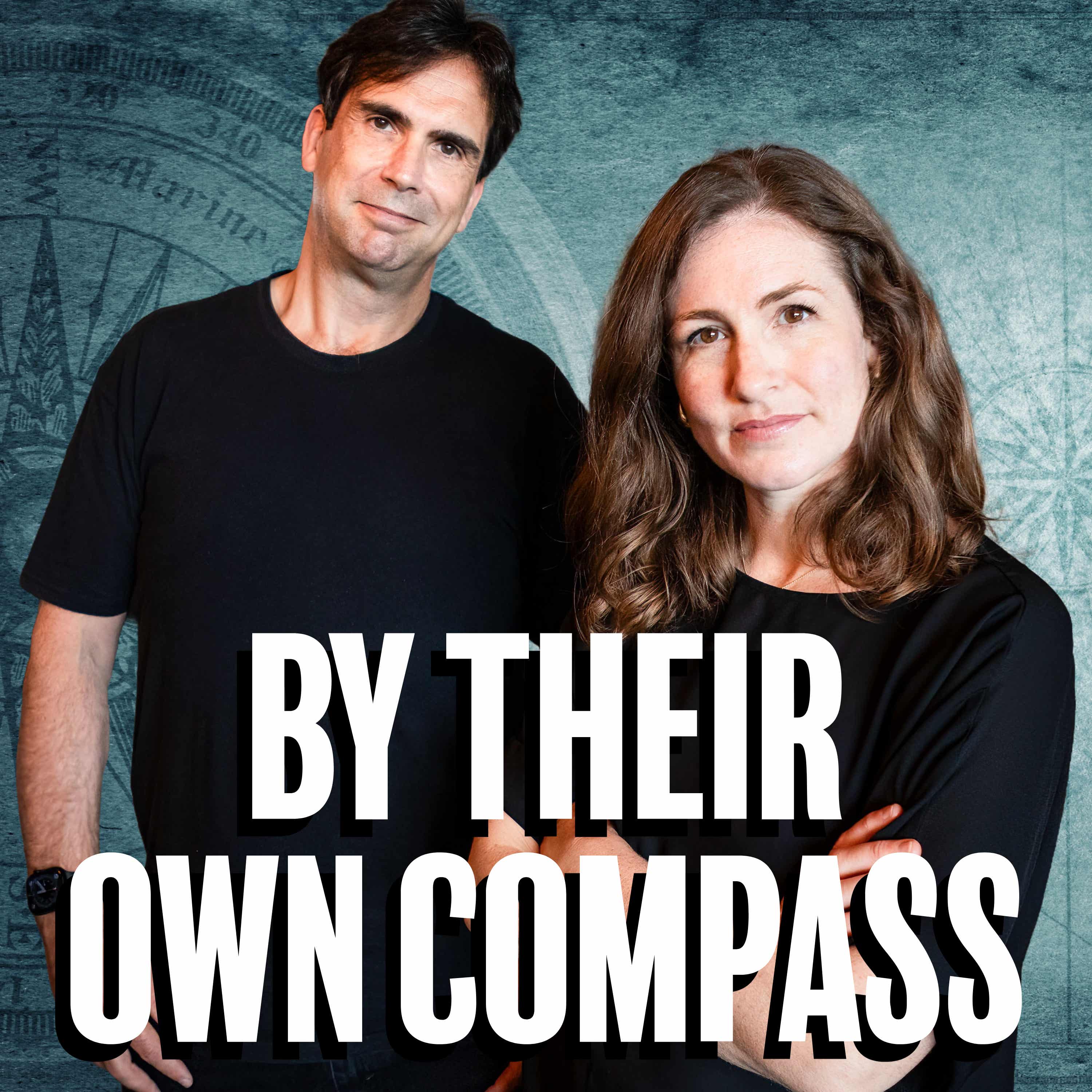
PODCAST · history
By Their Own Compass
by Where a love of history meets a passion for travel.
Historian Jeremiah Jenne and journalist Sarah Keenlyside explore historical travellers and the worlds they encountered, connecting past journeys to today's travel destinations. bytheirowncompass.substack.com
-
21
History’s Funniest Diplomatic Fails: the US in Guam, Louis XIV’s Fake Persian Ambassador and China’s Unluckiest Envoy
In diplomatic history, some missions don’t always go off with a bang, but with a cringe. During the Spanish-American War in 1898, the US Navy attacked Guam and waited for return fire that never came. Turns out the Spanish-run island had no idea they were enemies and sent an army officer and port commander out in a rowboat to go say a cheerful hello instead. In 1715, Louis XIV donned his finest diamond encrusted outfit to welcome a Persian “ambassador” in his spectacular Hall of Mirrors at the Palace of Versailles only to be told his translator was no good; and in 1870, Chinese diplomat Chonghou went all the way to France to say sorry for the murder of some nuns during the Tianjin Massacre, only to wait around for a year to find someone to apologize to.In this episode, Jeremiah and Sarah take turns to tell the stories of three of history’s most embarrassing diplomatic incidents and attempt to put themselves in the shoes of those who were there. Jeremiah balks at Sarah’s lack of Beatles song recognition, and Sarah reveals her favourite modern diplomatic fail: when Emmanuel Macron surprised Donald Trump with a Daft Punk medley performed by the Garde Républicaine. This is a public episode. If you'd like to discuss this with other subscribers or get access to bonus episodes, visit bytheirowncompass.substack.com/subscribe
-
20
Leo Africanus: Pirates, Popes, and the Moor Who Knew Too Much
Captured by a Spanish pirate? A gift to Pope Leo X? Europe’s expert on Africa for nearly three centuries? Leo Africanus lived many lives. Born al-Hasan ibn Muhammad al-Wazzan around 1488 in Granada, Spain, he was trained in the madrasas of Fez to be a diplomat. He travelled across the Sahara Desert and North Africa, sailed the Red Sea, and called on courts from Tunis to Timbuktu, Cairo to Constantinople. Then he became a prisoner of Rome, a convert (possibly) to Christianity, and one of the most celebrated scholars of his era, writing the Cosmography and Geography of Africa in 1526 (published in 1550). Then he disappeared.In this episode of By Their Own Compass, we tell the story of how a roving ambassador from Fez ended up a prisoner in the Castel Sant’Angelo, the dungeons and luxury apartments rolled into a single fortress on the Tiber. We follow his capture at sea in 1518, his fifteen months in the papal cells, his baptism by the Medici pope who gave him his own names, and the nine years he spent in Rome as a convert, a scholar, and a curiosity. We also follow him out, because when the city was sacked by mutinous Imperial troops in May 1527, Leo Africanus used the chaos to disappear, most likely back to Tunis, where he becomes untraceable in the historical record.Become a member of the By Their Own Compass Club on Substack for research notes on Leo Africanus, extended travel tips for Fez and Rome, a full episode transcript, and an original parody song we’re not entirely sorry about. The gratitude is real.Along the way, we talk about what it meant to be a Muslim diplomat captured in Renaissance Europe, the family history that starts with the fall of Granada in 1492, and the Venetian editor Giovanni Battista Ramusio, who published Leo’s manuscript and, in the process, smoothed over the Islam and sharpened the Christianity for his European readers. We also ask the same question we asked of Marco Polo. How much of Leo’s Africa did he actually see, and how much did he hear about in the markets of Fez and write down as if he’d been there? Our guide through the tangle is the historian Natalie Zemon Davis, whose Trickster Travels is the most thorough reconstruction of who this man was. An updated edition of Cosmography and Geography of Africa is out from Penguin Classics, the first new English translation of the book in over four hundred years.Sarah and Jeremiah take you through the Rome and Fez of Leo’s life too, from the Castel Sant’Angelo and the Passetto di Borgo (the corridor the Pope fled down in 1527) through the May 6 swearing-in ceremony of the Swiss Guard, and across the Mediterranean to the medina of Fez and the Chouara tanneries, where the smell still hits you on the terrace.Share this episode with a friend who thinks Kashmir is part of Morocco simply because Robert Plant used to buy the really good drugs there back in 1973. This is a public episode. If you'd like to discuss this with other subscribers or get access to bonus episodes, visit bytheirowncompass.substack.com/subscribe
-
19
The Lost Generation in 1920s Paris: How Glamorous Was It Really?
Cobblestones. Cafes. The smell of baguettes hits you as you walk into a warm boulangerie on a rainy morning. An open notebook on a chequered tablecloth, an old-style pen, and a café au lait at the ready. Paris in April. They even wrote a song about it. Paris is probably the most pre-imagined city on earth, and the so-called Lost Generation, the writers and artists who flooded here after the First World War, wrote a version of the city that most of us still carry with us.Ernest Hemingway’s A Moveable Feast was the book that launched a thousand tote bags. But that version of 1920s Paris with its champagne, café feuds, and glamorised poverty (trust funds and inheritances conveniently hidden) is only one man’s memories, written down and romanticised decades after the fact.In this episode of By Their Own Compass, we take a look at three writers who were all in Paris at the same time, but writing about three different cities. Jean Rhys was a writer from Dominica. Later, she would become famous for her 1966 classic, Wide Sargasso Sea, but in 1920s Paris, she was a struggling writer with little money and a husband in a French prison. George Orwell was there, too. Washing dishes at a fancy hotel and scraping by in a rundown hotel just 500 metres from where Hemingway lived.We trace their haunts from the Place de la Contrescarpe to Montparnasse, from Jean Rhys’ beautifully evocative Left Bank and Other Stories to Orwell’s Down and Out in Paris and London, whose stories of crowded, profane kitchens would be among the inspirations for Anthony Bourdain and his famous book Kitchen Confidential. And we offer a Paris travel guide for those on their way to France or just dreaming of a trip. Sarah and Jeremiah walk you from the Latin Quarter to the Luxembourg Gardens. This is a public episode. If you'd like to discuss this with other subscribers or get access to bonus episodes, visit bytheirowncompass.substack.com/subscribe
-
18
Historian Nicola Di Cosmo on Venice, the Mongols, and Marco Polo in China
Our Marco Polo episode was the most downloaded show in the history of By Their Own Compass. This week, we go deeper into the world of Marco and the Mongols as we sit down with Nicola Di Cosmo, Professor of East Asian Studies at the Institute for Advanced Study in Princeton and co-author of Venice and the Mongols, out this month from Princeton University Press, to talk about how the Mongol discovery of Europe (rather than the other way around) made Marco's journey possible in the first place. We also ask Professor Di Cosmo why Marco, one of the world's most famous travellers, came home from China and chose to skip out on an entire era of growing economic and political ties between Venice and the Mongols, preferring instead to promote his book and invest in canal-adjacent real estate. Finally, we find out how a slap to the face of a Venetian merchant in a Black Sea trading post might have been responsible for the Black Death reaching Europe. This is a public episode. If you'd like to discuss this with other subscribers or get access to bonus episodes, visit bytheirowncompass.substack.com/subscribe
-
17
Marco Polo’s 17 Year Journey in China: Reality vs Fiction
It’s a question that’s puzzled historians for centuries: did Marco Polo really go to China – or is history’s most famous traveller also its greatest liar?In this episode of By Their Own Compass, Jeremiah Jenne and Sarah Keenlyside attempt to uncover the true story of Marco Polo – the Venetian merchant who left home at 17, spent 17 years at the court of Kublai Khan, and came back with a tale so extraordinary that people still argue about whether it’s true.Moreover, what was China like during the Yuan dynasty? We examine what Marco Polo actually saw – the cities he visited, the jobs he claimed to hold, the things he noticed, and, intriguingly, the things he didn’t, and ask whether those omissions work for or against him as a reliable narrator. He may not have mentioned the Great Wall, or tea, or chopsticks, but he sure went into detail about the Khan’s legions of concubines and the empire’s impressive postal system, which stretched all the way to Persia.We also look at the famous book that came out of it – The Travels of Marco Polo – dictated to his cellmate Rustichello of Pisa in a Genoese prison, and ask how much of it is memoir, how much is merchant’s log, and how much is a romance writer adding colour for a medieval audience.And, as always, we follow the Marco Polo trail in China today – from Beihai Park and the hutongs of Beijing, both built on the bones of Kublai Khan’s capital Khanbaliq, to the West Lake at Hangzhou, the city Marco called the greatest in the world. We also talk about why the bridge outside Beijing that bears his name is known to Chinese people for a very different reason. This is a public episode. If you'd like to discuss this with other subscribers or get access to bonus episodes, visit bytheirowncompass.substack.com/subscribe
-
16
History's Biggest Travel Divas: Fanny Trollope, Empress Dowager Cixi, and Alice Roosevelt
From Fanny Trollope's war on American manners to Alice Roosevelt's pet snake to the Empress Dowager Cixi's private theme park: a travel history of women who refused to behave.Every traveller knows one. You might be one. The person who sends the steak back twice, requests a different hotel room because the view isn't quite right, and has opinions about thread count that they're not afraid to share with the concierge at volume.But is it always a fair label? Are Divas difficult? Demanding? Or are they a woman who refuses to travel on somebody else's terms? We discuss.Fanny Trollope: The Woman Who Hated America (And wrote a bestseller all about it) In 1827, Frances "Fanny" Trollope was nearly broke, pushing 50, and raising five children plus a husband going mad on his own mercury cures. So naturally she decided to sail to America to join a utopian commune in Tennessee. By 1831, she was over the American experience and moved back to England to write a caustic book of her travels which earned her the name "Old Madam Vinegar." It was a smash hit.Empress Dowager Cixi: The Woman Who Built Her Own Theme Park The de facto ruler of China from 1861 to 1908 spent a dynasty's fortune rebuilding the world in her back yard. Landscapes. Temples. Famous vistas. Unfortunately, events would force this reluctant traveller to leave her theme park world behind.Alice Roosevelt Longworth: The Woman Who Simply Did Not Care WHAT You Think Teddy Roosevelt put his eldest daughter on a diplomatic ship to Asia in 1905, probably because he needed a break. She jumped fully clothed into the swimming pool, learned the hula in Hawaii, carried a pet snake named Emily Spinach in her handbag, and slid down a banister at the Korean royal court.We also share some of our own encounters with diva behaviour from years of leading trips and running a luxury travel company.To sign up for regular updates or to become a member of the By Their Own Compass Club and get bonus content, transcripts, research notes, and reading lists for each episode, visit bytheirowncompass.com This is a public episode. If you'd like to discuss this with other subscribers or get access to bonus episodes, visit bytheirowncompass.substack.com/subscribe
-
15
Interview: Annie Londonderry’s Great-Grandnephew Peter Zheutlin
It’s rare that one of history’s most iconic travellers has a living relative we can speak to – but that’s exactly the case with Annie Londonderry, whose great-grandnephew Peter Zheutlin has a remarkable story of his own.In 1894, Annie Londonderry, real name Annie Cohen Kopchovsky, became a global sensation when she claimed to be the first woman to cycle around the world. A fearless Victorian adventurer and brilliant self-promoter, she filled newspaper columns from Paris to Singapore before vanishing without a trace for nearly a century. Even her own descendants knew nothing about her.Until Peter Zheutlin got a phone call.In this bonus episode of By Their Own Compass, the US-based author and journalist recounts piecing Annie’s life together from scratch, clue by clue, until he had enough to write her definitive biography. What followed was a full-scale revival: West End musicals, documentaries, children’s books, and more.Spin: A Novel Based on a (Mostly) True Story can be found at your local independent bookseller, and an audio version of Peter’s first book, Around the World on Two Wheels, is available on Libro.fm.Want even more of the juicy details? Paid subscribers to our Substack newsletter and members of the By Their Own Compass Club get Zheutlin’s full story. Sign up at bytheirowncompass.substack.com. This is a public episode. If you'd like to discuss this with other subscribers or get access to bonus episodes, visit bytheirowncompass.substack.com/subscribe
-
14
Annie Londonderry: The Woman Who Bicycled Around the World (Sort Of)
On June 25, 1894, five hundred people gathered on the steps of the Massachusetts State House to watch a young woman named Annie Londonderry climb onto a Columbia bicycle and ride off to circle the globe. She carried a pearl-handled revolver, a placard advertising spring water from New Hampshire, and a wager (allegedly worth thousands) that no woman could complete such a journey in fifteen months.There were a few things the crowd didn’t know. Her name wasn’t really Annie Londonderry. She’d never ridden a bicycle until a few days earlier. She had a husband and three small children at home. And the wager was almost certainly something she made up.In this episode of By Their Own Compass, we follow Annie Cohen Kopchovsky, advertising saleswoman, Latvian immigrant, mother, and one of history’s most audacious self-promoters — as she talks, pedals, and occasionally steamships her way around the world. From Boston to Chicago (where she ditches her skirts for bloomers and never looks back), across the Atlantic to Marseilles (where she tells reporters she’s a Harvard medical student), through a hopscotch tour of Asia (mostly from the deck of a ship), and back across the American West (where she crashes into a drove of pigs in Iowa), Annie’s journey is a story about the bicycle as a tool of women’s liberation, the birth of influencer marketing, and the thin line between adventurer and con artist.We explore how Annie invented her own sponsorship model, turning her body into a walking billboard decades before the concept existed, why Susan B. Anthony said the bicycle did more to emancipate women than anything else in the world, and how Annie was forgotten for over a century until a letter from a stranger led her great-grandnephew to uncover her story in dusty newspaper archives.Plus: how to follow Annie’s wheel tracks today, from the golden dome of the Massachusetts State House to the cycling routes of southern New England, and why the Boston neighbourhood she grew up in no longer exists.This episode owes a tremendous debt to Peter Zheutlin's Around the World on Two Wheels: Annie Londonderry's Extraordinary Ride, the definitive account of Annie's journey. Zheutlin, Annie's great-grandnephew, spent years piecing her story together from newspaper archives, microfilm, and the few surviving artifacts held by her granddaughter. Without his research, Annie would still be forgotten. If this episode sparks your interest, that book and his novelization of Annie’s journey, Spin, are the essential next steps. This is a public episode. If you'd like to discuss this with other subscribers or get access to bonus episodes, visit bytheirowncompass.substack.com/subscribe
-
13
History's Greatest Travel Scams: From Medieval Relic Fraud to the Tea House Scam in Beijing
If you’ve ever Googled “how to avoid scams in [destination],” you already know the genre: YouTube videos breathlessly (and ominously) exposing the 15 tricks that will ruin your trip to Florence, Bangkok, or Marrakech. Full disclosure: We watch them too. But the historically minded traveler will be quick to note that almost none of these scams are new.Structurally, the “hey, did you lose your wallet” scam is identical to cons recorded in Chinese travel literature over 400 years ago. The “helpful stranger” who leads you to his friend’s shop? A porter scam from 1617. Fake antiquities? Egyptian villagers were running that play on European collectors since the days of Napoleon.In this episode, we trace the world’s most common travel scams back to their historical origins across three centuries and three continents, and then embarrass ourselves by sharing the ones we’ve fallen for personally or that have happened to people on our trips we’re supposed to be protecting.Medieval Europe: Holy Bones, Unholy BusinessThe medieval relic trade was a continent-wide fraud economy hiding in plain sight. Churches needed relics to attract pilgrims, pilgrims brought money, and money built cathedrals. The problem? There are only so many saints, and they only have so many bones. Enter the relic hunters: professional grave robbers descending into the Roman catacombs to fill orders from churches across Northern Europe, and (in the greatest heist/relic rescue of the era) two Venetian merchants who smuggled the body of St. Mark out of Alexandria (hidden under a shipment of pork). We also meet Chaucer’s Pardoner, literature’s most shameless con artist, and hear John Calvin’s withering data-driven observations about the improbable number of supposed holy relics held in churches across Europe.Ming Dynasty China: The Original Lonely Planet WarningIn 1617, a Chinese writer named Zhang Yingyu published The Book of Swindles — essentially a traveler’s field guide to every way you could get cheated on the road. The bag-drop switcheroo. The porter who disappears into the crowd with your luggage. The commentary is remarkably familiar: a traveler on the road doesn’t seek ill-gotten gains, and to keep his own property safely hidden, it’s the only way to prevent loss. Four centuries later, it still is.19th-Century Egypt: When the Scammed Deserved ItAfter Napoleon kicked off a European craze for Egyptian antiquities, colonial collectors stripped temples and bought relics by the crate. We find it difficult to feel sorry for them when it turns out local workshops were producing fake scarabs and amulets by the thousand. The crowning achievement: an entire village near Luxor that built a convincing fake royal tomb, furnished it with forged antiquities, and conned a dealer out of 600 gold pounds.And Then There’s UsWe also share some of our own less glorious moments — including the tea house and KTV bar double-hit (one student, one day, both scams), a game of bat and ball at the Temple of Heaven that turned out to have a cover charge, and a Berber market in Marrakech that supposedly only happens once every two months but whose bracelet broke in two days.The through-line? The scam works because the wanting is universal. We want to believe. We want our trip to be magical. And sometimes that plays right into the magician's hands.Have a scam story of your own? Send it in — we might feature it in a future newsletter. This is a public episode. If you'd like to discuss this with other subscribers or get access to bonus episodes, visit bytheirowncompass.substack.com/subscribe
-
12
What Happens When You Recreate a Viking Voyage, with W. Hodding Carter
It’s one thing to read about Leif Erikson’s epic journey from Greenland to North America in the 10th century as a child; it’s quite another to build a replica Viking cargo ship and attempt the same journey as an adult.But that’s exactly what W. Hodding Carter and his team did in 1997, making them the first crew in history to authentically follow in Leif Erikson’s footsteps. In reality, that meant sailing over 3,000km in a wooden boat with no heating, no shelter, and in brutal conditions.In this bonus episode of By Their Own Compass, we chat to the man himself about why he did it, how well his replica Viking clothing held up in freezing, stormy seas, and why you shouldn’t eat abandoned whale blubber.By retracing the intrepid Norse explorer’s route using the same equipment, Carter also stumbled across several fascinating insights about what he thinks really happened, and why some items the Vikings had – in particular sun stones to help navigate through the fog – remain a complete mystery today.*You can buy A Viking Voyage by W. Hodding Carter at all good booksellersSubscribe to By Their Own Compass🎧 Want extended cuts?🗺️ Insider travel tips we don’t share anywhere else📚 Full reading lists + source material🎙 Behind the scenes silliness> Join here for the price of a coffee per month: bytheirowncompass.substack.com This is a public episode. If you'd like to discuss this with other subscribers or get access to bonus episodes, visit bytheirowncompass.substack.com/subscribe
-
11
Erik the Red & Leif Erikson: The outlaw who founded Greenland and the son who reached North America
Around the year 985 A.D., Icelandic exile Erik the Red, a man renowned for his fiery temper, founded the first Norse settlement in Greenland. Years later, his ambitious son Leif Erikson went on to become one of the first known Europeans to set foot in North America – centuries before Columbus.In this episode, we dive into the real history of Greenland’s Norse origins, the legends of Vinland, and the first confirmed European site in North America at L’Anse aux Meadows. Who exactly were these seafaring Norse explorers? How did Greenland get its name? And how on earth did they survive (and thrive) in such inhospitable conditions?Amid the modern mythmaking of Netflix’s Vikings: Valhalla and the cultural misunderstandings around Greenland thanks to one Donald J. Trump, we unpack the reality of this father-son duo’s epic travels as they got further and further from their Scandinavian homeland; how they created a fragile Norse colony built on trade (including walrus ivory), got incredibly lucky with the climate during the Medieval Warm Period, and why they failed to settle North America once landing on its shores.We also take a little detour to discuss Freydís Eiríksdóttir, Leif’s formidable sister (whose bare-breasted sword posturing in the sagas shows she wasn’t exactly a believer in the art of making friends and influencing people), and discuss how Norse encounters with those they called skrælingjar* foreshadowed later patterns of contact and conflict with Arctic indigenous peoples.Plus: how to travel to Greenland and Newfoundland today, visit Norse ruins, and follow the route of the brave (and occasionally reckless) Vikings who sailed beyond the limits of their world.Warning: This word is a pejorative term for Indigenous people and appears in the episode in quotations from the Icelandic Sagas or in contexts that reflect Norse attitudes toward some of the people they encountered. This is a public episode. If you'd like to discuss this with other subscribers or get access to bonus episodes, visit bytheirowncompass.substack.com/subscribe
-
10
The Grand Tour Explained: Bridgerton, Bad Behaviour and Too Many Sex Scandals to Count
When the writers on Netflix’s Bridgerton send Colin Bridgerton off on the Grand Tour in season three, it’s treated as a throwaway plot device. In reality, the Grand Tour was one of the most influential – and ridiculous – phenomena in British history, shaping everything from travel writing to modern tourism.In this episode, we use Colin Bridgerton’s continental adventures as a starting point to explore the 18th-century Grand Tour: the original gap year for wealthy young men. Its participants travelled through Paris, Rome and Venice, crossed the Alps, wrote pompous letters home, got embroiled in scandals, caught STDs, and became the target of savage satirical cartoons.We unpack how the Grand Tour also helped invent the travel guidebook, why tourists still flock to the same “must-see” sights today, how so-called souvenirs often meant mass produced art and looted antiquities, and why Venice became both a cultural hotspot and an early warning about over-tourism. It’s a story of privilege, taste-making and cultural theft –and explores how many of travel’s biggest controversies in 2026 can be traced back to the Grand Tour.Ps. Hang around for the end of the podcast, where we’ve included another episode-themed musical easter egg. This is a public episode. If you'd like to discuss this with other subscribers or get access to bonus episodes, visit bytheirowncompass.substack.com/subscribe
-
9
Bonus Dispatch: Modern-day Missionaries, Walking Safaris, and the Livingstone Trail with Dan Kobayashi
David Livingstone spent thirty years wandering across Africa. In our main episode we spent forty minutes talking about him. We may have missed a few spots. Dan Kobayashi, a writer and longtime Africa analyst, helps us fill in the blank spaces on the map. Dan spent 13 years as an expert on Southern and Central Africa for the U.S State Department, and most recently analyzed global power competition on the African continent. He has worked at the U.S. Embassies in Lesotho, Zambia, Malawi, and Botswana and has organized U.S observation of five African elections.We get into the geography we skipped, especially Malawi and Tanzania, and the complicated modern legacy of Victorian missionaries. We also discuss the importance of humility when traveling, and why a walking safari can be both the best and most nerve-wracking way to see wildlife there.He is currently a writer, consultant, and stay-at-home father based in Geneva, and writes at expatriarch.substack.com. If you would like to hire him for Africa analysis, strategic communications, or writing and editing projects, or to publish his memoir "Africa: A Love Story," ask us for his email.Show Notes & Reading ListDestinations Discussed* Zimbabwe: Harare, Mosi-oa-Tunya (Victoria Falls), Mana Pools.* Zambia: Lower Zambezi National Park, South Luangwa National Park, Zambezi Breezers.* Botswana: Kalahari Desert, Okavango Delta, Deception Valley Lodge, Chobe National Park, Maun.* Tanzania: Zanzibar (Stonetown), Serengeti, Ngorongoro Crater.* Malawi: Zomba (Chancellor College), Majete National Park.* South Africa: Kruger National Park, Sabi Sands.Books & References* Men with Tales (Safari guide anthology)* Livingstone by Tim Jeal* Stanley: The Impossible Life of Africa’s Greatest Explorer by Tim Jeal* Don’t Let’s Go to the Dogs Tonight by Alexandra FullerLinks* Expatriarch: Dan Kobayashi’s Substack – Subscribe Here* Further Reading: “I Suppose I Have to Talk About Lesotho Now” by Dan KobayashiEpisode TranscriptJeremiah: Hello and welcome to a special bonus edition of By Their Own Compass. I’m Jeremiah Jenne, and I’m really pleased today to be joined by Dan Kobayashi, a thirteen-year Africa analyst for the State Department’s Office of Africa Analysis. He spent quite a bit of time living and working in the places we talked about in our David Livingstone episode. Dan, thank you for joining us today.Dan Kobayashi: Happy to be here.Jeremiah: Now, in our episode, one of the things that was difficult was that David Livingstone went to so many different places in southern Central Africa, and because we had to narrow it down, we chose Zambia, Zimbabwe, and Botswana. But of course, there were so many more places we could have covered. What are some of the places that we missed, and what are your impressions of the area where David Livingstone once explored, traveled, and lived?The Missing Pieces: Malawi and TanzaniaDan Kobayashi: Sure. When I first heard you were doing this episode and you invited me on, I thought the choice of Zimbabwe, Zambia, and Botswana—”Zim-Zam-Bots” for short—was slightly curious. Zimbabwe and Zambia everyone obviously thinks of with Livingstone because that’s where Mosi-oa-Tunya (Victoria Falls) is, right on the border. There are statues of him on each side of the border.I knew that he had crossed the Kalahari and whatnot, but it was in some ways almost a footnote to me. The third country I think of really very heavily with him is Malawi. Part of that is because Malawi is my first African home. It’s probably my favorite place on the continent.And then, of course, I also think of Tanzania, because Zanzibar was the epicenter of the slave trade, which he worked so tirelessly to abolish. Tanzania is where he had his famous encounter with Stanley—though I’ll note, Burundi claims it was there. I’ve got a picture of myself, which I sent to you actually, in front of the monument in Burundi commemorating their meeting, which absolutely did not happen there. That makes it an even better picture. Tanzania and Malawi are sort of the ones I think of more than Botswana.That said, Botswana is a critical place. And I could go on and on about Malawi and its joys as one of the underappreciated locations in Africa and home to the single most lovely, nicest people I’ve ever met. But “Zim-Zam” and Botswana are places for perhaps more accessible travel than Malawi, with the qualification that Zimbabwe is not always accessible.First Impressions and Hyperinflation in ZimbabweDan Kobayashi: The first time I was in Africa south of the Sahara was Christmas 2007. I flew into Harare, Zimbabwe, to meet my then-girlfriend, who was a doctor and who I met while she was doing a Master of Public Health at Harvard. She’d worked in Zim previously and had gone off to take a job in Malawi.I met her in Zimbabwe in Christmas 2007, and I was a pretty experienced traveler. I’d been to some weird places so Africa might not have been as completely different. But Zim in that particular moment certainly was. One of the tips she gave me at the time was, “Don’t bring one hundred dollar bills.” But this was the period of hyperinflation in Zimbabwe. You would trade, like, twenty US dollars, and you would get—going to betray my New England roots here—a hockey bag full of bricks of 200,000 Zimbabwe dollar notes, all of which were effectively worthless.You couldn’t get more than that. You had to do business in local currency, but you couldn’t exchange currency on the local market. The official rate was something like 40,000 to 1, and the real rate was 1.8 million to 1, and it was going up every day. It was the highest inflation on record aside from one particular period in Hungary. So, it was a case where if you went to a bar, the second beer would literally cost twice as much as the first beer.Jeremiah: Wow.Dan Kobayashi: So you’d buy them two at a time. It was just for an introduction to Africa... it was sort of stunning. Without local help, we’d have been completely out of luck. But my girlfriend had a Zimbabwean colleague who sort of helped us through the system with fixers and how to change money on the black market, because even if you wanted to do it on the legal market, you couldn’t do it, and you’d be changing money for nothing. It was very important to do it in very careful ways.So this is my introduction to Africa. I’m there as a tourist. I’m not doing any work. I’m not doing sort of “do-gooder” stuff or even neutral stuff. I’m just there to visit my friend and see the sights. But to this day, it’s probably the strangest and most difficult situation I’ve ever traveled in. There was this question of, “Well, if you run out of US dollars to change on the black market, what do you do?” It’s a three-day line to wait at the ATM, and they’ll only let you take out maybe twenty dollars US worth of money at the official exchange rate, which is you’re effectively getting robbed. Same thing with Western Union. We actually had a period where we had to cross over into Botswana at Vic Falls to get Botswana Pula out of an ATM, which we could then change into US dollars, and then take back into Zimbabwe and change for local currency.Jeremiah: That sounds like quite an introduction to a place. And I would guess over the years, as you move from being a tourist to working or in an official capacity, I wonder, as you saw other people come into Malawi, Zimbabwe, and other parts of Africa for their first time... did you start to catalog a list of the most common rookie mistakes that people coming to Africa tended to make?The “Farmerista” Approach and HumilityDan Kobayashi: I was blessed to go in with a reasonable amount of humility because the doctor I was traveling with came out of the Paul Farmer school—what are often called “Farmeristas”—which is one of extreme humility, self-flagellating humility almost, in the context of Africa, or Haiti in the case of Farmer originally.So there was a real emphasis on respect and local knowledge. Don’t think that you’re so great or so smart coming from outside. Don’t think you understand people. Don’t think that they’re ignorant of the Western world. They have TV. They have radio. Though Malawi only got TV in 1996.I should add: don’t assume that a person of no particular competence in the US is somehow of more competence in Africa. I’d visit Chancellor College in Zomba, Malawi—the old colonial capital, which is like the fourth biggest city in Malawi—but it has the national college. The professors there are real professors. They’re not interested in having some random American come in and teach there. There are no jobs for that, any more than I could walk into Harvard and say, “Hey, I’m a very smart guy.”But it’s easy to be arrogant. One of the themes that’s unifying from Livingstone’s time through to today is Africa remains a place where Westerners, especially white Westerners frankly, of no particular distinction can go and be treated like they are something more than they are.But I think you have to be frank about the fact: I am not Livingstone. I am not going there in that time. As monstrous as some of these adventurers were, they were doing wild, incredibly risky things in places that really were unknown or relatively unknown to people like them. Stanley, as you correctly note, was a huckster and a charlatan. But you can’t say he lacked for physical bravery. Going into the African interior, having almost everyone on your mission die, and then somehow escape and do it again—just as Livingstone did, until it of course caught up with him eventually—is no joke. And that is decidedly not what we are dealing with as visitors to Africa, even in quite remote and rural places now.Perceptions of LivingstoneDan Kobayashi: To answer your question about perceptions of Livingstone, I do think Livingstone is viewed differently in general. In South Africa, there was the “Rhodes Must Fall” movement to take down statues of Cecil Rhodes some years ago. I think there is very rightly a fair amount of antagonism towards him. There are other explorers who are viewed quite negatively, Stanley often among them. I think Livingstone is generally viewed differently.He is, I think, perceived by a lot of Africans in southern Africa and other parts of East Africa as having brought Christianity to Africa. His extremely poor record as a missionary notwithstanding—you know, he converted one more person than I did. And I’m not a Christian.Jeremiah: Yeah. We had a joke about that in the episode that we ended up cutting: that the number of people he officially converted probably wouldn’t be enough to field an entire baseball team, or even an infield.Dan Kobayashi: I mean, he couldn’t have fielded an entire tennis match from the historical records, as I see it. But he still does have that reputation. Christianity is a very central part of life in most of southern Africa. There are still Islamic outposts there, including in parts of Malawi, but Christianity is central to life. And people generally regard its importation as a positive thing. There is syncretism, of course—combination with local religions that predate Christianity—but that’s generally positively received.At Makerere University in Uganda, long regarded as the top university in East Africa, they have a giant statue outside one of the dorms of “Black Livingstone,” which is a depiction of Livingstone as a black African man, which I find fascinating. So I think he’s held in pretty high regard still. He is not viewed as rapacious in the way that a lot of other explorers, or conquerors or colonialists as the case may be, are.Jeremiah: When we look at the map of where he went, it covers an area that today are so many different countries. For example, one of the places that we didn’t talk as much about in the episode as a modern-day place, Tanzania... Not only was that where he met Stanley, but of course when we talk about Tanzania, we also have to talk about Zanzibar, which at that time was the center of the slave trade.Dan Kobayashi: Yeah. That’s correct. And there’s a church in Zanzibar, in Stonetown—which is pretty much one hundred percent Muslim—adjacent to the site of the last open-air slave market in East Africa. And Livingstone is perceived, not without reason, as having been a crucial figure in the end of the East African slave trade.And I should note, his relationship with the actual slave traders was complicated. While he categorically opposed them, there were many times where he relied on them for his own personal security. There’s one Swahili slave trader of great historical note named Tippu Tip, who was sort of the “king of the slave traders” in East Africa, who Livingstone relied on for transport and directions a variety of times. So these were the guys who knew how to get around the area. And Livingstone was not immune from having to rely on information they’d acquired through their ugly, ugly business.Jeremiah: In the context of his time, and compared to some of his contemporaries, I have to say I feel like Livingstone does get a certain... he’s in a special category. And it comes back to something you were saying earlier. There’s a humility about him. Not in every aspect of his life. As we talked about in the episode, he was probably a bit of a “project” as a husband and father. But when dealing with people that he would encounter on his travels on the African continent... I’m not saying it was always perfect, but he does seem to approach these interactions with a degree of humility that doesn’t necessarily come across in the writings of other Victorian-era explorers of the continent. And I wonder if that might be part of the reason, not only for his success as an explorer, but also why he’s remembered so well today.Dan Kobayashi: I think that’s right. It’s hard to look at Livingstone and his work and his legacy and think, “This is a guy who was going there for the purpose of greed and rapaciousness and to dominate the local people.” Was he there to export foreign values? Yes, absolutely. But at the very least, it was with largely good intentions. Now the road to hell is paved with good intentions, but I’ll still take good intentions over bad intentions any day.And, you know, you’ve mentioned Burton... like, Burton was a monster. Even to his fellow Europeans. I want to note on Stanley: I know you relied heavily on Tim Jeal’s book about Livingstone for the background in this episode. His book on Stanley is one of my favorite books about African exploration. And one of the arguments he makes is that Stanley, by our current standards, made himself look worse than he actually was in the name of “fabulism”—that his readers were interested in stories of taming savages. So he greatly exaggerated his personal cruelty. And by the standard of explorers, he was fairly reasonable. Not Livingstone, but not like some of these other guys. Tim Jeal’s insights into exploration in general are just superb.The Missionary ImpulseJeremiah: Yeah, I really enjoyed that. I research missionaries as part of my own work. I’m doing a book on missionaries. And it is interesting to me when I look at, again, all missionaries are not all the same. They all have their different motivations. Obviously, Livingstone was not interested in conversion, but is there a “missionary impulse” that comes out of this era? For all the best reasons—the desire to help, the desire to go places, the desire to get involved... But at the same time, are there people who are working in this part of Africa today who are doing good but still have that kind of missionary impulse that still seems very similar to what many of Livingstone’s contemporaries were trying to do?Dan Kobayashi: So, I think most people going out there at least now approach it with a certain amount of humility, that there’s at least a fair amount of: “Am I actually accomplishing anything here? Is this worthwhile? How do I advance this while respecting local traditions?” There are people who are very committed to localization and moving off of the “we’re coming here to fix everything” approach versus giving local organizations tools.This question of, “Can an international organization exist forever? Should it exist forever?” ... My wife came up through an organization in Tanzania and effectively their model was going into an area where there was really limited knowledge about HIV in rural areas. And then over time—this was a very successful organization—it ceased to exist. It ran out of business in large part because the work was actually done. There had been more local capacity built up; the Ministry of Health took over some of these functions. There was vocabulary about how to talk about HIV. People were getting treatment. The external part withered away so the local institution could flourish. And I think that’s ideally where we want to be.There are a lot of places where that doesn’t happen. This sort of “in perpetuity, the purpose of providing aid becomes to provide aid” is a real problem. That said, I think the notion that the HIV crisis, given its magnitude, could have been addressed as effectively without massive external infusions of money and resources is extremely difficult to imagine. A place like Malawi, for example... they don’t have resources. At the end of the day, they have coffee, sugar, tea, tobacco and—depending on the market price—uranium. There’s no way to grow the economic base. The US government filled in a huge part of the health budget, but that money is literally not coming from anywhere else.We should not overrate our importance in any of these issues. You know, being outside, you’re going to make mistakes. And I think the analogy between the old missionaries and development workers of today is absolutely a fair analogy. It’s not perfect. I know plenty of people in Africa will say, “Well, yeah, but we didn’t have schools before the missionaries came here. We didn’t have literate populations,” and so on. I think there is more ambiguity towards missionaries amongst the Western left than there is in much of the African population. I think there’s still a lot of appreciation for missionaries, despite a lot of the really awful things that were done as part of the missionary process.To this day, you still have plenty of missionaries working in the most remote parts of countries, living much more humbly than diplomats or NGO workers do, and providing services that would be unprovided other ways. There are a lot of other missionaries that are accomplishing nothing too—you know, the “mission trip” culture where if you just sent a check for two thousand dollars instead of spending five thousand dollars on the trip, you would have done a lot more good.Travel Recommendations: Beyond the Ordinary SafariJeremiah: We’ve talked a lot about the challenges in this part of Africa, and obviously that’s important. But I’ve traveled a little bit around Tanzania, I’ve traveled a little bit around East Africa. Tanzania especially has some of the most beautiful things I’ve ever seen in the world. And I was wondering—not to put you too much on the spot, because I know you’ve traveled to a lot of places—but for modern-day travelers, what are some of the places that you might recommend that maybe people don’t always think about? Obviously saying “I want to go to Africa” is almost meaningless because it’s such a big statement. But if somebody wanted to really experience a part of Africa that they might not otherwise think about, what would you recommend?Dan Kobayashi: Yeah, what generally people do when they want to go on the African safari is they either do some combination of Tanzania or Kenya: the Masai Mara on the Kenyan side and Serengeti on the Tanzanian side. And that can be combined with Ngorongoro Crater, which is sort of, from an American perspective, the Africa you really imagine—the vast plains. Even when there are no animals there, it’s still stunningly beautiful. Ngorongoro Crater... take every single animal away, and it’s still an absolute wonder of the world. That’s the classic, “you’re doing one safari in your life” trip. That said, it’s more of a mass-market product. There are sort of cruise-ship-adjacent ways to do it.Then there’s the South Africa route. In South Africa you’re more likely to see all five of the Big Five, largely because they have a relatively robust rhinoceros population that they don’t in East Africa. But a lot of the South African safari locations are what they call “bushveld.” It’s like, if there were no animals there, this would not be that interesting. You’re just driving around acacia trees forever.I think my favorite safari experiences have really been ones where you do get more off the beaten track. Not to un-touristed places, but to places that are less touristed, more obscure, where if you see a lion, it’s not “Here’s a lion surrounded by thirty safari trucks.” And those places do still exist.I know you guys reflected on it in your piece: Botswana is really, really good for that. Botswana has really placed an emphasis on high-end, low-volume tourism. Some of that is enabled fundamentally by the remoteness of parts of Botswana. One of the best safaris of my life was a trip to Botswana where the animal life was relatively limited. We went when I was living in Lesotho. My parents flew in and we went to Botswana, to the Kalahari to a lodge called Deception Valley, and to the Okavango.It was a low season trip—rainy season—so you’re getting less wildlife because things are growing. The Kalahari was green; our guide said it was the greenest they’d seen it in a decade. And in the Okavango, the floods hadn’t hit yet. So when you’re going through on the dugout canoes, you’re not seeing that much wildlife. Mostly you’re getting hit in the face by hippo grass.But we had it to ourselves, which is a magical experience. Being in the middle of the Kalahari with effectively no one around but the lodge staff is one of the most special and meaningful experiences of my life. We got them to turn off the lights so we could stare up at the Magellanic Clouds—the galaxies that Magellan saw when he went south of the equator.This particular lodge is owned by an Afrikaner family, but the son who was our guide speaks the local San language, Naro. No one who’s not one of the members of this ethnic group speaks it. But there was a chance to go out with some of the Naro people and learn about their traditional way of life. I had massive fears that this was going to feel like a “human safari,” which is the worst thing in the world. But it was the opposite. Just talking with these Naro people as they explained how in the old days they would hide water in ostrich eggs, how to light a fire in the Kalahari, how they would make the poison for their arrows... The Kalahari has effectively no rocks; giraffe bone was the hardest material around. Thinking about common humanity—that even in the middle of the Kalahari, under the ancient ways, there was still art and music and stories—was really deeply humbling.And then you go to the Okavango, where you can do a walking safari. I’ve done walking safaris in a few places, but one of the interesting things at my particular lodge was that the guides did not have rifles. Their theory was if you have a rifle, you’re more likely to do dumb stuff and take dumb risks. On the other hand, being told, “If we see a lion, they might charge, but don’t worry, it will be a mock charge as long as you don’t turn and run. They’ll stop when they get within a meter and a half of us...”Jeremiah: That’s pretty close.Dan Kobayashi: It’s under two yards. It’s incredibly close. I have never been so glad to not see that many animals at close range. I’m there with my parents, who are in their early seventies at the time, and it’s like... this is legitimately scary. And then we got this book at the lodge called Men with Tales, which was sort of stories of bush guides involving people being dragged away by lions and run over by Cape Buffalo. I would not recommend going on a walking safari without a guide with a rifle.Canoeing the ZambeziDan Kobayashi: In terms of other things you can do, in the Lower Zambezi National Park in Zambia—which is effectively the Zambian side of the Zambezi, where it’s Mana Pools on the Zimbabwean side—you can canoe on the Zambezi. I did a three-day canoe trip there which was absolutely grueling (headwind), but incredible. It’s an unmediated experience with the animals, but with a pretty good degree of safety because when you’re in the middle of the river, hippos generally don’t go where the water is deep because they don’t swim.And there’s a certain level where you can do this more economically. I did a very economical safari to South Luangwa in eastern Zambia. That was really Kool-Aid and spaghetti and sleeping in tents, but it was a terrific safari with elephants walking through camp.There’s been a lot of rehabilitation of parks that were quasi-dead recently. One of the most wonderful safaris I had was in a park in southern Malawi called Majete National Park, which was taken over by African Parks and repopulated with wildlife. When I was there around 2013, there were very few people but it was absolutely teeming with life.Jeremiah: Well, for those people who do want to follow in the footsteps of Livingstone, there are many places you can go. You can do it the old-fashioned way with a walking safari—hopefully that ends with a different lion encounter than Livingstone had. And of course, the Zambezi River. Canoeing up that river sounds absolutely amazing. That sounds like a once-in-a-lifetime journey.Dan Kobayashi: I recommend canoeing down. Going up would be brutal.Jeremiah: Okay, there we go. Canoeing down the river.Dan Kobayashi: Zambezi Breezers is a place you can start. At least when I was there, the parents of Alexandra Fuller, who has written several books about her life in Rhodesia, hung out around there and were fascinating to talk to.Outro: Africa: A Love StoryJeremiah: Well, Dan, thank you so much for taking the time to come on the podcast. Thank you for sharing your experiences and your information about this part of Africa. It’s been a real treat to see you and to catch up. And as you mentioned... did you want to talk about the book that you are currently working on right now?Dan Kobayashi: Sure. I’ve got a book that’s finished but looking for a publisher called Africa: A Love Story. It’s a tale of “boy meets continent.” I’m not so presumptuous as to think I can tell the story of Africa, but it’s my story of falling in love with the continent. How I went there in pursuit of a traditional love story with another human being, and that didn’t last, but the love of the continent did. And how I sort of made the transition from inexperienced traveler to an Africa professional—working at the State Department, being an election monitor in Zambia, and overcoming some real challenges.So, if you’re a publisher, give me a call. Otherwise it will be out someday, somehow. I currently write at https://expatriarch.substack.com/. I wrote a little bit of “Everything you need to know about Lesotho but were afraid to ask” that we can probably put up a link to here.And I encourage all of you: if you go to Africa, get out there. Don’t just do the safari. Figure out ways to get into cultural spaces in the cities. It’s beautiful, it’s fascinating, and it’s a part of our world.Jeremiah: Well, thank you so much, Dan, and thank you all for listening. We’ll be back next week with another episode of By Their Own Compass. This is a public episode. If you'd like to discuss this with other subscribers or get access to bonus episodes, visit bytheirowncompass.substack.com/subscribe
-
8
Dr. David Livingstone's Thirty-year Journey in Africa
In 1871, Scottish missionary and explorer David Livingstone (1813-1873) was hanging out in the village of Ujiji, in what is today Tanzania. He wasn’t exactly lost, but the last few years had been rough, full of heartbreak and disappointment. Livingstone had spent three decades exploring and mapping territory that is now part of the modern countries of Botswana, Zambia, and Zimbabwe. But after crossing the African continent, running the Zambezi River, renaming Victoria Falls, crossing the Kalahari Desert, and seeking the source of the Nile, the legendary Victorian voyager was nearing the end of the trail.That’s when the American (by way of Wales) journalist and huckster Henry Morton Stanley blundered into Ujiji with a caravan, drums, and a parade worthy of the Fourth of July.It was, perhaps, the most famous greeting in African history, but there is more to the legend of David Livingstone than what Henry Stanley presumed.In this week’s episode of By Their Own Compass, we are hacking our way through the dense undergrowth of myth surrounding David Livingstone, the Scottish explorer and anti-slavery crusader, to uncover the life of the man who spent years traveling through Central and Southern Africa, fuelled by a potent mix of abolitionist zeal and a total inability to sit still.This is the story of one of history’s most fascinating travelers, a man who loved Africa and understood it better than most non-Africans of his era. And as always, at the end of the episode, we talk about how today’s travelers can follow David Livingstone’s footsteps and plan their own modern-day explorations of Botswana, Zambia, and Zimbabwe. This is a public episode. If you'd like to discuss this with other subscribers or get access to bonus episodes, visit bytheirowncompass.substack.com/subscribe
-
7
Bonus Episode: Sacagawea Does K-Pop, Lewis and Clark, and AI in Podcasting
In this bonus episode of By Their Own Compass, we go behind the scenes of our Sacagawea episode to unpack one of the most misunderstood figures in American history — and the creative choices involved in telling her story today.We pull back the curtain on podcasting and creative production, including a candid discussion about AI in creativity. From AI-generated music (yes, including a Sacagawea K-pop experiment) to voice modulation, artwork, and workflow shortcuts. Where does AI genuinely enhance storytelling, and when does human judgement remain non-negotiable?We also explore the challenges of responsibly representing Native American history, why Meriwether Lewis might have been the Steve Jobs of his day, and the power of music to shape cultural narratives. How much interpretation is too much? And what does ethical storytelling look like when the archive is incomplete? This is a public episode. If you'd like to discuss this with other subscribers or get access to bonus episodes, visit bytheirowncompass.substack.com/subscribe
-
6
Sacagawea
In this episode of By Their Own Compass, we explore the extraordinary journey of Sacagawea, a nursing teenager travelling across North America with the Lewis and Clark expedition and the Corps of Discovery from 1804–1806. Looking beyond the legend, we examine her role as a traveller, cultural mediator, and Native American woman navigating survival, motherhood, and agency in a rapidly changing America.Join us as we gently dismantle the stereotypes attached to Sacagawea to tell her story as a voyager and cultural pioneer learning to move between two radically different worlds.Was she the faithful guide so often portrayed in American history books? A collaborator in a process that brought devastation to Indigenous peoples across the United States? Or was Sacagawea acting for her own reasons – making the best of a situation she did not choose, while doing what she believed was right for herself and her newborn child?Do you know someone who loves travel? How about someone who loves great stories from history? Send them a link to this episode. It’s an even better gift than a dead sea otter. Just ask Thomas Jefferson.Born into a world shaped by seasonal migrations and annual rhythms, her tribe, the Shoshone, were part of a complex network of exchange, cooperation and conflict with neighbouring peoples, including the Hidatsa, Mandan, Sioux and Crow – each with their own languages, customs and political realities. It was a world Sacagawea understood instinctively, and one the expedition did not.Along the way, she repeatedly saved Lewis and Clark from disaster, asserted herself when it mattered – insisting on being allowed to see a beached whale – and experienced moments of deep emotion, including a brief reunion with her long-lost brother, only to be forced to leave him again.This is a story of a Native American woman negotiating colonial expansion, motherhood on the move, and the power of finding your voice in a world being reshaped around you. We finish the episode by exploring how modern travellers can follow in Sacagawea’s footsteps today along the Lewis and Clark National Historic Trail, tracing her route through some of the most dramatic landscapes in the United States – from the Missouri River breaks to the mountain passes of her Shoshone homeland.Join the By Their Own Compass club and subscribe to a paid membership. Get special bonus episodes, invitations to chat with the hosts, behind-the-scenes emails with notes from our research, as well as a transcript and reading list for every episode. This is a public episode. If you'd like to discuss this with other subscribers or get access to bonus episodes, visit bytheirowncompass.substack.com/subscribe
-
5
When Travel Goes Catastrophically Wrong: History's Greatest Fiascos
Pour yourself something strong (we suggest a nice scotch for reasons that will become clear a few minutes into the episode) and settle in for a festive tour through history's most spectacular travel disasters.Whilst the rest of the world is busy booking flights and packing bags for the holidays, we thought we'd offer a public service: a cautionary tale (or four) about what happens when travelers combine breathtaking optimism with catastrophically poor preparation.For your benefit, dear listeners, we've organized historical travel fiascos into convenient categories, because even disasters deserve structure:High Expectations, Low Planning: Scotland gambles a quarter of its national wealth on a fever swamp in Panama, armed with thousands of wigs and exactly zero useful supplies. Spoilers: It does not go well. Scotland is still somewhat tetchy about it.High Expectations, Low Cultural Awareness: Lord Macartney shows up to the Chinese Emperor's birthday party thinking he's the guest of honour, only to discover he's one of dozens on the mailing list. Then he refuses to kowtow. The Emperor is not impressed.Low Expectations, Proven Entirely Correct: Tobias Smollett travels through France and Italy with preemptive contempt for everything he's about to see, then spends 400 pages confirming his suspicions. He mansplains the Venus de Medici and complains about the weather on the French Riviera. The patron saint of one-star reviews.High Expectations, Catastrophically Poor Equipment: Thomas Stevens circumnavigates the globe on a penny farthing bicycle—a vehicle designed by someone who absolutely hated gravity but loved concussions. He crashes roughly 500 times and starts riots in China. Somehow survives.If you've ever wondered whether your holiday travel could possibly go worse than you imagine, we can confirm: yes, but probably not as badly as these.Perfect listening for anyone currently stuck in an airport, contemplating a long drive to see relatives, or simply grateful their ancestors didn't invest the family fortune in Panamanian swampland.Happy Holidays from your correspondentsListen on Apple PodcastsFurther Reading & Useful Links:The Darien Scheme: Scotland's Darien Disaster – BBC HistorySome account of the public life, and a selection from the unpublished writings, of the Earl of MacartneyTobias Smollett's Travels through France and ItalyThomas Stevens' Around the World on a Bicycle This is a public episode. If you'd like to discuss this with other subscribers or get access to bonus episodes, visit bytheirowncompass.substack.com/subscribe
-
4
Bonus Episode: Emily Hahn’s Shanghai
If you enjoyed our deep dive into the life of the New Yorker correspondent, Emily Hahn wild times in China, you won’t want to miss this special bonus episode. Sarah sits down with Tina Kanagarathnam of Historic Shanghai to answer the burning question: What is actually left of Emily’s world?Every week, we transport you to a different time and place. Subscribe to get full show notes, reading lists, and historic itineraries like this one delivered straight to your inbox. No visa required.From the smell of the Huangpu River to the preserved Art Deco apartment where Emily lived (and kept her pet gibbons), Tina reveals the ghosts of the 1930s International Settlement. Whether you are planning a trip to China or just armchair traveling, tune in to discover the hidden ballrooms, surviving bookstores, and jazz haunts that defined an era of glamour and chaos.Sarah and Tina map out a specific “Emily Hahn Loop” you can walk today, taking you from the grandeur of the Peace Hotel (formerly the Cathay) to the exact apartment building on the old “Red Light” line where Emily wrote her early dispatches. We discuss what has been demolished, what has been gentrified, and the surprising corners where the spirit of Old Shanghai is still very much alive.A co-founder of Historic Shanghai, Tina is an award-winning writer and, in her almost 30 years in the magic city, has authored several books and numerous articles on Shanghai. These include the original Insight Guides Shanghai guidebook, the Zagat Guide to Shanghai, and two historic walking guides to the city. She also wrote a column on historic Shanghai architecture for the Shanghai Daily for several years.Know a friend who loves 1930s jazz, Art Deco architecture, or just a good travel story? Forward this dispatch their way and help them plan their next mental escape.Podcast Transcript: Emily Hahn’s ShanghaiHost: Sarah Keenlyside | Guest: Tina Kanagarathnam (Historic Shanghai)Introduction: The Emily Hahn Bonus EpisodeSarah (00:08)Hi everyone, it’s Sarah. And today we’re going to be doing an Emily Hahn episode companion podcast, a bonus podcast, if you like, about how you can follow in her footsteps today. We want to go in a bit more depth about Shanghai because it’s such a wonderful city that I’ve spent a lot of time in. And today the person who is still there and knows even more about it than I do—much more about it than I do in fact—is Tina Kanagarathnam from Historic Shanghai.Tina and her team have led deeply researched walking tours that bring the city’s past to life. For those of you who don’t know, I have a travel company called Bespoke Travel Company and we’ve worked with Historic Shanghai for many years. And yes, I can tell you that our clients, our guests, always absolutely love their tours. And so, there’s really no one better to speak to about Emily Hahn and the places that she went and that still exist that were in her orbit back in the 30s than Tina. So welcome, Tina, to the podcast.Tina (01:10)Thank you, and thank you for that very wonderful and warm introduction.Sarah (01:14)So let’s start. Let’s jump straight in. Obviously, Emily, she’s a real character. If you haven’t already listened to the podcast that we did, the episode that we did on Emily to our listeners, please go back and have a listen. Jeremiah and I talk in depth about her journey from America to Shanghai and beyond.And today, we really want to jump straight in and find out a little bit about what Emily would have seen in 1935. For a traveler arriving around that time, Tina, what do you think Shanghai would have felt like to her on day one when she first stepped foot in the city?First Impressions: The Bund and the SkylineTina (01:53)Well, one of the best things about Shanghai is that history is all around us in terms of the buildings. And in those days, people came by ship. And so what Emily would have seen as she came down the Huangpu River would have been pretty much what a traveler today standing on the Bund would see. That is, all the buildings of the Bund. There were a couple that weren’t yet built in 1935 when she arrived in the spring, but the vast majority of the buildings were there.It would have been—and again, this is not alien to anybody who’s lived in China—it would have been a city under construction because this was the period between the wars and things were going crazy money-wise. People were building and building and building. So, Emily, her first sight would have been the Bund. And the nice thing is, if you want to walk in Emily’s footsteps, all you have to do is just, you know, go down to the Bund and turn around and you’ll see the Peace Hotel where she spent a lot of time with her buddy Victor Sassoon.Sarah (03:03)And Tina, if we were to explain to someone who doesn’t know what the Bund is, can you explain what that is? Because I think before I went to China, also, I kept hearing this word and I didn’t actually know what it was referring to. In fact, for a long time, I thought it was referring to the other side of the river where the tall flashy buildings are.Tina (03:07)No, where the new buildings are. So the “Bund” is actually an Anglo-Indian term that just means the embankment of a river. And there are bunds all over the British colonies. The word came from, obviously, their colonies in India. But the Shanghai Bund is the most famous.And it was known as the Wall Street of Asia. So it was basically the strip—it’s about a mile long—where all the banks and financial companies, a couple of hotels, were all built between the 1880s and currently the last one was 1948. And it’s interesting because it also tells you a little bit about how Shanghai progressed because the first buildings to be built on the Bund were the 1860s. But Shanghai’s DNA has always been: What is the latest? What’s the newest? What’s the most modern? So they just kept knocking down and building up and knocking down and building up. And I always say that if not for the communist Revolution in 1949, the Bund would look very different. It was a gift that it was frozen for 50 years. So we can see Emily’s Shanghai.Sarah (04:39)And I think it’s quite surprising to some people because it’s very European looking, isn’t it? It’s not necessarily what you’d expect when you think of Chinese buildings. You think of sort of temples and peaked roofs. And of course, this really famous waterfront is very European looking, isn’t it? Can you explain why briefly?Tina (04:55)It is very European because at that point, that part of the city was the International Settlement, which was governed by 14 different countries, but let’s say primarily Britain and America were sort of the leading forces. But on the Bund, you will find countries from all over the world. There’s Russian buildings, there’s Bank of China, there’s Japanese banks. There are hotels owned by Baghdadi Jewish businessmen. So it was a very international strip.But yes, all the buildings did look very European. I’ve been told that it looks a lot like Liverpool. And that’s also because even if you were a Japanese bank or a French bank or a Russian bank, that was the status style of the era. You wanted to look Western. You weren’t going to be building a Russian building. You weren’t going to be building a fully Chinese building, although the Bank of China does have some Chinese elements.The Sensory Experience of 1930s ShanghaiSarah (05:58)And if you had to choose one sound or one smell or one sight that sort of defines interwar Shanghai, what would they be? Bit of a tricky question, but...Tina (06:09)One sound. Well, you know, I think the sound... two things. People when they arrived in Shanghai, they always talk about the smell, the smell of the river. You know, there was a stench. People lived on the rivers. They lived on the Sampans and they, you know, waste went into the water. And so these Europeans who’d gone through these month-long voyages, they’d arrive in Shanghai and the first thing they’d do would step out—and if it was the summer, it would be unbearable heat—and they would smell this pretty awful stench. So that was your arrival smell.But if there was a sound, I think it was also the sounds of the bells. There were all these vendors who would sell all kinds of—whether it was food or wares—and actually until very recently, they’d still go up and down the streets, you know, fixing your umbrella. And they all had different cries. You know, they’d have different sounds. So that is another part of the soundscape, I think.The other thing that every single person who lived in old Shanghai talks about is the dead babies on the street. Because it was, you know, it was difficult times. Sometimes people couldn’t afford more children and they would wrap them up in rattan. And people talk about, you know, like kids, you know, they’d say that on their way to school, they know if they saw something wrapped up in rattan, what it was, and they just walk around and avoid it. And then trucks would come and carry them away. Every single person who lived in old Shanghai talks about the dead babies on the street. So that’s something that was there and was never forgotten.Sarah (07:54)So quite confronting actually for Emily. Probably wouldn’t have been... well, very much not like what it is today. But in terms of the buildings, they’re the sort of stalwarts that haven’t left, thankfully.Emily Hahn’s Haunts: Where She Lived and WorkedSarah (08:21)So we know, obviously, Emily Hahn wrote in the New Yorker a lot. She wrote these dispatches. Well, she wrote an awful lot in general, didn’t she? More than 50 books, I think, and so on. So whereabouts in the city did she spend most of her time? She did talk about a few streets in particular, but they had different names than they do today. Is that right?Tina (08:29)Yes, they had different names or they were spelled differently. So she did spend a lot of time in the Bund area. Like I say, she was very good friends with Sir Victor Sassoon, who was a Baghdadi Jewish tycoon, whose family had been in Shanghai and been extremely wealthy for four or five generations. I say he was Baghdadi Jewish, but he was really English. He was born in Italy when his parents were on their six-month-long honeymoon and went to Eton and Cambridge. And he only lived in Shanghai for a short time as well, but he made an enormous impact because he decided his family was going to, rather, not his family, but he was going to invest in real estate. So he built all over Shanghai and his buildings are still there.So she became very good friends with him. She spent a lot of time at what was then called the Cathay Hotel. She also worked about three buildings down from the Cathay at the North China Daily News. That was her first job. So when she arrived in Shanghai, she didn’t expect to like it. She was only gonna stay for a couple weeks, but she really did like it. And so she ended up getting a job at the North China Daily News, which was the British-owned newspaper. There were also quite a few American-owned newspapers. But she only lasted there for five months.And then she went off to another job where she taught at Customs College. And that was in the former French Concession. I don’t think that building’s still there.But she also lived very close to the Bund, about two blocks from the Bund, at Jiangxi Lu, which was spelled with a K [Kiangse Road] and then, you know, differently back then. And that apartment, that building is still there. Her third-floor apartment is still there. The number is still there. It looks—I mean, it really is one of these buildings that hasn’t changed. I mean, you go up there, you can feel the ghost of Emily Hahn.We took a man there recently who I figured out after a while that he was really just an Emily Hahn fan. He said, you know, I want a tour... he just read, I think, Taras Grescoe’s book about the Cathay and Sir Victor and Emily. And I mean, the thrill that he had! We went to Emily’s apartment, we knocked on the door, we talked to the people who are living there, who lived there for about 40 years. It’s a Chinese family. We met the young son who’s like about 30, young... who’s about 35. And he said he lived there his whole life. No idea who Emily Hahn was.Sarah (10:54)Who is living there now? Really? None?Tina (11:08)And we met his parents, so I mean, that’s sort of the, you know, the post-Emily generation, but that building really, really hasn’t changed exterior and interior. You can imagine, you know, Emily... we peered inside and some of the doors have like the original numbering. So, I mean, they all have original numbering, but some of them have not been replaced. So they’ve got like wooden numbers from, you know, when it was first built.Sarah (11:23)What? Yeah, I think that’s one of the lovely things about Shanghai is that there’s a lot of 1930s... some of those elements are still there. When I... we had an office in Shanghai for a little while on Julu Lu, Julu Road, and it had all the original wrought iron windows, even this lion’s foot bath that looked like it hadn’t been moved from the 30s. You know, and that’s one of the nice things, that none of that has really been destroyed, it is still there.And one of the things I love about doing tours with you guys is that part of the tour is diving in and out of buildings and sort of being a bit opportunistic, right? And sort of going in and just trying your luck. And so that story that you just mentioned is a perfect example of why tours... going around Shanghai with you guys is very different than the usual kind of tour and what’s so wonderful about it.But it used to be that street that she was on, it was the red light district, right? And she... it was called “The Line”?Tina (12:28)It absolutely was, yes.Sarah (12:29)She said it was a crowded screaming street and obviously it was, yeah, not the most...Tina (12:35)Yeah, I have a feeling that Emily’s section was less... was kind of more civilized than Jiangxi Lu and the “Line” and the brothels. And remember the Line was very, very fancy brothels and very, very discreet. But there were other parts of the street that I think were as exactly as you describe it.Sarah (12:39)I think she liked the chaos though a little bit, didn’t she?Tina (12:57)But she was very excited. I think she liked the chaos. Yeah, I think she was like Zhang Ailing in that way. I think, you know, she liked the chaos. She liked hearing the noise outside. But I think she just also liked the idea of being on the street of the brothels. Because, you know, she just found this romantic or something.Sarah (13:14)Mm. And what’s Jiangxi Road like today? Because some, obviously some cities retain their red light districts, but I’m pretty sure this one is not.Tina (13:27)Sadly, no. I mean, I don’t know anyone who’s ever even seen the exterior of what would have been... what’s her name? Gracie Gales. She was the famous brothel owner, you know, so who even seen hints of what that would have looked like. So it must have been gone by the 80s.Social Life and SalonsSarah (13:45)And where else would Emily have hung out apart from the Bund? Obviously we know that she spent a lot of time... she went to a lot of parties of Victor Sassoon’s. Where would they have taken place? Would they have taken place in the Cathay Hotel, which is now the Peace Hotel, which is run by the Fairmont, right? It’s a Fairmont?Tina (14:02)Yes, run by the Fairmont, but soon to be run by the Raffles, I understand. Raffles is taking over, in a couple years. So he did have parties in his ballroom, but he also had parties out at his country estate in Hongqiao. So he had two houses out in Hongqiao, where people would ride, it’s sort of very country gentleman type of life and he liked to entertain out there as well.She was also very good friends with Bernadine Fritz, who was a salon hostess. And Bernadine was famous for bringing together Chinese and Westerners, so sort of well-known Chinese intellectuals and well-known Westerners as well, people who were visiting. Charlie Chaplin, for example, and Miguel Covarrubias, the artist. So she’d bring them all together at these salons.And that’s actually where Emily met her Chinese lover, Zau Sinmay [Shao Xunmei]. Because, you know, she brought people together. So she met him there. So she would have spent a lot of time, you know, with Bernadine. And Bernadine lives in the heart of French Concession, actually at the end of the same block that I live on. I walk by Bernadine’s house all the time. And it’s pretty much unchanged.There’s a wonderful book about Bernadine called Bernadine’s Shanghai Salon by Susan Blumberg-Kason, which is how we know a lot of what we know about Bernadine. And also she and Emily wrote to each other for years and years and years. So a lot of information about Emily and what she did, you know, comes from these letters.Sarah (15:54)And also you mentioned Shao Xunmei [Zau Sinmay]. I think his family lived on what was then called Bubbling Well Road, right, which is now Nanjing West Road, is that right?Tina (16:06)So they first lived... I mean the big family house was out in Yangshupu, which was like way out in the Chinese section. And then when the Japanese bombed that part of the city, they moved in actually to Huaihai... but Emily lived on Huaihai and then she moved them in like, you know, right by her. That lane neighborhood existed until about the early 2000s. It’s right by the Shanghai Library. And then it was knocked down and rebuilt with houses, but they’ve kept the historic sign up, which is very confusing for people because the houses kind of look, you know, historic. They look old style western, so some people think they’re old, but they’re not. Anyway, so, yeah, so she lived there, I think from ‘37 on.So in ‘37, she briefly moved to Yuyuan Lu to a place called the “Hotel Tiny,” which still exists, is still in a wonderfully shabby state. Every time you go by there, there’s like five people sitting outside and they’re always happy to engage you in conversation. There’s one guy there who’s maybe 70, says he was born in that house and so forth. So Emily lived there very, very briefly, I think right around the time of the Japanese bombing of the city during the Battle of Shanghai.Sarah (17:27)What about the Paramount Ballroom? Is that because that’s a bit of an iconic sort of Art Deco building that still exists in Shanghai that she went to, is that right? And is that nearby where you mentioned that same area?Tina (17:40)Yes, it’s not far because Yu Yuan Road is just up the street. It’s very close to Jing An Temple.Preservation and Destruction in Modern ShanghaiSarah (17:47)So I think one of the things about Shanghai, and correct me if I’m wrong—obviously Art Deco is one of your specialisms, it’s something that you’re really passionate about. And it’s something that again, I think perhaps people don’t necessarily associate with Shanghai. I think we all know like Miami and I think, is it Melbourne has a lot of Art Deco?Tina (18:04)Miami, Melbourne, Bombay, Napier...Sarah (18:09)Yeah, so there’s certain hubs where you can still see loads of really amazing Art Deco and Shanghai is definitely one of them. But in terms of some of these older places, there has been a lot of destruction of Shanghai’s older neighborhoods in the last decade. Is that right? What’s disappeared that Emily would have been able to see? And just to give people a sort of visual image of when they go to Shanghai, obviously Shanghai has all of these incredible tall glitzy buildings on one side of the river. And then the other side of the river is a little bit more like the kind of Shanghai that Emily would have remembered, the former French Concession, as you mentioned. But it’s that section that quite a lot has disappeared, right? And more and more. Has that stopped now or is it still continuing a pace, the destruction?Tina (18:53)Yeah, I mean, I think... No, no, it’s still... well, it’s slowed down because I think developers are less eager to develop now. So what’s happened is people have moved out of lane neighborhoods, but nothing’s happened to the lane neighborhoods. So they’re all boarded up, but nothing... but they’re sort of just as they were.So, but in terms of what has gone down, so a lot has been demolished in terms of lane neighborhoods, but a lot of the French Concession has been gentrified rather than demolished. Or they will like demolish much of it and leave one or two buildings and say, “Yay, we’ve done preservation.”The parts of the city that have just disappeared are parts of Hongkou and what the foreigners called the Old Chinese City, the walled city where the Chinese lived before the first foreigners came to Shanghai. I mean, that has just been demolished at a rapid, rapid rate. I don’t recall reading of Emily going to the Old Chinese City, but it wouldn’t surprise me if she did because that’s the sort of person that she was. Maybe during her opium era, it might have been the kind of thing she did if Sinmay had had friends over there.And the same thing with Hongkou. I mean, Hongkou is just across the bridge from the Bund, but it was considered sort of the low rent district. But again, it was the kind of place that a lot of foreigners like to go because further into Hongkou was where the very large Japanese community lived. And a lot of journalists and foreigners in general like to go there for the Japanese food. They always talk about the sukiyaki. So it seems like the kind of thing Emily would have done.Literary Circles and BookstoresSarah (20:48)Right, interesting. And she also sort of crossed into Chinese literary circles, didn’t she? So where would that salon culture have lived and what echoes of it still remain today in Shanghai, in your opinion? How do people get a feel for that?Tina (20:56)Very much. So she... I think a lot of that was with Sinmay and his... he had a bookstore which was on the Suzhou Creek. It was on what is Bei Suzhou Lu today, which still has a lot of intact buildings. It’s where the post office was. It was where, you know, there were large apartment buildings and many of those buildings are still there, but his bookstore sadly is gone.So a lot of the salons were held there. And there were others in places like Hongkou where, for example, the Japanese bookseller Uchiyama had a bookstore and Lu Xun and his friends would have hung out there. You know, salons, I feel, just, you know... they don’t really like a lot of discussion these days. So there aren’t so many of those, but there are still some very lovely bookstores in and around the city. One in the old Russian church, which is really lovely. I love the ones in old buildings. There’s another one in the old Columbia Country Club, where I’m sure she went because Bernadine used to go there, which was the American Country Club out on Yanan Road.So places like that, they do have a nice kind of like bookstore vibe. They do talks, they do different kinds of things. And I think that’s the closest thing you’d get to something like a literary salon.Sarah (22:27)And is that easy for foreign tourists to turn up to or all of those talks in Chinese?Tina (22:33)Most of them are in Chinese, yeah. But there is one language independent bookstore here, Garden Books, and sometimes they do talks in English.Sarah (22:47)Yeah, so Garden Books is still going then. I remember that one.Tina (22:50)Garden Books is still going. Yes, they have a new owner who used to work there. So yeah, it’s great. Lots of, you know, fresh energy and new things and all of that.Sarah (23:00)And... were gibbons common pets in Shanghai?Tina (23:03)You know, I don’t think so, but I think she talks about sort of seeing them, you know, like as, you know, like on the street. And I remember that too, from like, you know, about 10 years ago, sometimes you’d see a guy who’d have like this random monkey, you know, like outside the bars. I mean, I’m not really sure what the point was. I mean, maybe he was trying to get money, but you would see that. So maybe they’re more common than we think.Sarah (23:19)Yes. Yeah, especially back then, perhaps it was easier to procure one, but she had more than one, didn’t she? She was bringing Mr. Mills around, put a little jacket on him, a bow tie, mean... party piece, right?Tina (23:37)She did have more than one. And yes, exactly. And apparently her cook had one too, and she was unhappy with him because she didn’t think he was treating the gibbon right, and he was like, “It’s an animal.” But Emily didn’t think so.The Emily Hahn Walking LoopSarah (23:55)For a listener who might have an afternoon in Shanghai, where should they go if they wanted to sort of see... apart from if they obviously if they were with you, Tina, in which case they’d do it very easily. But if they had an afternoon by themselves, where should they go to sort of do a little loop walk around Shanghai and take in Emily’s Shanghai?Tina (24:15)So I would say:* The Bund & Peace Hotel: Go first to the Bund and maybe have tea at the Peace Hotel because the interior really hasn’t changed all that dramatically. And then have a wander around. Go up to the eighth-floor ballroom. She would have gone to Sir Victor’s parties there. And then just kind of soak up the atmosphere.* North China Daily News (AIA Building): When you’re done with that, take a walk over to the North China Daily News, which is now the AIA building. Very big sign saying AIA on the top, can’t miss it. And that’s where she worked. And so AIA, the insurance company, actually rented a floor in that building. And that’s important for Emily because the man who started that, C.V. Starr, he also invested in a bilingual publication that she did with Sinmay, Candid Comment. So that was important to her life as well.* Customs House: So you’ve got the North China Daily News and then the Customs House. She didn’t actually work in that building, but after she left the North China Daily News, she went to teach at the Customs College, which was in the French Concession. But her students... she taught English literature. I think she taught English literature and composition. And her students, though, would all have worked for the China Maritime Customs, which then was operated out of that building. So that’s where her students would have been.* Jiangxi Lu (Apartment 32): Then of course, you walk down to Jiangxi Lu, where her apartment was, and hang around outside and wait for someone to open to the door and go inside and go up to the third floor. And I think her apartment was 32. But yeah, go up and look for Emily’s apartment. And it’s one of these lovely buildings that actually has a huge courtyard on the inside. And it’s very, very pretty, very nicely designed. And you look at the courtyard and you think, yeah, Emily was looking at this. You know, she’d walk out of the room and that view hasn’t changed, that courtyard hasn’t changed.* The Capitol Theater: Then you could continue on down... Sichuan Lu maybe... no, before Sichuan Lu, let’s go to the Capitol Theater, which is on Yuan Ming Yuan Road. And that was where she performed for the International Arts Theater and she took the lead in Lysistrata, the Greek play about the Peloponnesian War where women said we need to end this war by withholding sex. And Emily played the lead and she wrote to her mother about it and she said, “It was really easy, all I had to do was stand there and declaim women of Athens.” But anyway, so that theater is still there, it is being renovated. They seem to be doing a pretty good job and one day soon it will reopen and we can actually see, but the theater itself looks like it’s exactly the same. I mean, it hasn’t changed. So you can actually go in there and see where Emily performed.The Music of Shanghai: JazzSarah (27:24)Actually, one other question for you, Tina, and then we’ll wrap it up. One of the things that I think was a little bit disappointing, or which I always felt that Shanghai Tourism Board, let’s say, could make more of is the music of that period and the sort of jazz. So in the Peace Hotel, you know for a long time some of the original band members would still play at the Peace Hotel. They would sort of do little renditions, but they weren’t necessarily playing the 1920s, 30s Shanghai jazz songs that you might know. Are they still going? Can you go and listen to the music?Tina (28:00)So they are, they are. And the story with those guys is that none of them actually played at the Peace Hotel back in the day. But yeah, and they started I think in the 1980s, and I interviewed them once in the mid-90s, and at that point, they had played jazz in old Shanghai. Many of them were members of a Chinese band known as the Jimmy King Band, which was a fairly well-known band.And they said, you know, so they had played like in the 40s. So by the 90s, you know, they were still around, still able to play. Now they’re all much younger and, you know... but there was one guy when I went... I went to, I think it was the 90th anniversary of the Peace Hotel. There was one guy who was a hundred who had been in the old Peace Hotel band. He didn’t play, he just showed up. So they’re there.But there has been a revival of jazz. Jazz is very much Shanghai’s signature tune. And there’s a place right on the Bund, Fuzhou Lu, called House of Blues and Jazz, run by a local celebrity, Lin Dong Fu, who used to be, I think it was television or something. They bring in jazz, they have local jazz, and it’s a very, very, very, very cool jazz club.There’s also JZ Club, which has same thing, local jazz performers, as well as people that they bring in. Yes, and there’s lots of Chinese jazz, because this was one of Shanghai’s contributions to the jazz scene, was it sort of Sinified Chinese jazz. Buck Clayton and all the Black American musicians came and played in Shanghai. And it was at that point that the Chinese sort of trying to figure out how to get this music to a wider Chinese audience who didn’t really understand a syncopated beat. And they kind of created a Chinese jazz band. The most famous band was the Clear Wind Jazz Band, which every so often somebody tries to revive and redo their music and create a new Clear Wind Jazz Band. I haven’t had one of those for a few years, but maybe we will again. But in short, lots of good places to hear jazz in Shanghai.Sarah (30:14)Yeah, okay. And so occasionally you might be lucky enough to hear some of those sort of lounge diva kind of standards from the 20s and 30s, like Ye Shanghai [Night Shanghai], the Zhou Xuans.Tina (30:26)Yes, yes, yes. Ye Shanghai and Rose Rose, I Love You. Yes.Sarah (30:32)Yeah, okay, good. It’s really evocative. And I think you get the music, you get the cocktail, you’re there, then you’re in Emily’s Shanghai, right?Conclusion and Next StepsSarah (30:41)Okay, amazing. So Tina, if people want to do tours with Historic Shanghai or engage with you, they can do group tours, they can do private tours, right? Can you tell us a little bit more before they...Tina (30:41)So we do group tours, public tours, almost every weekend. And we’ve over 150 different types of tours, different neighborhoods, different themes, different people, sometimes following books. Obviously, we did an Emily Hahn one. People can also do private tours. Those are customized so they can be whatever you want. So if you want to just do Emily Hahn, if you want to follow the trail of a particular book, if you had a grandmother who lived in Shanghai and you want to find out where she lived and see if we could get into the apartment, we can do all those things.Sarah (31:35)Amazing. Yeah. And I think only only you can do that because you know it so so well. How long have you lived in Shanghai now, by the way?Tina (31:41)28 years and this month we will have been in China for 30.Sarah (31:46)Wow, congratulations, a Chinaversary as we call it. Well, thank you so much, Tina. I learned a lot. I’m sure our listeners learned a lot and I hope we’ve inspired them to go to Shanghai because it’s such a wonderful city and it is one of the few Chinese cities where you can still see so much history from the 20th century, which I think is quite refreshing and really lovely.Tina (31:49)Yes, indeed. Yes, yes, please come.Sarah (32:07)Thank you, Tina. We’ll put Historic Shanghai’s links in the show notes along with our Emily Hahn reading list and a simple Hahn loop map for first-timers like the one you just mentioned.So if this episode helped you plan a walk, share it with a friend who needs an excuse to visit Shanghai. Next time we’re back with a full episode, a new traveler, a new city. So subscribe wherever you get your podcasts. This is a public episode. If you'd like to discuss this with other subscribers or get access to bonus episodes, visit bytheirowncompass.substack.com/subscribe
-
3
Emily Hahn
We’re back and in our second episode, we’re following the travels of Emily “Mickey” Hahn in 1930s China. Mickey Hahn was a writer, an adventurer, and a professional rule breaker whose wanderlust took her from the American Midwest to Europe and Africa and finally to China, all before she turned 30.By the time she got to China, she had already established herself as an up-and-coming literary voice and one of the New Yorker’s earliest star writers. In her career, she published 54 books and over 200 articles, but her most famous book is China to Me, a memoir of the years that we’re going to talk about in this episode.She partied with poets (and her pet gibbon) at Shanghai soirees. Wrote biographies while dodging bombs in wartime Chongqing, and did her best to keep herself and her family alive in Japanese-occupied Hong Kong. Along the way, she became famous (some might add “notorious”) for her affairs, including with Chinese writer Sinmay Zau (Shao Xunmei 邵洵美) and the head of British intelligence in Hong Kong, Charles Boxer.Mickey lived through some of China’s most tumultuous moments. While many foreigners experienced these events, Mickey gave her readers an unvarnished look at what was happening, with a style all her own.We’ll explore Mickey’s life, travels, and adventures, and we’ll also discuss how to follow in her footsteps today through the modern cities of Chongqing, Hong Kong, and especially Shanghai.Thanks for listening. If you’d like to support our project exploring the crossroad between history and travel, consider a paid subscription. Every donation matters, and we appreciate your support. Links:Books referenced in the episode* China to Me by Emily Hahn* Nobody Said Not To Go by Ken Cuthbertson (biography of Emily Hahn)* I Wonder as I Wander: An Autobiographical Journey by Langston Hughes* The Soong Sisters by Emily HahnTours & Resources:* Historic Shanghai - walking tours (Patrick Cranley and Tina Kanagarathnam)Further Reading:* Her Lotus Year: China, the Roaring Twenties, and the Making of Wallis Simpson by Paul French* Hong Kong Holiday by Emily Hahn* No Hurry to Get Home: A Memoir by Emily Hahn* Mr Pan by Emily HahnIf you know somebody who took a short trip to China and came back eight years later with a book deal, a baby, and an on-again-off-again opium habit, send them a link to this episode. We think they’ll enjoy it. TranscriptBy Their Own Compass: Emily “Mickey” Hahn in 1930s ChinaHosts: Sarah Keenlyside and Jeremiah JenneIntroductionSarah (00:07) Welcome to By Their Own Compass. Each week we explore history’s most fascinating travelers and their journeys. I’m Sarah Keenlyside, journalist and lifelong traveler.Jeremiah (00:17) And I’m historian and writer Jeremiah Jenne. Together we dive into the remarkable lives of those who crossed borders, bridged cultures, and made the connections that built our world. It’s about the journey and the destination. After all, one person’s frontier is another person’s front door.Sarah (00:42) In today’s episode, we’re exploring the travels of Emily Hahn—she was better known as Mickey Hahn—in 1930s China. She’s a writer, an adventurer, and a professional rule breaker whose wanderlust took her from the American Midwest to Europe, Africa, and finally China, all before she turned 30.Jeremiah (01:01) That’s right, and you could call Mickey Hahn something of a patron saint of this podcast, even though she’d probably hate the idea of being made a candidate for sainthood. By the time she even got to China, she’d already established herself as a literary voice, as one of the New Yorker’s earliest star writers. She took an unconventional approach, both to her life and to her writing. Her most famous book is probably China to Me, a memoir of the years that we’re going to talk about in this episode.Sarah (01:30) Yeah, after reading China to Me, she’s just ballsy and moreover she’s funny and who doesn’t want to engage with a writer like that, right? Also at the end of the episode, we’ll dive into the ways that you can follow in Mickey’s footsteps and we’ll talk a bit about what the destinations she visited are like today. But before we get to where she went—and in this episode we’re going to cover her adventures in three Chinese cities in particular: Shanghai, Chongqing and Hong Kong—let’s put her in a bit of context and talk a little about who she was, where she came from and why she’s so fascinating.Early Life and BackgroundJeremiah (02:07) Born in St. Louis in 1905, Emily “Mickey” Hahn grows up in a large, bustling, competitive family. Her father, Isaac Newton Hahn, is a dry goods salesman with a knack for storytelling. He’s a born raconteur. Her mother, Hannah, a strong-willed former suffragette, gives Emily her nickname Mickey after a popular comic character of the day. And no, not the mouse. It’s a name she will use throughout her life.Later, at the University of Wisconsin-Madison, when she tries to enroll in a geology class, she’s told it’s only open to mining engineering majors, a program no woman has ever entered at that university. In 1926, Mickey becomes the first woman to graduate with a mining engineering degree from the University of Wisconsin, Madison.After graduation, her career as a mining engineer proves disappointing. Hired as a secretary with no chance of advancement unless she becomes her boss’s girlfriend, she quits and heads west to New Mexico. There, she works as a tour guide, spending her nights partying in bars and her days writing amusing letters home to her family, including a brother-in-law who sends some of them to his friends in publishing.By the late 1920s, she’s in Manhattan, drinking with Dorothy Parker and writing for the New Yorker, emerging as a rising star among the bright young things. But Mickey’s wanderlust won’t let her settle. She sets off to explore Europe and then two years in Africa, traveling hundreds of miles on foot to the Congo and living in a remote camp where she adopts a baboon. Granted, not the best house pet, but it marks the start of her lifelong love of primates.Back in New York, a cocktail-fueled affair with a married screenwriter flames out. Mickey decides it’s time for another adventure. Her sister Helen, who’s recently divorced, proposes a trip with a quick detour to Shanghai. But this brief stop will turn into an eight-year sojourn that will come to define her literary career.Jeremiah (04:16) So I think before we get to China, it’s worth talking about where she comes from because she doesn’t exactly spring fully formed from the Missouri sod, but it does seem like there were the ingredients from the start. She’s headstrong, she’s whip smart. She had an absolute unwillingness to take even the littlest bit of crap from anyone. She had this very highly sensitive b******t detector and it became quite apparent to anyone that met her that this was somebody who was destined for more than hanging out in St. Louis or being a tour guide on the Grand Canyon.Sarah (04:53) Yeah, I think the thing that most strikes me about her story is that she’s part of this really big family. She’s got all these sisters and you know, when you grow up sandwiched between sisters, you either develop a personality or you’re going to disappear, right?Jeremiah (05:08) There’s this great biography of Mickey entitled, Nobody Told Me Not To Go. And it’s written by Ken Cuthbertson. By the way, “Nobody Told Me Not To Go”—great line. And Cuthbertson writes how the gender politics in the Hahn household must have been fascinating and at the same time, somewhat terrifying. Cuthbertson kind of argues she had already developed some sharp elbows. I mean, elbows that could cut glass. And I think that’s what I take away from his biography—that Mickey ends up carrying this chip on her shoulder. She was charming, but once you drop her in, say, genteel society, like a cocktail party in Shanghai or the club in Hong Kong, it didn’t always go over as well with the people that she interacted with. Whenever there is an obstacle, whenever a wall appears in front of Mickey, she goes right at it and leaves a Mickey-sized hole right in that wall. She may not have always made the best decisions, but when she’s confronted with something, she makes a choice and she goes for it with everything she’s got.Sarah (06:11) And somehow her writing talent does get recognized, doesn’t it? First in the letters home, her brother-in-law, who’s a minor literary figure in Chicago at the time, he can tell that Mickey’s more than just a smart letter writer. There’s definitely some serious writing chops there.Jeremiah (06:27) It’s a great story because some of these smaller publications, he sends them Mickey’s letters and over time the letters get circulated in the publishing community and she ends up writing for the New Yorker, which in this era was really in its infancy. This was the beginning of that magazine. The editors there were smart enough to snap her up. I think the problem for Mickey was that even when she’s writing for the magazine, even doing what really should have been a dream job, there seems to be this innate restlessness. She’s writing about pickup lines. She’s writing about cafe society and martinis and literary feuds. And she gets bored. And it seems over and over again in her life, when she gets bored, she gets the happy feet and she starts wandering. So she picks up, she hits Europe. She says, well, Africa is a place I’ve always wanted to go. Let me just go there, even though I don’t know a thing about where I’m going. And the same thing happens in 1935.Things are not working out with the screenwriter guy. She’s been on and off dating him. It’s turning into a disaster. Her sister’s just got divorced herself. They’re commiserating. And Mickey thinks, all right, I’m going to head back to Africa. And my sister Helen wants to go on a trip. She’ll come with me. Let’s go. It just so happens, and this wasn’t part of a plan, Mickey gets stuck in Shanghai of her own volition.Arrival in ShanghaiJeremiah (continued) Helen and Mickey travel to Shanghai, and it isn’t long before Mickey realizes that Africa will always be there, but Shanghai is the place to be right now. Mickey lives in Shanghai from 1935 until 1940 during an exciting and increasingly dangerous time in the city. It’s the final act of Shanghai’s golden era, those fabled interwar years when it earned nicknames like Paris of the East and Pearl of the China Coast.Since the 1911 revolution, China had been fractured under competing warlords. And it was only in 1927 when a government under the leader Chiang Kai-shek finally established tenuous control over the country. And so the Shanghai where Mickey and Helen arrived was a bit of an island and would have been, until quite recently, a failed state. And it was still a country under threat of fragmentation and invasion by the Japanese. The Japanese Navy patrolled Shanghai’s waterways, and their soldiers walked its streets increasingly with impunity.Nevertheless, Shanghai is a place where people from all over the world converge. Now, most people know the movie Casablanca. Think of Humphrey Bogart and Rick’s Cafe, a refuge for the stateless, the lost and the desperate. But the real Casablanca of that era isn’t in North Africa. It’s in Shanghai.Mickey lands in a city of nearly three million people, of whom approximately 60,000 were foreigners. Most lived in either the international settlement, where the British, to a lesser extent the Americans, were in charge, or in the French concession. These areas had been carved out by treaty signed after 19th century wars, and they were areas where foreign nationals managed their own affairs, operated their own courts, and remained essentially exempt from Chinese law.The city also boasts fine restaurants, exquisite craft shops, backstreet opium dens, several hundred ballrooms, gambling parlors, and brothels with quaint names like Galaxy of the Beauties and Happiness Concentrated.The American poet and author Langston Hughes, who traveled through Shanghai about the same time as Mickey, vividly captures the city’s contradictions in his memoir, I Wonder as I Wander, an autobiographical journey. Hughes wrote:Mickey (reading Hughes) (12:36) “Incredible Shanghai. While the raw materials and the narcotics trade float over the Bund to the Western world, child slaves are sold to factories and students imprisoned for harboring dangerous thoughts against Chiang Kai-shek. On Nanjing Road, Bubbling Well Road, and the other brilliantly lighted streets in the evening, at the cafes and gambling houses, mahjong chips rattled like locust pods in a high wind. In luxurious bathhouses, singing crickets in cages and musical frogs croaked for the amusement of bathers, jazz bands played in fine cafes and clubs, and thousand-year-old operas performed by actors in noisy theaters, while barbed-wire barricades went up at the gates, and Japanese patrols ever increasingly stalked the city.”Life in Shanghai: Victor SassoonJeremiah (continued) By day, she’s working on her writing, filing dispatches for the New Yorker. She’s also receiving royalties from her books in American dollars. In Depression-era China, a foreigner earning in dollars can still live rather well. By night, she immerses herself in Shanghai’s vibrant and chaotic social scene, rubbing elbows with some of the city’s most influential figures. And she quickly catches the eye of one Sir Victor Sassoon, an immensely wealthy businessman, property mogul, and the unofficial king of Shanghai nightlife.Victor owns the Cathay Hotel, where Shanghai’s elite gather to see and be seen. What’s the attraction? Well, for Mickey, Victor offers entree into Shanghai’s social circles, fascinating conversation, and he has a shiny blue Chevrolet coupe for weekend jaunts.Among Victor’s many passions is photography, specifically nude photography. And Mickey, being Mickey, poses for him. But Mickey isn’t looking to be tied down, even by somebody as dashing as Victor Sassoon. And she makes an effort to explore the city beyond the foreign concessions and the international settlements. Soon she is broadening her social and her dating circles. For Mickey Hahn, someone who loves excitement, cigars, cocktails, unconventional people, and different cultures, Shanghai is a perfect fit.She describes her affection for the city in her memoir, China To Me.Mickey (reading from China To Me) (12:36) “Of all the places it is the town for me. Always changing, there are some things about it which never change, so that I will forever be able to know it when I come back. There will still be the Chinese, there will still be the old codgers among whom I will someday take my place, drinking a little too much and telling each other how Shanghai isn’t what it used to be. Let the aesthetes sigh for Peking in their dream world. It is a reward for the afterlife. Shanghai is for now, for the living me.”Sarah (13:09) Yeah, it seems to me that Shanghai at that time was maybe more like someone coming from the countryside and landing in New York or London would be today. It was just really multicultural, really interesting, colourful and, you know, a real feast for the senses. And also, it was a bit of a free for all where none of the rules applied. And she’s also dating one of the most famous men in Shanghai. Not everybody loves Victor Sassoon. He’s not always the most popular person, but he’s well known and there she is posing nude for him. She’s riding around in this blue Chevrolet and she’s still managing to write her dispatches for the New Yorker.Jeremiah (13:49) I totally get what you’re saying. Even though Mickey had lived in New York and she had lived in London and she spent time in Africa, you get the sense from her writing that Shanghai was just, if not overwhelming, it was just so much. And it was so many of the things that she really values. It was a place that finally she could stop for a moment because there was so much to see. It filled that void. It calmed her wanderlust, at least for a moment. And for you and I and anyone who’s been to China, you just can’t get away from it, the sheer weight of being one person in a city of millions. It can be a lot and there’s no eject button. There’s no pause button to say, okay, let’s stop this ride for a moment. You either embrace it or you get swept away by it. And to me, it really feels like Mickey embraces it.She’s living this kind of exciting life—jazz, cocktails, new people. As you said, she’s dating one of the most famous men in the city. He owns the Cathay Hotel, which was basically the Studio 54 of interwar Shanghai, this man about town. And he finds her fascinating because there just aren’t a lot of single American women in Shanghai and certainly none with Mickey’s independent spirit and freewheeling attitude.Sarah (15:02) Yeah, I think they seemed like they were on the same wavelength. They didn’t like to do anything that other people expected of them. Certainly rebellious and taking pleasure in being a bit cheeky and drawing disapproving stares from other people. She just seemed allergic to situations that bored her as well. You know, Victor, as we know, as a character, he was certainly not boring.Jeremiah (15:25) Our friend Paul French has just published a fascinating book about another American’s time in Shanghai, and that is Wallis Simpson, the future Duchess of Windsor. And Paul writes about these infamous rumors about the Duchess of Windsor having posed naked for Victor Sassoon. And what’s interesting about this story is that Paul makes a rather compelling case that the gossip mongers had gotten it wrong. In fact, Wallis and Victor weren’t even in Shanghai at the same time. So these rumors about the Duchess of Windsor’s nude photos in Shanghai were not made up, but he theorizes were mixed up with the story of another liberated American woman who was adventuring in town. And that was Mickey.Mickey’s Financial Independence and Cultural AwarenessSarah (16:12) Yeah, what I find remarkable about Mickey in Shanghai is that she wasn’t there as some kept woman or she wasn’t looking for a sugar daddy. She didn’t need the money, essentially. She was financially independent because of her New York income. And I think a lot of other people from around the world, especially creatives, were flocking to China because the currency exchange just made it so easy to live like royalty on a writer’s salary.Jeremiah (16:39) And most of these writers, you know, they talk about how much they love and they respect China’s culture, but it’s hard not to feel like there’s a certain parasitic element to it as well. Not all the writers—and Mickey is an exception—but they’re often writing these novels and stories and dispatches about their art collections or their parties or their friend, the opera star. And the vast majority of people in China or the realities of living in China often appear only incidentally or as background color. I think Mickey is one of the few who realizes that her grand adventure is being financed by some pretty backbreaking inequalities that was China in the 1930s.Sarah (17:25) But that’s what makes travel writing from this period so complicated, isn’t it? Because Mickey was essentially a 1930s digital nomad, wasn’t she? She was writing remotely for the New Yorker. She was living the expat lifestyle. We can’t deny that. And it reminds me of conversations that we might have today about people who set up camp in Chiang Mai or Bali. How do you acknowledge disparities that make your life or your lifestyle, I should say, possible without seeming insensitive to the economic realities of your situation?But to be fair to Mickey, what’s so great about her, and I think that’s one of the reasons that you and I want to talk about her on this podcast, is that she wasn’t blind to that privilege. She talks about riding in rickshaws, for example, being pulled around by these guys all over town. And there’s a rare self-awareness in her writing about it that you don’t often see in Western accounts from that era.Jeremiah (18:21) She actually writes: “I have never gone through the phase experienced by most Europeans in China. When they first see rickshaws, I was always ready to admit that it was shameful to be pulled around on wheels by another human being when I was just as able to walk as he was. But why balk at a rickshaw when you’re doing just as much harm in every other way, merely by living like a foreigner in the overcrowded country of China.”One other factor too is Shanghai, the city. We’re going to talk about some other cities in China, but she arrives in Shanghai and it really is the ultimate bubble for this kind of experience, especially if you live in the international settlement or the French concessions. The Chinese government had very limited, if any, jurisdiction in these areas. And so Europeans and Americans and other foreign nationals, they could be dancing and drinking even as things might be falling apart just outside the Shanghai city limits.And the looming threat is the Japanese. And this is hanging over almost everything that’s happening in Shanghai during the period that Mickey is there. Japan is part of this foreign concession system. But of course, in the 1930s, even more than the other foreign powers, they’re using their influence to take over large sections of China, the country. They’ve already conquered parts of the Northeast. They’re aiming to conquer the rest. And as Japanese power rises in China, it’s clear even to the other foreign nationals that things are changing. And it’s starting to make that little island of safety maybe not as secure as everybody thought it was.Sinmay Zhao and Chinese Literary SocietySarah (20:00) After her dalliance with Sassoon, Mickey finds herself drawn to a different Shanghai circle, a world of Chinese intellectuals. She becomes friends, and then more than friends, with Sinmay Zau, a handsome Cambridge-educated poet from a wealthy family who, despite his Western education, insists on wearing traditional Chinese robes. Sinmay becomes Mickey’s entry into Chinese literary society.And soon her apartment transforms into a salon where artists, intellectuals and revolutionaries gather late into the night, debating politics and literature. These discussions start in English out of respect for Mickey’s limited Chinese, but as they grow heated, they slip into Mandarin. Mickey isn’t the first foreigner to learn more Chinese after midnight than in daylight.The small detail that Sinmay is already married with children doesn’t slow their relationship one bit. His wife is never directly confronted with their affair, although it’s hard to imagine her not being aware of the situation. In fact, Mickey gradually becomes part of the extended household, even becoming a favorite of Sinmay’s children.Everything changes in 1937 when the Japanese invade Shanghai. Sinmay, with his connections to Chinese resistance, becomes a target. In a desperate move, he asks Mickey to marry him—polygamy still being legal in China—so his printing press and other assets would, on paper, belong to her, an untouchable foreigner from a still neutral country. Mickey agrees.Mickey (reading from her memoir) (21:32) “Sinmay suggested that we visit a Chinese lawyer to sign a document stating that we were husband and wife. It was more of a matter of legal procedure than substance. What’s more, Sinmay promised me a plot in the Zhao family graveyard so that if I should die in Shanghai, I wouldn’t be alone as I had feared.”Sarah (21:51) This unconventional arrangement with Sinmay sets tongues wagging from Shanghai all the way to Manhattan, where rumors spread that Mickey Hahn has thrown away her career to become the concubine of a Chinese poet.Jeremiah (22:08) One of the things we like to talk about on this podcast is not just the travelers, but the people they meet along the way or when they get to where they’re going. And one of those people for Mickey has to be Sinmay Zau. He’s a fascinating figure in his own right. And he’s this kind of liminal figure in the sense that he exists with a foot in two worlds. There were plenty of Western educated Chinese intellectuals. They would act, dress and in the Western style and all of that. And there were of course, many people in Shanghai who despite all of the foreign influence still had these really intense emotional ties to the old society’s tradition.But here’s Sinmay. He’s this handsome guy. He has interests that are global. He was educated at Cambridge, but then you see him walking down the street or when he walks into a cafe, especially—you’re thinking like a cafe with a lot of foreigners—and he’s there with this long robe, which is an affectation for someone of his age in this era. And I don’t know whether it’s a pose or not, but it makes an impression. And now you think about Mickey, she’s never really been shy about making an impression herself. And I think I can kind of see why she’s really taken with him.And the relationship, it’s not just about Sinmay, it’s also about this whole other world, this whole literary world. They’re in her apartment like two in the morning, all these guys shouting at each other about French philosophers and anarchism and Chinese opera and whatever their new or next literary project’s going to be. It’s all very idealistic. And many of Sinmay’s friends and to some extent Sinmay himself, they dabble—sometimes more than dabble—in politics, in revolution. They’d be exactly the kind of people that the Japanese authorities would be looking out for.And Sinmay, he’s a publisher. He’s got a printing press. He edits all these journals. He’s somebody who would definitely have a target on his back if the Japanese were to increase the control of the city. So what does Mickey do? She marries him and makes all of his assets technically hers. And of course, as an American, at the time at least, she’s still from a neutral country. There isn’t that same kind of danger to her that there might be for Sinmay and his Chinese friends.I love the way too that Sinmay, out of gratitude, I don’t know, throws in an added bonus of: if this all goes to hell and we all die, you can be buried with me in the Zhao family plot next to me and my parents and my other wife.Sarah (24:46) I was going to say that part’s quite sweet, but yeah, is it in that case? But yeah, she constantly crosses those social boundaries, doesn’t she? She’s just so good at that. She’s gone from dating Sir Victor Sassoon and then all of a sudden she’s the second wife in a traditional Chinese family. It’s not exactly what you’d expect from this sort of girl from Missouri, is it?Jeremiah (25:10) I get the feeling too that she learned Chinese or at least Mandarin pretty well, pretty quickly, or at least in that kind of foreigner getting around the city and able to communicate the basic needs kind of way. And I’m sure a lot of it has to do with not just her relationship with Sinmay, although Sinmay speaks English great, but just being in that environment with Sinmay and his friends. I’m guessing the cocktails didn’t hurt. There’s nothing quite like liquid Berlitz to help travelers immerse themselves in a local culture when language might be a barrier.Sarah (25:45) Yeah, exactly. Alcohol always helps, at least with your confidence. And I also think for Mickey, she’s a great example of a traveler whose attitude was, right, I’m going to roll up my sleeves. I’m just going to throw myself into this because you always have a choice when you land in a new place. Are you going to engage? And so all credit to her.Jeremiah (26:03) I totally agree with you, Sarah. It’s about that attitude. It’s about that willingness to take a risk. Just to be clear, Sarah and I are not saying that travelers need to emulate Mickey Hahn and for example, find themselves a polyamorous semi-legal marriage as a form of cultural immersion. But just taking that little bit, that little extra and putting it out there, it pays enormous dividends no matter where you are. And Mickey was somebody who clearly was not afraid to do that.Mr. Mills the GibbonSarah (26:35) While in Shanghai, Mickey acquires a gibbon named Mr. Mills for 170 Shanghai dollars—about one third the usual market price, she wants us to know—and proceeds to make Mr. Mills the most controversial figure in the international settlement.Mr. Mills the Gibbon attends cocktail parties, sometimes wearing a coat made from pieces of Mickey’s Chinese sable. He also sports diapers that scandalize colonial society, although one wonders what they would have thought if he’d shown up without them. His natural curiosity also makes Mr. Mills unpopular with Mickey’s Shanghai neighbours.Mickey (reading from her memoir) (27:23) “When Mr. Mills escapes, there is simply nothing to do about it but wait for developments, holding your breath. He usually scales some likely wall and enters an open window. After a horrible pause, there comes a shriek, a crash, or both. Shortly afterwards, he climbs out the window, saying thoughtfully to himself, ‘whoop, whoop.’”Sarah (27:49) One English hostess sends an invitation with a penciled note: “Sorry, we cannot extend an invitation to Mr. Mills.” Mickey refuses to attend at all.Gibbons aside, living in China strips away what Mickey later calls her “crass American perspectives.” “I was over-educated and under-experienced,” she later would write. “And like most Americans, I was a smart aleck.” But as has happened with many other travelers turned expats, the captivating sights, sounds, and the rhythms of life in China work their magic. Even later, Mickey would recall with perfect clarity the streets of Yangtze Pu in Shanghai, the dust-choked air of Peking in summer, or the wet pathways of Hangzhou along the lakeside, referencing some of the country’s most famous sites then and today.Sarah (28:50) Let’s talk about Mr. Mills, this gibbon in a sable coat and nappies attending cocktail functions. You know, apart from the fact that it’s wearing a coat made of another animal’s fur, which I just find incredibly creepy, I can’t think that gibbons make very good pets in general, let alone as a fashion accessory at social events.Jeremiah (29:10) No, I do not think so. I would guess that if you were to Google “should I keep a gibbon as a house pet,” every website would come back with an emphatic, like, do not keep primates in an apartment. More than her choice of pet, I just love her reaction to the invitations that say, “we want you to be here, Mickey, but Mr. Mills can’t come.” She’s like, listen, accept my weird life and my weird pet, or don’t bother inviting me at all.Sarah (29:38) It’s such a power move and honestly, it’s a bit radical even by today’s standards, you know, no matter how eccentric she was. Just imagine showing up to a dinner party with your emotional support ape.Jeremiah (29:51) I use a phrase that gets overused today—it’s kind of part of her lifestyle brand. There are so many foreigners in China at this time who try to conform to some idealized version of expat life. They try to recreate little versions of England or mini versions of America—the race courses, the club, all the trappings of life back home. But in China, Mickey does the opposite of this.Don’t get me wrong. I mean, gibbon shaming aside, she’s always down for the cocktails. But at the same time, more than the other foreigners in the city, or more than most foreigners in the city, she’s embracing the unfamiliar and she’s choosing to make the unfamiliar a part of her daily existence. It’s reflected in her friends. It’s reflected in the way she decorated her apartment, which many people commented on. And the kindest thing people would say is that it was eclectic.And while gibbons aren’t necessarily reflective of any particular aspect of say Chinese culture, it’s still a statement. Her pets aren’t going to be some yippy dog. She’s not going to be a cat lady. No, what she’s going to do is she’s going to have a four foot primate that occasionally breaks into people’s homes.Sarah (31:07) I think that’s also all of that is part of kind of squeezing all the juice out of the orange, right? She’s really making the most of being there. And at this point, I think it’s clear that she’s no longer just visiting. Of course, now she’s decided to settle down. She’s a sojourner, right? She’s become part of the community. She’s a resident in Shanghai with a job. She’s got social circle, pets and daily interactions with the neighbors who hate her pets. She’s got the full experience now. She’s no longer a tourist.The Song Sisters Biography ProjectJeremiah (32:14) By 1938, after three years in Shanghai, Mickey Hahn is restless. Because while life in Shanghai is affordable, especially if you’re earning in US dollars, her income is still a little unreliable. She needs a project, one that will bring both purpose and income. Serendipitously, she is commissioned to write a biography about three of the most famous women in China, the Song Sisters: Ai Ling, Qing Ling, and Mei Ling.Now long before the world knew anything about Kardashians, the Song sisters were famous for being famous in Shanghai high society. But their influence wasn’t just about glamour. It was about power. Ai Ling, the eldest, is married to H.H. Kung, a banker, politician, and a descendant of Confucius. Qing Ling is the widow of Sun Yat-sen, the revolutionary hero who helped overthrow China’s last dynasty. And Mei Ling, the youngest, is the wife of Chiang Kai-shek, leader of the nationalist government.These women didn’t just marry well, they control their own narratives. They know how to manage their image, how to play the press, and how to dictate what can and what cannot be said about them. Many journalists have tried to get inside their world. Most have failed. But Mickey takes the commission anyway, knowing full well that access to the Songs is nearly impossible.Then, fortune smiles on Mickey. Sinmay’s aunt is an old friend of Madame Kung, the eldest, Ai Ling. And when Mickey flies to Hong Kong to make her case, she’s surprised to find Madame Kong is interested. Why? Well, it’s a little unclear, but one thing is certain. The Songs are frustrated with how they’ve been portrayed in the Western press. And so despite their usual reluctance, they grant Mickey near exclusive access.But writing their story won’t be easy. First, she needs to finalize arrangements in Hong Kong with Ai Ling. Then she has to make the treacherous journey to China’s wartime capital, Chongqing, nestled in the mountains of southwest China, where the youngest, Madame Chiang Kai-shek, awaits.Once in Chongqing, Mickey soon settles into a new routine. She types away at her portable typewriter, hammering out chapter after chapter. But when the air raid sirens wail, she has to grab her unfinished manuscript and her typewriter to rush down into a basement bomb shelter, waiting for the all clear.Over time, Mei Ling, Madame Chiang Kai-shek, grows to trust her. She invites Mickey to functions, photo opportunities, and public appearances. She also answers Mickey’s endless questions. Mickey, for her part, respects the sisters, but she isn’t there to write a flattering state-approved biography. The sisters, to their credit, don’t ask for one. All they want is a fair portrayal.After several months dodging Japanese bombs and winning the trust of China’s most powerful women, Mickey finally finishes her manuscript. Her thoughts turn homeward. She flies back to Hong Kong from Chongqing with a simple plan: arrange to have her belongings and her beloved gibbons shipped from Shanghai, book passage on a steamer from Hong Kong back to the States and close this remarkable chapter of her life. Hong Kong should merely be a waypoint, a brief administrative stop on her long journey home.But Hong Kong has other plans.Sarah (35:37) Talk about a change of pace at this point. Everybody wants to write about the Song Sisters, but they’re notoriously private.Jeremiah (35:46) Right. This comparison to the Kardashians, you know, “famous for being famous”—it’s a good one, but it somewhat undersells how powerful the Songs were. This youngest one, Mei Ling, Madame Chiang Kai-shek, she’s married to the leader of the country. And later on in the 1930s and 1940s, she becomes something of a de facto foreign minister for China. She gives speeches at the US Congress. She is one of the public faces of the country.The middle sister, Qing Ling, she was married to this great revolutionary hero, Sun Yat-sen, who is, along with Chiang Kai-shek, one of the most famous men in early 20th century Chinese history. And the eldest one, Ai Ling, the one that had this connection with Sinmay’s aunt that gets Mickey the access that she needs, Ai Ling is married to one of China’s richest men. And because of that power, they are so wary of the press. And with all of that, it’s kind of amazing that this American woman who’s been living a rather unconventional life in Shanghai is the one that they trust with their story.Sarah (36:50) As you and I know, Jeremiah, in China, having personal connections is everything. It’s the thing that can open doors that might otherwise stay shut, especially if you’re a foreigner. And obviously the fact that Sinmay’s aunt is a connection goes a really long way towards helping her get to these women. And he’s Chinese as well. All of that helps.Jeremiah (37:13) I think it does. And in China, like a lot of places, knowing somebody’s aunt is a great tool that can unlock or fix many difficult situations. But just getting the commission and then getting the access, this is all the first part. She still has to write the book. And to do that, she’s going to need to go to Chongqing, the city that’s the wartime capital. And even though the war is starting to affect Shanghai at this time, you can still get the finer things in life available. Hong Kong is still at this point too, relatively safe. It’s an island, it’s a British colony, it’s got everything that you might need. But now she’s going off into the interior to a part of the country or to a city that’s more or less cut off from the rest of China or even the rest of the world.Sarah (38:02) Yeah, that’s right. It’s in Sichuan province. And for people who aren’t familiar with China, that’s in the southwest part of the country. You probably mostly know it because of its famously spicy and delicious food, but it’s up in the mountains in the upper reaches of the Yangtze River. And I think that’s why it was chosen as a wartime capital because it was thought to be relatively safe from the Japanese. But to get to China’s interior, most of the flights were out of the then British colony, Hong Kong, and they were very strictly controlled because you’re flying into a war zone.Jeremiah (38:34) She actually does meet Chiang Kai-shek once. Remember, this is Mei Ling Song’s husband. And so there is this story that she recounts where she was interviewing Mei Ling in the living room of the presidential home, what they were using. And the thing about Chiang Kai-shek, he’s a notoriously very fussy, very kind of difficult guy. He’s always very buttoned up.But one day, Mickey and Mei Ling are chatting in the living room of the presidential house. And all of a sudden Mickey turns around and there is Chiang Kai-shek, you know, the guy who’s known as the Generalissimo, right? But not in any uniform. He’s there in his dressing gown and then he’s still trying to be very proper because he didn’t expect to see this American woman sitting in his living room. And he greets her and Mickey greets him. And then he slowly walks away. And then Mei Ling turns and says, “I’m so sorry for him. He’s usually more talkative. He just didn’t have his teeth in at the time.” So that was Mickey’s brief moment of meeting the leader of China.Sarah (39:33) How does she get herself into these situations, honestly? She’s amazing for that. She wasn’t there as a passive observer, that’s for sure. She became a participant in China’s wartime history at this point. So just going, transitioning from her lifestyle in Shanghai, and now she’s in the middle of a war. She’s experiencing the bombings, the dangers, just like anyone else, just like the Chinese citizens around her. Because at the end of the day, when the bombs fall, you’re either in the shelter or you’re not.Jeremiah (39:58) There was one rather harrowing moment that she writes about, in fact, where the bombs are falling. She’s outside and there’s this huge panicked crowd that she gets caught up in moving up these rather steep steps because Chongqing as a city is kind of built on a hillside. And at one point she is nearly knocked off the staircase, off the cliff and down into the river and would have fallen, except for this Chinese guy who’s on the steps with her. He just reaches out and grabs her at the last second. So there’s some real danger there in what she’s doing. And she doesn’t shy away about writing about it either in her accounts.There were foreigners who perhaps went even further into the front lines than Mickey did, but still, her experiences in Chongqing, she was part of a war.Sarah (40:52) Yeah, in some ways she’s sort of like a spiritual literary or journalistic sister to people like Martha Gellhorn, isn’t she, who wrote about the civil war in Spain or the British writer Rebecca West, who actually was a close friend of Mickey’s in London, funnily enough. She wrote quite a bit about Yugoslavia. These are women writers who risk their lives to tell stories, essentially, to commit journalism, as we say, and immerse themselves in critical moments in a country’s history. And whether she found herself there by accident or not, I’m not sure what you think about that. She stuck it out.Jeremiah (41:26) Right. And as anyone who’s ever written a book knows, it’s a hard process under the best of all possible circumstances. She’s dodging bombing raids. She is running out of underwear. She seems to always want to tell us because of the limited goods that can be flown into Chongqing. But she manages to finish the book and now she’s headed back to Hong Kong. She’s going to get the manuscript to a publisher and finally her time in China is coming to an end, she thinks.Hong Kong: Meeting Charles BoxerSarah (41:59) In 1940, Mickey Hahn’s life has taken another dramatic turn. Initially, Hong Kong is meant to be a brief stopover. Her manuscript on the Song Sisters is finished and has been delivered to the publisher. She’s heading home, but for the moment, she’s fresh from wartime Chongqing and back in a city not yet at war.Mickey (reading from her memoir) (42:19) “As an experienced observer of myself, I should have realized that I was set for mischief that summer.”Sarah (42:31) She finds Hong Kong society dreary, rigid, and not nearly as much fun as Shanghai. But it does have its attractions. While waiting for her boat to leave, she’s spending her time partying. She meets up with Charles Boxer, a married British intelligence officer who’s fluent in Japanese and who had previously sought her out in Shanghai after admiring her writing. He’d wanted to meet the woman behind the words.Their reconnection is immediate and electric. Soon tongues are wagging about Mickey and Boxer. But Mickey cares little for colonial propriety. Mickey and Charles share a love of conversation, drinking and defying convention.Mickey (reading from her memoir) (43:13) “I was serious about Charles from the beginning, from before the beginning, and that was a completely new departure for me. I told him so. We never talked about it seriously, but I told him just the same when I had fortified myself with whiskey.”Sarah (43:29) When she reveals her feelings, Charles proposes an audacious plan. Mickey should stay in Hong Kong, send for her gibbons, and have a child with him.Despite the scandal, Mickey seems happier than ever. She settles on May Road in the mid-levels with not just her original gibbons shipped from Shanghai, but three more purchased in Hong Kong. Because as Mickey might say, what’s better than three gibbons? Six gibbons.That quote that she’s “set for mischief” is classic Mickey. She’s obviously restless and bored. In my opinion, by today’s standards, she’d be called just an adrenaline junkie. I think she’s slightly addicted to the drama. She’s just finished this really intense project in wartime Chongqing. She’s probably quite tired. She’s probably letting her guard down a little bit. Then along comes a very handsome Charles Boxer.Jeremiah (44:29) And there’s something about turning a page, finding yourself in a somewhat new environment. There’s also this sense, and I think a lot of people, we’ve been there—I’m done with the work. I’m semi on vacation. I’m just kind of biding my time on my way home. And that is, you know, it’s exactly the sort of time that many travelers get into a little bit of trouble. And that is exactly what Mickey does. And who better to get in trouble with than Charles Boxer?He’s this British army officer stationed in Hong Kong. He’s fluent in Japanese. He’s a historian and a scholar at heart. He’s a master at kendo, Japanese sword fighting. He almost sounds like a fictional character. The other thing too is because he’s an intelligence officer, he reads pretty widely what’s written about China and he’s become a fan or he was a fan of Mickey’s writing.Sarah (45:20) Yeah, I love how he essentially tracks her down because he quote unquote “likes her articles.” It’s kind of like the 1940s version of sliding into someone’s DMs, isn’t it? “Oh hello. I liked your New Yorker pieces. Do you fancy getting a drink sometime?”Jeremiah (45:37) Well, it does seem to move pretty fast. You know, she gets to Hong Kong at sometime at the end of 1940 and then they connect and pretty soon he’s making this bold proposal—stay in Hong Kong, have a baby and we’ll work the rest out later. And there are complications to this plan. Boxer’s wife, Ursula, had just left Hong Kong and she had been part of a general evacuation order that meant that British officers’ families left the colony for safer locations. It may in fact have been the head of British intelligence, Charles Boxer, who recommended this plan.Regardless, the situation left Charles free to spend more time with Mickey and this relationship became an open secret. I think for Boxer, the stakes were high, you know, maybe more so professionally for him than for her. He’s a military officer. His personal conduct is always under scrutiny. So he has a lot to risk.Sarah (46:42) Yeah, but at the same time, you know, she’s literally packed up her bags, she’s ready to go home, the manuscript for the Song Sisters is finished. And by the way, it eventually will go on to become a really huge success. You know, she had pitched and written a few books based on her time in China and not all of them had been a success. Some of them have been rejected outright and now she’s enjoying her moment of literary fame. So at the same time, her personal life is set to maximum chaos thanks to this suggestion from Mr. Boxer.Japanese Occupation of Hong KongJeremiah (47:19) In October 1941, just weeks before the Japanese invasion of Hong Kong, Mickey Hahn gave birth to her daughter, Carola.When the city fell to the Japanese on Christmas Day 1941, Mickey’s world was transformed. Charles is severely wounded in the battle. The Japanese begin rounding up enemy foreigners. Mickey faces a desperate choice. Will she be interned with her infant daughter or will she find a way to stay free?With characteristic ingenuity, she pulls off her boldest gambit yet. She claims Chinese citizenship through her previous marriage to Sinmay. When Japanese officials—many of whom knew her and had dined with her and Charles on previous occasions—questioned how she could have a Chinese husband while caring for the baby of a British officer, Mickey delivers what really is a classic response.Mickey (48:12) “Because I’m a bad girl.”Jeremiah (48:20) Remarkably, the Japanese officials accept this explanation. Freedom, though, comes with its own challenges. Despite her literary success, Mickey’s American bank account is frozen, so she strikes a pragmatic bargain: teaching English to Japanese officers in exchange for food rations and for having them not look too carefully at her marriage situation. Precious supplies sustain not only herself and baby Carola, they also help Charles, to whom Mickey smuggles food during daily visits.Mickey (reading from her memoir) (48:49) “I had become an expert black marketeer, which is to say that I was an incorrigible optimist, living from day to day, exchanging everything for food. My most valuable possessions, a gold watch, my wedding ring from Sinmay, all went for condensed milk and rice.”Jeremiah (49:10) When she’s offered a place in a Red Cross prisoner exchange in fall of 1942, Mickey refuses to leave. She will not abandon Charles.Sarah (49:27) You know, what’s remarkable about that “I’m a bad girl” moment is that it reveals how Mickey understood power dynamics. She didn’t plead her innocence or try to present any complex justifications or any sort of BS excuse. Most people would probably try to do that, but she just shrugs and says, “Well, I’m a bad girl, you know, what of it?”Jeremiah (49:49) Yeah, and she does have these interesting personal relationships with the Japanese authorities. Part of it is that Charles as a Japanophile and as an intelligence officer had had pre-invasion contact with many of the same Japanese officials who then oversee the occupation of Hong Kong. And so she kind of knows a lot of them. And through those connections, she ends up getting a job teaching English to some of the officers. Some people might call that collaboration. It’s certainly a practical reality. She needs the money. She needs those connections to help her get the ration coupons that feed her and especially her baby.And she’s able to also keep this fiction of a marriage with Sinmay. And she hasn’t really heard from Sinmay in quite some time. They had started to break off the relationship long before she had gotten to Hong Kong. The idea that she was married to Sinmay at least kept her out of the prison camps because she’s not an American. If she’s married to a Chinese national, she’s a Chinese national and Chinese nationals are being protected by the Japanese, at least according to the propaganda. And so she can’t be interned with the other foreigners. It’s an interesting arrangement. It’s a complicated arrangement, but somehow she makes it work.Sarah (51:10) She’s wearing all these different hats and she’s so good at it. And it’s that kind of adaptability that makes her so interesting. Well, and remarkable as a person and as a writer and as a traveler. She’s essentially conducting a resistance operation. Like she’s smuggling food. And yes, okay, some people might think that her decision to teach English and stay on good terms with the Japanese officials and charm them could be seen as collaboration, as you say. But I think she understood that survival required some moral compromise, you know, she wasn’t above that, let’s say.Jeremiah (51:41) One of her English students who’s also an intelligence officer gives Mickey a picture of himself in his uniform and he signs it something like “to Emily Hahn, my prisoner, 1942” or something like that. She has a bad habit of getting drunk with the Japanese officers. At one point she ends up slapping the head of the Japanese intelligence service in Hong Kong for an intemperate remark that he makes. It’s complicated.But let me just say this. I hope that in our lives, we never are in a situation where we have to make the kind of choices that Mickey or anyone living under occupation has to make on a daily, hourly basis. But that level of adaptability means sometimes doing the smart thing, even if it’s not always the right thing, may be the best approach. I guess that’s the only way I can really think about what she did during her time in Hong Kong.Leaving Hong Kong and Postwar LifeSarah (52:49) By 1943, Mickey’s precarious existence in occupied Hong Kong becomes unsustainable. Mr. Mills, her faithful gibbon companion through so many adventures, dies. Allied warplanes appear overhead and her access to Charles becomes severely restricted. Charles manages to convince her to accept an upcoming prisoner exchange. “Get to America,” he tells her. “After the war, I will find you.”Before departing, Mickey is granted one final, heavily supervised visit to see Charles.Mickey (reading from her memoir) (53:25) “Carola jumped up and waved. She shouted loud and clear. Her shrill voice sounded through the silent camp. ‘Daddy, bye-bye. Daddy, bye-bye.’”Sarah (53:37) On September 23, 1943, Mickey’s eight-year China adventure ends. She and Carola are aboard a Red Cross vessel first to India, where they swap ships with a group of Japanese POWs heading east and then on to New York.Back in America, she reunites with family who haven’t seen her since 1935. Mickey transforms her experiences into China to Me, a memoir that becomes an immediate sensation, selling over 700,000 copies.Despite success, she battles the torment of conflicting reports about Charles. Rumors of his execution alternate with reported sightings. But on September the 4th, 1945, Mickey learns that Charles has survived. That November, he flies to New York for an emotional reunion captured by Life magazine. They marry in Connecticut days later, settling at the Boxer family estate in Dorset.While Charles found life in the English countryside idyllic, Mickey remained characteristically restless. Not even the arrival of a second daughter, Amanda, could keep her in one place. By 1950, gossip columns reported their impending divorce, but true to form, they found an unconventional solution: an open marriage. Mickey would spend exactly 90 days a year in England, the maximum before having to pay British income tax, while the rest of her time was spent in New York or traveling.For nearly 50 years, Mickey became a cornerstone of the New Yorker. Her career was astonishingly prolific—54 books and over 200 articles filed from across the globe, writing on subjects from Mata Hari to diamonds, Chinese cuisine to animal-human communication. In late 1996, at 91 years old, Mickey had a bad fall in her apartment. She died on February 18, 1997.Visiting Shanghai TodayJeremiah (55:33) So if you’re interested in learning more about Mickey Hahn, there are some books, including ones that Sarah and I quoted or used to put together this episode that are worth exploring, including Ken Cuthbertson’s biography, Nobody Told Me Not To Go. We’ll put the links and the list of books in the show notes. Of course, we’ll also recommend that you check out China to Me. She’s a great person to travel with, whether you’re sitting in an armchair traveling or you’re on a plane all the way to Shanghai.Sarah (56:02) Yeah, speaking of being on a plane to Shanghai, let’s talk a little bit more about Shanghai now because it really is a nice entry point to China.Jeremiah (56:11) Shanghai is kind of China level one. It’s a great place to go if you’re a little bit concerned about, “I don’t speak Chinese” or “I’m not as familiar traveling in Asia.” There’s a lot that will be familiar to someone who’s been to other cities around the world when you arrive in Shanghai. I think sometimes it does get unfairly overlooked as a city of history and culture because it tends to lean into that glamorous international image thing.If you go to Shanghai, there’s a lot of what Emily writes about that some of it is gone, admittedly, but there’s a lot that’s still there. There’s the waterfront known as the Bund, which has these great old buildings. The Bund today looks somewhat like the Bund that would have been the place where Mickey Hahn arrived or where Langston Hughes arrived. And you can still walk through some of the foreign concession areas. They’re no longer foreign concession areas, but they do feel different. You can definitely get that sense that these were built on a European model. The tree-lined streets, the buildings, all of them give a sense of the cosmopolitan nature.And if you want to know what Shanghai would have been like back in the 1930s, back in the time of Mickey Hahn, there’s a great company known as Historic Shanghai, and they do walking tours of the city. And if you’re visiting the city and you want to get a little more of that feel for the city that Emily Hahn lived in, that Langston Hughes visited, they’re a great group of people to explore the city with.Sarah (57:48) Yeah, I’m glad you mentioned Historic Shanghai. It’s one of my favourite outfits in the city. It’s run by Patrick Cranley and his wife Tina Kanagarathnam. And I absolutely love—one of my favourite things to do in Shanghai is go on a sort of art deco safari with those two because one of the really lovely things about Shanghai is that it still retains a lot of its original 1920s and 1930s art deco architecture and it’s really delightful.Jeremiah (58:16) What we’ll do is we’ll put in the show notes links to Historic Shanghai, links to some of the books and other materials that we used to put together this episode. And for anyone who’s interested in learning more about Mickey Hahn, her time in China, the China that she visited, and her amazing life and literary career, you can find that information, as I said, in the show notes.ConclusionSarah (58:46) From her days in Shanghai’s literary salons to her wartime resilience in Hong Kong, and finally to her long tenure as one of the New Yorker’s most prolific writers, Mickey’s story is one of courage, independence, and a relentless curiosity about the world.Jeremiah (59:00) She lived through some of China’s most tumultuous moments—Shanghai in 1937, Chongqing in 1939, and Hong Kong from 1940 to 1943. While many foreigners experienced these events, Mickey gave her readers an unvarnished look at what was happening, and she did it with a style all her own.Sarah (59:20) Thank you for joining us on this journey through the life of Emily “Mickey” Hahn. Join us next time as we explore more stories of people who lived life by their own compass. This is a public episode. If you'd like to discuss this with other subscribers or get access to bonus episodes, visit bytheirowncompass.substack.com/subscribe
-
2
Ibn Battuta
After months of planning, scripting, and the sort of meticulous historical fact-checking that would make Ibn Battuta himself say, “Mate, it’s just a travel story,” we’re thrilled to announce the launch of By Their Own Compass.Our inaugural episode features Ibn Battuta, one of history’s most spectacular travel overachievers, on his journey from modern-day Turkey, across Central Asia, to India, hoping to land a job but following an itinerary that redefines “taking the scenic route.” Along the way, he dined with sultans, khans, and emperors whilst braving rough seas, high mountain passes, questionable lodging arrangements, and all the usual adventures familiar to long-term travellers, whether backpacking across Southeast Asia or crossing the mediaeval world.It’s as if you responded to a job offer posted on LinkedIn with a message saying you’re interested and that you’ll be coming in for an interview sometime in two years.Subscribe to receive updates on new episodes and our regular newsletter The Compass DispatchWhy are we starting with Ibn Battuta? Because whilst most people know about Marco Polo, Ibn Battuta travelled five times farther than Marco, covering more ground, meeting more people, and leaving behind one of the most entertaining travel memoirs ever compiled. Ibn Battuta is the traveller’s traveller: curious, always ready for a detour, and eager to make contacts wherever he turns up. But he’s also a very human traveller: he can be judgmental, vain, occasionally insufferable, frequently brave, but always alive in the moment, whether it’s a Turkish bathhouse, a Mongol feast, or standing outside the Hagia Sophia.If you enjoy this episode, there’s much more to come. Episode 2 drops in November, and we’re following the adventures of Emily “Mickey” Hahn in 1930s China, an era of jazz clubs, opium dens, pet gibbons, and hunky Chinese poets.We’re soft-launching on Substack for now, but we’ll be adding feeds later this month so that you will be able to find us on Apple Podcasts, Spotify, YouTube, and all of the usual podcast haunts. Consider this first episode as a “friends and family” preview.By Their Own Compass is hosted by Sarah Keenlyside and Jeremiah Jenne: one journalist, one historian, both convinced that the best way to understand how we got here is to follow the people who actually made the journey.Welcome aboard. Pack light. Bring an open mind.And pro travel tip: if a Mongolian khan offers you a cup of fermented mare’s milk, it’s probably best to drink it, no matter what you think it tastes like.Thanks for Listening! If you know somebody who also likes taking the longest route possible just because, send them this episode. Episode TranscriptBy Their Own Compass: Ibn BattutaEpisode TranscriptSarah (00:38) Welcome to By Their Own Compass. Each week we explore history’s most fascinating travellers and their journeys. I’m Sarah Keenleyside, journalist and lifelong traveller.Jeremiah (00:48) And I’m historian and writer Jeremiah Jenne. Together we dive into the remarkable lives of those who crossed borders, bridged cultures, and made the connections that built our world. It’s about the journey and the destination. After all, one person’s frontier is another person’s front door.Sarah (01:09) In today’s episode, we’re exploring the travels of Ibn Battuta. Now, you might vaguely remember his name from a BBC documentary or school textbook, depending on where you grew up, probably under the heading “The Muslim Marco Polo,” which is both inaccurate and deeply unfair.Jeremiah (01:26) Marco Polo’s journey was maybe 15,000 miles. By the time Ibn Battuta finally made it back to Tangier, he had traveled five times farther than Marco, covering an estimated 75,000 miles across three continents through territory that is now part of 44 modern countries.Sarah (01:43) Why does that matter? Because Ibn Battuta’s journey is a spectacular example of how connected the medieval world could be. A Moroccan could wander into a Mongol camp in Central Asia and be greeted with a banquet and a goblet of fermented mare’s milk, which by the way, he pretended to very much enjoy.Now, Ibn Battuta’s complete three-decade journey would take us many episodes to cover properly. And we promise this won’t be the last time he appears on our podcast. So why this leg of his journey? Because it captures one of history’s most famous travelers at a pivotal moment in his lifetime of wanderlust.Jeremiah (02:17) Either 1330 or 1332—Ibn Battuta isn’t always clear on dates. But by this point, he’s no longer the medieval equivalent of a gap year kid who refuses to come home. He’s in his mid-20s. He’s already done three pilgrimages to Mecca, including spending an extended sojourn there as a scholar and student of Quranic law to level up. While in Mecca, he hears about a possible job opening with the richest sultan of them all, the Sultan of Delhi. He’s supposedly on his way to India for a job but decides to take the longest route imaginable.Sarah (02:51) Yeah, and what also makes this part of his journey so fascinating is the time he’s doing it, because it’s not only a transitional time for our intrepid traveler but also for the medieval world.Jeremiah (03:02) The Ottoman Empire is rising, Constantinople is declining, and the Mongol Empire of Genghis Khan and his descendants is fragmenting. As Ibn Battuta makes his way from modern-day Turkey to Central Asia over the Hindu Kush, he is witnessing the end of one world order and the birth of another.Sarah (03:20) It’s an epic adventure and later in the episode, as always, we’ll talk about how you can follow this route today with some insider tips for the modern traveler.Jeremiah (03:34) So let’s talk about who Ibn Battuta actually was. Muhammad ibn Abdullah ibn Muhammad ibn Ibrahim ibn Muhammad ibn Ibrahim ibn Yusuf—try saying that three times fast—was born in 1304 in Tangier, Morocco into a family of legal scholars.In the Battuta household, you didn’t get a PlayStation for your birthday. You got a book on Quranic law and a quiz before bedtime.Sarah (03:56) Yes, they were very respectable, middle-class, scholarly, serious. The sort of family where becoming a judge is considered slacking off and your progress was measured against your Uncle Ahmed. And young Ibn Battuta, bright, well-behaved, articulate, memorized the Quran, and seemed perfectly destined to spend his life in Tangier telling other people what not to do.Jeremiah (04:18) So Sarah, do you know what they call somebody from Tangier?A Tangerine.Yes, I was this episode years old when I learned that.Sarah (04:25) Boom, there you go then.Jeremiah (04:27) At the age of 22, Ibn Battuta told his family, “Hey guys, I’m just going to run over to Mecca, do my religious obligations, maybe meet some folks, I’ll be back in a year. Two tops.”Sarah (04:37) Smash cut to 30 years later when Ibn Battuta finally returns home after basically doing a lap around what he considered the entire known world. He dictated his travels in a work called The Rihla or more formally, A Masterpiece to Those Who Contemplate the Wonders of Cities and the Marvels of Traveling.Jeremiah (04:55) Great title and one of the wildest, most detailed records of medieval travel we’ve got. In it, we also get to learn what kind of traveler Ibn Battuta was. Sure, he was brave, adventurous, and always willing to take the scenic route.Sarah (05:07) But he was also absolutely shameless about name-dropping and social climbing with a supernatural ability to insert himself into almost any situation.Jeremiah (05:16) As a result, his travel account can read a bit like a LinkedIn profile.“I stayed with this incredibly wealthy merchant in Damascus. Lovely fellow, gave me a horse, then I had dinner with the governor of Aleppo. We’re best friends now.”Sarah (05:28) And he could be the ultimate busybody with impossibly high standards. He was, after all, trained to be a judge.Jeremiah (05:35) Whether it was men not covering up their junk in bathhouses or women showing their faces, and sometimes way more than that in parts of Africa, Ibn Battuta was right there to tell you that he does not approve.Sarah (05:47) He could be vain, funny, savage. He often traveled with a spear and when traveling off the beaten track, that’s probably about as wise a precaution as Imodium would be to a modern traveler, but he’s always entertaining.Ibn Battuta’s traveling the world, but what kind of world was it? I seem to remember from university that this was about the time that Edward III takes control of England, but is still about a decade away from launching a war with France that will last 100 years. In other words, the Hundred Years War.Jeremiah (06:19) And in the Muslim world, there’s a general sense of relief that the worst of the Crusades are over, or at least in a timeout. “We’ll trade with you, but don’t get comfy” seems to be the motto.As this episode today opens in 1330, there’s an uneasy peace, two divorced people trying to co-parent the Eastern Mediterranean.Sarah (06:37) The shadow of the Mongols is still looming large, but here’s what makes the timing so perfect for our traveler. In the previous century, Genghis Khan’s armies rolled out of the steppe conquering everything from Korea to the suburbs of Vienna. Now Turkish tribes displaced from the West Asian steppe by Mongol pressure are staking out pieces of Anatolia, which is modern-day Turkey, creating a patchwork of ambitious mini-sultanates, each trying to outdo each other in terms of power, money and cultural capital.Jeremiah (07:06) Now Christian Constantinople was perched on the edge of this transformation clinging to what it can on the Asian mainland. Constantinople, still stunning. Ibn Battuta is amazed at all of the domes, the decor, the walls, the ceremonies. But the Byzantine emperors who live there are basically Blockbuster Video circa 2005. Impressive business model, but for how much longer? Meanwhile, Ibn Battuta visits a scrappy Turkish clan called the Osmanli. We might know them better as the Ottomans. In a few decades, they’ll become the Netflix that puts the Byzantine Blockbuster out of business permanently.Sarah (07:42) The vast Mongol Empire has splintered into competing Khanates and each one is desperately trying to prove it’s the most civilized. In China, the Mongol rulers of the Yuan dynasty are building Confucian temples and hosting Taoist mystics.Jeremiah (07:54) While in Western Asia, Khans are converting to Islam and courting learned Muslims like Ibn Battuta to give their courts that little bit of intellectual credibility. Plus, there’s the usual royal competition over who controls the best trade routes and who throws the most lavish banquets. For a traveling scholar and professional freeloader like Ibn Battuta, this is being a free agent in a seller’s market.Sarah (08:18) So that’s Ibn Battuta’s world in 1330: crusades cooling off, empires fragmenting, trade booming, and through it all strolls Ibn Battuta. No set itinerary, no backup plan, just vibes, a great beard, and the confidence of a man who thinks a 3,000 mile detour is extended networking.Jeremiah (08:39) For Ibn Battuta, traveling to Anatolia in the 1330s was to step into another world. Muslim, sure, but only recently. The faith of the Anatolian sultanates still wore the scent of the steppe, but they were also fascinated by the poetry and culture of Persia and Byzantium. It was rough becoming refined. Now our Moroccan traveler arrives first in the port of Alanya. It’s a city on the southeastern coast of Turkey that today is still known for stunning architecture, a truly magnificent coastline and as a destination for package holiday booze-ups and sunburnt tourists with names like Klaus and Liam.The Turks were generous, open, and surprisingly chill about certain recreational habits. Ibn Battuta noted, with what you sense was perhaps a slightly raised eyebrow, that they consume hashish and think nothing wrong in doing so.One of the challenges with Ibn Battuta’s travelogue, The Rihla, is that it is sometimes sparing in geographic details and a bit casual with timelines.It’s a memoir recorded decades later, not a daily journal or a Fodor’s guide to the 14th century Islamic world. Thus, Ibn Battuta’s Anatolian itinerary is a little difficult to reconstruct, but we do know he’s traveling from city to city, meeting sultans and famous religious figures, and he’s always down for a side quest. For example, he visits Konya, to this day a popular tourist destination in central Turkey. It’s known, both then and now, as the former home of the Sufi poet Rumi, who lived and taught there in the late 13th century.Ibn Battuta was in his element, speaking with scholars and acolytes in the shade of the magnificent domes of the Konya mosques. Perhaps he even felt he had crossed back into Persia, as not only Rumi, but other Persian merchants, scholars, and teachers joined the polyglot mix of Turks, Greeks, Armenians, and a Jewish population in the city. And even 50 years after Rumi’s death, the mystic poet’s followers in Konya were gaining a reputation for their devotion, their mysticism, and euphoric rituals inspired by Rumi’s teachings.The performers of this ecstatic whirling prayer were known as dervishes and it’s still a part of Konya’s cultural landscape today, both as a private religious practice and as a prepackaged performance for tourists.Then there was the time at the Sultan’s court in central Anatolia when Ibn Battuta was asked, “Have you ever seen a stone that fell from the sky?”His journey in Anatolia also took him to the Sultanate of Osmanli, then a second division Sultanate, but clearly on a path to promotion.There was some debate as to whether Ibn Battuta met Orhan, the Sultan at the time. He was after all a notorious “yeah, I totally met that guy” name-dropper. But whether they met or not, he recalled Orhan’s great wealth and his growing military might.Within Ibn Battuta’s lifetime, Orhan will begin expanding his sultanate, laying the foundations for an empire that would last into the 20th century, the Ottomans.Ibn Battuta is more than playing tourist in Turkey. He is leveling up his reputation as he takes the long way to his job interview with the Sultan of Delhi. Every ruler, every holy figure is another name to drop later. Every gift from horses to fine clothes—and more troublingly, slaves—raises his status.But despite his newfound wealth and standing, traveling on the outer edges of the Muslim world is still perilous. Our traveler and his growing entourage must contend with unscrupulous guides, treacherous mountain passes, all the usual fun of going off the edge of the map a bit. And the most unpredictable part, crossing the Black Sea to the Crimean Peninsula is yet to come.Sarah (13:14) So Ibn Battuta rocks up to port in Turkey and he immediately gets the full medieval welcome wagon treatment.Jeremiah (13:22) Which is basically armed men sprinting at him with knives in their belts. Yeah, but here’s the important thing that kills me and I guess doesn’t kill him. They’re not trying to rob him. These groups, they’re referred to as Akhi or Fityan. They’re fighting each other for the privilege of making him dinner. “Back off buddy, dibs on the scholar.”Sarah (13:26) As you do.It’s quite sweet really in a slightly terrifying way. I’ve had competitive hotel touts in Chiang Mai, but this is another level.Jeremiah (13:51) Yeah, and then when he actually gets to these places, I don’t know what he’s expecting, a medieval hostel situation, but it’s more like a boutique hotel. Carpets, lamps, the works. These associations were kind of part religious order, part frat house, and they did a lot more than just offer lodging for weary travelers.Sarah (14:10) Yeah, these fityans were community funded social organizations that weren’t just hostels, though that’s the part that most interested Ibn Battuta. But they were also sources of stability and mutual protection and safety in a sometimes turbulent Turkish world.Jeremiah (14:25) Yeah, I have to say that at least reading Ibn Battuta, trekking through Turkey was probably challenging, but never boring. And friendly accommodations and generous sultans aside, his reaction to a lot of what he sees is very him, isn’t it? He has this whole “this is quite lovely, but also deeply morally concerning” vibe.He’s in Muslim territory. But he’s coming out of Mecca. He’s coming out of some areas that are a lot more established or a lot more Arab, influenced by Arabic culture. And now he’s on the edges.And so it’s Muslim, but not like he knows Muslim. The women aren’t veiled. Everyone seems to be getting stoned. You’ve got these judges that are running these side businesses with slave girls.Sarah (15:13) Which is genuinely awful, by the way.Jeremiah (15:15) Yeah, absolutely. And for Ibn Battuta, it’s all just evidence that he’s reached the edges of civilization as he knows it. And honestly, in some ways, the man’s not wrong about that.Sarah (15:27) No, there’s something quite relatable about that culture shock, isn’t there? That moment when you realize your assumptions about how things work just don’t apply in this new place.Jeremiah (15:36) This is why it’s so relatable. It’s a medieval travelogue but yet he’s expressing a lot of the same frustrations, a lot of the same questioning that any traveler has no matter what the era. And he has some very pointed opinions about some of the things he sees.Sarah (15:52) But the thing is, this is just the beginning for him because Anatolia is going to look positively conventional compared to where he’s going next, right?Jeremiah (15:58) Right, because we’re going to be putting him on a boat to cross the Black Sea to the Crimean Peninsula on his way to meet a Mongolian Khan.Sarah (16:07) What could possibly go wrong?Ibn Battuta was famously not a brave sailor. He was far more comfortable on horseback or simply walking through the world. But across this Black Sea from Anatolia lay the lands of the Golden Horde and their leader, Özbek Khan.Like the Turkish sultans, Özbek Khan was a recent convert to Islam and just the type of man who might appreciate a learned scholar like Ibn Battuta, with the added bonus that Özbek Khan was one of the wealthiest and most powerful potentates in Western Asia.He nominally ruled an empire that extended from the frozen wastes of Siberia and the area around Moscow to the Caspian Sea and from Eastern Europe across the steppe to parts of modern day Kazakhstan. But first, Ibn Battuta had to get to the steppe and the voyage across the Black Sea did little to diminish our traveler’s dislike of ocean crossings.First the boat was blown off course, then it was nearly swamped by high waves.It’s a bit like asking the flight attendant if there will be any more turbulence and she hands you a life vest, a crash helmet and a hit of her vape.After several days at sea, their ship reached Kaffa. Today, the Crimean port of Feodosia. This polyglot port teamed with traders from across the known world.Italian sailors, Egyptian merchants, and rough folks from the frozen north. It was a city of many faiths, something which seems to have triggered Ibn Battuta. While relaxing in the local mosque, he and his entourage were shocked when bells in the local Christian church began to ring.In what was not Ibn Battuta’s finest moment of intercultural adaptation, he decided to respond to this sonic assault by ascending the minarets and chanting as loudly as he possibly could the Quran and the call to prayer. Local Muslim leaders rushing to this interfaith battle of the bands quickly told Ibn Battuta to knock it off lest he start a holy riot.From the Crimean Peninsula, our Moroccan scholar went north, hitching a ride with an official caravan bound for the camp of Özbek Khan. This meant leaving behind the familiar world of cities and ports for something entirely different, a world where entire civilizations moved with the seasons.Traveling into this nomadic world meant adapting to a completely different way of life. People rode in felt-covered carts, what were essentially yurts pulled by horses, oxen or camels, little mobile homes where families lived as they followed their herds across endless grasslands.The man, the Khan didn’t disappoint.He was wealthy, generous and commanding. His table, however, was another matter. Ibn Battuta quickly discovered that Central Asian haute cuisine was not to his taste.He had a more favorable view of the Khan’s wives, particularly the principal wife, who invited his lurid curiosity.Wisely not investigating this anatomical phenomenon of wife number one, Ibn Battuta did eventually befriend the Khan’s third wife, the likely illegitimate daughter of the Byzantine Emperor. She was pregnant and begged her husband to let her give birth among her family in Constantinople. The Khan agreed and ever the opportunist, our traveler signed up as part of the escort.As a parting gift, the Khan lived up to his reputation for generosity, adding considerably to Ibn Battuta’s wealth: 1500 gold dinars, silver ingots, and a large collection of horses, robes, and furs. In July 1332, he joined Princess Bayalun’s impressive retinue of 5,000 horsemen, 500 troops and servants, 200 slave girls, 20 Greek and Indian pages, 400 wagons, 2,000 horses and 500 oxen and camels. Their destination? The great and still Christian capital of the Byzantine Empire, Constantinople.Jeremiah (21:01) So my favorite part of this story is here’s this patron saint of globalized travel in an incredibly cosmopolitan Crimean port. Everybody is sort of getting along and he decides to start a noise war. Church bells ring and he’s “right, that’s it. Get the Muslims. We’re going up the minaret. We’re fighting back.”Sarah (21:27) Yeah, it’s so embarrassing because he just completely freaks out and you know the local Muslim leaders are just thinking, “for heaven’s sake, he’s such a tourist.”Jeremiah (21:35) Yeah, “we have a good thing going here with the Christians. This guy from Morocco comes in, he’s going to ruin it for everyone. Just stop, just stop.”Sarah (21:44) Yeah, he does better on the steppe though, doesn’t he? He somehow talks his way into the Khan’s inner circle to the point that they’re serving him this fermented mare’s milk and oversharing about royal bedroom habits.Jeremiah (21:56) The mare’s milk thing kind of... I’ve had kumis before, it’s kind of like fizzy yogurt. I’ve never done it in the presence of a Khan. I have had a situation where I’ve led travel groups to Tibet and we’ve drunk yak butter tea, which is exactly what it sounds like if you’ve never had it. It’s salty tea made with yak butter and the first cup is amazing on a cold winter’s day. The third, fourth, fifth cups start to have some very lubricating effects on the lower digestive system. And it’s always tough to say no when it’s being served to you by these amazing monks. I’ve never had to turn it down from a khan. I’ve never had to try to drink it in front of one of the most powerful rulers in the world.Sarah (22:47) This brings to mind a time when I found myself at a very fancy dinner at the Royal Opera House in London. I think this was 2003 or something like that. And I was sitting opposite Raine Spencer, who I don’t know if you know who that is. She...Jeremiah (23:02) Yeah, for the American, explain to me who Raine Spencer is.Sarah (23:04) Well, she’s kind of Princess Diana’s evil stepmother or was Princess Diana’s evil stepmother. Her nickname was Acid Raine. Anyway, she looks a bit sort of Margaret Thatcher-esque, big bouffant hair and lots of makeup. And I was served a cold asparagus gazpacho with sour cream and then lots of caviar. And this was before I moved to China and I was a very fussy eater.And I just took the first mouthful of this thing and just very unfortunately happened to make eye contact with her as I retched in her face. Yeah, I never forgot it because just the look of horror on her face as she saw my reaction to this cold green soup. Even now I probably wouldn’t eat that. Asparagus, sure. Sour cream, sure. Caviar sometimes. But put them all together, it’s a pretty gross combination in my opinion, but feel free to disagree with me.Jeremiah (24:02) I like all those things. I’m not sure I’d put them together. I can imagine the pressure of trying to do that while somebody is staring at you. I think also Ibn Battuta, he’s there, he’s at these big banquets. I guess he’s kind of used to it—this banquet thing is kind of his game, right? He goes, he shows up and he’s “feed me.” And one of the interesting things about the Khan as well, which is a little bit different from some of the other sultans, particularly in the Islamic heartland. The wives eat with the Sultan. They’re there too, which is a little bit unusual for Ibn Battuta. Not the least of which because he’s eating in front of these women and he keeps thinking to himself “I know a secret about you.”But first wife aside, also the third wife Bayalun. She’s a Byzantine princess, and she’s pregnant. And it seems that from the little we get from Ibn Battuta that the two of them actually got on pretty well, not in any kind of carnal sense, obviously, at least as far as we know. But the fact that they’re both outsiders in this nomadic steppe world. And she’s married to this Khan. She wants to go home to have her baby. And so she asks her husband to gather 5,000 people, 2,000 horses, 500 camels, and this Moroccan dude. And let me head home for a quick spell to see the family.And Ibn Battuta’s along for the ride, probably just wants to get away from the mare’s milk, it’d be my guess.Sarah (25:42) Yeah, but let’s be honest, he’s not exactly a passive victim here is he? He’s this dude who has a talent for inserting himself into the most dramatic situations possible. “You’re planning a mission to Byzantium? Is there room for one more?”Jeremiah Jenne (25:58) Fifty-two days after departing the Khan’s camp on the grassland, the Princess Bayalun’s huge entourage, plus one Moroccan traveler, reached the guarded frontier of the Byzantine Empire. They cross into Byzantium at a point in what’s today the southeastern part of Bulgaria. The party says goodbye to the Khan’s guards and their steppe RVs, swapping carts for horses.And that isn’t all that’s abandoned at the border. Like any of us returning after a long sojourn abroad, the princess and her immediate entourage indulge in some of the familiar comforts of home.Poor Ibn Battuta, prim and mostly proper Muslim scholar that he is, watches in horror as the Khan’s wife celebrates being back in her homeland with the medieval equivalent of a bacon martini.As a guest of the princess, Ibn Battuta is not only under imperial protection, but is given the honor of meeting her father, Emperor Andronicus III. With the aid of an interpreter, he entertained the emperor with travelers’ tales of Christian shrines in Palestine and in the Levant. The emperor, clearly charmed by his exotic visitor, offers Ibn Battuta use of a royal steed as well as a guide.Ibn Battuta makes the most of this imperial access, exploring the city’s bazaars, markets, and monasteries.He crosses the Bosporus Strait to see the Genoese colony on the opposite bank and carefully notes that one section of the city is called Estanbul, an early rendering of what would become Istanbul. In his wanderings, one building in particular stands out for Ibn Battuta: the Hagia Sophia.Constantinople is a fading capital, a declining empire, but Ibn Battuta seems aware he’s witnessing something magnificent. What he couldn’t know was that a little over a century later, Mehmed II, descendant of that scrappy sultan Orhan he had met in Anatolia, would convert this very Christian shrine into one of the largest mosques in the Muslim world.Ibn Battuta plays tourist in a Christian city for almost a month, but it becomes clear that the princess is happy to be home and in no rush to return to her husband on the steppe. So Ibn Battuta decides that it’s time for him to continue his travels to India. He leaves Constantinople sometime in the autumn of 1332, backtracking to the Byzantine frontier, once again, exchanging his horse for a cart and heading out into the steppe.Winter comes early as he rides north towards his ultimate destination, a long and cold slog before he finally reaches the capital once again of Özbek Khan.So it’s a long, hard trip with the princess, but I guess the payoff is he gets to see what would have been one of the greatest cities in the medieval world. And when he gets there, it’s a Christian city. And his description of the Hagia Sophia is... Let’s be clear, absolutely bonkers. Thirteen gates, marble water channels, grapevines, jasmine everywhere. He talks about two walls, about a cubit high, inlaid, forests of trees. I mean, come on, church or garden? He’s just rhapsodic about the Hagia Sophia, a place he never actually walks into.Sarah (29:40) Yeah, he can’t actually go inside it, right, because they want him to prostrate himself to what they claim is a piece of the true cross.Jeremiah Jenne (29:47) Yeah, he’s a century early, because once the Ottomans get through with it, not a problem at all. And I keep thinking about... he’s absolutely blown away by Constantinople, its grandeur, its majesty, palaces, the churches. He doesn’t, I don’t know if he notices or maybe senses the unraveling. It’s almost like we go to one of those famous old hotels that has a little bit faded, one of the places where the jet set movie stars like Richard Burton and Elizabeth Taylor hung out in the 1970s, but today is trading on its name and keeping the creditors at bay and not paying the maintenance guy. And so we see what we want to see, but we’re not always paying attention to the little dark stains in the corner.Sarah (30:36) It is one of the challenges of playing tourist, isn’t it? You go to a place that’s famous and you really want to be impressed and sometimes it can be hard to see the realities underneath.Jeremiah Jenne (30:45) Yeah, that’s a fair point. You get the sense with Ibn Battuta, faded or not, it’s still the capital of the Byzantine Empire. And he’s still psyched to be there. And he gets to meet the emperor Andronicus, father of the pregnant princess, who is the whole reason for the trip. And the emperor, at least according to Ibn Battuta, seems really eager to meet Ibn Battuta.Why do you think this is? It seems like whether it’s a fityan neighborhood hostel, a sultan, a khan, now an emperor, he seems to always be able to score the dinner invite, or he always is able to get the meeting.Sarah (31:20) Yeah, he’s edutainment, isn’t he? Some kings go on crusades and the Khans have mobile courts, but they can’t go everywhere. So they have to rule, they have a job to do. So someone like Emperor Andronicus III would rarely, if ever leave his palace or capital city, nevermind his realm. Now he’s got this bloke who waltzes in and tells him tales of ocean crossings and steppe camping and deserts and Africa. And that’s pretty exciting, right? It’s “feed this guy the good figs and he’ll give us a TED talk on his top 10 magical destinations for the pious Muslim traveler.” It helps you travel without traveling.When Ibn Battuta and party finally reached the great steppe city of Bukhara, modern day Uzbekistan, he expects to see one of the most renowned centers of Islamic learning in the world. Instead, he finds devastation. The Mongol ancestors of his old friend, Özbek Khan, had obliterated cities across Central Asia in displays of warfare so terrifying that resistance meant annihilation. And Bukhara was an example.Our wandering judge isn’t above leaving a one-star review, it seems. But the Uzbek trading city of Samarkand lifts his spirits.Although its walls and gates were also destroyed and the city’s famed gardens and centers of learning only gradually restored, Ibn Battuta heaps praise on the town and its people.In other words, five stars, highly recommended. On the outskirts of Samarkand stands the tomb of Qutham, son of the Prophet Muhammad’s uncle, who died during the Islamic conquest of the city.The remarkable thing is that you can still visit this tomb today. The site just outside of modern Samarkand remains one of the most revered pilgrimage sites in Uzbekistan. The marble columns, the decorative inlays, the flowing water, it’s all still there, seven centuries after his visit.Finally, on September 12th, 1333, Ibn Battuta reaches the Indus River and the edges of the Delhi Sultanate. The revelation of medieval connectivity that a Moroccan scholar could traverse continents, find welcome in remote courts, and witness civilizations in transition has been fully revealed. He’s excited about the job opportunities in India. Surely the Delhi Sultanate is a fair and reasonable employer. Wouldn’t be a total lunatic who would try and ruin or end the lives of his employees, right? Well, that’s a whole other story.Jeremiah Jenne (34:52) So after following Ibn Battuta through all these incredible places, the obvious question is, can you actually go there today?Sarah (35:02) Turkey is absolutely brilliant. If you want that mystical Sufi atmosphere that Ibn Battuta experienced, you can head to Konya.Jeremiah Jenne (35:20) So Sarah, where could we go if we still wanted to experience a little bit of that kind of nomadic lifestyle? Maybe not the way Ibn Battuta did it, but at least experience some of what he described.Sarah (35:33) Yeah, definitely. So Mongolia during the Naadam festival, parts of Kazakhstan, they use trucks now, but that whole hospitality culture, the mobile lifestyle, that’s all still there.Jeremiah Jenne (35:45) Yeah, I think there are some interesting modern adaptations of the nomad lifestyle out on the Mongolian steppe. Yes, horses are still used, but so are ATVs.Sarah (35:56) Central Asia, that’s where you can properly follow in his footsteps, I would say today in 2025. Uzbekistan is fantastic. That tomb he described in all that really ridiculous level of detail for him, that’s still there. It’s still gorgeous.Jeremiah Jenne (36:12) Is it still as ornate? Is there all the gold and silver and stuff that he saw? I’m guessing time has kind of ravaged it a bit.Sarah (36:21) A bit less bling, yeah. But when you walk into that complex in Samarkand, the Shahi Zinda necropolis, it’s completely breathtaking. There’s row after row of these turquoise tiled tombs. Each one is more intricate than the last. And Ibn Battuta’s tomb of Qutham is right there among them.Jeremiah Jenne (36:39) Have these tombs been opened by archaeologists? Can you go inside?Sarah (36:43) Well, you can’t actually go inside the actual tomb, but you can stand in that courtyard. And there’sstill some marble columns that he described and there’s still water flowing through the channels. So pilgrims still come on Fridays, bringing offerings just like they did seven centuries ago. So in that sense, all of that authenticity is still there.Jeremiah Jenne (37:01) I guess I’ve never been to Uzbekistan and I’m kind of thinking what is travel like there? Is it—I have no frame of reference. Is it easy? Is it hard?Sarah (37:10) I think it’s easier than you think actually. There’s an e-visa online, there’s trains between the major cities, proper hotels. The Tashkent-Samarkand high-speed rail takes two hours. And if you’re serious about going, there’s a company called Koryo Tours, a really great company that we’ve worked with many times and they do excellent trips there.I probably wouldn’t go with anyone else actually. They know all the historical sites and also how to do the logistics. So yeah, I think totally worth doing. And also just somewhere that most people haven’t been and it’s always nice to go to a place where you don’t see loads of other tourists, especially right now. So yeah, I can’t recommend that enough.Jeremiah Jenne (37:49) So if all of this has got you inspired—and it’s certainly got me inspired to try to follow Ibn Battuta—not only can you go to some of the places that Sarah just talked about, but I’d also recommend your local library and Ross Dunn’s The Adventures of Ibn Battuta, which is the definitive academic biography in English. It’s really well researched. It’s really well documented. But if you’re looking for something a little bit more travelogue, a little bit—I wouldn’t say light reading—more written for a general audience, I would definitely, definitely check out Tim Mackintosh-Smith’s trilogy. It’s absolutely brilliant. He follows Ibn Battuta’s route in the modern world. I’d start with his first book Travels with a Tangerine which, as I mentioned at top of the episode, when I first bought the book, I thought involved some kind of fruit. He goes on, there’s two other books in the series. It’s amazing, it’s amazing travel writing to begin with, but it also kind of shows how Ibn Battuta’s world and the modern world intersect. Other thing too, proper wordsmith.Sarah (38:50) Thanks.Jeremiah Jenne (38:58) I had to look up more words from reading Tim Mackintosh-Smith than I have had in a modern book in a while. Guy has a vocabulary.Sarah (39:07) Yeah, he also knows his stuff. Tim Mackintosh-Smith lived in Yemen for years. He speaks Arabic. He reads Ibn Battuta in the original. So yeah, he’s definitely qualified, isn’t he? He also wrote an impressive history of the Arab people. His insights are fascinating. I agree. I highly recommend it.Jeremiah Jenne (39:25) All right, so between those books, maybe a trip to Samarkand, definitely a trip to Turkey. Read Ibn Battuta and you’ll never look at medieval travel the same way.Sarah (39:36) From his departure from the Turkish coast as a wandering scholar to his arrival at the Indus River as an international man of means with horses, glittering gifts, servants, and letters of recommendation from emperors, Ibn Battuta’s early journeys are a remarkable example of the richness and cultural sophistication of the medieval Islamic world.Jeremiah Jenne (39:56) But in many ways, the adventures of Ibn Battuta are only just beginning.Sarah (40:00) In India, he’ll test everything he’s learned in the service of the Sultan of Delhi, one of the most powerful but unpredictable rulers in the medieval world. Whether his great gamble pays off spectacularly or goes absolutely nowhere. Well, that’s a story for future episodes.Jeremiah Jenne (40:17) Thank you for coming on this journey. Join us next time as we explore more stories from people who lived life by their own compass. This is a public episode. If you'd like to discuss this with other subscribers or get access to bonus episodes, visit bytheirowncompass.substack.com/subscribe
We're indexing this podcast's transcripts for the first time — this can take a minute or two. We'll show results as soon as they're ready.
No matches for "" in this podcast's transcripts.
No topics indexed yet for this podcast.
Loading reviews...
ABOUT THIS SHOW
Historian Jeremiah Jenne and journalist Sarah Keenlyside explore historical travellers and the worlds they encountered, connecting past journeys to today's travel destinations. bytheirowncompass.substack.com
HOSTED BY
Where a love of history meets a passion for travel.
Loading similar podcasts...
Frequently Asked Questions
How many episodes does By Their Own Compass have?
By Their Own Compass currently has 20 episodes available on PodParley. New episodes are automatically indexed when they're published to the podcast feed.
What is By Their Own Compass about?
Historian Jeremiah Jenne and journalist Sarah Keenlyside explore historical travellers and the worlds they encountered, connecting past journeys to today's travel destinations. bytheirowncompass.substack.com
How often does By Their Own Compass release new episodes?
By Their Own Compass has 20 episodes. Check the episode list to see recent publication dates and frequency.
Where can I listen to By Their Own Compass?
You can listen to By Their Own Compass on PodParley by clicking any episode. We provide an embedded audio player for direct listening, and you can also subscribe via your preferred podcast app using the RSS feed.
Who hosts By Their Own Compass?
By Their Own Compass is created and hosted by Where a love of history meets a passion for travel..
URL copied to clipboard!