
PODCAST · education
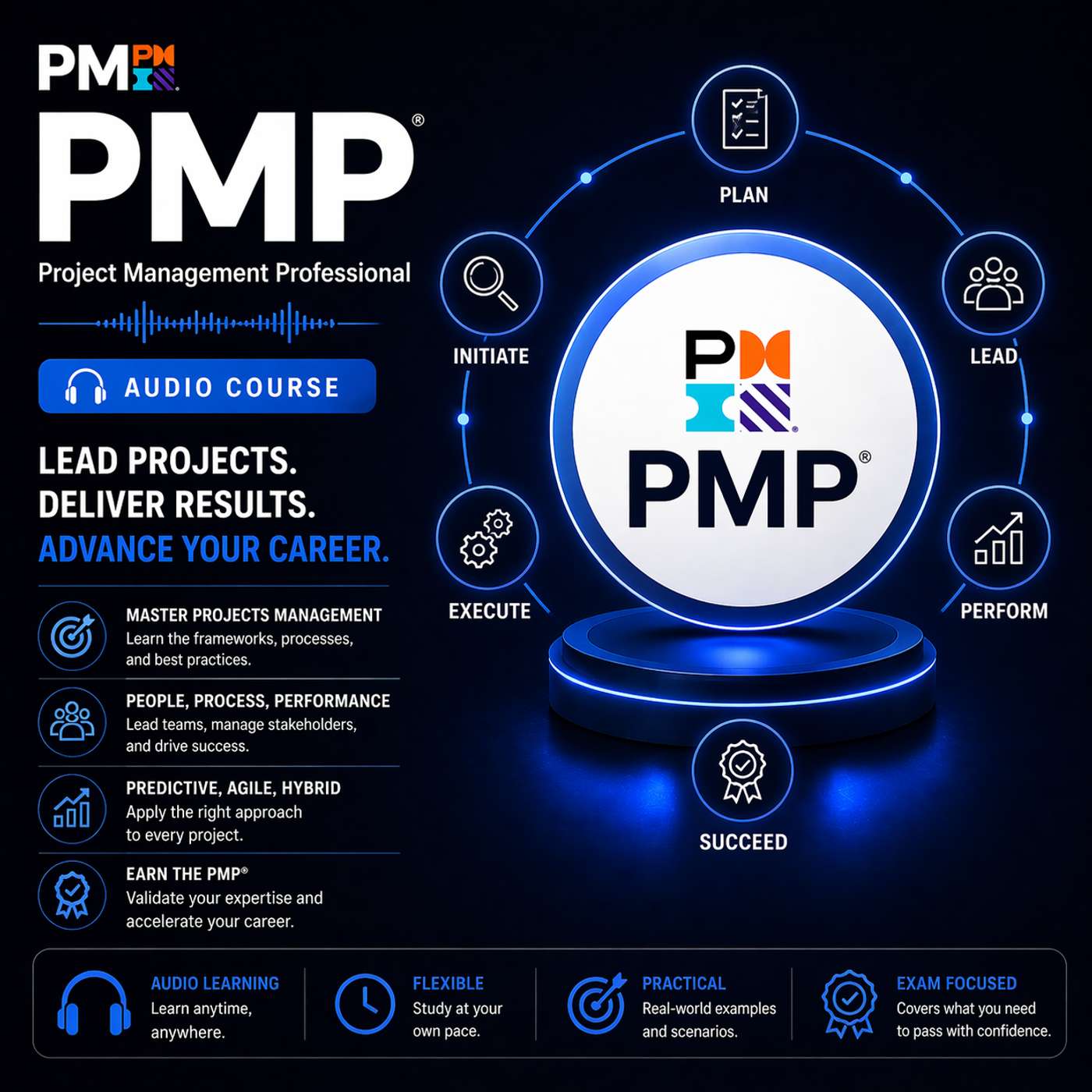
Certified - Project Management Professional (PMP) Audio Course
by Jason Edwards
The Certified PMP® Audio Course is your complete, on-the-go study companion for mastering the Project Management Professional (PMP®) certification exam. Designed for busy professionals, this Audio Course transforms every aspect of the Project Management Institute’s (PMI) exam content into structured, easy-to-follow lessons that blend clarity with real-world application. Each episode guides you through the principles of project leadership, process integration, stakeholder management, risk, quality, and agile methodologies—ensuring you understand not only the “what” but also the “why” behind each concept. Whether you’re commuting, exercising, or reviewing between meetings, this series helps you study smarter, stay motivated, and move steadily toward exam success.The PMP® certification is the global gold standard for project managers, validating your ability to lead teams, deliver results, and manage complex projects under real-world constraints. It measures your proficiency across pred
-
101
-
100
Episode 100: Recovery After Failure — Post-Mortems to Prevention
Even the best-managed projects sometimes fail. What defines a strong leader is how recovery is handled. In this final episode, we explore how to conduct post-mortems that are honest, constructive, and focused on learning. We’ll discuss how to capture lessons without assigning blame, turn insights into actionable improvements, and rebuild trust with stakeholders after setbacks.We’ll also talk about prevention — how to use those lessons to strengthen risk planning, governance, and culture so future projects avoid the same pitfalls. Recovery after failure isn’t the end of the story; it’s the beginning of a stronger, wiser project management practice. Produced by BareMetalCyber.com
-
99
Episode 99: Global Remote Teams and Follow-the-Sun Delivery
When teams span continents, project management takes on new dimensions. In this episode, we examine scenarios where work is handed off across time zones — a model known as follow-the-sun delivery. We’ll explore how to manage communication across cultures, coordinate overlapping schedules, and maintain momentum when the sun never sets on your project.We’ll also discuss how to build trust among people who may never meet face-to-face, using clear documentation, shared tools, and inclusive leadership practices. Global projects can be daunting, but with the right approach, distributed teams become a strength rather than a challenge. Produced by BareMetalCyber.com.
-
98
Episode 98: Public Sector and Federal Procurement Scenarios
Government projects bring a different kind of complexity: intense procurement rules, strict transparency requirements, and political oversight. This episode explores scenarios where bidding processes, accountability mandates, and shifting public priorities shape every step of the project.We’ll talk about how to balance compliance with delivery, navigate long approval cycles, and maintain trust in environments where scrutiny is constant. Public sector projects may move slower, but the stakes are higher — taxpayer money, public trust, and national objectives are on the line. This episode prepares you to operate with discipline and integrity in highly visible environments. Produced by BareMetalCyber.com.
-
97
Episode 97: Construction and Capital Projects Scenarios
Construction and capital projects bring unique challenges: long timelines, fixed budgets, safety concerns, and physical deliverables that can’t be hidden when problems arise. In this episode, we step into scenarios that test your ability to manage subcontractors, coordinate inspections, and keep massive budgets under control.We’ll also highlight how predictive methods dominate these environments — detailed schedules, critical path analysis, and earned value tracking — but still leave room for adaptive practices when unforeseen conditions emerge. By mastering these scenarios, you’ll see how large-scale projects demand precision, foresight, and steady leadership from start to finish. Produced by BareMetalCyber.com.
-
96
Episode 96: Financial Services and Vendor Risk Scenarios
In the world of finance, projects operate under tight scrutiny and heavy regulation. This episode drops you into scenarios where vendor risk, third-party management, and financial controls are central. We’ll discuss how to assess supplier stability, enforce contract performance, and manage risks that ripple across global markets.We’ll also explore how transparency, documentation, and audit trails aren’t just compliance requirements — they’re vital for trust. Whether you’re building new financial products, managing technology rollouts, or navigating regulatory change, this episode will give you the tools to handle risk with confidence and foresight. Produced by BareMetalCyber.com.
-
95
Episode 95: Regulated Healthcare and Pharma Scenarios
Few industries are as complex and compliance-heavy as healthcare and pharmaceuticals. In this episode, we step into scenarios where patient safety, data security, and regulatory oversight drive every project decision. We’ll explore how to balance clinical trial deadlines with rigorous approval gates, manage highly sensitive personal data, and respond when audits demand immediate evidence of compliance.You’ll also learn strategies for aligning diverse stakeholders — from scientists and clinicians to regulators and patients — all while keeping timelines realistic and quality uncompromised. Healthcare projects test not only your technical skills but your ethical compass, and this episode shows how to lead with both. Produced by BareMetalCyber.com.
-
94
Episode 94: Culture, Sustainability, and Social Impact
Projects don’t happen in isolation — they shape people, cultures, and even the environment. In this final episode, we zoom out to look at how project managers can lead with awareness of culture, sustainability, and social impact. We’ll discuss creating inclusive team environments that respect cultural differences, designing projects with sustainability in mind, and ensuring deliverables support long-term organizational and societal value.Far from being “extra,” these responsibilities define the future of project management. Leaders who understand the ripple effects of their projects are the ones who create not just successful outcomes, but meaningful legacies. This episode challenges you to think beyond the triple constraint and consider the broader impact of your work. Produced by BareMetalCyber.com.
-
93
Episode 93: Integrity in Contracts, Vendors, and Data
Projects are full of gray areas — especially in contracts, vendor relationships, and data handling. This episode explores how integrity guides your choices in these areas. Should you accept a vendor’s “free extra” that wasn’t in the contract? How do you respond if pressured to misstate progress in a report? What do you do when data security conflicts with speed of delivery? These are the kinds of dilemmas that test your principles.We’ll provide frameworks for making decisions that hold the line on integrity while still moving the project forward. By practicing integrity consistently, you protect not only your project’s outcomes but your own professional reputation. At the end of the day, integrity is the invisible asset that earns you trust and keeps doors open in your career. Produced by BareMetalCyber.com.
-
92
Episode 92: Fairness and Honesty Under Pressure
In the heat of project delivery, fairness and honesty can be tested. This episode looks at what it means to be transparent with stakeholders, even when the news isn’t good. We’ll explore scenarios where scope slips, risks materialize, or budgets stretch thin — and the temptation is to gloss over problems instead of confronting them.We’ll also discuss fairness in decision-making: making sure resources and recognition are distributed equitably, not based on favoritism or politics. Honesty and fairness form the bedrock of professional credibility. When you consistently act with both, you gain something more valuable than a successful project — you gain long-term trust and influence as a leader. Produced by BareMetalCyber.com.
-
91
Episode 91: Responsibility and Respect in Tough Calls
Ethics isn’t an abstract add-on — it’s tested every time you make a hard call under pressure. This episode explores what responsibility and respect look like when deadlines are tight, stakeholders are frustrated, and shortcuts seem tempting. We’ll talk about standing by your commitments, protecting the team, and respecting all voices in the project, even when power dynamics make it difficult.Real ethical leadership isn’t about avoiding mistakes, but about modeling integrity and fairness when the easy path would be to cut corners. By training yourself to see responsibility and respect as non-negotiables, you create trust with your team and credibility with stakeholders. This isn’t just about passing a test — it’s about becoming the kind of leader people want to follow. Produced by BareMetalCyber.com.
-
90
Episode 90: Cross-Industry Scenarios Sampler
Project management is universal — but the flavor of challenges varies across industries. In this episode, we dive into a sampler of scenarios pulled from different sectors: technology rollouts, healthcare compliance, construction deadlines, and even public-sector initiatives with unique governance rules. You’ll see how the same principles of leadership, scope control, and risk management apply, but with industry-specific twists that force you to adapt.By walking through multiple environments, you’ll gain a broader perspective on how project management scales beyond your current role. The skills you’re building for the PMP aren’t locked to one sector — they transfer across industries and contexts. This episode helps you strengthen your versatility and prepares you to see the common threads of good project leadership no matter where you work. Produced by BareMetalCyber.com.
-
89
Episode 89: Rapid Triage — What to Do First
When everything seems urgent, what do you do first? This episode focuses on rapid triage — the skill of quickly analyzing a situation and choosing the action that creates the most stability. We’ll dive into scenarios like multiple stakeholders pulling you in different directions, overlapping issues in scope and schedule, or risks turning into live problems all at once.Through guided drills, we’ll show you how to prioritize based on impact, urgency, and alignment with project goals. Sometimes the right move is to escalate; other times it’s to resolve quietly at the team level. By practicing triage, you develop calmness under fire — the ability to filter noise, see the signal, and act decisively. That’s not only exam gold, it’s leadership gold in any project environment. Produced by BareMetalCyber.com.
-
88
Episode 88: “Best Next Action” Intensive
Project managers rarely face black-and-white choices; they face messy situations where several paths could work. This episode is all about sharpening your instincts for the “best next action.” We’ll practice dissecting scenarios where the technically correct answer isn’t the right one for the moment, or where escalation is tempting but empowerment is better.You’ll also learn how to spot PMI’s recurring logic: prioritize stakeholder engagement, choose proactive over reactive responses, and build long-term trust rather than chasing quick wins. The more you practice this mindset, the more natural it becomes. By the end of this episode, you won’t just answer questions better — you’ll think like a leader who sees the big picture and acts with clarity. Produced by BareMetalCyber.com.
-
87
Episode 87: Laddered Difficulty Set — Easy to Hard
Confidence comes from progression, and this lab walks you through a carefully laddered set of scenarios that increase in difficulty. We’ll start with straightforward “warm-up” questions that reinforce foundational knowledge, then climb into medium-complexity cases with multiple stakeholders, and finally tackle advanced, layered situations where every answer feels plausible.The purpose here is not just to challenge you, but to show you how to build endurance and adaptability. By the time you reach the toughest scenarios, you’ll be applying frameworks automatically, managing time under pressure, and trusting your process. This laddered approach mimics how skills develop in real projects — starting simple, adding complexity, and eventually handling crises with composure. Produced by BareMetalCyber.com.
-
86
Episode 86: Debrief Lab 2 — Bias and Trap Breakers
Even experienced project managers can be caught by subtle traps. This episode focuses on how biases — from anchoring on the first option to assuming the loudest stakeholder always wins — cloud judgment during both real projects and exam scenarios. We’ll examine classic traps PMI builds into questions: answers that feel right because they mirror your workplace habits, but don’t align with global best practices.We’ll also practice strategies for “trap breaking.” That includes slowing down to reframe the question, asking yourself which answer shows proactive leadership, and using PMI’s lens of collaboration and governance as a filter. These techniques not only raise your accuracy but also sharpen your leadership instincts in real life, making you less vulnerable to bias-driven mistakes when stakes are high. Produced by BareMetalCyber.com
-
85
Episode 85: Debrief Lab 1 — Root-Cause Patterns
Practice only works if you actually learn from it, and that’s where debriefing comes in. In this episode, we step into the first of our debrief labs, focused on identifying the root causes behind missed questions or failed scenarios. Was the error due to a content gap, a misread detail, or a failure to apply the right process under pressure? We’ll walk through examples where two wrong answers look tempting, and unpack why the “best” option stood out if you analyzed the scenario correctly.This session also provides you with tools to make your own debriefing structured and repeatable. We’ll cover error taxonomies, journaling techniques, and reflective practices that transform each mistake into a durable learning opportunity. By the end of this lab, you’ll stop seeing wrong answers as failures and start seeing them as the fastest way to climb in skill. You’ll be learning how to “fail forward” in training so you can succeed when it counts. Produced by BareMetalCyber.com.
-
84
Episode 84: Full-Length Situational Set 2
In this follow-up to Episode 83, we present another full-length situational set with fresh challenges. The goal here is not just repetition, but reinforcement: practicing how to pace yourself, manage time windows, and sustain concentration across diverse domains of project management. You’ll see how domains overlap, how PMI phrases questions to test judgment, and how to keep your confidence high through the entire run.By completing two separate full-length drills, you’ll be able to compare your performance, spot patterns of strength, and identify areas where further review is needed. This session reinforces that success is built on both knowledge and endurance, preparing you to walk into test day calm, practiced, and ready. Produced by BareMetalCyber.com.
-
83
Episode 83: Full-Length Situational Set 1
Sometimes the real challenge isn’t one scenario — it’s managing endurance across many. In this episode, we give you a full-length set of situational questions designed to simulate the flow and pressure of the PMP exam. You’ll need to pace yourself, recognize question patterns, and keep your decision-making sharp over a longer stretch of time.This exercise isn’t just about testing knowledge — it’s about training your focus, stamina, and ability to recover from a tough question without losing rhythm. By experiencing this drill, you’ll gain the confidence that you can handle a real exam session and keep your clarity even under pressure. Produced by BareMetalCyber.com.
-
82
Episode 82: Mixed-Domain Drill 4 — Predictive Heavy
Some projects require rigor and structure above all else. In this drill, we immerse you in predictive-heavy scenarios where detailed planning, baselines, and strict governance dominate. You’ll practice managing fixed schedules, controlling costs against tight budgets, and handling change requests in environments that demand formal approvals.But predictive doesn’t mean rigid for its own sake. You’ll also see how predictive methods provide stability and accountability in contexts like construction, defense, or compliance-driven industries. By working through these scenarios, you’ll sharpen your ability to lead projects that require precision, documentation, and discipline — while still finding room for adaptability where it counts. Produced by BareMetalCyber.com.
-
81
Episode 81: Mixed-Domain Drill 3 — Agile/Hybrid Heavy
Agility isn’t confined to software anymore — it’s part of the entire project management ecosystem. In this drill, we put you into hybrid and agile-heavy scenarios where you need to demonstrate adaptability, incremental delivery, and collaborative leadership. You’ll face situations where predictive planning collides with agile iteration, and learn how to tailor methods to fit both organizational governance and team dynamics.We’ll also test your ability to use agile tools in high-stakes contexts: backlog reprioritization under shifting goals, iterative releases with demanding stakeholders, and lightweight governance that still satisfies compliance. This drill shows how agility, when properly applied, makes projects more resilient and responsive. Produced by BareMetalCyber.com.
-
80
Episode 80: Mixed-Domain Drill 2 — Process + Business Environment
Projects don’t just live inside process charts; they operate within the larger business landscape. In this mixed-domain drill, we blend Process tasks with Business Environment challenges, putting you in scenarios where technical delivery must align with compliance, strategy, and organizational priorities. You’ll practice navigating trade-offs between schedule control and regulatory requirements, or balancing procurement efficiency with long-term value realization.This drill strengthens your ability to keep the bigger picture in focus while managing the day-to-day mechanics of delivery. By connecting process discipline to business context, you’ll train yourself to think like a project leader who delivers not just outputs, but true organizational impact. Produced by BareMetalCyber.com.
-
79
Episode 79: Mixed-Domain Drill 1 — People + Process
Real projects don’t separate leadership from execution — they demand both. In this mixed-domain drill, we combine People and Process scenarios, challenging you to demonstrate not only technical planning skills but also the leadership instincts to guide a team through complexity. You’ll encounter blended situations where stakeholder engagement collides with scheduling, or conflict resolution overlaps with risk planning.This drill will sharpen your ability to switch lenses quickly, connecting soft skills with hard processes. It’s about practicing the kind of multidimensional thinking the PMP exam rewards and the real world demands. By tackling People + Process together, you’ll strengthen the bridge between managing tasks and leading humans. Produced by BareMetalCyber.com.
-
78
Episode 78: Handover, Transition, and Closeout Lab
Finishing a project doesn’t mean just walking away. In this lab, we dive into scenarios where handovers risk falling through the cracks — knowledge isn’t transferred, operations teams aren’t ready, or closure criteria aren’t met. You’ll learn how to prepare for transitions, engage receiving teams early, and ensure documentation and lessons learned are captured before people disperse.We’ll also emphasize the importance of rituals in closure: celebrating wins, acknowledging contributions, and officially releasing resources. These steps may seem small, but they create clean transitions and strong morale. Closing well is both a technical and a human task, and this lab equips you to handle both sides with professionalism. Produced by BareMetalCyber.com.
-
77
Episode 77: External Environment Shifts and Scope Impact Lab
No project is immune to forces outside its walls. In this episode, we step into scenarios where regulatory updates, market changes, or geopolitical events disrupt plans overnight. You’ll learn how to assess the scope impact, prioritize adjustments, and engage stakeholders in making tough calls about trade-offs.We’ll also explore the leadership side: how to maintain calm, communicate transparently, and preserve team focus in the face of disruption. External shocks test a project manager’s adaptability more than any exam question ever could. By mastering this lab, you’ll be prepared to navigate turbulence while still delivering outcomes that matter. Produced by BareMetalCyber.com.
-
76
Episode 76: Change Control and Baseline Integrity Lab
Change is constant — but unmanaged change is chaos. In this lab, we explore real-world scenarios where stakeholders push for scope shifts, budget reallocations, or deadline adjustments. You’ll learn how to apply structured change control: capture requests, analyze impacts, seek approval from the right authority, and then update baselines responsibly.We’ll also test your ability to resist shortcuts, like accepting “small” changes without analysis or bending the rules for VIPs. Baseline integrity is what keeps projects credible; once trust in the baseline erodes, the project loses direction. This lab will train you to protect baselines while still enabling necessary adaptation, striking the balance between control and agility. Produced by BareMetalCyber.com.
-
75
Episode 75: Benefits Realization and Value Delivery Lab
Delivering outputs is easy; delivering outcomes that matter is harder. In this lab, we step into scenarios where projects are at risk of completing on time and on budget but still failing to generate real value. You’ll learn how to define benefits clearly, track them with meaningful metrics, and ensure ownership doesn’t vanish once the project closes.We’ll also practice handling tough conversations with stakeholders who want to declare victory early. Benefits realization is about discipline and courage — keeping the focus on value delivered to the business rather than box-checking activities. This lab will sharpen your instincts for connecting project work to organizational impact, helping you ensure that effort translates into measurable success. Produced by BareMetalCyber.com.
-
74
Episode 74: Compliance, Audits, and Regulated Environments Lab
What happens when your project is audited midstream? In this lab, we step into the high-pressure world of compliance-driven projects. You’ll practice how to respond when regulators demand evidence, how to manage documentation under scrutiny, and how to maintain delivery momentum even when oversight is intense.We’ll also explore strategies for embedding compliance into daily operations, so audits become less of a disruption and more of a confirmation. Whether you’re in healthcare, finance, defense, or any regulated space, this lab trains you to stay calm, organized, and credible when external reviewers come knocking. Produced by BareMetalCyber.com.
-
73
Episode 73: Virtual Teams and Cross-Cultural Situations Lab
Remote and global projects bring both opportunities and challenges. In this episode, we drop you into scenarios where cultural norms, time zones, and communication barriers test your leadership. You’ll learn how to choose the right collaboration tools, establish shared ground rules, and respect cultural differences while maintaining alignment.We’ll also explore practical techniques for building trust in virtual teams — from rotating meeting times to balancing synchronous and asynchronous communication. Managing cross-cultural teams isn’t just about logistics; it’s about empathy and awareness. By the end, you’ll see how inclusive leadership transforms distance into strength and diversity into innovation. Produced by BareMetalCyber.com.
-
72
Episode 72: Stakeholder Negotiation and Influence Lab
Projects rarely have unlimited resources, so negotiation is constant. In this lab, we dive into scenarios where stakeholders have competing interests — scope vs. budget, schedule vs. quality — and explore how to navigate those trade-offs with confidence. We’ll discuss strategies for building common ground, using data to strengthen your position, and knowing when to compromise and when to hold firm.You’ll also see how influence goes beyond formal authority. By building trust, understanding stakeholder motivations, and framing project outcomes in terms of their goals, you can shift conversations from conflict to collaboration. Negotiation and influence aren’t just survival skills — they’re leadership skills that make the difference between project deadlock and forward motion. Produced by BareMetalCyber.com.
-
71
Episode 71: Conflict Resolution and Team Alignment Lab
Conflict is inevitable, but it doesn’t have to be destructive. In this scenario-based lab, we step into realistic project conflicts — from personality clashes to competing priorities — and explore how to resolve them in ways that strengthen the team. You’ll learn how to analyze the source of conflict, apply the right resolution style, and realign the group toward shared goals.We’ll also practice reframing conflict as an opportunity: disagreements often surface hidden assumptions or risks that need attention. When handled well, conflict becomes a catalyst for innovation and stronger collaboration. This lab gives you the mindset and tools to turn tension into alignment, both in the exam and in your career. Produced by BareMetalCyber.com.
-
70
Episode 70: Organizational Agility and Scaling Patterns
Agility isn’t just for teams — it’s for entire organizations. In this episode, we explore what it takes to build organizational agility, where strategy, governance, and delivery all move at the speed of change. We’ll examine scaling patterns like SAFe, LeSS, and Disciplined Agile, and how they help multiple teams coordinate without losing the benefits of agile principles.We’ll also highlight the cultural shifts needed for true agility: leadership that embraces transparency, governance that supports experimentation, and structures that reward outcomes instead of outputs. Organizational agility is not about chasing buzzwords — it’s about creating resilience, responsiveness, and relevance in a complex business landscape. This episode will show you how project leaders can spark agility at every level, not just within their own teams. Produced by BareMetalCyber.com.
-
69
Episode 69: Hybrid Tailoring — Phase Gates Plus Iterative Delivery
Hybrid project management is not a compromise — it’s a strategic blend. In this episode, we look at how to tailor hybrid approaches that bring together the strengths of predictive and agile methods. For projects with regulatory or compliance milestones, predictive phase gates provide control. For innovation-heavy components, agile iterations deliver value early and often. Together, they form a balanced model that satisfies oversight while driving adaptability.We’ll talk about how to design hybrid lifecycles, where certain streams follow traditional planning while others use iterative backlogs, all coordinated under a single governance umbrella. Real-world examples include construction projects that follow strict permitting while using agile for design elements, or product launches that combine predictive marketing timelines with agile development sprints. Hybrid tailoring is about pragmatism — choosing what works, discarding what doesn’t, and building a delivery approach that fits the project’s unique DNA. Produced by BareMetalCyber.com.
-
68
Episode 68: Agile Procurement and Contracting
Procurement often feels like the least agile part of any project, but it doesn’t have to be. In this episode, we’ll explore how contracting can be adapted to support iterative delivery, collaboration, and flexibility. That includes contract models with shared risk and reward, milestone-based payments tied to delivered value, and agreements that leave room for scope to evolve.We’ll also highlight strategies for working with vendors in an agile way — from co-located teams and open communication channels to joint backlog refinement and shared retrospectives. Agile procurement isn’t about throwing out contracts; it’s about designing agreements that reflect the realities of adaptive work. By the end, you’ll see how to align procurement with agile principles, making suppliers part of the solution rather than a barrier to progress. Produced by BareMetalCyber.com.
-
67
Episode 67: Adaptive Risk and Lightweight Governance
Traditional risk management can feel heavy and slow — but agile environments require speed. This episode looks at how risk can be managed adaptively, using lightweight governance structures that enable faster decisions without sacrificing oversight. We’ll explore techniques like risk-adjusted backlogs, frequent reassessments, and decentralized authority for handling lower-level risks.We’ll also discuss how governance can be scaled to fit context. In highly regulated environments, you may still need formal risk boards and sign-offs, but even then agile techniques can make the process more responsive. The real key is finding the balance — enough structure to protect the organization, but not so much that it paralyzes the team. With adaptive risk management, you create systems that are both resilient and agile, prepared for uncertainty without being slowed by it. Produced by BareMetalCyber.com.
-
66
Episode 66: Servant Leadership and Team Maturity
Leadership in agile isn’t about command and control — it’s about enabling others to succeed. In this episode, we’ll explore the philosophy of servant leadership, where the project leader’s role is to remove obstacles, nurture collaboration, and foster autonomy. We’ll talk about how this approach builds trust, empowers individuals, and creates an environment where teams can reach their full potential.We’ll also connect servant leadership to team maturity. Early-stage teams may need more guidance and structure, while mature teams thrive on autonomy and self-organization. A great leader adapts to where the team is on that journey. By practicing servant leadership, you not only help teams grow faster, you also model the kind of inclusive, resilient culture that organizations need in an uncertain world. Produced by BareMetalCyber.com.
-
65
Episode 65: Agile Metrics — Burndown, Burnup, and Flow
Agile thrives on transparency, and metrics are the compass that guide both teams and stakeholders. In this episode, we go deep into the most common agile metrics and why they matter. A burndown chart shows how much work remains in a sprint or release, providing a simple visual cue of whether the team is on track. A burnup chart flips the lens, showing how much value has been delivered against the total scope — a powerful way to illustrate progress even when scope shifts.We’ll also examine cumulative flow diagrams, which reveal bottlenecks by visualizing how work moves through stages of the process. These tools aren’t just about reporting — they are about decision-making. When a burndown flatlines, leaders know to investigate blockers. When a cumulative flow shows too much work in progress, it signals overload. By the end of this episode, you’ll know how to interpret agile metrics with confidence and use them not to punish, but to guide improvement and maintain trust with stakeholders. Produced by BareMetalCyber.com.
-
64
Episode 64: Iteration and Release Planning
Iteration and release planning is where strategy meets execution. In this episode, we’ll walk through how teams set goals for a sprint or iteration, decide what to deliver, and ensure the work fits within capacity. Iteration planning creates focus, while release planning zooms out to map how increments stack up to deliver larger features or capabilities.We’ll also discuss the importance of balancing ambition with realism — planning enough to provide direction while leaving room for change. Agile release trains, minimum viable products, and staged delivery are all part of this toolkit. By mastering iteration and release planning, you give teams clarity on the short-term path and stakeholders confidence in the long-term roadmap. Produced by BareMetalCyber.com.
-
63
Episode 63: Agile Estimation
Traditional estimation often fails in complex projects — agile estimation offers a smarter alternative. In this episode, we’ll unpack methods like relative sizing, story points, and t-shirt sizing, which allow teams to estimate effort without getting bogged down in false precision. We’ll talk about how teams use planning poker and consensus-building to arrive at shared estimates that are both realistic and motivating.We’ll also explore how velocity — the measure of how much work a team completes in a sprint — becomes a key planning tool. With velocity, you can forecast timelines, balance workloads, and set stakeholder expectations without overcommitting. Agile estimation isn’t about predicting the future perfectly — it’s about creating a framework that supports adaptability and informed decisions. Produced by BareMetalCyber.com.
-
62
Episode 62: Backlog Management and Prioritization
A backlog is not just a to-do list — it’s a dynamic, prioritized source of truth for what the team will deliver next. In this episode, we’ll explore backlog management as both an art and a science. We’ll talk about refining items into clear, actionable stories, aligning backlog priorities with business value, and ensuring transparency so stakeholders understand the “why” behind every item.We’ll also examine prioritization frameworks like MoSCoW (Must-have, Should-have, Could-have, Won’t-have) and Weighted Shortest Job First (WSJF), showing how they help balance urgency, risk, and value. Managing a backlog well means your team always knows what to focus on and stakeholders trust the process. Done poorly, backlogs create chaos. This episode arms you with the practices that keep backlogs healthy and value-focused. Produced by BareMetalCyber.com.
-
61
Episode 61: Kanban and Flow Metrics
Kanban is more than sticky notes on a wall — it’s a system for visualizing and managing the flow of work. In this episode, we’ll explore the principles of Kanban, from limiting work in progress to focusing on flow and continuous delivery. You’ll learn how to use Kanban boards to bring clarity to workloads, spot bottlenecks, and encourage incremental improvement.We’ll also dive into flow metrics — cycle time, lead time, throughput, and work in progress. These numbers reveal how efficiently your system operates and where delays occur. By mastering flow metrics, you can forecast delivery with greater confidence and drive improvements that make your team more predictable and effective. Kanban isn’t just for software — it’s a versatile approach that applies to any workflow where visibility and flow matter. Produced by BareMetalCyber.com.
-
60
Episode 60: Scrum Roles, Events, and Artifacts
Scrum is the most widely used agile framework, and in this episode we break it down into its essential building blocks. We’ll start with the three key roles: Product Owner, who defines the “what” and prioritizes value; Scrum Master, who ensures the team works smoothly and removes barriers; and the Development Team, who self-organize to deliver increments of value. Understanding how these roles complement one another is crucial to making Scrum succeed in practice.We’ll then explore Scrum’s core events — sprint planning, daily scrums, sprint reviews, and retrospectives — and explain how each builds cadence, focus, and improvement into the team’s rhythm. Finally, we’ll unpack the artifacts: product backlogs, sprint backlogs, and increments. These aren’t just terms — they are the heartbeat of Scrum, ensuring transparency and accountability. By the end, you’ll have a clear, practical grasp of how Scrum fits together as a lightweight yet powerful framework. Produced by BareMetalCyber.com.
-
59
Episode 59: Agile Principles and Value Delivery
Agility is more than a buzzword — it’s a mindset rooted in delivering value continuously. In this episode, we explore the core principles of agile, starting with the Agile Manifesto and the values that drive collaboration, customer focus, and adaptability. You’ll learn how incremental delivery helps reduce risk, how feedback cycles accelerate improvement, and how agile practices keep teams resilient in changing environments.We’ll also connect these principles to value delivery, showing how agile methods prioritize outcomes that matter to stakeholders rather than just outputs. Through examples of iterative development, backlog prioritization, and continuous feedback, you’ll see how agility empowers teams to deliver faster, learn faster, and adapt faster. This episode lays the foundation for the agile and hybrid micro-series that follows. Produced by BareMetalCyber.com.
-
58
Episode 58: Stakeholder Management Toolkit
Stakeholders aren’t just names on a list — they’re the people who can make or break your project. In this episode, we explore the stakeholder management tools that help you identify, analyze, and engage with them effectively. We’ll talk about power-interest grids, stakeholder salience models, and mapping exercises that reveal whose voices must be prioritized and whose influence shapes decisions.We’ll also dive into engagement tools like communication plans, influence strategies, and trust-building techniques that keep stakeholders aligned with project goals. Beyond managing expectations, these tools help you create genuine collaboration — ensuring that stakeholders feel heard, valued, and committed to the project’s success. Produced by BareMetalCyber.com.
-
57
Episode 57: Procurement Management Toolkit
Vendors, contracts, and partnerships bring opportunity — but also risk. This episode focuses on the procurement tools that help you manage external resources effectively. We’ll start with procurement management plans and requirements documents, then move into contract types like fixed-price, cost-plus, and time-and-materials, showing when each is most effective. We’ll also explain concepts like the point of total assumption, which tells you when risk shifts from buyer to seller.Managing procurement doesn’t end with a signature. We’ll explore monitoring tools such as performance reviews, earned value checks, and relationship dashboards that track vendor alignment over time. You’ll also learn how incentives and penalties can be structured to encourage collaboration instead of conflict. With these tools in hand, procurement becomes a strategic advantage, not just an administrative function. Produced by BareMetalCyber.com.
-
56
Episode 56: Risk Management Toolkit
Every project carries uncertainty, and the difference between success and failure is how you prepare for it. This episode is all about risk management tools, starting with risk registers, probability-impact matrices, and heat maps that help you prioritize threats and opportunities. We’ll cover qualitative and quantitative analysis, exploring decision trees, expected monetary value, and sensitivity charts that give you a clearer picture of what’s at stake.But risk management isn’t just analysis — it’s action. We’ll talk about response planning tools that help you decide when to avoid, transfer, mitigate, or accept risks, and how to embed contingency plans into your project roadmap. By mastering these tools, you’ll transform risk from something that derails projects into something you can anticipate, monitor, and manage with confidence. Produced by BareMetalCyber.com.
-
55
Episode 55: Communications Management Toolkit
Communication is the lifeblood of projects. In this episode, we unpack the tools that help you plan, execute, and refine communication so that every stakeholder stays informed and aligned. We’ll talk about stakeholder communication matrices, channel selection, and tailoring your message to different audiences — from executives who want high-level dashboards to technical teams who need detailed instructions. Tools like information radiators, newsletters, and dashboards bring clarity and consistency to the flow of information.We’ll also explore feedback loops — because communication is not just about sending updates, it’s about confirming they’ve been received and understood. You’ll hear how to close the loop using surveys, quick check-ins, and active listening techniques. With these tools, you can prevent misunderstandings before they escalate and create a culture of transparency where information flows freely in both directions. Produced by BareMetalCyber.com.
-
54
Episode 54: Resource Management Toolkit
Projects don’t succeed because of plans alone — they succeed because of people and resources. In this episode, we look at how to effectively plan, acquire, and manage the resources needed to bring a project to life. We’ll cover tools for capacity planning, resource histograms, and RACI charts that clarify roles and responsibilities, ensuring that no task is left in limbo.We’ll also explore how to balance workloads to avoid burnout, resolve resource conflicts when teams are shared, and motivate people through recognition and development opportunities. Resource management isn’t just about assigning work — it’s about unlocking human potential while coordinating physical and financial assets. With the right tools, you can anticipate shortages before they hurt progress, allocate fairly across competing needs, and keep your team engaged and performing at its best. Produced by BareMetalCyber.com.
-
53
Episode 53: Quality Management Toolkit
Quality isn’t about perfection — it’s about fitness for purpose. In this episode, we explore the tools that ensure deliverables meet the standards your stakeholders expect. We’ll cover quality planning tools like checklists, standards baselines, and acceptance criteria, which make expectations explicit before work even begins. Then we’ll dive into quality assurance practices and control tools such as Pareto analysis, control charts, and cause-and-effect diagrams.Beyond the mechanics, we’ll discuss how quality is everyone’s job — not just the responsibility of inspectors or QA teams. Embedding continuous improvement into the project culture means fewer defects, more trust, and smoother handovers. Whether you’re working in a predictive environment with rigorous testing or an agile team with frequent demos and retrospectives, quality tools give you the ability to detect issues early, prevent rework, and deliver outcomes stakeholders truly value. Produced by BareMetalCyber.com.
-
52
Episode 52: Cost Management Toolkit
Budgets are more than numbers — they’re commitments of trust. This episode digs deep into the tools that help you build, track, and defend a project budget with confidence. We’ll explore estimation methods, from quick analogous approaches to detailed bottom-up analysis, and discuss how to layer contingency reserves for known risks and management reserves for the unknowns.We’ll also break down earned value management, not as a formula set to memorize, but as a language for telling the story of cost and schedule performance. Terms like cost variance, schedule variance, and cost performance index become powerful when you know how to interpret them and communicate what they mean to stakeholders. By the end, you’ll see cost tools as more than accounting exercises — they’re leadership instruments that allow you to make smarter trade-offs, secure executive confidence, and ensure that value is delivered within financial guardrails. Produced by BareMetalCyber.com.
We're indexing this podcast's transcripts for the first time — this can take a minute or two. We'll show results as soon as they're ready.
No matches for "" in this podcast's transcripts.
No topics indexed yet for this podcast.
Loading reviews...
ABOUT THIS SHOW
The Certified PMP® Audio Course is your complete, on-the-go study companion for mastering the Project Management Professional (PMP®) certification exam. Designed for busy professionals, this Audio Course transforms every aspect of the Project Management Institute’s (PMI) exam content into structured, easy-to-follow lessons that blend clarity with real-world application. Each episode guides you through the principles of project leadership, process integration, stakeholder management, risk, quality, and agile methodologies—ensuring you understand not only the “what” but also the “why” behind each concept. Whether you’re commuting, exercising, or reviewing between meetings, this series helps you study smarter, stay motivated, and move steadily toward exam success.The PMP® certification is the global gold standard for project managers, validating your ability to lead teams, deliver results, and manage complex projects under real-world constraints. It measures your proficiency across pred
HOSTED BY
Jason Edwards
CATEGORIES
Loading similar podcasts...
Frequently Asked Questions
How many episodes does Certified - Project Management Professional (PMP) Audio Course have?
Certified - Project Management Professional (PMP) Audio Course currently has 50 episodes available on PodParley. New episodes are automatically indexed when they're published to the podcast feed.
What is Certified - Project Management Professional (PMP) Audio Course about?
The Certified PMP® Audio Course is your complete, on-the-go study companion for mastering the Project Management Professional (PMP®) certification exam. Designed for busy professionals, this Audio Course transforms every aspect of the Project Management Institute’s (PMI) exam content into...
How often does Certified - Project Management Professional (PMP) Audio Course release new episodes?
Certified - Project Management Professional (PMP) Audio Course has 50 episodes. Check the episode list to see recent publication dates and frequency.
Where can I listen to Certified - Project Management Professional (PMP) Audio Course?
You can listen to Certified - Project Management Professional (PMP) Audio Course on PodParley by clicking any episode. We provide an embedded audio player for direct listening, and you can also subscribe via your preferred podcast app using the RSS feed.
Who hosts Certified - Project Management Professional (PMP) Audio Course?
Certified - Project Management Professional (PMP) Audio Course is created and hosted by Jason Edwards.
URL copied to clipboard!