
PODCAST · technology
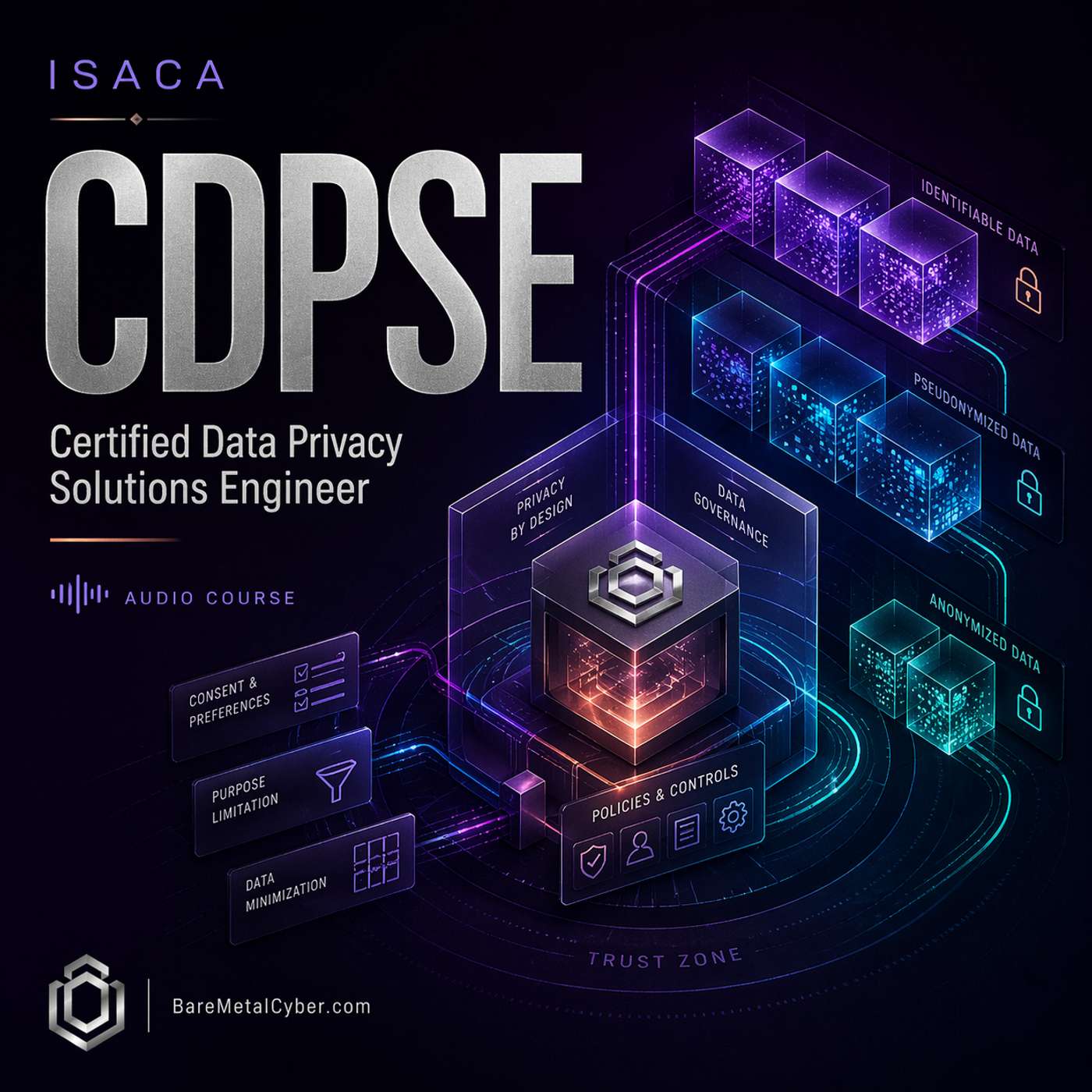
Certified: The ISACA CDPSE Audio Course
by Jason Edwards
Welcome to Certified: The ISACA CDPSE Audio Course. I’m going to guide you through the ideas and skills that sit behind the Certified Data Privacy Solutions Engineer credential, in a way that’s clear, exam-aligned, and grounded in how privacy actually works inside organizations. You can expect focused episodes that build your understanding step by step, from privacy governance and data life cycle thinking to privacy by design practices that hold up under real delivery pressure. We’ll keep the language straightforward, define terms in context, and connect each topic to the kinds of decisions you make when you handle personal data, assess vendors, review designs, or respond to incidents.To get the most from this course, treat it like a repeatable routine instead of a one-time listen. Start from the beginning, keep your pace steady, and replay episodes when a concept feels slippery, because reinforcement is part of the method. If you’re studying close to an exam date, you can also rotat
-
71
Welcome to the ISACA CDPSE Audio Course
Certified: The ISACA CDPSE Audio Course is an audio-first prep program built for working privacy and security professionals who need a structured path to the ISACA CDPSE credential without living in a textbook. It’s a strong fit for privacy program managers, GRC and risk leaders, security analysts moving into privacy work, and technologists who touch personal data and need to explain their decisions clearly. If your job involves governance, data handling, vendor oversight, product delivery, or incident response—and you want to prove you can lead privacy by design in the real world—this course is designed for you. Expect a practical, exam-aligned approach that respects your time while still going deep enough to build confidence.Across the series, you’ll build a working understanding of privacy governance, data life cycle management, and privacy by design—the core skills the ISACA CDPSE exam expects you to apply. Lessons focus on definitions, decision points, and the “why” behind controls, so you can recognize what a question is really testing. Because it’s audio-first, each episode is built to work during commutes, walks, or work breaks, with clear framing, careful pacing, and repetition where it actually helps. You’ll hear concepts explained in plain language, then anchored to realistic workplace situations like intake of new data sources, vendor assessments, or operationalizing retention and deletion.What makes this course different is the way it bridges exam objectives and day-to-day privacy work, so you’re not memorizing jargon—you’re learning how to think like a privacy leader. You’ll get consistent terminology, clean mental models, and decision-ready takeaways you can reuse in policy reviews, design discussions, and risk conversations. The tone stays professional and direct, with no fluff and no detours, so every minute moves you forward. Success here looks like two things: you can answer exam questions with calm precision, and you can explain privacy tradeoffs to engineers, lawyers, and executives without losing the room.
-
70
Episode 70 — Essential Terms: Plain-Language Glossary for Fast CDPSE Recall (Domains 1–4)
This episode delivers a plain-language glossary of essential CDPSE terms, focusing on definitions you can apply immediately to scenario questions instead of memorizing formal phrasing. You’ll reinforce the vocabulary that drives correct choices, including how to talk about personal information, lawful bases and consent concepts, risk and assessment language, lifecycle controls like minimization and retention, and technology terms like tokenization, anonymization, encryption, and logging practices. We’ll connect each term to the kind of decision the exam expects, such as selecting evidence, identifying the next best action, or recognizing which control actually reduces exposure in a system. You’ll also learn how to avoid confusion when organizations use different labels for the same concept, by anchoring your understanding to outcomes, accountability, and enforceability. Produced by BareMetalCyber.com, where you’ll find more cyber audio courses, books, and information to strengthen your educational path. Also, if you want to stay up to date with the latest news, visit DailyCyber.News for a newsletter you can use, and a daily podcast you can commute with.
-
69
Episode 69 — Exam-Day Tactics: A calm mental model for triage, time, and confidence (Domains 1–4)
This episode provides exam-day tactics built around a calm, repeatable mental model for triage and time management, so you can answer CDPSE scenario questions decisively without getting pulled into distracting details. You’ll learn how to quickly identify the domain and the underlying objective being tested, then filter answer choices by what is most defensible: clear ownership, actionable controls, measurable evidence, and lifecycle-aware impact reduction. We’ll practice how to handle common traps such as “legal-sounding” answers that lack implementation, “security-only” answers that miss privacy obligations, and overly broad actions that do not fit the scenario’s constraints. You’ll also learn a simple pacing method for flagging and returning to hard questions, plus a sanity check approach that confirms your final choice aligns with risk reduction and auditable process. Produced by BareMetalCyber.com, where you’ll find more cyber audio courses, books, and information to strengthen your educational path. Also, if you want to stay up to date with the latest news, visit DailyCyber.News for a newsletter you can use, and a daily podcast you can commute with.
-
68
Episode 68 — Promote accountability, fairness, and transparency across the full data life cycle (Task 19)
This episode teaches how to promote accountability, fairness, and transparency across the full data life cycle, because CDPSE expects you to think about privacy outcomes as continuous obligations, not isolated checkpoints. You’ll learn how accountability shows up in ownership, decision trails, and evidence that controls work; how transparency becomes accurate, timely communication of collection, use, sharing, and retention; and how fairness becomes disciplined handling of impacts, bias pathways, and disproportionate harm risks, especially in analytics and automated decision contexts. We’ll walk through scenarios like expanding data use for personalization, introducing new data sources, or deploying models that affect customer experience, and you’ll practice selecting actions that strengthen governance while producing operational mechanisms such as review forums, measurable controls, and clear documentation. You’ll also learn to spot exam distractors that promise fairness or transparency without specifying how the organization will implement and verify them. Produced by BareMetalCyber.com, where you’ll find more cyber audio courses, books, and information to strengthen your educational path. Also, if you want to stay up to date with the latest news, visit DailyCyber.News for a newsletter you can use, and a daily podcast you can commute with.
-
67
Episode 67 — Create educational content and training that builds a privacy-aware culture (Task 18)
This episode focuses on creating educational content and training that builds a privacy-aware culture, emphasizing outcomes that change behavior in the moments where privacy risk is created. You’ll learn how to design role-based training for product, engineering, support, marketing, and procurement, and how to connect training content to real decisions like data collection choices, logging standards, vendor selection, access approvals, and request handling steps. We’ll cover best practices for making training durable, including short refreshers tied to workflow triggers, practical examples drawn from incidents and near-misses, and clear references to procedures and escalation paths that people can use under pressure. You’ll also practice how CDPSE questions evaluate training effectiveness, pushing you toward answers that include measurement, reinforcement, and feedback loops rather than one-time annual compliance modules. Produced by BareMetalCyber.com, where you’ll find more cyber audio courses, books, and information to strengthen your educational path. Also, if you want to stay up to date with the latest news, visit DailyCyber.News for a newsletter you can use, and a daily podcast you can commute with.
-
66
Episode 66 — Advocate for privacy maturity improvements aligned to organizational objectives (Task 17)
This episode teaches how to advocate for privacy maturity improvements that align with organizational objectives, because CDPSE scenarios frequently test your ability to drive change through realistic prioritization rather than idealized wish lists. You’ll learn how to assess current maturity in terms of governance, control coverage, evidence quality, and operational consistency, then identify improvements that reduce the highest risks while supporting delivery, customer trust, and regulatory resilience. We’ll walk through practical advocacy techniques like framing proposals in business outcomes, using incident and audit signals as leverage, and proposing phased roadmaps that include quick wins and durable platform changes. You’ll also troubleshoot common blockers such as unclear ownership, competing priorities, and limited engineering capacity, practicing how to select next steps that create accountability, measurable progress, and sustainable operating rhythms. Produced by BareMetalCyber.com, where you’ll find more cyber audio courses, books, and information to strengthen your educational path. Also, if you want to stay up to date with the latest news, visit DailyCyber.News for a newsletter you can use, and a daily podcast you can commute with.
-
65
Episode 65 — Build metrics that report privacy program performance in language leaders trust (Task 16)
This episode explains how to build privacy program metrics that leaders trust, because CDPSE often tests whether you can measure performance in a way that supports governance decisions instead of producing vanity numbers. You’ll learn how to choose metrics that reflect control effectiveness and operational reality, such as request handling timeliness and quality, inventory and dataflow coverage, retention enforcement success rates, vendor compliance verification, incident trends, and exception volume and age. We’ll cover how to define metrics so they are comparable over time, hard to game, and tied to clear ownership and remediation actions, including thresholds that trigger reviews and corrective work. You’ll also practice scenario thinking where leadership asks “Are we improving,” and you must select reporting that explains risk reduction and capability growth with evidence, not just policy completion counts or training attendance. Produced by BareMetalCyber.com, where you’ll find more cyber audio courses, books, and information to strengthen your educational path. Also, if you want to stay up to date with the latest news, visit DailyCyber.News for a newsletter you can use, and a daily podcast you can commute with.
-
64
Episode 64 — Advise on personal information classification so risk and controls stay consistent (Task 15)
This episode teaches how to advise on personal information classification so the organization applies consistent risk logic and consistent safeguards across systems, teams, and vendors. You’ll learn how to set defensible classification criteria that account for identifiability, sensitivity, context, linkage risk, and potential harm, and how to avoid the common failure mode where teams label data differently based on convenience or local norms. We’ll cover practical examples like classifying device identifiers, behavioral telemetry, support interactions, and derived attributes that can become sensitive through inference, then connect those choices to access rules, encryption coverage, retention, sharing constraints, and monitoring expectations. You’ll also practice troubleshooting conflicts, such as when a product team wants to downgrade classification to speed delivery or when a vendor treats data as non-personal, and you’ll learn to recommend resolutions that are measurable, enforceable, and backed by evidence. Produced by BareMetalCyber.com, where you’ll find more cyber audio courses, books, and information to strengthen your educational path. Also, if you want to stay up to date with the latest news, visit DailyCyber.News for a newsletter you can use, and a daily podcast you can commute with.
-
63
Episode 63 — Keep personal information inventory and dataflows current with durable processes (Task 14)
This episode focuses on keeping personal information inventories and dataflow documentation current, because stale inventories are a root cause of missed risks, failed rights requests, and weak incident scoping, and CDPSE questions often reward answers that make documentation self-maintaining. You’ll learn durable mechanisms that keep records accurate, such as onboarding gates for new systems, change triggers tied to releases and vendor integrations, periodic reconciliation against logs and configurations, and clear ownership with review cadence. We’ll walk through scenarios like a team launching a new event stream, a vendor adding a sub-processor, or a data lake expanding with new datasets, showing how drift happens and how to detect it early. You’ll also practice choosing improvements that produce evidence, like update trails, exception tracking, and measurable coverage reporting, so documentation is both useful operationally and defensible in audits. Produced by BareMetalCyber.com, where you’ll find more cyber audio courses, books, and information to strengthen your educational path. Also, if you want to stay up to date with the latest news, visit DailyCyber.News for a newsletter you can use, and a daily podcast you can commute with.
-
62
Episode 62 — Track regulatory change, emerging threats, and PETs so the program stays current (Task 13)
This episode teaches how to keep a privacy program current by tracking regulatory change, emerging threats, and privacy enhancing technologies, because CDPSE expects you to think beyond today’s controls and anticipate drift in obligations and risk. You’ll learn how to build an intake-and-triage process for changes, including identifying which updates matter, who owns interpretation, and how decisions get translated into requirements, controls, and evidence expectations. We’ll cover practical examples like new guidance changing consent expectations, emerging tracking behaviors expanding data sharing risk, or new AI capabilities increasing inference and re-identification exposure. You’ll also practice what “actionable monitoring” looks like, such as periodic control reviews, vendor reassessments, telemetry checks, and targeted updates to procedures and training, so the program evolves deliberately instead of reacting only after incidents or audits. Produced by BareMetalCyber.com, where you’ll find more cyber audio courses, books, and information to strengthen your educational path. Also, if you want to stay up to date with the latest news, visit DailyCyber.News for a newsletter you can use, and a daily podcast you can commute with.
-
61
Episode 61 — Evaluate information architecture choices that enable privacy by design outcomes (Task 12)
This episode explains how to evaluate information architecture choices through a privacy engineering lens, because CDPSE scenarios often hide privacy failures inside “reasonable” architecture decisions like centralized lakes, shared identifiers, or broad event streams. You’ll learn how architecture patterns influence data minimization, purpose limitation, retention enforcement, and data subject request fulfillment, and how to spot design choices that create uncontrolled copies, unclear ownership, or irreversible downstream sharing. We’ll work through examples like designing identity graphs, splitting identifiers from content, segmenting sensitive attributes, and choosing where to perform processing so exposure stays contained. You’ll also practice troubleshooting when architecture constraints collide with obligations, such as a legacy platform that cannot delete cleanly or a pipeline that fans data out to many consumers, and you’ll learn to recommend changes that are feasible, measurable, and defensible with evidence. Produced by BareMetalCyber.com, where you’ll find more cyber audio courses, books, and information to strengthen your educational path. Also, if you want to stay up to date with the latest news, visit DailyCyber.News for a newsletter you can use, and a daily podcast you can commute with.
-
60
Episode 60 — Collaborate with stakeholders to resolve privacy compliance gaps and risk responses (Task 11)
This episode teaches how to collaborate with stakeholders to resolve compliance gaps and select appropriate risk responses, because CDPSE often tests your ability to move from problem identification to coordinated, durable improvement. You’ll learn how to frame gaps in terms of control intent and evidence, then engage the right owners across legal, security, engineering, product, and operations to agree on scope, timelines, and success criteria. We’ll cover practical approaches for resolving recurring issues like inconsistent retention, missing data flow documentation, weak consent enforcement, uncontrolled third-party sharing, or delayed data subject request handling, emphasizing tradeoffs that are realistic without sacrificing defensibility. You’ll also practice how to document acceptance decisions when risk cannot be eliminated quickly, including ownership, rationale, compensating controls, and re-evaluation triggers, so exam answers reflect accountable governance rather than vague “fix it later” plans. Produced by BareMetalCyber.com, where you’ll find more cyber audio courses, books, and information to strengthen your educational path. Also, if you want to stay up to date with the latest news, visit DailyCyber.News for a newsletter you can use, and a daily podcast you can commute with.
-
59
Episode 59 — Participate in incident management to address privacy impacts and drive remediation (Task 10)
his episode focuses on participating in incident management with a privacy lens, emphasizing how to identify privacy impacts quickly, make defensible decisions, and drive remediation that prevents recurrence. You’ll learn how to scope personal information exposure when details are incomplete, how to assess harm and notification triggers based on data types and populations, and how to document actions and decisions so evidence is audit-ready. We’ll walk through scenarios like misdirected exports, vendor compromise with unclear downstream access, application logging that captured sensitive fields, or privilege misuse that led to broad internal viewing, and you’ll practice selecting the next best action that stabilizes risk while preserving investigative integrity. You’ll also learn how strong remediation goes beyond patching, including changes to access controls, minimization, monitoring, retention enforcement, and process gates, so the program becomes more resilient after the event. Produced by BareMetalCyber.com, where you’ll find more cyber audio courses, books, and information to strengthen your educational path. Also, if you want to stay up to date with the latest news, visit DailyCyber.News for a newsletter you can use, and a daily podcast you can commute with.
-
58
Episode 58 — Evaluate vendor contracts, SLAs, and practices, then monitor for compliance evidence (Task 9)
This episode explains how to evaluate vendors beyond marketing claims by reviewing contracts, SLAs, and actual operating practices, then setting up monitoring that produces ongoing compliance evidence. You’ll learn how to translate privacy requirements into contractual controls like purpose limits, onward transfer restrictions, breach notification timelines, deletion and return obligations, audit rights, and subcontractor transparency, and how to avoid the exam trap of assuming paperwork equals control. We’ll cover how to validate vendor practices through evidence requests, technical testing, and operational verification, including access scope reviews, logging expectations, retention enforcement proof, and incident handling exercises. You’ll also troubleshoot common failures like vendors expanding use, unclear shared responsibility boundaries, and weak exit planning, practicing best actions that reduce dependency risk and maintain traceability when auditors or regulators ask how you know the vendor is behaving as agreed. Produced by BareMetalCyber.com, where you’ll find more cyber audio courses, books, and information to strengthen your educational path. Also, if you want to stay up to date with the latest news, visit DailyCyber.News for a newsletter you can use, and a daily podcast you can commute with.
-
57
Episode 57 — Identify and assess privacy threats and vulnerabilities with repeatable rigor (Task 8)
This episode teaches a repeatable method for identifying and assessing privacy threats and vulnerabilities so your conclusions are defensible, consistent, and actionable across teams and systems. You’ll learn how to define privacy threats in terms of harm pathways, such as unauthorized access, unintended disclosure, re-identification, inference, over-collection, and secondary use, and then map those threats to vulnerabilities like weak IAM, uncontrolled exports, verbose logging, missing retention enforcement, and fragile vendor integrations. We’ll walk through scenarios like data pipelines that replicate identifiers widely, support tools that expose customer history, and analytics SDKs that share data before consent checks apply, practicing how to prioritize based on likelihood, impact, and exposure surface. You’ll also learn what strong outputs look like for CDPSE, including documented assumptions, evidence references, recommended controls, and monitoring plans that confirm risk stays reduced after changes ship. Produced by BareMetalCyber.com, where you’ll find more cyber audio courses, books, and information to strengthen your educational path. Also, if you want to stay up to date with the latest news, visit DailyCyber.News for a newsletter you can use, and a daily podcast you can commute with.
-
56
Episode 56 — Collaborate to ensure Privacy by Design is applied through build and rollout (Task 7)
This episode focuses on collaboration patterns that make Privacy by Design real from early requirements through build, testing, deployment, and operational monitoring. You’ll learn how to work with stakeholders so privacy requirements are captured as engineering constraints, implemented as controls, and verified as part of release readiness, which is the mindset CDPSE exams target in “best action” questions. We’ll walk through a launch scenario where time pressure drives risky shortcuts, and you’ll practice how to introduce privacy gates that preserve delivery speed, such as reusable design patterns, privacy-focused test cases, automated checks for telemetry and retention settings, and clear exception handling with accountable approval. You’ll also learn how to manage tradeoffs when business goals push for more data, by proposing alternatives like aggregation, sampling, on-device processing, or shorter retention that still meet product needs while reducing exposure. Produced by BareMetalCyber.com, where you’ll find more cyber audio courses, books, and information to strengthen your educational path. Also, if you want to stay up to date with the latest news, visit DailyCyber.News for a newsletter you can use, and a daily podcast you can commute with.
-
55
Episode 55 — Integrate privacy principles into procedures and operational manuals people follow (Task 6)
This episode teaches how to integrate privacy principles into procedures and operational manuals so people can actually follow them under time pressure, which is often what separates high-scoring CDPSE answers from generic “update the policy” responses. You’ll learn how to convert principles like minimization, purpose limitation, transparency, and accountability into step-by-step procedures for teams such as product, engineering, support, marketing, HR, and procurement. We’ll cover practical examples like intake checklists for new data collection, runbooks for data subject requests, logging standards that prevent sensitive capture, and vendor onboarding procedures that enforce data handling requirements. You’ll also troubleshoot why manuals fail, including vague language, missing triggers, unclear ownership, and procedures that conflict with real workflows, and you’ll practice selecting improvements that make compliance easier than noncompliance through automation, templates, and measurable checkpoints. Produced by BareMetalCyber.com, where you’ll find more cyber audio courses, books, and information to strengthen your educational path. Also, if you want to stay up to date with the latest news, visit DailyCyber.News for a newsletter you can use, and a daily podcast you can commute with.
-
54
Episode 54 — Perform PIAs and privacy-focused assessments without missing real-world impacts (Task 5)
This episode explains how to perform PIAs and privacy-focused assessments in a way that captures real-world impacts, not just formal requirements, which is a core CDPSE skill when exam questions present incomplete facts and expect structured reasoning. You’ll learn how to scope an assessment based on processing purpose, data categories, populations affected, and system boundaries, then identify harm pathways such as unauthorized disclosure, inference, secondary use, or inability to honor rights requests. We’ll walk through scenarios like introducing a new identity verification tool, adopting a third-party analytics SDK, or using customer interactions for model training, showing how to gather evidence and ask questions that reveal hidden data flows and control gaps. You’ll also practice turning findings into prioritized control recommendations with ownership, timelines, and measurable outcomes, so the assessment output supports governance decisions and withstands audit scrutiny. Produced by BareMetalCyber.com, where you’ll find more cyber audio courses, books, and information to strengthen your educational path. Also, if you want to stay up to date with the latest news, visit DailyCyber.News for a newsletter you can use, and a daily podcast you can commute with.
-
53
Episode 53 — Design and evaluate technical and operational controls for classification and life cycle (Task 4)
This episode teaches how to design and evaluate controls that make data classification and life cycle governance real in day-to-day operations, because CDPSE scenarios frequently test whether you can move from principles to enforceable control choices. You’ll learn to connect classification to specific safeguards, such as access rules, encryption coverage, field filtering, retention enforcement, and monitored transfer boundaries, and you’ll see how operational controls like change management, approvals, and periodic reviews keep those safeguards from drifting. We’ll work through examples like classifying customer identifiers versus behavioral telemetry, handling sensitive attributes in support records, and controlling downstream copies in data lakes, focusing on what good control evidence looks like. You’ll also practice troubleshooting when classification exists but controls do not follow, such as overly broad roles, unmanaged exports, or vendors receiving more data than necessary, and you’ll choose fixes that are measurable and durable. Produced by BareMetalCyber.com, where you’ll find more cyber audio courses, books, and information to strengthen your educational path. Also, if you want to stay up to date with the latest news, visit DailyCyber.News for a newsletter you can use, and a daily podcast you can commute with.
-
52
Episode 52 — Advise on data life cycle policies so data governance reflects privacy reality (Task 3)
This episode focuses on advising leaders and teams on data life cycle policies so governance reflects how systems actually collect, use, share, store, and delete personal information. You’ll learn how to evaluate whether policies are actionable, enforceable, and consistent across products and platforms, and how CDPSE questions often reward answers that connect policy language to technical and operational mechanisms. We’ll cover practical policy topics like collection limits, lawful basis signals, purpose statements, retention schedules, deletion handling, third-party sharing rules, and logging constraints, then show how to validate that teams can comply without constant exceptions. You’ll work through scenarios such as a legacy system with uncontrolled copies, a new analytics pipeline, or a vendor workflow that breaks retention promises, practicing how to recommend policy changes that reduce risk while staying feasible and measurable. Produced by BareMetalCyber.com, where you’ll find more cyber audio courses, books, and information to strengthen your educational path. Also, if you want to stay up to date with the latest news, visit DailyCyber.News for a newsletter you can use, and a daily podcast you can commute with.
-
51
Episode 51 — Review programs for legal alignment, best practices, and data subject expectations (Task 2)
This episode teaches how to review a privacy program for legal and regulatory alignment while also checking whether it matches best practices and real data subject expectations, which is a common CDPSE testing angle when questions ask what is “most effective” or “best next.” You’ll learn how to translate requirements into review criteria, then evaluate governance artifacts, control coverage, and operational execution to confirm the program is not just compliant on paper. We’ll walk through scenarios like a new market expansion, a customer audit request, or an internal incident that exposes process gaps, and you’ll practice identifying where legal alignment exists but user expectations are still unmet, such as unclear transparency, weak preference handling, or inconsistent request fulfillment. You’ll also learn what evidence makes a review defensible, including traceability from obligations to controls, monitoring signals, and documented decisions that show accountability. Produced by BareMetalCyber.com, where you’ll find more cyber audio courses, books, and information to strengthen your educational path. Also, if you want to stay up to date with the latest news, visit DailyCyber.News for a newsletter you can use, and a daily podcast you can commute with.
-
50
Episode 50 — Identify internal and external requirements that shape every privacy program decision (Task 1)
This episode teaches you to identify and reconcile the internal and external requirements that drive privacy program decisions, because CDPSE frequently tests how you translate obligations into consistent, governable actions. You’ll learn how external drivers like laws, regulations, contracts, and industry expectations intersect with internal drivers like business objectives, risk appetite, architecture constraints, and operational capability. We’ll cover how to capture requirements in a way that is testable and traceable, including mapping obligations to controls, defining evidence expectations, and establishing ownership for interpretation and implementation. You’ll work through scenarios like entering a new market, adopting a new vendor, launching a new data use, or responding to a customer contract addendum, practicing how to select next steps that confirm applicability, prevent conflicting commitments, and produce documentation that stands up in audits and incidents. Produced by BareMetalCyber.com, where you’ll find more cyber audio courses, books, and information to strengthen your educational path. Also, if you want to stay up to date with the latest news, visit DailyCyber.News for a newsletter you can use, and a daily podcast you can commute with.
-
49
Episode 49 — Spaced Retrieval Review: Privacy engineering decisions across stacks, controls, and data (Domain 4A-1 to 4C-5)
This review episode strengthens rapid recall across Domain 4 by connecting infrastructure choices, operational controls, and privacy-enhancing techniques into a single engineering decision framework. You’ll rehearse how platforms, endpoints, connectivity, SDLC integration, and cloud-native patterns create or reduce privacy exposure, then tie those decisions to asset management, IAM, hardening, and secure transport as the controls that make privacy enforceable day to day. We’ll revisit encryption and hashing with their real limits, then connect monitoring and logging to minimization and evidence quality so observability supports privacy rather than undermining it. Finally, you’ll reinforce consent tagging, tracking governance, de-identification techniques, PET selection, and AI and ML considerations through short scenario prompts that force you to pick the best next action and justify it with risk, feasibility, and verifiable control outcomes. Produced by BareMetalCyber.com, where you’ll find more cyber audio courses, books, and information to strengthen your educational path. Also, if you want to stay up to date with the latest news, visit DailyCyber.News for a newsletter you can use, and a daily podcast you can commute with.
-
48
Episode 48 — Detect AI and ML privacy pitfalls like inference, drift, and overcollection risks (Domain 4C-5 AI/Machine Learning (ML) Considerations)
This episode focuses on privacy pitfalls that appear after AI and ML systems go live, including inference risks, drift-driven behavior change, and overcollection through “helpful” logging and feedback loops. You’ll learn how models can reveal sensitive information through outputs, how prompt and input data can become unintended data collection, and how monitoring designed for performance can accidentally capture personal information at scale. We’ll discuss practical safeguards such as output filtering, prompt and input minimization, access controls for inference endpoints, secure handling of user feedback, and monitoring that detects abnormal query patterns or data leakage without storing unnecessary content. You’ll also troubleshoot scenarios where model updates change outcomes, where drift leads to new use of sensitive signals, or where vendors do not provide enough transparency, practicing exam-ready responses that emphasize measurable controls, clear evidence, and continuous review rather than one-time approval. Produced by BareMetalCyber.com, where you’ll find more cyber audio courses, books, and information to strengthen your educational path. Also, if you want to stay up to date with the latest news, visit DailyCyber.News for a newsletter you can use, and a daily podcast you can commute with.
-
47
Episode 47 — Address AI and ML privacy considerations before models ship to production (Domain 4C-5 AI/Machine Learning (ML) Considerations)
This episode explains AI and ML privacy considerations in a way that maps to CDPSE objectives, focusing on what must be decided before a model ever reaches production. You’ll learn how training data sourcing, lawful basis, consent alignment, and purpose limitation apply to model development, and why “we only store embeddings” or “we removed names” is not enough if the underlying data remains personal or sensitive. We’ll cover lifecycle governance for models, including documentation of data provenance, feature selection that avoids unnecessary sensitive signals, retention rules for training artifacts, and access controls for datasets, model weights, and inference endpoints. You’ll work through scenarios like using support transcripts to train models, vendor-hosted AI services, and fine-tuning with customer data, practicing best actions that reduce privacy risk while producing auditable evidence and enforceable controls. Produced by BareMetalCyber.com, where you’ll find more cyber audio courses, books, and information to strengthen your educational path. Also, if you want to stay up to date with the latest news, visit DailyCyber.News for a newsletter you can use, and a daily podcast you can commute with.
-
46
Episode 46 — Choose privacy enhancing technologies that match threats, data, and architecture (Domain 4C-4 Privacy Enhancing Technologies)
This episode introduces privacy enhancing technologies as a toolbox that must be matched to a specific threat model, dataset, and system architecture, because “use a PET” is never a complete answer on CDPSE. You’ll learn what PETs are trying to achieve, such as limiting exposure during computation, reducing identifiability, or enabling analysis with reduced disclosure, and how to evaluate tradeoffs in performance, complexity, and evidence. We’ll discuss practical selection factors like who needs access to raw data, where processing occurs, what outputs are allowed, and what adversaries you are defending against, then apply those factors to scenarios like cross-team analytics, partner reporting, and sensitive attribute processing. You’ll also practice troubleshooting when PETs are proposed as marketing language rather than engineered controls, focusing on questions and evidence that prove the technology is correctly implemented and actually reduces risk. Produced by BareMetalCyber.com, where you’ll find more cyber audio courses, books, and information to strengthen your educational path. Also, if you want to stay up to date with the latest news, visit DailyCyber.News for a newsletter you can use, and a daily podcast you can commute with.
-
45
Episode 45 — Apply anonymization and pseudonymization with honest limits and verification (Domain 4C-3 Anonymization and Pseudonymization)
This episode explains anonymization and pseudonymization in the way CDPSE expects: as risk-reduction techniques with strict limits, not magic labels that eliminate obligations. You’ll learn the functional difference between truly anonymized data and data that is merely pseudonymized, masked, or tokenized, and you’ll see why identifiability depends on context, auxiliary data, and re-identification feasibility. We’ll work through scenarios like sharing datasets for analytics, releasing aggregated reports, and de-identifying logs, highlighting where linkage risk remains even when direct identifiers are removed. You’ll also learn how to verify claims with practical tests and documentation, such as threat modeling the re-identification pathway, assessing k-anonymity-like exposure in practical terms, and ensuring separation of key material, access controls, and retention rules, so exam answers reflect defensible engineering judgment. Produced by BareMetalCyber.com, where you’ll find more cyber audio courses, books, and information to strengthen your educational path. Also, if you want to stay up to date with the latest news, visit DailyCyber.News for a newsletter you can use, and a daily podcast you can commute with.
-
44
Episode 44 — Govern tracking technologies and cookie management with clear, enforceable rules (Domain 4C-2 Tracking Technologies)
This episode covers tracking technologies and cookie management as a governance-and-implementation problem that spans websites, mobile apps, SDKs, and third-party tags. You’ll learn how tracking creates privacy risk through cross-context linkage, hidden data sharing, and secondary use, and how CDPSE scenarios often test whether you can control tracking beyond marketing intent statements. We’ll define practical governance elements such as approved tag inventories, purpose definitions, consent requirements, and change control for tag deployment, then connect them to technical enforcement like tag managers with approvals, consent mode patterns, SDK configuration controls, and periodic scanning to detect drift. You’ll also troubleshoot real-world issues like teams adding new analytics tools without review, vendors changing behavior, and consent banners that do not actually block tracking, practicing best actions that reduce exposure and produce evidence of enforcement. Produced by BareMetalCyber.com, where you’ll find more cyber audio courses, books, and information to strengthen your educational path. Also, if you want to stay up to date with the latest news, visit DailyCyber.News for a newsletter you can use, and a daily podcast you can commute with.
-
43
Episode 43 — Implement consent tagging that travels with data and survives system boundaries (Domain 4C-1 Consent Tagging)
This episode explains consent tagging as a practical mechanism for making consent enforceable across pipelines, services, and vendors, rather than treating consent as a one-time UI event. You’ll learn how to represent consent states in data models, how to tie tags to purpose and processing context, and how to ensure downstream systems can read and enforce those tags consistently, even when data is transformed or aggregated. We’ll cover common failure points such as tags that stay only in the source system, batch exports that drop metadata, and event-driven architectures where consumers never see preference changes. You’ll also practice troubleshooting exam scenarios like opt-out propagation delays, conflicting preferences across devices, and vendors receiving data before consent checks occur, focusing on control choices that create verifiable enforcement through governance, testing, monitoring, and audit trails. Produced by BareMetalCyber.com, where you’ll find more cyber audio courses, books, and information to strengthen your educational path. Also, if you want to stay up to date with the latest news, visit DailyCyber.News for a newsletter you can use, and a daily podcast you can commute with.
-
42
Episode 42 — Build monitoring and logging that supports privacy without creating new exposure (Domain 4B-6 Monitoring and Logging)
This episode teaches how to design monitoring and logging so it improves detection, troubleshooting, and auditability without quietly increasing privacy risk through over-collection and long retention. You’ll learn how to decide what events to collect, what fields to exclude or redact, and how to enforce consistent practices across services so personal information does not leak into telemetry by default. We’ll discuss privacy-safe observability patterns such as allowlisted fields, structured logging with redaction, tokenization for identifiers, role-based access to logs, and retention limits that match purpose, along with the evidence artifacts that show controls are real. You’ll troubleshoot scenarios like “log the full request payload,” distributed tracing that captures sensitive fields, and vendor observability platforms that store data outside your control, practicing exam-ready responses that balance operational need with minimization, purpose limitation, and enforceable safeguards. Produced by BareMetalCyber.com, where you’ll find more cyber audio courses, books, and information to strengthen your educational path. Also, if you want to stay up to date with the latest news, visit DailyCyber.News for a newsletter you can use, and a daily podcast you can commute with.
-
41
Episode 41 — Use encryption and hashing correctly so privacy goals match cryptographic reality (Domain 4B-5 Encryption and Hashing)
This episode clarifies how encryption and hashing support privacy goals, and it corrects the common misunderstanding that “hashed” automatically means “anonymous” or “safe.” You’ll distinguish encryption at rest, encryption in transit, and application-level encryption, and you’ll learn what each protects against and what it does not protect against, especially when insiders, misconfigured keys, or overly broad access are the real threat. We’ll explain hashing and salting in practical terms, including why deterministic hashes can enable linkage, how weak or reused salts can collapse protections, and how key management choices often matter more than the algorithm name in exam scenarios. You’ll also work through troubleshooting cases like tokenization versus hashing for identifiers, backup encryption boundaries, and how to select controls that provide provable risk reduction with clear evidence, such as key rotation records, access logs, and encryption coverage mapping. Produced by BareMetalCyber.com, where you’ll find more cyber audio courses, books, and information to strengthen your educational path. Also, if you want to stay up to date with the latest news, visit DailyCyber.News for a newsletter you can use, and a daily podcast you can commute with.
-
40
Episode 40 — Select transport protocols that protect privacy across modern and legacy paths (Domain 4B-4 Communication and Transport Protocols)
This episode focuses on communication and transport protocols as privacy safeguards, because the protocol choices and configurations determine whether data can be intercepted, altered, misrouted, or exposed through weak defaults. You’ll learn how to evaluate protocols in terms of confidentiality, integrity, authentication, and downgrade risk, and how to recognize when “encrypted somewhere” is not the same as end-to-end protection with clear trust boundaries. We’ll work through scenarios involving web traffic, API calls, file transfers, email-like workflows, legacy integrations, and internal service traffic, highlighting where privacy risk increases with plaintext channels, weak certificate handling, or inconsistent enforcement across environments. You’ll also practice choosing best practices that are exam-relevant, such as strong encryption in transit, modern protocol configurations, mutual authentication where appropriate, and monitoring that can prove secure transport is actually being used. Produced by BareMetalCyber.com, where you’ll find more cyber audio courses, books, and information to strengthen your educational path. Also, if you want to stay up to date with the latest news, visit DailyCyber.News for a newsletter you can use, and a daily podcast you can commute with.
-
39
Episode 39 — Maintain patching and hardening discipline that protects privacy at scale (Domain 4B-3 Patch Management and Hardening)
This episode explains patch management and hardening as privacy protection at scale, because unpatched systems and weak baselines often lead to the kinds of unauthorized access and data exposure events that drive regulatory reporting and loss of trust. You’ll learn how to connect vulnerability management to privacy risk by considering what data the system touches, how reachable it is, and what lateral movement paths exist once it is compromised. We’ll cover practical processes like asset-to-patch coverage mapping, risk-based prioritization, maintenance windows, configuration baselines, and exceptions management, along with the evidence artifacts that demonstrate the program is real and continuously operating. You’ll also troubleshoot scenarios where business uptime conflicts with patch urgency or where legacy systems cannot be updated quickly, practicing exam-ready responses that include compensating controls, segmentation, monitoring, and documented acceptance with re-evaluation triggers. Produced by BareMetalCyber.com, where you’ll find more cyber audio courses, books, and information to strengthen your educational path. Also, if you want to stay up to date with the latest news, visit DailyCyber.News for a newsletter you can use, and a daily podcast you can commute with.
-
38
Episode 38 — Implement identity and access management that enforces least privilege for privacy (Domain 4B-2 Identity and Access Management)
This episode teaches IAM as one of the strongest privacy controls available, because access decisions determine who can view, export, modify, or share personal information in both normal operations and high-pressure events. You’ll learn to apply least privilege in practical terms, including role design, entitlement review, privileged access workflows, service account governance, and separation of duties that prevents quiet misuse. We’ll explore scenarios like customer support needing broad access, engineers troubleshooting production, vendors requiring temporary privileges, and data teams using analytics platforms, highlighting where “convenience access” becomes privacy exposure. You’ll also learn how CDPSE questions often test evidence, expecting you to choose answers that include access logging, periodic recertification, approval trails, and revocation discipline, rather than generic statements like “restrict access” without a mechanism. Produced by BareMetalCyber.com, where you’ll find more cyber audio courses, books, and information to strengthen your educational path. Also, if you want to stay up to date with the latest news, visit DailyCyber.News for a newsletter you can use, and a daily podcast you can commute with.
-
37
Episode 37 — Operationalize asset management so data assets and owners are never ambiguous (Domain 4B-1 Asset Management)
This episode explains asset management as a foundational privacy enabler, because you cannot protect or govern what you cannot confidently identify, classify, and assign to an accountable owner. You’ll learn how to treat systems, datasets, pipelines, and integrations as assets with defined owners, purpose statements, data categories, and lifecycle expectations, and how to keep this accurate through onboarding, change management, and periodic reconciliation. We’ll cover real-world failure points like shadow IT, duplicated datasets, unmanaged data stores, and orphaned services after reorganizations, and how those failures directly impact data subject requests, incident scoping, retention enforcement, and vendor oversight. You’ll also practice selecting exam answers that establish clear ownership, enforce inventory updates at meaningful triggers, and produce evidence that asset records reflect the current operational reality. Produced by BareMetalCyber.com, where you’ll find more cyber audio courses, books, and information to strengthen your educational path. Also, if you want to stay up to date with the latest news, visit DailyCyber.News for a newsletter you can use, and a daily podcast you can commute with.
-
36
Episode 36 — Engineer APIs and cloud-native services to prevent silent privacy failure modes (Domain 4A-5 APIs and Cloud-Native Services)
This episode focuses on APIs and cloud-native services as places where privacy failures can happen silently, such as over-broad responses, weak authorization checks, unintended data propagation through events, and uncontrolled downstream consumers. You’ll learn how to evaluate API design for privacy outcomes, including data minimization in payloads, field-level authorization, consistent handling of consent and purpose states, and strong identity and access enforcement for both users and services. We’ll cover common cloud-native patterns like microservices, serverless, message queues, and event streaming, showing how data replication and fan-out can break retention, purpose limitation, and deletion commitments if governance and technical controls are not aligned. You’ll practice exam-style scenarios like partner APIs, internal service-to-service calls, and logging or tracing that captures sensitive fields, choosing mitigations that are testable, scalable, and measurable in production. Produced by BareMetalCyber.com, where you’ll find more cyber audio courses, books, and information to strengthen your educational path. Also, if you want to stay up to date with the latest news, visit DailyCyber.News for a newsletter you can use, and a daily podcast you can commute with.
-
35
Episode 35 — Embed privacy into the secure development life cycle without slowing delivery (Domain 4A-4 Secure Development Life Cycle)
This episode explains how to integrate privacy into the SDLC so it becomes a predictable part of delivery rather than a last-minute blocker, which is a common CDPSE scenario theme. You’ll learn where privacy fits into requirements, design, build, test, deploy, and operate, with concrete examples like collecting only necessary fields, handling consent states, enforcing retention rules, and preventing unintended data leakage through logs and analytics. We’ll cover practical gates and artifacts that support exam-ready answers, such as privacy requirements in user stories, threat modeling with privacy harms, privacy-focused test cases, and release checks that verify configuration and telemetry behavior. You’ll also troubleshoot situations where teams ship fast, reuse components, or inherit legacy data flows, practicing the best next action that preserves velocity while improving privacy outcomes through automation, standard patterns, and measurable evidence. Produced by BareMetalCyber.com, where you’ll find more cyber audio courses, books, and information to strengthen your educational path. Also, if you want to stay up to date with the latest news, visit DailyCyber.News for a newsletter you can use, and a daily podcast you can commute with.
-
34
Episode 34 — Design connectivity choices that reduce privacy risk across networks and services (Domain 4A-3 Connectivity)
This episode teaches connectivity as a privacy risk multiplier, because the way systems connect often determines whether data is exposed, intercepted, misrouted, or broadly accessible by default. You’ll learn to evaluate connectivity patterns such as VPN access, private links, service meshes, direct internet exposure, and third-party network paths, and you’ll connect each to privacy outcomes like unnecessary data movement, weak boundary controls, and poor auditability. We’ll work through scenarios like integrating a SaaS vendor, connecting branch offices to centralized services, enabling remote administrative access, or exposing APIs to partners, focusing on how to minimize data exposure while keeping operations functional. You’ll also learn how exam questions reward answers that include segmentation, least-privilege connectivity, encrypted channels, strong identity-based access controls, and monitoring that can prove what flowed where and why. Produced by BareMetalCyber.com, where you’ll find more cyber audio courses, books, and information to strengthen your educational path. Also, if you want to stay up to date with the latest news, visit DailyCyber.News for a newsletter you can use, and a daily podcast you can commute with.
-
33
Episode 33 — Secure devices and endpoints so personal information exposure stays contained (Domain 4A-2 Devices and Endpoints)
This episode covers endpoint and device security as a privacy control surface, emphasizing how laptops, mobile devices, kiosks, and managed endpoints can become the fastest route to personal information exposure even when servers are well protected. You’ll learn to connect endpoint risks to privacy-specific harms, such as local caching of sensitive data, unapproved sync tools, screenshots and exports, and credential theft leading to broad internal access. We’ll discuss controls that matter for exam scenarios, including hardening baselines, full-disk encryption, strong authentication, session protections, device management enforcement, and data loss prevention patterns that reduce accidental disclosure. You’ll also practice troubleshooting real-world cases like remote work devices, contractors, BYOD constraints, and support staff tools that handle customer data, choosing responses that prioritize containment, evidence, and enforceable technical safeguards over “remind users” answers. Produced by BareMetalCyber.com, where you’ll find more cyber audio courses, books, and information to strengthen your educational path. Also, if you want to stay up to date with the latest news, visit DailyCyber.News for a newsletter you can use, and a daily podcast you can commute with.
-
32
Episode 32 — Choose infrastructure and platform approaches for privacy across legacy and cloud (Domain 4A-1 Infrastructure and Platform Technology)
This episode explains how infrastructure and platform choices influence privacy outcomes, and how CDPSE questions often test whether you can connect architecture decisions to exposure, control effectiveness, and evidence quality. You’ll compare common patterns across legacy data centers, hybrid environments, and cloud platforms, focusing on where personal information resides, how it moves, and which platform services change your risk profile. We’ll cover practical considerations like segmentation, encryption boundaries, key management responsibilities, logging pipelines, and tenancy concerns, plus how shared responsibility models can create blind spots if governance does not clearly define what the organization must configure and verify. You’ll work through scenarios such as migrating a database to managed cloud services, consolidating identity stores, or enabling cross-region replication, and you’ll practice selecting actions that reduce privacy risk while preserving availability and operational needs. Produced by BareMetalCyber.com, where you’ll find more cyber audio courses, books, and information to strengthen your educational path. Also, if you want to stay up to date with the latest news, visit DailyCyber.News for a newsletter you can use, and a daily podcast you can commute with.
-
31
Episode 31 — Spaced Retrieval Review: Data life cycle management from collection to destruction (Domain 3A-1 to 3B-4)
This review episode locks in rapid recall for Domain 3 by walking the data life cycle as a single continuous control story, from the moment data is collected to the point it is destroyed or irreversibly de-identified. You’ll rehearse how collection decisions shape downstream risk, how processing and storage create new exposure through copies and transformations, and how sharing and access patterns either preserve or break purpose limitation and minimization. We’ll connect retention and disposal to the operational realities of backups, logs, archives, and vendor-held data, and we’ll reinforce how evidence and ownership must stay traceable at each stage so audits and incident scoping are defensible. Expect short scenario prompts that force you to choose the best next action, identify which life cycle stage is failing, and justify your choice using risk, feasibility, and control enforceability rather than policy language alone. Produced by BareMetalCyber.com, where you’ll find more cyber audio courses, books, and information to strengthen your educational path. Also, if you want to stay up to date with the latest news, visit DailyCyber.News for a newsletter you can use, and a daily podcast you can commute with.
-
30
Episode 30 — Spaced Retrieval Review: Data inventory, flows, classification, minimization, and retention (Domain 2C-1 to 2C-9)
This review episode strengthens rapid recall across the Domain 2C data management objectives by linking them into an end-to-end control story you can apply to exam scenarios. You’ll rehearse how inventory and dataflow accuracy enables everything else, then connect classification to safeguard selection, and connect minimization, purpose limitation, and consent to the decisions that control collection and use. We’ll reinforce retention and disposal with the real constraints of backups, logs, and vendors, and we’ll revisit third-party sharing as the moment when your visibility and enforcement can break down. You’ll also practice short scenario prompts that force you to identify the weakest link and pick the next best action, emphasizing evidence, ownership, and technical enforceability over vague commitments. Produced by BareMetalCyber.com, where you’ll find more cyber audio courses, books, and information to strengthen your educational path. Also, if you want to stay up to date with the latest news, visit DailyCyber.News for a newsletter you can use, and a daily podcast you can commute with.
-
29
Episode 29 — Protect privacy in monitoring, logging, and observability without losing visibility (Domain 2C-9 Monitoring and Logging)
This episode addresses a common real-world conflict: monitoring and logging are essential for reliability and security, but they can also become a privacy liability through over-collection and long retention. You’ll learn how to evaluate logs for personal information, how to limit what is captured, and how to protect what must be collected with access controls, segregation, redaction, and retention limits. We’ll cover practical patterns like structured logging with field allowlists, tokenization of identifiers, sampling, and secure log pipelines, and we’ll discuss troubleshooting cases where teams rely on raw payload logging that quietly violates minimization. You’ll also practice exam scenarios where auditors ask for evidence, incidents require investigation, and data subject requests include log data, so you can choose responses that maintain operational capability while reducing privacy exposure. Produced by BareMetalCyber.com, where you’ll find more cyber audio courses, books, and information to strengthen your educational path. Also, if you want to stay up to date with the latest news, visit DailyCyber.News for a newsletter you can use, and a daily podcast you can commute with.
-
28
Episode 28 — Manage privacy in third-party data sharing with clear boundaries and controls (Domain 2C-8 Data Sharing and Third Parties)
This episode teaches you how to control privacy risk when data is shared with third parties, emphasizing boundaries, contractual constraints, and technical enforcement that can be verified. You’ll define common sharing patterns such as processors, joint activities, and partners, and you’ll learn how each pattern changes obligations around purpose, onward transfer, breach notification, and deletion. We’ll work through scenarios like marketing platforms, payment providers, analytics vendors, and enrichment services, highlighting where risk spikes at API integrations, bulk exports, and loosely governed access. You’ll also learn best practices like least-privilege scopes, tokenization, field-level filtering, periodic access reviews, and monitoring of transfer activity, so CDPSE answers reflect operational control rather than trust-based assumptions. Produced by BareMetalCyber.com, where you’ll find more cyber audio courses, books, and information to strengthen your educational path. Also, if you want to stay up to date with the latest news, visit DailyCyber.News for a newsletter you can use, and a daily podcast you can commute with.
-
27
Episode 27 — Apply purpose limitation so data use stays aligned with promises and approvals (Domain 2C-7 Purpose Limitation)
This episode explains purpose limitation as a governance-and-technology pairing that prevents silent expansion of how data is used, which is a frequent source of privacy failures and exam scenarios. You’ll learn how to define purpose in operational terms, how to document it in inventories and processing records, and how to enforce it through access patterns, service boundaries, and approval gates. We’ll walk through examples like using support tickets to train models, reusing sign-up data for advertising, or sharing customer data with a partner for “enhancement,” showing how secondary use can be noncompliant even when security is strong. You’ll also practice choosing the next best action when teams propose new uses, focusing on assessment triggers, updated notices, renewed consent when needed, and technical controls that prevent unauthorized repurposing. Produced by BareMetalCyber.com, where you’ll find more cyber audio courses, books, and information to strengthen your educational path. Also, if you want to stay up to date with the latest news, visit DailyCyber.News for a newsletter you can use, and a daily podcast you can commute with.
-
26
Episode 26 — Build consent management that is measurable, reversible, and reliable (Domain 2C-6 Consent Management)
This episode covers consent management as a system capability with clear states, audit trails, and enforcement points, not just a banner or checkbox. You’ll define valid consent characteristics, how consent differs from other legal bases, and how to represent consent decisions in data models so downstream services can honor them consistently. We’ll explore scenarios like marketing preferences, analytics opt-outs, cookies and SDKs, and consent withdrawal, showing how failures typically occur when consent is stored but not enforced, or when vendors receive data before preferences apply. You’ll also learn best practices for preference centers, consent logging, versioning of notices, and testing consent flows during releases, so you can answer CDPSE questions with practical control and evidence reasoning. Produced by BareMetalCyber.com, where you’ll find more cyber audio courses, books, and information to strengthen your educational path. Also, if you want to stay up to date with the latest news, visit DailyCyber.News for a newsletter you can use, and a daily podcast you can commute with.
-
25
Episode 25 — Define retention and disposal that is enforceable across systems and vendors (Domain 2C-5 Retention and Disposal)
This episode teaches retention and disposal as enforceable control systems rather than policy statements, because exam scenarios often reveal gaps between stated retention and actual technical behavior. You’ll learn how to design retention rules based on purpose and obligation, then connect them to implementation patterns like TTL enforcement, automated deletion jobs, archive controls, and deletion propagation to replicas and downstream processors. We’ll discuss the hard realities of backups, logs, data lakes, and vendor systems, and how to handle them with documented exceptions, technical constraints, compensating controls, and clear communication in notices and contracts. You’ll also practice exam-style questions about “right to delete” versus legal hold, and you’ll learn to select answers that show traceability, ownership, and verifiable disposal evidence. Produced by BareMetalCyber.com, where you’ll find more cyber audio courses, books, and information to strengthen your educational path. Also, if you want to stay up to date with the latest news, visit DailyCyber.News for a newsletter you can use, and a daily podcast you can commute with.
-
24
Episode 24 — Use data minimization to reduce exposure without breaking the business (Domain 2C-4 Data Minimization)
This episode explains data minimization as an engineering and product discipline that reduces exposure by limiting collection, limiting use, and limiting retention to what is necessary for defined purposes. You’ll learn how to translate minimization into design choices, such as collecting fewer fields, reducing event granularity, shortening retention, avoiding sensitive enrichment, and splitting identifiers from content. We’ll cover common conflicts, like analytics and personalization goals pushing for “collect everything,” and we’ll show how to negotiate alternatives such as sampling, on-device processing, aggregation, and differential access patterns that still support business outcomes. You’ll also practice troubleshooting when minimization is blocked by legacy schemas, weak governance, or vendor defaults, and you’ll learn how CDPSE questions reward answers that reduce data footprint early and enforce minimization continuously. Produced by BareMetalCyber.com, where you’ll find more cyber audio courses, books, and information to strengthen your educational path. Also, if you want to stay up to date with the latest news, visit DailyCyber.News for a newsletter you can use, and a daily podcast you can commute with.
-
23
Episode 23 — Classify data properly to drive the right privacy safeguards (Domain 2C-3 Data Classification)
This episode focuses on data classification as a decision tool that drives safeguards, access rules, retention, and sharing controls, not as a label exercise. You’ll learn how privacy classification differs from security-only classification by emphasizing identifiability, sensitivity, context, and potential harm, including re-identification and inference risk. We’ll cover practical classification methods that work across structured and unstructured data, and we’ll walk through examples like telemetry, chat logs, biometrics, health-related attributes, and financial signals to show how classification choices change control requirements. You’ll also practice exam-style situations where data is partially masked, tokenized, or aggregated, and you’ll learn how to choose answers that prioritize defensible criteria, consistent application, and measurable control enforcement. Produced by BareMetalCyber.com, where you’ll find more cyber audio courses, books, and information to strengthen your educational path. Also, if you want to stay up to date with the latest news, visit DailyCyber.News for a newsletter you can use, and a daily podcast you can commute with.
-
22
Episode 22 — Map data flows end-to-end so privacy risk is visible, not guessed (Domain 2C-2 Data Flow)
This episode teaches you to map data flows with enough precision to answer exam scenarios about collection, sharing, storage, and deletion across complex architectures. You’ll define what a complete data flow includes, such as sources, collection mechanisms, transformations, destinations, access paths, sharing boundaries, and where controls and approvals apply. We’ll use scenarios like mobile apps feeding analytics, support tools syncing CRM data, and third-party enrichment services to show how privacy risk appears at handoffs and transformations, not only at databases. You’ll also learn how to troubleshoot incomplete maps by correlating logs, network paths, vendor integrations, and pipeline configurations, and how to tie the map back to evidence artifacts so your documentation supports audits, incident response, and rights requests. Produced by BareMetalCyber.com, where you’ll find more cyber audio courses, books, and information to strengthen your educational path. Also, if you want to stay up to date with the latest news, visit DailyCyber.News for a newsletter you can use, and a daily podcast you can commute with.
We're indexing this podcast's transcripts for the first time — this can take a minute or two. We'll show results as soon as they're ready.
No matches for "" in this podcast's transcripts.
No topics indexed yet for this podcast.
Loading reviews...
ABOUT THIS SHOW
Welcome to Certified: The ISACA CDPSE Audio Course. I’m going to guide you through the ideas and skills that sit behind the Certified Data Privacy Solutions Engineer credential, in a way that’s clear, exam-aligned, and grounded in how privacy actually works inside organizations. You can expect focused episodes that build your understanding step by step, from privacy governance and data life cycle thinking to privacy by design practices that hold up under real delivery pressure. We’ll keep the language straightforward, define terms in context, and connect each topic to the kinds of decisions you make when you handle personal data, assess vendors, review designs, or respond to incidents.To get the most from this course, treat it like a repeatable routine instead of a one-time listen. Start from the beginning, keep your pace steady, and replay episodes when a concept feels slippery, because reinforcement is part of the method. If you’re studying close to an exam date, you can also rotat
HOSTED BY
Jason Edwards
CATEGORIES
Loading similar podcasts...
URL copied to clipboard!