
PODCAST · business
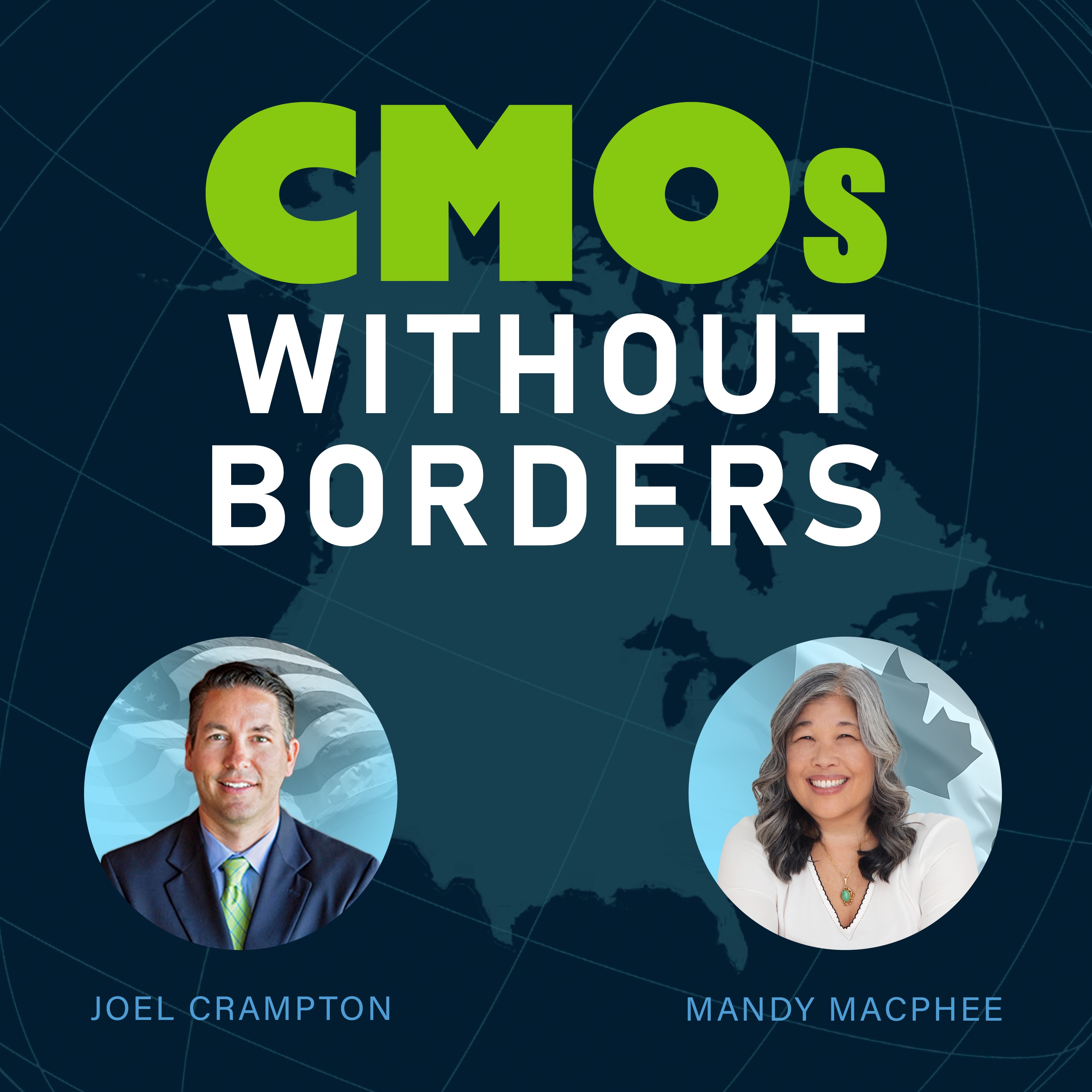
CMOs Without Borders
by Joel Crampton
Welcome to CMOs Without Borders — the podcast where two seasoned marketing leaders with decades of experience from opposite sides of the border cut through the noise and get real about what actually drives growth in financial services.Hosted by fractional CMOs Joel Crampton, founder of CMO/Alpha (U.S.), and Mandy MacPhee, founder of illumination (Canada), this show explores the strategic marketing moves that help RIAs, fintechs, credit unions, and financial brands thrive — regardless of size, structure, or postal code.We bring different lenses to the mic: U.S. vs. Canada, Fintech vs. Institutional, Independent firms vs. Enterprise marketingBut we’re united by one mission: helping you build a smarter, more strategic marketing function that actually drives results — not just more activity.Each episode delivers candid conversations, real-world examples, and field-tested insights to help you: - Align your marketing with business goals - Outperform the competition without wasting time
-
18
The Appointment Generation Engine — How RIAs Are Scaling with Facebook Advertising
Most financial advisors know they need more clients. What they don't know is that the answer might already be in their prospects' Facebook feeds.In this episode, Mandy MacPhee and Joel Crampton sit down with Alex Khassa, founder of Clients Blackbox — a Meta advertising partner with $10M+ in ad spend and 30,000+ appointments booked for RIAs. Alex breaks down why education, not promotion, is the strategy that changes everything.🔑 Key TakeawaysEducation beats promotion. Lead with content that solves a real problem — trust builds before skepticism sets in.70% of Baby Boomers are on Facebook. No other platform matches it for reaching pre-retirees at scale.The sales cycle is 60–90 days. Nurture sequences convert leads into clients.Marketing brings the lead. Sales closes it. Conversion depends on the firm's internal follow-up systems.Niche down to scale up. Focus drives repeatable results.Content volume wins. Clients Blackbox runs up to 25 ad variations per client and scales what works.💡 For Founders, RIAs, and Growth-Focused FirmsPaid advertising without infrastructure is just spending money. With the right systems, it's a growth engine.Connect with Alex KhassaClients Blackbox Inc. /alexkhassa clientsblackbox.comConnect with the HostsJoel Crampton — Fractional CMO for RIAs and Wealth Managers / joelcrampton cmoalpha.comMandy MacPhee — Fractional CMO for Founder-Led Companies / mandymacphee illuminationcmo.com
-
17
The Model Behind Modern Marketing Leadership — Lessons from the Fractional CMO Frontier
The best marketing leaders aren't just strategists. They're operators, builders, and systems thinkers — and the fractional model is exactly where those skills come to life.In this episode, Mandy McPhee and Joel Crampton pull back the curtain on what it actually means to be a fractional CMO. No guests, no filters — just two practitioners sharing what a real week looks like: the clients, the chaos, the AI tools making it all possible, and the honest conversation about capacity, growth, and what it takes to scale without burning out.Their message is clear: the fractional model works because it was built for this moment. When founders need executive-level marketing leadership without the full-time overhead, the fractional path delivers on both sides.When marketing leadership is embedded, growth accelerates. When it's outsourced from the outside, strategy stays stuck.🔑 Key TakeawaysFractional is not part-time — it's a different operating model Fractional CMOs sit inside the executive team, own the KPIs, and are accountable for growth just like a full-time CMO — across multiple companies simultaneously.Success means growing your clients past needing you The goal of every engagement is to drive enough growth that the company eventually needs a full-time marketing leader. That's not a loss — it's the measure of a job well done.Always work on the business, not just in it Blocking time for your own business development isn't optional — it's survival. When a client moves on, the pipeline you neglected becomes the crisis you're scrambling to solve.AI is a service delivery multiplier From automating invoice processing to training Claude on brand voice, to running full GA4 analysis in two days instead of four weeks — AI is changing what a fractional CMO can deliver. The leaders using it are doing more and going deeper than ever before.The job displacement conversation is no longer hypothetical With 192 million jobs projected to be lost to AI by 2030, the message is simple: adapt now or get left behind. The efficiency gap between those using agentic AI and those avoiding it is widening fast.Pick a platform and get reps in Claude, ChatGPT, Gemini — they're all improving constantly. Find the platform that fits your workflow, train it on your brand, and go deep. Don't chase the leapfrog.Strategy without execution is just a slide deck The most effective fractional CMOs don't just hand off a plan — they get in the weeds and build momentum. AI has made that possible at scale without getting buried in the details.💡 For Founders, CMOs, and Growth-Focused LeadersThe fractional model isn't a compromise. It's a strategic choice.Embedded leadership creates accountability. Accountability drives execution. Execution — backed by the right AI systems — creates compounding results.And the fractional CMOs building that way today aren't just keeping up. They're setting the pace. Connect with the HostsJoel Crampton — Fractional CMO for RIAs and Wealth Managershttps://www.linkedin.com/in/joelcrampton/cmoalpha.comMandy MacPhee — Fractional CMO for Founder-Led Companieshttps://www.linkedin.com/in/mandymacphee/illuminationcmo.com
-
16
The Strategy Behind Safe and Scalable AI
AI isn’t coming for your business — it’s already inside it. The real question isn’t whether to use it, but whether you’re using it strategically, safely, and in a way that actually drives results.In this episode, Mandy MacPhee and Joel Crampton sit down with JL Verboomen, analytics and AI strategist at Massive Insights. With 30+ years of experience in data and analytics, JL shares a practical perspective on one of the most important conversations founders and marketing leaders are having today.His message is clear: AI isn’t magic, and it isn’t a threat — it’s a tool. Like any tool, the results depend on the person using it, the guardrails in place, and the clarity of the problem being solved.When AI is rushed, it creates risk. When AI is strategic, it creates scale.🔑 Key TakeawaysAI isn’t new.From statistics to data science to generative AI, the fundamentals haven’t changed. What’s changed is access, speed, and the stakes.Start with a pain point.Successful AI implementations begin with a single friction point. Solve that first, prove the value, then scale.Agentic AI brings promise — and risks.Without guardrails, tools can expose APIs, run up costs, and create security issues.Context matters when prompting AI.The more context you provide about your audience, product, and goals, the stronger the output.Question the output.Hallucinations still happen. Ask for sources and challenge the response.Start with external research.Use AI for competitive insights, pricing research, and industry trends before sharing internal data.💡 For Founders, CMOs, and Growth LeadersAI doesn’t replace judgment — it accelerates execution. The leaders who win pair the right tools with the right strategy, guardrails, and problems to solve.Efficiency creates capacity. Capacity creates focus. Focus creates growth.Connect with JL VerboomenMassive Insightshttps://www.linkedin.com/in/jlverboomen/Connect with the HostsJoel Crampton — Fractional CMO for RIAs and Wealth Managershttps://www.linkedin.com/in/joelcrampton/cmoalpha.comMandy MacPhee — Fractional CMO for Founder-Led Companies https://www.linkedin.com/in/mandymacphee/illuminationcmo.com
-
15
The Leadership Patterns Behind Scalable Companies — Lessons from "The Work That Holds You"
Growth doesn’t begin with tactics, campaigns, or activity. It begins with self-awareness — understanding the patterns shaping your leadership, the foundations supporting your business, and the systems required to turn effort into sustainable growth.In this episode, Mandy MacPhee, fractional CMO and co-host of CMOs Without Borders, shares the thinking behind her new book The Work That Holds You. She explores how leadership patterns, marketing foundations, and intentional systems shape a company’s ability to grow and scale.Her message is simple: growth requires inner work and structural work. When leaders recognize the patterns holding them back and build strong marketing foundations, companies gain clarity, consistency, and the ability to scale without chaos.When execution comes before understanding, growth stalls. When systems support the work, growth compounds.🔑 Key TakeawaysLeadership patterns shape business outcomesFounders often carry instinctual patterns formed through past experiences. These patterns influence decisions, communication, and leadership style. Growth begins when leaders recognize these patterns and intentionally evolve.Many companies are built around the founder instead of the customerEarly success often comes from founder-driven vision and personality. Sustainable growth requires shifting focus outward — building the business around the needs of the ideal customer, not the founder’s identity.Founders frequently become the bottleneck to growthAs companies grow, founders must release control and trust systems and teams. Holding onto every decision slows progress, reduces accountability, and limits scalability.Execution without systems creates motion but not progressMany companies jump into tactics too quickly — running campaigns, ads, and initiatives without a unified strategy. Sustainable growth requires strong foundations, a clear direction, and coordinated execution.A healthy marketing system creates relief, alignment, and consistencyWhen systems are in place, founders feel less overwhelmed, teams gain autonomy, and messaging becomes consistent across the organization. Growth becomes measurable and repeatable.Pattern recognition is the first step toward meaningful changeLeaders must distinguish between personal preference and customer relevance. Asking “Does this serve the customer?” instead of “Do I like it?” leads to better decisions and stronger outcomes.Strong marketing foundations drive sustainable growthUnderstanding your market, ideal customer, and positioning is the most common gap leaders face. Clarity at this level creates direction, confidence, and momentum.💡 For Founders, Leaders, and Growth-Focused CompaniesGrowth is not driven by execution alone. It is driven by awareness, alignment, and systems that support both leadership and marketing.Connect with the HostsJoel Crampton — Fractional CMO for RIAs and Wealth Managershttps://www.linkedin.com/in/joelcrampton/cmoalpha.comMandy MacPhee — Fractional CMO for Founder-Led Companieshttps://www.linkedin.com/in/mandymacphee/illuminationcmo.comGet her book: The Work That Holds You
-
14
The System Behind Predictable Client Acquisition — Lessons from "Trailblazing Growth"
Client growth doesn’t begin with tactics, campaigns, or quick wins. It begins with clarity — understanding the journey prospects are already on, the psychology behind their decisions, and the systems required to guide them from interest to trust.In this episode, Joel Crampton, fractional CMO, co-host of CMOs Without Borders, and author of Trailblazing Growth, shares the thinking behind his framework for helping financial advisors build sustainable growth through strategy, systems, and trust.His message is simple: growth is intentional. When firms replace random acts of marketing with clear positioning, structured journeys, and consistent trust-building, performance compounds and growth becomes predictable.When marketing is scattered, growth is inconsistent. When marketing is strategic, growth accelerates.🔑 Key TakeawaysProspects are already deep into the journey before contacting youToday’s buyers complete most of their research independently using digital resources and AI. By the time they reach out, they may already be halfway (or more) through the decision process. Firms must meet prospects where they are with the right message, trust signals, and next steps.Strategy must come before tacticsTactics are easy to find. Strategy requires understanding the audience, the journey, and the desired outcome. Firms that lead with strategy build systems that drive consistent growth instead of chasing short-term wins.Random acts of marketing weaken growthMany firms jump from tactic to tactic without measurement or patience. Real growth comes from a coordinated system where every action connects to a single objective: growth and revenue.The evaluation stage is where trust begins to formStage 3 of the client journey is where confidence and trust start to take hold. Firms that nurture prospects effectively at this stage increase conversion and long-term client loyalty.Trust is fragile and must be earned consistentlyBroken follow-ups, weak branding, poor communication, or unmet promises quickly erode trust. Firms must stay present, responsive, and reliable throughout the entire decision journey.Founders often become the bottleneck to growthMany advisory firm owners built their business through personal sales and marketing. Scaling requires letting go of those roles and focusing on leadership, vision, and strategic direction.Clarity → Confidence → Trust drives sustainable growthClarity defines the goal. Confidence builds belief in the path. Trust allows commitment. When these three elements align, growth becomes durable and repeatable.💡 For Founders, RIAs, and Growth-Focused FirmsGrowth is not driven by activity alone. It's driven by alignment between strategy, systems, and trust.Marketing creates visibility.Systems create consistency.Trust creates conversion.And conversion is what ultimately drives durable, scalable growth.Connect with the HostsJoel Crampton — Fractional CMO for RIAs and Wealth Managershttps://www.linkedin.com/in/joelcrampton/cmoalpha.comGet the book: Trailblazing Growth (available on Amazon or request a copy directly from Joel)Mandy MacPhee — Fractional CMO for Founder-Led Companieshttps://www.linkedin.com/in/mandymacphee/illuminationcmo.com
-
13
The Culture Advantage – From Client Trust to Firm Growth
Client trust doesn’t begin with performance reports, portfolios, or marketing. It begins inside the firm — in how people work together, how culture is lived, and how leadership shapes the environment clients ultimately experience.In this episode, Ethan Chazin, fractional Chief Culture Officer and leadership advisor, provides insights into how he helps organizations build high-performance workplaces where people, culture, and business results reinforce each other.His message is simple: growth is driven by people first. When culture is intentional, aligned, and actively shaped, performance improves, trust deepens, and growth becomes sustainable.When culture is weak, growth is fragile. When culture is strong, performance compounds.🔑 Key TakeawaysCulture is a leading indicator of performanceFinancial results reflect what has already happened. Culture influences what happens next. Firms that intentionally build strong cultures consistently outperform those that leave culture to chance.People are not a cost — they are the growth engineStrategy, tools, and systems only work when the right people are aligned to execute them. High-performing firms treat people as an investment, not an expense, and build environments where individuals can contribute at their highest level.Every organization has a culture — intentional or notCulture forms the moment more than one person works together. Ignoring it doesn’t eliminate it. It allows misalignment, conflict, and inefficiency to grow unnoticed until performance begins to suffer.Leadership blind spots often weaken performanceMany leadership teams believe employees are aligned and engaged — but internal reality often tells a different story. Disconnect, generational differences, and even one toxic leader can quietly undermine execution and morale.Hiring for attributes unlocks long-term growthGreat organizations hire for mindset, behavior, and cultural alignment — not just job descriptions. When people are placed in roles that match their strengths and values, performance and engagement accelerate.Vision, mission, and values must come before toolsTechnology, business operating systems (such as EOS), and AI can improve execution, but they cannot define purpose. Strong firms start with clarity around vision, mission, and core values, then build systems that reinforce them daily.AI accelerates execution — but culture determines resultsAI improves speed, analysis, and productivity, but it cannot replace leadership, trust, or human connection. Technology multiplies performance only when the cultural foundation is strong.💡 For Founders, RIAs, and Growth-Focused FirmsSustainable growth doesn’t come from strategy alone. It comes from aligning people, culture, and leadership around a shared vision.Marketing builds visibility.Performance builds credibility.Culture builds trust.And trust is what ultimately drives durable growth.Connect with Ethan Chazinhttps://thechazingroup.com/Check out his latest book, The Compassionate Organization, on Amazon: https://www.amazon.com/Compassionate-Organization-People-Love-Them/dp/154621707X/Connect with the HostJoel Crampton — Fractional CMO for RIAs and Wealth Managershttps://www.linkedin.com/in/joelcrampton/cmoalpha.com
-
12
From Founder Chaos to Scalable Growth: How EOS Builds Real Business Infrastructure
Most founders don’t struggle because they lack ideas.They struggle because everything still runs through them.Growth stalls when the founder is the system — making every decision, solving every problem, and carrying every role.In this episode, we sat down with Mike Walrod, fractional integrator and EOS practitioner at Incite Business, who helps companies replace founder-driven chaos with structure, accountability, and scalable operating systems.His message is simple: growth doesn’t come from working harder, it comes from installing systems that allow a business to run and improve — even when the founder steps back.Because when the business depends on the founder, growth is fragile. When it runs on systems, growth becomes repeatable.🔑 Key TakeawaysBusinesses plateau when the founder is the infrastructureMost companies hit a ceiling when everything flows through the owner. EOS helps founders move from doing everything to building shared accountability, structure, and clarity across the leadership team.Growth requires letting go and replacing instinct with systems.Structure turns effort into scalable executionEOS creates:clear roles and accountabilitystructured leadership meetingsmeasurable scorecardsaligned quarterly prioritiesreal follow-throughInstead of endless discussion, teams identify, discuss, and solve the issues that move the business forward.Execution improves when structure replaces chaos.Marketing and operations scale companies the same way: through systemsMarketing breaks when it’s scattered. Real growth comes from:clear positioning and messagingconsistent executioncustomer-driven decisionsmeasurable outcomesWhen both operations and marketing run as systems, companies grow faster with less founder dependency.Data beats instinct when scalingEarly growth often comes from founder instinct. Sustainable growth comes from:testing and validationcustomer insightmeasurable dataDecisions shift from “what the founder prefers” to “what the market responds to.”Growth accelerates when the market guides decisions.AI accelerates execution, but experience still drives resultsAI improves research, analysis, and speed — but it cannot replace leadership, trust, judgment, or real-world experience.AI is a multiplier, not a substitute.💡 For Founders, RIAs, and Growth-Focused FirmsScaling isn’t about doing more. It’s about building systems that make growth sustainable.EOS provides structure. Marketing provides the growth engine. Leadership provides alignment.Because real growth doesn’t depend on the founder — it depends on the systems that outlast them.Connect with Mike WalrodIncite Businesshttps://incitebusiness.com/Connect with the HostsJoel Crampton — Fractional CMO for RIAs and Wealth Managershttps://www.linkedin.com/in/joelcrampton/cmoalpha.comMandy MacPhee — Fractional CMO for Founder-Led Companieshttps://www.linkedin.com/in/mandymacphee/illuminationcmo.com
-
11
Marketing As An Exit Planning Strategy: Build Systems That Transfer
Most founders treat exit planning like something you only worry about when you’re ready to retire or sell.But your exit gets decided years earlier by one simple question: Can your growth run without you? If growth only happens through referrals and founder effort, buyers don’t see a system, they see dependency.In this episode, we sat down with Tracy Jepson, a multi-passionate entrepreneur and business coach who helps service-based businesses (including financial advisors) build companies that are profitable, scalable, and actually sellable.Her message is simple: if the business can’t make money while you’re gone, it isn’t a business yet, it’s a job with overhead.And that’s why marketing matters. Not as random tactics but as the engine that proves growth is repeatable, measurable, and transferable.🔑 Key TakeawaysIf the founder is required, the business isn’t transferableTracy challenges founders to ask early: Can the business make money without you in it? If the answer is no, the firm’s value is capped because the founder is the infrastructure.Marketing only transfers when it’s a systemMarketing breaks when it’s scattered: a website refresh, a few ads, a new idea every month. What is transferable is a repeatable engine with:clear strategyconsistent executionmeasurable KPIsenough runway to workimprovement over timeNiching down makes growth easier to sustain and sellNiching doesn’t mean turning away business. It means creating clarity, which leads to:stronger messagingmore efficient marketing spendbetter-fit clientsmore predictable growthAnd predictable growth is what buyers pay for.Marketing should be funded like an investment, not a gambleFrom a Profit First lens, marketing can’t be “hope and pray”. It needs structure:commit to a monthly budgetbuild runway (6–9 months)test what’s sustainablescale what performsAvoid expensive activity without outcomesFor example, building a new website can be an investment, but without a plan to drive traffic and measure behavior, it’s just expensive activity.💡 For RIAs, Wealth Managers, and Founder-Led FirmsMarketing is bigger than lead gen.It’s how you prove your firm can grow without founder dependency, build leverage, and create real exit options.Because buyers don’t just want AUM and revenue. They want confidence that growth doesn’t disappear when the founder steps back.That’s what transferable systems deliver.Connect with Tracytracyjepson.comLinkedInInstagramConnect with the HostsJoel Crampton — Fractional CMO for RIAs and Wealth ManagersLinkedIncmoalpha.comMandy MacPhee — Fractional CMO for Founder-Led CompaniesLinkedInilluminationcmo.com
-
10
The Future of Financial Services Marketing Is AI + Humans
As Season 1 of CMOs Without Borders comes to a close, we step back to reflect on what defined marketing in financial services in 2025 — and what leaders need to prepare for as we head into 2026.In this episode, Joel Crampton and Mandy MacPhee unpack the realities behind AI adoption, the evolution of search and digital trust, and why strategy, not shiny tools, will separate winners from noise in the years ahead.AI dominated the conversation in 2025, but not in the way many feared. Rather than replacing marketers or advisors, AI has become a powerful copilot — accelerating research, content drafting, note-taking, and operational efficiency. The real risk isn’t adoption. It’s blind reliance. As Joel and Mandy emphasize, AI gets you 60–70% of the way there. Human judgment, context, and authenticity still do the rest.They also explore how the rise of AI-driven search is fundamentally changing how prospects discover and evaluate firms. Traditional SEO is giving way to AEO (answer engine optimization) where clarity, authority, and plain-language content determine visibility — not keyword tricks. This shift makes digital first impressions more critical than ever, especially in trust-based industries like financial services.Along the way, the conversation returns to a consistent theme from the entire season: trust is not built through tactics alone. It’s built through cohesive systems, clear positioning, consistent messaging, and human-centered experiences that AI cannot replicate.🔑 Key TakeawaysAI won’t replace you — but it will replace inefficiency.Firms that use AI as an assistant, not a substitute, gain speed, insight, and leverage. Those who ignore it risk falling behind. The future belongs to AI + humans, not one or the other.Search is no longer about keywords — it’s about answers.Prospects now do the majority of their decision-making before ever reaching out. If AI tools can’t clearly understand who you serve, what you do, and why you’re credible, you won’t show up when it matters.Authentic storytelling beats generic content every time.As AI-generated content floods the market, real voices stand out more than ever. Founder-led stories, lived experience, and human perspective are becoming the ultimate differentiators.Niching down creates leverage.Trying to serve everyone leads to sameness. Firms that define a clear niche, identify their white space, and speak directly to a specific audience will grow faster and more efficiently.Marketing is a long-term trust engine, not a campaign.Shortcuts, viral hopes, and “spaghetti-on-the-wall” marketing fail without strategy. Sustainable growth comes from systems that compound over time.💡 What This Means for Financial Services LeadersFor RIAs, wealth managers, fintech founders, and financial services executives, the path forward is clear:Build your marketing foundation before chasing toolsTreat digital presence as a trust signal, not a brochureUse AI to enhance clarity, not create noiseAlign marketing, sales, and leadership around one cohesive strategy🧭 Parting Thought“The future isn’t AI versus humans. It’s AI plus humans — anchored by clarity, confidence, and trust.”Joel Crampton — Fractional CMO for RIAs and Wealth Managerscmoalpha.comMandy MacPhee — Fractional CMO for Founder-Led Companiesilluminationcmo.com
-
9
How Client Experience Becomes a Credibility Engine
Every financial services leader eventually reaches the same truth: your products don’t set you apart — your client experience does.We sat down with Glenn LaCoste, founder of Surviscor Group, whose team has spent over two decades evaluating client experience across banks, credit unions, brokerages, and digital-first financial brands.Glenn breaks down why the client experience is far more than a slick digital interface. It’s the sum of every task, interaction, and moment of friction — and it quietly determines whether a client feels confident, frustrated, or ready to leave.He shared how his team measures thousands of data points through ongoing mystery shopping, why most firms overestimate how “good” their experience actually is, and how internal bias, not capability, is the biggest barrier to improvement.Along the way, he unpacked why trust is built one completed task at a time, how to avoid chasing new “rabbits,” and why consistency beats complexity in today’s competitive landscape.🔑 Key TakeawaysTrust is earned through tasks, not taglines.Clients trust firms who help them effortlessly complete what they came to do — whether that’s placing a trade, fixing an issue, or accessing an account. Every successful task builds confidence. Every roadblock erodes it.Digital-first… but not digital-only.People start online, but the human element still matters. Younger clients eventually want face-to-face advice for bigger decisions. Older clients may prioritize phone support. The winning firms integrate both intentionally.Internal bias is the biggest experience killer.Glenn sees the same pattern year after year: teams assume they’re delivering excellence, even when external data shows otherwise. Improvement starts when leaders finally confront their blind spots.Small firms must niche down to compete.You can’t out-feature big banks. You can outperform them with clarity, specialization, and a client experience that feels custom-built for your ideal audience.AI is accelerating change… and uncertainty.AI can enhance personalization and speed, but it can’t replace human judgment, nuanced advice, or true Know Your Client responsibility. Advisors who fear replacement misunderstand what clients value most.💡 For RIAs, Wealth Managers, and FoundersGlenn’s insights map directly to the challenges faced by independent advisors and growth-minded firms:Your digital presence is your first impression.Before a prospect ever calls, they’ve already judged your website, messaging, resources, and ease of navigation.AI won’t replace advisors — but unprepared advisors may lose trust.Clients will still need experts to ask the questions AI can’t, interpret nuance, and ensure advice aligns with real life.🧭 Glenn’s Parting Insight“Trust comes from doing. If I can complete what I came to do — and you help me when there’s a problem — trust builds. It’s that simple, and that hard.”Connect with the HostsJoel Crampton — Fractional CMO for RIAs and Wealth ManagersLinkedIncmoalpha.comMandy MacPhee — Fractional CMO for Founder-Led CompaniesLinkedInilluminationcmo.com
-
8
Your Story Is Your Superpower: Why Every Leader Should Write a Book
Every great leader eventually runs into the same realization: expertise alone doesn’t set you apart — your story does. We sat down with Will Severns, co-founder of ShareYourStory.com, to explore how books, personal narratives, and authentic storytelling are becoming the next major differentiator for founders, financial advisors, and thought leaders.Will shared how he and his team have helped more than 200 authors turn lived experiences into powerful narratives that build trust, deepen relationships, and strengthen brands. Along the way, he unpacked why so many leaders doubt their own story, how to overcome the fear of “self-promotion”, and why authenticity is quickly becoming one of the rarest skills in business.🔑 Key TakeawaysStory is your strongest competitive advantage. In industries where everyone looks the same on paper — especially financial services — your personal story becomes the emotional anchor that sets you apart.Books aren’t about fame — they’re about impact.Will encourages authors to write for the one person whose life or perspective might change because of their story. That shift removes pressure and unlocks clarity.AI helps you work faster, but it can’t replace your voice.AI can outline, brainstorm, and organize, but it can’t replicate empathy, humor, vulnerability, or lived experience. Leaders who rely solely on AI risk losing the very thing readers connect with most.💡 For Financial Advisors & FoundersWill’s insights map directly to the challenges faced by RIAs, wealth managers, fintech founders, and financial-services executives:A book deepens trust before you ever meet the prospect.It allows clients to connect with your values, philosophy, and story... long before you show them a single planning tool or presentation.Compliance is less intimidating than advisors fear.Books focused on story, purpose, or the “why” behind your work tend to avoid the regulatory pitfalls that come with investment commentary.You don’t need to be a celebrity to matter.“You’re not a somebody or a nobody — you’re an anybody,” Will says. And anybody with a meaningful life experience has a story worth sharing.📚 Books Mentioned in the ConversationA handful of titles came up as influential or widely recommended by the hosts and guest:Goals — Brian TracyThe Baby Whisperer — Tracy HoggThe Psychology of Money — Morgan HouselHow to Spend Money — Morgan HouselSacred Pace — Terry LooperStrength to Strength — Arthur BrooksFounder Brand — Dave Gerhardt🧭 Will’s Parting Thought“Someone you haven’t met yet is counting on you to get better today — and your story might be the thing that helps them.”Connect with Willhttps://shareyourstory.comConnect with HostsJoel Crampton — Fractional CMO for RIAs and wealth managersLinkedIncmoalpha.comMandy MacPhee — Fractional CMO for founder-led companiesLinkedInilluminationcmo.com
-
7
Building Authentic Networks with Clay Hicks, Founder of H7 Global Network
In this episode we sit down with Clay Hicks, founder and CEO of H7 Global Network, to unpack what authentic networking really looks like and how founders, financial advisors, and entrepreneurs can build relationships that actually move the needle.Clay shares the story behind H7’s rise from a regional Ohio-based network to a global community spanning 23 countries, all grounded in one simple philosophy: “Connect. Serve. Ask.”🔑 Key TakeawaysTrust is the currency of connection. Clay emphasizes that networking shouldn’t start with a pitch — it starts with curiosity. Focusing on understanding others first earns trust faster and creates deeper, longer-lasting opportunities.From contacts to advocates. Turning a first meeting into real advocacy means consistent follow-up and service beyond your own business interests. The Connect–Serve–Ask method helps people move from introductions to influence.💡 For Financial Advisors & FoundersClay offers practical advice that applies directly to client acquisition and retention:Stop treating discovery calls like transactions — instead, ask about the person, not the portfolio.Expand your professional network beyond CPAs and estate attorneys; relationships outside the typical channels often lead to unexpected referrals.Always approach networking with the mindset of earning trust first, not closing a sale.🌍 What’s Next for H7As H7 continues its international expansion, Clay is preparing for the network’s annual virtual holiday extravaganza in December and an in-person global conference in Nashville in April 2026.🧭 Clay’s Parting Thought“Before you network at all, think about what you really want to accomplish — and focus on earning trust with every person you meet. That one shift could change everything.”Connect with Clayhttps://h7network.blog/Connect with HostsJoel Crampton — Fractional CMO for RIAs and wealth managersLinkedIn profilehttps://cmoalpha.com Mandy MacPhee — Fractional CMO for founder-led companies LinkedIn profile https://www.illuminationcmo.com/
-
6
Why Most Marketing Funnels in Financial Services Still Don’t Convert
In this episode of CMOs Without Borders, hosts Joel Crampton and Mandy MacPhee tackle one of the most persistent problems in financial-services marketing: why most funnels still don’t convert.From RIAs to fintechs, firms spend heavily on awareness and ads — but too often, those efforts fail to translate into meaningful conversations or new clients. Joel and Mandy break down what’s really going wrong and share how to build a full-funnel marketing system that works in today’s multi-channel, compliance-bound environment.They dive into how top-of-funnel visibility connects with middle-funnel nurturing and bottom-funnel conversion, why too many firms stop at “getting names in the door,” and how to close the gap between activity and results. You’ll hear practical strategies for building awareness that earns trust, nurturing prospects through value-added content, and aligning marketing and sales so every touchpoint feels intentional, not random.Along the way, they unpack how AI, social proof, and modern buyer behavior are reshaping the customer journey — and why the middle of the funnel is where most revenue quietly dies. This episode goes beyond theory, offering step-by-step ideas for optimizing your campaigns, tightening your messaging, and creating a repeatable system for scalable growth.What You’ll Learn in This EpisodeThe New Shape of the Funnel: Why today’s buyer journey isn’t linear and what that means for your marketing strategy.Top-of-Funnel Reality: How to build awareness that earns trust — even when it’s hard to measure.The Missing Middle: Why nurture and consideration phases make or break conversion outcomes.Bottom-of-Funnel Fixes: How to align sales and marketing around value-based CTAs instead of “schedule a call.”Social Proof That Converts: How reviews, certifications, and third-party validation drive trust (and even influence AI search).Reddit, Reviews, and Real Talk: Why unfiltered peer conversations matter more than polished brand copy.Full-Funnel Optimization: The continuous feedback loop that keeps campaigns improving instead of stalling — and the metrics that matter most to prove it.Why It MattersIn financial services, trust is everything — and yet too many firms chase short-term conversions while neglecting the systems that build credibility and nurture long-term relationships. The result? Bloated ad budgets, cold leads, and inconsistent growth.A well-designed funnel doesn’t just generate names — it builds belief. It helps prospects feel confident enough to take the next step with you. That’s the difference between a disconnected campaign and a marketing system that scales.👉 If your marketing system feels disjointed — or your funnel isn’t converting the right leads — Joel and Mandy can help.Reach out to learn more about their 30-Day Clarity Sprint, designed to audit and optimize your entire marketing funnel — from awareness to conversion — so you can build predictable growth that lasts.Joel Crampton — Fractional CMO for RIAs and wealth managershttps://www.linkedin.com/in/joelcrampton/https://cmoalpha.comMandy MacPhee — Fractional CMO for founder-led companieshttps://www.linkedin.com/in/mandymacphee/https://www.illuminationcmo.com/
-
5
Reimagining Legacy: How AI and Storytelling Are Transforming Estate Planning
EPISODE OVERVIEW In this episode, hosts Joel Crampton and Mandy MacPhee sit down with Randy Frisch, founder of Trusty, an AI-powered estate planning platform redefining how families manage, document, and pass down their legacies. With $84 trillion set to change hands in the coming decades, Randy shares how technology, emotion, and storytelling can transform estate planning from a cold, legal process into a deeply personal, human experience. This conversation explores how advisors and families alike can move beyond wills and trusts to create meaningful legacy plans — ones that connect generations, reduce conflict, and capture the stories behind the assets.ABOUT OUR GUEST Randy Frisch is the founder and CEO of Trusty, an AI-driven estate planning platform helping families document and communicate their wishes with clarity and connection. Before Trusty, Randy co-founded Uberflip, one of Canada’s most successful SaaS companies, which scaled globally and was later acquired.KEY TOPICS COVERED ● Why traditional estate planning is broken and how Trusty is making it more human. ● The “letter of wishes” revolution: How families can leave behind video messages and stories that give deeper meaning to their gifts. ● AI’s role in legacy planning: Real-world ways Trusty uses “quiet AI” to simplify, summarize, and guide complex estate decisions without overwhelming users. ● Why storytelling matters: How focusing on narratives — not just features — builds trust and emotional resonance. ● Advisor opportunities: How financial advisors, estate attorneys, and planners can use legacy tech to differentiate, retain heirs, and deepen client relationships. ● Privacy & legal clarity: What’s binding, what’s not, and how to keep sensitive information secure while still making it accessible. NOTABLE INSIGHTS $84 trillion is projected to transfer between generations — but 80% of heirs change advisors when they inherit.Trusty’s mobile-first platform lets families easily photograph, catalog, and assign meaningful items — from heirlooms to handwritten letters — while capturing stories and intentions.“The stories are often more valuable than the stuff.” Video messages and backstories give assets emotional weight and reduce family conflict. Privacy is foundational: users control access, data is encrypted at rest, and even Trusty’s team can’t view client information. WHO SHOULD LISTEN Financial advisors, RIAs, and wealth managers looking to differentiate their services and retain next-gen clients Estate attorneys and planners interested in modernizing legacy planning Families navigating estate planning who want to go beyond the will and leave meaningful stories behind.RESOURCES & LINKS Explore Trusty: https://mytrusty.ai Connect with hosts: Joel Crampton — Fractional CMO for RIAs and wealth managers LinkedIn: https://www.linkedin.com/in/joelcrampton/ CMO Alpha: https://cmoalpha.com Mandy MacPhee — Fractional CMO for founder-led companies LinkedIn: https://www.linkedin.com/in/mandymacphee/ Illumination CMO: https://www.illuminationcmo.com/
-
4
The Importance of Founder-Led Demand Creation
When founders tell their story, they don’t just market their product or service, they create demand and separate their company from the competition. In this episode, Joel Crampton and Mandy MacPhee sit down with fellow fractional Chief Marketing Officer Chris Downey to unpack a modern, founder-led approach to building pipeline — show up where your buyers already consume content, earn trust with your authentic voice, and make conversion dead simple when they’re finally ready.Top Takeaways:Creation over capture. Treat the “funnel” like a loop. Most buyers aren’t ready today. Consistent, useful content warms the 95% that aren't ready to purchase just yet, so they choose you when timing hits.Your voice is the moat. AI can assist, but it can’t replace your lived experience. Founders should write the first draft, then use AI for polish.Founder first, brand second. Early buyers want the person behind the logo. Lead with your POV on your personal LinkedIn.Pick one core platform. For B2B, start with LinkedIn. Nail consistency there before expanding to YouTube or Reddit.Post cadence. Zero is the wrong number. Aim for 3x per week, build the habit, then work up to daily. Comment strategically on others' posts to expand reach.Repetition wins. Algorithms show each post to a small slice of your network. Recycle and repurpose strong content across formats.Track what matters. Add a required open-text field as part of your customer intake process: “How did you hear about us?” Then categorize responses for planning.Fractional CMO advantage. Senior strategy without a full-time executive. Use fractional leadership to hire, coach, and stretch budget.Engage With Us:Chris Downey (guest) — LinkedIn | Reverb Strategic MarketingHosts:Joel Crampton — Fractional CMO for RIAs and wealth managers — LinkedIn, CMO AlphaMandy MacPhee — Fractional CMO for founder-led companies — LinkedIn, Illumination CMO
-
3
AI: The Great Equalizer in Financial Services Marketing
Financial institutions are waking up to the power of AI in accelerating their marketing engines. In this episode, Heather Gerdes, co-founder of Promode.ai, joins Joel and Mandy to unpack what real adoption looks like inside banks, credit unions, and RIAs. We dig into customer-driven demand for better digital experiences, how to keep compliance tight while moving faster, and why AI is an amplifier that still needs human strategy. We also get technical about context windows, RAG, workflow bottlenecks, and the culture shifts leaders must drive.Key takeaways:Why end customers are pushing financial firms to adopt AI nowHow to speed approvals and stay compliant with clear guardrails and rolesContext over clever prompts for higher-accuracy outputsScaling organic content and testing without enterprise headcountCulture change from fear to curiosity, and how to communicate the “why”Near-term AI use cases that will soon feel normal in financial marketingGuest:Heather Gerdes, co-founder, Promode.aiHosts:Joel Crampton — cmoalpha.comMandy MacPhee — illuminationcmo.com
-
2
How Financial Services Firms Can Stand Out in the Sea of Sameness
In this episode of CMOs Without Borders, hosts Joel Crampton and Mandy MacPhee dive into one of the biggest challenges facing financial services marketing today: the Sea of Sameness.From fintechs to RIAs to credit unions, firms are sounding more and more alike, shouting the same claims about being “client-focused,” “digital-first,” or “fee-only.” But if everyone is saying the same thing, how do you actually stand out?Joel and Mandy share personal stories, cross-border perspectives (U.S. and Canada), and practical frameworks to help financial brands find their white space — the unique position in the market that competitors can’t touch.What You’ll Learn in This EpisodeWhy the end of summer is the perfect time to reflect, reset, and plan for 2026.The four lenses for uncovering white space:Voice of the Customer – listening beyond features to actual pain points.Competitive & Category Audits – mapping sameness to identify gaps.Cross-Industry Inspiration – borrowing proven ideas from outside financial services.Brand Truth – aligning to the authentic story only your firm can credibly own.How regional RIAs, fintech startups, and even nonprofits can flip the narrative to stand out.The three practical moves you can start tomorrow to escape the sea of sameness.Why It MattersBlending in is the fastest way to lose in financial services. When your message sounds like everyone else’s, the default choice becomes the biggest or the cheapest provider. Differentiation isn’t a luxury — it’s survival.Key Quote“What got you here isn’t going to get you there. Founders can only run on referrals and word of mouth for so long. At some point, you need a strategy that makes your marketing work harder than your competition’s.” – Joel CramptonResources & ShoutoutsToronto Local Charity (TLC): Supporting underserved youth with mental health services and life skills.Example brands discussed: Wealthsimple, Chime, COHO, TD, RBC.👉 If your firm’s marketing sounds just like your competitors, it’s time to find your white space. Reach out to Joel and Mandy to cut through the noise and build systems that align marketing with measurable growth.
-
1
Why Most Financial Services Marketing Plans Fail (and How to Fix Them)
Before you spend another dollar on marketing, find out if your plan is already broken.Most marketing plans at financial services companies don’t fail because of sloppy execution — they fail before they even start. In this first episode of CMOs Without Borders, Mandy MacPhee and Joel Crampton unpack the hidden reasons plans break down, from fuzzy positioning and misaligned teams to leadership that undervalues marketing as a growth driver.You’ll hear real-world examples from both sides of the border, the role trust plays in fintech and advisory marketing, and the “Three C’s” framework for building resilient marketing plans: Clarity, Capacity, and Commitment.If you’re tired of throwing spaghetti at the wall and hoping for growth, this episode will help you see exactly where to start — and what to stop — so your marketing actually moves the needle.
We're indexing this podcast's transcripts for the first time — this can take a minute or two. We'll show results as soon as they're ready.
No matches for "" in this podcast's transcripts.
No topics indexed yet for this podcast.
Loading reviews...
ABOUT THIS SHOW
Welcome to CMOs Without Borders — the podcast where two seasoned marketing leaders with decades of experience from opposite sides of the border cut through the noise and get real about what actually drives growth in financial services.Hosted by fractional CMOs Joel Crampton, founder of CMO/Alpha (U.S.), and Mandy MacPhee, founder of illumination (Canada), this show explores the strategic marketing moves that help RIAs, fintechs, credit unions, and financial brands thrive — regardless of size, structure, or postal code.We bring different lenses to the mic: U.S. vs. Canada, Fintech vs. Institutional, Independent firms vs. Enterprise marketingBut we’re united by one mission: helping you build a smarter, more strategic marketing function that actually drives results — not just more activity.Each episode delivers candid conversations, real-world examples, and field-tested insights to help you: - Align your marketing with business goals - Outperform the competition without wasting time
HOSTED BY
Joel Crampton
Loading similar podcasts...
Frequently Asked Questions
How many episodes does CMOs Without Borders have?
CMOs Without Borders currently has 18 episodes available on PodParley. New episodes are automatically indexed when they're published to the podcast feed.
What is CMOs Without Borders about?
Welcome to CMOs Without Borders — the podcast where two seasoned marketing leaders with decades of experience from opposite sides of the border cut through the noise and get real about what actually drives growth in financial services.Hosted by fractional CMOs Joel Crampton, founder of CMO/Alpha...
How often does CMOs Without Borders release new episodes?
CMOs Without Borders has 18 episodes. Check the episode list to see recent publication dates and frequency.
Where can I listen to CMOs Without Borders?
You can listen to CMOs Without Borders on PodParley by clicking any episode. We provide an embedded audio player for direct listening, and you can also subscribe via your preferred podcast app using the RSS feed.
Who hosts CMOs Without Borders?
CMOs Without Borders is created and hosted by Joel Crampton.
URL copied to clipboard!