
PODCAST · government
Cultural Commentary Project
by AlterEcoArtist
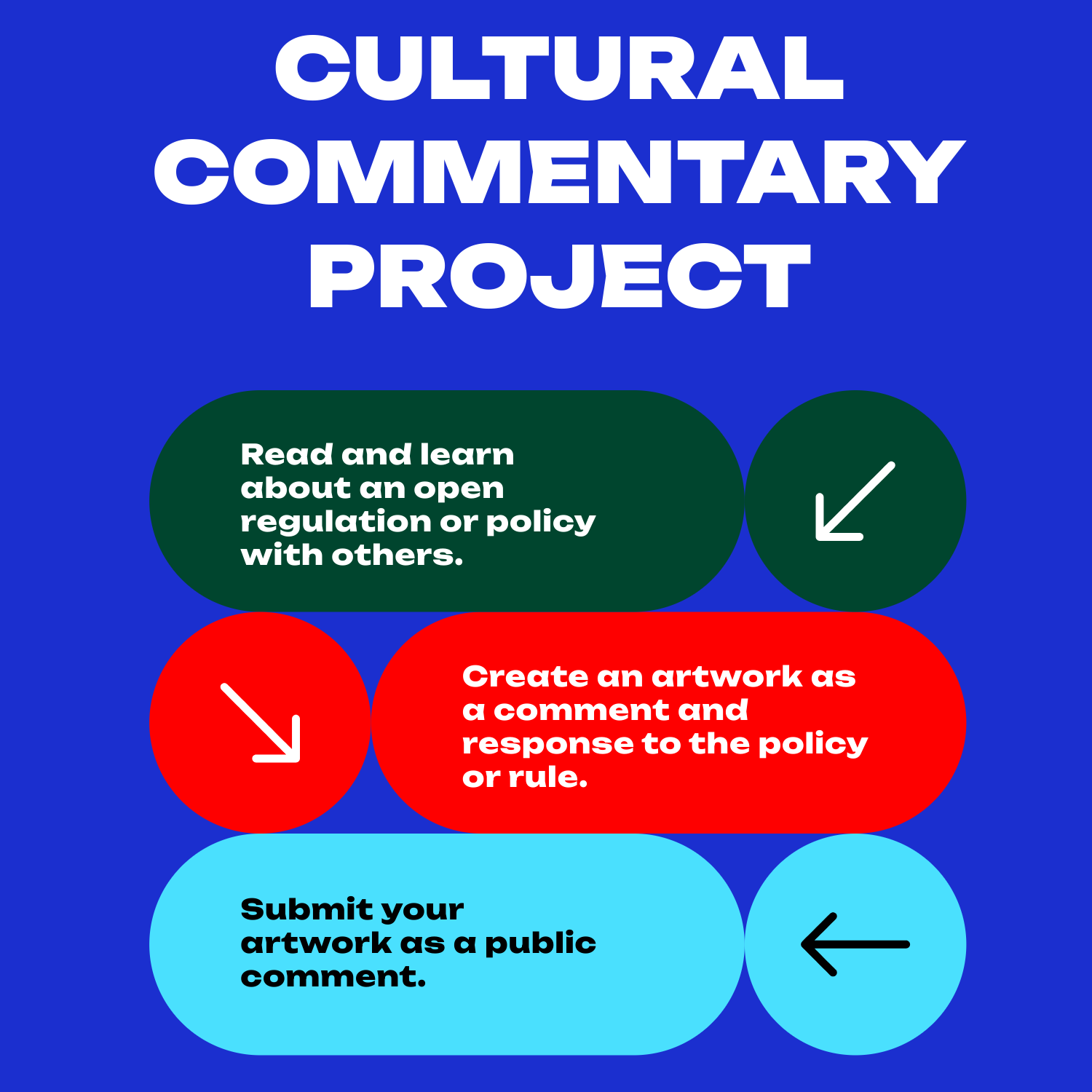
Read. Create. Comment.The CULTURAL COMMENTARY PROJECT taps into a powerful, often underused tool: the public comment system. Every time laws are proposed, public comments are required to be considered—this is your chance to make your voice count. Whether it’s about local transit or national policy, your thoughts matter. By submitting your art as a comment, we can influence change and bring a fresh perspective to the table.Artists have a unique way of seeing and interpreting the world, often uncovering ideas that policy experts may overlook. Now is your time to share those insights through art, words, sounds, and images—whatever form
-
3
Fiduciary Duties In Selecting Designated Investment Alternatives
Fiduciary Duties in Selecting Designated Investment Alternatives https://www.regulations.gov/document/EBSA-2026-0166-0001 Comment Deadline June 1, 2026 The Cultural Commentary Project taps into a powerful, often underused tool: the public comment system. Every time laws are proposed, public comments are required to be considered—this is your chance to make your voice count. Whether it’s about local transit or national policy, your thoughts matter. By submitting your art as a comment, you can help drive change and bring a fresh perspective to the table. https://www.siembieda.com/cultural-commentary-project The proposed regulation, "Fiduciary Duties in Selecting Designated Investment Alternatives," while designed to give fiduciaries more confidence in offering alternative assets, has raised significant concerns regarding participant risk, fee transparency, and the potential for a fundamental transfer of financial liability from plan managers to workers. Public and Stakeholder Concerns Critics and observers have highlighted several areas where the rule may negatively impact retirement savers: Shift of Risk from Fiduciaries to Participants: A primary concern is that the process-based safe harbor protects the decision-making process of fiduciaries rather than the financial outcomes for participants. Under this framework, if a fiduciary follows a well-documented process using the rule's six factors, they may be shielded from legal liability even if the chosen investment suffers severe losses or becomes illiquid. This is viewed by some as a "fiduciary trap" where administrative paperwork protects sponsors while workers bear the full weight of investment failure. High and Complex Fees: Alternative assets like private equity and hedge funds typically carry much higher and more sophisticated fee structures than traditional index funds, including performance-based fees and "carried interest." There are concerns that these layered fees can significantly erode long-term savings, and the proposed rule does not require fiduciaries to select the lowest-cost option. Opacity and Fee Transparency Gaps: A major criticism involves the use of Collective Investment Trusts (CITs) as vehicles for these assets. Because CITs are not registered with the SEC, they are not subject to the same standardized fee disclosure requirements as mutual funds, making it difficult for fiduciaries and participants to conduct "apples-to-apples" cost comparisons. Liquidity and Valuation Risks: Alternative assets are often illiquid and difficult to value accurately on a daily basis. Critics worry that participants who need immediate access to their funds—for loans, hardship withdrawals, or job changes—may face redemption delays or be forced to sell at "stale" or inflated valuations that do not reflect true market reality. Volatility of Speculative Assets: The rule's asset-neutral stance effectively reverses prior cautionary guidance on digital assets like cryptocurrency. Opponents argue that allowing highly volatile assets with no meaningful track record or cash flows into retirement accounts is "dangerous by design" and threatens the financial security of working families. Potential for Market Overcrowding: Some analysts warn that a massive influx of 401(k) capital into private markets could lead to increased competition for top-tier managers and higher fees, potentially diluting the very "risk premium" these investments are supposed to provide. Quantified and Economic Costs The Department of Labor's Regulatory Impact Analysis (RIA) identifies several direct and indirect costs associated with the rule: Monetized Compliance Costs: Rule Review: The DOL estimates a one-time cost of $103.9 million in the first year for plans and service providers to review and understand the new regulation. Documentation: Providing additional documentation from independent fiduciaries to named fiduciaries is expected to cost approximately $1.1 million annually. Unquantified and Transfer Costs: Higher Investment Fees: While not a direct regulatory cost to the plan sponsor, the increased use of alternative assets will result in higher management and performance fees paid by participants to investment companies. Market Transfers: The rule is expected to cause a transfer of revenue from financial institutions that sponsor traditional stocks and bonds to those that sponsor alternative investments, such as private equity firms and hedge funds. Potential Losses: There is an inherent risk that if the rule results in significant flows into alternative assets that then underperform, it could negate efforts to improve retirement security. Conversely, the DOL expects these costs to be offset by significant cost savings from reduced litigation risk, estimating a reduction of $592.8 million annually in time spent by investment committees researching and discussing the legal landscape.
-
2
Proposed Rule by the FCC - Delete, Delete, Delete
Details about the proposed rule Comment by February 3, 2026, here. The Federal Communications Commission initiated a sweeping deregulatory campaign titled "In Re: Delete, Delete, Delete" in March 2025 to align with a broader executive mandate for government efficiency. This initiative, specifically tracked under GN Docket No. 25-133, utilizes a "direct final rule" process to expedite the removal of hundreds of regulations deemed facially obsolete, redundant, or burdensome. The Commission evaluates these rules based on a seven-factor framework, considering cost-benefit ratios, technological advancements like the shift from telegraphs and phone booths, and legal changes following the Loper Bright decision. Multiple waves of deletions have already targeted sectors including wireless, wireline, broadcast, and public safety, removing tens of thousands of words from the Code of Federal Regulations. While the FCC allows a short window for public comment, rules are automatically repealed unless significant adverse comments are received. Ultimately, this effort aims to modernize the regulatory framework and spur economic innovation by clearing out decades of administrative accumulation. ---- The Cultural Commentary Project Read. Create. Comment. The Cultural Commentary Project taps into a powerful, often underused tool: the public comment system. Every time laws are proposed, public comments are required to be considered—this is your chance to make your voice count. Whether it’s about local transit or national policy, your thoughts matter. By submitting your art as a comment, you can help drive change and bring a fresh perspective to the table.Artists have a unique way of seeing and interpreting the world, often uncovering ideas that policy experts may overlook. Now is your time to share those insights through art, words, sounds, and images—whatever form your creativity takes. Read more about this project on the WEAD Artist Magazine.
-
1
AI Training Data Copyright Transparency Act
See full legislation and comment options here . AB 412, the A.I. Copyright Transparency Act, creates a framework requiring Generative AI (GenAI) developers to disclose whether registered copyrighted materials were used to train their models. Developers must document covered materials and establish a mechanism for rights owners to submit requests, often including a content "fingerprint," to identify use. They must respond within 30 days. Failure to comply allows rights owners to seek civil relief, including statutory damages of $1,000 per violation (per day). Supporters emphasize this is vital for creator rights and enforcement, while opponents argue the bill creates an "impossible standard" leading to excessive litigation and market consolidation among large tech firms. Read. Create. Comment. The CULTURAL COMMENTARY PROJECT taps into a powerful, often underused tool: the public comment system. Every time laws are proposed, public comments are required to be considered—this is your chance to make your voice count. Whether it’s about local transit or national policy, your thoughts matter. By submitting your art as a comment, we can influence change and bring a fresh perspective to the table.
-
0
Reconsideration of the Greenhouse Gas Reporting Program
EPA is proposing to amend the Greenhouse Gas Reporting Program to remove program obligations for most source categories, including the distribution segment of the petroleum and natural gas systems source category, and suspend program obligations for the remaining subpart W segments until the reporting year 2034. Comments are open on this proposed rule until November 3, 2025.
We're indexing this podcast's transcripts for the first time — this can take a minute or two. We'll show results as soon as they're ready.
No matches for "" in this podcast's transcripts.
No topics indexed yet for this podcast.
Loading reviews...
ABOUT THIS SHOW
Read. Create. Comment.The CULTURAL COMMENTARY PROJECT taps into a powerful, often underused tool: the public comment system. Every time laws are proposed, public comments are required to be considered—this is your chance to make your voice count. Whether it’s about local transit or national policy, your thoughts matter. By submitting your art as a comment, we can influence change and bring a fresh perspective to the table.Artists have a unique way of seeing and interpreting the world, often uncovering ideas that policy experts may overlook. Now is your time to share those insights through art, words, sounds, and images—whatever form
HOSTED BY
AlterEcoArtist
CATEGORIES
Loading similar podcasts...
URL copied to clipboard!