
PODCAST · education
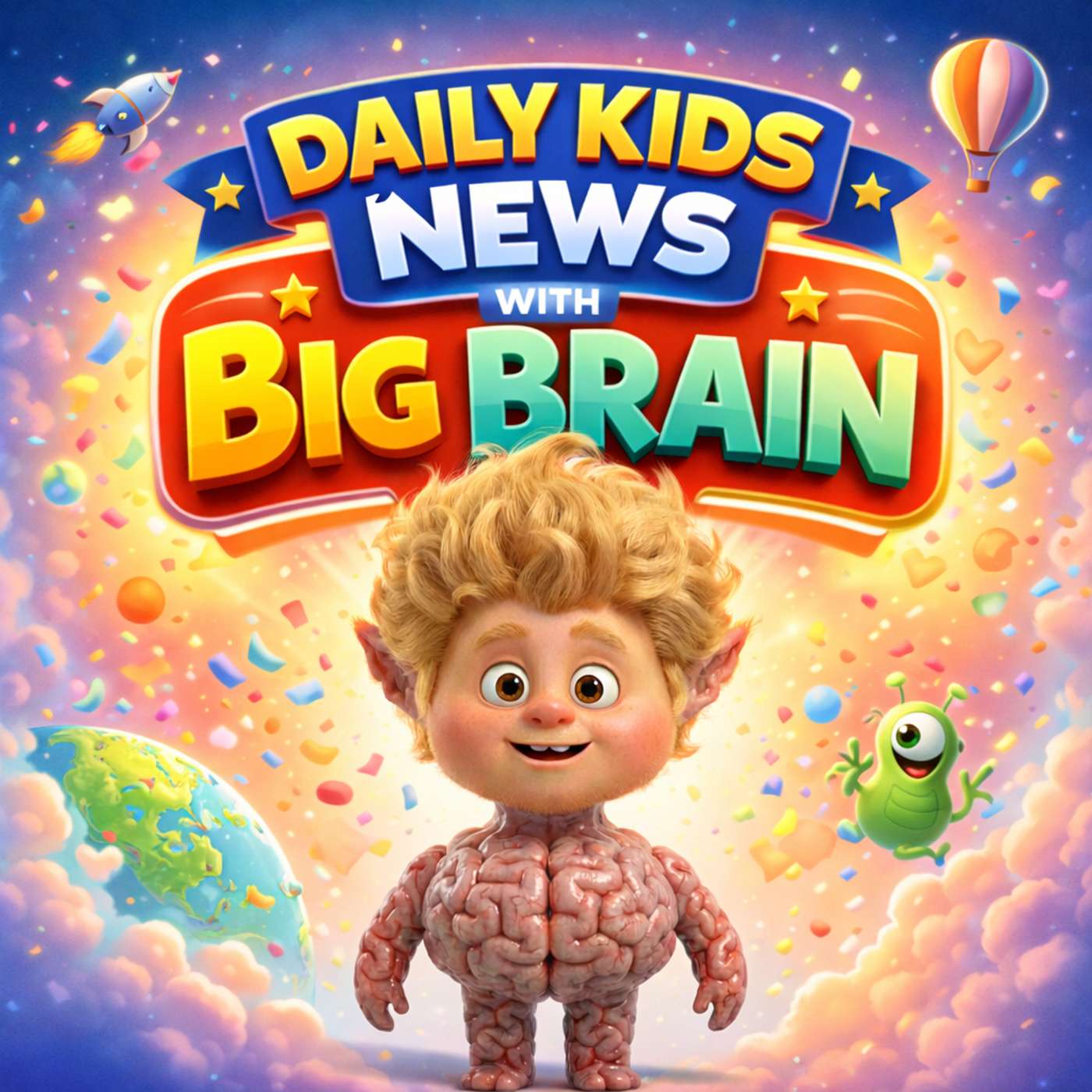
Daily News for Kids with Big Brain
by Big Brain
Big Brain is your kid’s curiosity buddy, turning yesterday’s real-world stories into a fun, safe 4–6 minute daily show.Each weekday you’ll get three kid-friendly stories (science, nature, inventions, sports, space), explained with silly visuals, simple analogies, and one tiny lesson that makes kids feel smart. If you don’t know the news, you are gonna lose!Parents and teachers: every episode includes a calm Parent Corner and two easy questions to spark a great conversation.Watch the full videos and find extras at bigbrainshows.com. Keep those neurons firing! See you next time!
-
64
Big Brain News Ep. 57: Robot Hands, Moon Tests, and Mighty Bison
Episode 57 (May 7, 2026) Today’s Stories 1) Robots Get a Smarter “Brain” for Better Hands • Robots can improve at careful tasks by practicing how much to squeeze and how to adjust their grip. • Connect to real life: gentle handling matters for sorting fruit, packing groceries, and working with small parts. 2) A Moon Lander Survives a Giant “Space Room” Test • Engineers test spacecraft in thermal-vacuum chambers to simulate space conditions. • Vocabulary: – Thermal = temperature – Vacuum = almost no air • Big idea: testing helps teams find problems early and improve safety. 3) A Giant New Bison Exhibit Opens at the Smithsonian • Bison are key grassland animals, and grasslands are ecosystems filled with many living things. • Museums can teach science and history together, including perspectives from Indigenous Nations with long relationships to bison. Parent/Teacher Corner These stories are a great chance to talk about how scientists test ideas safely before using them in the real world. You can also connect museum learning to your child’s own curiosity—what they notice, wonder, and want to research next. Discussion Questions • If you could design a robot hand, what helpful job would you want it to do? • What’s one question you’d ask if you visited a bison exhibit at a museum?
-
63
Big Brain News Ep. 56: Asteroid Spotters, Solar Cows, and a Super-Snooker Finish
Big Brain News Episode 56 1. NASA Builds a New Space Telescope to Spot Sneaky Asteroids 2. Cows and Solar Panels Share a Sunny Field 3. A Super-Close Snooker Match Goes Down to the Last Point Discussion questions: - If you could name a space telescope, what would you call it and why? - How could farmers and scientists share land in smart ways where you live?
-
62
Big Brain News Ep. 55: Kiwi VIPs, Space Internet, and Super-Speedy Recycling!
Big Brain News — Episode 55 (2026-04-30) Stories in this episode: 1) Kiwi birds at Parliament (New Zealand) • Five kiwi visited Parliament in Wellington. • The visit highlights conservation work helping kiwi return after being gone from the area for more than 100 years. • Big idea: protecting habitats helps animal populations recover. 2) Faster lithium-ion battery recycling • Scientists reported a water-based method that works at room temperature. • It can recover more than 65% of key metals in about one minute. • Big idea: recycling can save energy by reusing valuable materials. 3) Satellites for space-based internet • An Atlas V rocket launched from Florida carrying 29 satellites into orbit. • Satellites in low Earth orbit can help provide internet coverage in places far from towers and cables. • Big idea: space technology can support connectivity on Earth. Parent/Teacher Corner: Use these stories to connect learning to everyday habits: • Nature care: What local animals need safe places to live? • Battery recycling: Identify battery-powered items at home or school and find a local battery drop-off option with an adult. Discussion Questions: • If you could protect one animal near where you live, which would you choose and why? • What’s one thing you use that has batteries, and how could you help it get recycled?
-
61
Big Brain News Ep. 54: Jazz Temples, Space Internet, and Stripey Antelopes
In Episode 54, we explore three upbeat learning stories: 1) Jazz Music Fills a Famous Building in Chicago • International Jazz Day celebrations and a concert at Unity Temple • What “improvisation” means (making music ideas in the moment) • How architecture can change sound through shape, space, and materials 2) A Rocket Launched 29 New Internet Satellites • What a satellite is and what it can do • Low Earth orbit: closer to Earth can mean less delay for signals • How satellites connect to Earth using radio waves and ground stations 3) Stripey Mountain Bongos Return Home to Kenya • Meet the mountain bongo: chestnut coat with bright white stripes • Quarantine as a calm adjustment and health-check period • Conservation planning and why genetic diversity supports healthier populations Try-it-together ideas (parents/teachers): • Listen to a short jazz playlist and “spot” the improvised parts • Use a night-sky app to talk about objects that orbit Earth • Find Kenya on a map and discuss what animals need in a forest habitat Discussion questions: • If you could design a concert building, what would you add to make the sound extra awesome? • Why do you think it’s helpful to have animals from different places in a conservation program?
-
60
Big Brain News Ep. 53: Pandas, Space Selfies, and a Winner’s Pond Splash!
Big Brain News Episode 53 1. Nelly Korda Wins a Big Golf Championship and Splashes the Winner’s Pond 2. A Satellite Took a Super-Close Picture of the Hubble Space Telescope 3. Giant Pandas Are Planned to Return to Atlanta in a New Conservation Partnership Discussion questions: - What’s one skill you’d like to practice a little each day, like an athlete does? - If you could send one helpful tool into space, what would it do?
-
59
Big Brain News Ep. 52: Space Super-Cameras, Museum Treasures, and Eco-Baseball
Episode 52 (April 23, 2026) Today’s Stories 1) NASA’s Roman Space Telescope: A wide-field “panorama” view of space • What it is: The Nancy Grace Roman Space Telescope is finished being built and moving into launch preparations. • Why it matters: Roman will capture huge sections of the sky at once, helping scientists study how galaxies grow and explore questions like dark energy. • Kid-friendly takeaway: Scientists collect clues with tools—telescopes turn light into information. 2) Smithsonian exhibit: “From These Lands” (all 50 states) • What it is: A new National Museum of Natural History exhibit featuring objects from every U.S. state. • What kids learn: Natural history museums use real objects (rocks, fossils, plants, tools) to tell stories about places and people. • Family/teacher angle: Compare regions—mountains, beaches, deserts, forests—and talk about what makes each place unique. 3) Greener baseball: Earth Day Sustainability Awards • What it is: MLB recognized teams/ballparks for practical steps to reduce waste. • Vocabulary: – Recycling: sorting materials so they can be used again – Composting: turning food scraps into soil • Kid-friendly takeaway: When bins and signs are clear, doing the helpful thing feels easy. Parent/Teacher Corner • Conversation focus: How scientists gather information (observations, data, tools) and how communities reduce waste at big events. Discussion Questions • If you could build a super-camera for space, what would you want it to take pictures of? • What is one small way our family could make less trash at an outing or game?
-
58
Big Brain News Ep. 51: Robots, Recycled Sunshine, and a Super-Accurate Space Helper
Big Brain News Episode 51 1. Student Robots Compete at a World Championship 2. Texas Approves a Place to Recycle Old Solar Panels 3. A New GPS Satellite Heads to Space to Help Maps Work Better Discussion questions: - If you could build a robot to help at home or school, what job would you give it? - What’s one thing you use that you wish could be recycled into something new?
-
57
Big Brain News Ep. 50: Ocean Rings on Mars and Super-Smart Design
Big Brain News Episode 50 1. Six Women Win a Big Earth-Helping Prize 2. Mars Has a Giant “Bathtub Ring” Clue 3. Design Week in Milan Shows Off Future Materials Discussion questions: - If you could design one object to make everyday life easier, what would it do? - What’s one small way people can help protect nature where we live?
-
56
Big Brain News Ep. 49: Shooting Stars, Space Rovers, and a Brand-New Art Maze!
Episode 49 (2026-04-20) Story 1: The Lyrid Meteor Shower • What kids call “shooting stars” are meteors—tiny bits of space material heating up in Earth’s atmosphere. • The Lyrids typically peak around April 21–22. • You don’t need a telescope—just a safe spot, patience, and time for eyes to adjust. Story 2: A Mars Rover Gets a Plan for a Big Rocket Ride • The Rosalind Franklin rover is part of a European Space Agency mission. • Launch planning can take years because systems must be tested again and again. • Drilling below Mars’ surface helps scientists look for clues that may be protected from harsh surface conditions. Story 3: A Brand-New LACMA Building Opens • The David Geffen Galleries at LACMA opened to members on April 19, 2026, with a public opening planned for May 4. • Architect Peter Zumthor designed the building to shape how visitors move through and experience art. • Museum design can encourage slowing down, noticing details, and supporting family/school visits. Parent/Teacher Corner (practical tip) • For nighttime skywatching: supervise closely, pick safe locations away from streets, use red/low lights, and consider bedtime routines. Discussion questions • If you could name a Mars rover, what would you call it and why? • What’s one kind of art you’d like to see in a brand-new museum building?
-
55
Big Brain News Ep. 48: Parades, Paintings, and Movie Magic!
Episode 48 (04/17/2026) helps kids connect the arts with community life—celebrations, creativity, and storytelling. Stories in this episode: 1) Fiesta San Antonio (Apr 16–26, 2026) • A citywide celebration with parades, music, costumes, and longtime traditions (dating back to 1891) • Many events are run by nonprofit groups that raise money to support the community 2) San Francisco Art Fair (Apr 16–19, 2026 | Fort Mason Festival Pavilion) • An art fair is many galleries gathered in one place • Kids practice visual literacy: noticing materials, making guesses, and describing feelings 3) Atlanta Film Festival (Apr 23–May 3, 2026) • Celebrating 50 years of movies and filmmakers • Great prompt for media literacy: how sound, costumes, and timing create a scene Grown-Up Corner (practical tips): • Invite your child to name what they liked (music, colors, stories) and explain why • If attending an event, practice planning: check times, find a map, and plan a break • Calm safety note: stay together, choose a simple meeting spot, and take water breaks Discussion questions: • If you could invent a new festival for your town, what would it celebrate? • What kind of art or movie stories make you feel curious or happy, and why?
-
54
Big Brain News Ep. 47: Glowing Birds, Super-Strong Paper, and a Brand-New Ancient Beast
In this episode (Big Brain News #47): 1) Fossil Re-Check: Crocodile Cousin • A fossil found in 1948 at Ghost Ranch (New Mexico) was studied again. • New observations (short snout and jaw structure) helped scientists reclassify it. • Key idea: Science is allowed to change when better evidence appears. 2) Origami Engineering: Strength from Shape • A student tested origami-style folds and demonstrated a structure holding over 10,000x its own weight. • Why it works: folds act like repeating beams that spread force. • Key idea: Engineering is often about smart design, not just stronger materials. 3) Cassowary UV Glow: Hidden Signals in Nature • Under UV light, a cassowary’s casque can glow blue-green. • Many animals can detect UV patterns that humans can’t see. • Safety note for families/classrooms: use UV tools only with adult guidance; never shine lights into eyes; admire wild animals from a safe distance. Discussion questions (for parents/teachers): • What measurements or comparisons might scientists use to decide where a fossil belongs on the “family tree” of animals? • How do tools (UV light) and designs (folds) help us discover things we can’t notice right away? Classroom/home extensions: • Try folding a strip of paper into an accordion and gently test how the shape changes its stiffness. • Talk about “visible vs. invisible” information: what tools do scientists use to observe more (UV, microscopes, cameras)?
-
53
Big Brain News Ep. 46: Robots, Water Splashes, and a Spacey Picture Puzzle!
Big Brain News Episode 46 1. Pennsylvania Kids Build a Robot That Earns a World Championship Spot 2. Thailand Celebrates the New Year With the Songkran Water Festival 3. NASA Shares a New Satellite Puzzler: A Mystery Photo From Space Discussion questions: - If you could build a helpful robot, what job would you give it and why? - What’s a celebration your family enjoys, and what does it represent or remind you of?
-
52
Big Brain News Ep. 45: Hoops Heroes, Space Snacks, and Magic-Like Electricity
Big Brain News Episode 45 1. Azzi Fudd Goes No. 1 in the WNBA Draft 2. A Giant Space Delivery Heads to the Space Station 3. Electricity That Disappears… Then Comes Back Discussion questions: - Which story would you want to learn more about, and why? - If you could send one experiment to space, what would you test?
-
51
Big Brain News Ep. 44: Green Jackets, Tiny Ocean Builders, and a New Comet Glow
Big Brain News Episode 44 1. Rory McIlroy Wins the Masters Again 2. Tiny Ocean Plankton Might Make New Species Fast 3. A Comet Is Brightening Before Sunrise Discussion questions: - If you could learn one new skill this month, what would it be and how would you practice it? - What’s one tiny thing in nature that you think does a big job?
-
50
Big Brain News Ep. 43: Space Selfies, Super-Safe Space Rocks, and Festivals Everywhere!
Big Brain News — Episode 43 (April 10, 2026) What we covered (kid-friendly + classroom-friendly): 1) A House-Size Asteroid Zoomed By Earth (Safely!) • Key idea: “Close” in space can still be very far. • Learning moment: How scientists use telescopes and math to track an asteroid’s path. • Vocabulary: asteroid, telescope, orbit/path, tracking. 2) Artemis 2 Astronauts Took a Space Selfie with a Kid-Designed Mascot • Key idea: A “zero-gravity indicator” is a small object that floats to show microgravity. • Learning moment: Microgravity means things drift instead of falling the usual way. • Classroom connection: Student creativity can be part of real science and exploration. 3) Smithsonian Folklife Festival ‘Goes National’ with Partner Festivals • Key idea: Folklife = traditions people share (music, dance, crafts, stories, foods). • Learning moment: Partner festivals help more communities participate locally. • Extension: Ask kids to name a family tradition and the story behind it. Parent/Teacher Corner: If kids ask about asteroids, emphasize the careful tracking scientists do and that space distances are enormous. Discussion Questions: • If you could send a tiny mascot to space, what would it be and why? • What’s a tradition or food your family would share at a community festival?
-
49
Big Brain News Ep. 42: Fashion Time Machines, Coral Gardens, and a Music Treasure Chest!
In this episode (2026-04-09), we explore creativity, science, and history—without hype. Story 1: The Met’s “Costume Art” exhibition • Big idea: Clothing can be studied like art and design. • Kid-friendly lens: How clothes protect us, help us move, and show who we are. • Try it: Invite kids to sketch a “museum outfit” with a purpose (warmth, rain, celebration). Story 2: NOAA coral reef restoration (“coral gardens”) • Big idea: Reefs are living habitats that can be repaired with careful, science-based help. • What kids learn: Algae can crowd reefs; sea urchins can help; coral can be grown and replanted. • Try it: Look up a kid-safe reef video and list reef “neighbors” (fish, crabs, coral). Story 3: Minnesota Music Archive • Big idea: Music is part of history—recordings and stories help communities remember. • What’s included: Songs, interviews, posters, photos, and behind-the-music stories. • Try it: Pick one family song and share: Where did you first hear it? What does it remind you of? Discussion Questions • If you could design an outfit for a museum, what materials or shapes would you use? • What’s one song that reminds you of a special memory, and why? Big Brain News is designed to be calm, educational, and easy to share in classrooms and at home.
-
48
Big Brain News Ep. 41: Spiderweb Science, Space Jellyfish, and Pets Finding Families
Episode 41 (April 8, 2026) What we covered: • Story 1: A spiderweb-like electrode made from silver nanowires helps keep pathways open so CO2 can reach the reaction area longer. The team reported about 86% efficiency. (Safety note: electricity-and-equipment lab work is for trained scientists.) • Story 2: A Falcon 9 launch created a glowing “space jellyfish” effect when leftover fuel spread into a cloud high in the atmosphere and sunlight lit it up while the ground was dark. • Story 3: California Adopt-a-Pet Day is planned for Saturday, June 6, 2026—an event that helps families meet shelter pets and learn how adoption works. Parent/Teacher Corner: Keep the tone practical and upbeat. Invite kids to explain the “how” in their own words. Discussion questions: 1) If you could invent a machine to clean the air, what would it look like? 2) What do you think makes a place feel like home for a pet? Safety reminders: • Don’t attempt experiments with electrical equipment—leave lab devices to trained adults. • If skywatching at night, go with a grown-up and choose a safe location.
-
47
Big Brain News Ep. 40: Asteroid Hunters, Star Selfies, and a Rainbow Festival
Episode 40 (2026-04-06) What’s inside (for parents & teachers): • Story 1: Asteroid hunting with big sky photos — how scientists use repeated images and software to spot “moving dots,” plus a gentle note that tracking helps scientists learn. • Story 2: SPARCS, a small NASA spacecraft — first pictures as a systems check, and how special cameras can measure kinds of light that reveal energetic star activity. • Story 3: Rainbow Color Festival on Maui — a community celebration that also supports the Maui Food Bank, plus a simple science connection: color comes from light, and floating powder scatters light. Try-this-at-home/at-school prompts: • “Tool designers”: Draw an imaginary space tool and label what it measures (light, motion, temperature). • “Light detectives”: Notice how shadows change during the day; talk about how cameras collect light. • “Community kindness brainstorm”: Plan a class or family mini-event that collects helpful items (with adult guidance). Discussion Questions: 1) If you could invent a space tool to discover something new, what would it do? 2) What’s one fun event your community could host that also helps other people?
-
46
Big Brain News Ep. 39: Canned Salmon Time Travel, Whale-Head Termites, and a Moon with a Nickname!
Episode 39 (2026-04-03) Today’s stories (kid-friendly science): 1) Canned salmon as a “time capsule” • Researchers examined canned salmon collected across decades (research only) to look for tiny organisms seen under microscopes. • The patterns can help scientists understand connections in ocean food webs—who eats what, and how energy moves through an ecosystem. 2) A new termite species in the rainforest canopy • Scientists described a new termite found high in the forest “roof” (the canopy). • The termite’s head shape inspired a whale comparison—careful observation helps scientists identify and describe species. • In rainforests, termites can be important recyclers that help return nutrients to the soil. 3) The April full Moon nickname: “Pink Moon” • The “Pink Moon” usually isn’t pink; it’s a seasonal nickname. • Skywatching tip: look for darker patches (lunar maria) and notice how the Moon looks near trees or rooftops. Parent/Teacher Corner: • Gentle episode overall. • Brief mention of tiny ocean hitchhikers under a microscope; families can skip or soften that line if needed. Discussion questions: • What’s one clue from nature you’ve noticed recently (in the sky, a park, or even your food)? • If you could name a full Moon, what silly nickname would you pick and why?
-
45
Big Brain News Ep. 38: Beaver Builders, Fast Fish DNA, and a Space Claw-Bubble
In this episode (kid-friendly, ages 5–9), we explore three big ideas: 1) Beaver builders and wetlands • Beaver dams can slow streams and spread water out into wetlands. • Slower water can help plants grow and can let mud and old leaves build up. • Scientists are studying how wetlands can store carbon in the ground and create habitats for many animals. 2) Fish “supergenes” and fast evolution • A supergene is a large section of DNA that often gets inherited together. • Think: a “sticker sheet” of traits that stays as a set. • This may help explain how fish in the same lake can become more different over time. 3) NASA’s nebula “claw” and “bubble” • Nebulae are huge clouds of gas and dust—star-making neighborhoods. • Baby stars can shape nearby clouds with gentle winds of particles. • The colors in NASA images can show which gases are present and where energy is strongest. Parent/Teacher Corner Use this episode to practice “How do we know?” • What did scientists measure or compare? • What clues come from observation (water depth, soil, DNA patterns, light/colors)? Discussion questions • What is one way animals can change their environment to help other living things? • If you could name a nebula based on its shape, what would you call it and why?
-
44
Big Brain News Ep. 37: Moon Loops, Deep-Sea Critters, and Gadget Time-Travel
Episode 37 (2026-03-31) Today’s theme: exploration + creativity (space travel, ocean science, and invention history). Story 1: Artemis II practices a trip around the Moon • NASA is preparing Artemis II, a mission designed to carry astronauts around the Moon (not land). • Key idea: a “launch window” means multiple possible launch days. • Why it matters: weather, safety checkups, and the Moon’s position help determine the best day to go. • What kids can learn: big projects use careful testing and step-by-step planning. Story 2: 24 new deep-sea species discovered • Scientists found 24 new amphipod species (tiny crustaceans) deep in the Pacific Ocean. • Researchers also described a new “superfamily,” a major grouping on the tree of life. • What kids can learn: classification helps explain how living things are related and how ecosystems fit together. Story 3: Museum exhibit celebrates 50 years of Apple inventions • An exhibit planned in Roswell, Georgia highlights decades of technology artifacts. • What kids can learn: inventions don’t appear instantly—people test, improve, and redesign. Parent/Teacher Corner • Talk about how scientists and engineers test ideas step-by-step. • Try a quick activity: pick a tool (phone, pencil, backpack) and imagine how it might change in 50 years. Discussion questions 1) If you could explore one place—deep ocean or the Moon—what tools would you bring and why? 2) What’s one invention you use every day, and what do you think it might look like 50 years from now?
-
43
Big Brain News Ep. 36: Lights Out, Codes to Space, and Ice Dancers in Prague
Episode 36 (March 30, 2026) Today’s theme: teamwork—neighbors saving energy, scientists sharing a space “hello,” and athletes training for years. Story 1 — Earth Hour (energy habits) • Earth Hour is a reminder to turn off extra lights and notice what uses electricity. • Kid-friendly actions: turn off lights in empty rooms, unplug chargers you’re not using, and use sunlight. • Community idea mentioned: real-time air-quality monitors that help people understand day-to-day air conditions. Story 2 — The Arecibo Message (science communication) • In 1974, scientists sent a patterned message made from 1s and 0s. • The message was aimed toward the M13 star cluster. • Big idea: numbers and patterns can be a shared way to communicate. Story 3 — Figure Skating Worlds in Prague (sports science) • Championships ran March 25–29, 2026, in Prague. • Events include men’s, women’s, pairs, and ice dance. • Science connection: pulling arms in can help skaters spin faster; skating uses balance, friction, timing, and strength. Parent/Teacher “Try This” • One-hour Energy Hunt: Walk through your home or classroom and spot simple ways to save electricity. Discussion Questions • What is one small way our family could save energy this week? • If you could send a space message, what would you include and why?
-
42
Big Brain News Ep. 35: Robots, Invisible Space Stuff, and a Brand-New Exploration Museum!
Big Brain News Episode 35 1. A Humanoid Robot Visits a Kids-and-Tech Summit 2. NASA Makes a New Map of Invisible ‘Dark Matter’ 3. A New National Geographic Exploration Museum Sets an Opening Date Discussion questions: - What is one helpful job you’d want a robot to do at home or at school, and why? - If you could design a museum exhibit about space or nature, what would people do in it?
-
41
Big Brain News Ep. 34: Robots, Runways, and a Perfect Bracket
Big Brain News Episode 34 1. A Pittsburgh 8th-Grader Nails a Perfect Women’s Bracket (So Far!) 2. A Human-Shaped Robot Practices Being a “Helper Teammate” 3. A Museum Fashion Show Where Clothes Get Super Surreal Discussion questions: - What’s something you could predict just for fun, and what clues would you use? - If you could design a helpful robot, what three chores would you want it to do?
-
40
Big Brain News Ep. 33: Rockets, Museum Magic, and a Sky Full of Sparkles!
Episode 33 (March 24, 2026) What we covered: 1) Rockets & patience in science • A new rocket (Spectrum) plans another try for orbit. • Kid-friendly idea: To reach orbit, a rocket goes very fast “sideways” around Earth. • Learning point: launches depend on weather, healthy systems, and a ready team—careful planning matters. 2) Public art on a museum building • M+ in Hong Kong adds a huge outdoor artwork by Shahzia Sikander. • Learning point: public art can be enjoyed by visitors and passersby, and it can tell stories or ask questions. • Connection: Art Basel Hong Kong week brings galleries and artists together to share work. 3) Evening skywatch: bright planets + zodiacal light • After sunset, look for Venus and Jupiter. • Zodiacal light = a faint triangle-like glow from sunlight reflecting off tiny dust in our solar system. • Tip: give eyes time to adjust to the dark; darker skies help. Parent/Teacher Corner (safety + routines): • Skywatch with a grown-up. • Choose a safe spot away from traffic and edges. • Never look at the Sun—this activity is only for after sunset. Discussion questions: • If you could design a rocket or robot for space, what job would you give it? • What’s one piece of art you’d love to make really, really big, and where would you put it? Big Brain reminder: News helps our brains grow!
-
39
Big Brain News Ep. 32: Space Snacks, New Art Rooms, and Cherry Blossom Magic
Episode 32 helps kids connect big projects to teamwork and planning—whether it’s sending supplies to astronauts, building better spaces for art, or getting ready for springtime events. What we cover: • Space deliveries: What cargo spacecraft bring to the International Space Station (food, tools, fuel, spare parts) and how docking works (matching speed and connecting gently). • Museum expansion: Why extra gallery space matters, and how museums protect art with thoughtful lighting, temperature control, and strong display systems. • Cherry blossoms: How trees use environmental clues (sunlight and temperature) to time buds and blooms—and how to do a “blossom hunt” anywhere. Parent/Teacher Corner: Use these stories to talk about planning, roles on a team, and how science and creativity both require careful thinking. Discussion Questions: 1) If you could send one helpful item to astronauts on the space station, what would it be and why? 2) What’s your favorite way to notice spring changing—flowers, weather, animals, or something else? Classroom-friendly extension ideas: • Draw a “space supply list” and label each item with its job. • Design a mini museum map with 3 rooms (quiet room, big sculpture room, video room). • Observe a local tree for one week: buds, petals, leaves, and weather notes.
-
38
Big Brain News Ep. 31: Spring Sunbeams, Space Rockets, and Movie Magic for Earth!
Episode 31 — March 20, 2026 Today’s stories (for curious kids and the grown-ups who guide them): 1) Spring Arrives: The Equinox Is a Sky “Balance Point” • What an equinox is: the Sun lines up over Earth’s equator • Why people say “equal day and night” (close to equal, not perfect everywhere) • Why the date can shift between March 19–21 (calendar math + leap years) 2) A Giant Rocket Did a “Static Fire” Test in Texas • What “static fire” means: engines ignite briefly while the rocket stays clamped down • What engineers look for: fuel flow, timing, temperatures, pressures, sensor readings • Safety reminder: rocket testing is done by trained teams behind safety fences 3) Environmental Film Festival Brings Nature Stories to the Big Screen • How films can zoom in on details we might miss in everyday life • How festivals spark questions about science, sound, and filming locations • At-home idea: treat your neighborhood like a living documentary Parent/Teacher Corner: These stories support curiosity and “explain it back” practice. Invite your child to retell one story using their own examples. Discussion questions: • What signs of spring can you spot outside this week? • If you made a movie about nature, what would you film first?
-
37
Big Brain News Ep. 30: Solar Blanket Spacewalks, Spring Flower Rivers, and a Satellite Internet Swarm!
In Episode 30, Big Brain guides kids through three short, educational stories that connect science, culture, and technology. Story 1 — Spacewalk upgrades: Two NASA astronauts performed a spacewalk to prepare the International Space Station for new roll-out solar panels. These panels unroll like a “solar blanket” to provide more electricity—supporting experiments and everyday systems onboard. Story 2 — Spring festival & community art: Valencia, Spain’s Las Fallas includes a Flower Offering where participants place bouquets to create a large, mosaic-like floral display. This tradition is connected to Catholic religious life (the Virgin Mary), offering a respectful chance to discuss faith traditions and world culture. Story 3 — Satellites & connection: Starlink has reached about 10,000 active satellites in orbit. The episode explains, in kid-friendly terms, how satellites can relay internet signals to places where cables are hard to reach. Discussion Questions (Home or Classroom): 1) If you could add one helpful gadget to the space station, what would it do? 2) What’s a celebration or tradition your family likes, and what does it remind you of? Keywords: spacewalk, ISS, solar power, festivals, Valencia, flowers, mosaics, satellites, internet, STEM. Big Brain News is designed to be calm, safe, and shareable—made for kids and trusted by parents and teachers.
-
36
Big Brain News Ep. 29: Buzzer-Beaters, Green Parades, and Helpful Robots
Episode 29 (March 18, 2026) | Big Brain News In this episode (3 stories): 1) March Madness begins — We explain single-elimination brackets and highlight teamwork and sportsmanship. 2) Dublin’s St. Patrick’s Festival — A geography-friendly look at Ireland, plus how music, dance, and parades share culture. 3) Robots and safety standards — Why robots need clear rules to work safely around people, and how they can help with deliveries and guiding visitors in hospitals. Parent/Teacher Corner (quick classroom or dinner-table connections): • Teamwork & communication: How do teammates signal and support each other? • Rules & fairness: Compare game rules to robot safety standards. • Geography: Find Indianapolis (USA) and Dublin (Ireland) on a map; talk about why people gather in certain places. Discussion Questions: • What’s one rule that helps a game (or a robot) stay safe and fair? • If you could invent a helpful robot for your school, what job would it do? Designed to be calm, constructive, and safe to share at home or in the classroom.
-
35
Big Brain News Ep. 29: Buzzer-Beaters, Green Parades, and Helpful Robots
Big Brain News Episode 29 1. March Madness Begins: One Game, One Chance 2. Dublin Turns Festive for St. Patrick’s Festival 3. Robots Learn Safety Rules and Help in Hospitals Discussion questions: - What’s one rule that helps a game (or a robot) stay safe and fair? - If you could invent a helpful robot for your school, what job would it do?
-
34
Big Brain News Ep. 28: Space Internet, Sparkly Movies, and a Giant Culture Party!
Episode 28 (03/16/2026) — Big Brain News Today’s kid-friendly stories: 1) Space internet and satellites: We explain how satellites in orbit (a “smooth racetrack in the sky”) can help send internet signals to places where laying lots of cables is difficult. 2) The Oscars: A simple look at how movies are made by big teams—costumes, music, sound, and special effects—plus why creative jobs matter. 3) Honolulu Festival turns 30: How festivals help communities share traditions through performances, parades, and music. Parent/Teacher Corner tip: • If your child wonders what an orbit is, compare it to a smooth racetrack around Earth. Conversation starters: • If you could win an award for making a movie, what would your movie be about? • What’s one way technology helps people who live far from big cities? Made for kids ages 5–9, and for parents/teachers who want safe, constructive current-events learning.
-
33
Big Brain News Ep. 27: Dragonfly on Titan and a Sideways-V of Stars!
Big Brain News Episode 27 1. NASA Builds Dragonfly: A Flying Robot for Titan 2. Find the Hyades: A Sideways ‘V’ of Stars 3. Indoor Track & Field: Fast Feet, Big Jumps, and Team Relays Discussion questions: - If you could send a robot to any planet or moon, where would you send it and what would it look for? - What’s one skill you’d like to practice a little each week, like athletes do?
-
32
Big Brain News Ep. 26: Space X-Rays, Super-Design Cities, and Weather That Can’t Decide
Episode 26 (2026-03-14) Story 1: NASA Pauses a New X-Ray Space Telescope Idea • What happened: NASA stopped planning the proposed AXIS mission. • Kid-friendly takeaway: Big science missions must meet requirements—like a careful, super-sized school project. • Vocabulary: X-ray light (invisible light), telescope, mission requirements. Story 2: Tokyo Turns Into a Giant Design and Art Playground • What happened: Tokyo Creative Salon 2026 (Mar 13–22) spreads design and art across multiple neighborhoods. • Kid-friendly takeaway: Design isn’t only decoration—it’s problem-solving with materials, shapes, and smart choices. • Classroom/home connection: Notice everyday design (zippers, packaging, maps). Story 3: U.S. Weather Does Different Things at the Same Time • What happened: Different regions may see snow near the Great Lakes, strong heat in the Southwest, and heavy rain in Hawaii. • Kid-friendly takeaway: Air masses (big areas of warm/cold air) move and interact, creating different conditions. • Family safety habit (non-scary): Check local forecasts and pick the right gear. Parent/Teacher Corner These stories are great for talking about how science projects get reviewed, how art festivals work, and how weather can differ across a big country. If weather comes up, focus on planning and everyday safety habits (like checking forecasts) rather than worrying. Discussion Questions 1) If you could invent a space telescope, what would you want it to discover? 2) What’s a helpful routine your family uses when the weather changes a lot?
-
31
Big Brain News Ep. 25: Magnetar Engines, Space Delivery Trucks, and the No-Waste Challenge!
Episode 25 (2026-03-13) What’s inside: 1) Superluminous supernovae + magnetars - Kid-friendly idea: A magnetar is a super-dense leftover star with an extremely strong magnetic field. - Key concept: Scientists use computer models to test whether a spinning magnetar could feed energy into the expanding supernova debris, creating a predictable “rise and fall” brightness pattern. - Why it connects to learning: Star life cycles help explain where many elements (like iron and oxygen) come from. 2) Space delivery to the ISS (Cygnus) - Kid-friendly idea: Cargo spacecraft are like careful delivery trucks in orbit. - Key concept: Undocking means safely unhooking and slowly drifting away, using planning and precise controls. - Why it connects to learning: Systems + teamwork keep a space lab running—supplies in, experiments on, unneeded items out. 3) Circular economy + textiles - Kid-friendly idea: A circular economy keeps materials moving through reuse, repair, and recycling. - Key concept: Some recycling is tricky (like mixed fabrics), so improved sorting and processing tools matter. - Classroom/home link: Focus on progress, not perfection—choose one item to repair, reuse, or donate. Parent/Teacher Corner: Systems thinking Try a simple “how it works” chain for each story: - Inputs → steps → tools → teamwork → results Discussion questions: • What’s one thing in our home we could reuse or repair instead of throwing away? • If you could send one helpful item to astronauts on the space station, what would it be and why?
-
30
Big Brain News Ep. 24: Space Ribbons, Backward Planets, and Bird Super-Highways
Episode 24 (2026-03-12) Today’s stories (kid-friendly science news): 1) Space science: Astronomers used the Very Large Telescope to spot a ribbon-like cloud of gas near Sagittarius A*, the supermassive black hole at the center of the Milky Way. Key idea: we learn about black holes by observing nearby matter and motion. 2) Skywatching: Jupiter’s “retrograde motion” is an optical viewpoint effect. Key idea: Earth’s faster orbit changes what we see against the background stars. 3) Nature & conservation: Thousands of acres protected along the South Carolina coast can support migrating birds by preserving marsh and wetland habitat. Key idea: healthy wetlands can also help people by soaking up rainwater and supporting cleaner water. Parent/Teacher Corner: • Try a simple stargazing plan: pick one night this week to look for Jupiter (if visible in your area) and notice how it sits among the stars. • Connect conservation to home: talk about one local park, creek, or green space that helps animals—and how taking care of it helps the whole community. • Keep it wonder-filled; no need to track space details minute by minute. Discussion questions: • If you could protect one place in nature near your home, what would it be and why? • What’s one thing in the night sky you want to learn to spot this month?
-
29
Big Brain News Ep. 23: Satellites, Slam Dunks, and Super-Animal Moves!
Big Brain News Episode 23 1. A NASA Satellite Takes a Fiery Trip Home 2. Gonzaga Wins a Big Women’s Basketball Tournament 3. Zoo Atlanta Plans a Day for Learning How Animals Move Discussion questions: - If you could design a satellite, what would you want it to measure or photograph? - Which animal movement would you want to study—jumping, climbing, swimming, or flying—and why?
-
28
Big Brain News Ep. 22: Space Bumps, Hockey Cheers, and a Butterfly Comeback!
Episode 22 (03/10/2026) Today’s stories (kid-safe, curiosity-first): 1) NASA’s DART mission: A spacecraft gently bumped the asteroid moon Dimorphos. Scientists already knew the bump changed its orbit around Didymos—and now they’ve measured a small, lasting change in how the system travels around the Sun. • Key idea: In space, small nudges can matter more and more over time. • Science tool spotlight: Stellar occultation—when an asteroid passes in front of a distant star and the star briefly “blinks,” helping researchers measure position and motion precisely. 2) Bright meteor over Europe: A meteor glowed as it moved through Earth’s atmosphere. Scientists are collecting footage from dedicated cameras and everyday observers to trace the path. • Key idea: Multiple viewpoints help scientists map motion and improve tracking. • Vocabulary: meteor (glow in the air) vs. meteorite (piece that reaches the ground). 3) Women’s pro hockey: Bigger crowds in Toronto and New York show growing support for women’s pro hockey. • Key idea: Attendance and community support help leagues stay strong. • Character & community: Mentorship—experienced people helping newcomers learn. Parent/Teacher Corner: • Try a stargazing moment: look for bright planets or constellations. • Try a nature walk: notice insects and flowering plants; talk about habitats. Discussion questions: • If you could design a “space bumper” to gently move an asteroid, what would it look like? • What’s one way we can help butterflies and other insects in our neighborhood?
-
27
Big Brain News Ep. 21: Flowers, Rockets, and One Hour of Time Travel!
Episode 21 (2026-03-09) Today’s focus: everyday science kids can notice in real life—time changes, living plants, and space technology. Story 1 — Daylight Saving Time (“Spring Forward”) • Key idea: We didn’t change the Sun; we changed the schedule. • What kids may notice: darker mornings for a while, more light in the evening. • Vocabulary: Daylight Saving Time, schedule, circadian rhythm. • Helpful routine tips (parent/teacher-friendly): morning sunlight, gentle movement, consistent bedtime routine. Story 2 — Philadelphia Flower Show • Plants as “busy workers”: leaves capture sunlight for energy; roots absorb water and anchor the plant. • Gardens can tell stories (theme and design). • Pollinators: bees and butterflies help flowers make seeds. • Vocabulary: roots, pollinators, seeds. Story 3 — Rocket launch + Starlink satellites • What a satellite does: sends/receives signals (like super-fast notes). • Simple signal path: device → ground antenna → satellite → long-distance connection. • Why it matters: helps connect faraway places for learning and communication. • Vocabulary: satellite, signal, gravity. Discussion questions (for the car, dinner table, or classroom): 1) What’s one place you’d like to have better internet, and why? 2) If you could design a garden theme, what would it be? Big Brain News promise: calm, educational, safe, and shareable for families and schools.
-
26
Big Brain News Ep. 21: Flowers, Rockets, and One Hour of Time Travel!
Episode 21 (March 9, 2026) Today’s themes: everyday science + community learning. Story 1 — Daylight Saving Time (“Spring Forward”) • What changed: clocks moved ahead by 1 hour in many parts of North America. • Key idea: we changed our schedule, not the Sun. • Kid science: circadian rhythm = your body’s “sleep clock” that likes patterns. • Helpful tip: morning sunlight, a little movement, and a steady bedtime routine can support the adjustment. Story 2 — Philadelphia Flower Show • Big indoor displays show how gardens can tell stories. • Plant basics: leaves help capture sunlight for energy; roots drink water and hold the plant steady. • Pollinators: bees and butterflies help move pollen so plants can make seeds. Story 3 — Rockets & Satellites (Starlink launch) • Rockets give a strong push to reach space (gravity makes it hard to lift heavy things). • Satellites orbit Earth and can help send/receive signals over long distances. • Why it matters: supports learning and communication in places where cables are hard to build. Parent/Teacher Corner If your child feels extra sleepy after the clock change, that’s normal. Keep routines steady, aim for morning light, and expect the adjustment to take a little time. Discussion questions 1) What’s one place you’d like to have better internet, and why? 2) If you could design a garden theme, what would it be?
-
25
Big Brain News Ep. 20: Moon Rockets, “Lost” Animals, and Super-Sticky Wi‑Fi!
Episode 20 • 2026-03-08 Today’s Stories 1) NASA Chooses a New Rocket “Stage” for Future Moon Trips • What a “rocket stage” is (a rocket’s parts that take turns doing different jobs) • Why NASA likes standardizing parts (easier planning, training, and scheduling) 2) Two Marsupials Found Alive in New Guinea Forests • What marsupials are (mammals that often carry babies in a pouch) • Why some animals can be hard to spot for a long time (remote habitats, rare and shy species) • Why scientists may keep locations private (to protect animals from trafficking and disturbance) 3) Wi‑Fi 8 Appears at a Big Gadget Show • Wi‑Fi as “invisible delivery” for data between devices and a router • “Reliability” vs. “speed” when many devices are online • What a gadget show is (a place to preview ideas before they show up in products) Parent/Teacher Corner These stories support conversations about: • How engineers test, improve, and reuse designs over time • Respecting and protecting habitats • Patience and problem-solving when technology is glitchy Discussion Questions • If you could design a Moon rocket part, what would you want it to do better—speed, safety, or carrying more supplies? • What are some ways people can protect rare animals without disturbing them?
-
24
Big Brain News Ep. 19: Speedy Rockets, Snuggly Sea Cows, and Brilliant Builder Brains
Episode 19 (03/07/2026) — Big Brain News Today’s theme: curiosity + care. Story 1: Speedy rocket delivery in space • A small rocket (Electron) launched a commercial satellite into low Earth orbit (~470 km). • What satellites can do: weather tracking, Earth pictures, navigation support, and communication. • Key idea for kids: orbits and timing matter—like catching the right bus. Story 2: A new manatee space at the zoo • A new manatee area helps families learn and supports rescue and care. • Why some manatees need help: they’re gentle, slow swimmers in busy waterways. • Key idea for kids: conservation is teamwork—clean water, safe habitats, and careful choices. Story 3: Museum learning through building • “Questioneers” style learning: read, question, think, play. • If something falls or wobbles, that’s data—adjust and try again. • “Waste to Wonder” concept: reuse materials (cardboard, caps, scraps) to make something new. Parent/Teacher Corner: quick online-safety reminder for kids • Keep personal info private (full name, address, school). • Don’t reply to messages from people you don’t know. • If anything online feels weird or confusing, tell a trusted grown-up. Discussion questions 1) If you could build a tiny satellite to help Earth, what would it watch or measure? 2) What’s one question you would love to test with a hands-on experiment?
-
23
Big Brain News Ep. 18: Worms, Moon Shadows, and Space Homes!
Episode 18 (2026-03-06) Today’s Stories 1) A New Tiny Worm in a Super-Salty Lake • Scientists identified a new tiny roundworm (a nematode) living in Utah’s Great Salt Lake. • Learning idea: in very salty water, salt can pull water out of living things—so some organisms need special strategies to stay balanced. • Language and community: the name “Wo’aabi” comes from an Indigenous word meaning “worm,” highlighting collaboration and respectful naming. 2) A Total Lunar Eclipse: The Moon in Earth’s Shadow • A lunar eclipse happens when Earth moves between the Sun and the Moon, blocking sunlight from reaching the Moon. • Learning idea: the Moon reflects sunlight; it doesn’t make its own. • Why reddish: some sunlight bends through Earth’s atmosphere, and reddish light can reach into Earth’s shadow. 3) Keeping the International Space Station Running Longer • The ISS is a research lab and living space in orbit where astronauts do experiments. • Learning idea: planning ahead helps keep long missions steady and safe—like not removing an old bridge until the new bridge is ready. • Connect to STEM: life support systems, water recycling, power, and microgravity research. Parent/Teacher Corner These stories are great for talking about: • How scientists name new discoveries (and why collaboration matters) • How shadows and eclipses work • How long-term planning supports safe science in space Discussion Questions • If you discovered a new animal, what would you name it and why? • What would you want inside a space station to help people live there comfortably? Quick At-Home/ Classroom Ideas (No special supplies) • Eclipse model: use a flashlight (Sun), a ball (Earth), and a smaller ball (Moon) to show the shadow. • Design challenge: draw a “space bedroom” with straps, pockets, and a gentle light for sleep. Big Brain News: calm, educational, and share-safe for families and classrooms.
-
22
Big Brain News Ep. 17: Powder Paint, Puzzle-Solvers, and a Space Visitor
Big Brain News — Episode 17 (03/05/2026) Today’s theme: curiosity + creativity (culture, engineering, and space science). Story 1: Holi — The Festival of Colors • Holi is a Hindu festival that welcomes spring with music, dancing, and colorful powders. • Holi’s date changes each year because it follows a lunar calendar (based on the Moon). • Learning idea: festivals help communities pass down stories, songs, foods, and traditions. • Safety note for kids: use safe colors, be gentle, protect eyes, and participate with a trusted adult. Story 2: World Engineering Day (March 4) • Engineering = using science and math plus imagination to solve problems. • Examples: cleaner water (filters), strong buildings (testing shapes and supports), solar energy. • Key word: iteration — build, test, learn, improve. Story 3: Space What-If — An interstellar visitor • “Interstellar” means between the stars. • Real examples of interstellar objects: 1I/‘Oumuamua (2017) and 2I/Borisov (2019). • Comet basics: ice + dust + rock; warming near the Sun can form a coma and tail. • Science habit: asking “How do we know?” and looking for clues through observation and light. Discussion Questions (for home or classroom) 1) What’s something you’d invent to help people every day? 2) If you could study one space object up close, what would you pick and why? Ideal for: elementary classrooms, family listening, and STEM/culture connection.
-
21
Big Brain News Ep. 16: Satellites, Super-Plants, and a Spiky Sea Surprise
Episode 16 • March 4, 2026 What we cover: 1) Internet satellites in orbit • What satellites do and why they help with long-distance communication • Orbit as a “space racetrack” around Earth • Reusable rocket boosters: landing and flying again 2) World Wildlife Day: Medicinal & Aromatic Plants • Why plants make special chemicals (to protect themselves) • How people use plants for health and helpful products • Conservation basics for kids: take only what you need, protect habitats, let plants regrow 3) A brand-new armored ocean species • What a chiton (KY-tuhn) is and how it lives on rocks • “Living fossils” as an old body design that still works well today • DNA testing as a way to compare living things from the inside Parent/Teacher Corner: Talk about how science helps us connect (internet), care for nature (plants), and discover new species (oceans). Try a nature walk, garden check, or aquarium visit to spot real-life examples. Discussion Questions: • Where do you think satellites “park” in space, and why? • What’s one plant you use at home (food, smell, medicine), and how do you think it grows in nature?
-
20
Big Brain News Ep. 15: Moon Robots, Dino Detectives, and a Nature Promise
Episode 15 helps kids practice curiosity and careful thinking with three science-and-nature stories. Story 1: Blue Ghost on the Moon • Blue Ghost, a commercial Moon lander, touched down near Mare Crisium. • It carried 10 “payloads” (science tools) to study things like moon dust, heat in the ground, and the Moon’s environment. • Learning goal: how tools and test missions help engineers plan safer future exploration. Story 2: Spinosaurus fossil clues • Scientists described a new Spinosaurus find from the Sahara Desert. • Fossils act like puzzle pieces; paleontologists compare shapes and measurements to identify differences. • Learning goal: how new evidence can update scientific ideas. Story 3: Costa Rica and wildlife protection • Costa Rica made its sport-hunting ban permanent. • Conservation helps animals thrive and supports healthy ecosystems (a teamwork system of living things and their environment). • Learning goal: how rules can protect nature and support communities. Parent/Teacher Corner • Invite kids to explain the “how” of each story (How do payloads help? How do fossils tell clues? How do rules protect ecosystems?). • Sensitivity note: If questions come up about wildlife rules, reassure kids that these rules are meant to help animals stay safe. Discussion Questions 1) If you could send one experiment to the Moon, what would you test and why? 2) Why do you think protecting wild animals can also help people who live nearby?
-
19
Big Brain News Ep. 14: Robot Cameras, Red Moons, and Books That Welcome Everyone
Big Brain News — Episode 14 (March 2, 2026) What we cover: 1) Robot camera phones (kid-friendly tech) • A concept phone with a camera that can tilt and rotate using a tiny motor. • Gimbal stabilization: like a smooth balancing platform that helps cancel hand wiggles. • Subject tracking: software that follows the person you choose. • Digital citizenship note for kids: ask an adult before posting, don’t share personal info, and get permission before filming others. 2) Sky science: Total lunar eclipse (March 2–3, 2026) • What’s happening: Earth moves between the Sun and Moon, and Earth’s shadow slides across the Moon. • Why it can look copper-red: sunlight bends through Earth’s air, which filters the light so warmer colors reach the Moon. • Family tip: Lunar eclipses are safe to watch with your eyes—no special glasses needed. • Practical plan: pick a safe viewing spot and time, watch with a trusted adult, and treat clouds as a normal part of sky-watching. 3) Reading and belonging: Inclusive Books for Children Awards • Celebrates UK-published books for ages ~1–9 with main characters from a range of backgrounds and life experiences. • Includes accessibility-aware books (example: braille—raised dots read with fingertips). • Classroom/home connection: stories can build empathy and help kids feel they belong. Discussion questions (great for classrooms and family dinner): • If you could invent a phone tool to help with one daily problem, what would it do? • What makes a story feel like it includes you and your friends? Mini activity: • At the library, choose one book that feels familiar and one that helps you learn about a different life experience.
-
18
Big Brain News Ep. 13: Moon Magic, Animal Selfies, and Nature Helper Projects
Big Brain News — Episode 13 (03/01/2026) What we cover: • Space science: The Moon “hides” Mercury (a lunar occultation). We explain the word occultation and how the Moon’s orbit makes these events happen quickly. • Nature + art + science: The 2026 World Nature Photography Awards. We discuss patience, timing, focus, and framing—and how images can build empathy for wildlife. • Communities helping nature: California funding for habitat projects, including wildlife crossings and efforts that support salmon in rivers and streams. Try it at home/classroom: • “Sky check”: Step outside and look for the Moon. Ask: Does it look still? How do we know it’s moving? • “Photo scientist” walk: On a park or schoolyard walk, practice noticing details (shapes, colors, animal behavior) without approaching or disturbing wildlife. • Design challenge: Draw a wildlife crossing for a local road (bridge or tunnel). What animals might use it? Discussion Questions: 1) If you could take one nature photo, what animal or plant would you hope to catch on camera? 2) What’s one thing humans could build to help animals travel safely where we live?
-
17
Big Brain News Ep. 12: Space Delivery, Two-Light Galaxies, and Art in an Airport!
Episode 12 (2026-02-27) — Big Brain News Stories in this episode: 1) SpaceX Dragon brings science home • Dragon leaves the International Space Station carrying over 5,000 pounds of supplies and research. • Kid-friendly science idea: the ISS stays in orbit with motion and occasional gentle boosts. • Classroom/home connection: talk about microgravity and how scientists compare “before” and “after” experiments. 2) One galaxy, two kinds of light • Hubble shows visible (and some ultraviolet) light; James Webb shows infrared. • Comparing images can reveal different details, especially where dust is present and where stars may be forming. • Vocabulary to try: visible light, infrared, telescope, dust, galaxy. 3) Frieze Los Angeles at the Santa Monica Airport • An art fair is like a large show-and-tell for galleries and artists. • Big spaces (like airports) can fit large artworks and sculptures. • Social-emotional learning tie-in: art can communicate ideas without a single “right” answer. Parent/Teacher Corner prompt: • Invite children to draw what they imagine: a space station, a telescope view in different light, or an airport filled with art. Discussion Questions: • If you could send one experiment to the space station, what would you test and why? • Why do scientists like to look at the same object in different kinds of light?
-
16
Big Brain News Ep. 11: Mars Maps, Mystery Fish, and a House Full of Ideas!
Big Brain News Episode 11 1. Perseverance Rover Gets “Super Directions” on Mars 2. Meet the Bumpy Snailfish: A New Deep-Sea Neighbor 3. A Real-Life “House of Ideas” Opens in Florida Discussion questions: - If you could design one room in a “show house,” what theme would you pick and why? - How do robots help humans explore places that are too hard to visit?
-
15
Big Brain News Ep. 10: Coral Giants, Sky Glow, and a Reusable Rocket Ride
Big Brain News — Episode 10 (2026-02-25) Today’s learning goals (great for classrooms + car rides): • How scientists collect evidence: photos, measurements, and models • Earth & space connections: the Sun, Earth’s magnetic field, and auroras • Engineering design: why reusing rocket parts can save materials and time Stories: 1) Coral Giants: A huge coral colony on the Great Barrier Reef • Key idea: coral is made of tiny animals (polyps) • Science tool: many photos → a 3D model to measure and study • Why it matters: healthy reefs can provide shelter for many ocean animals 2) Northern Lights: The sky’s glow paint • Key idea: Sun particles + Earth’s magnetic field + upper atmosphere = aurora colors • Try it (with a grown-up): look from a dark, safe place and give eyes time to adjust 3) Reusable Rocket Ride: A twilight Falcon 9 launch and a ship landing • Key idea: satellites orbit Earth to support communication • Engineering idea: reusable boosters are like a reusable water bottle vs. a one-time juice box Parent/Teacher Corner (safety + confidence): If stargazing, always go with a grown-up, dress warm, bring a flashlight (red mode helps protect night vision), choose a safe open area away from roads and water, and make sure you’re not on private property. Discussion questions: • If you could explore the ocean or space for one day, which would you pick and why? • What’s one way people can help scientists learn more about nature?
We're indexing this podcast's transcripts for the first time — this can take a minute or two. We'll show results as soon as they're ready.
No matches for "" in this podcast's transcripts.
No topics indexed yet for this podcast.
Loading reviews...
ABOUT THIS SHOW
Big Brain is your kid’s curiosity buddy, turning yesterday’s real-world stories into a fun, safe 4–6 minute daily show.Each weekday you’ll get three kid-friendly stories (science, nature, inventions, sports, space), explained with silly visuals, simple analogies, and one tiny lesson that makes kids feel smart. If you don’t know the news, you are gonna lose!Parents and teachers: every episode includes a calm Parent Corner and two easy questions to spark a great conversation.Watch the full videos and find extras at bigbrainshows.com. Keep those neurons firing! See you next time!
HOSTED BY
Big Brain
Loading similar podcasts...
Frequently Asked Questions
How many episodes does Daily News for Kids with Big Brain have?
Daily News for Kids with Big Brain currently has 50 episodes available on PodParley. New episodes are automatically indexed when they're published to the podcast feed.
What is Daily News for Kids with Big Brain about?
Big Brain is your kid’s curiosity buddy, turning yesterday’s real-world stories into a fun, safe 4–6 minute daily show.Each weekday you’ll get three kid-friendly stories (science, nature, inventions, sports, space), explained with silly visuals, simple analogies, and one tiny lesson that makes kids...
How often does Daily News for Kids with Big Brain release new episodes?
Daily News for Kids with Big Brain has 50 episodes. Check the episode list to see recent publication dates and frequency.
Where can I listen to Daily News for Kids with Big Brain?
You can listen to Daily News for Kids with Big Brain on PodParley by clicking any episode. We provide an embedded audio player for direct listening, and you can also subscribe via your preferred podcast app using the RSS feed.
Who hosts Daily News for Kids with Big Brain?
Daily News for Kids with Big Brain is created and hosted by Big Brain.
URL copied to clipboard!