
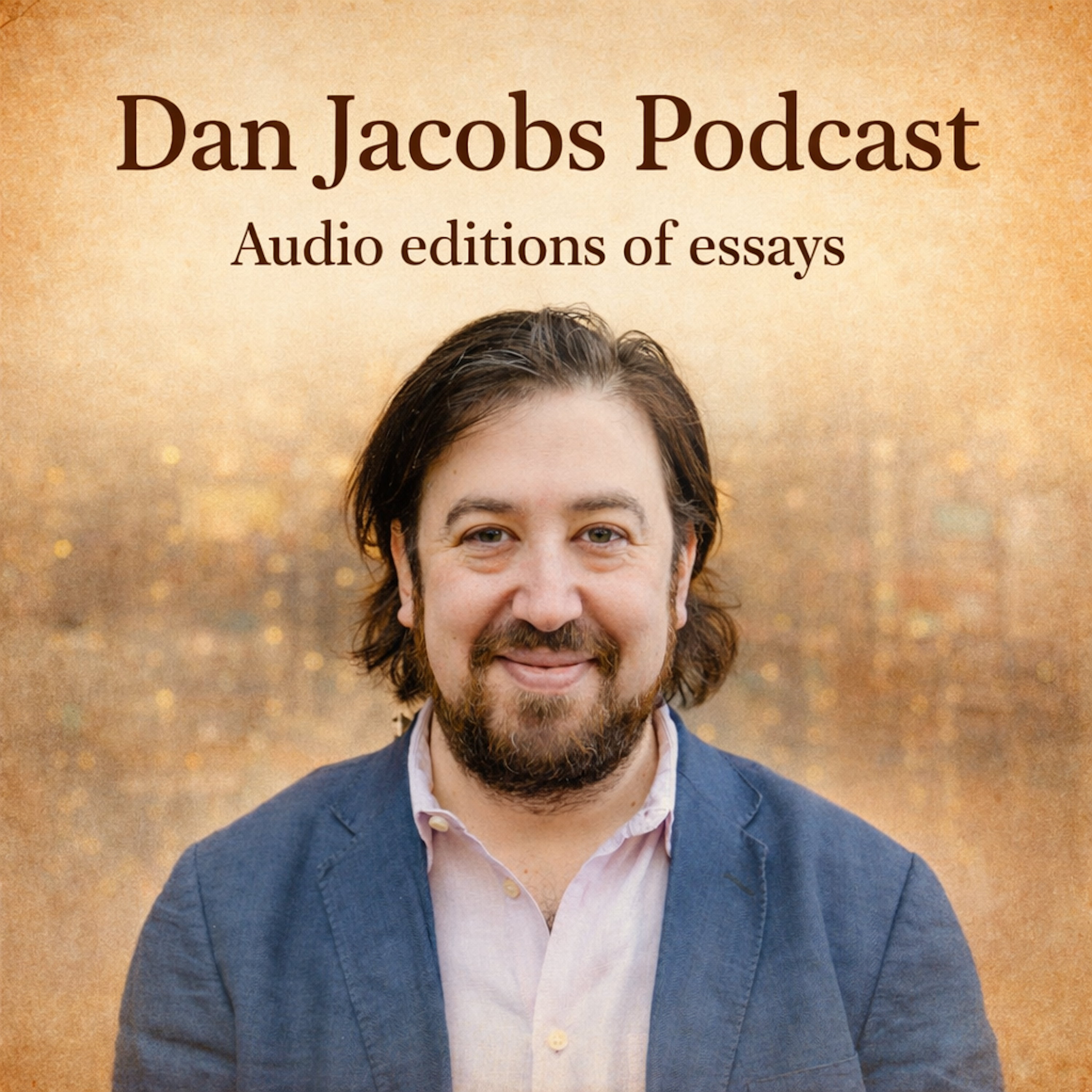
PODCAST · society
Dan Jacobs Podcast
by Dan Jacobs
This is the audio edition of my long-form writing: essays on Jewish history, antisemitism, politics, and the stories we tell ourselves about conflict and identity. Some episodes are standalone. Others run as short series, where I stay with a subject long enough to let it get messy. I’m interested in mechanisms over slogans: how communities argue and how we humans make sense of the world.
-
5
Parting Ways (5/5): Empire, enforcement, and the split that never ended
Part 5 follows the split between rabbinic Judaism and Christianity into the fourth and fifth centuries, when imperial power entered the story and the cost of overlap began to rise. We start in Antioch, where John Chrysostom’s sermons reveal Christians still attending Jewish festivals and synagogues, and ask what that persistence tells us about how slow separation really was. From there we move to Nicaea and the struggle over sacred time, as Easter and Sabbath become identity markers, then to the ratchet effect: preaching becomes canon, canon becomes law. The Theodosian Code turns boundary-making into administration. The Callinicum synagogue burning shows how bishops could bend imperial policy. Augustine offers a theology of “toleration” that keeps Jews alive but subordinated, and Jerome’s reliance on Jewish Hebrew learning exposes a dependence Christianity could never fully escape. The episode ends in the Jewish east, where rabbinic authority becomes more portable and resilient, and with the central claim of the series: the divorce papers were written in calendars and law, but the two communities never stopped sharing the same book.
-
4
Parting Ways (4/5): Who owns Israel’s library? The Bible through rabbinic and Christian Greek reading worlds
By the second and third centuries, the question is no longer mainly how gentiles enter Israel’s story. It is who gets to tell the story at all. This episode follows the fight over Israel’s scriptures as a shared library that becomes contested property: through translation, naming, canon-building, and the delegitimising of Jewish continuity.
-
3
Parting Ways (3/5): When the centre of gravity changed, and both sides drew borders
Part 3 traces the slow split between the Jesus movement and Jewish communal life. As gentiles became the majority, Torah shifted from lived practice to quoted text, and overlap grew harder to sustain through calendars, meals, taxes, and prayer.
-
2
Parting Ways (2/5): A Jewish Jesus movement, and the fight over Torah law
Part 2 follows the Jesus movement before it became a separate religion. In the first decades after Jesus’s death, the argument was still internal: how to read Torah in a messianic moment, what Gentile followers should do about circumcision and food laws, and whether Jews and Gentiles could share a table without dissolving Jewish boundaries. We move through Paul’s letters, Acts 15, and the everyday mechanics of mixed communities under Rome, and you can already see the split forming long before anyone calls it “Christianity.”
-
1
Parting Ways (1/5): From Temple to text, law, and argument
Religious splits are rarely neat. Part 1 begins in the late Second Temple world, before the catastrophe, with Hillel and the Pharisaic culture of argument. It then follows the shock of 70 CE and the long aftermath: how Jewish life survived when sacrifice and priestly authority could no longer function as the public centre. Along the way: messianic expectation in the air around Jesus, Josephus on certainty under pressure, the rabbinic survival story of Yavneh, and a set of classic texts that show what “portable Judaism” meant in practice.
We're indexing this podcast's transcripts for the first time — this can take a minute or two. We'll show results as soon as they're ready.
No matches for "" in this podcast's transcripts.
No topics indexed yet for this podcast.
Loading reviews...
ABOUT THIS SHOW
This is the audio edition of my long-form writing: essays on Jewish history, antisemitism, politics, and the stories we tell ourselves about conflict and identity. Some episodes are standalone. Others run as short series, where I stay with a subject long enough to let it get messy. I’m interested in mechanisms over slogans: how communities argue and how we humans make sense of the world.
HOSTED BY
Dan Jacobs
CATEGORIES
Loading similar podcasts...
URL copied to clipboard!