
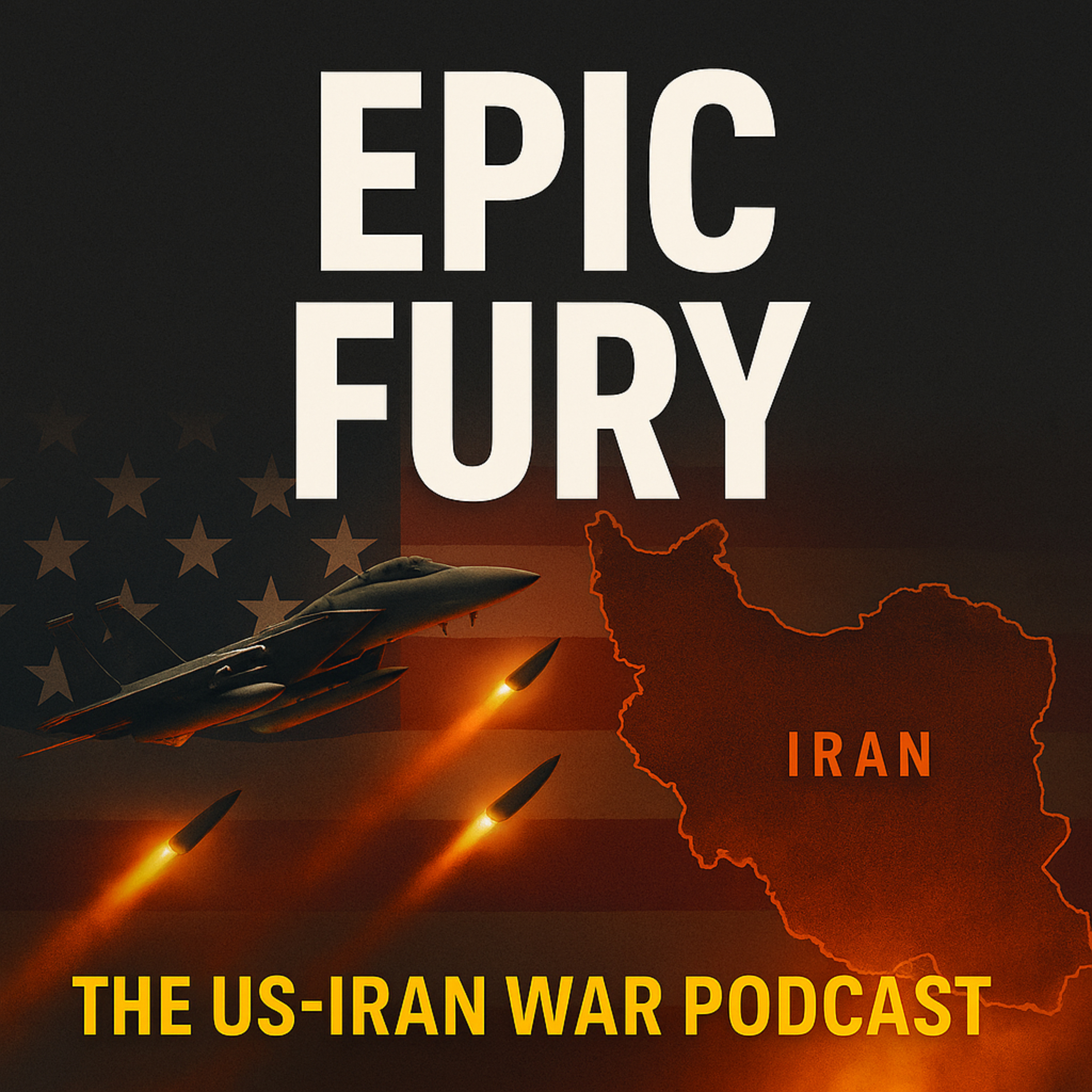
PODCAST · news
Epic Fury: The US-Iran War Podcast
by The Briefing Network
Epic Fury is a daily news and analysis podcast covering the US–Iran war, global conflict, geopolitics, and financial markets. Each episode breaks down the most important developments from the last twenty-four hours — from military operations and diplomacy to oil prices, stock markets, and global risk. Fast, clear, and high-impact. No filler. Just the facts and what they mean. New episodes daily. Follow now to stay ahead of every major development.
-
79
The Fog of War: Inside the Chaos of Modern Conflict
The Fog of War: Inside the Chaos of Modern Conflict explores the uncertainty, confusion, misinformation, and psychological pressure that shape decision-making during war.In this Epic Fury bonus episode, we examine how military commanders, intelligence analysts, governments, journalists, and civilians attempt to understand fast-moving conflicts while operating with incomplete and often contradictory information.The episode explores battlefield confusion, intelligence failures, friendly fire incidents, false alarms, misinformation, cyber warfare, social media disinformation, radar misidentification, drone surveillance errors, and the psychological pressure of making irreversible decisions under extreme uncertainty.Topics covered include:the origin of the phrase “fog of war”Carl von ClausewitzCold War nuclear false alarmsStanislav PetrovIraq War intelligence failuresweapons of mass destruction assessmentsVietnam War reporting confusionmodern drone warfarecyber deception operationsAI-assisted intelligence systemsconfirmation bias during crisesaccidental escalation risksfriendly fire incidentscommand centre decision-makingreal-time battlefield analysisinformation overload during warWe also examine how modern technology — satellites, drones, AI systems, cyber operations, and twenty-four-hour information networks — has changed warfare while failing to eliminate the uncertainty at its core.This episode is ideal for listeners interested in geopolitics, military strategy, intelligence analysis, modern warfare, psychological decision-making, information warfare, cyber conflict, military history, and the hidden realities behind global conflict.Because even in the age of satellites and artificial intelligence, war remains shaped by confusion, fear, miscalculation, and incomplete information.The fog never fully disappears.
-
78
Iran War Day 75: Trump and Xi Meet as US Strike Plans Intensify
Trump lands in Beijing for one of the most consequential meetings of the war so far. As he prepares to sit down with Xi Jinping, US officials say military pressure on Iran is intensifying, generals are awaiting orders, and an Ohio-class ballistic missile submarine has appeared at Gibraltar.In this episode of Epic Fury, we break down the growing signs that Washington is preparing for possible limited strikes against Iran if diplomacy fails — and why Israel fears a Beijing-shaped deal could leave Iran’s nuclear programme partially intact.We cover Trump’s warning that Iran “will do the right thing or we will finish the job,” China publicly defending Iran’s civilian nuclear rights before the summit, the Pentagon’s escalation posture, IRGC infiltration attempts in Kuwait, and the widening divide between American, Chinese, Israeli, and Iranian strategic goals.Also in this episode:Trump and Xi’s high-stakes Beijing summitUS military readiness and possible Iran strike scenariosThe Ohio-class submarine deployment to GibraltarIsrael’s fears over a partial Iran nuclear dealChina’s balancing act between Tehran and WashingtonKuwait arresting alleged IRGC infiltratorsIran warning Trump not to mistake the ceasefire for victoryIron Dome systems operating inside the UAEThe ceasefire remains on life support. The diplomacy is narrowing. And the next phase of the Iran war may now depend on what happens behind closed doors in Beijing.
-
77
Inside the Pentagon: Where America’s Wars Are Planned
Behind every American air strike, covert operation, and military escalation is a building most people will never truly understand.In this Epic Fury bonus episode, we go inside the Pentagon — the nerve centre of American military power — to explore how modern wars are planned, authorised, and coordinated long before the public sees the first missile launch.We break down the hidden systems operating behind the scenes: the National Military Command Center, classified SCIFs, nuclear command procedures, CENTCOM coordination, military targeting processes, intelligence analysis, and the chain of command linking the White House to combat operations across the Middle East.From the Gulf War and September eleventh to the Bin Laden raid and Operation Epic Fury, this episode explores the architecture of modern American warfare and the people working inside secure rooms twenty-four hours a day under fluorescent lights, giant digital maps, and constant escalation pressure.Because by the time war appears on television, it has already been unfolding behind reinforced walls for a very long time.
-
76
Iran War Day 74: Trump Rejects Iran Proposal as Ceasefire Nears Collapse
Trump says the Iran ceasefire is on “massive life support” after rejecting Tehran’s latest nuclear proposal and accusing Iran of backing away from a private uranium deal with the United States.In Episode 74 of Epic Fury, we break down Trump’s explosive Oval Office remarks, Iran’s missing uranium commitment, and why US officials are now reportedly considering renewed military operations after weeks of fragile ceasefire negotiations.We examine the hidden diplomatic channel between Washington and Tehran, Trump’s upcoming summit with Xi Jinping in China, new US sanctions targeting Chinese networks tied to Iranian oil sales, and Netanyahu’s warning that the US and Israel could “reengage militarily” if diplomacy fails.This episode also explores the growing internal divisions inside Iran’s leadership, the battle over the enriched uranium stockpile, the future of the Strait of Hormuz crisis, and why the gap between what Iran said privately and what it submitted in writing may become the moment this ceasefire collapses.Follow Epic Fury for daily coverage of the US-Iran war, breaking geopolitical developments, Middle East conflict analysis, nuclear negotiations, military escalation, and global security updates as events unfold in real time.
-
75
How Wars Are Sold to the Public
How Wars Are Sold to the Public explores the hidden information systems, media strategies, political messaging, and psychological operations that shape public opinion during modern conflict.In this Epic Fury bonus episode, we examine how governments, militaries, intelligence agencies, news organisations, and social media platforms influence the way wars are presented to the public before and during military operations.The episode explores wartime propaganda, information warfare, embedded journalism, strategic communications, psychological operations, twenty-four-hour news cycles, social media algorithms, AI-generated content, political messaging, and the role of emotional narratives during conflict escalation.Topics covered include:Gulf War media strategyIraq War and weapons of mass destruction narrativesSeptember eleventh and the War on TerrorVietnam War television coverageRussian information warfareISIS propaganda operationsIran conflict media narrativessocial media influence campaignsgovernment press briefingsclassified intelligence leakscensorship pressureonline disinformationdigital propaganda systemsmodern psychological warfareWe also examine how fear, uncertainty, repetition, and emotionally charged imagery shape public perception during wartime, and how modern information environments have transformed conflict into a battle not only for territory, but for attention, narrative control, and public belief.This episode is ideal for listeners interested in geopolitics, military strategy, media manipulation, propaganda, intelligence operations, information warfare, modern conflict analysis, political communication, cyber influence campaigns, and the psychology of public opinion during war.Because modern wars are fought not only with missiles and drones.They are also fought with headlines, algorithms, narratives, and the struggle to control what the world believes is happening.
-
74
Iran War Day 73: Trump Rejects Iran’s Uranium Offer as US Monitors Nuclear Stockpile
Iran’s long-awaited response to the US peace proposal has arrived — and Trump has already rejected it as “totally unacceptable.”In Episode 73 of Epic Fury, we break down Iran’s partial uranium transfer offer, why Tehran refuses to dismantle its nuclear facilities, and the critical gap between Iran’s proposal and Washington’s demands. Trump says the United States is actively monitoring Iran’s enriched uranium stockpile and warned that anyone approaching it would be destroyed. Netanyahu says there is still “work to be done” inside Iran. Oil surges above one hundred and four dollars a barrel as fears of renewed escalation grow.We examine:Iran’s proposal to transfer enriched uranium to a third countryWhy the US insists on physical removal of the stockpileTrump’s warning about American surveillance over Iran’s nuclear materialNetanyahu’s push for direct removal of Iran’s uraniumThe growing divide between diplomacy and military escalationPakistan’s role as mediator in the ongoing talksThe latest ceasefire violations across the regionWhy markets believe the war is far from overThe letter arrived. The offer was rejected. The uranium question remains unresolved.This is Day 73 of Operation Epic Fury.
-
73
Iran War Day 72: Iran Threatens Hormuz Shipping as Nuclear Deal Stalls
Iran says its nuclear programme is “not being negotiated at this stage.” Trump says a deal is close. And while the ceasefire technically holds, the Strait of Hormuz is becoming more dangerous by the day.In Episode 72 of Epic Fury, we break down the growing contradiction at the center of the US-Iran negotiations, the attack on a French shipping giant’s vessel in the Strait of Hormuz, and Iran’s latest warning that countries complying with US sanctions could face difficulties transiting the waterway.We examine:Iran publicly rejecting nuclear negotiations while reviewing the US framework proposalThe demand for UN Security Council guarantees against future US or Israeli strikesThe attack on the CMA CGM San Antonio and the escalating maritime security crisisFrance moving the aircraft carrier Charles de Gaulle toward the regionBahrain arresting forty-one people allegedly linked to the IRGCThe first public statement on Khamenei’s health in seventy-two daysPakistan’s behind-the-scenes mediation efforts between Washington and TehranWhy the ceasefire is simultaneously holding and steadily becoming more fragileThis is Episode 72 of Epic Fury: The US-Iran War Podcast. The nuclear deal has stalled. Commercial shipping is still under threat. And the gap between Washington and Tehran may be wider now than at any point since the ceasefire began.
-
72
Iran War Day 71: Trump Awaits Iran Letter as US Fires on Tankers, Rubio Demands Serious Offer
In Episode 71 of Epic Fury: The US-Iran War Podcast, the United States waits for Iran’s official response to the proposed peace framework as President Trump says he is expecting a letter from Tehran “tonight” and Secretary of State Marco Rubio demands a “serious offer.”As diplomatic negotiations hang in the balance, Iran’s foreign ministry calls the US approach a “grotesque absurdity,” accusing Washington of threatening massive military escalation while publicly claiming to seek peace. Foreign Minister Abbas Araghchi warns that “diplomacy is always the victim” whenever negotiations begin to advance.Meanwhile, the US Navy fires on two Iranian oil tankers enforcing the Hormuz blockade, Trump unveils “Project Freedom Plus” as a potential escalation path if talks collapse, Hezbollah launches its first publicly claimed cross-border strike since the Lebanon ceasefire extension, and the State Department announces a second round of Israel-Lebanon peace negotiations.We break down:Trump’s expected letter from IranRubio’s comments on Tehran’s peace responseThe growing pressure of the Hormuz blockadeProject Freedom Plus and possible US escalationIran’s “grotesque absurdity” accusationHezbollah’s renewed strike against IsraelChina sanctions linked to Iran’s defence industryASEAN’s emergency economic contingency planThe unanswered question at the centre of Day 71The ceasefire officially remains intact. The blockade remains active. And somewhere between diplomacy and escalation, the future of this war may now depend on a single letter.Follow Epic Fury for daily coverage of the US-Iran war, the Strait of Hormuz crisis, Middle East escalation, global oil shock risks, nuclear negotiations, and breaking geopolitical developments.
-
71
Iran War Day 70: CENTCOM Strikes Iran, Trump Says Ceasefire and Nuclear Deal Still Hold
Trump says Iran has agreed to the nuclear framework. Iran says the response is still not finalised. And while both sides insist the ceasefire remains intact, CENTCOM has now conducted self-defence strikes inside Iranian territory after Iranian attacks on US Navy destroyers in the Strait of Hormuz.In Episode 70 of Epic Fury: The US-Iran War Podcast, we break down the most dangerous and contradictory day of the war so far. US forces struck Iranian military facilities, including missile and drone launch infrastructure, after CENTCOM said American warships came under attack while transiting the Strait of Hormuz. Iranian state media said the situation had “settled down” — even as Trump warned that without a deal there would be “one big glow coming out of Iran.”We examine:The CENTCOM strikes on Iranian military sites inside IranThe Hormuz naval confrontation involving US destroyers and IRGC attacksTrump’s claim that “they have agreed” to the nuclear frameworkIran’s public contradiction that Tehran has not yet finalised its responseThe legal and military meaning of “self-defence strikes” during a ceasefireThe future of the US-Iran ceasefire after direct military exchangesThe proposed uranium enrichment limits and nuclear inspection regimeFordow, highly enriched uranium stockpiles, and the “nuclear dust” proposalTrump’s “one big glow” warning and what it could meanWhether the US-Iran nuclear deal is hours away — or collapsing in real timeDay 70 of Operation Epic Fury may be remembered as the moment the war moved simultaneously closer to peace and closer to catastrophic escalation.Follow Epic Fury for daily coverage of the US-Iran war, the Strait of Hormuz crisis, nuclear negotiations, Middle East escalation, CENTCOM operations, Trump administration strategy, and global security developments.
-
70
Where Is Iran’s Uranium? The Hidden Nuclear Stockpile Crisis
Where is Iran’s uranium stockpile?After months of airstrikes, bunker-busting bombs, naval warfare in the Strait of Hormuz, and the destruction of major nuclear facilities including Natanz and Fordow, one question now sits at the centre of the US-Iran war: what happened to Iran’s enriched uranium?In this deep-dive bonus episode of Epic Fury: The US-Iran War Podcast, we break down the hidden nuclear material crisis now dominating negotiations between the United States, Iran, Israel, the IAEA, and international mediators in Islamabad.We examine Iran’s estimated 408 kilograms of 60% enriched uranium, why weapons-grade enrichment could still be achieved within weeks, and why destroying centrifuge halls does not eliminate existing nuclear material. This episode explores breakout time, the collapse of the JCPOA nuclear deal, the strategic importance of Fordow, Natanz, and Isfahan, and the growing fear that portions of Iran’s uranium stockpile may have been secretly dispersed to undeclared underground facilities before Operation Epic Fury began.We also analyse President Trump’s reported demand that all enriched uranium be removed from Iranian territory, the debate over transferring the stockpile to Russia or the United States, and why the uranium question may ultimately decide whether this war truly ends — or simply pauses before the next conflict.This episode covers:Iran’s hidden uranium stockpileFordow nuclear facility analysisIran nuclear breakout timelineThe IAEA inspection crisisTrump’s nuclear demands on IranIsrael’s position on Iranian nuclear capabilityThe future of the Iran nuclear programmeNuclear deterrence and Middle East securityOperation Epic Fury falloutThe real reason the US-Iran war was foughtIf you want serious geopolitical analysis, military strategy, nuclear proliferation breakdowns, and daily coverage of the Iran war, follow Epic Fury: The US-Iran War Podcast.
-
69
Iran War Day 69: Trump Pushes Iran Deal, Uranium Removal, Hormuz Talks
The United States and Iran are negotiating a one-page Memorandum of Understanding that could end the sixty-nine-day Iran war and launch the most consequential nuclear talks since the JCPOA.In Episode 69 of Epic Fury: The US-Iran War Podcast, we break down the proposed US-Iran deal framework, the planned uranium enrichment moratorium, the removal of Iran’s highly enriched uranium stockpile, the reopening of the Strait of Hormuz, sanctions relief negotiations, and Trump’s warning that “the bombing starts” if Iran rejects the agreement.We examine:Trump’s final Iran deal pushThe proposed twelve-to-fifteen-year nuclear freezeRemoval of Iran’s uranium stockpile from Iranian territoryThe reopening of Hormuz and lifting of the US blockadeRubio declaring the military phase of Operation Epic Fury concludedIsrael’s reported preparations for escalationThe Lebanon ceasefire clause inside the proposed agreementSnap IAEA inspections and underground nuclear facility restrictionsIran’s expected response within forty-eight hoursReuters, Axios, the Wall Street Journal, and Israeli media all reported major new details about the negotiations as Washington and Tehran moved closer to a potential agreement that could reshape the Middle East and formally end Operation Epic Fury.If negotiations fail, Trump warned Iran would face bombing “at a much higher level and intensity than before.”This is Day 69 of the Iran war.Follow Epic Fury for daily coverage of the US-Iran conflict, the Strait of Hormuz crisis, Middle East war developments, nuclear negotiations, sanctions, military escalation, and global geopolitical analysis.
-
68
Iran War Day 68: Trump Pauses Project Freedom, Israel Launches Massive Lebanon Strikes, Iran Threatens Attack
Trump pauses Project Freedom less than forty-eight hours after launching the US Navy’s Hormuz escort operation. Israel responds with its largest Lebanon strikes of the war under Operation Eternal Darkness. Iran threatens direct military retaliation against Israel for the first time in the conflict. In Episode 68 of Epic Fury: The US-Iran War Podcast, we break down the collapse of the Lebanon ceasefire, the escalating Hormuz crisis, the humanitarian disaster unfolding in the Strait, and the growing risk of a full regional war involving the United States, Iran, Israel, and Hezbollah.This episode covers Trump’s decision to suspend Project Freedom while maintaining the blockade of Iranian ports, Iran’s warning that it could directly attack Israel, the massive Israeli air campaign across Beirut and southern Lebanon, Rubio confirming ten civilian sailors have died in the blocked Strait of Hormuz, and the worsening diplomatic crisis surrounding the US-Iran nuclear negotiations through Pakistan and Oman.We also examine the military and geopolitical implications of Operation Eternal Darkness, the Beirut casualty figures, the future of the US-Iran ceasefire, the stranded oil tankers trapped in the Gulf, the role of Hezbollah, the collapse of the Lebanon truce, and why the next forty-eight hours could decide whether the Middle East returns to full-scale war.Epic Fury is the daily US-Iran war podcast covering breaking news, geopolitics, military strategy, oil markets, global security, naval warfare, nuclear diplomacy, Israel-Iran tensions, and the escalating crisis in the Strait of Hormuz.Follow Epic Fury for daily coverage of the Iran war, Project Freedom, Israel’s Lebanon operations, Trump administration decisions, Hormuz shipping disruptions, and the wider Middle East conflict.
-
67
Fujairah Oil Hub Hit: Iran Drone Strike Outside Strait of Hormuz
An Iran drone strike on the Fujairah oil hub in the United Arab Emirates has raised new concerns about global energy supply and the stability of oil flows outside the Strait of Hormuz. UAE authorities said the attack caused a fire at the Fujairah facility and originated from Iran, though Tehran denied any pre-planned operation.Most attention in the US–Iran conflict has focused on the Strait of Hormuz, one of the world’s most critical oil chokepoints, where roughly one-fifth of global supply passes. But Fujairah sits outside the Strait on the Gulf of Oman and was built to bypass it entirely. It is one of the largest oil storage and bunkering hubs in the world, supplying fuel to ships moving between Asia, Europe, and the Middle East.This episode explains why the Fujairah strike matters. If the Strait of Hormuz is the primary route for global oil flows, Fujairah is the backup system. The attack suggests disruption may no longer be limited to the chokepoint itself, but could extend to the infrastructure designed to replace it.As tensions between the United States and Iran continue, energy infrastructure across the Gulf is becoming increasingly exposed. Even limited disruption can ripple through oil markets, shipping routes, insurance costs, and global supply chains. The strike on Fujairah highlights how quickly a regional conflict can escalate into a broader economic risk.This is Epic Fury: The US–Iran War Podcast.
-
66
Iran War Day 67: Strait of Hormuz Clash, Ceasefire Under Fire, Conflicting US–Iran Claims
The ceasefire is holding — but only just.On Day sixty-seven of Operation Epic Fury, the Strait of Hormuz became the most dangerous flashpoint in the world. Iran claimed it fired missiles at a US Navy destroyer. The United States denied it. The US confirmed it destroyed multiple Iranian fast attack boats. Iran denied that too. Two governments, two completely incompatible accounts, unfolding in the same thirty-four-mile-wide waterway that carries nearly twenty percent of global oil supply.This episode breaks down what actually matters beneath the competing narratives: a live military confrontation between US and Iranian forces taking place under a ceasefire that both sides still claim is intact.Only two merchant vessels crossed the Strait under US naval protection — not a reopening of global trade routes, but a limited test of capability. Meanwhile, a South Korean-operated ship caught fire after an explosion in the same corridor, underscoring the growing risk to neutral халықаралық shipping and the fragility of commercial confidence.The global shipping insurance market has issued a stark warning: there is no clarity on how US operations are being coordinated with Iran, if at all. Without that coordination, risk remains elevated — and without reduced risk, the Strait does not reopen in any meaningful economic sense.At the same time, a rare diplomatic signal emerged. Twenty-two crew members from the seized Iranian vessel Touska were released through Pakistani mediation — a small but real confidence-building measure occurring on the same day as direct military confrontation.This episode also examines the widening gap between political messaging and operational reality. The Trump administration formally declared hostilities with Iran “terminated” under the War Powers framework — yet hours later publicly stated: “you know we’re in a war.” That contradiction reflects a dual-track strategy shaping both domestic politics and international positioning.Public opinion inside the United States is shifting. New polling shows only thirty-six percent of Americans believe the use of military force against Iran was the right decision. At the same time, the economic pressure campaign continues to intensify, with over fifty million barrels of Iranian oil stranded in tankers unable to reach global markets.The central question now is whether the ceasefire can survive direct confrontation inside the Strait of Hormuz — or whether Monday’s events mark the beginning of its collapse.This is Episode 67 of Epic Fury: The US-Iran War Podcast — a real-time analysis of the most consequential geopolitical conflict shaping global energy, military strategy, and international power dynamics.Follow the show to stay ahead of breaking developments. Premium episodes are available for deeper strategic analysis and forward-looking intelligence on where this conflict is heading next.
-
65
Iran War Day 66: US Enters Hormuz, Tanker Hit, Trump Signals Positive Talks
US warships have entered the Strait of Hormuz for the first time since the war began, marking a major escalation in the Iran war and a direct challenge to Iranian control of one of the world’s most critical shipping routes. The operation — increasingly referred to as Project Freedom — signals a new phase in US strategy in the Persian Gulf. Within hours of the announcement, a tanker was hit by unknown projectiles, raising immediate questions about whether the situation is already slipping toward direct confrontation between the United States and Iran.In this episode of Epic Fury: The US-Iran War Podcast, we break down the US guided transit operation, the difference between naval presence and formal convoy escort, and why that distinction matters for whether the ceasefire still technically holds. We analyse Iran’s response, including new parliamentary moves to restrict access to the Strait of Hormuz, and what this means for global oil markets, shipping risk, and the likelihood of further escalation in the Persian Gulf.We also examine the latest developments in US–Iran diplomacy, as Washington sends a written response to Iran’s fourteen-point proposal through Pakistan. With Donald Trump describing the talks as “very positive,” we explore whether negotiations are genuinely progressing or if both sides remain locked in a deeper strategic standoff over nuclear sequencing and war-ending conditions.Beyond the battlefield, this episode looks at the economic impact of the conflict, including rising petrol prices in the United States and the broader global consequences of instability in the Strait of Hormuz. We also cover escalating violence in Lebanon, Israeli strikes, Hezbollah responses, and the growing humanitarian toll across the region.This is Day 66 of Operation Epic Fury — a moment where military escalation and diplomatic movement are happening at the same time. US naval forces are in Hormuz under Project Freedom. A tanker has been hit. Talks are active. And the outcome remains uncertain.Follow Epic Fury so you don’t miss the next update as this story continues to develop.
-
64
Iran War Day 65: US Rejects Iran Proposal, 48 Ships Blocked, Khamenei Doubts Peace Talks
Iran War Day 65. The United States rejects Iran’s latest deal as tensions escalate and the path to peace narrows. In this episode of Epic Fury, the US-Iran War Podcast, we break down the fourteen-point Iranian proposal versus the nine-point American framework, and the critical divide over timing that could determine whether negotiations succeed or collapse. Iran is pushing for a thirty-day resolution. Washington wants sixty days to maintain pressure. That single disagreement is now shaping the entire diplomatic process.The US blockade is accelerating, with forty-eight Iranian-linked vessels turned away in just twenty days. This episode explains what that means in real terms for Iran’s economy, global shipping, and the leverage behind US strategy in the Strait of Hormuz. As economic pressure builds, political messaging is hardening. Donald Trump signals the proposal is unacceptable, framing the conflict against decades of Iranian actions, while Ayatollah Khamenei describes the talks as a delay rather than a genuine peace process. That contrast raises a critical question: are these negotiations real, or are both sides buying time?We also examine the wider war context shaping the talks, including continued violence in Lebanon, the risk of escalation across the region, and new details about the US negotiating team that point to a more hardline policy environment. This episode connects the military, economic, and diplomatic threads driving the conflict forward, giving you a clear, structured understanding of where the war stands on Day 65. Follow Epic Fury for daily analysis of the US-Iran war, nuclear negotiations, Middle East conflict, and global geopolitical strategy as this story continues to unfold.
-
63
Iran War Day 64: Khamenei’s First Message, War Powers Dispute, CENTCOM Strike Strategy
Khamenei has spoken for the first time since taking power — and it wasn’t a message of compromise. As the War Powers deadline expires, a US strike plan is already on the table.Iran War Day 64. Iran’s Supreme Leader Mojtaba Khamenei delivers his first public message since taking office, stating that Iran will safeguard its nuclear programme and ballistic missile capabilities while warning that US military forces have no place in the Persian Gulf.At the same time, the War Powers Act sixty-day deadline has expired. The Trump administration argues that the US-Iran ceasefire ended hostilities, avoiding the need for congressional authorisation under the War Powers Resolution. This legal dispute raises major questions about executive war powers, US military authority, and the future of US involvement in the Iran conflict.Meanwhile, US Central Command (CENTCOM) has prepared a contingency strike strategy described as a short, high-impact wave of military strikes on Iran designed to break the diplomatic stalemate over Iran’s nuclear programme.Iran’s Islamic Revolutionary Guard Corps (IRGC) has responded with threats of long and painful retaliation against US military bases and assets across the Middle East, including the Persian Gulf, Iraq, Qatar, Bahrain, Kuwait, and the Strait of Hormuz.Despite escalating rhetoric, Donald Trump states that US-Iran negotiations are “better than they appear,” confirming the existence of a private diplomatic channel operating alongside public confrontation and public escalation.The Iran war continues to evolve across military, political, legal, and economic dimensions, with tensions in the Strait of Hormuz, global oil markets, and Middle East security all at stake.Follow Epic Fury: The US-Iran War Podcast for daily analysis of the Iran war, US foreign policy, and global conflict.
-
62
Iran War Day 63: Trump Rejects Iran Nuclear Deal, Hormuz Blockade Holds, US Requests Hypersonic Missiles
Iran War Day 63. Donald Trump has rejected Iran’s latest nuclear proposal, leaving negotiations stalled and the core issue unchanged: sequencing. Iran’s offer, delivered through Pakistani mediators, proposed reopening the Strait of Hormuz and lifting the naval blockade before any nuclear negotiations begin. The United States refused. Washington’s position remains fixed — no sanctions relief, no end to the Hormuz blockade, and no diplomatic breakthrough until Iran commits to nuclear concessions first. The result is a deepening Iran nuclear deadlock at the center of the war.The Strait of Hormuz blockade continues to define the economic battlefield. As one of the most critical global oil transit chokepoints, disruption in the Strait of Hormuz is driving volatility in energy markets while applying sustained financial pressure on Iran’s government. The United States strategy is built on maintaining that pressure, using the blockade as leverage to force movement on Iran’s nuclear programme. Iran, however, cannot politically agree to nuclear concessions under maximum economic pressure, creating a structural standoff where neither side is willing to move first.At the same time, the military situation is escalating. US Central Command has formally requested the deployment of Dark Eagle hypersonic missiles, the United States Army’s Long Range Hypersonic Weapon, capable of travelling at speeds above Mach 5 and designed to strike hardened and time-sensitive targets. The request signals a potential expansion of US military capabilities in the Middle East and reinforces that the military option remains active as diplomacy stalls. Additional US military build-up, including naval forces, marine units, and airborne deployments, continues to expand the American posture in the region.In Washington, political pressure is beginning to rise as the war enters its third month. During a congressional hearing, the term “quagmire” was used to describe the trajectory of the conflict, echoing language historically associated with prolonged US wars. As costs increase, casualties mount, and no clear resolution emerges, the Iran war is becoming not only a military and diplomatic crisis, but a growing political issue inside the United States.This episode explains why Trump rejected Iran’s nuclear delay proposal, how the Strait of Hormuz blockade is shaping the conflict, what the hypersonic missile request means for escalation, and why the sequencing problem continues to block any deal. The negotiations remain open, but the gap between the United States and Iran has not narrowed. The blockade holds, the nuclear question remains unresolved, and the next move in the Iran war still depends on whether either side is willing to break the deadlock.
-
61
War Powers Act 1973 Explained: 60-Day Limit & Who Really Controls the Iran War
The War Powers Act of 1973 was designed to answer one question: who controls American war — Congress or the President? Passed after Vietnam, the law requires presidents to notify Congress within 48 hours of military action and limits unauthorized conflict to just 60 days, with a final 30-day withdrawal window. On paper, it is one of the most important checks on executive power in modern history. In reality, its limits have been tested — and repeatedly pushed.As the Iran war unfolds under Donald Trump, that 60-day clock has become more than a legal technicality. It has become the centre of a constitutional crisis. With U.S. military operations continuing as the deadline approaches and political efforts in Congress failing to halt the conflict, the gap between law and power is being exposed in real time. This episode breaks down how the War Powers Resolution actually works, why the definition of “hostilities” has been stretched by multiple administrations, and how older military authorisations are used to justify new wars.From Vietnam to Iraq, Libya to Iran, the same pattern keeps repeating: the law sets a limit, the deadline approaches, and the war continues anyway. With no automatic enforcement mechanism and no clear judicial intervention, the real question is no longer what the law says — but who has the power to enforce it. If the 60-day limit can be ignored, then who really controls war in the United States?
-
60
Iran War Day 62: Trump No Nuclear Deal Ultimatum, Putin Call, Hormuz Mine Clearance Begins
Iran war Day 62, Trump no nuclear deal ultimatum, Iran nuclear weapons red line, Trump Putin call, Strait of Hormuz mine clearance, Iran proposal, Israel strike warningIran war Day 62. Donald Trump sets a clear red line: no deal unless Iran commits to no nuclear weapons. This is not a negotiating position — it is the minimum condition. Any Iran proposal that delays the nuclear issue is likely to be rejected, making the revised proposal expected within days one of the most critical moments of the war so far.At the same time, Trump escalates pressure with a Truth Social gun post and a warning to Iran to “get smart.” A one-and-a-half-hour call with Vladimir Putin adds a global dimension, with Trump suggesting the Iran war and Ukraine war could end on a similar timeline. On the ground, the United States begins active mine clearance in the Strait of Hormuz to reopen global shipping, while Iran’s parliament backs the negotiating team and Israel signals it is ready to strike again.
-
59
Iran Nuclear Program Part 3/3: Trump Withdrawal, JCPOA Collapse, Path to War
The Iran Nuclear Deal collapsed in 2018 when Donald Trump withdrew the United States from the Joint Comprehensive Plan of Action, reimposing sanctions and ending one of the most consequential arms control agreements of the twenty-first century. This episode explains how the JCPOA, negotiated under Barack Obama, constrained Iran’s nuclear program, why it was verified by inspectors, and how its collapse reshaped the balance of power in the Middle East.As sanctions returned, Iran responded by expanding uranium enrichment, rebuilding advanced centrifuges, and moving closer to weapons-grade capability. From the killing of Qasem Soleimani to the breakdown of diplomacy under Joe Biden, this episode traces the escalation from maximum pressure to nuclear acceleration. It explains why the deal failed, what the “sunset clauses” meant, and how trust between Washington and Tehran collapsed beyond repair.By 2025, Iran’s nuclear program had reached a critical threshold, with enriched uranium stockpiles, hardened facilities, and advanced missile systems reshaping the strategic landscape. This final part of the series connects the collapse of the JCPOA to the outbreak of war, showing how decades of diplomacy, sanctions, and covert action led to a point where military conflict became the last remaining option. This is the conclusion of the Iran Nuclear Program series — and the turning point that led directly to Operation Epic Fury.
-
58
Iran War Day 61: Nuclear Deal Rejected, UAE Leaves OPEC, Hormuz Standoff Deepens
Iran’s nuclear deal is rejected before it even begins. The United States refuses Iran’s proposal after a critical flaw — delaying the nuclear question until after the war — while the UAE makes a shock move to leave OPEC, reshaping global oil markets overnight.On Day sixty-one of Operation Epic Fury, the core issue becomes sequencing. Iran offers to reopen the Strait of Hormuz and enter a ceasefire, but refuses to discuss its nuclear programme until later — a structure Washington sees as a trap. As the diplomatic standoff deepens, signals emerge through Pakistan, Trump’s position hardens, and Tehran faces an internal decision between economic pressure and political risk. At the same time, the UAE’s exit from OPEC fractures the energy order, rerouted global shipping drives up costs, and the Panama Canal absorbs the strain of a disrupted oil route.This episode breaks down the Iran nuclear standoff, the Strait of Hormuz crisis, UAE oil strategy, OPEC fallout, and the geopolitical power struggle shaping the next phase of the US-Iran war. Follow Epic Fury for daily updates as the conflict, diplomacy, and global markets continue to shift in real time.
-
57
Iran Nuclear Program Part 2/3: Natanz Inspections, Stuxnet Cyberattack, Covert War Escalates
Iran’s nuclear program is exposed, and inspectors at Natanz uncover a hidden industrial enrichment operation built in secret. The International Atomic Energy Agency begins urgent inspections as questions grow over Iran’s undeclared nuclear activities and the true scale of its uranium enrichment.As diplomacy stalls and sanctions tighten, the conflict shifts into a covert war. Intelligence agencies target Iran’s nuclear infrastructure, and the Stuxnet cyberattack infiltrates Natanz — the first cyberweapon designed to cause real-world physical destruction inside a nuclear facility.This is the escalation that reshaped global security: Iran nuclear tensions rise, Natanz remains at the centre, and the Stuxnet attack marks the beginning of a new kind of warfare. Part 2 of 3 in the Iran Nuclear Origins series — leading directly to the nuclear deal, its collapse, and the road to confrontation.
-
56
Iran War Day 60: Putin Backs Iran, Khamenei Message Sent, Hormuz Deal Proposal Ignites Tensions
Iran War Day 60: Vladimir Putin publicly backs Iran, Mojtaba Khamenei sends his first confirmed message, and Iran submits a Strait of Hormuz deal proposal to the United States. Trump’s national security team reviews the offer as the nuclear issue remains unresolved.Russia signals full alignment with Iran after Putin’s meeting with Foreign Minister Abbas Araghchi in St. Petersburg, pledging support that reshapes the diplomatic balance of the war. At the same time, Iran delivers its first formal written proposal through Pakistan — offering to reopen the Strait of Hormuz if the US lifts its blockade — while deliberately avoiding any commitment on its nuclear programme. The White House reviews the proposal behind closed doors, with no public decision announced.This episode breaks down the growing Russia–Iran alignment, the strategic significance of Khamenei’s message, and why the Hormuz proposal may be rejected despite opening a new diplomatic channel. With tensions rising in Lebanon, Gulf states tightening internal security, and no clear signal from Washington, the trajectory of the war remains uncertain at the two-month mark.
-
55
Iran Nuclear Program Part 1/3: Atoms for Peace, the 1953 Coup, and the Origins of War
This is Part 1 of a 3-part series on the Iran nuclear program — the story behind how it began, and how it led to war.In this episode, we break down the origins of Iran’s nuclear program, starting with the 1953 CIA-backed coup, the rise of the Shah, and the American “Atoms for Peace” initiative that introduced nuclear technology into Iran. What began as a civilian energy partnership between the United States and Iran would eventually evolve into one of the most dangerous geopolitical conflicts in modern history.This episode explains how Iran’s nuclear ambitions developed under the Shah, why the West supported it at the time, and how the foundations were built for a future nuclear crisis. From early reactor deals and Western cooperation to long-term strategic miscalculations, this is the beginning of a seventy-year chain of events that leads directly to the Iran war.If you want to understand the Iran nuclear program, the roots of the Iran conflict, and how this crisis really started, this is where the story begins.Part 2 covers the hidden rebuild after the 1979 revolution, the Iran-Iraq War, and the secret expansion that the world didn’t see — until it was too late.Follow the show now so Part 2 appears in your feed the moment it’s released.
-
54
Iran War Day 59: Trump Cancels Talks, Iran’s Written Nuclear Red Lines, Russia Talks
Iran War Day 59. Trump cancels Iran talks. Iran sends written nuclear red lines. Russia talks begin with Vladimir Putin.This episode covers the Iran war, US Iran conflict, nuclear negotiations, and the Strait of Hormuz crisis. We break down Trump cancelling talks, Iran’s nuclear red lines, Russia’s role, and rising tensions in the Middle East.We analyse the US Iran war, nuclear deal talks, sanctions pressure, and global oil prices as the conflict continues. The episode also covers Lebanon escalation, Hezbollah tensions, and the risk to the ceasefire.Follow Epic Fury for daily updates on the Iran war, US Iran conflict, nuclear talks, and global geopolitics.
-
53
Iran War Day 58: Trump Evacuated After Shooting at White House Correspondents’ Dinner
A gunman opened fire at the White House Correspondents’ Dinner in Washington, D.C., forcing the evacuation of President Donald Trump, senior cabinet officials, and hundreds of journalists inside the Washington Hilton. Secret Service agents moved within seconds as shots were fired near a security checkpoint. One federal officer was hit but survived after a ballistic vest stopped the round. The suspect, armed with multiple weapons, is now in custody and faces federal charges, with the FBI continuing to investigate motive.This episode breaks down exactly what happened inside the ballroom, how the security breach unfolded, and why the concentration of America’s top leadership in a single civilian venue represents a critical vulnerability during wartime. With no confirmed link to the Iran conflict, the incident still lands in a moment of heightened political tension, just fifty-eight days into Operation Epic Fury, raising urgent questions about domestic stability, presidential security, and the risks facing U.S. leadership during an active war.We then turn to the Iran diplomacy track, where negotiations continue indirectly through Pakistan as the ceasefire holds without a deal. Oil markets remain elevated, the Strait of Hormuz disruption continues, and the Lebanon ceasefire shows early signs of strain. This is the full strategic picture of Day 58 — a shooting in Washington, a war without an endpoint, and a global system under pressure.
-
52
Iran War Day 57: Talks Denied — But Iran Is Already in the Room
Iran’s Foreign Minister Abbas Araghchi has arrived in Islamabad — but Iran insists there are no direct talks with the United States. So what is actually happening behind the scenes? In this episode, we break down the contradiction at the centre of the Iran war on Day 57: diplomacy is moving, but officially, negotiations do not exist. With Pakistan acting as the key mediator, Tehran is communicating indirectly with Washington at a moment when the ceasefire holds and the outcome of the war remains uncertain.We analyse the five unresolved barriers preventing a deal — from Iran’s nuclear programme and missile capabilities to the Strait of Hormuz, proxy networks, and sanctions relief — and explain why each one could determine whether the conflict ends or escalates. With a US naval blockade still in place and global energy and security risks rising, what is said — and not said — in Islamabad this weekend could shape the next phase of the war.Plus: Trump’s latest “everlasting agreement” stance, Netanyahu’s hidden health revelation, rising global food insecurity linked to the conflict, and a fragile Lebanon ceasefire already under pressure. This is the inside analysis of the channel that may decide war or peace — even as both sides publicly deny talks are happening.
-
51
Iran War Day 56: No Timeline, No Deal — Trump Signals Escalation as Pressure Builds on Iran
Iran War Day 56. Trump signals no timeline for ending the conflict as pressure on Iran intensifies. In this episode of Epic Fury, we break down the most significant shift in the war so far: Donald Trump’s Oval Office statement that he is prepared to wait years, comparing the conflict to Vietnam and Iraq. With no deadline, no deal, and no second round of talks scheduled, the trajectory of the war is changing.We examine Iran’s fractured leadership and why no unified proposal has been delivered, alongside the expanding US naval blockade and the seizure of Iranian-linked tankers across multiple oceans. The Strait of Hormuz is operating at reduced capacity, oil markets are adjusting to sustained disruption, and the Lebanon ceasefire extension adds a separate but critical layer to the regional picture as pressure on Tehran continues to build.As the three-to-five-day negotiation window narrows, the key question remains: will Iran respond — or will the conflict escalate further? Follow Epic Fury: The US-Iran War Podcast for daily analysis of the Iran war, geopolitical strategy, oil markets, and global security.
-
50
Iran War Day 55: Ships Seized in Hormuz, Khamenei Injured, US Sets 3–5 Day Deadline
Hours after Donald Trump extended the ceasefire with no deadline, Iran’s IRGC seized two commercial vessels and attacked a third in the Strait of Hormuz — one of the world’s most critical oil chokepoints. A Greek cargo ship, the Epaminondas, was fired upon despite having received permission to transit, raising serious questions about who is actually controlling Iran’s military operations as tensions escalate across the region.At the same time, new reporting confirms Iran’s Supreme Leader, Mojtaba Khamenei, was injured in the strikes that killed his father and is now governing through audio calls and AI-generated video appearances. With Iran’s leadership fractured, the country has yet to produce the unified proposal the United States is waiting for, while the gap between civilian authority and the IRGC continues to widen.Behind the scenes, US officials have set a private three-to-five-day deadline for Iran to enter negotiations — even as the White House publicly insists there is no time pressure. Oil prices remain near one hundred dollars, airlines are cutting thousands of flights, and a thirty-country coalition is preparing for a potential Hormuz navigation mission, as the window for diplomacy narrows and the risk of escalation grows.
-
49
Iran War Day 54: Trump Extends Ceasefire, No Deadline, Global Oil Blockade Expands
The Iran war enters a new phase. On Day 54, Donald Trump extends the ceasefire just hours before it expires—without setting a new deadline. Instead of a countdown, the United States shifts to a new strategy: sustained economic pressure through a global oil blockade, while demanding a unified proposal from a deeply divided Iranian government. With Iran refusing talks in Islamabad and internal fractures becoming more visible, the structure of this conflict has fundamentally changed.This episode breaks down what that shift means. From the Pentagon’s interception of Iranian oil in the Indo-Pacific to rising pressure on Kharg Island’s storage capacity, the blockade is no longer regional—it is global. At the same time, questions around Iran’s leadership, nuclear material recovery after Operation Midnight Hammer, and the risk of prolonged stalemate are shaping what comes next. Is this still a ceasefire, or the start of a slower war of attrition?Follow Epic Fury for daily updates on the US-Iran war, including military strategy, geopolitics, oil markets, and global security.
-
48
Iran War: Can Bitcoin Bypass Sanctions? Crypto vs US Financial Power
Bitcoin, crypto, and sanctions are colliding in the Iran war — and one question is driving global attention: can Bitcoin bypass US sanctions? With a ceasefire holding but financial pressure intensifying, Iran remains cut off from the global financial system, including SWIFT, dollar clearing, and international banking, raising the possibility that cryptocurrency like Bitcoin and stablecoins such as Tether (USDT) could provide a workaround.This episode breaks down the reality of how crypto actually functions under sanctions, including whether Bitcoin can move money at scale, how liquidity and exchanges limit its use, and why blockchain traceability makes large transactions visible. It also explores the role of stablecoins, capital flight, and how Bitcoin compares to gold and oil during periods of geopolitical conflict and economic pressure.Epic Fury delivers daily analysis of the Iran war, geopolitics, financial markets, and global power shifts, explaining how money moves in a modern war economy and separating crypto narrative from reality while tracking the real impact of sanctions on Iran and the global system.
-
47
Iran War Day 53: Ceasefire Deadline Hours Away, Trump Warns of Bombing, Supreme Leader Clears Talks
The Iran war could restart within hours. The ceasefire expires tonight, and Donald Trump has warned that if no deal is reached, US bombing will begin again. But in a last-minute development, Iran’s supreme leader Mojtaba Khamenei has reportedly approved a delegation to attend emergency nuclear talks in Islamabad.In this episode, we explain what is happening right now in the US-Iran conflict, including the ceasefire deadline, Trump’s warning, Iran’s response, and whether talks can prevent war. We break down the latest Iran war news, the nuclear deal negotiations, tensions in the Strait of Hormuz, and the role of J. D. Vance and the US negotiating team.After 53 days of war, thousands have been killed and global oil supplies have been disrupted. The outcome of these final hours could decide what happens next. Follow Epic Fury for daily Iran war updates, clear explanations, and real-time coverage of one of the most important conflicts in the world.
-
46
Iran War Day 52: Strait of Hormuz Attack, US Iran Talks Collapse, US Navy Seizes Iranian Ship
Iran fires on ships in the Strait of Hormuz as IRGC gunboats attack a tanker and damage multiple vessels. The second round of US–Iran talks collapses before negotiations begin, while Donald Trump threatens strikes on Iranian power plants and infrastructure. The US Navy seizes an Iranian cargo ship in the Gulf of Oman, prompting a retaliation warning from Iran’s military command. This episode breaks down the Strait of Hormuz crisis, US Iran conflict escalation, oil market reaction, and the risk of war as the ceasefire deadline approaches.
-
45
Iran War Day 51: US–Iran Nuclear Deal Gap (20 vs 5 Years) + Ceasefire Countdown
The US–Iran nuclear deal talks enter a critical phase as delegations arrive in Islamabad ahead of a looming ceasefire deadline. For the first time, the exact gap in negotiations is clear: the United States is pushing for a twenty-year suspension of uranium enrichment, while Iran has countered with five.This episode breaks down what that 20 vs 5 year nuclear gap really means — and why it could still lead to a deal.We analyse Russia’s offer to take control of Iran’s enriched uranium stockpile, Secretary of State Rubio’s signal that Iran could retain a civilian nuclear energy programme, and the growing pressure on both sides as the ceasefire expires Tuesday.With markets rallying, oil prices falling, and officials privately reluctant to return to war, the question is no longer whether a deal is possible — but whether it can happen in time.If you want to understand the US–Iran war, nuclear negotiations, uranium enrichment, sanctions, and global market impact in plain English, this episode gives you the full picture.Follow the podcast for daily updates on the Iran war, geopolitics, financial markets, and global conflict.
-
44
Iran War Day 50: Strait of Hormuz Reopens, Oil Crashes, S&P 500 Hits Record as Deal Nears
Iran has declared the Strait of Hormuz open — and global markets reacted instantly. Oil prices plunged below $90 in their sharpest drop of the war, while the S&P 500 surged to a third consecutive record high, erasing every loss since the conflict began.But within hours, Iran’s IRGC contradicted the announcement — raising a critical question: who is really in control of Iran right now?With just 4 days left on the ceasefire, Pakistan confirms a deal is over 80% complete, and high-stakes talks resume Monday in Islamabad. Meanwhile, Iran’s newly appointed Supreme Leader has still not appeared in public six weeks after taking power.In Episode 50 of Epic Fury, we break down:The truth behind the Strait of Hormuz “reopening”Why oil markets are crashing despite ongoing tensionsThe internal power struggle between Iran’s diplomats and militaryWhat to expect from the next round of US–Iran negotiationsWhy global markets are betting heavily on a dealThe mystery surrounding Iran’s unseen Supreme LeaderDay 50. The ceasefire is ticking down. The deal is close — but not done.Follow now to stay ahead of every major development in the Iran War.
-
43
Iran War Day 49: Lebanon Ceasefire Changes Everything + Trump Pushes Deal + 5 Days to Deadline
Lebanon has a ceasefire — and it may have just changed the entire trajectory of the Iran war.On Day 49 of the conflict, Donald Trump announces a sudden 10-day Israel–Lebanon ceasefire, unlocking the stalled Iran negotiations with just five days remaining before the April 22 deadline.In this episode:Why the Lebanon ceasefire was the hidden precondition for Iran talksHow Trump forced a deal through Netanyahu in hoursThe real reason Iran linked Lebanon to nuclear negotiationsTrump’s explosive claim that Iran may surrender buried nuclear materialWhy he says he could fly to Pakistan himself to sign the dealThe 5-day window that could end the war — or escalate it furtherMilitary pressure vs diplomacy: US blockade, strike readiness, and dual messagingA one-vote margin in Congress that could decide whether war continuesWith celebrations in Beirut, rising diplomatic momentum, and tensions still high on the ground, this is the most fragile — and potentially decisive — moment of the entire war.Five days. One narrow bridge. Everything at stake.Follow Epic Fury: The US-Iran War Podcast on Apple Podcasts and Spotify to stay ahead of every major development as this story unfolds in real time.
-
42
Iran War Explained: How Wall Street Recovered in Days
The bombs were still falling. And the market was already recovering.When the Iran war began, global markets reacted exactly as expected. Stocks dropped. Oil surged. Investors rushed into safe-haven assets like US Treasuries and the dollar.But within days, Wall Street turned.In this bonus episode of Epic Fury: The US-Iran War Podcast, we break down how the United States stock market recovered so quickly — and why the financial system responded very differently from what most people expected.This episode explains:Why markets react more to uncertainty than to war itselfHow expectations shifted within seventy-two hoursThe role of oil prices, defence spending, and big techWhy stocks rebounded even as the conflict continuedAnd the deeper truth about how markets actually workDespite the geopolitical shock, US equities surged back toward record levels, driven by investor expectations, strong earnings outlooks, and confidence that the worst-case scenario would be avoidedThis is not a story about markets ignoring war.It is a story about how markets think.
-
41
Iran War Day 48: Trump Says “War Nearly Over” + Markets Hit Record Highs + Australia Refinery Fire
Trump says the Iran war is “very close to over” as the White House signals confidence in a deal. Pakistan’s army chief heads to Tehran with a direct message from Washington, while Prime Minister Sharif tours Saudi Arabia, Qatar, and Turkey to build support for a second round of talks.On Day 48 of Operation Epic Fury, the diplomatic track is accelerating fast. The first round of negotiations came close — reportedly “eighty percent” complete — but stalled on the final decisions only Tehran can authorise. Now, the next forty-eight hours could determine whether a deal is within reach before the ceasefire expires.Meanwhile, markets are making a bold call. The S&P 500 and Nasdaq hit record highs, erasing all war losses — signalling confidence that a resolution is coming even as oil remains elevated.But the global system is showing strain. A major fire at Australia’s largest refinery threatens fuel supply at a critical moment, highlighting how the Strait of Hormuz disruption is rippling far beyond the battlefield.In this episode:– Trump’s prediction of a breakthrough within days– Pakistan’s central role in US–Iran backchannel diplomacy– Why the first talks failed — and why the second could succeed– The economic pressure of the blockade and secondary sanctions– China’s shifting position– The Australian refinery fire and global energy fragility– What markets are pricing in — and what they might be getting wrongSix days remain on the ceasefire clock. The next move is Tehran’s.Follow Epic Fury: The US-Iran War Podcast to stay ahead of every major development.
-
40
Iran War Day 47: New US-Iran Talks Incoming + Blockade Turns Back Ships + Missile Bases Rebuild
A second round of US-Iran talks could happen within days — even as the blockade tightens and both sides prepare for what comes next.On Day 47 of the US-Iran War, diplomacy and escalation are moving at the same time. Donald Trump says new negotiations could begin within 48 hours, with both sides looking to return to the table before the ceasefire expires. But on the ground, the situation tells a more complex story.The US naval blockade is now being enforced, turning back multiple merchant vessels. At the same time, a sanctioned Chinese tanker passed through — raising questions about how effective the blockade really is.Meanwhile, new satellite imagery shows Iran actively clearing and rebuilding its underground missile bases, restoring military capability during the ceasefire. And regime sources are openly warning: they are preparing for the next round of war.In this episode, we break down:The push for a second round of US-Iran peace talksWhy the blockade may be a pressure tactic, not just escalationWhat the turned-back ships reveal about enforcementThe significance of the Chinese tanker passing throughIran’s missile base reconstruction and what it means militarilyThe race against time with just 6 days left on the ceasefireWhether diplomacy can outpace preparation for warThe window for a deal is shrinking. The pressure is increasing. And both sides are moving in opposite directions at once.Follow Epic Fury: The US-Iran War Podcast for daily, in-depth analysis as the conflict unfolds.
-
39
Iran War Day 46: US Naval Blockade Begins + “Right People” Call + Strait of Hormuz Crisis Escalates
The US naval blockade of Iran is now active — and the war may be entering its most critical phase.On Day 46 of the US-Iran War, the United States begins enforcing a blockade on Iranian ports, triggering global shockwaves across energy markets, diplomacy, and international law. Iran calls it piracy. The UK refuses to support it. France proposes a rival multinational mission. And nearly 20,000 seafarers are stranded in the Strait of Hormuz, running out of food, water, and medical supplies.But the most important development may be happening behind the scenes.Donald Trump reveals he has been contacted by the “right people” in Iran — a cryptic signal that high-level backchannel talks may now be underway. If true, this could mark a turning point in the conflict.In this episode, we break down:What the US blockade actually means (and what it doesn’t)Why the Strait of Hormuz is effectively closed despite legal distinctionsThe humanitarian crisis unfolding at seaThe global split: US vs UK, France, China, and RussiaOil nearing $100 and the economic consequences worldwideThe significance of Trump’s “right people” callWhether the blockade is escalation… or leverage for a dealThe final 7-day countdown before the ceasefire expiresMarkets are betting on a resolution. Governments are preparing for escalation. And the next seven days could decide everything.Follow Epic Fury: The US-Iran War Podcast for daily, high-stakes analysis as events unfold.
-
38
Iran War Day 45: US Blockades Strait of Hormuz as Trump Warns China
On Day 45 of the Iran War, the United States has escalated the conflict by ordering a naval blockade of the Strait of Hormuz, following the collapse of high-level talks in Islamabad.With the ceasefire still technically in place but rapidly narrowing, this episode examines the strategic, economic, and geopolitical consequences of the blockade.Key developments covered:The US Navy begins enforcing a blockade on Iranian ports and shipping routesIran issues direct threats in the Strait of HormuzDonald Trump warns China against supplying air defence systems to IranWhy the Islamabad negotiations failed after 21 hours of talksWhat this means for global oil markets and energy securityWith just eight days remaining on the ceasefire timeline, the risk of escalation is rising — and the next moves from Iran, China, and the United States could define the outcome of this conflict.Follow Epic Fury: The US-Iran War Podcast for daily, fact-based coverage of the war as it unfolds.
-
37
Iran War Day 44: No Deal After 21-Hour Talks, Hormuz Crisis and Vance Warning
Twenty-one hours of negotiations. No deal.On Day 44 of the Iran–US war, the highest-level talks in forty-seven years end without agreement after marathon negotiations in Islamabad — leaving a final US offer on the table and just nine days left in the ceasefire.Vice President JD Vance, alongside Jared Kushner and Steve Witkoff, held direct talks with Iranian officials for the first time since the 1979 rupture — a historic breakthrough in diplomacy that still failed to close the gap on the war’s biggest issues.In this episode of Epic Fury, we break down:Why the 21-hour Islamabad talks collapsedThe nuclear standoff at the centre of the deadlockThe significance of direct US–Iran negotiations after 47 yearsThe ongoing Strait of Hormuz crisis and US naval movementsTrump’s “final offer” strategy — and what “reset” really meansWhat Iran’s next move could be with the deal now in its handsWith the ceasefire still holding — but fragile — the next nine days will decide whether diplomacy continues or the war resumes.A final offer is on the table. Iran now decides what happens next.Follow Epic Fury on Spotify and Apple Podcasts for daily, fact-based coverage of the Iran–US war as it unfolds.
-
36
Iran War Day 43: US–Iran Talks Begin, Hormuz Crisis Deepens and Ghalibaf’s Warning
The most important US–Iran talks in decades have begun — but the opening message is already escalating tensions.On Day 43 of the war, Iranian parliament speaker Mohammad Bagher Ghalibaf arrives in Islamabad carrying blood-stained school bags from the Minab strike, turning civilian casualties into a direct negotiating signal.Inside the Serena Hotel, US officials JD Vance, Jared Kushner, and Steve Witkoff are engaged in indirect “proximity talks” with Iran’s leadership, with Pakistan acting as mediator between two sides that still refuse to sit in the same room.In this episode of Epic Fury, we break down:Why these talks are happening nowThe strategy behind Iran’s opening moveThe reality behind Trump’s claim that “Iran has no cards”The ongoing Strait of Hormuz crisis and its global impactWhether diplomacy can hold — or if this war escalates againWith oil markets, global shipping, and nuclear tensions all at stake, what happens in Islamabad could shape the next phase of this conflict.
-
35
Iran War Day 42: Hormuz Still Closed, Islamabad Talks Begin | Nuclear Deal Showdown Explained
The ceasefire is holding—but the Strait of Hormuz is still largely closed.With global oil flows stalled and war-risk insurance still surging, the economic test of the ceasefire is already failing. Now, all eyes turn to Islamabad, where US and Iranian delegations meet in the most consequential diplomatic talks of the war.JD Vance leads the US team. Iran sends its foreign minister and a senior IRGC-linked power broker. The stakes: Iran’s nuclear programme, the future of the Middle East, and whether this ceasefire holds—or collapses.In this episode:Why the Strait of Hormuz hasn’t reopenedThe real reason shipping and oil markets aren’t recoveringInside the Islamabad talks and who’s at the tableThe nuclear red lines: zero enrichment vs Iran’s demandsThe political stakes for Trump, Iran, and global energy marketsThis is Episode 42 of Epic Fury: The US-Iran War Podcast.Follow now on Spotify and Apple Podcasts for daily, real-time analysis as the story unfolds.
-
34
Iran War Day 41: Ceasefire Fractures | Israel Strikes Lebanon, Hormuz Dispute, Islamabad Talks Loom
The ceasefire is less than 24 hours old — and it’s already under pressure.On Day 41 of the Iran War, Israel launches its largest strike on Lebanon since the conflict began, killing over 180 people and threatening to collapse the fragile truce. Iran’s IRGC claims it has halted oil tanker traffic through the Strait of Hormuz, while the White House insists the waterway remains open.With contradictions mounting and tensions rising, Vice President JD Vance heads to Islamabad for high-stakes negotiations that could determine whether this ceasefire holds — or fails.In this episode:Israel’s Lebanon strikes and the legal grey zone of the ceasefireIran’s response and the Strait of Hormuz crisisConflicting narratives between the US, Iran, and IsraelInside the “deliberate ambiguity” shaping the ceasefire dealWhat to expect from the Islamabad talksTrump’s nuclear red line: zero uranium enrichmentWhy the next two weeks could decide the future of the Middle EastThis is Episode 41 of Epic Fury: The US-Iran War Podcast.Follow now to stay ahead of every major development as this story unfolds.
-
33
Iran War Day 40: Ceasefire Reached, Strait of Hormuz Reopens, Pakistan Brokers US-Iran Deal, Markets Surge
The war has paused — but the risk isn’t gone.On Day 40 of the Iran War, a two-week ceasefire between the United States and Iran was agreed just hours before a major escalation deadline, with Pakistan playing a decisive role in brokering the deal.The Strait of Hormuz — one of the most critical energy routes in the world — is now set to reopen, triggering a sharp drop in oil prices and a surge in global markets.In this episode, we break down the final dramatic hours before the ceasefire, the competing narratives from Washington and Tehran, and what comes next as negotiations move to Islamabad.In this episode:How the ceasefire was agreed just before escalationPakistan’s key role in stopping the conflictWhy the Strait of Hormuz matters to the global economyOil price reaction and market impactUS vs Iran: competing claims of victoryRisks that could collapse the ceasefireWhat to expect from the upcoming Islamabad negotiationsAfter 40 days of war, thousands of casualties, and global economic disruption, this conflict has entered a critical pause — not a resolution.Shipping firms remain cautious, and full stability in the Strait of Hormuz is not yet guaranteed, highlighting how fragile this moment really is.Follow on Spotify and Apple Podcasts to stay ahead of every development as this story unfolds.
-
32
Iran War Day 39: Ceasefire Rejected, Trump Threatens Total Strike, South Pars Hit Before Deadline
Iran rejects a 45-day ceasefire as tensions explode ahead of Trump’s final 8PM deadline — raising fears of the largest escalation yet in the US-Iran war.In this episode of Epic Fury, we break down the biggest developments from Day 39:Trump warns Iran “could be taken out in one night”Israel strikes South Pars, the world’s largest gas fieldIran’s IRGC intelligence chief killed in a major decapitation strike15 US personnel wounded in Kuwait after Iranian drone attackRegional tensions surge as Saudi Arabia closes the King Fahd CausewayDespite rejecting the ceasefire, Iran submits a counterproposal — keeping diplomacy alive, but barely.With oil markets, global energy supply, and Middle East stability on the line, tonight’s deadline could change everything.Follow now on Spotify & Apple Podcasts to stay ahead of the war as it unfolds daily.
-
31
Iran War Day 38: Elite F-15 Rescue Inside Iran, Trump Deadline Moves Again, Haifa Missile Strike
Day 38 of Operation Epic Fury. Elite US special forces — including Delta Force and SEAL Team 6 — execute one of the most complex rescue missions in modern military history, extracting a downed F-15E weapons systems officer from deep inside Iran.As the rescue unfolds, Trump pushes the Iran power plant ultimatum to a fourth deadline — Tuesday at 8PM ET — warning that “everything” could be targeted if no deal is reached. Iran rejects the threat and signals potential retaliation against Gulf energy and water infrastructure.We break down the Haifa missile strike, rising civilian impact, the credibility crisis behind repeated US deadlines, and the widening gap between US and Iranian negotiation demands.Will this deadline finally trigger escalation—or slip again?Follow Epic Fury for daily US-Iran war updates, geopolitical analysis, and breaking news.
-
30
Iran War Day 37: US Rescues Downed F-15 Pilot Inside Iran
Day 37 of Operation Epic Fury. The Iran war enters a critical phase.On Easter Sunday, the United States launched one of the most daring rescue operations in modern warfare. A downed F-15E Strike Eagle crew member — a wounded American colonel — was recovered from deep inside Iran after being shot down by Iranian air defences on Good Friday.This episode breaks down the full story of the US rescue mission inside Iran. A coordinated CIA deception operation misled Iranian forces on the ground. MQ-9 Reaper drone strikes eliminated units closing within three kilometres of the target. US special forces inserted and extracted under fire. Multiple aircraft entered Iranian airspace. A firefight erupted at the extraction site. All personnel made it out alive.But the implications go far beyond the rescue.What does the F-15 shoot-down reveal about Iranian air defence capability? Why do three US aircraft losses in a single day challenge claims of total air dominance by CENTCOM? What would the capture of a senior American officer have meant strategically?This episode also examines the wider escalation in the Iran war. Israel delayed planned strikes to support the operation, highlighting deep US-Israeli coordination. Diplomatic efforts remain stalled. Iran has rejected the US proposal and issued its own demands, including war reparations and control over the Strait of Hormuz.Meanwhile, strikes continue across Iran. The Mahshahr Petrochemical Zone has been hit, with mass casualties reported. Universities have been targeted across the country. Civilian losses continue to rise.And now, the clock is ticking.Trump has issued a 48-hour ultimatum. The April 6 deadline is less than forty hours away.New episodes daily covering the Iran war, US military operations, and global escalation.
We're indexing this podcast's transcripts for the first time — this can take a minute or two. We'll show results as soon as they're ready.
No matches for "" in this podcast's transcripts.
No topics indexed yet for this podcast.
Loading reviews...
ABOUT THIS SHOW
Epic Fury is a daily news and analysis podcast covering the US–Iran war, global conflict, geopolitics, and financial markets. Each episode breaks down the most important developments from the last twenty-four hours — from military operations and diplomacy to oil prices, stock markets, and global risk. Fast, clear, and high-impact. No filler. Just the facts and what they mean. New episodes daily. Follow now to stay ahead of every major development.
HOSTED BY
The Briefing Network
Loading similar podcasts...
Frequently Asked Questions
How many episodes does Epic Fury: The US-Iran War Podcast have?
Epic Fury: The US-Iran War Podcast currently has 50 episodes available on PodParley. New episodes are automatically indexed when they're published to the podcast feed.
What is Epic Fury: The US-Iran War Podcast about?
Epic Fury is a daily news and analysis podcast covering the US–Iran war, global conflict, geopolitics, and financial markets. Each episode breaks down the most important developments from the last twenty-four hours — from military operations and diplomacy to oil prices, stock markets, and global...
How often does Epic Fury: The US-Iran War Podcast release new episodes?
Epic Fury: The US-Iran War Podcast has 50 episodes. Check the episode list to see recent publication dates and frequency.
Where can I listen to Epic Fury: The US-Iran War Podcast?
You can listen to Epic Fury: The US-Iran War Podcast on PodParley by clicking any episode. We provide an embedded audio player for direct listening, and you can also subscribe via your preferred podcast app using the RSS feed.
Who hosts Epic Fury: The US-Iran War Podcast?
Epic Fury: The US-Iran War Podcast is created and hosted by The Briefing Network.
URL copied to clipboard!