
PODCAST · history
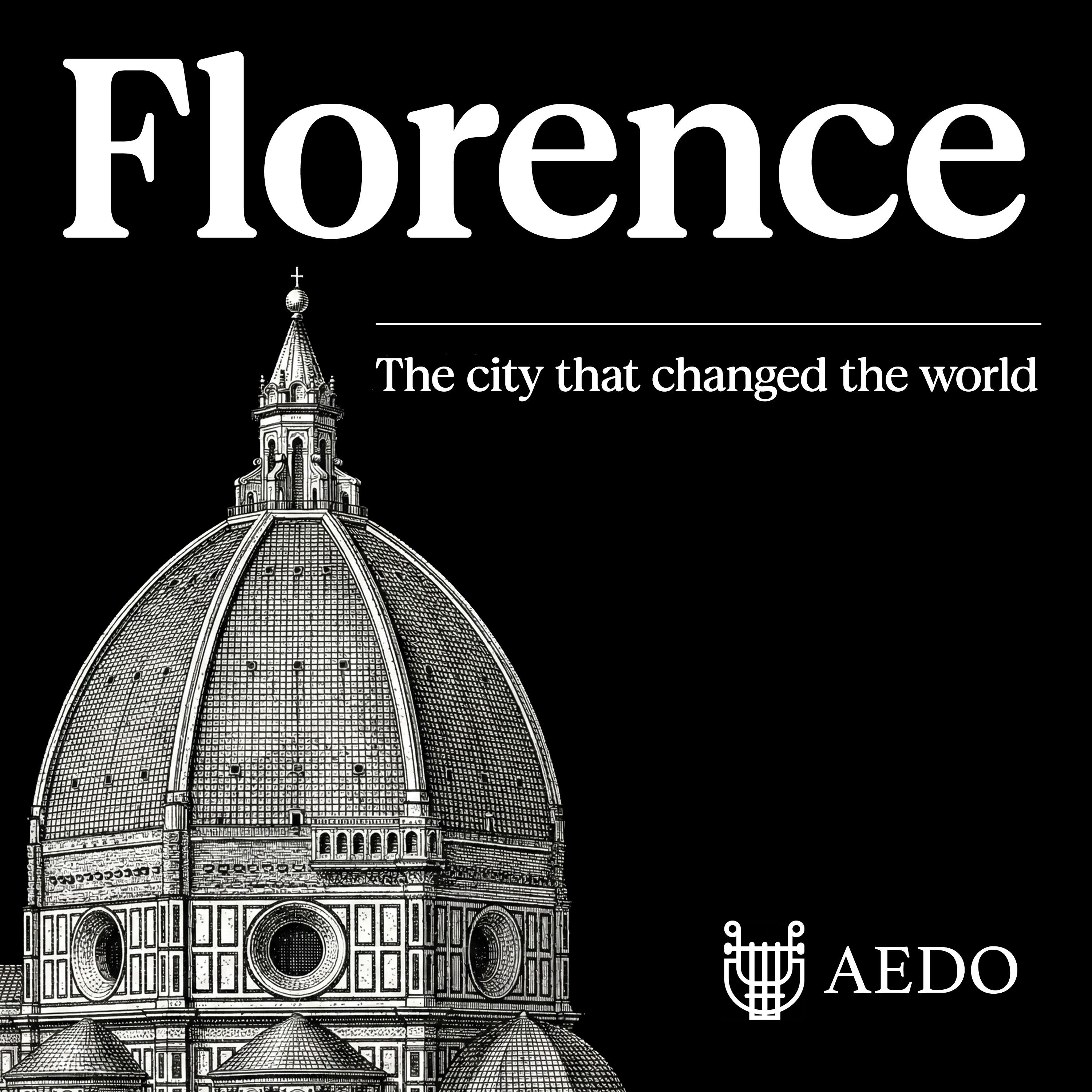
Florence: The city that changed the World
by AEDO Media
Sometime between the 13th and 16th centuries, a small city on the banks of the Arno River decided—without knowing it was deciding—to change the world.Florence produced Brunelleschi, Michelangelo, Leonardo, Dante, and Machiavelli. It invented the Renaissance, created the modern banking system, and exported ideas that are still present in everything you see and use today.This series tells that story, with the depth of a documentary and the pacing of a literary narrative.Every great story has an address. And this world began here.
-
11
Ponte Vecchio: The City That Continues
The Ponte Vecchio has stood for nearly seven hundred years. It survived the floods that destroyed it and forced it to be rebuilt. It survived the Second World War — the only bridge in Florence left standing when the Germans destroyed all the others in retreat. It survived the flood of 1966, when the Arno rose six meters and the world held its breath.No one knows exactly why the Germans spared it. The documentation is thin. What is not in doubt is that every other bridge fell, and this one did not.This is the final episode of the first season — and the story of the bridge that became a threshold between two versions of Florence: the city the world came to see, and the city the Florentines still inhabit. The butchers who were expelled to make room for goldsmiths. The Medici who crossed above it without ever touching the street. The Mud Angels who arrived from around the world in 1966 to pull paintings from the flood and save whatever could still be saved.The Ponte Vecchio does not tell the story of Florence. It is the proof that Florence continues.—Florence: The City That Changed the World is a series about the city that invented the Renaissance, financed Europe, and left a legacy still present in everything you see, think, and use every day.Don't forget to subscribe, thank you for listening, and if you'd like to support or contribute to the project, reach out through Instagram.See you in Season Two — where we leave the stages behind and turn to the characters.
-
10
Boboli Gardens: The City Seen From Above
The Medici built it to dominate nature. Nature had other plans.In 1549, Eleonora de Toledo commissioned a garden on the hillside behind the Palazzo Pitti. The architects were given a simple brief: turn a steep, unruly slope into a declaration of power. What followed were decades of terraces, fountains, sculptures, and a grotto so strange it seems to belong to a different world entirely — a cave built by human hands to look like something nature never actually made.Boboli became the model for the great gardens of Europe. Its geometry, its choreographed perspectives, its insistence that beauty is something imposed rather than found — all of it travelled north and ended up in the gardens of Versailles.But five centuries later, the trees have grown beyond any plan. The sculptures wear their moss. Buontalenti's grotto has become stranger and more beautiful with time. The garden built to prove that man controls nature ended up being shaped by it.From the top of the hill, Florence opens below you exactly as it did for Cosimo, for Lorenzo, for Michelangelo. The dome still dominates everything. The Arno still runs.Some things were built to last.-Florence: The City That Changed the World is a series about the city that invented the Renaissance, financed Europe, and left a legacy still present in everything you see, think, and use every day.Don't forget to subscribe, thank you for listening, and if you'd like to support or contribute to the project, reach out through Instagram.
-
9
Palazzo Pitti: The Palace That Outlived Everyone
Luca Pitti wanted a palace larger than the Medici's. He got it. Then lost everything — including the palace.In 1458, one of Florence's most powerful bankers commissioned a residence on the other side of the Arno designed to dwarf anything the Medici had ever built. He died before it was finished. His family fell. And in 1549, the palace built to surpass the Medici was purchased by Eleonora de Toledo — wife of Cosimo I de' Medici.What followed were five centuries of accumulation. The Medici expanded it into one of the most sumptuous residences in Europe. The Habsburg-Lorraine kept collecting after them. The kings of unified Italy moved in after that. Each left a layer. Today the Palazzo Pitti houses several museums within its walls — including a gallery where the paintings still hang exactly as the Medici placed them, floor to ceiling, without the chronological logic of modern museums. Not a museum's interpretation of the Medici. The Medici's own interpretation of themselves.This is the story of the palace that began as an act of rivalry and ended up belonging to everyone.—Florence: The City That Changed the World is a series about the city that invented the Renaissance, financed Europe, and left a legacy still present in everything you see, think, and use every day.Don't forget to subscribe, thank you for listening, and if you'd like to support or contribute to the project, reach out through Instagram.
-
8
Uffizi Gallery: The Office That Became the World
In 1560, Cosimo I de' Medici wanted to solve an administrative problem. The government of Florence was scattered across the city, and he wanted it in one place. He called Giorgio Vasari. He asked for an office building.What he got — eventually — was the Uffizi Gallery.This is the story of how a bureaucratic commission became one of the greatest art museums in the world. How a private ducal collection became public property. And how the woman who made that possible — the last of the Medici line, with no heirs and no dynastic future — turned the only act of power still available to her into a gift that belongs to everyone.The Primavera. The Birth of Venus. The Titians, the Caravaggios, the Raphaels. All of it in Florence today because of a decision made in 1743 by a woman who decided that if she could not pass it forward, no one else would take it.-Florence: The City That Changed the World is a series about the city that invented the Renaissance, financed Europe, and left a legacy still present in everything you see, think, and use every day.Don't forget to subscribe, thank you for listening, and if you'd like to support or contribute to the project, reach out through Instagram.
-
7
The Dome: The Hole That Should Have Stayed Open
Imagine arriving in Florence in the early fifteenth century and looking toward the center of the city.The cathedral is there. The walls rise. The marbles fit together with a precision that seems almost supernatural.But at the center — nothing. An open hole in the sky.For decades, one of the richest cities in the world had a cathedral that ended in a hole. The Roman techniques that made the Pantheon possible had been lost. No one in Europe knew how to close a span forty-two meters wide. In 1418, Florence opened a public competition. The proposals ranged from the impractical to the absurd.And then a goldsmith with no architectural credentials, a criminal record with his own guild, and a complete refusal to explain himself stood before the committee and said he could build it without scaffolding at all.They had no other option. They gave him the job.Brunelleschi died without revealing the whole secret. The dome holds something that only he knew.—Florence: The City That Changed the World is a series about the city that invented the Renaissance, financed Europe, and left a legacy still present in everything you see, think, and use every day.Don't forget to subscribe, thank you for listening, and if you'd like to support or contribute to the project, reach out through Instagram.
-
6
Piazza della Signoria: The Mirror That Forgot Nothing
For five centuries, the Piazza della Signoria was where Florence went when it needed to decide who it was.A republic raised its tower here to stand taller than any noble in the city. A conspiracy was punished here — not quietly, but publicly, with bodies in the windows and portraits of traitors painted on the walls for everyone to see. A friar burned books, mirrors, and paintings in an eight-story bonfire. Then, one year later, the city burned the friar in the same spot.The Medici were proclaimed here. And expelled here. The republic was celebrated here. And buried here.The Piazza della Signoria is not the most beautiful square in Florence. It is the most honest one — a place that never chose sides, never romanticized, never hid the traces. It just kept accumulating everything the city was willing to do in public.This is the story of the square, the palace that was a fortress, the sculptures left in the rain, and the small plaque in the pavement you can step on without noticing — marking the exact spot where a man who tried to rewrite Florence was burned by the city he tried to save.—Florence: The City That Changed the World is a series about the city that invented the Renaissance, financed Europe, and left a legacy still present in everything you see, think, and use every day.Don't forget to subscribe, thank you for listening, and if you'd like to support or contribute to the project, reach out through Instagram.
-
5
David: The Stone That Already Held Everything
In 1464, a block of marble arrived in Florence that no one knew what to do with. Two sculptors tried. Both gave up. For decades, it sat in a courtyard — exposed, abandoned, already cut in ways that limited everything.In 1501, a grumpy, antisocial twenty-six-year-old who slept in his clothes and quarreled with everyone was handed the commission no one else wanted.What Michelangelo saw when he looked at that stone was not a problem. It was a figure waiting to be freed — a young man caught in the moment before the fight, hand tensed, eyes fixed on something larger than himself. The result was not just the most famous sculpture in the world. It became the self-portrait of an entire city trying to believe in itself.This is the story of the David — the stone, the man who carved it, and the republic that placed it at the center of everything.-Florence: The City That Changed the World is a series about the city that invented the Renaissance, financed Europe, and left a legacy still present in everything you see, think, and use every day.Don't forget to subscribe, thank you for listening, and if you'd like to support or contribute to the project, reach out through Instagram.
-
4
The Medici, Part III: The City Devours Its Masters
The Medici had ruled Florence for sixty years. They were the family the city couldn’t imagine losing—until the moment it decided to discard them like something that no longer served a purpose.When Lorenzo the Magnificent died in 1492, he left behind a son with his name and his palace, but none of his judgment. In a single moment of weakness before a French King, the decades of patient diplomacy built by his ancestors vanished. Within hours, the family was received with stones and driven into exile.This is the final chapter of the Medici trilogy—a story of a power vacuum filled by a radical friar, a city that burned its own treasures in the "Bonfire of the Vanities," and the eventual realization that while Florence could exile its masters, it would forever keep their inheritance.-Florence: The City That Changed the World is a series about the city that invented the Renaissance, financed Europe, and left a legacy still present in everything you see, think, and use every day.Don't forget to subscribe, thank you for listening, and if you'd like to support or contribute to the project, reach out through Instagram.
-
3
The Medici, Part II: Lorenzo, The Flame That Burned Too Bright
Lorenzo de' Medici: The Flame That Burned Too Bright.The Medici were already in power. The hard work had been done — the invisible networks, the quiet loyalties, the patience of decades. All Lorenzo had to do was not ruin it.He decided to make it immortal instead.This is episode two of the Medici arc — the story of Lorenzo, the man who turned his family's invisible power into the most brilliant court in Europe, and paid for it with everything Cosimo had built to last.-Florence: The City That Changed the World is a series about the city that invented the Renaissance, financed Europe, and left a legacy still present in everything you see, think, and use every day.Don't forget to subscribe, thank you for listening, and if you'd like to support or contribute to the project, reach out through Instagram.
-
2
The Medici, Part I: Cosimo, The Man the City Went to Find
The Medici were not at the top of Florence. They had no noble blood, no military tradition, no name that opened doors. They had come from the Mugello valley like so many other families — and no one would have bet on them.That was exactly what made them dangerous.This is episode one of the Medici arc — the story of Cosimo, the man who learned that declared power creates enemies, and invisible power creates dependents.-Florence: The City That Changed the World is a series about the city that invented the Renaissance, financed Europe, and left a legacy still present in everything you see, think, and use every day.Don't forget to subscribe, thank you for listening, and if you'd like to support or contribute to the project, reach out through Instagram.-*Correction: at the end of the episode, the hook refers to our next character, Lorenzo, as a son, but as you will notice, he is actually Cosimo's grandson and the successor following his father Piero's brief time in power.
-
1
The River, the Wool, and the Money
Before the Medici. Before the Dome. Before the David.There was a small city on the banks of a river that processed wool, lent money, and survived its own internal wars. A city that lost half its population in a spring of plague and remained standing. That forged a republican identity in the fires of adversity and accumulated—without yet knowing what it was accumulating—everything it would need to change the world.This is episode one — the world before it all began.-Florence: The City That Changed the World is a series about the city that invented the Renaissance, financed Europe, and left a legacy still present in everything you see, think, and use every day.Don't forget to subscribe, thank you for listening, and if you'd like to support or contribute to the project, reach out through Instagram.
We're indexing this podcast's transcripts for the first time — this can take a minute or two. We'll show results as soon as they're ready.
No matches for "" in this podcast's transcripts.
No topics indexed yet for this podcast.
Loading reviews...
ABOUT THIS SHOW
Sometime between the 13th and 16th centuries, a small city on the banks of the Arno River decided—without knowing it was deciding—to change the world.Florence produced Brunelleschi, Michelangelo, Leonardo, Dante, and Machiavelli. It invented the Renaissance, created the modern banking system, and exported ideas that are still present in everything you see and use today.This series tells that story, with the depth of a documentary and the pacing of a literary narrative.Every great story has an address. And this world began here.
HOSTED BY
AEDO Media
CATEGORIES
Loading similar podcasts...
Frequently Asked Questions
How many episodes does Florence: The city that changed the World have?
Florence: The city that changed the World currently has 11 episodes available on PodParley. New episodes are automatically indexed when they're published to the podcast feed.
What is Florence: The city that changed the World about?
Sometime between the 13th and 16th centuries, a small city on the banks of the Arno River decided—without knowing it was deciding—to change the world.Florence produced Brunelleschi, Michelangelo, Leonardo, Dante, and Machiavelli. It invented the Renaissance, created the modern banking system, and...
How often does Florence: The city that changed the World release new episodes?
Florence: The city that changed the World has 11 episodes. Check the episode list to see recent publication dates and frequency.
Where can I listen to Florence: The city that changed the World?
You can listen to Florence: The city that changed the World on PodParley by clicking any episode. We provide an embedded audio player for direct listening, and you can also subscribe via your preferred podcast app using the RSS feed.
Who hosts Florence: The city that changed the World?
Florence: The city that changed the World is created and hosted by AEDO Media.
URL copied to clipboard!