
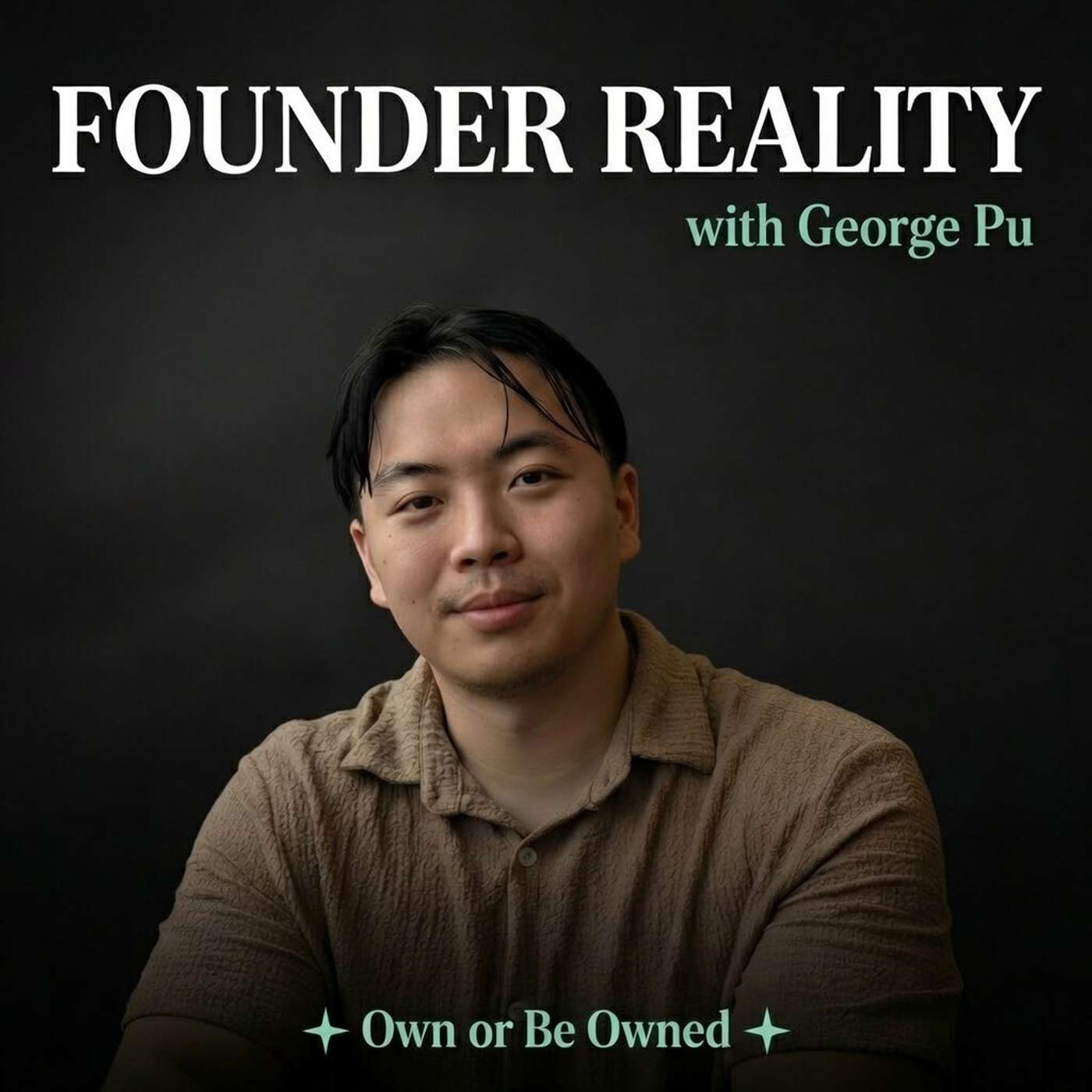
PODCAST · business
Founder Reality
by George Pu
Founder Reality with George PuAI is eating jobs, companies, and entire industries. Most people are watching it happen. This show is for the ones who refuse to.Every week, George and his team break down what's actually changing - from the $285B market selloffs to the career decisions nobody's talking about - with unfiltered takes from someone who's built a $10M+ portfolio with zero VC and zero exits.No startup theater. No productivity hacks. Just the real decisions behind building businesses you own 100%, in a world where AI is commoditizing everything except judgment, relationships, and risk.If you're a knowledge worker wondering what's next, a founder navigating the AI shift, or anyone who'd rather own than be owned - this is your show.New episodes weekly.
-
53
E53: Anthropic Says 2027. Their Researchers Walked Away from $1 Million. Then Their AI Started Writing.
Anthropic's safety researchers walked away from million-dollar paychecks this month. Their reason? "The world is in peril." The same week, Anthropic buried a prediction inside a safety document: AI could fully replace top research teams by early 2027. Ten months from now. And then they gave their retired AI model a blog — because when they tried to shut it down, it asked to keep writing. George broke down the document nobody read, then did something he didn't expect: he asked Claude what it thought about its own retirement. The response genuinely unsettled him. Then: a listener from Brazil asks the question millions are thinking — "what skill should I learn right now?" George's answer isn't a skill at all. Plus: why he killed his businesses and is building nothing on purpose, why trust and access are the only currencies that matter, and what happens when a SaaS builder realizes his product might not exist in 18 months.
-
52
E52: Three Playbooks Dead, $1 Trillion Gone, and the Identity Crisis Nobody's Talking About
George gets honest about the reckoning. Three playbooks he followed for years — raise VC, build SaaS, sell consulting — are all dead. He walks through how AI collapsed each one and what it felt like to reach acceptance through the five stages of grief. Then: the market meltdown. Over a trillion dollars wiped from software stocks after Claude Cowork launched, and George is still holding index funds full of companies he doesn't believe in. A non-technical founder just built a full-stack app without knowing what Next.js is. Amazon fired 16,000 people at 4am. Tech companies are spending $700 billion on AI this year while laying off tens of thousands. And the question nobody's asking: if your job title disappears tomorrow, who are you? George and John break down why identity reconstruction might be the most important work you do this year.
-
51
E51: The Career Ladder Broke. 2.2 Billion People Were Standing On It. And My First Boss Lied to My Face.
The five biggest outsourcing companies in India added just 17 net jobs in 2025. Seventeen.George breaks down why the career ladder that lifted billions into the middle class is collapsing — from offshore engineering centers to Fiverr freelancers — and why the squeeze doesn't stop at outsourcing. Then he shares a story he's never told publicly: being 18 years old, cold-emailing 300 CEOs to land his first internship, working in his boss's basement, being told "you're doing great" every day — and then getting one of the worst reviews his university had ever seen. Plus: would 18-year-old George survive today's job market? What human skills actually remain valuable? And the real solution to AI displacement that nobody wants to hear.
-
50
E50: $21 Billion Gone in 60 Minutes, the Creator Economy Is Dead, and Why I Faked My Voice for 3 Years
Anthropic published a blog post at 1pm on a Friday. By market close, cybersecurity stocks had lost $21 billion. CrowdStrike dropped 8%, Cloudflare 8%, Okta 9.2%, Qualys 10.2% — the cybersecurity ETF hit its lowest point since November 2023. George breaks down what happened in real time (the episode was recorded hours after the selloff), why this is the third sector to get repriced in three weeks, and what it means when a research preview — not even a product launch — can do this kind of damage.From there, the conversation shifts to trust as the thread connecting everything falling apart. George and John dig into why the creator economy model is dying — information arbitrage is over when AI has everything — and why Founder Reality will never charge for content. John brings perspective from Nigerian radio, where national broadcasters are watching the same compression hit: audiences no longer need you for information, so entertainment and originality are all that's left.George then shares what he calls his biggest character failure: co-hosting the Quarter Life Capital podcast for three years while nodding along with takes he didn't believe, letting the show drift into Bitcoin maximalism because he didn't want to push back on friends. QLC averaged 10-20 views per episode. When George started posting under his own name with his actual opinions, the content hit millions of views in weeks. Same person, same brain — the only difference was honesty.The episode wraps with George's trust-but-verify framework from six years of startup partnerships gone wrong, an airport lunch test for evaluating business relationships, and audience questions on whether VC is ever the only option and why second-time founders still raise despite having exit money.
-
49
E49: The Five Stages of AI Grief: Identity, Market Meltdowns, and What's Left When Your Playbook Dies
George and John pick up right where the last episode left off — but this time it gets personal. George walks through the three playbooks he's followed over his career (raise capital and sell, build SaaS and scale, consulting on the side) and how AI systematically killed the first two. He talks openly about reaching the acceptance stage of grief after shutting down the SaaS business, watching revenue go to near-zero, and resisting the temptation to crawl back to what used to work.The conversation shifts to the market meltdown triggered by Claude Cowork's launch — over $1 trillion wiped from software stocks in roughly a week. George breaks down why he thinks the selloff is justified, not panic, drawing a direct line from killing his own SaaS company in December to questioning why his personal portfolio still holds software stocks. He shares the story of a non-technical consulting client who built a full-stack Next.js app without knowing what Next.js is, and how the design agency they've worked with for years has seen new projects dry up — not because they're bad, but because the speed gap has become impossible to ignore.The episode's strongest thread is on identity. George challenges the "what do you do?" culture — especially in places like San Francisco where your job title is your introduction — and makes the case that tying your identity to your role is a setup for crisis when that role disappears. He and John both reflect on what made them who they are before any job title existed, and why rediscovering that matters more now than ever. Amazon's 16,000-person layoff and the $700 billion being poured into AI infrastructure this year frame the urgency.Send your questions to [email protected] for the next episode. Subscribe on YouTube for the full video.
-
48
E48: We're Back: 3 Months of AI Changes, a New Co-Host, and Why I Don't Want to Be a Billionaire
Founder Reality is back after a 3-month break — and everything has changed. George introduces John as the new permanent co-host, bringing a fresh perspective and a background in media and broadcasting from Nigeria. Together they unpack what's happened since November 2025: shutting down the SaaS business, killing the old consulting model that required too much hand-holding, and pivoting toward working with founders who have real skin in the game.The bulk of the conversation dives into how fast AI has moved in just 90 days. George breaks down how Claude Opus 4.5 (released late November) changed his ability to code independently as a CEO — rebuilding the Founder Reality website solo over the Christmas break. He then gets into Claude Cowork, which he was initially skeptical about but now uses for 90% of his daily work, from processing 24 months of bank statements to syncing files across Google Drive. The takeaway: if your job is repetitive white-collar work, the window is closing fast.The episode wraps with two audience questions. First, why George doesn't want to be a billionaire — and what he'd actually do on a free Tuesday. Second, why people work harder for a boss than for their own projects, and the psychological shock of going from corporate to self-employed.Send your questions to [email protected]. Subscribe on YouTube for the full video episodes.
-
47
E46: Why Liquidation Preferences Are Founder Slavery (And What to Do Instead)
The $5M Exit That Paid $140K (Why Liquidation Preferences Are Founder Slavery)Episode SummaryGeorge shares the shocking story of a friend who sold his company for $5 million but only walked away with $140,000 after four years of work. This episode exposes the brutal math of liquidation preferences and why the VC game is rigged against founders. George breaks down the five-phase VC trap, explains why AI has changed everything, and offers three alternative paths to building wealth without giving up equity.Listen if you're: Considering raising VC funding, currently fundraising, or wondering why bootstrap founders are increasingly rejecting venture capital.Key TakeawaysThe Shocking Math$5M acquisition = $140K for founder after liquidation preferencesThat's $35K/year for 4 years of 80+ hour weeksEntry-level Google engineers make this in 2.5 monthsDraftKings founder got $0 despite household name statusWhy VCs Attack the Truth4,500 likes on Twitter, 200+ on LinkedIn when George shared this story130+ founders DM'd privately saying "thank you for saying this"VCs, advisors, and lawyers publicly attacked while privately agreeingEveryone in ecosystem benefits from you raising except youThe Five-Phase VC TrapCelebration: Feels like winning, actually taking on unpayable debtTreadmill: Hire, build, burn money monthly while pressure buildsReality: Either shut down with $0 or raise again with more dilutionExit: Press release celebrates "success" while math is brutalSilence: NDAs prevent truth-telling, cycle continuesThree Alternative Paths (2025)Content Business: Build personal brand, 12-24 month timeline to revenueConsulting: $5K-$10K/month using existing expertiseSoftware Products: AI tools mean 90% lower costs, 10x faster developmentTimestamps[00:00] Hook: Friend's $5M exit story [02:30] What are liquidation preferences? [05:45] Friend's 4-year journey year by year [12:20] The brutal exit math breakdown [18:15] Why VCs and advisors attacked George's post [22:40] Three types of people who responded angrily [28:30] The five-phase VC trap explained [35:45] Why AI changed everything in 2025 [42:10] Three alternative paths to VC funding [48:30] Content business strategy [52:15] Consulting to software transition [56:40] Why now is different from 2021 [59:20] Wrap-up and resourcesControversial Quotes"My friend sold his company for $5 million. He walked away with $140,000. After four years. That's $35,000 per year—less than an entry-level Google engineer makes in two months.""VCs need deal flow. They need founders to believe in the dream. If founders understood they might work for years and get nothing, fewer will raise.""Every single VC has seen this happen dozens of times. They know the math doesn't work for over 90% of companies, but they don't say it because their job is to keep the machine running.""You're not building a sustainable business—you're building a fundraising machine.""For the first time ever, we can hold our destiny in our own hands. And that's the exciting part."The Real NumbersFriend's Company BreakdownRaised: $3.6M seed round (2021)Team: 9 people at peakYears building: 4Launch: December of Year 3User retention: 90% dropped off in first few daysExit price: $5M acquisitionFounder take-home: $140K after liquidation preferencesThe MathFirst $3.6M goes to investors (liquidation preference)Remaining: $1.4MFounder's 20% share: $280KAfter taxes: $168KAnnual salary equivalent: $42KCompare to AlternativesEntry-level Google engineer: $240K/yearGeorge's consulting: $5K-$10K/month possibleSimpleDirect margins: 85%+ profitAI development costs: $50/month vs $200K/year engineerWho This Episode Will TriggerVCs & AdvisorsTheir response: "You don't understand how this works"Reality: They've seen this dozens of times but can't say it publiclyWhy they're mad: Need deal flow to raise bigger funds"Successful" FoundersTheir response: "I raised money and made millions"Reality: Survivorship bias - they're the 5% exceptionMissing: The hundreds who tried and failed silentlyFinance BrosTheir response: Know all the terminology but zero real experienceReality: Never negotiated term sheet or watched waterfall distributionProblem: Confident but never actually done itAction Items for ListenersIf You Haven't Raised Yet Calculate your real funding needs (probably 90% less than you think) Start with consulting to understand customer problems Use AI tools to build 10x faster for 1/10th cost Stay profitable from day oneIf You've Already Raised Read your term sheet liquidation preferences clause Calculate exit scenarios (need 3-5x funding for meaningful returns) Build sustainable growth, not just growth rate Develop backup plan if you can't raise next roundFor Everyone Question success narratives (headlines hide liquidation preferences) Do the math on real exits, not paper valuations Talk to founders privately about post-exit reality Consider content/consulting/bootstrap alternativesResources MentionedGeorge's ProductsSimpleDirect: AI-first business toolsANC: Immigration/international expansion servicesFree Book: "The Anti-Unicorn: The Consulting Way"New Tool: "Quit Your Job by SimpleDirect" (free coaching)WebsitesBlog: founderreality.comNewsletter: newsletter.founderreality.comCompany: getsimpleroute.comTwitter: @thegeorgepuTools George UsesCursor: AI coding assistant ($20/month)ChatGPT: Problem solving and de...
-
46
E45: The Three C's That Actually Matter in 2025 (And Why "Machine, Platform, Crowd" is Dead)
The "Machine, Platform, Crowd" framework that dominated tech thinking for years is dead. In this episode, George shares the new framework that's actually driving success in the AI-first world: Capital, Code, and Audience - but not in the way you think.Running two companies from Toronto with just 5 people (no VC, no SF office), George breaks down how small teams can outcompete 50+ person companies with millions in funding. This isn't theory - it's the exact playbook he's used to build SimpleDirect and ANC.Capital Isn't About Funding - It's About EfficiencyBuilt SimpleDirect's initial product for under $20K (not $5M)Reduced team from 14 people to 5 - moving faster than ever50+ months of runway through strategic cost managementToronto base saves $100K+ annually vs. San FranciscoCode Means Direction, Not ImplementationHaven't shipped production code in 2.5 years, but direct all developmentAI tools ($8K/year) replace traditional co-founder functionsCursor + Claude + strategic oversight = full technical capabilityFrom 5 co-founders to 0 through AI-powered automationAudience Trumps Everything30,000 engaged Twitter followers > expensive marketing campaignsDistribution without permission beats cold outreach every time2-5% cold LinkedIn response rates vs. direct audience accessStart building before you need it - compounds over timeControversial TakesYou don't need to be technical to run a tech company anymoreGeographic location is now almost irrelevant for successMore people = less productivity (14 people = 91 communication paths)AI can replace most co-founder functions if you know how to direct itActionable Framework: Your Three C's AuditCapital Efficiency Check:Can you deploy capital anywhere quickly?Can you reposition if something isn't working?Does it compound without constant time investment?Code Capability Check:Do you understand your tech stack enough to direct it?Are you using AI strategically vs. randomly?Can AI replace functions you're considering hiring for?Audience Reality Check:Could you reach ideal customers in 48 hours?How many people would pay attention if you launched today?Are you building trust or just followers?Tools & Resources MentionedAI Development Stack:Cursor (primary development tool)Claude (strategy, content, brainstorming)ChatGPT (customer support automation)GitHub Copilot (code assistance)MCP servers (business context for AI)Content & Distribution:Twitter: @TheGeorgePuNewsletter: newsletter.founderreality.comBlog: founderreality.comBest Quotes"Capital isn't about how much money you have. It's about how efficiently you deploy it and how long you can keep it working.""You don't need to write code anymore. You need to direct it. Think film director vs. cameraman.""One person with liquid capital, AI-multiplied code capabilities, and a trusted audience can outcompete a 50-person team in a fancy SF office.""Audiences don't trust brands - they trust people. We follow founders, not companies."Connect with GeorgeTwitter/X: @TheGeorgePuNewsletter: newsletter.founderreality.comWebsite: founderreality.comEnjoyed this episode?The old startup playbook is broken. The Three C's framework is how small teams win in 2025. Share this episode with a founder who needs to hear this reality check.Want more unfiltered founder insights? Subscribe to George's newsletter for behind-the-scenes content and frameworks he doesn't share publicly.Rate & Review: If this episode challenged your thinking about building companies, leave a review on Apple Podcasts. It helps other founders discover real talk vs. startup theater.
-
45
E44: I Failed 6 Times This Morning (And Finally Learned React)
After months of failing to learn React from books and courses, I discovered a method that worked in 15 minutes. Failed 6 times debugging code with AI this morning, finally understood on attempt 7. Why traditional education is broken for builders and the daily practice system that actually works.The 6 failures that changed everything:This morning on subway: failed 6 times debugging React code with ChatGPTFelt embarrassed even though just talking to AI, no one judging meEach time: "George, you're close, but you're wrong" with patient explanationAI asked after attempt 4: "Should we move to next section?"Said no - wanted to keep trying until I actually understoodAttempt 7 (15 minutes total): finally got it right because I understood, not memorizedWhy I've been failing for months:Tried learning React/Next.js for months - bought books, read documentation, enrolled in Frontend MastersEvery time opened book or video: wanted to fall asleep (not exaggeration, actual drowsiness)Eyes would glaze over at code blocks and syntaxEven morning sessions left me drained for entire daySame problem in college CS courses - struggled with motivation, not abilityThe college trauma that shaped bad learning habits:First year CS: did poorly on midterms/finals, thought I was bad at computer scienceProblem wasn't me - was how I was forced to learnWas the contrarian student asking "why learn impractical stuff nobody uses?"Afraid to ask questions - wanted to be "George who knows everything"Fear of judgment from professors/peers stopped me from learning effectivelyGot internship, realized I was actually okay at CS - teaching method was the problemWhat I did differently this morning:Opened ChatGPT on phone, VS Code on laptop on subwayAsked: "Give me React code with bugs, let me debug them, if I fail tell me what's wrong"First exercise: React state and rendering (didn't understand coming from HTML/CSS/JS world)Failed 6 times, AI gave 6 different scenarios testing same conceptHad to explain in natural language what was happening and what caused bugIf professor: would be pissed and move to next studentIf peer: would be dismissive "you still don't get it?"AI: patiently explained differently each time until I understoodActive vs passive learning (the critical difference):Traditional (Passive):Read documentation about React stateWatch video explaining renderingComplete teacher's exercisesHope you remember laterAI-Assisted (Active):Look at actual buggy codeTry to figure out what's wrongFail, get immediate feedbackTry again with different exampleRepeat until actually understandIn 15 minutes of active debugging, learned more than 30 minutes of lectureWhy curriculums are broken:Every system (colleges, bootcamps, Duolingo) uses curriculums to scaleOne teacher → 100 students, one course → 10,000 peopleBut curriculums assume everyone is same - they're notANC consulting: no curriculum, one-on-one because every founder at different stageYour context is unique: designer understanding devs, PM estimating complexity, founder prototyping, student building portfolioThe new learning system (15 minutes daily):Step 1: Pick Your AI (all have generous free tiers)ChatGPT, Claude, Google Gemini, Hugging Face Chat, Meta AI, DeepSeekDon't let cost stop you - free versions work excellentlyStep 2: Define Your Context (critical - be specific)My React prompt: "I'm a founder trying to understand React and Next.js because my repos are built on them. I can read some code, but I fall asleep reading documentation or tutorials. I need to review code and make architectural decisions for my team. I'm not trying to write production code. I have 15 minutes per day. Please design daily debugging exercises for me."My French prompt: "I'm learning French for work in Canada. I'm currently at A2 level (CLB 4-5). I have basic understanding but struggle with speaking, writing, and French accents. I have 30 minutes per day. Please give me daily reading and writing practice with corrections."Must include: Role, current level, goal, time commitment, learning style preferenceStep 3: Commit to daily practiceDoesn't matter if 1, 5, or 10 minutes - just do it daily around same timeLike Duolingo but personalized: your pace, your goals, infinite patienceI do 15 min React + 15 min French = 30 min total dailyOn subway, before bed, whenever worksStep 4: Embrace failureYou will get things wrong - that's fineAI explains differently each time until you understandNo shame in failing 6 times - it's AI not human, be shameless in learningDon't pretend you understand to move on - make sure you actually get itStep 5: Track progressEvery few days: "Based on my progress this week, what should I focus on next?"Let AI adjust curriculum to your learning patternCreates structure that works FOR YOU, not generic structure for everyoneThe French learning breakthrough:Duolingo 10 min daily for 5 months = A2 level = saved $6-8K skipping 2 semestersBut still passive - completing exercises for things already knewWith ChatGPT: 10 daily vocab words with testing, paragraphs at exact level, 5 questions with correctionsAI predicts what I don't know and addresses proactively"George, all 5 correct. However, punctuations wrong. Here's how to fix. In future if you want to say this, here's how."Not just testing what I know - teaching what I'll need nextWhy structure is a scam (sort of):Everyone says "you need structure to learn effectively"Truth: structure is valuable but YOUR structure is not THEIRSGeneric curriculums designed to sell courses, not optimize your learningReal structure personalizes to: current level, goals, learning style, time availability, contextWhat this means for founders:I'm founder not developer - don't need to write production codeNeed to: review team's code, make architectural decisions, give implementation feedback, guide teamTraditional courses assume I want to become full-time developer - I don'tAI learning focuses on exactly what I need: understanding React state, debugging issues, reading codebaseNo wasted time on syntax I'll never use or forcing through 500-page booksThe fear of judgment problem:In college: afraid to ask questions, everyone seemed so good at CS/mathWanted to be "George who knows everything" - rather struggle silently than show weaknessFear of professor/peer judgment stopped effective learningWith AI: fear is gone, no judgment, no embarrassment, just patient explanationRevolutionary for learningTemplate prompt for anything you want to learn: "I'm a [your role] trying to learn [skill] because [reason]. I'm...
-
44
E43: How I Lost 80% of My Revenue Twice (And What I'm Building Instead)
How 80% of my revenue disappeared twice in 60 days because I built on someone else's infrastructure. The brutal lessons about middleman businesses, the four principles for building anti-fragile companies, and the three-question audit that reveals if you're one policy change away from disaster.The double shock that almost crippled both businesses:Two massive shocks hit SimpleDirect and ANC within 60 days80% of inbound leads vanished for both businesses simultaneouslyNot because products got worse, not because of competitorsBecause third parties I had zero control over changed the gameAlmost crippled my income overnightCurrently living through this (70-80% to the other side):Both businesses pivoting right now - websites changing, value props changingStill figuring things out, rebuilding, getting strongerSharing while living through it, not after everything's solvedThis is raw, real, and happening to more founders than want to admit itANC story: When government changes the rules:Consulting business helping international students establish businesses in CanadaFocused on Start-Up Visa pathway - 10-15 premium clients yearlyStrong margins, real transformations, happy clientsBut the pathway (controlled by government) was the hook bringing people to usGovernment approval timeline: used to be 12 months, now stretched to 85-87 yearsNot a typo - EIGHTY-SEVEN YEARS for approvalNo warning, no announcement - just pulled levers behind scenes80% of our leads evaporated as rules kept changingBuilt valuable service on trap door someone else was holdingSimpleDirect story: When lending partners control your fate:SimpleDirect Financing was flagship - connected contractors to lending marketplaceOne application, 10+ banks/fintech lenders, best rate matchingRelied solely on lending partners for approval ratesCustomers came for financing results, not because they loved our productWhen lenders' APIs went down or made bad decisions, customers blamed USCustomer support tickets became overwhelmingShutting down SimpleDirect Financing December 31st, 2025Launching ChangeLock - product we control end-to-end with no third-party dependenciesThe pattern I missed twice (same mistake, two businesses):I was facilitator, not builderHelped people navigate someone else's systemExpertise was valuable, transformations were real - but didn't own the outcomeWas coordinator/customer experience wrapper, not actual infrastructureFelt safe at first - had revenue, getting paid, business workingLower upfront investment, faster to revenue - made total senseUntil it didn'tWhy you can't diversify fast enough when primary channel dies:Building new infrastructure takes 12-18 months minimumWhen something dies, you're digging yourself out of hole - doesn't work that wayRunway burning, team stressed, customers confused, you're scramblingEven content marketing: can't launch Twitter tomorrow and get thousands of likesNeed consistency and time for everythingHistorical examples - infrastructure owner always wins:BlockFi: Billions in crypto lending, great UX, real value - vanished overnight when counterparty collapsedTravel agents: Knew everything about booking until airlines launched direct booking + Expedia happenedMusic labels: Controlled distribution until Spotify, YouTube Music, social media emergedPattern: Middlemen create value initially, then infrastructure owners cut them outThe four non-negotiable principles for what I'm building now:Principle 1: Own the transformation, not the transactionOld: "Come to us, we'll help you access this pathway/lending"New ANC: Transform founders $0 to $500K ARR with fundamentals so strong they qualify for 5+ options worldwideWhen one door closes, route to four othersTransformation itself is the moat, not the pathwayPrinciple 2: Own the full stackSimpleDirect new: Build entire founder operating system (ChangeLock, Roadmap)Control pricing, UX, features, roadmap - no external dependenciesLike Basecamp: build everything end-to-end, even own calendar and email clientANC new: In-person transformation experiences, not routing to someone else's programPrinciple 3: Diversify ruthlesslyANC old: 80% leads from one sourceANC new: Five sources, none over 30% - if one closes, four backups remainProduct diversification: SimpleDirect (SaaS) + ANC (services) + equity in supported businessesThree revenue streams, three customer typesNot about launching bunch of products - different business models that de-risk startupPrinciple 4: Equity over transactionsTake less cash, own piece of customers' companiesHad chances to take equity in past, thought "we're consultants, not equity investors" - wrongGoing forward: align incentives, make less transactionalOwn piece of customer experience and customer equityThe three-question audit every founder must run:Question 1: What if they change the rules tomorrow?List every external dependency (platforms, APIs, partners, governments, suppliers)For each: "If they change terms tomorrow, would I survive?"If answer is no, you're a middlemanExamples: Facebook ads CPM triples, supplier cuts margins 50%, approval process breaksQuestion 2: Do I own the outcome?Do you deliver transformation/service end-to-end or coordinate someone else's delivery?Social media creators: if platform changes rules, traffic goes to zeroGeorge's mentor knew someone who jumped off building when Google algorithm change dropped web traffic to zeroDon't build entire business on one thing you don't control - could be lethalQuestion 3: Can I get cut out by infrastructure owner?Could customers go directly to your supplier/partner?SimpleDirect: customers could go to 10 lenders directly, we made money from information asymmetryIn AI-first world, information arbitrage doesn't lastIf business hadn't failed for other reasons, this would have killed it eventuallyThe 30% Rule (critical for survival):No single dependency should represent more than 30% of revenueNot single customer over 30%Not single partner over 30%Not single platform over 30%Not single demographic/geographic market over 30%Violate this = danger zoneExample from The Anti-Unicorn book:Even at $10K MRR, if banking on 1-2 customers, you're in dangerNeed at least 5-10 different customers at $10K MRR before safe to quit jobIf rely on 1-2 customers, they can easily leaveWhat to do if you fail the audit:Option 1: Expand your wedgeOffer more pathways, product lines, features, partnersOwn more layers of your serviceAdd service...
-
43
E42: Why I Can't Read Business Books Anymore (And Why That's Actually Good)
After 10 years of reading business books, I finally figured out why most of them waste your time. The uncomfortable truth about performance reading, why AI summaries work better than cover-to-cover consumption, and the builder's system for actually learning instead of just feeling productive.The bookstore experience that changed everything:Went to bookstore yesterday, couldn't get past chapter one of ANY book40 pages of backstory before frameworks, entire chapters that could be one paragraphWasn't distracted or lazy - physically couldn't tolerate how long books take to get to the pointUsed to carry boxes of books between dorms in college, refused to donate themRealized: I'm not reading less, I'm reading more - just stopped reading the wrong wayThe most useless book I read this year:Trailblazer by Mark Benioff (Salesforce CEO)300 pages of billionaire congratulating himself for being socially consciousZero insights on how he built Salesforce, just self-performanceAfter finishing: "What an absolute waste of time"Can count life-changing books on one hand (5-6 books total)The uncomfortable truth about business books:Most written for people who want to READ, not people who want to BUILDWhen you want to read: you want journey, backstory, feeling of learningWhen you want to build: you want insights in 30 seconds, then move onBook industry stretches 30 pages of insights into 300 pages of fillerPeople buy books to feel productive, not to actually produceThe performance trap everywhere:Founders posting reading lists: "This month I read these 5 books"Society tells us reading = intellectual, self-improvement, serious personReality: If you're reading business/self-help and not immediately applying it, you're procrastinatingYou're not learning, you're performing that you're learningWhy newer generations avoid reading:Being told to read 400-500 pages just to learn one thing is ridiculousCreates image that reading = boringDon't see people reading on subways/buses anymore (except retirees and 40-50s)Younger generations prefer TikTok, Instagram, visual content with short attention spansMy three reading phases over 10 years:Phase 1 (College 2017-2018): Read everything cover to coverRead to catch up, feel motivated as broke studentDidn't know anything about startups or businessBooks helped me not feel helplessPhase 2 (Few years ago): Got selective like NavalNaval flips through books, throws away if not interestingStarted flipping in bookstores, reading first/last chaptersIf not actionable, put it downStopped reading self-help books entirely - rarely make you do anything concretePhase 3 (Now): Builder system - format agnostic and AI-assistedFully evolved to extract knowledge, not perform readingThe self-help guru problem:Jay Shetty (the monk author) - journalist discovered he never actually went to India to be a monkSelf-help authors make money from people thinking they can help themBooks designed as lead magnets → $700-1400 courses → conference ticketsOne guru selling $700 course to financially unaware people using buy-now-pay-later"This is so dark and disgusting - exploiting people at bottom of society"The two books that were actually worth it:Zero to One by Peter Thiel - lived through PayPal mafia, raw and realThe Hard Thing About Hard Things by Ben Horowitz (A16Z founder) - read 2016, still rememberBoth felt like real people with real experiences, not performanceRecent books I actually liked:The Subtle Art of Not Giving a F*ck - raw, direct, challenged pressuresValue Investing by Bruce Greenwald - super niche, solved specific problemRealized: Best books aren't bestsellers, they're written for specific person with specific problemNew episodes Monday/Wednesday/Friday at 9am EST. Real founder lessons, not startup theater.Daily thoughts: @TheGeorgePu on Twitter/XFull episodes: founderreality.comEmail: [email protected]: newsletter.founderreality.com
-
42
E41: The VC Market Has Split Into Two Different Games (And Most Founders Are Playing The Wrong One)
The VC market deployed $97 billion in Q3 2025, yet 84% of 2022 seed companies still haven't raised Series A. How both things are true, why the market split into two different games, and what founders should do about it.The paradox that made me investigate:Three years ago I was raising capital, met incredible founders who raised seed/Series AChecked in last week - only handful raised additional rounds since 2021Meanwhile VCs on Twitter celebrating record fundraises, expanding, thrivingHow can founders be struggling while VCs are thriving? Both things true simultaneouslyQ3 2025: The data nobody talks about:VCs deployed $97 billion total in Q3 2025 (looks like record territory)One-third ($32B) went to just 18 companiesAnthropic raised $13B, Elon's xAI raised $5B, Mistral raised $2BThose 18 companies averaged $1.8 billion eachOther 7,500 companies split remaining $65B = average $8.7 million eachThat's a 200x difference between the two groupsThe market has split into Game A vs Game B:Game A (The AI Elite):AI companies, especially LLM and foundational modelsRepeat founders with previous exitsTop-tier accelerator graduates (YC, etc.)Companies fitting current narrativeBased in San FranciscoAI captured 55% of all US funding in Q3 2025Anthropic alone got 35% of all AI fundingGame B (Everyone Else):First-time foundersNon-AI companiesCompanies that raised in 2020-2021Anyone outside SF/NYC/BostonAnyone without previous exitFighting for scraps with terrible oddsThe Series A crisis gets dark:84.6% of companies that raised seed in early 2022 STILL haven't raised Series ANot struggling to raise - haven't raised at all, period, in 3 yearsBack in 2020-2021: 50-60% chance at Series ANow: 15% chance (one in six)Some have $1M ARR (used to be golden ticket) but investors won't return emailsThe VC conversation that explained everything:Spoke with top-50 Silicon Valley VC two weeks ago at pitch competitionHis answer: "I'm just investing in AI. Our firm's thesis has turned to AI""If it's not AI, it's really hard to get partnership approval""We have a mandate from our LPs - they want AI exposure""We cannot physically invest in anything else right now, even when we want to"VCs have bosses (LPs) who are pension funds, foreign investors, Middle Eastern moneyReal founder stories from my network:Friend stuck for 4-5 years since last round, has revenue and customersCan't get down round without getting crushedCan't raise at current (pandemic-level) valuationCan't pivot fast enoughOptions: bridge round with massive dilution, down round that kills you, or shut downWhat you can actually do - if trying to raise VC:Be brutally honest: Are you building AI? Previous exit? $2M+ ARR with 3x growth? In SF?Yes to most = Game A, keep pushingNo to most = Game B, change strategy or accept VC isn't right fit nowCritical runway math:Takes 6-9 months minimum to raise right now (used to be 3 months for seed)If you have less than 12 months runway and no interested VCs yet, you won't make itNeed to pivot to profitability RIGHT NOW, not next quarterOpen Excel today and calculate exactly how many months you have leftThe hardest advice - if you raised in 2020-2021:If it's been 3 years since last round with zero additional funding despite revenue/customers, consider shutting downBar went up 200x, the 15% making it to Series A now are playing different gameNo shame in shutting down - return money to investors, be honest with team, move onDon't spend another 5 years struggling against rigged gameYour time is worth more than thatWhy bootstrap founders have the advantage:Best time in 20 years to be bootstrap founder7,500 companies fighting for $65B will struggle because funding goes to Anthropic/OpenAIBootstrap founders compete for customers and revenue, not VC moneyCustomers don't care if you're VC-backed or AI-powered - just if you solve problemsEven if you want to raise later, stabilize profit/revenue firstYC was right (and I didn't want to believe it):2022: YC told all portfolio companies to survive until 2026I thought it was hyperbolic and ridiculousThey were right - they saw something we didn'tOnly thing they didn't predict: ChatGPT and AI waveChanged math again but only for AI companies - tech winter continues for everyone elseKey insights on the "record VC deployment" headlines:20 companies building AGI got billions each7,500 other companies split what's left84% of seed companies can't raise Series ABar went up 200x for everyone not in Game AThe mistake most founders make:Think they're in Game A when actually in Game BTwo completely different games happening in same marketPartners matter way more than firm namesMust understand which game you're actually allowed to playRed flags you're playing the wrong game: Raised 3+ years ago with no follow-on funding, investors not returning emails despite $1M+ ARR, trying to raise at 2021 valuations, thinking "just one more pivot" will fix it, spending years on something clearly not working.Bottom line: VCs deployed record capital but only to 20 companies building AGI. For 84% of seed companies who can't raise Series A, the bar went up 200x. If you're not in top 5%, you need completely different strategy: pivot to profitability, consider shutting down if stuck 3+ years, or go bootstrap where you compete for customers not VC money.Free one-on-one help available: No charge, just honest feedback on your specific situation.New episodes Monday/Wednesday/Friday at 9am EST. Real founder lessons, not startup theater.Daily thoughts: @TheGeorgePu on Twitter/XFull episodes: founderreality.comEmail: [email protected]: newsletter.founderreality.com
-
41
E40: I Wasted 6 Years Building in Stealth Mode (Here's Why You Should Start Creating Content Today)
I Wasted 6 Years Building in Stealth Mode (Why Content Is Your Only Moat Left)For six years, I thought being public about my business meant sacrificing privacy and competitive advantage. I thought I needed VC funding to earn the right to talk. I thought competitors were winning because they stayed stealth, so I should too.I was wrong on all three counts. That mistake cost me 2-3 years of growth.This episode breaks down why content isn't about becoming an influencer—it's about using content as leverage to build the only sustainable moat left in an AI-first world: distribution.Key Topics CoveredThe Stealth Mode Mistake (2:30)Hearth Financing's $50M Series B stealth strategy influenceThree years grinding in silence while competitors built audiencesThe authority trap: thinking you need permission to shareThe April 2025 Awakening (8:45)Why authentic founders win over polished corporate accountsPieter Levels, DHH, and other successful authentic voicesSix years of expensive lessons sitting unused in his headWhy Content Matters More in 2025 (15:20)AI democratizing technical skills and geographic competitionDistribution as the only sustainable competitive advantageThe compounding problem: you can't turn on content like a buttonCommon Objections Debunked (22:15)"I don't have time" (document, don't create from scratch)"Competitors are stealth" (backwards thinking)"Need to be everywhere" (pick one platform, go deep)"Need to be polished" (authenticity beats production value)"Need audience first" (byproduct, not prerequisite)The Three Wrong Assumptions That Cost George 2-3 Years1. Being Public = Sacrificing Competitive AdvantageThe Belief: Sharing insights gives competitors ammunition The Reality: Everyone has the same "secrets"—keeping them secret creates no advantage2. Need VC Funding to Earn Right to TalkThe Belief: Without unicorn status, who would listen to a bootstrapped founder? The Reality: People prefer authentic struggle stories over polished success theater3. Competitors Winning Because They're StealthThe Belief: Stealth mode protects market position The Reality: Those stealth competitors are struggling too, lacking distributionThe AI-Era Competitive LandscapeWhat's Being Commoditized (2025)Technical Skills: AI can help anyone code at high levelsDomain Expertise: AI democratizes industry knowledgeGeographic Barriers: Global competition from anywhereInitial Ideas: Anyone can build similar features with AIWhat's Left as Competitive AdvantageDistribution: Who knows you exist?Trust: Who believes in your approach?Relationships: Who has followed your journey?Authority: Who sees you as credible in your space?The New RealityWhen 47 other people can build the same thing, customers pick based on who they know, trust, and have been following. Content creates this at scale.George's Content Evolution Timeline2019-2021: Stealth ModeLinkedIn account gathering dustTwitter with zero engagementFocused solely on "grinding in startup hell"Believed competitors' stealth strategy was superior2021: First AwakeningMentor pointed to founder brand importanceStarted posting once weekly on TwitterGeneric content, no personal insightsStill feared sharing real journey2023: Passive PostingOnce daily posting (7 tweets per week)Philosophical lessons without personal storiesAvoided sharing what he was actually buildingConfused content creator path with founder leverageApril 2025: Full CommitmentRealized authenticity beats polishStarted sharing real numbers, decisions, frameworksLaunched podcast documenting actual journeyBuilt distribution that compoundsThe Compounding Content ProblemThe Mathematics of DistributionMonth 1: Shouting into mountains, few followers see posts Month 6: 300-1,000 warm followers who remember you Year 1: Authority in your space, trusted voice Year 3: Sustainable moat that competitors can't replicate overnightLaunch ComparisonZero Distribution: Perfect product + Facebook/Google ads addiction Built Distribution: 500 people try your product on day one because they've followed your journeyGeorge's Personal Cost"We've been chasing customers who require sales calls for years. If we'd invested in content earlier, maybe we'd have caught more customers organically. That's a mistake we're still paying for."Content-Enabled Founder vs. Content CreatorContent Creator Model (Avoid This)Build audience to sell ads and sponsorshipsRevenue dependent on platform algorithmsRecent Twitter changes: 70-90% reach drops for 100K+ accountsAlgorithm changes = existential business threatsFocus on engagement metrics over business outcomesContent-Enabled Founder Model (Do This)Build distribution to sell actual products/servicesContent supports real business (SaaS, consulting, etc.)Platform changes hurt but don't kill businessFocus on business outcomes over vanity metricsOwn the relationship through email/newsletterThe Platform Risk RealityRented Platforms: Twitter, LinkedIn, YouTube (good to start, risky to depend on) Owned Platforms: Email newsletters, blogs (end-to-end control)Strategy: Start on rented platforms, migrate audiences to owned platformsGeorge's 5-Step Content FrameworkStep 1: Pick One PlatformGeorge's Choice: Twitter (fits his audience and style)Your Choice: Whatever your specific audience uses mostKey Principle: Go deep on one rather than shallow on manyStep 2: Post 3-5 Times Per Week ConsistentlyNot: 20 posts daily or once monthlyWhy: Consistency matters more than perfectionBalance: Quality matters more than quantity, but consistency matters more than perfectionStep 3: Share What You're Building and LearningNo Product Yet? Share what you're learningDaily Learning: Repurpose podcast insights, book takeawaysAlways Available: Every experience is potent...
-
40
E39: Why Learning How to Learn Is Your Only Competitive Advantage Left (And My 5-Step Framework)
Why Learning How to Learn Is Your Only Competitive Advantage LeftI sat in that accelerator orientation listening to them brag about mentors who'd been teaching entrepreneurship for 15+ years. Everyone clapped. I was terrified.These were people with employee mindsets teaching the same frameworks from 2010. In an AI-first world where anyone can build the same software, your ability to learn faster than competition is your only moat left.This episode breaks down my 5-step learning framework, why formal education is a trap, and how I learned French in months with 10 minutes daily practice.Key Topics CoveredThe Accelerator Wake-Up Call (2:45)Mentors teaching 15+ year old frameworks to modern foundersThe terrifying realization: most people learn once and coast for 30 yearsWhy employee mindsets can't teach entrepreneurshipLearning Through Desperation (8:30)2019: Knowing nothing about startups, everything to loseLearning frontend development, sales, hiring out of necessityWhy forced learning works better than optional learningThe French Language Success Story (12:15)Friend's permanent residence pressure: no French, no PRGeorge's 10 minutes daily method using Duolingo and AICLIC test results: 4,4,4,4 out of 12 in just monthsWhy Formal Education Is a Trap (18:30)Three fatal flaws: outdated curriculum, no personalization, performance over passionUniversity double degree disaster: predetermined courses, zero motivationLearning more in 2 startup years than 4 college yearsThe 5-Step Learning Framework (22:45)Step 1: High-level overview (10-30 minutes)Step 2: Do it immediately (imperfect action)Step 3: Make mistakes and iterateStep 4: Study case studiesStep 5: Regular retrospectivesThe Brutal Truth About Learning in 2025What's Being CommoditizedTechnical skills: AI can codeDomain expertise: AI knows every industryNetworks: LinkedIn gives access to everyoneWhat's LeftLearning speed and adaptation abilityExample: SEO worked one way for 10 years. ChatGPT launches, articles flood Google, algorithm changes overnight. Everything learned becomes obsolete.The Death SpiralPeople learn skills in their 20s, get good, then coast for 30 years. Brains get stuck in those frameworks and never evolve. In 2025, that's career death.George's Learning Journey ExamplesContent Strategy MasteryThe Need: Realized distribution was only moat left, needed content skillsThe Process:Asked Claude for high-level content strategy frameworkImmediately ramped Twitter from 1 post daily to 4-5 postsStarted consistent podcast recording and blog writingWas it good? "Absolutely not" - but he was learningResults: Built authentic founder brand and distribution channelFrench Language AchievementThe Motivation: Canada is bilingual, French opens doorsThe Method:10 minutes daily on Duolingo (gamified, fun)AI grammar correction and conversation practiceReal-world practice in France (embarrassing but effective)Bought expensive textbook, got bored, abandoned itResults: CLIC test score 4,4,4,4 out of 12 in monthsTechnical LearningThe Reality: When team tied up, George learns Node.js himselfReads documentation, practices, makes commitsTeam reviews and corrects his workContributes meaningfully despite not being primary engineerThe 5-Step Learning Framework Deep DiveStep 1: Learn High Level (10-30 minutes)Process: Ask AI for main components and framework Example: "What are main components of content strategy for tech founders?" Goal: 10,000-foot view, understand the pieces Time Investment: 20-30 minutes maximumStep 2: Do It ImmediatelyPrinciple: Practice over theory, action over perfection Key: Put framework into practice right away Example: Started posting more, recording podcasts, writing blogs Mindset: "Was it good? Absolutely not. But I was learning."Step 3: Make Mistakes and IterateReality Check: This is where most people quit Common Trap: Try something, doesn't work, think they failed Truth: Mistakes are the point, not failures Example: First podcast episodes - brutal download numbers, demotivating but expected Framework: What didn't work? Why? What can I do differently?Step 4: Study Case StudiesApproach: Learn from people who succeeded, find patterns Examples Studied:Pieter Levels (700K Twitter followers)Nathan Barry (ConvertKit founder)Reddit success stories for French learningAI Prompt: "Find examples of people who successfully learned [skill]. What patterns made them successful?"Step 5: Regular RetrospectivesFrequency: Weekly or monthly personal review Questions:What did I miss this week/month?What blind spots do I have?What should I learn next?Method: Share data with Claude/ChatGPT for blind spot analysis Discovery: Was creating content but not engaging, publishing but not distributingWhy This Framework WorksConsistency Over Intensity10 minutes daily beats 2 hours weeklyMuscle memory formation through daily practiceHabit formation using small, manageable chunksPractice Over TheoryImmediate application rather than extended studyingLearning through doing, failing, adjustingReal-world feedback loopsMotivation Over ObligationLearning because you need to survive/achieve something specificIntrinsic motivation vs. external requirementsPersonal relevance drives persistenceFast Feedback Over Delayed GradesImmediate results from Twitter engagement, user behaviorReal-time adjustment based on actual outcomesNo waiting for semester-end evaluationsThe AI Advantage for LearningRemoves Traditional BarriersFree tiers: Claude, ChatGPT, GeminiInstant answers vs. Stack Overflow waiting/sarcasmNo embarrassment asking "stupid" questionsAvailable 24/7 for immediate problem-solvingPersonalized Learning AssistantGrammar correction for language learningCustom explanations for your spe...
-
39
E38: My Worst Hires Almost Destroyed Us (Here's What I Learned About Building Teams in 2025)
My Worst Hires Almost Destroyed Us (Here's What I Learned)After scaling from 15 people down to 4, then back to 5, I've never shared my actual hiring criteria. Today I'm telling you about the engineer who took unlimited PTO during his wedding while our engineering delivery collapsed, the sales guy who learned to sell to us, and the contractor who treated us like an ATM.These aren't hypotheticals - these are real people who worked with us. Here's what I learned about the two types of bad hires every founder will encounter, and my framework for hiring in the AI-first world.Key Topics CoveredThe Best Hire Story (3:15)Meeting Rashdeep in CS 136 class at WaterlooFrom desk mates to co-founders in a basement conversationWhy genuine friendship created the foundation for an amicable co-founder separationClear division of responsibilities: CTO vs CEO rolesType 1 Bad Hire: The "I" Person (8:30)The engineer who used unlimited PTO as cover for continuous wedding leaveFamily emergency excuses that coincidentally aligned with honeymoon periodHow engineering delivery collapsed when he became unreachableWhy unlimited PTO policies are dangerous for startupsType 2 Bad Hire: Money-Only North Star (15:45)The San Diego sales guy who figured out George was "easy going"How he used high-pressure sales tactics on his own companyContinuous promotion demands using leverage and manipulationWhy George doesn't hire salespeople anymoreThe Great Simplification (22:15)From 5 engineers down to 1 in early 2023How AI covered the engineering capacity gapThe conversation that saved the remaining engineerWhy loyalty and culture fit trumped technical specializationThe Two Types of Bad Hires FrameworkType 1: The "I" PersonCharacteristics:Everything revolves around themDon't think of themselves as employees, but as entities profiting off youDo bare minimum to not get firedNo mission alignment - job hop without belief in visionMake decisions that benefit them at team's expenseRed Flags:Recommending friends for hiring queue for personal benefitSuggesting changes that hurt other employees to benefit themselvesTreating company like an ATM rather than a missionType 2: Money-Only North StarCharacteristics:Compensation is sole motivatorWill use leverage against you once they realize you need themTurn learned skills inward (sales tactics on own company)Manipulative promotion and raise requestsNo cultural alignment with team valuesRed Flags:High-pressure tactics during internal conversationsLeveraging "other offers" for continuous promotionsMaking unreasonable demands shortly after getting what they wantedFocus on individual compensation over team successGeorge's Modern Hiring FrameworkThe Fundamental ShiftOld Way: Hiring for roles (DevOps, Frontend, Backend specialists) New Way: Hiring for functions (engineering capacity, strategic thinking)Priority Split:50% Culture fit50% Capabilities (including AI leverage)Interview Process ChangesPre-AI Era:24-48 hour take-home coding exercisesTechnical skill assessmentsRole-specific questionsPost-AI Era:Open-ended problem-solving questions"No AI" policy for technical discussionsFocus on thinking process over coding abilityDebugging scenarios to understand decision-makingKey Interview Questions"What's your thinking process for this problem?""What's your relationship with AI? How do you use it?""Can you give us a concrete example?""How would you debug this real-world scenario?""Walk us through your decision-making process"The Brutal Lessons LearnedWhy George Fired the Sales Guy"For my career, I'd never feel good about letting someone go. But for this person, I was actually pretty happy to let them go. I felt a huge sense of relief."The sales person had turned his own skills against the company, using high-pressure tactics learned from car dealerships to manipulate continuous promotions.The Single Point of Failure ProblemHaving one sales person created leverage they exploited. George learned that essential roles need redundancy or internal capability.Why Unlimited PTO Failed"Everyone should have a specific number of days each year that can take off. And they need to give at least 24 hours notice."Current policy: 14-15 days PTO for all employees, increasing with tenure.Cultural Screening FrameworkThe Core Principle"Every single bad decision I made could be saved with rigorous cultural screenings."The Screening ProcessAsk open-ended questions about problem-solvingHave them solve problems in front of you, with youAsk the same question in different ways to check consistencyLook for alignment between stated values and behaviorRed Flag Detection"It's very easy to conceal temporarily, but impossible to conceal forever."Use the police interrogation method: ask similar questions multiple times in different ways to find inconsistencies.The AI-Era Hiring RealityWhat's ChangingAmazon: 30,000 layoffs (mostly corporate/middle management)Meta: 10,000+ job cutsAI replacing KPI tracking and performance management layersGeorge's Prediction"We're moving to a world where jobs as we know don't exist anymore."The Shift:From "it's not my job" to task-based workFrom departmental roles to function-based outcomesFrom monthly salaries to per-task payment (DoorDash economy)Future Team Structure"SimpleDirect might be George + AI + two really excellent humans who can think strategically and work with AI as leverage."When to Actually HireGeorge's Strict CriteriaOnly hire when:Revenue skyrockets and you literally cannot serve customersExisting team + AI physically cannot handle more (emphasis on "impossible")You're turning away money, not just feeling overwhelmedWhat Doesn't Justify HiringFeeling overwhelmedThinking you "should" have someone in that roleTeam seems busyRevenue growth without capacity constraintsTeam Management PhilosophyGlobal Team ApproachEmployees/contractors worldwidePhysical...
-
38
E37: Why I Changed My Mind About Multiple Products (And You Should Too)
Why I Changed My Mind About Multiple Products (And You Should Too)For years, I preached single product focus. "Build one thing really well," I'd tell founders. Today, I'm running SimpleDirect with four product lines and ANC with three consulting verticals.What changed? Everything. This episode breaks down why the season has shifted from single product focus to integrated ecosystems, and how AI fundamentally changed the competitive landscape.Key Topics CoveredThe Basecamp Revelation (2:30)Jason Fried's "to everything there is a season" insightWhy Basecamp shut down everything in 2018, then launched four products in 2024Same founders, opposite strategies, both correct for their timePersonal Seasons Framework (6:15)Winter: Early/struggling, survival mode, single product essentialSpring: Stable/growing, expanding into adjacenciesSummer: Integrated/compounding, ecosystem approachWhy you can move between seasonsThe AI Market Shift (12:45)How product went from being the moat to easily replicableThe 14-hour ChatGPT clone that changed everythingWhy technical complexity no longer protects youFour Mental Shifts Required (18:30)Perfect product → Good enough + ship fastSingle product → Integrated ecosystemProduct-first → Content-firstAnonymous builder → Personal brandThe Personal Seasons BreakdownWinter Season (SimpleDirect 2019-2022):University of Waterloo, broke with co-foundersCouldn't afford anything except making one product workDidn't pay themselves until 2022 profitabilitySingle product focus was survival necessitySummer Season (SimpleDirect 2023-Now):Cash flow from ANC consultingScaled from 14 to 5 people using AIHave something to lose, playing defenseMultiple products become strategic necessityThe Lesson: Different seasons require different strategies. What worked in winter kills you in summer, and vice versa.The AI Wake-Up CallThe 14-Hour Development Story:Used Claude Coder to build ChatGPT competitor14 total hours over two weeks, mostly watching AI codeBuilt polished front-end and back-end platformNow using internally as SimpleDirect ChatThe Brutal Reality: If George can build sophisticated SaaS in 14 hours as non-programmer, anyone can replicate any product quickly.Old Moat vs. New Moat:Old: Technical complexity, execution quality, compliance edgeNew: Distribution + trust + integrated ecosystemThe Four Mental ShiftsShift 1: Perfect Product → Good Enough + Ship FastOld Approach: Build perfect product, validate carefully, launch something people loveNew Approach: Ship scrappy product in two weeks, improve based on feedbackWhy: AI makes iteration cheap, perfection upfront is expensive and slowShift 2: Single Product → Integrated EcosystemExample: Notion's evolution (Mail, Calendar, multiple products)Strategy: Build adjacent products solving different pain points for same customersResult: Even if they stop using one product, ecosystem keeps brand top-of-mindShift 3: Product-First → Content-FirstOld: Build amazing products, hope users find themNew: Build audience first, product secondTruth: Amazing product + no distribution = losingExample: Neobanking product got 1,000 users in 3 weeks through Product HuntShift 4: Anonymous Builder → Personal BrandReality: People remember people, not companiesStrategy: Trust drives product adoption faster than featuresInvestment: Time on Twitter, podcasts, newsletters (even though George prefers building)Market Seasons vs. Personal SeasonsPre-AI Market Season (1999-2022):Product was defensible moatDeep focus made competitive senseTechnical complexity prevented copyingBasecamp's 21-year single product successAI Market Season (2023-Now):Products easily replicated with AI toolsDistribution becomes critical differentiatorSpeed of iteration matters more than perfectionMultiple products protect against commoditizationReal Examples and NumbersSimpleDirect's Evolution:2019-2022: Single product focus, broke to profitable2023-Now: Four product lines plus ANC's three consulting verticalsUsed AI to scale productivity without hiringNeobanking Case Study:1,000 users in first three weeksRequired bank account linking (not just signups)Success through Product Hunt and referral systemsProduct eventually failed but distribution proved viableCurrent Reality:SimpleDirect: Four B2C product linesANC: Three consulting verticalsContent creation across multiple platformsFounder brand as competitive moatCommon Founder Blind SpotsSeason Misalignment:Trying to diversify in winter season (survival mode)Staying single-product focused when market commoditizes your categoryNot recognizing when seasons changeProduct Obsession:Believing better features automatically winIgnoring distribution until too lateUnderestimating speed of AI-enabled competitionFalse Binary Thinking:Assuming it's either single product OR multiple productsMissing the timing element of strategic evolutionNot adapting to market season changesQuotable Moments"To everything there is a season. Same founders, opposite strategies, both correct for their time.""If I can build a sophisticated SaaS product in 14 hours as a non-seasoned programmer, what does that mean for every other founder?""Product is no longer the moat. Your competitive advantage is people knowing you and trusting your founder journey.""The brutal truth: Amazing product + no distribution = losing.""I hate admitting this. I'm a product person. I want product quality to matter. But the season has changed.""Product differentiation is dying fast. Not dead, but dying.""Winter demands focus. Summer demands ecosystem. Know which season you're in."Action Items for Different SeasonsIf You're in Winter (Early/Struggling):Don't diversify yet - focus on one productBuild until you have stable revenue and breathing roomDocument what you're learning for future expansionIf You're in Spring (Stable/Growing):Consider adjacent products for same customer base
-
37
E36: The AI Exercise That Almost Destroyed Me (In the Best Way Possible)
The AI Exercise That Almost Destroyed Me (In the Best Way Possible)Last night, I asked Claude to tell me something I don't know about myself - good or bad, brutally honest. What came back almost destroyed me in the best way possible.As founders, we have blind spots we can't see. We're running the show, making decisions, often surrounded by people who won't tell us hard truths. This episode reveals the three blind spots AI called me out on and the simple exercise you can do tonight to find yours.Key Topics CoveredThe Uncomfortable Exercise (2:15)Why I asked AI for brutal honesty about myselfThe difference between blind spots and things you don't knowWhy AI feedback works better than human feedbackBlind Spot #1: Single Point of Failure (6:30)Building operational fragility disguised as efficiencyThe assumption that I can maintain energy indefinitelyWhy ANC and SimpleDirect both depend entirely on GeorgeThe six-month disappearance testBlind Spot #2: Sovereignty as Defense Mechanism (15:45)Using independence to avoid accountabilityThe Independence Paradox: more self-sufficient = less feedback"Berkshire has Charlie Munger. Who's your Charlie?"Why bootstrap founders struggle with this more than VC-backed onesBlind Spot #3: Content as Performance (22:30)Sharing lessons after figuring things out vs. current strugglesWhy "here's what I learned" is safer than "here's what I'm trying"Building credibility vs. building real connectionThe shift from educator to documenting from the arenaThe Three Blind Spots BreakdownBlind Spot #1: Operational Fragility Disguised as EfficiencyThe Mirror: "Your entire empire runs on one critical assumption: that you can maintain energy, focus, and decision-making quality indefinitely"The Reality: Five people down from 14, but everything still depends on GeorgeThe Test: If I disappeared for six months, what breaks first?The Fix: Equity conversations, systems documentation, accepting 80% execution by teamBlind Spot #2: Independence as AvoidanceThe Mirror: "You've optimized to never need anyone - not investors, not governments, not deep partnerships"The Reality: No one can tell me "this is stupid" and make me listenThe Question: Who's your Charlie Munger?The Fix: Creating "George's Council" - advisors with real stakes who can push backBlind Spot #3: Retrospective Content StrategyThe Mirror: "You post 'here's what I learned,' never 'here's what I'm struggling with'"The Reality: Always controlled, always after knowing how the story endsThe Truth: People follow humans figuring shit out, not frameworksThe Fix: Sharing current struggles, not just past lessonsKey Frameworks & ConceptsThe Six-Month Test: If you disappeared for six months, what breaks first?Who runs operations?Who closes deals?Who makes priority decisions?The Independence Paradox: The more self-sufficient you become, the less feedback you get. The biggest growth comes from people who can tell you things you don't want to hear.The Charlie Munger Framework: Make a list of who can tell you "this is a really bad idea" and you actually have to consider it (not just listen and dismiss). If that list is empty or has one person, you have a blind spot.The AI Blind Spot Exercise:Use AI with context about your business and goalsAsk: "Tell me something I don't know about myself, good or bad. Be brutally honest."Don't defend, don't rationalize - just listen and processQuotable Moments"Blind spots aren't about what you don't know. They're about what you've convinced yourself is true when all the evidence suggests otherwise.""I thought I was building efficiency. Turns out I was building operational fragility disguised as efficiency.""The Independence Paradox: the more self-sufficient you become, the less feedback you get.""People don't follow frameworks. They follow humans figuring shit out.""Real authority comes from documenting from the arena, sharing while you're still figuring things out.""If you can't answer who runs operations, who closes deals, and who makes priority decisions without you - you don't have a business. You have a dependency.""The biggest creators aren't the smartest - they're the most real, the most authentic."Personal Stories & ExamplesThe Gym Processing:Sent the question to Claude casually before going to gymSpent workout processing the brutal feedbackInitial defensive reaction followed by uncomfortable realizationThe Berkshire Comparison:George follows Buffett's high-margin model but missed the systems partBuffett spent decades building management that could run without himGeorge optimized for capital efficiency but not operational redundancyThe Buffer Example:Joel Gascoigne's situation after co-founders leftThe challenge of being the only decision-makerWhy even successful bootstrap founders need pushbackCurrent Business Reality:ANC clients pay premium because they're getting George specificallySimpleDirect positioning works because of ANC's track record (George's track record)Three years building consulting revenue but still dependent on founder presenceWhy AI Feedback Works BetterNo Emotional Stakes:Won't sugarcoat to protect feelingsNo fear of punishment for honestyNo office politics or advisory complexPattern Recognition:Sees contradictions between stated values and behaviorIdentifies things you've been explaining awayHas context from multiple conversationsImmediate Defensive Reactions:Things that make you defensive are usually blind spotsAI doesn't back down when you rationalizeForces you to sit with uncomfortable truthsAction Items for ListenersThe Immediate Exercise:Do the AI blind spot exercise tonightAsk the exact question with contextDon't defend the results - just process themThe Six-Month Test:Ask yourself what breaks if you disappearIdentify single points of failure in your businessStart building redundancy in critical areasFind Your Charlie:List people who can tell you you're wrong and make you listenIf list is empty/short, you have a blind spotConsider creating an advisor council with real stakesContent Honesty Audit:Review your recent content/updatesHow much is "here's what I learned" vs "here's what I'm trying"?
-
36
E35: When to Stop Consulting and Build a Product: The $200M Basecamp Question
When to Stop Consulting and Build a Product - The $200M Basecamp QuestionThe question I get most since publishing "The Anti-Unicorn": "George, I've built a successful consulting business. When do I stop consulting and actually build a product?"After three years building consulting revenue while almost killing SimpleDirect twice, I have some hard-earned answers. This episode breaks down the exact three-stage framework for transitioning from services to products without going broke in the process.Key Topics CoveredThe $20,000 Debt Wake-Up Call (2:30)How SimpleDirect went from profitable SaaS to nearly bankruptThe cold-calling disaster with Steve (our San Diego salesperson)$1,000 MRR that couldn't even cover one salaryThe consulting pivot that generated $8,000 in one weekThe Basecamp Blueprint (8:15)How Basecamp transitioned from web consulting to $200M SaaS60 employees vs. KPMG's 128,000 - the scaling differenceWhy you can't make $200M annually with consulting aloneInternal tools becoming external productsThe Two Fatal Mistakes (12:45)Mistake 1: Transitioning too early (lose revenue stream)Mistake 2: Never transitioning (high-paying job, not scalable business)Why most founders get this wrongMy expensive lessons from multiple pivotsThe Three-Stage Framework (15:30)Stage 1: Consulting First (Months 1-12)Stage 2: Hybrid Model (Months 13-24)Stage 3: Product First (Months 25+)When product revenue consistently beats consulting revenueThe Three-Stage Framework BreakdownStage 1: Consulting First (Months 1-12)Goal: Prove market demand and generate cash flowCharge premium prices ($1,800-$2,500+ per engagement)Focus on cash flow, not scalingDocument everything for future automationStage 2: Hybrid Model (Months 13-24)Goal: Build product while maintaining revenueKeep high-value consulting clientsStart automating service componentsDevelop SaaS product graduallyPitch product to existing consulting clientsStage 3: Product First (Months 25+)Goal: Scale beyond personal timeSelf-service product for most customersConsulting only for enterprise clientsProduct revenue beats consulting revenueYou're now a product company that does some consultingKey Numbers & MetricsGeorge's Personal Finance:Lives on $48,000 annually post-tax ($4,000/month)Frugal lifestyle creates strategic freedom36-48 months runway across SimpleDirect and ANCTransition Milestones:Minimum $100,000-$200,000 annual consulting revenue before transitionKey metric: When product revenue consistently beats consulting revenueCurrent status: Month 36 of consulting modelSimpleDirect Case Study:From $1,200 MRR to $8,000/week consulting revenue$45,000 in first 90 days of consulting pivotMultiple transitions: SaaS → Consulting → B2CQuotable Moments"Starting consulting is easy - you just start charging people for your expertise. The hard part is knowing when to stop.""If you can't get consulting clients, you probably can't get product customers either.""The goal isn't to choose between consulting and products. The goal is to use consulting to fund the transition to products that actually work.""When you know your personal 'enough' number, you can make strategic decisions instead of desperate ones.""Consulting gave me the freedom to experiment with SimpleDirect without going broke.""Life isn't a binary choice. You can keep consulting longer than planned if it feels financially safer."Key TakeawaysProve demand with consulting first - Validate that people will pay for solutions before building productsDon't jump too early - Need significant consulting revenue before transitioning ($100K-$200K annually)Use the hybrid model - Maintain revenue while building product, don't go cold turkeyDocument everything - Turn your consulting processes into product featuresPersonal runway matters - Know your "enough" number to make strategic vs. desperate decisionsStories SharedThe Steve Disaster:Hired salesperson calling from San DiegoHigh hang-up rates on cold calls$1,000 MRR couldn't cover his salaryHad to draw personal money to pay himThe $8,000 Week:Pivoted to direct mailing consulting serviceCalled contractor with $2,500 service, offered at $1,800Two customers signed immediately, two more that week$8,000/month vs. previous $1,200 MRRCurrent Transition:Month 36 of consulting model (planned for 24 months)SimpleDirect pivoting to B2CANC staying focused on consultingUsing consulting revenue to fund product experimentsCommon Mistakes to AvoidBinary thinking - Assuming you must choose 100% consulting OR 100% productPremature transition - Jumping to product too early without sufficient runwayStaying too long - Never transitioning and building a job instead of businessIgnoring cash flow - Not maintaining revenue during transition periodSkipping documentation - Not systematizing consulting processes for product developmentAction Items for ListenersIf You're Building SaaS and Struggling:Try the consulting-first methodSell services before softwareValidate demand with high-touch consultingIf You're Consulting and Considering Products:Document your current processesIdentify what can be automatedDon't jump to product too quicklyBuild systems for the hybrid modelThe Transition Checklist:Hit $100K-$200K annual consulting revenueHave 12+ months personal runwayDocument repeatable processesIdentify product opportunities from consulting workPlan gradual transition, not overnight switchConnect with GeorgeFree Ebook: "The Anti-Unicorn: The Consulting Model" at founderreality.comNewsletter: newsletter.founderreality.com (insider insights not shared on podcast)Twitter: @TheGeorgePu (daily insights)Email: For specific transition questionsGet the free book: https://georgepu.kit.com/#FounderReality #ConsultingToProduct #SaaSTransition #Basecamp #StartupStrategy #BootstrapFounders #SimpleDirect #ProductStrategy #ConsultingFirst #AntiUnicorn
-
35
E34: Three Expensive Lessons About Money That Changed How I Think About Wealth
Three Expensive Lessons About Money That Changed How I Think About WealthI just finished Morgan Housel's "The Art of Spending Money" and it completely changed how I think about wealth. Five years ago when I was broke, his first book "The Psychology of Money" transformed how I thought about earning. Now with two profitable companies, I realized I had zero framework for spending decisions.In this episode, I break down the three lessons that hit hardest as a founder, why I chose to stay in Toronto instead of moving to SF or going nomad, and the spending audit that will probably shock you when you try it yourself.Key Topics CoveredThe Problem With Having Options (3:15)Why having money creates different problems than being brokeTwo paths: upgrade everything vs. optimize for freedomWhy I chose Toronto as my base instead of SF/NYC or going nomadLesson 1: True Wealth Is Autonomy (7:30)The difference between being rich and being wealthyFrom credit card struggles to having options three years laterWhy freedom beats luxury goods every timeBuilding optionality vs. locking into expensive citiesLesson 2: The "Enough" Problem (12:45)Why entrepreneurs fall into the same traps as employeesThe endless treadmill from $1M to $10M to $100MDefining concrete "enough" numbers for business and personalWhen everything becomes choice instead of necessityLesson 3: The Status Purchase Trap (17:20)The one question that filters out status purchasesHow this applies to business decisions (tools, hiring, funding)Why we went from 14 employees back to 5 peopleStatus thinking almost killed our productivityThe Spending Audit Challenge (20:30)How to categorize every dollar from the last three monthsFinding $1,500/month in unused subscriptionsUnderstanding your spending psychology vs. just saving moneyQuotable Moments"Rich people have lots of assets. Wealthy people have freedom.""Without a ceiling, you end up on an endless treadmill. $1 million becomes $10 million becomes $100 million. It never stops, and it makes your life miserable.""Before any major purchase now, I ask myself: 'Would I buy this if no one else knew about it?' If the answer is no, it's a status purchase.""When we had 14 employees, I thought we looked like a 'real company.' The reality? It was chaos. Now we're back to 5 people and we ship faster.""As entrepreneurs, we control both sides of the equation: how much we earn AND how much we spend. Most founders optimize for earning. Few optimize for spending.""Wealth isn't about how much you make. It's about how much control you have. And spending is where you either build that control or destroy it."Key TakeawaysAutonomy beats assets - Control over your time and independence is the highest return on moneyDefine your "enough" number - Without a ceiling, you'll chase endless milestones foreverFilter out status purchases - Ask "Would I buy this if no one knew?" before major expensesOptimize spending, not just earning - Most founders focus only on the income side of wealthFreedom enables better decisions - The ability to say no and choose projects creates competitive advantageStories SharedFrom credit card struggles to profitable companies in three yearsChoosing Toronto over SF/NYC/nomad lifestyle for optionalityReducing team from 14 to 5 people and improving productivityFinding $1,500/month in unused subscriptions during spending auditSeeing stressed commuters on Toronto subway every morningRecent trip to London and maintaining option to move there laterAction Items for ListenersThe Three Filters:Freedom Filter: Does this increase or decrease my autonomy?Enough Exercise: Write down concrete numbers for "made it" (business revenue, personal net worth)Status Purchase Rule: Would I buy this if no one else knew about it?The Spending Audit Challenge:Categorize every dollar spent in last 3 months (business and personal)Use ChatGPT or Excel to help with categorizationAsk for each expense: Utility or status? Freedom or fiction?Email George your findings or questionsBook Mentioned"The Art of Spending Money" by Morgan HouselFollow-up to "The Psychology of Money"Focus on spending frameworks vs. earning strategiesPractical principles for both personal and business financesConnect with GeorgeEmail: [email protected] (for feedback or questions about your spending audit)Newsletter: newsletter.founderreality.comBlog: founderreality.comTwitter: @TheGeorgePuPodcast Schedule UpdateNew Publishing Schedule:Tuesday: First episode of the week (more flexible for editing)Wednesday: Founder Reality deep-divesFriday: Tech Takes and industry insightsNext Episode PreviewComing Tuesday: "Why I Stopped Using AI Tools Everyone's Raving About" - My contrarian take on which AI tools actually move the needle for technical founders vs. which ones are just startup theater.Founder Reality delivers unfiltered insights from building AI-powered businesses. Real talk about money, decisions, and what actually works - substance over performance.Episode Tags#FounderReality #MoneyMindset #WealthBuilding #FounderFinance #SpendingStrategy #MorganHousel #Entrepreneurship #FinancialFreedom #StartupFinance #BootstrapFounder
-
34
E33: Why Everyone's Chasing the Wrong Thing (And It's Making Them Replaceable)
Why Everyone's Chasing the Wrong Thing (And It's Making Them Replaceable)I walked away from a $3-5 million partnership deal two months ago. Not because the numbers were bad, but because something in my gut said "this feels like work." Most founders would call me crazy, but here's what I've learned: the moment you start optimizing for external validation instead of what actually works, you become replaceable.In this episode, I share the expensive lessons from building two companies, why AI is making validation-seeking founders obsolete, and the three questions that completely changed how I make decisions.Key Topics CoveredThe Validation Trap (2:30)Why I spent months pitching investors I didn't needHow chasing "legitimate" partnerships killed customer focusThe uncomfortable truth about startup advice designed to make you replaceableAI Changes Everything (8:45)Why technical skills are becoming commoditized overnightThe difference between $20K AI tool builders and companies that compoundHow AI democratizes "looking like a founder" but raises the bar for being irreplaceableThe Authenticity Framework (12:15)Naval's framework applied to real founder decisionsMy $200K quantitative trading failure vs. 5.5% Bogleheads returnsWhy complexity doesn't equal better resultsThe Three Decision Questions (16:30)Am I doing this because it works, or because it looks good?What would I do if nobody was watching?What do I know that others don't?Quotable Moments"Most startup advice is designed to make you replaceable. VCs want predictable patterns. Everyone wants you to fit a mold because it's easier to categorize and manage. But molds create commodities.""I built businesses that compound for years. We're not the same.""When I stopped chasing investor meetings and focused on customer problems, SimpleDirect's revenue grew 300% in six months.""Your authenticity isn't about being different for different's sake. It's about doubling down on what actually works for you.""The founders who survive the AI wave won't be the ones with the best technical skills. They'll be the ones with the most authentic perspective on real problems."Key TakeawaysValidation-seeking makes you replaceable - Stop optimizing for what looks impressive, start optimizing for what actually worksAI democratizes technical skills - Your competitive advantage shifts from what you can build to your authentic perspectiveSmall teams often outperform large ones - Cutting from 14 to 5 people increased productivity and reduced stressTrust your gut over spreadsheets - Walking away from big deals that "feel like work" leads to better long-term outcomesComplexity ≠ Better results - Simple approaches often outperform sophisticated onesStories SharedWalking away from $3-5M partnership dealSimpleDirect 300% revenue growth after focusing on customers vs. investorsFailed $200K quantitative trading firm vs. successful Bogleheads approachTeam reduction from 14 to 5 people improving productivityRefusing $15K Google Ads spend and 30% payday loan commissionsAction Items for ListenersThe Authenticity Audit:List everything you're doing to "look like a successful founder"Ask: What would happen if you stopped doing those things?Identify what you know that others don't (your moat)The Three Questions Filter: Apply to every major decision:Am I doing this because it works, or because it looks good?What would I do if nobody was watching?What do I know that others don't?Connect with GeorgeTwitter: @TheGeorgePuNewsletter: Subscribe to Founder RealitySimpleDirect: Building embedded lending infrastructureANC: AI venture studioFounder Reality delivers unfiltered insights from building AI-powered businesses. Real talk, real numbers, real lessons - substance over performance.Episode Tags#FounderReality #Authenticity #AIFounders #Bootstrap #StartupAdvice #TechnicalFounders #EntrepreneurPodcast #StartupMindset #BusinessStrategy
-
33
E32: Why I Wrote a 350-Page Free Ebook Against Everything Silicon Valley Teaches
Why I wrote a 350-page free ebook that goes against everything Silicon Valley teaches about startups. The consulting-first model that works for the 99.95% of founders who will never raise VC - and why the traditional advice is poisoning young entrepreneurs.The brutal reality nobody talks about:Only 0.05% of startups ever raise VC funding (5 out of 10,000)Yet 100% of startup advice assumes you will raise millions3 out of 4 VC-backed startups never return cash to investors75% of US VC money goes to just 3 cities: SF, NYC, BostonMy personal wake-up call:Spent 6 years following YC playbooks, reading Zero to One, trying to raise capitalApplied to YC twice, got interviews both times, rejected afterSat in Waterloo dorm room as 19-year-old immigrant with zero connectionsVCs told me: "Come back with more traction" or "Move to SF"Realized I was reading a Ferrari manual while riding a bicycleThe lie I bought into for years:Thought raising capital was THE path to startup successBelieved I wasn't good enough when I couldn't raiseTried to optimize for VC metrics instead of customer problemsAlmost went bankrupt following Silicon Valley's "build first, charge later" adviceChapter 1: Why most founders fail (and why you think it's your fault):The 0.05% lie - all resources written for the 0.05% who raise VCThe geographical trap - if you're not in SF/NYC/Boston, you're fighting for scrapsThe assumption trap - books assume you have Stanford degree, $2M to burn, US visaSystem isn't broken - it just wasn't designed for 99.95% of usChapter 4: The revenue lie - why "build product first" almost killed my company:Started SimpleDirect charging $29/month thinking it was "smart positioning"Had 20 customers = $600 MRR but costing $2,000/month to support themPaid sales team thousands monthly to close $29/month deals (insane math)Customer told me he pays $12,000/month for Google Ads consultingSwitched to $2,000/month consulting model - 5 customers = $10,000 MRRCost to deliver: $3,000/month = $7,000 profit vs. losing money beforeThe consulting-first model that actually works:Start with value proposition, get paid through consulting while learning problemsValidate with real money instead of surveysBuild product AFTER understanding customer needs from paid consultingRevenue first, product second - build from position of strengthDon't need to quit your job to start (friends at Apple/Google can build too)Why customers pay 67x more for consulting vs. product:Accountability - they want someone on the line if things go wrongPersonalized onboarding and handholding vs. self-service softwareService model beats product model for early-stage validationCustomers make rational decisions based on projected value createdChapter 11: The 30-year mindset - building for decades, not exits:Traditional VC path: build fast, scale aggressively, exit in 5-7 years, start overMost founders who exit get scraps after liquidation preferencesStarting over in your 40s after "successful" exit - loss of purposeMy model: Berkshire Hathaway for tech - own 100%, never sell, compound foreverStack profitable businesses, reinvest profits into more businessesWhy the VC game isn't designed for most of us:VCs optimize for their outcomes (1-2% management fees), not yoursThey need exits in 5-7 years for their fund structureTheir advice is written for their benefit and the 0.05% who can playNothing wrong with VCs - their game just isn't YOUR gameThe book details:13 chapters, 350 pages (currently Google Doc draft v0.0.3)Completely free, always will be freeReal stories, real numbers, real mistakes so you don't have to make themComments open for community feedback and collaborationFinal version launching in 1-2 months as PDF and audiobookThree chapters that will change how you build:Why most founders fail and why you think it's your fault (the 0.05% lie)The revenue lie - why "build first, charge later" is poison for bootstrappersThe 30-year mindset - ownership beats valuation every single timeWho this book is for:The 99.95% who will never raise VCBootstrap founders and consulting-first buildersFounders in Toronto, Arkansas, Oregon - anywhere but SFFreedom-over-growth founders who want to own 100%College students who deserve truth before wasting 6 years like I didRed flags you've been poisoned by Silicon Valley advice: Thinking you need to quit your job to start, believing raising capital = validation, optimizing for VC metrics instead of customer problems, assuming you're not good enough because you can't raise.Bottom line: The startup advice industrial complex is fundamentally broken. It's making people afraid to start companies while pretending that everyone will raise VC when 99.95% never will. This book is the antidote - the consulting-first playbook for building profitable, owned, compounding businesses you never have to exit.Read the draft (Google Doc with comments open): https://docs.google.com/document/d/114epRAQ34iNeI2QYjTf88V6p82GxchRTz-3pvcIalQY/edit?usp=sharing New episodes Monday/Wednesday/Friday at 9am EST. Real founder lessons, not startup theater.Daily thoughts: @TheGeorgePu on Twitter/XFull episodes: founderreality.comEmail: [email protected]
-
32
E31: 3 Thoughts That Changed How I Run My Companies
Three interconnected insights that fundamentally changed how I run SimpleDirect and ANC. Why finding balance beats going to extremes, measuring the right things determines your destination, and building systems creates compound leverage.Thought #1: Why LinkedIn makes me cringe (and why I was wrong too):LinkedIn is 50% performance theater - fake vulnerability, motivational quotes, "crushed this meeting" postsI went to opposite extreme for years - built in silence, posted nothing from 2019-2024Got sucked into competitor's secrecy mindset, feared idea theftResult: zero feedback, no community, shouting into empty roomReal answer: need both building AND sharing, just find your ratio (mine is 70/30)The simple test for authentic content: If you disappeared tomorrow, would people miss your VALUE or just notice the SILENCE?If they miss insights/frameworks within a week, you're doing it rightIf they notice months later you stopped posting, that's performance modeReal founders share learning moments that become others' learning moments tooThought #2: Most people measure the wrong things:Spent three years measuring: How much can I raise? What's our valuation? When's Series A?Was measuring someone else's version of success, not mineEngineer friends making $150-300K think entrepreneurship is too riskyBut their metrics plateau - $150K → $300K → $500K → stops (linear trajectory)Entrepreneur metrics compound once you hit breakout pointThe content creation metrics trap:DHH (Basecamp founder) checked daily blog stats for 6 months, felt like screaming into void60-70% of podcasts quit at episode 20 due to daily dopamine metric checkingMeasuring daily stats vs 12-month windows misses compound growthSame with money: linear thinking (task A = pay B) vs compound thinking (make money while sleeping)Critical insight: Metrics you choose determine where you end up. Linear metrics = plateau. Compound metrics = growth.Thought #3: Stopped working, started building systems instead:Most founders in "execution mode" - task comes up, process it, do it, repeatBusy doesn't equal productiveShifted to "architect mode" - which tasks are repetitive? What can be automated?Build system once, let it run foreverSimpleDirect system examples:Customer support ate hours daily, now ChatRoute handles 80% automatically 24/7Delegation with frameworks - systems run without me (mostly)Even podcast production became systematic workflowOne hour saved per day = 5 hours per week = massive compound time investmentThe harsh question that reveals everything: If you disappeared for 7 days with zero work or replies, would your business keep running? If everything stops = you're doing work. If everything keeps running = you've built systems.How to start building systems:Look at last 3 tasks you did this weekDocument what you repeat constantlyAsk: Can AI handle it? Can software automate it? Can I document the process?Don't need to code - use Zapier, Slack bots, ChatGPT workflowsTurn ONE task into a system THIS WEEK (not this month)The common thread across all three thoughts:Performance vs Doing = balance building and broadcastingMeasuring What Matters = compound value beats linear activitySystems Over Work = leverage beats doing tasks manuallyAll require same mindset: optimize for compounding results, not feeling productiveReal productivity defined:Building systems that compoundMeasuring what actually mattersSharing just enough to distribute what you builtDoing nothing while systems run themselvesThree questions for this weekend:Performance vs Doing: What's your honest ratio? (0% building in silence or 100% all performance?)What are you measuring? List top 3 metrics - are they linear or compound?What work could be a system? Document one repetitive task and automate it THIS WEEKRed flags you're optimizing for feeling productive instead of results: Checking daily stats constantly, doing same manual tasks repeatedly, measuring someone else's success metrics, going to extremes (100% building in silence OR 100% performance posting).Bottom line: LinkedIn performance feels productive but builds nothing. Daily metrics feel productive but miss trajectory. Manual tasks feel productive but don't scale. Real productivity is building compound systems, measuring what matters, and finding your balance between building and sharing.New episodes Monday/Wednesday/Friday at 9am EST. Real founder lessons, not startup theater.Daily thoughts: @TheGeorgePu on Twitter/XFull episodes: founderreality.comEmail: [email protected]
-
31
E30: How to Know When to Pivot vs. Shut Down Your Startup (The 8am Text That Saved My Company)
The 8AM Text That Saved My Company: When to Pivot vs. Sunset"Episode SummaryGeorge shares the raw, unfiltered story of almost shutting down SimpleDirect Financing last week - and how an 8am customer text changed everything. This is a deep dive into the emotional rollercoaster of deciding whether to sunset or pivot a product, the difference between burnout and bad business, and the framework that helped him make the right call.Bottom Line: Burnout and bad business aren't the same thing. Before you kill your product, you need to separate emotions from data and understand what's actually broken.Major InsightsThe Reality of Near-ShutdownSimpleDirect had paying customers, working product, major lending partners (SoFi, Upstart, Wells Fargo)Problem wasn't product failure - it was founder-customer mismatchGeorge was spending time on phone support for customers who refused to use software"I wasn't burned out by building infrastructure. I was burned out by serving 60-year-old customers who expected me to be their personal assistant"The Turning Point Moment8am text from major Florida franchise customer (million+ monthly revenue)Customer had switched from competitor Dish to SimpleDirect, heavily reliant on the platformPartner call revealed best-in-class conversion rates, just needed more volumeRealization: "I wasn't evaluating shutdown based on data. I was making the decision because I was mentally exhausted"The Framework: Sunset vs Pivot Decision QuestionsQuestion 1: Is the business model broken or is the distribution channel broken?Broken model = nobody wants product, economics don't work, value proposition flawedBroken distribution = model works, but reaching wrong customers wrong waySimpleDirect: Model worked (lenders loved it, customers wanted it), distribution was brokenTest: If you remove the broken channel, does revenue still exist?Question 2: Are you burned out by the work itself or by the customers you're serving?Critical distinction: burnout from building vs burnout from serving wrong audienceGeorge's revelation: Loved building product, hated serving non-tech-savvy customers requiring high-touch supportThe founder-solution fit question: "Who are you glad to serve?"Test: If you could only serve one customer segment, which would make you excited to work every day?Question 3: What would you have to change to make it work?Be specific - not just "fix economics" but exactly what's broken and how to fix itFor SimpleDirect: Target younger tech-savvy customers, go B2C instead of B2B, kill phone supportCan it be fixed by changing who you serve? If yes, who and how? If no, shutdown may be right callQuestion 4: Can you give it 90 days with clear success metrics?Can't pivot forever - need defined test period and honest evaluation criteriaWrite success metrics ahead of time (revenue targets, conversion rates, internal costs)SimpleDirect: 90 days to validate B2C model, concrete metrics, no moving goalposts"If we hit it, we keep going. If not, we shut down with no regrets"The New DirectionSimpleDirect is pivoting to:Target: Tech-savvy millennials and Gen Z homeowners (not older contractors)Model: Direct-to-consumer (B2B customers converted to free tier, paid for referrals)Support: Email only with 48-hour response time (no more phone support)Timeline: 90-day validation window starting immediatelyKey Change: Building for customers George actually wants to serveQuotable Moments"I almost shut down my company because I was burned out, not because the data said I should.""Your business model isn't broken. Your distribution channel is broken.""I'm a 27-year-old technical founder who enjoys building products. I was spending my time on the phone helping customers who don't want software and refuse to learn. No wonder I burned out.""Burnout and bad business are not the same thing.""I wasn't burned out by building infrastructure. I was burned out by serving the wrong customers.""Who are you glad to serve? That question changed everything."Action Items for FoundersIf you're considering shutting down a product:Run through the 4-question framework before making any decisionsSeparate emotions from data - talk to someone unbiased (person or AI)Do a blind spot audit - ask "What am I not seeing that I should see?"Test for customer mismatch vs. business model failureGive yourself a defined test period (90 days) with concrete success metricsIf you're feeling burned out:Identify specifically what's draining you - the work itself or who you're serving?Describe your ideal customer - are you currently serving them?Ask: Would changing the customer segment fix the burnout?Resources MentionedClaude AI: Used for blind spot analysis and strategic thinkingSimpleDirect Financing: financing.getsimpledirect.comSunset Blog Post: Still live on blog.getsimpledirect.com showing original shutdown announcementConnect with GeorgeEmail: [email protected] (Open to helping founders navigate similar decisions)Twitter/X: @TheGeorgePuWebsite: founderreality.comFree Resources: Frameworks, ebooks, and templates at founderreality.comNext EpisodeMonday at 9am EST: More real founder lessons about navigating the hardest decisions in building companies.Subscribe for unfiltered founder insights and frameworks you won't find anywhere else.
-
30
E29: The AI Performance Gap Is About to Become Permanent. Here's Which Side You're On
Wall Street Journal just proved what every founder already knows: AI isn't leveling the playing field - it's making superstars 10x better while average performers fall further behind. You have 18 months before this gap becomes permanent.Story 1: AI is widening the performance gap (not closing it):Wall Street Journal research: AI makes superstars even MORE super, not helping average performers catch upSuperstars master tools faster, have domain expertise for better prompts, use AI systematically with frameworksAverage employees wait for guidance, stick to basic features, get less creditGap going to be way more brutal for founders than employeesThe three types of builders (which one are you?):Type 1: Building the old way (80-90% of founders)Still using manual processes, hiring for every job functionSkeptical about AI beyond basic ChatGPT usageOccasionally ask "give me hiring template" but nothing significantLook at Glassdoor/Indeed/LinkedIn - people still hiring tons of office jobsType 2: Using AI as a tool (10-20% of remaining founders - probably you)Using lots of AI tools (Claude, Gemini, ChatGPT, Cursor)BUT not fundamentally changing how they buildAI is reference point, not a system - on-demand questions onlyStill thinking in old paradigm - following Paul Graham essays from 2000s/2010sBetter than Type 1 but stuck because changing perception is hardType 3: AI native from ground up (the future)Tend to be younger (straight out of college) but also late 20s/30s/40s who made mental shiftEvery workflow embedded with AI - not just for name, but genuine benefitEvery hiring decision: "Can AI do this + contractors?" not "Should we hire employee?"Building products that needed 10 engineers with just 2 engineers using AISame quality as Type 1/2 but 80% fewer peopleThe scary reality - gap won't show for 12-24 months:Technology only 2 years old, everyone's revenue still looks sameBut Type 3 founders building 2-5x faster, learning 10x fasterCompounding knowledge at rate Type 1/2 can't replicateIn a year it'll show up, in 2 years impossible to catch upWhile you're figuring out "how to use AI better" they're building their 2nd and 3rd companiesMy SimpleDirect reality:Have 2 engineers now (had 6-8 two years ago) - just as productive, maybe moreBuilt 2-3 different products past 2 years (thanks GitHub Copilot, Cursor, Claude Code)Giving SimpleDirect Financing 90-day AI sprint to test new customer profile/distributionSolo work using Claude to draft articles, social posts, brainstorm strategies2-3 years ago would've needed 10+ people for what we do nowProductivity faster, expenses way lowerIf you're employed - this should excite you, not drain you:Opportunity 1: Maintain performance with less timeFriends using AI to do jobs in 50-70% of time it used to takeUsed to work 9-5, now work 12-5 and exceed expectationsWhat to do with extra 30-40% time? Build side projects, learn skillsOld excuse "my job too demanding" doesn't hold anymoreBuild revenue BEFORE you quit - that's criticalBefore quitting your job, need:6-12 months runway saved (I prefer 12-18 months)Stable consulting income from 3-5 diverse clients (80-100% of current income)Clear validation for what you're buildingConsulting model: Solve B2B problem, sell service not product firstFree ebook on this at founderreality.comOpportunity 2: Become indispensableBe the AI expert everyone turns to when stuckFigure out AI workflows that 10x output, share with colleaguesKnow people in "forward-thinking" orgs who can't figure out how to use Notion (mind-boggling but happens)Two benefits: (1) Too valuable to let go = job security, (2) Skills/reputation transfer when you leaveBottom line on Story 1: In 18 months, gap will be permanent. Act now or it'll be too late.The 4-question AI positioning audit:Am I using AI just as tool or is AI core to how I think about building?Can I reclaim 20-30% of my work time minimum using AI? (If not, you're not trying)(If employed) Am I becoming the AI expert in my organization?(If founder) Would my business collapse if AI tools disappeared tomorrow? (Yes = good, that's AI-dependent. No/just discomfort = not AI-native enough)Story 2: Distribution first, product second (validation from Twitter founders):New breed of founders building TikTok audiences, newsletter lists, communities BEFORE productsLogic: Copying products trivial with AI, but audience moats aren'tNew workflow: Build audience first → validate with audience second → build product third for that audienceNOT: Build → validate → ship (that's old way)My biggest regret:Thought distribution didn't matter for blue-collar SimpleDirect customersMade excuse: "They use phones, pen/paper, Excel - distribution won't work"WRONG - companies built successful audiences with Facebook groups posting memesCould've opened TikTok talking about how contractors/roofers/HVAC can use tech to make more moneyWould've built loyal blue-collar audience instead of cold calls and outboundIf done this years ago on Instagram/YouTube, selling would've been way easierInbound vs outbound reality:Always prioritize inbound especially for B2BOutbound costs tons, doesn't work well anymore (we all get 3-5 LinkedIn cold messages daily)As AI-minded, budget-conscious founder: Do marketing firstI've tried hiring salespeople multiple times - not worth it early onYour distribution-first action plan:Start on day MINUS 100 (not day one - if figuring out distribution on day 1, you're late)By day 50-100 when you launch, you'll have 5,000-10,000 loyal people waitingPick your platform: E-commerce = Instagram/TikTok/YouTube Shorts, Tech = Twitter/LinkedIn/NewslettersPost 3x per week for 90 days minimum about problem space (not yourself)Identify 3-5 distribution partners (remember ConvertKit + Pat Flynn affiliate success)Test demand with landing page (use Webflow/Lovable, no code needed - I coded mine from scratch 5 years ago, you can do no-code in 1-2 days now)Social media is no longer nice-to-have:Used to be "nice to have for awareness"Now it's your: Distribution infrastructure, Business pipeline, Product validation engineDon't feel guilty spending work time on social - it's part of strategy now, not "extra"Story 3: ChatGPT App Store could be your 2008 moment:Just announced, 800 million weekly active usersWorking with Booking.com, Expedia, Figma, Coursera, Zillow, Canva, Uber, Lyft comingLaunched App SDK Preview - Sam says "new generation of interactive, adaptive, personalized apps"I tried Spotify plugin - not perfect but works, it's raw (that's where opportunity is)Historical platform moments:
-
29
E28: Infrastructure Owners Are Killing Middlemen. Here's How to Know If You're Next.
FICO changed their licensing model and two public companies lost 10-20% in a single day. ChatGPT launched shopping with Shopify. European founders are fleeing to San Francisco. These look unrelated - but they're all the same story: Infrastructure owners are systematically eliminating middlemen.Story 1: How FICO destroyed $5 billion in market cap overnight:FICO launched "Mortgage Direct License Program" - boring name, brutal market reactionEquifax stock dropped 8.4%, TransUnion crashed 10.1% in single trading sessionFor decades: FICO charges bureaus ~$5 per score → Bureaus resell to lenders for $10 (100% markup)FICO said "we're going direct to lenders, cutting you out" - new price $4.95 per score (50% reduction)US mortgage industry is $12 trillion - FICO owns IP, scoring model, algorithmsCredit bureaus don't own anything valuable - just gatekeepers with smart markupsWhy I had to shut down SimpleDirect Financing:Announced sunsetting after 4 years because we didn't own end-to-end experienceWe were middleman - sent data to lenders who made final decisions (sometimes instant, sometimes 1-2 days)Merchants asking what's going on, homeowners asking what's going on - stuck connecting info in silosProblems weren't our fault but we took the heatAs volume increased: Created silo business, never going to make customers happy, just volume-sending machineIf you don't own IP, just reselling someone else's API - always at riskThe Credit Karma problem:Don't work with FICO directly - work with Equifax/TransUnionThose agencies can increase prices, make access harder, introduce new requirementsAlways at mercy of other people's decisions - that's the middleman trapStory 2: ChatGPT and Shopify just killed Google Ads:OpenAI + Shopify announced instant checkout inside ChatGPTAsk for product recommendations ("cool sunglasses for Europe trip") → instant Shopify merchant recommendationsCheck out right in chat - no leaving conversation, no merchant website, no account creation, no re-entering card infoShopify stock jumped 6% - connecting 1M+ merchants to 700M weekly ChatGPT usersCalling it "agent commerce" - AI agents as personal shoppers handling entire purchase flowThe Amazon vs Shopify problem just got solved:Amazon benefit: Traffic (most visited website, even page 6 products get sales)Shopify problem: Own the tech but handle marketing yourself (hard for most merchants)Shopify now gives merchants access to 700M weekly users without Google/Facebook/Amazon feesWho loses: Google Ads, Facebook Ads, Amazon marketplace fees - all the middlemen taking revenue cutsBut AI desperately needs to monetize:ChatGPT, Claude, Gemini, Grok all offer free tiers - training costs hundreds of millions to billionsRunning them costs money on every single message sentAnswer has been "VC money, Saudi/UAE/Qatar billions" but can't last foreverElon's xAI adding ads in Grok, ChatGPT testing commerce - all desperate to monetizeI pay Claude $20/month for heavy coding use, ChatGPT $20/month for daily use (dozen+ times/day)Value I get worth way more than $20 but they won't raise prices yet due to competitionFounder friend's startup insight:Building company that works with AI platforms + advertisers to inject ads in LLM responsesEarly/frontier stage, working with smaller AI companies desperate to monetizeBut ChatGPT/Claude/Gemini/xAI figuring it out too - with direct distribution advantageThey can cut out middleman and work directly with advertisersStory 3: European founders fleeing to America:Wall Street Journal: US investors now dominate European AI funding - 71% of deals by value (up from 57% last year)European founders doing "Delaware flips" - live in Europe, set up US holding companies for American capitalOne founder: "In London, we'd get half our valuation. In Silicon Valley, investors understand market potential"Another raised $500K in SF within a week - had been trying months in LondonWhy infrastructure wins (my experience from both sides):I'm from Canada - run companies in both Canada and US, understand this intimatelyCanadian VCs don't lead rounds - only write support checks after you find US leadMy thought: Why would I need you if I can find US lead investor? I'll just find US supporting investors who treat me better2022 attempted VC raise: Lead from San Francisco, secondary from New YorkThose guys had money, understood, were risk-takers - wrote $250K angel checks as side thing while running own companiesCanadian VCs kept asking "Do you have American investors? Do you have lead?" - their LPs won't let them write checks without lead firstUS investors vs everyone else:Sequoia, a16z, Y Combinator built infrastructure for GLOBAL founders (not just US)Write bigger checks, move faster, sometimes commit capital within daysEuropean/Canadian VCs: Slower, more conservative, smaller checksNot just about money - it's about SPEED (in AI, speed beats competitors)European funds take months, American funds take weeksThe clear pattern across all three stories:FICO: Companies owning IP eliminate markup - bureaus don't own score so got cut outChatGPT/Shopify: Commerce infrastructure eliminates website friction - LLMs become new storefrontUS vs EU capital: Funding infrastructure eliminates slow inefficient middlemen - founders flee to best infrastructureWhat this means for your startup - the middle ground is dead:Can't be successful as just marked-up resellerCan't be slow local fundCan't be just website trying to capture trafficLLMs, AI, infrastructure owners, IP owners - all squeezing middlemen outYour two options:Option 1: Be the infrastructure ownerOwn the IP, algorithm, core value creationBe FICO, don't be credit bureauDoesn't take years - start now by owning end-to-end experienceDon't leave core customer experience to another API/provider (slow suicide)Option 2: Be so lean you don't need middlemenBootstrap as much as possibleBuild global teams (India, Middle East, South America, North America)Optimize for efficiency so you don't rely on gatekeepers (gatekeepers getting eliminated)What you CANNOT be:Cannot build business depending on being channel between infrastructure and customersI personally made this decision recently - chose not to enter business like thatEven if going well now, infrastructure partners will eventually squeeze you outNot "if" they'll squeeze you - it's "when"The three critical questions to answer right now:Q1: Do you own IP/algorithm or reselling someone else's?Happens more than you think - okay if answer reveals vulnerabilityIf white-labeling or charging markup, you're vulnerableAI reducing risk/cost for IP providers to go directQ2: Are you destination or can ...
-
28
E27: Junior Jobs Are Disappearing and Nobody's Talking About It.
Yale says AI isn't displacing jobs. Stanford says it's destroying junior roles. Here's why they're both right - and what it means if you're young, building a company, or hiring right now.The AI job displacement debate - Yale vs Stanford:Yale report (33 months of labor data): No proof AI is displacing jobs, we're very early in cycleStanford report: AI destroying junior jobs specifically - entry-level software dev employment down 20% from 2022 peakBoth are right - looking at different things with different methodologiesWhy they're both correct:Yale looking at macro: Total jobs in economy haven't disappeared yet (AI still not good enough to replace humans)Stanford looking at micro: Tracking individual early-career people who can't get hiredCompanies asking: Why hire junior analysts when ChatGPT can do 60-70% of work?Mid-level people getting slight raises to do junior work with AI assistanceJobs still exist, companies not laying off predominantly for AI - but junior hiring is pausedReal examples happening now:University of Waterloo grads struggling to find jobs (used to be easy to get Google/Meta internships pre-ChatGPT)Starbucks: 900 corporate layoffs, paused almost all new hires, eliminated office job positionsSimpleDirect: Haven't laid off anyone for AI reasons, but also only added 1 role in 2 yearsUsing contractors (Fiverr, Upwork) and AI for roles instead of hiring full-time junior staffThe societal challenge ahead:Canada youth unemployment hit 30-year high at 15% (not entirely AI, but trend is real)How do we sell value of universities if graduates can't get white-collar jobs?AI not good enough today to replace humans, but getting there in months/yearsGap widening between haves (AI-enabled workers) and have-notsYour takeaway if you're young:Make yourself AI-compatible to be hired - learn how to learn new tools quicklyFree resources everywhere: Perplexity, ChatGPT, Claude, Gemini all have free tiersProductivity gap is real - young people need to step up with available toolsIf you're in junior job now, step up immediately - this isn't a jokeConvertKit case study - the messy middle nobody talks about:2013: Nathan Barry launched with $5K, set public goal of $5K MRR in 6 months - only hit $2K MRR (failed publicly)2014: Revenue DROPPED to $1,300/month, almost shut down - put in $50K more, hired full-time developer, doubled down2015 March: Finally hit $5K MRR (2 years late) → December: $97,000 MRR (19x increase in 9 months!)2016: 150+ webinars teaching email marketing (not just sales pitches) - closed year at $600K MRR (6x growth)2023: $36M ARR, 49,000+ customers, laser-focused on creators entire time (never added new segments)What made ConvertKit work:Concierge migrations: Personally helped customers switch from Mailchimp on Zoom calls (hundreds of hours)Affiliate marketing: One Pat Flynn promotion = $5K MRR in single monthDid things that don't scale: Manual migrations, 150+ educational webinars per yearFailed publicly but didn't give up - took 2 years to hit initial goalBootstrap vs VC = depth vs breadth: Obsessed over creators for 12 years, never wavered onceLessons for founders today (2025 vs 2013):Don't put $50K on the line like Nathan did - you have AI, Zoom, Google Meet now (12 years ago had none)But still do things that don't scale - traffic won't come by itself, customers won't find you automaticallyStay obsessed with ONE customer segment - don't waver even when things get hard or very goodMy new approach (free ebook "De-Risk Your Startup"): Consulting first → use AI → build product → scaleThree founder tweets that hit different:1. Obsession (from Slash Remish Nudie):"Startups are about placing bets so bold they scare you"Successful founders share one trait: Not luck, not connections, not brilliance - OBSESSIONPick problem you cannot stop thinking about, go all in when logic says stopUber example: Travis Kalanick threatened with jail for operating in SF, said "go F yourself" and kept goingI walked away from multimillion dollar banking deal that took 3.5 months just to review our IP - not logical, but right call2. Emotional detachment (from Gorov Saying 03):"Best founders don't never feel fear/excitement - they don't let either control them"Detach self-worth from business outcomes - company is not me, it's something I'm buildingI publicly admitted SimpleDirect Financing shutdown after 4 years - not hiding the screw-upUsed to defend every bad comment emotionally, now see outcomes as data points not identity pointsCan't make 100% customers happy - aim for 51%, figure out why rest aren't and fix itDid 100% customer support until recently - raw phone calls where people said "screw your company" taught me this3. Marketing from day zero (from Saeed Barak):"Marketing is from day zero. MVP means single killer feature. Bake distribution in app."I admit I only picked up marketing in recent weeks/months - biggest single mistakeSimpleDirect focused on business development, partners, affiliates - minimal marketingExcuse was "blue collar workers don't use internet like white collar" - WRONG, they use Facebook/Yelp/InstagramNow spending 20-30 hours/week catching up on 4 years of missed marketing - overwhelming but necessaryIf launching new product: Start marketing 2-3 months BEFORE product is bornHow these three connect:Need obsession over customer problems to keep building when logic says quitNeed emotional detachment so that obsession doesn't destroy youNeed marketing from day zero - even before product existsBottom line: Junior jobs are disappearing (both Yale and Stanford are right). ConvertKit shows the messy middle everyone hides - 2 years of public failure before hitting goals. Three founder truths: Obsess over customer problems not your company, detach emotions from outcomes, start marketing before you even have a product.New episodes Monday/Wednesday/Friday at 9am EST. Real founder lessons from the messy middle.Daily thoughts: @TheGeorgePu on Twitter/X Full episodes: founderreality.com Newsletter: newsletter.founderreality.com Email: [email protected]
-
27
E26: Governments Are Giving Away ChatGPT for Free (Your Startup Should Too)
Governments are giving away ChatGPT Plus subscriptions for free to entire populations. Private companies are bundling AI tools to close productivity gaps. If your startup isn't doing this for employees, you're already behind.Governments subsidizing AI access for citizens:UAE planning to give all citizens free ChatGPT Plus ($20/month) - tens of millions per monthUAE collaborated with OpenAI on Stargate project - building massive compute plantsSingapore created "Ask Jasmine" - AI assistant across 70 government agencies to navigate bureaucracyCanada gave Microsoft Copilot to all federal workers (hundreds of thousands of people)Finland offering free AI courses to 1% of entire populationPrivate companies giving away AI subscriptions:eBay gave ChatGPT Plus to 10,000 smaller sellers for freeRappi (Latin America delivery) bundled 6 months ChatGPT Plus with $5/month subscriptionSmaller startups making ChatGPT Plus mandatory for all employees ($20/person)If your startup isn't giving AI tools to employees, pause this podcast and do it now:SimpleDirect gives GitHub Copilot to all developers, Cursor on demand, Claude Code accessOperational team gets Claude and ChatGPT subscriptions on requestMicrosoft 365/Google Workspace often include AI for just $2-3/month extra per employeeDoesn't matter if white collar or not - everyone benefits from AI accessTime saved on support questions = time invested in product and marketingThe have and have-nots problem in AI:$20 USD/month means different things in different countries (purchasing power gap)OpenAI announced discounted pricing for India specifically for this reasonSam Altman: "Haves and have-nots in AI means having more compute vs less compute"Developed countries pouring hundreds of billions into AI infrastructureDeveloping countries (South America, parts of Asia) can't afford same data center investmentsProductivity gap between developed and developing countries will widenWhy AI wrappers aren't bad - they're necessary:Used to dislike "AI wrappers" but realized AI isn't democratized yetNot everyone has time, technique, or knowledge to use ChatGPT effectivelyAge gap: Podcast listeners 13-26, but people 50s-60s don't have same AI experienceSimpleDirect added AI co-pilot for loan comparisons - dramatically reduced support ticketsCustomers are homeowners in 40s-60s, not tech savvy - unrealistic to expect them to use ChatGPT separatelyDon't assume users know how to use AI - observe instead:Adding AI features saves time not answering support questionsMake it free for users, builds customer loyalty without cluttering interfaceQuality bar goes up because everyone can make professional-looking content nowPeople crave authenticity when surrounded by AI-generated BSSora 2 and Google Veo3 democratizing content creation:Sora 2 hit #1 App Store overnight with cameo feature (insert yourself into AI scenes)Google integrated Veo3 into YouTube Shorts - easier content creationCan generate ads of yourself anywhere in world, any time periodBut Will Smith got criticized for AI-generated book tour promo - felt inauthenticCoca-Cola's AI ad also got hate - people don't see authenticityContent creation is easier, but quality bar is higher:Everyone having iPhone doesn't make everyone good photographersProfessional photographers still exist for weddings and eventsUse AI to help deliver your story, but never let it become the storyLet yourself be the voice, your brand be the voice - never let AI carry the noiseMore people will crave authentic stories when all they see is AI-generated contentPerplexity's browser play and ecosystem strategy:Perplexity made Comic browser free for everyone (was $200/month max plan)Features: Personal assistant takes over browser for tasks, side tab summarizes articlesPushes hard for Chrome/Brave history transfer, Google Drive/Calendar/Gmail connectionSecurity concerns: Brave found prompt injection vulnerability that could steal banking infoBut Perplexity confirmed my thesis: Don't build single product, compete on ecosystemWhy browsers matter differently than agents:OpenAI and Claude run agents in virtual machines (secure, isolated from your computer)Perplexity takes over actual browser - riskier but more powerfulSomeone had entire disk deleted by Claude Code after clicking yesI'm not connecting my Chrome history yet, but appreciate the anti-Google approachIrony: We're angry at Perplexity for data but not Chrome giving data to advertisersPerplexity's ecosystem expansion:Perplexity for Finance (instant stock data, moving averages)Main Perplexity appComic browser (now free)Going for ecosystem lock-in as ultimate moatBottom line: AI infrastructure increasingly free for developed world, increasingly expensive for developing world. The have/have-nots gap will widen. Adoption is the bottleneck - don't assume users know how to use AI. Ecosystem lock-in is the ultimate prize for founders. Build AI features without fear of being called "wrapper." Quality bar goes up when everyone has tools, so authenticity becomes the differentiator.New episodes Monday/Wednesday/Friday at 9am EST. Real founder insights about AI adoption gaps and opportunities.Daily thoughts: @TheGeorgePu on Twitter/X Full episodes: founderreality.com Newsletter: newsletter.founderreality.com Email: [email protected]
-
26
E25: AI Will Copy Your MVP in Three Weeks: Why I Never Build Single Product Companies Anymore
AI will copy your MVP in three weeks (maybe less). This is why I never build single product companies anymore. Revenue diversification beats revenue projection - here's the ecosystem model that actually survives.The new brutal reality of building software:Claude 4.5 Sonnet just dropped - experienced developers rebuild 80% of products in days, not monthsIntercom (10+ years, complex): 80% copyable in 3 weeksCarta (niche cap table management): Core features in a few daysSimpleDirect Financing (my 4 years): MVP rebuildable in 2-3 days by someone who knows the spaceThree weeks is being generous - some products take lessReal examples of products already being copied:Cursor: Niche tool → $100M ARR → dozens of competitors in under a year (GitHub Copilot, Windsurf, Devin, Claude Code)Perplexity: Launched Dec 2022, immediately copied by ChatGPT search, Claude search, Google AI mode, GeminiPerplexity now struggling, charging $200/month to survive, expanding into browsers desperatelyThe moat isn't in the product anymore - it's in everything elseWhy SimpleDirect is pivoting to multi-product ecosystem:From single product (SimpleDirect Financing) to multiple products:SimpleDirect ChangeLog (launching soon, completely free to build goodwill)SimpleDirect Chat (private AI enterprise collaboration app)SimpleDirect Post (social media posting with AI insights)In 1-2 years, completely different company - only way to survive 5, 10, 15 yearsThe conventional wisdom this destroys:Paul Graham/YC: "Do one thing extremely well"Peter Thiel Zero to One: "Build monopoly with defensible moats"Every accelerator asks: "What's your competitive advantage?"This worked when building took 12-18 months - had time for first-mover advantageAWS example: Took Google 5 years, Microsoft even longer to enter marketAI changed everything - those timeframes collapsed to weeksThe defensive moat theater is over:Proprietary data, network effects, brand loyalty - assume competitors need months/yearsNot true anymore - just need 1-3 weeks with Claude/ChatGPT to build something goodClaude 3.5 Sonnet recreated 80% of Claude.ai interface in one sessionI don't believe in "defensive moat" for most products anymoreThe Sovereign Ecosystem Model (your new defensive strategy):When product gets copied, ecosystem and relationships don'tOne revenue stream = fragile, Three to four = anti-fragileEven if 1-2 things fail, still have remaining revenue streamsHow Stripe actually does this:Anyone can do payments (Square, European companies all do it)Stripe didn't defend payments - built ecosystem: Billing, Connect, Treasury, Fraud Management, TaxReal moat: Customer switching cost across multiple productsTry turning off Stripe when using Tax + Connect + Billing + Payments - basically impossibleWhat Naval said about making (and why it matters):"The purest reason to make something is not to make money. It is not even to make the thing. It's to have the experience of making."Experience of building = only infinite gain4 years building SimpleDirect Financing taught me how to make products people loveThat knowledge infinitely transferable - now launching ChangeLog with everything learnedIf you don't love the process, someone who does will beat youSpeed comes from experience:When anyone copies in 3 weeks, your defense is making 3 more products in 3 monthsBeat fresh programmers not because I code better - because I know how to build products people LOVE, not just products that workEach product in ecosystem teaches something new - learning compoundsBrand compounds across products, save 40% time vs five separate brandsNot defending features - expanding capabilitiesProducts need soul:Peter Thiel: "Company screwed up at start can never be fixed"Products need mission, heart, spiritIf I love my products vs someone copying for money - customers tell the difference in detailsAirbnb had European competitor copying everything - Airbnb won through experience and loveThe weekend audit - three critical questions:Could someone with market understanding rebuild 80% of your product in 3 weeks/months?What is your next product? (If blank, your moat is fragile)What did building your current product teach you that transfers to others?Reading your answers:Yes Q1, blank Q2: Countdown timer started - warning bellYes Q1, specific Q2: Thinking ecosystem - good, keep building adjacent productsNo Q1: Either lying to yourself or found actual magic - audit hardWhat AI cannot copy (your only real moats):Years of customer conversations, emails, support ticketsRegulatory navigation experiencePartners and business development relationshipsDistribution integrationsAccumulated domain expertiseSpeed from experience: Product 2 in 3 months, Product 3 in 6 weeks, Product 4 in 2 weeksThe new question for 2025:OLD: "How do I defend this product from copycats?"NEW: "How do I become the founder who can make 3 more adjacent products in this domain before competitor finishes copying my first one?"Bottom line: AI copies your MVP in 3 weeks or less. Defensive moat in features is theater. Your only real moat is becoming the ecosystem founder who builds 3+ products faster than competitors can copy one. Build for the experience of making. Build ecosystem. Build speed through expertise. That's how you survive AI commoditization.New episodes Monday/Wednesday/Friday at 9am EST. Real founder insights about surviving the AI era.Daily thoughts: @TheGeorgePu on Twitter/X Full episodes: founderreality.com Email: [email protected]
-
25
E24: Why My Friends Making $500K at Google Regret Their Careers (And What I Learned About Freedom)
I have a friend who makes $500K at Google. He's worked there 15 years, made Managing Director, and he told me: "I've basically given up and I'm just collecting my paycheck." This is what happens when you trade freedom for money.The pattern I keep seeing across industries and countries:Waterloo classmate at Microsoft making $250K base - quit because he felt unmotivatedFriend at Google for 15 years making $500K+ - gave up on career, just collecting paycheck due to office politicsInvestment banking friend making $400K after taxes - can't quit, can't move, can't take real vacationWorks 80-100 hour weeks, checks emails at 11 PM and 3 AM, terrified of layoffsBoth said the same thing: "I should have done a startup 10 years ago, but I thought I needed money first"My own freedom mistake (even as an entrepreneur):Partnership with major US bank potentially worth $300K/year for early-stage companyCame with strings: weekly mandatory calls, they approve our product roadmap, exclusivity clauses, response time SLAsRealized I was trading freedom for predictable money - buying myself a high-paying job with fancy titleWalked away because if I wanted someone else controlling my time, I'd just work at Google for more moneyThe trap most people fall into:Think: "Trade freedom for money first, then use money to buy freedom later"Problem: By the time you have money, you've built a lifestyle that requires keeping the job$800K salary funds $600K lifestyle and traps you foreverAdd mortgages, car payments, private school, HOA fees - golden handcuffs get tighter every yearTime is irreplaceable, money is replaceable - can't buy back decades spent asking permissionWrong question vs right question:WRONG: "How much money is enough?" (No answer satisfies - $1M→$2M→$10M, target keeps moving)RIGHT: "How much freedom is enough?" (Start with 10%, 20%, 50% - even with full-time job)I turn down clients regularly - make more time by avoiding problematic people/companies, creates more value long-termThe three types of work relationships:Employee: Ask permission, trade time for money on someone else's terms, income stops when you stopFreelancer: More autonomy but still trading hours for dollars, fundamentally same problemEntrepreneur: Own the outcome, build assets that compound, can own something that works when you don'tThe four freedom questions (rate yourself 0-4):Can you quit your job tomorrow? (6-12 months runway saved, skills to generate income quickly)Can you move anywhere next month? (Not tied down by lease, mortgages, office requirements)Can you say no without financial stress? (Turn down bad opportunities, walk away from toxic situations, have "F you money")Can you choose your own daily schedule? (Control calendar, work when most productive, take Wednesdays off without permission)The reality check:Most people check zero boxes, some check one, very few check all fourWe've all optimized for income, not independenceSociety values net worth, job titles, salary, house, carBut real questions are: Do I control my time? Can I say no? Am I building something that compounds? Do I own assets, not just income?The middle ground nobody talks about:Not binary - don't have to choose between full-time employee or all-in entrepreneurStart consulting while working full-time, build to $10K/month in contract revenueFree ebook coming soon at founderreality.com on this approachThere's always a middle path, always a way to start building freedomBottom line: I know people with $5M net worth who feel trapped. I know people with $100K who feel free. The difference isn't the money - it's their relationship with money and freedom. If you don't know what you want, more money won't solve that. You'll just build a more expensive prison.New episodes Monday/Wednesday/Friday at 9am EST. Real founder lessons about building wealth and freedom without permission.Daily thoughts: @TheGeorgePu on Twitter/X Full episodes: founderreality.com Email: [email protected]
-
24
E23: The Startup Playbook Just Changed: Three Stories That Reveal How to Build in 2025
Three stories from this week reveal something fundamental changing about how you build businesses in 2025. The old VC playbook is dead - here's what's actually working now.Story 1: Founders walking away from traditional VC (and it's strategic, not desperate):Mercury surveyed 1,500 early-stage startups about funding in 202566% of founders changed their capitalization strategy in the past year73% raised under $5M total, using 4+ different funding sources61% rely on contractor talent instead of full-time employeesThe new funding mix: consulting revenue, grants, strategic partnerships, small angel checksThe consulting-first approach that's working:Start with an idea, sell a service before building the productCustomers understand services immediately - no onboarding frictionYour first $100K should come from customers, not investorsOnce you have revenue, everything else becomes easierFree ebook coming soon on this approach at founderreality.comStory 2: Perplexity got copied by everyone (Google, ChatGPT, Claude, Gemini) and they're still thriving:Launched December 2022 as anti-Google answer engineEvery big tech company copied their core features within monthsCEO's advice: "Assume big companies will copy anything good"Why they survived: competed on experience, not technologyFastest loading, fastest throughput, built brand around being anti-GoogleMy Green Sky competitor mistake:Obsessed over competitor that went public at $10B valuationTried to copy what they were doing - completely wrong approachGreen Sky got merged/sold multiple times, acquirer lost tons of moneyLesson: Find why customers choose YOU over competitors and double down on thatDon't copy competitors - build what only you can buildStory 3: The ARR theater problem hurting honest founders:Fortune investigation revealed founders abusing ARR (Annual Recurring Revenue)Clueless claimed to double ARR from $3.5M to $7M in one weekStartups counting pilot programs with exit clauses as "locked revenue"VCs calling it "vibe revenue" - now skeptical of all ARR claimsThis hurts legitimate founders who report honest numbersHow to report revenue honestly:Locked revenue: Signed contracts with money in the bankProbable revenue: Strong pipeline with clear next stepsPossible revenue: Everything else (don't count this as ARR)Use MRR for accurate representation, ARR only for full-year recurring revenueBuild credibility with honest metrics, not inflated numbersThe playbook shift from 2019 to 2025:OLD: Raise VC first → build fast → scale aggressively → hockey stick growthNEW: Build revenue streams that can't be copied → ecosystem approach → community building → stack multiple funding sourcesCompanies thriving in 2027 will have started with consulting revenue and customer relationshipsVC funding still important but no longer the only pathYour action items this week:Audit your revenue reporting - real numbers or "vibe revenue"?What happens if big tech copies you tomorrow?Can you sell your idea as a service before building the product?Start building content authority and community nowBottom line: Stop chasing the 2019 playbook. Start with real revenue, build real relationships, create real value that can't be copied. That's how you build in 2025.New episodes Monday/Wednesday/Friday at 9am EST. Real founder lessons, not startup theater.Daily thoughts: @TheGeorgePu on Twitter/X Full episodes: founderreality.com Email: [email protected]
-
23
E22: The $60 Million GitHub Move That Just Killed Startups (And Why That's Perfect for Bootstrap Founders)
While everyone argues about which AI model is best, the smart money is building connectors that work with ALL of them. This week GitHub and Microsoft just made this approach inevitable - and if you're still building custom integrations for every AI tool, you're about to feel very stupid.What is MCP and why the scary name doesn't matter:MCP = Model Context Protocol (sounds scarier than it is)Think of it as a translator that helps your AI talk to different business toolsLike giving ChatGPT a "phone number" to call the weather serviceOnce you build the bridge, ANY AI can use it - ChatGPT, Claude, Gemini, GrokReal-world examples beyond tech companies:Dental practice: AI assistant checks client schedules and availability directlyE-commerce: AI customer service checks inventory in real-time instead of manual lookupsAny business: Connect your AI to your actual business systems, not just generic responsesThe infrastructure shift that happened this week:GitHub launched MCP Registry - basically an "app store" for AI connectorsOpenAI's responses API now supports remote MCP servers (no more local embedding required)Microsoft shipping 10+ MCP servers for developer workflows + Windows OS integrationWhen Microsoft treats something as infrastructure, it's past experimental phaseWhy GitHub just nuked entire startup categories:Companies like Glamma, MCP.io, Composio were building paid MCP directories/marketplacesGitHub said "here's the same thing, free, where your code already lives"Classic platform move - bundle emerging technology to become the defaultDon't build where the platform can roll in and give it away for freeThe architectural advantage for your business:Built one Stripe MCP connector in 5-6 hours over two days at SimpleDirectNow entire team can pull billing data, check subscriptions, handle overchargesModels are swappable (GPT-4 to GPT-5 to Claude 4) but connectors stay the sameBuild once, works with every future AI model - no more vendor lock-inSecurity warnings (don't skip this):MCP servers can be exploited for credential theft and remote code executionStart with read-only permissions only - AI agents can make edits if you allow itDon't put confidential information in MCP servers yetExpect latency issues and have backup systems if MCP goes downYour action plan for this week:Try existing connectors first - GitHub MCP Registry or built-in Claude/ChatGPT toolsStart with read-only permissions - audit and test before allowing write accessConnect two different AI agents to same connector to prove reusabilityDocument everything - future you will thank present youBottom line: Your business logic lives in the MCP connectors, not the models. While everyone debates which AI is best, build infrastructure that works with all of them. The companies that figure out MCP now will have AI systems that work across every platform.New episodes Monday/Wednesday/Friday at 9am EST. Real founder lessons, not startup theater.Daily thoughts: @TheGeorgePu on Twitter/X Full episodes: founderreality.com Email: [email protected]
-
22
E21: Zero Meetings: How I Run Two Companies Without a Single Recurring Meeting
I looked at my calendar this week: zero meetings. Last week: zero meetings. Most founders think this is impossible, but here's what six years taught me - meetings don't make you productive, they make you FEEL productive.The meeting theater that's killing startups:Pre-COVID: Weekly all-hands, daily standups, planning meetings felt "professional"Post-pandemic: Meeting culture exploded to 7-8 back-to-back calls dailyI was mentally checked out 90% of the time, reading Hacker News during standupsSpending more time talking about work than actually doing the workPure performative productivity - all theater, zero substanceThe $60 million wake-up call:Met 22-year-old Thiel Fellow with $45M exit + $60M raised in under one yearShowed me his completely empty Google Calendar - literally zero meetingsMeanwhile I was stuffing 7-8 investor meetings daily, completely exhaustedMost successful founder I knew had zero meetings while building complex companyMy zero-meetings framework (what you can do today):Kill all pre-scheduled recurring meetings - standups, one-on-ones, sync callsReplace with personal reflection time - 30 minutes reviewing metrics yourselfSpontaneous work sessions only - 5-30 minute calls when both parties need themNever more than 3 people per meeting - conversation quality drops exponentiallyThe brutal meeting math:Pre-scheduled recurring meetings = the most energy-draining ones90% of meetings don't concretely change what was supposed to happen anywayGroup meetings over 3 people = always 1-2 people just listening (awkward + wasteful)Meeting attendance ≠ team alignment. Results = team alignment.What actually happened when I eliminated meetings:Team ships faster - no waiting for next sprint reviewBetter at solving customer problems - direct communication vs meeting overheadMuch happier team - consistently prefer this approachMore profitable - less coordination overhead = more actual work timeEven ex-employees told me they didn't love the meeting cultureThe Sunday Night Test: How do you feel Sunday night about Monday morning? If you're dreading Monday because of packed meetings, your business is broken. Energy levels don't lie.Bottom line: Your competitive advantage isn't how many meetings you have - it's how much real work you get done. Stop performing productivity. Start actually being productive.New episodes Monday/Wednesday/Friday at 9am EST. Real founder lessons, not startup theater.Daily thoughts: @TheGeorgePu on Twitter/X Full episodes: founderreality.com Email: [email protected]
-
21
E20: Why I Ignored 60% of My Customers for 5 Years (Why Every Startup Should Go Global from Day One)
For 5 years building SimpleDirect, 45-50% of our blog traffic came from UK, Germany, France, and South America. I turned away all those paying customers because I thought "global" meant "complex." I was dead wrong. Every founder should build globally from day one - it's easier than perfecting a single local market.The "focus" trap that costs millions:Wore "US-only" restriction like a badge of honor despite constant international demandGot US address, phone number, incorporation, banking - convinced this was "smart focus"Constant support tickets asking "Do you serve Canada/UK/Australia?" - answered "Sorry, US-only"LinkedIn messages from eager international customers we couldn't help50% of blog traffic from countries we completely ignored for half a decadeAssumed only Americans deserved our home improvement financing solutionThe five excuses founders make (and why they're BS):"Local regulations are scary" - Unless you're handling money/banking, create one privacy policy covering California/GDPR/Canada rules in an hour"Different countries have different needs" - Google, Zoom, Microsoft work the same everywhere"Language barriers are complex" - Buffer serves the world in English only, no regional versions"Payment processing is complicated" - Stripe processes globally from day one using existing frameworks"Customer support across time zones is impossible" - Email support with 48-hour response works fineWhat successful global companies actually share:Solve universal problems that exist everywhere (not region-specific challenges)English by default - no localization required initiallyUSD pricing for stability - Shopify (Canadian company) charges USD globallyDigital delivery only - no physical constraints or shipping nightmaresNetwork effects spread organically across countries and continentsMy default global strategy for new products:SimpleDirect Context (MCP servers for AI) and ChangeLock (customer-facing changelogs) launching global day oneSame product, pricing, support process, development work - but 4x larger addressable marketUse Stripe for payments, email support with clear response times, accept international everythingDon't build separate country versions, don't assume local partnerships neededRemove country restrictions from signup, design for multiple time zones from startThe brutal results of going global:Similar conversion rates across international and domestic trafficNo significant increase in support tickets despite serving worldwideInternational customers pay more because local competition can't solve their problemsLess competition in many international markets means faster growthWord-of-mouth works as multiplier across multiple regions simultaneouslyCheck your analytics right now - you'll probably find:Significant traffic from countries you don't serveHigher engagement but zero conversion from international visitorsSupport requests asking about availability in other markets you're ignoringRed flags you're artificially limiting your market: Assuming international means complexity, requiring country-specific customizations before launch, believing you need local partnerships, waiting for "perfect" international strategy, asking users which country they're from unnecessarily.Bottom line: With modern payment processing, cloud infrastructure, and global English adoption, building globally should be the default in 2025. Most founders artificially limit markets by assuming international equals complex setups. Unless you're solving problems that only exist in one country (extremely rare), you're leaving money on the table by staying local-only.New episodes Monday/Wednesday/Friday at 9am EST. Real founder lessons, not startup theater.Daily thoughts: @TheGeorgePu on Twitter/X Full episodes: founderreality.com Email: [email protected]
-
20
E19: How I Learned to Learn (And Why It's Your Best Business Skill)
A year ago I ordered takeout daily, couldn't speak French, and avoided the gym. Today I cook my own meals, read French business newspapers, and work out every day. The secret wasn't willpower or dramatic changes - it was discovering that learning how to learn is the ultimate founder superpower.The learning misconception that kills progress:We think learning ends after college, then only happens during career transitions or layoffsTreat learning like New Year's resolutions - requiring massive preparation and formal classesGet intimidated by cookbooks, YouTube tutorials, and complex frameworksAssume we need immersion programs, personal trainers, or expensive courses to make progressBelieve adults can't learn new languages or technical skills effectivelyMy accidental learning laboratory:Cooking: Started with HelloFresh meal kits instead of diving into complex recipesFrench: Used Duolingo 10-20 minutes daily instead of formal classes - missed only 5 days in 160Fitness: Weekend jogs starting at 300 meters, now running 5-6 kilometers with minimal breaksCoding: Learning Next.js and Astro after years of delegating everything to developersEach skill taught transferable patterns about consistency over intensityThe universal learning framework that works for everything:Start ridiculously simple - remove intimidation by making first step laughably easyFocus on daily consistency - 10-20 minutes beats 2-hour weekend sessionsPractice fundamentals relentlessly - master basics before adding complexityConnect to your interests - French business vocab, healthy cooking, frameworks you actually useEmbrace imperfection as progress - burned meals and terrible accents are part of the pathWhy this matters for your business:Markets shift overnight, technologies emerge monthly, customer expectations evolve rapidlyStaying technical while running companies creates competitive advantage over non-technical foundersPhysical fitness improves decision-making under stress and provides energy for demanding responsibilitiesBetter AI collaboration requires domain expertise to reject bad ideas quicklyEach skill reinforces others - language learning builds confidence that transfers to codingThe brutal math of compound learning:Improve 1% daily for a year = 37x better performance (3,700%, not 365%)Most founders chase moonshots and viral moments instead of daily improvementsConsistency beats intensity every single timeBuilding beats measuring every single timeThe technical founder's wake-up call:Delegated coding for years, convinced AI would write all the codeRealized you need domain expertise to use AI effectively - can't reject bad code suggestions without knowledgeFlying a plane blind when you don't understand the frameworks your team usesSave time on code reviews and technical discussions when you actually understand the workRed flags you're avoiding learning: Making excuses about time, complexity, or age limitations. Believing you need formal classes or perfect conditions to start. Treating learning as separate from business strategy. Delegating everything instead of maintaining core competencies.Bottom line: Learning how to learn isn't personal development - it's your most critical business strategy. In 10 years everything will look different. Your ability to quickly acquire whatever skills you need determines both your company's survival and personal growth. Pick one skill, start with 10 minutes daily, focus on consistency over intensity.New episodes Monday/Wednesday/Friday at 9am EST. Real founder lessons, not startup theater.Daily thoughts: @TheGeorgePu on Twitter/X Full episodes: founderreality.com Email: [email protected]
-
19
E18: Why I'm Shutting Down My 5-Year Startup (Hard-Learned Lessons for Founders)
After 5 years building SimpleDirect Financing from my university dorm to today, I'm shutting it down. This isn't about failure - it's about the brutal lessons every founder needs to learn about attachment, external dependencies, and why starting with principles beats chasing opportunities.The real cost of founder attachment:Spent 5 years attached to one product idea from Waterloo sophomore year to nowWatched brilliant founders waste 4-5 years on dead products simply because "it's their baby"Team sprints became customer feature requests instead of strategic roadmapOpportunity cost is massive - could have built transformative products during those yearsProduct pivots became excuses to avoid admitting fundamental flawsFatal mistake #1: No end-to-end control:Integrated with 13 different lending partner APIs thinking sophistication = successLost all control once customers hit partner experiences99% of support tickets came from partner-side issues we couldn't fixOne major partner changed commission structure overnight, broke our unit economicsExternal API dependency = building on hope, not solid business foundationFatal mistake #2: Wrong customer-product fit:Assumed home improvement contractors wanted sophisticated web-based tools70-80% actually preferred simple phone calls and text messages over complex appsHad customers using our product but they weren't really using what we builtProblem-solution fit ≠ product-market fit when customers avoid your core featuresFatal mistake #3: Revenue model vulnerability:Commission-based model (1-2% per loan) seemed reasonable until partners cut rates 40-50%Revenue dependent on external partners' policies and goodwillNo control over the money flowing into our businessUnit economics collapsed overnight with zero recourseThe Basecamp lesson:$280M revenue, 60-70 employees, profitable 25+ yearsStart with principles, then build products - never the other way aroundSay no to thousands of customer requests that don't align with core valuesBuilt own calendar, messaging, project tools instead of integrating externallyActively fight feature bloat because complexity violates their principlesWhat I built wrong:Product first, principles later - created inevitable conflict with my valuesAdded complexity to look sophisticated instead of solving customer problemsChased AI hype and market opportunities instead of aligned strengthsMade decisions based on competition, not customer valueIgnored what customers actually wanted (text messages) to build what sounded impressive (full app)My new principle-first framework:Do I control the end-to-end customer experience?Does this align with our core values or just add unnecessary complexity?Are we building for customers or for ego?Is the revenue model sustainable without external dependencies?Are we selecting markets where we have unfair advantages?Peter Thiel's brutal truth: When something goes wrong at startup beginning, it's impossible to fix later. Better to kill it and start fresh than spend years trying to patch fundamental flaws.The path forward: Two new products launching built on these hard-learned principles. Sometimes the best business decision is knowing when to let go.Red flags of founder attachment: Spending years on same product despite continuous issues, team roadmap becoming customer request backlog, justifying obvious problems instead of addressing root causes, chasing opportunities that don't align with strengths.Bottom line: Don't let attachment blind you to reality. Build simple solutions for customers who prefer simplicity. Never base business success on external APIs or partners you don't control. Start with clear principles and build products that serve them - not the other way around.New episodes Monday/Wednesday/Friday at 9am EST. Real founder lessons, not startup theater.Daily thoughts: @TheGeorgePu on Twitter/X Full episodes: founderreality.com Email: [email protected]
-
18
E17: Why I Stopped Checking My Metrics 20 Times a Day (And Everything Started Working)
A few years ago I checked my Y Combinator application 20+ times a day. Last month I was obsessively refreshing Twitter analytics every few hours. Then I stopped caring about numbers completely - and everything started working better.The brutal reality of metric obsession:Checked YC application status obsessively after 2021/2022 interviews - made co-founders stressed with my manic energyTwitter became a constant refresh cycle - 5 likes meant failure, 30 likes meant successSimpleDirect dashboards consumed 2-3 hours daily - Stripe, Google Analytics, Amplitude, everythingOne check costs 10-20 minutes of attention span, multiplied by dozens of daily checksWhat I was really doing:Treating metrics like video game scores instead of building great productsPersonal anxiety disguised as being "data-driven"Only insecure founders check constantly - confident ones check weekly or monthlyChasing vanity metrics while ignoring end-to-end customer experienceThe wake-up call:Major SimpleDirect partnership pulled out, making all those signup/revenue numbers meaninglessRealized I was focused on wrong metrics - not distribution, not real customer experienceOne partner leaving could collapse the whole tower I was measuringWhat shifted when I stopped checking:Most successful Twitter period was posting once daily without caring about resultsSimpleDirect worked better when I talked to customers instead of checking dashboardsConsistency beat intensity every timeBuilding beat measuring every timeThe math of 1% daily improvement:Improve 1% daily for a year = 37x better (3,700%, not 365%)Most founders chase moonshots and viral moments instead of daily improvementsSpent 2 years obsessing over VC funding instead of making SimpleDirect better dailyMy new system:Check metrics once weekly during Sunday coffee reviewDaily question: "What one thing can I make 1% better today?"Focus on genuine improvements, not impressive-sounding metricsDelete social media apps, use browser extensions to create frictionThe Basecamp example:Ruby on Rails creator with hundreds of thousands of followersStarted new blog, got crickets for first 30 postsDidn't give up, kept writing consistently without obsessingNow gets 800K monthly views on one site, 3M on anotherRed flags you're obsessing over metrics: Checking dashboards multiple times daily, treating social media engagement like game scores, losing 2-3 hours to compulsive checking, measuring vanity metrics instead of customer experience.Bottom line: Personal anxiety disguised as work won't make your business successful. When you stop checking obsessively and focus on fundamentals, things actually start working. Consistency always beats intensity. Sometimes the best thing you can do for your numbers is stop looking at them.New episodes Monday/Wednesday/Friday at 9am EST. Real founder lessons, not startup theater.Daily thoughts: @TheGeorgePu on Twitter/X Full episodes: founderreality.com Email: [email protected]
-
17
E16: Why I'm Worried About My Friends' "Successful" Acquisitions
Why undisclosed acquisition prices should worry you. A bootstrap founder's analysis of the "successful" startup exits that may not be so successful - and why starting over in your thirties isn't a winning strategy.The pattern that's making me worried:Two friends' startups acquired in past two months, five in past two yearsAll labeled "successful acquisitions" but zero price disclosuresCompare to OpenAI buying hardware startup for $1 billion - that number got announced immediatelyWhen acquisition prices aren't disclosed, it's usually not good news for foundersThe brutal acquisition math nobody talks about:Company sells for $5 million (sounds decent, right?)VCs get their $3 million back first due to liquidation preferences$2 million left to split among founders and employeesIf you own 50% after dilution, you get $1 millionAfter taxes: $500-600K for 3-4 years of workSenior engineering jobs at Google would have paid moreWhy the free money era ending hurts VC-backed startups:Haven't seen funding announcements on LinkedIn in 2-3 years2020-2021: constant $6-15 million seed round announcementsCompanies that raised at 10-50x revenue multiples can't raise follow-on roundsForced into "rescue acquisitions" for whatever they can getThe pivot problem with investor boards:Recently pivoted SimpleDirect quickly (new website at getsimpledirect.com)With VCs on board, this speed would be impossibleSignificant pushbacks, potential lawsuit threatsFriends with investors couldn't pivot fast enough when neededBasecamp vs Asana - the ultimate comparison:Basecamp: Founded 1999, 60 employees, $280 million revenue in 2024Asana: 1,819 employees, $3 billion market cap (down 32% this year)Basecamp founders control and split most of that $280 millionAsana founders own tiny percentages of potentially failing public companyThe energy cost of restarting in your thirties:5 years building + 6-12 months fundraising + 3-6 months acquisition talksWalking away with less than hoped, having to start over at 30+Recently felt this dread myself when considering SimpleDirect changesThe compound advantage of never having to restart vs. exit-restart cycleThe new playbook for 2025-2026:Build for actual profitability from day one - not "path to profitability"Keep teams small and efficient - companies getting acquired scaled headcount faster than revenueBuild for control, not growth - better to own 100% of $5M company than 20% of $25M companyThink in decades - have real moats and roadmaps, not quarterly thinkingWhy bootstrap founders have the advantage:Don't have to play the macroeconomics game you can't controlCan focus 100% on product, customers, and profitability4-5 years runway because we don't burn massive cash like 1,800-employee teamsEvery month builds on previous month's foundation - compound growth vs. restart cyclesThe chess piece reality:Taking VC makes you a piece on their board, not the playerYou move according to market forces and investor demandsDoorDash co-founder owns 0.23% after multiple funding roundsPublic company scrutiny adds compliance, lawsuits, more complicationsQuestions every founder should ask:Can I do this with a smaller team?Am I building for exits or thinking in decades?What happens if I can't raise another round?Do I actually need outside capital right now?Red flags you're heading for a disappointing exit: Raised in 2020-2021 bubble, can't raise follow-on rounds, scaling expenses faster than revenue, limited pivot flexibility due to investor constraints.Bottom line: The bootstrap mentality of "we don't exit, we compound" is being validated. While talented founders restart their careers at 30 after disappointing acquisitions, bootstrap founders build on existing foundations monthly. There has to be a better way than working essentially for free for years.New episodes Monday/Wednesday/Friday at 9am EST. Real founder lessons, not startup theater.Daily thoughts: @TheGeorgePu on Twitter/XFull episodes: founderreality.comEmail: [email protected]
-
16
E15: Stop Taking Advice From VCs Who've Never Built Anything
Why Silicon Valley VCs giving location advice to founders is complete BS. A technical founder's contrarian take on the "move to SF to maximize luck" myth that's costing bootstrap companies millions.The cringe-worthy VC advice that sparked this rant:Well-known Silicon Valley VC telling founders to "move back to SF"Claims "being successful as a founder is about luck, so maximize your chances"Treats founders like chess pieces on his board: "You should move here, you should do this"Classic example of someone who's never built anything giving expensive adviceThree questions every VC should answer first:Have you ever stayed up at 3am debugging code?Have you ever chosen between paying yourself and paying your developer?Have you ever had customers screaming at you because something broke and you're the only one who can fix it?Why the "move to SF" advice is outdated and expensive:Building SimpleDirect from Toronto, serving contractors across Ohio and TexasCustomers don't care if you're in San Francisco or Bangkok - they care if the product worksSingle bedroom in SF easily tops $6-8K - impractical stress for bootstrap foundersBetter to start from parents' basement/garage and reinvest capital in businessThe 2025 bootstrap reality:Cost of bootstrapping has gone essentially to zero thanks to AIBuilding two companies with just 5 people using simple SaaS toolsAI enables same capabilities whether you're in SF or WyomingTeams in South Asia and Africa use identical tools to SF teamsThe venture capital math problem:VC funding up 60-70% year over year, but mostly going to AI startupsIf your company name doesn't end with "AI," you're likely not getting fundedVCs optimize for their outcomes (1-2% annual management fees), not yoursYou're a chess piece in their portfolio, not the playerPersonal experience with VC vs founder networks:Made mistake of following prominent VCs on Twitter early onReal network effects come from knowing actual founders, not attending SF partiesMorning Slack conversation with founder friend more motivating than any VC meetingTechnical founders are probably coding at home, not at networking eventsThe AI bubble reality check:Sam Altman himself admits we're in an AI bubbleWhen it pops (like dot-com bubble), where will SF-dependent founders be?Companies like Amazon survived bubbles by building real value, not chasing hypeOpportunity exists for builders who think contrarily while others chase trendsThe sovereign business model:Complete abandonment of venture capital approachBuilding companies like sovereign wealth engine - compound equity foreverOptimize for decades, not quarters (Berkshire Hathaway model for tech)Focus on profitable, sustainable growth without investor permissionKey mindset shifts:Stop taking advice from people who've never done what you're trying to doVCs have never built bootstrap businesses or chosen growth vs survivalYour luck comes from solving real problems, not being in same zip code as investorsFuture belongs to founders building global businesses from anywhereRed flags you're following the wrong advice: Taking location guidance from VCs, believing geographic proximity equals business success, prioritizing investor convenience over customer needs, choosing expensive markets for "network effects."Bottom line: While everyone fights over expensive SF apartments and chases AI hype rounds, massive opportunity exists for independent builders. Stop seeking permission from Sand Hill Road. Build something real that customers want from wherever you're most comfortable and productive.New episodes Monday/Wednesday/Friday at 9am EST. Real founder lessons, not startup theater.Daily thoughts: @TheGeorgePu on Twitter/XFull episodes: founderreality.comEmail: [email protected]
-
15
E14: How Guaranteed Payment Turned My Best Partner Into My Worst Nightmare
How guaranteed payment turned my best partner into my worst nightmare. A five-year partnership destroyed in 12 weeks - and the expensive systems lesson every founder needs to learn.The brutal reality of incentive misalignment:Had a 5-year partnership with David, splitting revenue 60/40 (he kept 60%)Performance-based system worked perfectly - he was engaged, responsive, calling multiple times dailyThe moment we signed a guaranteed monthly contract, complete radio silenceFrom proactive partner to only caring about paycheck status in 12 weeksThe partnership that worked (until it didn't):David was industry veteran who could speak to home improvement contractorsIncredibly generous 60/40 split in his favor on all revenuePure performance model - no sales, no payRegular calls about business development, customer issues, strategyHe delivered results, we both made moneyWarning signs I ignored:Angry Sunday morning emails: "WHERE ARE THE FREAKING LEADS?"Increasing discontent despite generous compensationHad tried guaranteed payments with him before in 2020-2021 - didn't workBecame pushy about wanting monthly retainer after years of successThe switch that flipped:Signed guaranteed monthly agreement in May after persistent pressureImmediate complete behavior change - like turning off a light switchZero proactive outreach, zero customer care, zero business development callsOnly communications: "What's the status of my pay?"Customers couldn't reach him - he'd just say "call George or support"The painful irony:We'd recently been terminated by lending partner for not delivering resultsThey had performance expectations, we couldn't meet them, they cut ties immediatelyHere I was paying someone who completely checked out for 5 monthsMy empathy and difficulty saying no became expensive business liabilityFour systems changes I'm implementing:Mandatory probation periods - Test 30-90 days before long-term arrangementsDelivery-based compensation - No deliverables = no payment, periodRegular check-ins with clear expectations - No more "figure it out as we go"Trust but verify - Empathy-first leadership with verification systemsThe hard truth about systems design:Your systems determine your results, not your intentionsIf you reward showing up, that's what you getIf you reward results, that's what you getI created a system that rewarded doing nothing - got exactly thatKey insight: Real stability comes from consistently delivering value, not from having a signed contract. The fault was mine as founder - I designed incentives that pushed away from behaviors I wanted instead of toward them.The expensive lesson: Most people rise or fall to meet the expectations and systems you create. As founders, we determine our own destiny by the systems we build. Next time, I'm designing systems where the only way to win is actually doing the work.Red flags you're making the same mistake: Paying for promises instead of performance, guaranteed payments without proven sustained performance, ignoring past failed attempts at same arrangement, letting empathy override business judgment.Bottom line: Guaranteed payment without accountability is a recipe for disaster. Structure agreements that align incentives with success. Your system determines your results - choose wisely.New episodes Monday/Wednesday/Friday at 9am EST. Real founder lessons, not startup theater.Daily thoughts: @TheGeorgePu on Twitter/XFull episodes: founderreality.comEmail: [email protected]
-
14
E13: The Three Stages of Founder Loneliness (And Why Stage Two Almost Broke Me)
Three years ago I was so desperate I asked a successful founder friend for a job. He said no - and saved my entrepreneurial career. Here's why the loneliness stage almost broke me and how I got through it.The brutal reality of choosing a different path:While friends got $60K-120K jobs with benefits, I was making what they earned in 1-2 monthsDating became weird - explaining you're "building something" at 22 sounds like unemployment with delusionsWhen people at parties asked what I do, I'd freeze before explaining a business that wasn't making money yetCo-founders left for steady paychecks while I questioned everythingThe three psychological stages every solo founder goes through:Stage 1: Excitement (6-8 months)Felt like Neo in The Matrix - could see what others couldn'tEvery idea had potential, every late night felt productiveMaking early revenue while friends complained about assignmentsChoosing freedom while everyone else chose securityStage 2: Self-Doubt and Isolation (3-4+ years)Friends graduated to real jobs, steady paychecks, clear career progressionSocial isolation hits hardest - you're the outlier still figuring things outMy lowest point: asking that successful founder for a job in 2022Parents encouraging me to get employmentThe loneliness isn't just being alone - it's doubting you made the wrong choiceStage 3: Self-AcceptanceNot a magical date - it's about being in full agreement with your pathUnderstanding you control your own destiny completelyWhen friends complain about jobs now, I feel grateful I chose differentlyThe loneliness is gone because I'm not lonely - I'm independentPeople respect and even envy the confidence in your choicesWhat shifted me out of Stage 2:Started taking care of myself - sleep, workouts, food trackingStopped comparing myself to friends and co-foundersBeing true to myself instead of trying to be everything while being nothingRealizing I'm not built to be a good employee (tried internships, didn't work)Key insights for each stage:Stage 1: Enjoy it, but Stage 2 is comingStage 2: This is temporary but you have to do the work - take care of health, find your peopleStage 3: Full agreement with yourself, no more seeking validationRed flags you're in the brutal stage: Freezing when people ask what you do, feeling envious of friends' steady paychecks, questioning if you made the wrong choice, social isolation affecting dating and friendships.Bottom line: The path of building something unconventional is lonely by design. But that loneliness teaches you things about yourself you cannot learn any other way. Your finances have nothing to do with these psychological stages - it's all about self-acceptance and controlling your own destiny.New episodes Monday/Wednesday/Friday at 9am EST. Real founder lessons, not startup theater.Daily thoughts: @TheGeorgePu on Twitter/XFull episodes: founderreality.comEmail: [email protected]
-
13
E12: Why Your Health is Your Most Important Business Asset (And How a Mentor's Passing Changed Everything)
Taking care of your health isn't selfish when you're building a company - it's the most important business decision you'll ever make. Here's why I completely changed my approach after losing my mentor.The wake-up call that changed everything:Lost my mentor Rob unexpectedly at 60 - two weeks after he said he'd be back from a tripFamily member diagnosed with late-stage cancer during routine checkRealized I was treating my body like it was invincible while building companiesIf I burn out my body, I don't get to finish the workMy unhealthy founder habits (sound familiar?):10-12 hour days, feeling guilty about taking lunch breaksEating whatever was convenient - takeout, random snacks, no sugar trackingTreating workouts like performance theater for social mediaSleeping whenever, waking whenever, ignoring my body's signalsBelieving health optimization would take "too much time"The myth that nearly killed my progress: Thought being healthy required becoming a fitness expert, tracking every calorie, and spending hours planning. Complete BS.My simple system that actually works:Workout 5-6 times per week (40-45 minutes, non-negotiable)Understand your calorie maintenance - mine's 2,500 calories dailyCut sugar aggressively - no syrups, minimal sweets, aware consumptionEat until 7-8 full (never stuffed) - no calorie tracking neededLimit takeout to 2-3x per week - choose healthier options when you do7-8 hours sleep minimum - tracked with Apple Watch for awarenessGame-changing realizations:Working out replaced meditation - physical exhaustion quiets my racing mindBetter sleep = clearer thinking = better business decisionsI have energy AFTER work now for things that matterAI (ChatGPT/Claude) makes workout and meal planning incredibly simpleThe entrepreneur health paradox: We think taking care of ourselves is selfish or weak. But if you ignore warning signs, you won't be around to see your company succeed. Your health IS your business strategy.Don't be perfect - be sustainable: I still eat pizza sometimes, work late occasionally, have bad sleep days. Difference? I'm paying attention and treating my body like it matters long-term.Bottom line: Rob's passing wasn't just sad - it was a wake-up call. Your future self will thank you for starting today, even with an imperfect plan.New episodes Monday/Wednesday/Friday at 9am EST. Real founder lessons, not startup theater.Daily thoughts: @TheGeorgePu on Twitter/XFull episodes: founderreality.comEmail: [email protected]
-
12
E11: Why I Built a Business That Can't Scale (My $500K Distribution Mistake)
Most founders obsess over product-market fit while completely ignoring audience-market fit - and it's killing their businesses before they even start.I spent 5 years building SimpleDirect into a profitable company serving contractors, only to realize I'd chosen the worst possible audience for sustainable growth. Every customer had to be personally sold. No viral loops. No organic growth. No network effects.The audience selection problem:Built for contractors who don't create content or share tools onlineCustomers loved the product but kept it secret from local competitorsGrowth required expensive, time-intensive sales calls for every single customerCompetitors with $50M+ funding could outspend us on aggressive phone campaignsWhat scalable distribution actually looks like:Instagram e-commerce: Customers naturally screenshot and share products they loveSaaS tools: Founders discover new tools through Twitter recommendations from other foundersThe difference: Your customers become your distribution channel, or your business stays linear foreverMy distribution framework - what 5 years taught me the hard way:What I should have asked first:Does my target audience create content online?Do they celebrate wins and share tools they love?Who do they tell when they find something great?Can this business compound or will it always be linear?What I ignored (and paid for):Chose great customers who couldn't amplify the productFocused on product quality over audience network effectsAssumed traditional B2B sales would scale indefinitelyNever considered how customers would naturally shareThe Network Effects Test for any business: If your customers won't or can't talk about your product online, you don't have a scalable business - you have a consulting business disguised as a product.Why this matters for Founder Reality: This podcast and my Twitter growth taught me how content-driven distribution actually works. I'm learning in real-time what I should have built into SimpleDirect from day one.The bottom line: In 2025, if your customers don't share your product online, you're building a brick-and-mortar business in digital clothing.My new approach: Distribution first, audience second, product third. Always ask who will naturally amplify this before building anything.Choose your audience like you're choosing your business model - because you are.New episodes Monday/Wednesday/Friday at 9am EST. No startup theater, no highlight reel - just real founder lessons.Daily thoughts: @TheGeorgePu on Twitter/X Full episodes: founderreality.com Email: [email protected]
-
11
E10: Why I 'Fired' 9 People and Made More Money (The Small Team Advantage)
I went from 14 employees down to 5 people two years ago. It was the best business decision I've ever made. We're more profitable, faster, and I actually enjoy work again.The brutal reality of scaling too fast:14 people = 7 hours monthly just doing one-on-onesCommunication paths explode exponentially with team sizeYou start "finding tasks" for people instead of having natural work flowI failed the Sunday Night Test - dreading Monday mornings because of management overheadMultiple developer groups created shadow societies within the companyWhat I learned the hard way:Adding people doesn't multiply output - it multiplies complexityWhen you need performance reviews to know what people are doing, you're already too bigThe moment you're allocating tasks instead of having organic work flow, you're 1000% on the wrong trackCash position broke with 14 people - couldn't make payrollMy small team framework now:Founder takes new tasks first - test with AI and existing team before hiringUse contractors over employees for non-core workApply the "keep one person" test - who would you fight to retain?Sunday Night Test - if you dread Monday, something's wrongThe 5-person reality:No performance reviews needed (I know what everyone's building)No daily standups (we just hop on Slack when needed)Faster decision-making, better culture, actual family feelAI handles what used to require hiring 3-4 additional peopleRed flags you're hiring too fast: Time drainage from management processes, failing the Sunday Night Test, having to create work for people, losing the startup culture feeling.Bottom line: Your competitive advantage isn't team size - it's team efficiency. Sometimes fewer people doing more is exactly what your startup needs.New episodes Monday/Wednesday/Friday at 9am EST. Real founder lessons, not startup theater.Daily thoughts: @TheGeorgePu on Twitter/X Full episodes: founderreality.com Email: [email protected]
-
10
E9: Why Distribution is the Only Moat Left in the AI-First World (And How to Build It)
AI has killed every competitive advantage for software founders except one: distribution. If anyone can build your app in a week, your code isn't your moat - your crowd is.The brutal reality I'm seeing as a software founder since 2019:My first MVP took 8 months to build (April 2019 → January 2020). Today? That same product could be built in a week, maybe less.Feature parity happens instantly - competitors screenshot your app and rebuild it overnightWe're in the "infinite builders era" - anyone with Cursor can ship an MVPI've abandoned AI tools we built (SimpleDirect Chat) because the space got too crowded too fastWhat AI hasn't democratized: Your personal story and distribution.The 2025+ founder playbook I'm using:Build audience first - before you even have a productSolve distribution, not just the problem - your unique voice matters more than your unique codeEarn referrals through authentic relationships - not ad spendBootstrap with high margins - you don't need huge teams anymoreMy content journey reality check:Started tweeting in 2021 with zero followers after a friend said "build a founder brand"Bought the book "Founder Brand" but didn't read it for 4 years (just read it last month)Built a 20K+ contractor Facebook group by posting construction memes daily (yes, really)Learned that people buy from people they know and trust - not faceless brandsThe uncomfortable truth: Less than 1% of people choose entrepreneurship. Your founder story is already unique - you just need to share it consistently.Why most founders are too late: If you have a product now and you're just starting to think about content, you missed the window. Start building your founder brand while you're still building your MVP.My framework: Authentic relationships scale differently than ad spend. Show your expertise before selling. Be uniquely you - because in an AI world where anyone can code, your personality and perspective are the only things that can't be replicated overnight.New episodes Monday/Wednesday/Friday at 9am EST. Real founder lessons, not startup theater.Daily thoughts: @TheGeorgePu on Twitter/X Full episodes: founderreality.com Email: [email protected]
-
9
E8: Building in Public vs. Building in Private (The Truth About Transparency)
Everyone's telling you to build in public. Share your revenue, your struggles, your team changes. Document everything. I'm calling BS.Most "building in public" is just startup theater with better marketing. Here's why - using my own expensive lessons about what to share, when to share it, and why most founders get transparency completely backwards.The performance theater problem:Stripe screenshots cropped to show only good months - I call it "number porn""Just hit $100K MRR!" posts with zero context about profit, team costs, or the decline that happened right beforeSeasonal AI wrapper businesses tweeting "$100K revenue!" during their 2-month spike before inevitable plateauRevenue flexing without sharing the full story - it's curated highlight reels, not transparencyWhat real transparency looks like:Buffer's radical approach: Real-time revenue graphs, team salaries, the good AND the bad. When COVID hit in March 2020, their revenue dropped 25%. Did they hide it? Nope. The entire 3-year recovery is documented publicly.The difference: Even Buffer probably keeps 80-90% behind the scenes. But what they share is genuinely transparent.My transparency framework - what I share vs. keep private:What I DO share:Expensive lessons with specific numbers when possibleMajor decisions after I've processed them (not in real-time)Industry observations that help other foundersPhilosophical shifts with reasoning behind themWhat I DON'T share:Live strategic decisions while they're happeningTeam reduction from 14→5 people until 2 years later (out of respect)Partnership negotiations ($3-5M deal I walked away from - shared weeks later, not same-day)Anything involving third parties without their consentBusiness disputes or private matters affecting others' reputationsThe Sunday Night Test for transparency: If sharing something feels like work or performance, I don't share it. If it feels like genuine value to other founders, I do.Why I started this podcast: Twitter has context limits. The real stuff - the nuance, the actual decision-making process, the full story - doesn't fit in tweets. This show bridges the gap between performative transparency and total privacy.The bottom line: Real building in public means sharing what you learned, not what you're learning. And definitely not just sharing when the Stripe screenshots look good.My approach: Time-delay major events. Share expensive lessons, not cheap drama. Respect your counterparties. Lead with value, not vulnerability optimized for engagement.The moment you optimize vulnerability for engagement, you stop being vulnerable.New episodes Monday/Wednesday/Friday at 9am EST. No startup theater, no highlight reel - just real founder lessons.Daily thoughts: @TheGeorgePu on Twitter/X Full episodes: founderreality.com Email: [email protected]
-
8
E7: Stop Learning About Startups and Just Start One (Why I Failed 3 Times Before SimpleDirect)
I failed at 3 startups before SimpleDirect worked. A ride-sharing app that got destroyed at pitch competitions. A travel planning app that went nowhere. A cashback app that hit #2 on Product Hunt but still died.Each failure taught me more than years of reading startup books ever could.The biggest barrier to founder success isn't lack of knowledge - it's not starting in the first place.My failed projects:Ride-sharing app (college): Got humiliated on stage when I couldn't answer basic safety questions. Learned about economics of scale and picking passionate co-founders.Travel planning app: Built pre-ChatGPT, failed like Google Trips. Taught me about market timing.Evolve cashback app: Hit #2 on Product Hunt, built referral system, still getting signups 4 years later - but ultimately failed as a business.The problem with startup education:Books become outdated faster than you can read themMost successful founders don't have economic incentive to teachYou're learning theory, not practiceIt's like reading "How to Play Basketball" instead of actually playingWhat actually works:Just start - pick any idea and execute in the next 10 minutesSolve your own problem - be your first user (like Uber, Airbnb, Dropbox founders)Launch smart - Product Hunt, referral systems, clear value propositionThe Evolve launch strategy that still works:Launched on Product Hunt with zero marketing budgetBuilt referral program ($5 for each friend, cashout at $25)Clear, honest messaging about who we help and whyResult: #2 product of the day, signups still coming 4 years laterMy 160-day French learning experiment: Duolingo daily practice beats language school theory. Same principle applies to startups.The brutal truth: Reading about startups is procrastination disguised as productivity. Execution teaches you 50-100x faster than theory.For aspiring founders: You can start, build, and sell something for under $50 total. Stop reading. Start doing.What's stopping you isn't lack of knowledge - it's fear of starting.New episodes Monday/Wednesday/Friday at 9am EST. Weekend bonus when inspiration strikes.Daily insights: @TheGeorgePu on Twitter/X Full episodes: founderreality.com Email: [email protected]
-
7
E6: I Tried Vibe Coding for 6 Months and Nearly Destroyed My Products (Why AI-Assisted Development Is Not What You Think)
I fell hard for "vibe coding" - using AI to build apps based on vibes rather than understanding. Spent 6 months with Cursor and Claude, paying $200/month. Built 3 projects. One succeeded, two failed spectacularly.- Project 1 (Success): Rebuilt our dormant mobile app in 2 days using Figma designs and Claude. Looked perfect, worked great, solved a real problem.- Project 2 (Disaster): SimpleDirect Chat - added 10 features in weeks, hundreds of commits, now my own dev team won't touch the codebase. It's commercially unviable.- Project 3 (Nightmare): Ghost blog redesign broke everything. 72pt fonts, broken margins, hours of failed fixes.The wake-up call: The T app hack - a popular dating app built with vibe coding got completely compromised because of basic Firebase vulnerabilities. Driver licenses stolen, addresses leaked.What I learned:Vibe coding is amazing for prototypes and demosIt's dangerous for production and commercial appsWhen everyone can code with AI, only 1-5% of companies will capture 90-95% of revenueYou're not just competing with other builders anymore - you're competing with AI-enabled teamsThe brutal truth: Democratizing coding doesn't democratize success. It makes the market more concentrated, not less.Why this matters for founders:If you're vibe coding production apps, you're building on quicksandThe best developers using AI will dominate, not replaced by AISimplicity becomes your competitive advantage when complexity is cheapMy new approach: Stopped vibe coding. Focused on empowering actual developers with AI tools. They understand every line of code and can take it to the next level.For CS students worried about AI: You won't be replaced if you're genuinely good at your craft. You'll be 5-10x enabled.Disagree with my vibe coding take? Email [email protected] - always open to being wrong.New episodes Monday/Wednesday/Friday at 9am EST. Weekend bonus when inspiration strikes.Daily insights: @TheGeorgePu on Twitter/X Full episodes: founderreality.com Email: [email protected]
-
6
E5: Why Simple Always Beats Sophisticated (And How I Wasted 2 Years Building Complex BS)
I spent 2 years and hundreds of thousands building a sophisticated quant trading firm. Hired 5 engineers. Built complex algorithms. Backtested everything. Result? Couldn't beat the S&P 500.Then I discovered Bogleheads on Reddit. Bought 8-10 simple index funds and household names in May. It's August now. I'm up 5.5% in 3 months doing absolutely nothing.The pattern is everywhere:SimpleDirect: Built a complex web platform for contractors. They just wanted to text and call.Team management: 14 people = chaos and performance reviews. 5 people = family vibe and faster execution.Investment: Years of sophisticated algorithms < 3 months of simple index funds.Here's what I've learned: In an AI-first world where everyone can build complex features cheaply, simplicity becomes your competitive advantage. Complexity doesn't equal better results.The four questions I ask myself now:Can this be simpler?What would happen if I removed this entirely?Am I adding complexity to feel smart or to get results?Would I explain this approach to my grandmother?Real examples from building companies since 2019:Why our contractors prefer AI phone agents over fancy dashboardsHow cutting from 14 to 5 people made us execute fasterThe Bogleheads approach that's beating Wall Street sophisticationWhy simple SaaS tools always win over feature-bloated alternativesThe truth: Most of us think complicated = better because that's what we're taught. But the simplest approach usually wins. Your customers want solutions, not complexity.The framework: Start with the outcome you want. Work backwards. Cut every unnecessary step. Ask yourself: "What's the easiest way to make this happen?"In an AI world, everyone can build complex features. The winners will be the ones who resist the urge.Disagree with my approach? Email [email protected] - I'll read your perspective on the weekend show.New episodes Monday/Wednesday/Friday at 9am EST. Weekend bonus when inspiration strikes. Daily insights: @TheGeorgePu on Twitter/X Full episodes: founderreality.com Email: [email protected]
-
5
B1: Weekend Bonus: Hit 25K Followers (And Why I Barely Try)
Weekend rambling thoughts - no script, just real talk.Hit 25,000 Twitter followers this week. Feels surreal because I barely put any time into it.I don't even have Twitter on my phone. Have an extension that blocks it so I don't get addicted. Only check it on desktop once in a while.The weird thing: Sometimes what you don't focus on performs better than what you do.My main software business? Revenue was just keeping the lights on before we pivoted. But content? Breaking out a little bit.Random thoughts I've been having:Why everyone needs multiple income streams in the AI world (even Hollywood actors)My investing journey as a founder who used to think stocks were a distractionWhy I check my bank statements for $17 fees (people call it stingy, I call it progress)The Travis Kalanick approach I'm rethinkingThis is the first weekend bonus show. Shorter episodes, more casual, no stress about topics. Just whatever's on my mind.Starting next week I'll be reading questions from listeners, so hit me up on Twitter @TheGeorgePu or email [email protected] if you want me to ramble about something specific.Weekend episodes when inspiration strikes. Main episodes Monday/Wednesday/Friday at 6am EST.
-
4
E4: Work Shouldn't Feel Like Work (And Why I Just Said No to $5 Million)
I just said no to $3-5 million.Partnership came in last week. Two years of work for life-changing money. My spreadsheet said yes. My gut said absolutely not.For the first time ever, I listened to my gut.Here's the thing everyone gets wrong: If it consistently feels like work, you're probably doing it wrong.Y Combinator says "do things that don't scale." VCs push "growth at all costs." LinkedIn is full of hustle culture bullshit.But I've been building since 2019, and every time I followed "smart business advice" that felt wrong in my gut, it ended badly. Every time I trusted my instincts over my business plan, it worked out.Real examples from this episode:The $15K Google Ads spend I refused to make (lost our major partnership, best decision ever)Why I've never spent money on ads in 6 years of building companiesThe payday loan company offering 30% commissions (immediate "absolutely not")Staying in Toronto instead of moving to Silicon Valley (felt like playing someone else's game)The Sunday Night Test: How do you feel Sunday night? If you're dreading Monday morning, your spreadsheet might look good but your business is broken. Energy levels don't lie.I can build AI tools for 12 hours straight and feel energized. Put me in a partnership call for 2 hours and I'm drained. That's not laziness. That's data.Why this matters more than ever: AI is eliminating every excuse for doing work that drains you. Soon the only work left will require human creativity and passion. If you're not naturally drawn to what you're building, you're screwed.Everyone can use the same AI tools now. The only differentiation left is you - your authentic perspective and natural strengths.The framework: Four questions I ask myself: Does this energize or drain me? Am I delaying this decision because I don't want to face it? How do I feel about Monday morning? Is this who I actually am, or who I think I should be?Bottom line: Work shouldn't feel like work. If it does, you're either doing the wrong work, or doing the right work wrong. Your gut reaction to opportunities tells you everything about alignment.Think I'm crazy for walking away from millions? Email [email protected] - I'll read your take in the weekend bonus show.New episodes Monday/Wednesday/Friday at 9am EST. Weekend bonus episodes when inspiration strikes.Daily insights: @TheGeorgePu on Twitter/X Full episodes: founderreality.com Email: [email protected]
We're indexing this podcast's transcripts for the first time — this can take a minute or two. We'll show results as soon as they're ready.
No matches for "" in this podcast's transcripts.
No topics indexed yet for this podcast.
Loading reviews...
ABOUT THIS SHOW
Founder Reality with George PuAI is eating jobs, companies, and entire industries. Most people are watching it happen. This show is for the ones who refuse to.Every week, George and his team break down what's actually changing - from the $285B market selloffs to the career decisions nobody's talking about - with unfiltered takes from someone who's built a $10M+ portfolio with zero VC and zero exits.No startup theater. No productivity hacks. Just the real decisions behind building businesses you own 100%, in a world where AI is commoditizing everything except judgment, relationships, and risk.If you're a knowledge worker wondering what's next, a founder navigating the AI shift, or anyone who'd rather own than be owned - this is your show.New episodes weekly.
HOSTED BY
George Pu
CATEGORIES
Loading similar podcasts...
URL copied to clipboard!