
-
6
5th Hall
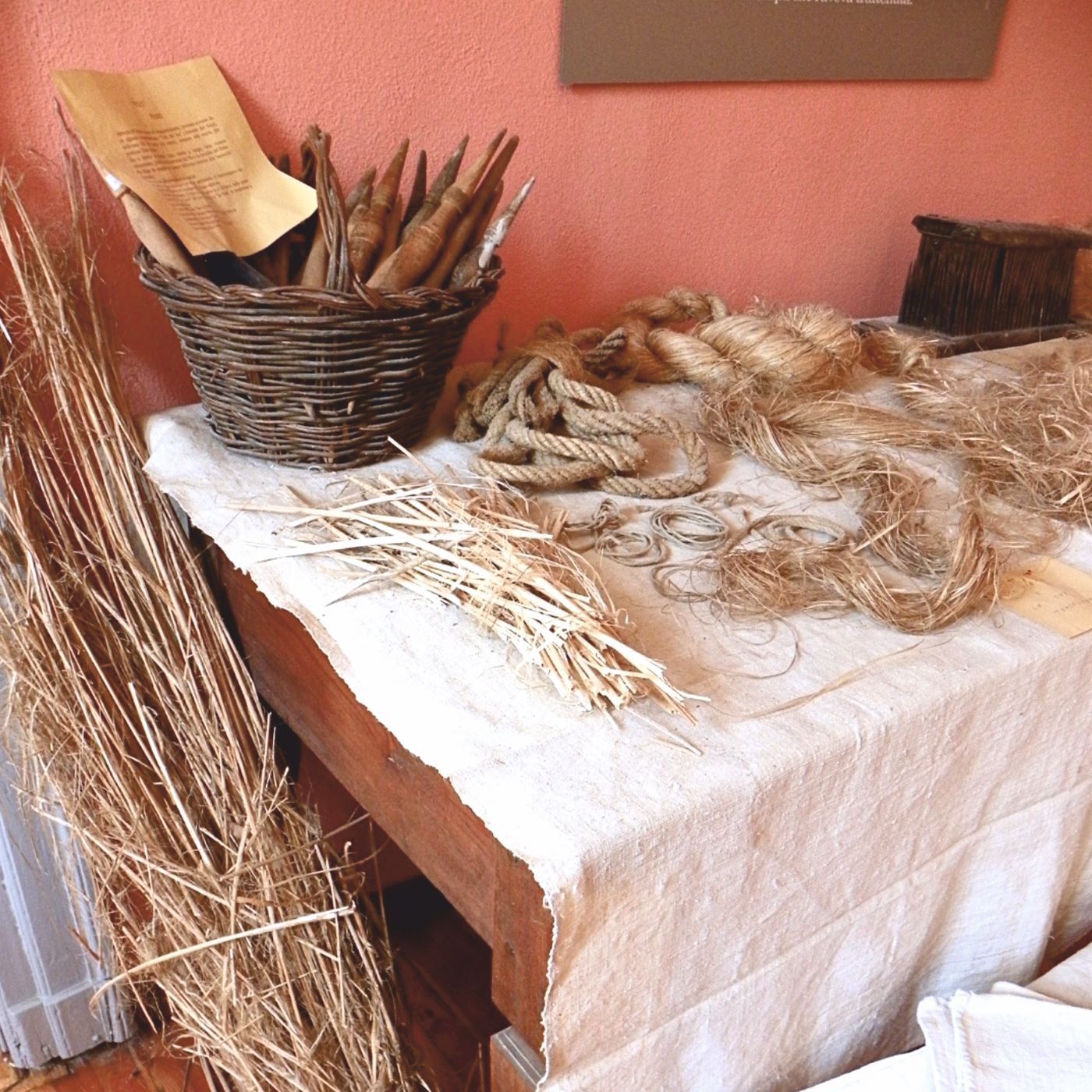
AudioZoom® by eArs5th HallAll parts of hemp were used. The leaves served as bedding for cows, sheep and goats, the seeds were kept for planting for the following year. The stems were used to light fires and the raw outer fibre was used to make ropes and animal harnesses.Subjected with great skill to various processes, the scutched fibre was transformed into textiles from which sheets, personal and household linen, grain sacks and even ceremonial robes for religious functions were made.Women played a fundamental role in the cultivation and processing of hemp, from sowing to spinning and the production of fine linens embellished with embroidery and pleating that made them absolutely unique.The various processing stages are explained through the display of tools, such as combs with iron teeth of various sizes, spools, spindles and brass tips. Panels describe the actual techniques and give us a picture of the society that revolved around these activities.The Museum is completed by the Hemp and Weaving Trail in the San Michele valley: the circular trail, furnished with explanatory panels, marks the stages of the typical places of manufacture, including the ‘Batou’, the beater mill with a horizontal internal wheel in the Rabiera district.
-
5
4th Hall - Hemp
AudioZoom® by eArs4th Hall - HempIn the centre of the kitchen, a large table, set with some crockery, underlines how frugal life was. All around, various home-made utensils provide information about the kind of food consumed, in particular the production and storage of cheese and butter. A gentleman, kneeling by the fireplace, the only means of heating the house, lights a fire under a pot of polenta. To do this, he uses pieces of canapulo, the woody inner part of the hemp stalk that remains after scutching, that is, the removal of the outer fibre.Hemp dishcloths, finely embroidered fabrics or full of patches, display mastery in the art of creativity and preservation.A number of panels relate amusing anecdotes that emerged during interviews with the ‘wise’ people of the Middle and Upper Maira Valley. It is thanks to their willingness and the richness of their cultural heritage that we have been able to recover the local micro-history.According to oral sources, on the central axis of the valley floor, hemp cultivation came to an end after the Second World War, although it continued in the side valleys until around 1950.In the written sources, hemp is mentioned in the Upper Maira Valley Statutes of 1396 and 1441, which state: ‘Weavers must make a tesam riste - a brim of hemp cloth - for 8 denarii’.
-
4
3rd Hall (to the right of the entrance) - The kitchen
AudioZoom® by eArs3rd Hall (to the right of the entrance) - The kitchenIn the centre of the kitchen, a large table, set with some crockery, underlines how frugal life was. All around, various home-made utensils provide information about the kind of food consumed, in particular the production and storage of cheese and butter. A gentleman, kneeling by the fireplace, the only means of heating the house, lights a fire under a pot of polenta. To do this, he uses pieces of canapulo, the woody inner part of the hemp stalk that remains after scutching, that is, the removal of the outer fibre.Hemp dishcloths, finely embroidered fabrics or full of patches, display mastery in the art of creativity and preservation.A number of panels relate amusing anecdotes that emerged during interviews with the ‘wise’ people of the Middle and Upper Maira Valley. It is thanks to their willingness and the richness of their cultural heritage that we have been able to recover the local micro-history.According to oral sources, on the central axis of the valley floor, hemp cultivation came to an end after the Second World War, although it continued in the side valleys until around 1950.In the written sources, hemp is mentioned in the Upper Maira Valley Statutes of 1396 and 1441, which state: ‘Weavers must make a tesam riste - a brim of hemp cloth - for 8 denarii’.
-
3
2nd room (left) - The bedroom
AudioZoom® by eArs2nd room (left) - The bedroomThis room displays a typical bedroom.Families mostly had double beds and, given the large number of children, four usually slept in them: two on the headboard side, two on the footboard side. Here, through symbolic references, we represent the various stages of existence.The cradle stands for birth, which often took place in the stable; some wooden toys, very rare, indicate childhood. The numerous bonnets of various sizes show the stages of adolescence; while the wedding dresses and the men's work or party clothes indicate youth and maturity.The colours of the wedding dresses makes it possible to place them in chronological order, to date them. In the past, only black was used: due to the high mortality rate within the extended family and the duration of mourning, this fine garment had to serve for all the anniversaries of life. Good and bad... including one's own death!Linen, blankets, day and night shirts are displayed on the bed, in wardrobes or hung on the wall.A mannequin depicts an old woman intent on looking at photos and letters arriving from afar. A small table displays notebooks, books, newspapers and documents concerning everyday life. Various signs of devotion recall a widespread and deep religious belief, as shown by the numerous churches, chapels and pillars scattered here and there, and the Path of Popular Religiosity in the Ussolo valley.
-
2
1st hall - Entrance
AudioZoom® by eArs1st hall - EntranceOn the landing facing the entrance, a number of objects depict the vital working activities of the area, such as haymaking and animal husbandry. The seasons marked the daily rhythms, which were repeated according to tradition and necessity. In the villages, hamlets and clusters of huts, everyone gave their support and help to their neighbours; nature was duly exploited for sustenance, but was always respected.Wooden objects and tools, even when extremely simple, are beautiful in their harmonious and essential form. They are unique, handmade from an early age, depending on the skills and creativity of each individual.Clothes and linens, indispensable and essential, are always coded and often embellished with beautiful embroidery.They were also made entirely by hand: the art of darning was learnt as children, before gaining expertise in knitting and finally spinning.This room displays some of the activities carried out in the home, for example the processing of wool, another important fibre in the domestic economy. Wool, of animal origin, is easier to work with than the plant fibre, hemp, especially at the spinning stage. In one corner, a typically male craft is presented: the cobbler. Other tools made by the family were used in house building or for cultivating the garden.
-
1
Good morning
AudioZoom® by eArsGood morningWelcome to the territory of Prazzo, the penultimate municipality in the Upper Maira Valley, lying at an altitude that ranges from 990 metres above sea level to the 3026 metres of the majestic Monte Chersogno. Due to depopulation, the municipality of Prazzo combined with the municipalities of San Michele and Ussolo in 1928. Since then, the population has continued to decline, falling from almost 2,000 inhabitants at the beginning of the 20th century to around 180 residents today .You are about to enter the ancient palace of the former Royal Magistrate's Court and visit the Museum called ‘Fremos, travai e tero’, words that in the local dialect mean ‘women, work and land’. It is a place dedicated firstly to women: without their daily, hard-working and constant contribution, the family and the economy of the area would not have been able to exist and resist.Secondly, it is also a museum of hemp, the plant that has played a fundamental role in the life and family economy of the entire valley.The museum was created thanks to the efforts of a group of volunteers from the Chaliar ODV Association and the contribution of the inhabitants of the village and the Upper Maira Valley, with the aim of safeguarding the demo-ethno-anthropological heritage of the area.To appreciate the contribution made by the local people, suffice it to say that all the material on display was donated and that all the information was obtained from the testimonies of the Valley's inhabitants over the age of 70 - whom we sincerely thank for passing on their knowledge, wisdom, and highly significant values.
We're indexing this podcast's transcripts for the first time — this can take a minute or two. We'll show results as soon as they're ready.
No matches for "" in this podcast's transcripts.
No topics indexed yet for this podcast.
Loading reviews...
Loading similar podcasts...
Frequently Asked Questions
How many episodes does Fremos, travai e tero - Women, work and land have?
Fremos, travai e tero - Women, work and land currently has 6 episodes available on PodParley. New episodes are automatically indexed when they're published to the podcast feed.
What is Fremos, travai e tero - Women, work and land about?
Fremos, travai e tero - Women, work and land is a podcast covering topics in society.
How often does Fremos, travai e tero - Women, work and land release new episodes?
Fremos, travai e tero - Women, work and land has 6 episodes. Check the episode list to see recent publication dates and frequency.
Where can I listen to Fremos, travai e tero - Women, work and land?
You can listen to Fremos, travai e tero - Women, work and land on PodParley by clicking any episode. We provide an embedded audio player for direct listening, and you can also subscribe via your preferred podcast app using the RSS feed.
Who hosts Fremos, travai e tero - Women, work and land?
Fremos, travai e tero - Women, work and land is created and hosted by eArs.
URL copied to clipboard!